Article Contents:
- What is wall finishing with flexible panels
- Where flexible panels are especially appropriate
- Accent Wall
- TV Area
- Bed headboard
- Hallway and corridor
- Niches
- Arches
- Columns
- Public and commercial spaces
- What types of flexible panels are there for wall finishing
- Slatted panels on a fabric base
- Flexible panel for painting (MDF)
- Flexible panel made of solid oak
- Smooth and textured options
- What tasks does wall finishing with flexible panels solve
- Visual zoning
- Creating an accent wall
- Softening geometry
- Decorating complex surfaces
- Adding depth and texture
- How to choose flexible panels by room type
- Living Room
- Bedroom
- Entry Hall
- Office and meeting rooms
- Commercial spaces
- How to choose flexible panels by interior style
- Modern style and minimalism
- Scandinavian and natural interior
- Neoclassicism and Modern Classicism
- Loft and Industrial Style
- Flexible panels or regular ones: an honest comparison
- What to look for when choosing: extended checklist
- Wall preparation for flexible panels
- Methodology of measurement works
- Specifics of radius surfaces
- Marking and Fitting
- Installing flexible panels on the wall: step by step
- Step 1. Cutting
- Step 2. Dry fitting
- Step 3. Applying adhesive
- Step 4. Gluing
- Step 5. Module joining
- Step 6. Corner finishing
- Step 7. Final processing
- Mistakes when finishing walls with flexible panels: analysis of each
- Mistake 1. Using rigid panel instead of flexible on radius
- Mistake 2. Poorly prepared base
- Mistake 3. Lack of dry fitting
- Mistake 4. Scale error
- Mistake 5. Overloaded pattern
- Mistake 6. Ignoring lighting
- Mistake 7. Weak adhesive
- What to combine flexible panels with in interior
- Painted Walls
- Natural Wood
- Metal
- Natural stone
- Textiles
- Lighting
- Who is this finishing format especially suitable for
- Conclusion: when flexible panels are the right choice
- FAQ: Answers to the Most Popular Questions
- About the Company STAVROS
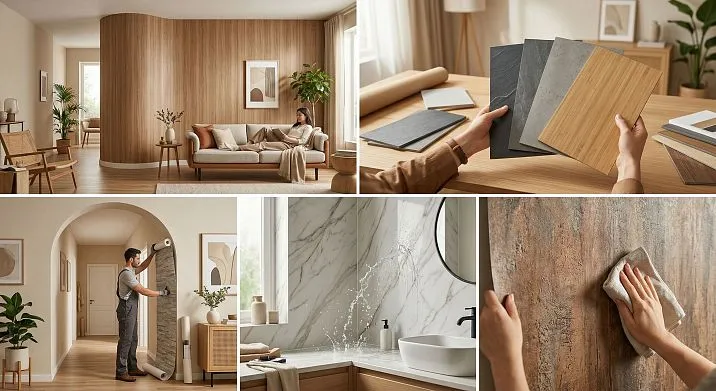
Interior begins with walls. It is the walls that set the tone for the entire space; they establish the rhythm, color, and texture—or disrupt them. And while the question 'how to finish the walls' once boiled down to a choice between paint and wallpaper, today the palette is significantly richer.Wall finishing with flexible panels— is a solution that over several years has evolved from a niche designer idea to a full-fledged mainstream in professional interior design.
Why flexible? Because space is rarely perfectly linear. Because architecture is alive. Because a decorative panel capable of wrapping around a column, tracing the path along an arch, and disappearing into a niche without a single seam—is not just a material, but a design tool.
This article provides a complete breakdown: what flexible wall panels are, where they work best, how to choose the right format, how to install them without mistakes, and what errors most often ruin the result.



What is wall finishing with flexible panels
Before discussing selection and application, it's important to understand the nature of the material itself.
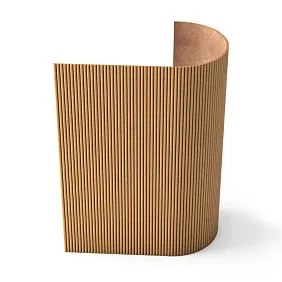
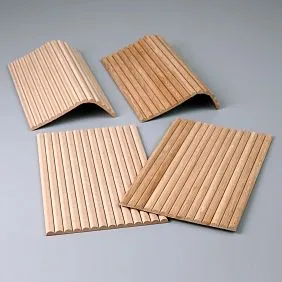
A flexible wall panel is a structure of decorative slats fixed to an elastic fabric backing. The key word here is 'elastic.' It is the fabric carrier that makes everything possible: it holds the slats at a strictly defined pitch, prevents them from shifting when bent, and ensures uniform adhesion to a surface of any curvature.
How does this fundamentally differ from a rigid panel? A rigid slatted panel is mounted on an MDF substrate and forms a monolithic module with fixed geometry. It is excellent on a straight wall—precise, strict, architecturally clear. But as soon as a curve appears in the space, rigidity becomes a problem. A rigid module does not bend. It can only be sawn, fitted, and assembled into complex angular joints.
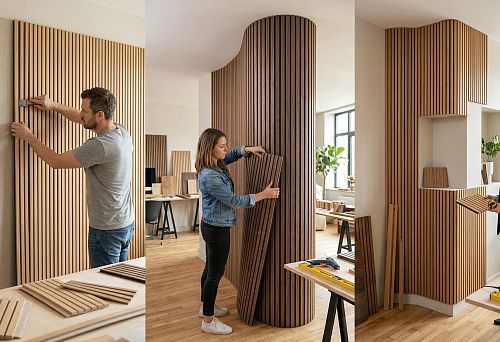
Flexible wall panelsThey remove this limitation. The fabric lays on the surface, follows its shape, and is fixed with mounting adhesive. A radius wall, a concave niche, a convex column, an arched vault — for a flexible panel, these are not obstacles, but tasks that it solves organically.
The visual result is no different from a rigid panel. The same clear slats, the same even spacing, the same expressive play of light and shadow. Only the surface is complex.




Where flexible panels are especially appropriate
Let's be honest: if your project only has straight, even walls — a flexible panel works there just as well as a rigid one. It is laid with adhesive, joins seamlessly, and holds its shape. But its true strength is revealed where a rigid solution falls short.
Our factory also produces:



Accent Wall
An accent wall is a key design technique. One plane, highlighted by texture, color, or relief, that sets the mood for the entire room.decorative wall panelswith a slatted structure — is one of the most powerful tools for creating an accent. Especially when the accent wall transitions to adjacent planes: wraps around a corner, goes into a niche, continues onto side panels — without interruption and without fitting.
Get Consultation
TV area
TV zone — a classic place for a slatted panel. Here it creates not only aesthetics but also a functional background: with directed lighting, the vertical slats form a soft play of light and shadow, which reduces the visual 'heaviness' of the equipment and makes the area more cozy. If the TV zone is framed by non-standard architectural elements — columns, rounded corners, built-in niches — the flexible format becomes the only option.
Bed headboard
Bedroom — the most personal space in the home. And the headboard of the bed is the place that sets the character of the entire room. A slatted panel behind the bed creates a feeling of an architecturally designed niche even where there is no niche. If the headboard is built into a semi-circular arch, has a curved shape, or transitions to adjacent surfaces — a flexible panel allows it to be finished as a single fabric.
Hallway and corridor
In the hallway, complex architecture is often encountered: pylons, arched openings, radius transitions between walls. This is precisely where flexible wall finishing shows its full strength. An additional bonus: the slatted texture masks minor base irregularities — relevant for older housing stock, where walls have undergone several layers of different coatings.
Niche
A niche with rounded corners or smooth transitions is a task that, when using rigid panels, requires complex cutting and assembly of corner elements. With a flexible panel, the niche is covered with a single sheet that wraps around all transitions without patches. The result is a monolithic, architecturally finished surface.
Arches
An arched opening is a symbol of classical architecture. Cladding it with wooden elements using traditional methods is expensive and labor-intensive. A flexible panel handles an arched vault perfectly: it wraps around the curve, is mounted with adhesive, and provides a continuous slatted pattern. At the same time, the arch can seamlessly transition into adjacent walls—all within a single finish.
Columns
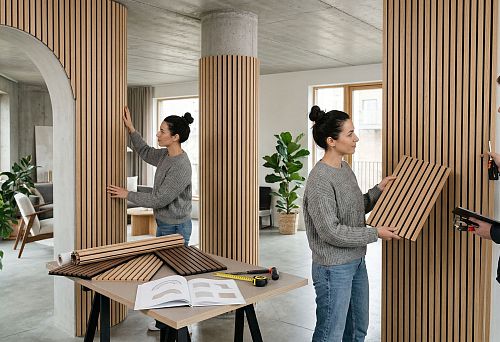
A column is the most illustrative scenario for the flexible format. A closed radius excludes rigid panels as a solution: it is impossible to cover a cylindrical surface with a rigid module without visible seams. A flexible panel wraps around the column entirely, joining at a single point—and the result looks like monolithic cladding. That is whypanels for columns and archesin professional design projects, it is invariably the flexible format.
Public and commercial spaces
Restaurant, hotel, showroom, office—commercial interiors operate by rules where non-standard geometry is the norm. Radius reception desks, decorative columns in halls, arched transitions, curved partitions—all are made not for the sake of complexity, but for expressiveness. Flexible panels allow achieving this expressiveness without costly manual work.
What types of flexible wall panels are there
The choice begins with understanding what exactly you need as the end result. Under the term 'flexible panel,' several fundamentally different solutions may be hidden.
Slatted panels on a fabric base
The most common type. Parallel slats are fixed to a fabric backing at a specified pitch. Expressive chiaroscuro, architectural rhythm, subtle spatial zoning — this is the language of slatted surfaces. Slats can be rectangular or have a semi-circular profile (beads) — the latter create an especially soft, almost tactile play of light and shadow.
Flexible panel for painting (MDF)
MDF slats — made from dense, homogeneous pressed wood fiber — take paint perfectly. The surface is primed and painted in any color: from arctic white to rich graphite. This is a solution for those who want to control the color and maintain the possibility of repainting without dismantling.Panels for paintingoffer maximum freedom in forming the interior color scheme.
Flexible panel made of solid oak
Natural oak is a living texture that cannot be imitated. Unique grain pattern, warm tone, tactile depth of surface, resistance to stress. Oak density of 700–750 kg/m³ is not just a number; it's a guarantee that the panel will withstand years of use without losing its appearance. Coated with oil, wax, or clear varnish — depending on the desired level of sheen and protection.
Smooth and textured options
Smooth surface without texture — for minimalist spaces where purity of form is important. Textured surface with pronounced relief — for interiors where the wall should 'work' even in diffused lighting. Wide slats with large pitch — for brutal loft and industrial style. Narrow slats with minimal pitch — for Scandinavian and Japanese minimalism.
What tasks does wall finishing with flexible panels solve
A flexible decorative wall panel is not just a covering. It is a tool with several working functions.
Visual zoning
A slatted surface on one wall instantly highlights a zone within a unified space. Living-dining room? The slatted panel defines the sofa area without a partition. A study in an open space? The panel creates a visual boundary without losing volume. This is soft zoning — without walls and without a ceiling.
Creating an accent wall
One accent wall with slatted texture — and the interior gets a focal point. This works especially powerfully when the other walls remain in a concise paint. The contrast of texture and plane creates depth that is difficult to achieve by other methods.
Softening geometry
In spaces with aggressive right angles, high ceilings, and cold surfaces, flexible panels bring warmth. Especially when oak with natural texture is used. The wooden rhythm softens the rigidity of the architecture, making the space human-scaled.
Finishing complex surfaces
This is the main function of the flexible format.Solutions for complex surfaces— arches, columns, radius niches — constitute one of the key application niches. Where a regular panel requires dozens of individual fittings, a flexible panel handles it in one pass.
Adding depth and texture
A flat wall is zero. A slatted surface is relief, play of shadows, visual depth. With directional lighting, each slat casts a thin shadow, and the wall comes to life. This is especially important in spaces with artificial lighting — restaurants, meeting rooms, residential living rooms with accent lighting.
How to choose flexible panels based on room type
There is no universal 'best' panel. There is the right panel for a specific room and a specific task.
Living Room
The living room is a representative space. Here, the panel should be expressive yet not aggressive. Oak with a natural tint, medium-width vertical slats, moderate spacing — a classic for a residential living room. If the ceilings are high — the slatted pattern further accentuates the vertical. For a living room with a curved TV zone or columns, choose exclusively the flexible format.
Bedroom
In the bedroom, a balance between expressiveness and calm is important. Narrow slats with soft spacing, warm oak tones, or neutral painting in pastel shades — that's the language of the bedroom. The panel at the head of the bed should cover the entire height of the wall or reach up to the ceiling cornice level — this is architecturally stronger than a 'square behind the bed'.
Entryway
The hallway is often small and functionally overloaded. Here, the panel performs a dual task: decoration and camouflage. The slatted texture hides minor wall defects, creates a 'warm corridor,' and directs the gaze inward. For hallways with non-standard geometry — flexible panels are the only option.
Study and meeting rooms
Here, seriousness and concentration are needed. Dark oak with a deep tint, horizontal or vertical slats with pronounced spacing, matte oil finish — such a combination creates a high-level study atmosphere without pretentiousness.
Commercial spaces
Restaurant, hotel, office — here, the walls work for the brand. Panels should speak the language of the establishment's audience: warm oak in a restaurant, strict graphite MDF in an IT office, natural oil without tint in an organic spa.Modern panels for interior finishingoffer this entire range.
How to choose flexible panels according to interior style
Style is not just aesthetics. It's a system of proportions, materials, and details that must be coordinated. Here's how flexible panels fit into the main directions.
Modern style and minimalism
Narrow slats, white or light gray MDF for painting, minimal spacing, strict vertical or horizontal orientation. No decoration on the panel surface—only form and shadow. This is the pure, professional language of modern minimalist space.
Scandinavian and natural interior
Oak with transparent oil or light stain, moderate slat spacing, semicircular profile relief. Natural tones, soft chiaroscuro, a sense of warmth and natural texture. This format currently dominates residential interiors in Scandinavia and European 'organic' design.
Neoclassicism and modern classicism
In neoclassicism, slatted paneling is used as the lower frieze of the wall—below the cornice level, in combination with moldings and architectural details. Wide slats with pronounced oak texture under dark tinting pair well with classical interior details.Wall finishing and decorationThis style requires precise scale and careful joining with the remaining elements.
Loft and industrial style
Wide slats, dark MDF for painting in anthracite or dark blue color, brutal rhythm. Metallic accents, concrete surfaces, brickwork nearby—and the slatted panel completes the picture of a strong, deliberately 'careless' space.
Flexible panels or regular ones: an honest comparison
This question is asked by almost everyone who encounters the choice for the first time. Let's break it down honestly.
| Parameter | Flexible panels | Rigid slatted panels | Plaster | Paint | Wallpaper |
|---|---|---|---|---|---|
| Radius surfaces | ✓ | ✗ | ✓ | ✓ | Limited |
| Pronounced texture | ✓ | ✓ | Partially | ✗ | Partially |
| Installation with adhesive | ✓ | ✓ | No | No | ✓ |
| Repainting | ✓ (MDF) | ✓ (MDF) | ✓ | ✓ | ✗ |
| Warmth and naturalness | ✓ (oak) | ✓ (oak) | Limited | ✗ | Limited |
| Application on columns | ✓ | ✗ | ✓ | ✓ | ✗ |
| Installation speed | Fast | Fast | Slowly | Fast | Medium |
| Price | Medium | Medium | Low | Low | Low |
When to choose flexible panels? When there are curved surfaces, when slatted texture is important, when fast installation without complex fitting is needed.
When to choose rigid? Only straight walls + maximum geometric precision is needed + mechanical mounting on guides is planned.
When is plaster suitable? If you need a monolithic, plastic surface without a pronounced rhythm — and there is time for technological pauses.
What to look for when choosing: an extended checklist
Before purchasing, go through this list. Each point affects the result.
Wall geometry. Are there curves, radii, non-standard angles? If yes — only flexible format. If no — both options.
Slat format. The width of the slat and the spacing between slats create a visual rhythm. Narrow spacing — refinement. Wide — brutality and scale. Proportion it to the room area: in a small room, large spacing can 'overload' the space.
Material. MDF for painting — if color is important. Oak — if natural texture and durability are important.
Joints. Ask for a sample and check the quality of the ends. A good joint is when two panels fit tightly together without a gap and without overlap. If the end is uneven — a visible seam will ruin the whole job.
Quality of the fabric backing. The backing should be dense, not loose. Check if the slats delaminate when bent.
Cutting. Make sure the panel cuts cleanly — without chips or burrs.
Lighting. The slatted texture is especially expressive under directional light. If the room only has diffused light, the chiaroscuro effect will be minimal. Consider this when choosing the slat profile: a semi-circular bead gives a softer shadow even with diffused lighting.
Color and tone. Warm oak tones with oil create coziness. Cool graphite MDF adds severity. White MDF brings purity. Coordinate with flooring and furniture.
Batch consistency. If the area is large, the entire volume should be from a single batch. Different batches may vary in color and texture.
Wall preparation for flexible panels
A flexible panel is not a miracle. It only performs well on a properly prepared base. This rule has no exceptions.
Requirements for the base
The surface must be:
-
Clean — free of grease stains, old paint, peeling putty, wallpaper, dust.
-
Dry — absolutely. Residual moisture under the panel will lead to adhesive seam delamination and slat deformation.
-
Strong — a loose base must be reinforced with deep-penetration primer.
Minor unevenness is not a problem. The slatted texture hides them. Critical deviations — more than 5 mm per meter — are leveled with putty before installation begins.
Specifics of Radius Surfaces
On columns, arches, and rounded surfaces, additionally check the uniformity of curvature. Plaster drips, protruding screws, and local bumps—all of these create point gaps under the panel, which over time lead to delamination.
Marking and Fitting
Before applying adhesive, always conduct a 'dry' fitting. Lay out the modules on the surface, mark the joints and layout lines. On a column—mark the joint point. On an arch—mark the center. These 30 minutes of fitting save several hours of rework.
Installation of Flexible Panels on a Wall: Step by Step
Installation is not difficult but requires care. Here is the complete sequence without simplifications.
Step 1. Cutting
MDF is cut with a utility knife with a sharp blade along a ruler. Oak—with a fine-toothed saw or miter saw. Cut along the fabric backing: this way the edge comes out smoother. Check the cut: burrs and irregularities on the edge will create a visible seam when joining.
Step 2. Dry Fitting
Place the cut modules against the surface. Ensure the layout looks as intended. Mark reference points for correct fixation.
Step 3. Applying Adhesive
Mounting adhesive — 'liquid nails' or parquet adhesive with high initial adhesion. Apply to the fabric backing of the panel in a zigzag or dotted pattern. Not a continuous layer: excess adhesive will seep through the gaps between the slats.
On vertical surfaces, adhesive is additionally applied to the wall — this is a double fixation that prevents slipping before polymerization.
Step 4. Gluing
Press the panel evenly onto the surface, from one edge to the other. Do not drop or slap — smooth pressing ensures even contact across the entire area of the fabric backing.
On curved surfaces, work from one end, gradually following the curve. Press each section for 5–10 seconds.
Step 5. Module Joining
The next module is placed tightly — slat to slat. Good end geometry makes the joint invisible: the connection point dissolves into the overall slat rhythm. This is seamless joining — one of the key advantages of professional panels.
Step 6. Corner Finishing
External corner — the ends of two panels are cut at 45° and joined 'on a miter'. Internal corner — one panel fits tightly against the other, cut butt-to-butt. Alternatively, a corner profile matching the panel color is used.
Step 7. Final Processing
After adhesive polymerization (24 hours): MDF is primed and painted in two coats. Oak is treated with oil or varnish. Joints are refined as needed with color-matched acrylic sealant.
Detailed technical recommendations are in the sectionAdvice on finishing and installationon the STAVROS website.
Errors in wall finishing with flexible panels: a breakdown of each
Years of practice have produced a list of errors that occur again and again—among beginners and experienced builders alike. We break down each one.
Error 1. Using a rigid panel instead of a flexible one on a radius
The most costly error. A rigid MDF module does not bend. Attempting to 'fit' it to a column or arch results in rough, visible seams and massive material waste. The rule is simple: if there's a curve, you need a flexible panel. No exceptions.
Error 2. Poorly prepared substrate
Adhesive is not filler. If the substrate is loose, dusty, or damp—within a few months the panel will begin to peel. Preparation takes time, but it is precisely what determines the durability of the result.
Error 3. Skipping the dry fit
'I'll install it right away'—a classic error. Without a dry fit, it often turns out the layout wasn't calculated: the end module is cut unattractively, a seam lands in the center of the wall or next to a light source. A dry fit is 30 minutes that changes everything.
Error 4. Scale error
Large slats with wide spacing in a small room visually consume space. Narrow slats in a spacious hall get lost and look insubstantial. The scale of the slat pattern must be proportionate to the room.
Error 5. Overloaded pattern
A slatted panel is an expressive material. It does not tolerate competition. If you place active floor tiles and colorful textiles next to a slatted wall, the interior will turn into chaos. There should be space and calm around the slatted panel.
Error 6. Ignoring lighting
The slatted texture works with directional light. If the project lacks accent lighting, the investment in a textured panel loses a significant part of its value. Plan the lighting together with the panel, not separately from it.
Error 7. Weak adhesive
Saving on adhesive is saving on reliability. This is especially critical on vertical surfaces and in rooms with unstable climates. Use only a proven structural compound with high initial adhesion.
What to combine flexible panels with in the interior
A slatted panel is not a lone soloist. It works best in an ensemble.
Painted walls
The cleanest combination: an accent slatted wall + other surfaces in solid paint. Choose paint slightly more saturated than it appears on the chip—the slatted surface absorbs some color due to shadows.
Natural wood
Wood with wood—but of different species, textures, and finishes. Oak slatted panel + oak parquet with matte oil = a cohesive space. Or contrast: a dark slatted panel + light ash wood floor.
Metal
Brass, copper, matte black metal—ideal accents next to a slatted surface. Lamps, handles, built-in metal shelves create a rhythm that echoes the rhythm of the slats.
Natural Stone
Oak + marble—a contrast of warmth and cold that always works. Especially in bathrooms and commercial spaces.
Textiles
Linen curtains, wool throws, velvet pillows next to a slatted panel create a tactile dialogue. Both materials are textured, natural, 'warm' in a visual sense.
Backlighting
LED lighting in front of slatted panels or behind them—one of the strongest techniques. Directional light from bottom to top creates a 'floating' surface effect. Backlighting through gaps gives a diffuse, soft glow.Relief finishand light—a combination that requires planning even at the project stage.
Who is this type of finish especially suitable for?
A flexible wall panel is a professional tool with a democratic entry threshold. Who uses it?
Interior designers. For a professional, a flexible panel is a standard working tool. As soon as columns, arches, or non-standard geometry appear in a project—it's the flexible format that opens up possibilities that would otherwise cost many times more.
Architects. Especially when working with complex spaces: historical buildings, non-standard layouts, public interiors. Material that follows architecture is what an architect needs.
Furniture manufacturers.Panels for furnitureon fabric backing — a ready-made solution for cladding curved facades and radius cabinets without expensive manual assembly from individual elements.
Private clients. Those who approach renovation thoughtfully and want designer-level results. Installing flexible panels is manageable for a prepared person — provided the substrate is properly prepared and patience is exercised during the fitting stage.
Those who are finishing complex geometry. If your space has at least one curved element — and you want to finish it with a single material — flexible panel is the only logical answer.
Conclusion: when flexible panels are the right choice
To summarize.Flexible panels for interior finishing— is a solution for cases where architecture demands from the material not only beauty but also plasticity.
Choose a flexible panel if:
-
the space has columns, arches, radius niches, or rounded corners;
-
a continuous slatted surface without visible transitions is needed;
-
installation speed is important without complex angular adjustments;
-
curved furniture fronts with slatted finishing are planned;
-
the accent wall should transition seamlessly into adjacent surfaces.
Choose a rigid panel if:
-
all surfaces are rectilinear and even;
-
strict geometry with mechanical fastening is needed;
-
installation on guides with perfect alignment is planned.
In large projects, both formats work together: rigid ones on flat planes, flexible ones on transitions and curved surfaces.
FAQ: answers to the most popular questions
What are flexible panels for wall finishing?
These are decorative slat panels on an elastic fabric backing. Unlike rigid panels, they can wrap around curved surfaces—columns, arches, radius walls—without distorting the slat pattern.
How do flexible panels differ from regular wall panels?
The main difference is in the backing. A rigid panel is mounted on an MDF board and does not bend. A flexible one is on a fabric base with elastic properties. This is the only structural difference, but it changes everything: the geometry of application expands to any shapes.
Are flexible panels suitable for an apartment?
Yes, fully. Residential interiors—living rooms, bedrooms, hallways, studies—are the primary area of application for flexible wall panels.
Can flexible panels be used in a living room?
Yes. The TV area, an accent wall behind the sofa, cladding columns, or a decorative niche—flexible panels in the living room look expressive and professional.
Are they suitable for hallways and corridors?
Yes. A hallway with non-standard geometry, arched openings, or pilasters is a direct scenario for the flexible format. The slat texture additionally masks minor irregularities in old walls.
Can niches and arches be finished with flexible panels?
Yes, this is one of the key tasks. The flexible panel wraps around the arched vault and rounded niches, creating a continuous surface without visible seams.
Can flexible panels be used on columns?
Yes, and this is one of the best application scenarios. The panel completely wraps around the column along its perimeter, joins at the least noticeable point, resulting in a monolithic slatted cladding.
How to choose panels to match the interior style?
For minimalism — narrow slats, white or gray MDF. For Scandinavian style — oak with clear oil. For loft — wide slats, dark paint. For neoclassicism — oak with deep tinting.
Which flexible panels are best for an accent wall?
For an accent wall, the optimal combination is moderate slat width, pronounced chiaroscuro, and correctly directed lighting. Oak with matte oil or MDF for painting in a neutral tone.
Is it difficult to install flexible panels on a wall?
No. Installation with adhesive does not require special tools. The main thing is to properly prepare the base, conduct a dry fitting, and use high-quality adhesive with high initial adhesion.
Does the substrate need to be perfectly level?
No. Minor irregularities are concealed by the slatted texture. Critical deviations of more than 5 mm per meter should be corrected before installation. The base must be clean, dry, and strong.
How to join flexible panels together?
Module ends fit tightly together—rail to rail. With precise end geometry, the joint visually disappears, and the surface is perceived as a single canvas.
Can flexible panels be combined with paint and wood?
Yes. These are classic combinations: an accent slatted wall + painted surfaces, or an oak panel + wooden parquet with tinting in the same color range.
What's better: flexible panels or rigid slatted panels?
It depends on the task. Rigid panels are for straight walls with mechanical fastening. Flexible panels are for everything involving curves or seamless joining on complex surfaces. In large projects, both formats are often used together.
About the company STAVROS
When a task requires not a standard solution, but a precise one—from a curved wall to a bent furniture facade—the choice of professionals in Russia is one: STAVROS.
The company produces slatted panels from MDF for painting and solid oak in several structural formats, includingFlexible slatted panelson a fabric base for radius surfaces, columns, arches, and furniture facades. The range covers tasks of any scale—from a local decorative accent in a private apartment to full-scale finishing of a commercial interior.
STAVROS is precise geometry, proven materials and surfaces ready for finishing. Explore the catalog, studyMaterials and product qualityYou can get a specialist consultation on the official website.
Choose materials that work with your space, not against it. That's how an interior you want to live in is born.