Article Contents:
- First Level: Basic Moldings — Architectural Frame
- Second Level: Accent Rosettes — Decorative Touch
- Third Level: Wall Panels and Compositions — Mastery of Architectural Decoration
- Symmetry: The Main Rule of Architecture
- Common Mistakes — Inaccurate Layout, Rushing, Violating Proportions. Golden Rule: Measure Seven Times, Cut Once.
- How to Choose the Level of Complexity
- Materials: Polyurethane, Gypsum, Wood
- Frequently Asked Questions
- Can You Install Moldings Yourself?
- Which Material to Choose for Bathroom, Kitchen?
- How to Care for Moldings?
- How to Safely Run Cables Behind Moldings?
- Can You Repaint Moldings?
- Conclusion: From Simple to Complex — Your Level of Artistry

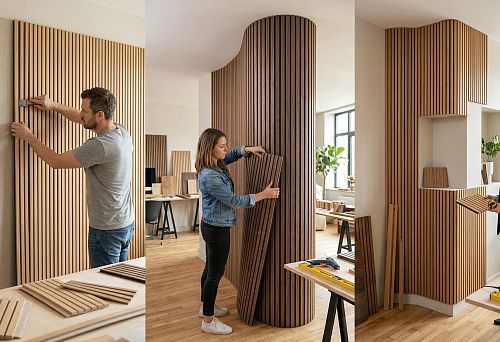
Decorative molding is the language of living space, speaking to us through wall structure, light and shadow, details, and symmetry. It transforms an ordinary room into an architectural scene, defines the character of the interior, and dictates its rules. But behind the apparent simplicity of molding or elegant paneling lies the art of choosing the level of complexity: from basic frames to complex compositions and panels, where molding becomes the key accent of the space.
Molding on the WallIt is not only a means of decoration, but also a tool for dividing a room into zones, correcting symmetry, and forming architectural accents. Three main levels of molding complexity allow creating completely different scenarios: from restrained classical interiors to art projects with panels and bas-reliefs.




First Level: Basic Moldings — Architectural Frame
The most accessible and universal way to give a wall structure — framing, borders, classic moldings. Moldings, picture frames, perimeter trim, horizontal and vertical lines — this is the very "frame" that separates chaos and turns a flat wall into an organized architectural surface.
For classical symmetry, rectangular or square frames from floor to ceiling or in the upper two-thirds of the wall are used. Especially effective are both single large frames and compositions of several arranged symmetrically or in a checkerboard pattern. Such frames are assembled from straight moldings, which simplifies installation — no complex corner joints, minimal trimming.
Basic moldings are installed point-wise or around the entire room perimeter, creating the effect of a gallery wall or elegant 19th-century halls. The width of the molding is chosen proportionally to ceiling height: at 2.5 meters, elements 40–60 mm wide look optimal, at 3 meters — 60–90 mm. Horizontal division by height can visually alter the room — expand or "raise" the ceiling.
Basic MoldingsThey allow hiding wall defects, running utility conduits, creating a backdrop for paintings, mirrors, portrait photographs. This level of complexity does not require high skill — installation is done with adhesive, joints are finished with putty, and after painting, seams become invisible.
The key question — symmetry. It is necessary to carefully calculate the placement of elements to preserve the harmony of space. Precision in installation is achieved only with the help of a laser level, tape measure, and layout. Broken symmetry immediately catches the eye and changes the perceived geometry of the room.




Second Level: Accent Rosettes — Decorative Touch
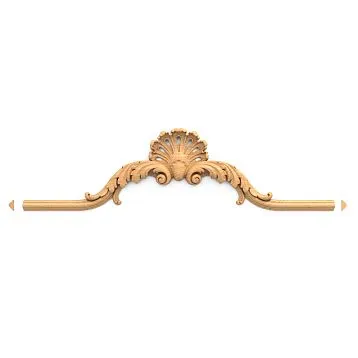
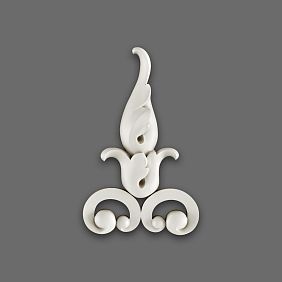
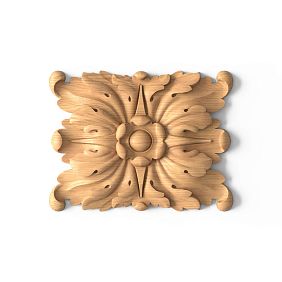
The next step — using accent elements: rosettes, medallions, decorative inserts. These are elements of complexity "2" that can be standalone wall decorations or part of a composition.
Rosettes can be round, oval, polygonal. Installing them requires proper centering, otherwise the effect will be lost. On an empty wall, such a rosette becomes a focal point of perception, attracts the gaze, creates a point of symmetry. Often, rosettes are combined with moldings, forming complex frames. For example, one or several rosettes are inserted into a rectangular frame, establishing rhythm.
Accent RosettesUsed not only in the center of the wall but also at corner junctions, above doors, in compositions with mirrors, wall sconces, and window openings. Recessed moldings acquire special significance when paired — two symmetrical elements placed on either side of a painting or television. This emphasizes spatial balance.
Combining moldings with additional elements — small molded flowers, scrolls, leaves — allows creating a unique decorative style that remains distinctive for your interior. Here, artistic intuition, experience working with drawings, understanding of symmetry and proportions is required.
Installing accent elements is more complex: details must be carefully fitted, joints sealed, and sometimes elements refined to the desired shape. When working with polyurethane, parts are lightweight and convenient to mount with screws or adhesive. When working with plaster, precision is crucial to avoid chipping. After installation, surfaces are painted — this integrates the elements into a unified whole.
Our factory also produces:




Third level: panels and compositions — the art of architectural decoration
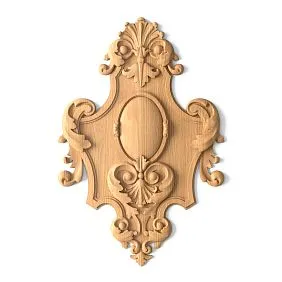
Highest level of complexity — creating complex compositional panels, bas-reliefs, and plaster artworks. This is art-deco requiring not only technical skills but also the talent of an artist. Such solutions are used to decorate accent walls in living rooms, halls, offices, and reception areas, creating a unique spatial character.
Compositions may begin with a set of moldings, transition into symmetrical recessed moldings, combine with decorative appliqués, scrolls, flowers, garlands. Panels are designed considering room dimensions, lighting scenarios, and visual movement routes. Symmetry must be maintained to ensure each element enhances rather than disrupts the architecture.
Creating panels begins with a sketch — the composition is designed on paper or in a graphic editor, determining the center, diagonals, and secondary elements. Next comes transferring the sketch to the wall, marking, mounting with alignment to levels and compositional rules. After installing the molding, spackling, relief correction, final painting, patination, and hand-drawing details follow.
Compositions in plasterworkAllow not only to decorate walls but also to adjust room proportions. For example, wide horizontal panels make long walls more cozy, while vertical ones 'stretch' the space. Large-scale compositions visually enlarge room dimensions, creating an illusion of depth.
Installing panels requires knowledge not only of techniques but also of materials. For large projects, polyurethane or plaster elements with precise fitting are used. All parts must be accurately sized — even the slightest mismatch will ruin symmetry. Large elements are mounted using a combined method: adhesive + screws, followed by masking. Surface preparation is essential — perfect flatness, absence of moisture, reliable primer.
Get Consultation
Symmetry: the main rule of architecture
At all levels of complexity, the principle of symmetry and balance remains key. Whether you are decorating a simple frame or a complex panel, the axis of symmetry, equal distances between elements, and precise centering are the foundation of interior harmony. Asymmetrical molding immediately appears foreign, disrupting the sense of order.
For perfect symmetry, laser levels, templates, and wall markings are used. In complex compositions, symmetry axes are drawn on sketches and then transferred to walls as lines along which elements are mounted. Installation begins with the central element, gradually adding secondary details, always checking against the axis.
Common mistakes — inaccurate marking, rushing, violating proportions. Golden rule: measure seven times, cut once.
How to choose the level of complexity
The choice between basic moldings, accent recessed moldings, and complex panels depends on the task, budget, architectural style of the room, and your taste.
-
If strict classicism is needed, wall structuring — chooseBasic Moldings.
-
To emphasize the composition's center, highlight the area around a painting or television —Accent Rosettes+ frames.
-
For individual interiors, non-standard solutions, large halls — complexCompositions in plasterworkand panels.
Material consumption and installation complexity are proportional to the level of solution, but the result differs — panels always serve as the name of the interior, defining its style.
Materials: polyurethane, plaster, wood
-
Polyurethane — lightweight, durable, moisture-resistant, suitable for DIY installation, easily painted, affordable. Ideal for basic and medium elements.
-
Plaster — premium material, long-lasting, elegant, requires professional installation, aesthetically flawless result. Optimal for recessed moldings, complex frames, and panels.
-
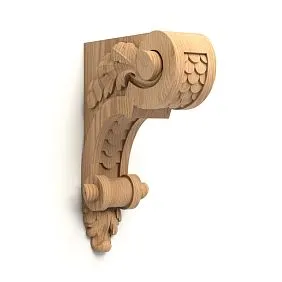
Wood — rare for molded decoration, typically used for picture frames, panels, and combinations with carved decoration.
Final finishing always concludes with painting — this allows achieving a unified texture, hiding seams and joints, emphasizing relief through patination, glazing, or gilding.
Frequently asked questions
Can plasterwork be installed independently?
Yes, at the basic complexity level — moldings, picture frames. For recessed moldings and complex compositions, it is better to consult a professional: here, perfect symmetry, precise fitting, professional spackling, and painting are crucial.
What material to choose for the bathroom, kitchen?
Polyurethane is moisture-resistant, does not fear temperature fluctuations, ideal for harsh conditions. Use plaster only in dry rooms.
How to care for stucco?
Wipe regularly with a dry or slightly damp cloth, avoid abrasive cleaning agents, repaint as needed.
How to safely run cables behind stucco?
Use special channels, mount stucco on a lath, do not drill into parts — this may cause chips or cracks.
Can stucco be repainted?
Yes, almost any stucco — just thoroughly prepare the surface: clean, prime, apply paint in two coats.
Conclusion: from simple to complex — your level of artistry
Wall molding is a tool that allows you to create architecture within interiors. Starting with simple frames, moving to rosettes, forming bas-relief compositions and panels, you advance to a new level of craftsmanship. In each case, the foundation is symmetry, precise installation, and respect for the material. The greater the complexity, the more opportunities to express individuality and transform your home into a work of art.
STAVROS company offers a wide selection ofbasic moldings, rosettes, polyurethane overlaysfor creating projects of any complexity level. Consultants will help you select the optimal combination of shapes, sizes, and materials, so your wall will sound anew — cleaner, brighter, more elegant, and deeper. Each project is a step toward your dream home.