Article Contents:
- Normative Requirements for Baluster Placement
- Influence of Material on Gap Calculation
- Mathematical Principles of Calculation
- Design Features for Families with Children
- Aesthetic Aspects of Placement
- Technological Nuances of Installation
- Adaptation to Various Architectural Styles
- Influence of Staircase Geometry on Baluster Placement
- Economic Aspects of Design
- Innovative Approaches in Modern Construction
- Specifics of Different Types of Buildings
- Climate Factors and Their Impact
- Psychological Aspects of Perception
- Maintenance and Longevity
- Modern Trends in Railing Design
- Regional Characteristics and Traditions
- Integration with Security Systems
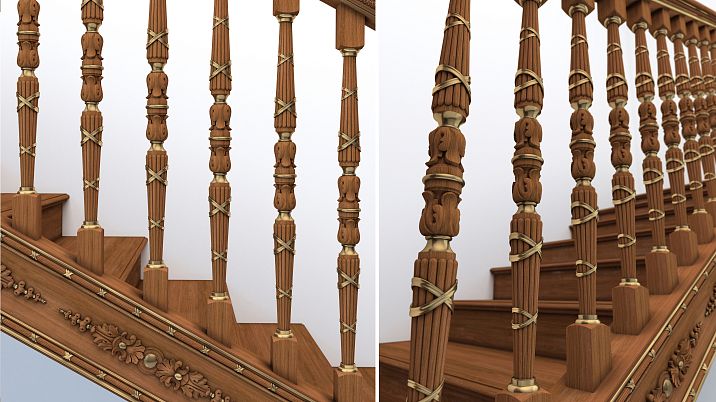
Designing stair railings is an art where every millimeter matters. The distance between balusters becomes a key parameter determining not only the aesthetic appeal of the structure but also the safety of all users. Modern architects and builders know: correctly calculated gaps between support elements are the foundation of a reliable and beautiful railing.
When it comes to creating stair railings, many homeowners focus exclusively on appearance, forgetting about technical standards. However, a professional approach requires a deep understanding of building codes, which have been shaped over decades of practical experience and scientific research.


Normative Requirements for Baluster Placement
Building codes and regulations establish clear boundaries for the spacing between balusters, based on principles of safety and functionality. The fundamental principle is that a spherical object with a diameter of 107 millimeters should not pass through the gap between support posts.
For residential and public buildings, the maximum allowable distance is 120 millimeters. This figure is not arbitrary — it is calculated to prevent the possibility of a child’s head getting stuck between railing elements. In childcare facilities, requirements become even stricter: the gap must not exceed 100 millimeters.
Professional designers recommend adhering to a range of 100 to 150 millimeters as the optimal spacing between balusters. This approach ensures an ideal balance between safety, visual appeal, and economic feasibility of the project.




Influence of Material on Gap Calculation
The choice of baluster material significantly affects the methodology for calculating gaps between them. Wooden elements, due to their natural texture and ability to create complex profiles, allow for a more flexible approach to planning distances.
Metal balusters, especially those made from standard-section profile pipes, require more precise calculations. Their geometric definiteness leaves no room for improvisation, but guarantees mathematical accuracy of the entire structure.
Stone and concrete elements have the greatest mass, which automatically affects the spacing between balusters. Their installation requires special attention to the load-bearing capacity of the foundation and precision of marking.
Polymer materials open up new possibilities for design solutions, allowing the creation of elements with complex shapes while maintaining the lightness of the structure. However, their installation requires consideration of thermal expansion and specific mounting characteristics.
Our factory also produces:


Mathematical Principles of Calculation
Professional calculation of the distance between balusters begins with determining the total length of the railing. This parameter is measured along the inclined line for stair treads or horizontally for balcony railings.
The next step is determining the effective cross-section of the balusters. For elements with complex shapes, the average value between the maximum and minimum diameters is taken. For example, if a carved baluster has a maximum diameter of 60 millimeters and a minimum of 30 millimeters, the calculated value will be 45 millimeters.
The calculation formula is as follows: from the total span length, subtract the product of the number of balusters and their average diameter; the resulting value is divided by the number of gaps (number of balusters minus one).
Practical example: for a span of 3000 millimeters with 18 balusters of 40 millimeters in diameter, the calculation will be: (3000 - 18×40)/(18-1) = 135 millimeters. This distance between balusters fully complies with regulatory requirements.
Get Consultation
Design features for families with children
The presence of young children in the house fundamentally changes the approach to planning stair railings. The distance between balusters in such cases should not exceed 100 millimeters, which requires an increase in the number of support elements.
Additional requirements pertain to the height of railings. The standard railing height of 900 millimeters can be increased to 1200 millimeters for enhanced safety. Additionally, it is recommended to install intermediate handrails at a height of 450-550 millimeters.
The shape of balusters also plays an important role. Elements with sharp angles or protruding details are not permitted in children’s areas. Smooth, streamlined forms without small detachable parts are preferred.
Baluster material must be environmentally safe and resistant to mechanical impacts. Wooden elements require special treatment with non-toxic compounds, while metal elements require reliable anti-corrosion protection.
Aesthetic aspects of placement
The visual perception of a stair railing largely depends on the rhythm of baluster placement. The distance between balusters creates a certain visual rhythm that can either emphasize the architectural concept or disrupt it.
Uniform placement of elements creates a sense of stability and order, which is especially important in classical interiors. Modern styles allow for some variations in rhythm, but they must be thoughtfully designed and justified.
Proportionality is a key principle of aesthetic design. Excessive placement of balusters creates a feeling of confinement and visually weighs down the structure. Excessively sparse placement disrupts the overall perception and may create a sense of incompleteness.
The play of light and shadow between balusters adds dynamism to the entire composition. Properly calculated distances between balusters allow for interesting lighting effects, especially when using decorative lighting.
Technological nuances of installation
Accuracy of marking is the foundation of quality baluster installation. Professional craftsmen use special templates and measuring tools to ensure uniform placement of elements.
The method of attaching balusters affects the ability to adjust the distance between them during installation. Attachment using dowels or bolts allows for minor adjustments, whereas bolted connections require absolute marking accuracy.
The sequence of installation also matters. Experienced craftsmen begin by installing the end balusters, then mark intermediate positions using a taut string or laser level.
Control of the vertical alignment of each element is critically important for the overall perception of the railing. Even minor deviations from vertical alignment become noticeable when viewing along a row of balusters.
Adaptation to various architectural styles
Classic style requires strict adherence to proportions and symmetry. The distance between balusters in classical interiors is typically 120-150 millimeters, creating a sense of grandeur and respectability.
Modern minimalism allows for a more flexible approach to element placement. Increased gaps between balusters emphasize the simplicity of forms and create a sense of spatial lightness.
Scandinavian style prefers functionality over decoration. Simple baluster shapes and optimal spacing between them create an atmosphere of coziness and practicality.
Loft style allows experimentation with non-standard solutions. Combining different materials and uneven placement of elements can become a distinctive feature of the interior.
Influence of staircase geometry on baluster placement
Straight staircases provide maximum freedom in planning the distance between balusters. Uniform placement of elements creates a harmonious composition and simplifies calculations.
Helical staircases require a special approach to baluster placement. Radial arrangement of elements creates a fan-like effect, which must be considered when calculating gaps.
L-shaped staircases present the greatest challenge for designers. The changing width of steps requires adapting the distance between balusters to maintain visual harmony.
Multi-flight staircases with landings require special attention to transition zones. The connection between different sections of the railing must be smooth and natural.
Economic aspects of design
Optimizing the number of balusters allows significantly reducing project costs without compromising safety or aesthetics. Increasing the distance between balusters to maximum allowable values may reduce costs by 20-30%.
Standardizing elements also contributes to cost savings. Using balusters of a single size simplifies production and reduces the cost of the finished product.
The choice of material significantly affects the overall project cost. Wooden balusters are usually cheaper than metal ones, but require regular maintenance. Polymer materials may be economically advantageous in the long term.
Installation complexity also affects the final cost. Simple mounting methods reduce labor costs and speed up installation.
Innovative approaches in modern construction
Modern technologies open new possibilities for optimizing the spacing between balusters. Computer modeling allows visualizing various placement options and selecting the optimal one.
Using composite materials expands design possibilities. Elements of complex shapes can be manufactured with high precision, simplifying the calculation of gaps between them.
Modular fence systems offer ready-made solutions with pre-set placement parameters. This approach ensures compliance with regulations and simplifies the design process.
Integrating lighting systems into balusters creates additional opportunities for architectural expression. LED elements can be embedded in support posts, creating an eye-catching staircase illumination.
Specifics of different types of buildings
Residential homes offer the greatest freedom in choosing the spacing between balusters. Owners can adapt parameters to their needs and preferences, while adhering to basic safety requirements.
Public buildings require strict adherence to regulations. Increased loads and intensive use dictate a more conservative approach to designing railings.
Childcare facilities impose the strictest safety requirements. Minimum spacing between balusters and additional protective elements become mandatory.
Medical facilities require special attention to hygiene aspects. Smooth surfaces and minimal inaccessible areas simplify cleaning and disinfection.
Climate factors and their influence
Temperature fluctuations affect the linear dimensions of materials, which must be considered when calculating the spacing between balusters. Metal elements have the highest expansion coefficient, while wooden ones have the lowest.
Air humidity particularly strongly affects wooden balusters. Seasonal changes in size may cause changes in the gaps between elements, requiring appropriate compensatory measures.
Wind loads in open spaces create additional requirements for structural rigidity. Reducing the spacing between balusters may be necessary to ensure required strength.
Aggressive atmospheric influences require special attention to protective coatings and material selection. Corrosion resistance becomes a critically important factor for longevity.
Psychological Aspects of Perception
The frequency of baluster placement affects the psychological perception of space. Excessive placement may create a sense of enclosure, while sparse placement may cause a feeling of vulnerability.
The spacing between balusters affects the perception of staircase scale. A fine rhythm visually increases the size of the structure, while a coarse rhythm reduces it.
The transparency of a railing depends on the density of element placement. The optimal balance between safety and openness of space is key to creating a comfortable environment.
Rhythmic placement creates a certain mood. Uniform rhythm calms, while variable rhythm adds dynamism and interest.
Technical maintenance and longevity
Properly calculated spacing between balusters simplifies railing maintenance. Adequate gaps between elements facilitate access for cleaning and preventive work.
The longevity of a structure depends on the even distribution of loads. Optimal baluster placement ensures even transfer of forces to load-bearing elements.
The possibility of replacing individual elements also depends on their placement method. Standard gaps simplify the search and installation of spare parts.
Railing inspection should include checking the condition of fasteners and verifying that actual dimensions match design values.
Modern trends in railing design
Minimalism in architecture influences approaches to baluster design. Increasing spacing between balusters to maximum allowable values creates a sense of lightness and airiness.
Ecological trends contribute to the popularity of natural materials. Wooden balusters made from certified wood become a preferred choice for environmentally conscious clients.
Technological innovations allow creating elements of complex shapes with high precision. This opens new opportunities for design experimentation while maintaining functionality.
Integrating smart technologies into railing elements creates additional possibilities. Motion sensors, built-in lighting, and security systems can be integrated into balusters.
Regional characteristics and traditions
Different regions have their own traditions in designing stair railings. Northern areas prefer more robust constructions with reduced spacing between balusters for added strength.
Southern regions often use lighter constructions with increased spacing between elements. This ensures better ventilation and reduces the visual bulkiness of the railing.
Historical traditions also influence modern solutions. Regions with rich architectural heritage often preserve traditional proportions and methods of element placement.
Local construction materials determine the technological features of manufacturing and installing balusters. This affects the optimal placement parameters of elements.
Integration with security systems
Modern safety requirements may require integrating additional elements into the railing structure. Motion sensors, surveillance systems, and emergency lighting can be embedded in balusters.
The spacing between balusters should consider the placement of additional equipment. Cable runs and mounting elements require appropriate space.
Access control systems can be integrated into stair railings. This is especially relevant for public buildings and office complexes.
Emergency evacuation systems require special attention to the strength and reliability of railings. Increased loads may require adjusting baluster placement parameters.
Correct calculation and planning of the spacing between balusters is the foundation for creating a safe, functional, and aesthetically appealing railing. A professional approach to this issue requires consideration of multiple factors: from regulatory requirements to individual client needs. Modern technologies and materials open up new opportunities for creative solutions, but basic principles of safety and functionality remain unchanged. For detailed information on calculating optimal baluster placement parameters, it is recommended to consult specialized resources such as spacing between balusters.
STAVROS Company, recognized as a leading producer of stair structures and railings, offers comprehensive solutions for any architectural task. Years of experience and deep understanding of technical nuances enable STAVROS specialists to create railings that perfectly combine safety, functionality, and aesthetic appeal. By contacting STAVROS professionals, you receive a guarantee of quality and compliance with all modern construction standards.