Article Contents:
- Features of a coffee table as a piece of furniture
- Purpose and usage
- Visual role
- Scale and proportions
- Standard height of a coffee table and its role
- Standard height and its justification
- Exceptions and variations
- Leg proportions - calculation and harmony
- Ratio of leg diameter to tabletop size
- Distance of legs from the edge of the tabletop
- Visual balance of height and leg width
- Requirements for coffee table stability
- Calculation of support area
- Center of gravity
- Angle of tipping
- Load on legs
- Safety of a coffee table
- Protection against tipping
- Protection from sharp edges and corners
- Safety for children
- Resistance to vibrations
- Materials for coffee table legs
- Wooden legs - naturalness and warmth
- Metal legs - modernity and graphic design
- Combined legs
- Types of leg constructions
- Straight legs - universality
- Turned legs with decoration
- Carved legs
- Legs with expansion at the bottom
- Leg attachment - reliability and durability
- Screwed attachment
- Adhesive Mounting
- Combined mounting
- Attachment with bushing
- Interior styles and coffee tables
- Classic style
- Scandinavian Style
- Minimalism
- Loft and Industrial Style
- Modern style
- Production and quality
- Choosing Material
- Finishing and sanding
- Finishing
- FAQ
- Conclusion

A coffee table is a piece of furniture often overlooked during interior design, yet its presence defines the comfort and safety of the living room. It is not merely a functional object for placing magazines, remote controls, or coffee cups — it is the central element of the relaxation zone, where people sit, lean back, stand up, and children play nearby. That is whyLegs for coffee tablesrequire special attention when choosing.
Correct legs for a coffee table ensure not only appearance but also functionality, safety, and durability. Incorrectly chosen legs can lead to table instability, create a hazard for seated people's feet, and spoil the living room's interior. Narrow legs on a large table are disproportionate and unstable. Too high legs make the table appear to float, disrupting the room's scale. Too low legs make the table look squat and inconvenient to move legs under.
This article examines all aspects of coffee table legs — from calculating the correct height to ensuring safety, from proportions that look harmonious to materials and constructions that serve for decades without deformation.




Features of a coffee table as a piece of furniture
A coffee table differs from a dining or work table by significant characteristics that affect requirements for its legs.




Purpose and use
A dining table is for eating, a writing desk for work, and a coffee table for relaxation. People do not work intensely or eat main dishes at a coffee table. It is a table for placing interior details, drinks, supporting legs while watching TV, and for children playing.
The use of a coffee table is versatile — people sit next to it on the sofa, stand up, walk around it, children run and jump. The legs must be strong enough to handle these dynamic loads, but not interfere with the table's usability. It is impossible to comfortably place feet under a coffee table if the legs are too close to the edges.
Our factory also produces:


Visual role
Unlike kitchen cabinetry, where legs are often hidden under the base, coffee table legs are fully visible. They are an inseparable part of the design, defining the table's style and its integration into the living room's interior.
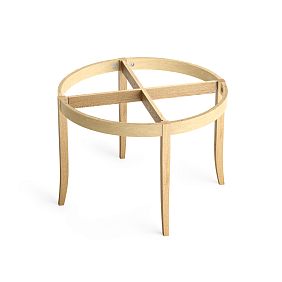
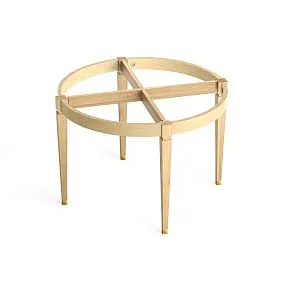
Elegant turned legs can be the main decorative element of a simple table. Solid straight legs emphasize a modern style. Carved legs convey a classic, traditional character.
The height of the legs relative to the thickness of the tabletop creates a visual balance. Thin legs under a thick tabletop look fragile. Thick legs under a thin tabletop look crude.
Get Consultation
Scale and proportions
A coffee table is usually small — 80-120 centimeters in length, 40-60 centimeters in width. Such a table requires appropriately scaled legs. Using legs designed for a dining table would make them appear too large and dominant.
Legs for a miniature coffee table 60x40 centimeters are suitable with a diameter of 20-25 millimeters. For a larger table 100x60 centimeters — legs 30-40 millimeters.
Standard height of a coffee table and its role
The height of a coffee table is one of the most important parameters affecting usability, safety, and appearance.
Standard height and its justification
The standard height of a coffee table is 350-450 millimeters — approximately 400-500 millimeters lower than the height of a standard sofa seat (800-900 millimeters). This ratio ensures convenience for placing items on the table and accessibility for seated individuals.
If the table is too low (below 300 millimeters) — people find it inconvenient to reach objects on the table, needing to lean forward. If too high (above 500 millimeters) — the table visually dominates the sofa, disrupting the comfortable relationship between elements.
Legs with a tabletop thickness of 30-40 millimeters should be 310-410 millimeters tall to achieve a final table height of 350-450 millimeters. This is the standard leg size for coffee tables.
For low sofas (seat height 650-700 mm), the coffee table can be lower - 280-350 mm. For high sofas (900-950 mm), the table can be higher - 450-500 mm.
For coffee tables not tied to a specific sofa (independent interior items), choose the medium height of 400 mm - a universal option.
Leg proportions - calculation and harmony
Correct leg proportions relative to the tabletop create visual balance and harmony.
Proper proportions of legs relative to the tabletop create visual balance and harmony.
Ratio of leg diameter to tabletop size
Classic rule - the diameter or thickness of the leg should be approximately 1/25 - 1/30 of the smallest tabletop dimension. For a coffee table measuring 80x60 cm, the minimum dimension is 60 cm, so the optimal leg diameter is 20-24 mm.
If the leg is too thin (less than 15 mm) - it looks disproportionate and fragile, despite sufficient strength. If too thick (more than 40 mm) - it looks crude and visually dominates.
Distance of legs from the tabletop edge
Legs should be positioned at a distance ensuring comfort for the seated person to rest their legs. Standard distance from the tabletop edge is 30-50 mm.
If legs are positioned too close to the edge (less than 20 mm) - it is uncomfortable for a person to extend their legs under the table. If too far from the edge (more than 100 mm) - the tabletop edges appear to overhang and look disproportionate.
For a square table 60x60 cm, legs are arranged in a 30x30 cm square - this ensures visual and functional harmony.
Visual balance of leg height and width
If the leg is too thin relative to its height - it looks wobbly, even if structurally stable. If thick - it looks low, crude.
Optimal height-to-diameter ratio of the leg is 10-15:1. For a leg height of 350 mm, the optimal diameter is 23-35 mm.
Requirements for coffee table stability
Stability is a critical safety parameter for coffee tables, where people often sit nearby, stand up, and children may run around.
Calculation of support area
The area where legs contact the floor determines the table's stability. The larger this area, the higher the stability, and the lower the likelihood of tipping under lateral pressure.
For an 80x60 cm table with four legs positioned 25 mm from the edge, the support area forms a rectangle approximately 75x55 cm. This is sufficient area for stability under normal usage conditions.
If legs are positioned close to the center of the table - the support area decreases, reducing stability. If a person leans on the edge, tipping may occur.
Center of gravity
The center of gravity of the coffee table must lie within the support area. If the tabletop is too thick (more than 50 mm) or carries heavy loads on one edge - the center of gravity may shift, reducing stability.
Correct leg placement ensures the center of gravity is located at the center of the rectangle formed by the four legs.
Tipping angle
The angle at which the table tips under lateral pressure depends on the height of the center of gravity and the size of the support area. For a coffee table with a low center of gravity (30 mm thick tabletop) and wide support area, the tipping angle is approximately 25-30 degrees, indicating high practical stability.
Load on legs
The weight of the coffee table is usually evenly distributed among four legs. For a table weighing 20-30 kg with a tabletop, each leg experiences a load of 5-7.5 kg under even weight distribution.
Under localized load (e.g., a person stepping on the edge), two legs closest to that edge experience greater weight. Wooden legs with a diameter of 25-30 mm can easily withstand localized loads up to 30-40 kg.
Coffee table safety
The coffee table is often located near walkways, where people may accidentally bump into it. This requires special safety measures.
Tip-over protection
A four-legged construction is the most stable. A three-legged construction is less stable under lateral loads. A six-legged construction is even more stable, but less practical due to manufacturing complexity.
The distance between legs should be maximum (close to the edges of the tabletop) for maximum support area. Some manufacturers add braces or connecting elements between legs to increase structural rigidity.
Protection from sharp corners and edges
If the legs of the coffee table are at the level of a seated person's knees, they must not have sharp corners that could cause injury. Legs should be rounded with smooth edges.
If a leg has a sharp upper edge where it attaches to the tabletop, this edge must be concealed under the tabletop or rounded.
Child safety
Children often play near the coffee table, running under it. Legs should not be thin enough to allow a child's head to fit through them. Legs with a diameter less than 15 millimeters create a risk of pinching.
Leg height should be sufficient for a child to freely pass under the table. A height less than 300 millimeters creates a risk of injury during movement.
Resistance to vibrations
If the table easily rocks upon touch, it indicates insufficient rigidity. Legs must be strong and thick enough to minimize table movement when walking nearby.
Loose fittings where legs attach to the tabletop gradually loosen the table. Legs must be securely fastened using appropriate fasteners (bolts, screws, glue).
Materials for coffee table legs
The choice of leg material determines durability, appearance, and compatibility with interior style.
Wooden legs - naturalness and warmth
Legs for coffee tablesWood - a classic choice, giving the table a natural and warm appearance. Pine, spruce, beech, oak, ash - each species has its own character.
Pine is light and warm, suitable for most interiors. Low cost - 100-250 rubles per set of legs. Disadvantage - softness, susceptibility to dents.
Oak is strong, durable, and noble. Cost 300-700 rubles per set. Suitable for classic, traditional interiors, creating a sense of solidity.
Beech is uniform, beautiful, and hard. Cost 250-600 rubles per set. Ideal for carved legs due to the uniformity of the material.
Metal legs - modernity and graphic design
Steel or aluminum legs create a modern, graphic look. Chrome steel has a shiny appearance and looks expensive. Powder coating allows any color to be achieved.
Cost of metal legs: 150-400 rubles per set. Lighter than wooden legs, easy to clean. Ideal for minimalist, modern interiors.
Combined legs
Wooden base with metal inserts or vice versa. Create an interesting texture contrast, often look premium.
Cost 300-800 rubles per set. Used for exclusive projects, custom furniture.
Types of leg constructions
Leg construction affects strength, appearance, and manufacturability.
Straight legs - versatility
Simple cylinder or prism without ornamentation. Functional, easy to manufacture, suitable for modern styles.
Straight legs can be conical — thinner at the top, thicker at the bottom, which improves proportions and visual balance.
Turned Legs with Decoration
Balusters, moldings, and rounded edges create visual interest. Require special equipment for production. Suitable for classic, traditional styles.
Turned legs often have a slender middle section and a thickening at the bottom, creating an elegant silhouette.
Carved Legs
Highest craftsmanship. Can feature geometric, floral, or narrative carving. Rare for coffee tables due to high cost, but create a unique look.
Legs with Expansion at the Bottom
Support platforms widen the leg at the bottom, improving stability and distributing load over a larger floor area. Especially important for heavy tables.
Leg Mounting — Reliability and Durability
The method of leg mounting determines the table's longevity and safety.
Screw Mounting
The leg is attached to the tabletop with one or several screws. Simple method, allows for disassembly and replacement of the leg. Requires precise alignment of holes.
Screw diameter is usually 4–6 millimeters. Screw depth should be sufficient for secure fixation, but not protrude through the tabletop.
Adhesive mounting
Wooden leg is glued to the tabletop with woodworking glue. Creates a monolithic structure, without play. Requires precise matching of leg shape and tabletop surface.
Disadvantage — practically impossible to replace the leg without damage. Rarely used, mostly in exclusive projects.
Combined mounting
Leg is screwed and additionally glued. Provides maximum reliability, eliminates play, increases durability.
Mounting with Bushing
A bushing (metal or wooden) is installed inside the tabletop, into which the leg's bolt is screwed. Ensures secure mounting in particleboard and MDF, without risk of thread stripping.
Interior Styles and Coffee Tables
Each interior style imposes specific requirements on coffee table legs.
Classic style
Requires legs with threading, turning, and elegant proportions. Material — oak, beech, ash. Shape — often cabriole legs with a distinctive curve resembling an animal’s paw.
Color — warm, dark wood tones. Finish — lacquer or oil, creating a deep gloss.
Scandinavian style
Simple, light-colored legs made of light wood (birch, pine, ash). No decoration, no ornamentation. Straight or slightly conical.
Finish — oil, highlighting wood texture, or light paint.
Minimalism
Graphic, geometric legs. Can be wooden or metallic. Color — contrasting or monochromatic with the tabletop.
Shape — straight, without embellishments. Minimal decorative elements.
Loft and industrial style
Contrasting legs — dark wood on light tabletop. Often combine wood and metal. Rough, rugged forms.
Modern style
Metal Legs — chrome-plated or painted. Graphic shapes. Often use contrast between black metal and light tabletop.
Production and Quality
The quality of legs for a coffee table is determined by the quality of the raw material, precision of processing, and quality of finishing.
Material selection
Selected wood without defects - knots, cracks, rot - is used for legs. The wood must be well-dried to prevent deformation after production.
The moisture content of the wood during production should be 8-12%, which corresponds to conditions in residential spaces.
Processing and Sanding
Legs are processed on machines - turning machines for turned legs, milling machines for carved legs. After processing, the legs are sanded with fine sandpaper to achieve a smooth surface.
Quality sanding eliminates chips, cracks, and gives the surface smoothness.
Finishing
After sanding, the legs are coated with a protective layer - varnish, oil, or paint. Quality finishing ensures longevity and protection against moisture and dirt.
FAQ
What height is optimal for a coffee table?
Standard height: 350-450 millimeters. For low sofas: 280-350 millimeters. For high sofas: 450-500 millimeters. Optimal height should be chosen based on the height of your sofa seat.
What diameter of legs is suitable for a coffee table measuring 100x60 centimeters?
Optimal diameter: 28-35 millimeters. Too thin legs (less than 20 millimeters) look fragile. Too thick legs (more than 40 millimeters) look bulky.
From what material should legs be chosen?
Wooden legs - naturalness, warmth, suitable for most interiors. Metal legs - modernity, graphic style, easier to maintain. The choice depends on the interior style.
How to ensure the stability of a coffee table?
Place legs as close as possible to the edge of the tabletop (30-50 millimeters from the edge), use a four-legged construction, and ensure that the legs are securely fastened without play.
Can legs be replaced on a ready-made coffee table?
Yes, if the new legs have the same mounting holes. If the holes do not match, you will need to modify the holes in the tabletop.
How often should wooden legs be maintained?
With oil finish - renew oil every 1-2 years. With varnish finish - every 5-10 years. With paint finish - every 3-5 years. Periodically check the tightness of fasteners.
Which legs look best with a transparent tabletop?
For a transparent tabletop, choose attractive legs - turned, carved, or made from beautiful wood. Simple straight legs may look dull under a transparent tabletop.
Are coffee tables safe for children?
Yes, if legs are properly chosen. Legs must be strong, rounded, and free of sharp edges. Leg diameter should be at least 15 millimeters. Table height of 350-450 millimeters does not pose a danger upon impact.
Conclusion
Legs for coffee tables are not just support elements; they are details that determine the functionality, safety, and aesthetics of this important piece of furniture. The right choice of legs — in terms of size, material, construction, and fastening — creates an item that will delight you for decades.
furniture legsLegs from STAVROS are produced with attention to every detail. Each leg undergoes quality control, tested for strength, surface smoothness, and perfection of proportions.
STAVROS not only provides high-quality legs but also offers consultation on selecting the optimal solution for your coffee table.Furniture legsSTAVROS — the choice of designers, furniture makers, and owners who value quality, beauty, and reliability.
Create furniture with STAVROS legs — invest in items you will enjoy using, with safety and pride in quality. Your coffee table deserves the right legs, ensuring reliability, beauty, and harmony in your interior.