Article Contents:
- Why the classic door portal often falls apart precisely on the profiles
- What in the portal is responsible for verticality, base and architectural linkage
- Wooden architrave: door frame and vertical rhythm
- Pilaster: vertical reinforcement and doorway framing
- Wooden skirting board: lower base of the room and portal support
- Profile logic: how three elements communicate with each other
- How to choose a wooden architrave for a classic portal
- Architrave width and its influence on the portal
- Profile depth: what determines the 'weight' of an architrave
- Pattern character: calm or active profile
- Architrave for a classic door: proportions
- How to choose a wooden skirting board so it doesn't clash with the door assembly
- Skirting board height and its ratio to the architrave
- Skirting board relief depth: the key coordination
- Skirting board profile character and its coordination with the architrave
- When the skirting board should be calmer than the architrave
- How a pilaster works in a classic door portal
- When a pilaster in a portal is truly needed
- Pilaster width: how to calculate it
- How a pilaster connects to a baseboard
- When a lightweight pilaster option is appropriate
- How to combine profiles: casing, baseboard, and pilaster
- Same profile: the safest solution
- Related profiles: acceptable and interesting
- Different activity with the same logic
- What should never be mixed under any circumstances
- How to check profile compatibility before purchase
- How to assemble a portal without a 'from different collections' feel
- Single breed or visually close tone
- Consistent element width: proportion as a system
- Relief logic: repetition of radii and bevels
- One architectural idea for the entire portal
- Ready-made combination schemes: five scenarios for different tasks
- Scheme 1: Calm classic
- Scheme 2: Ceremonial portal with pilasters
- Scheme 3: Narrow portal with lightweight pilaster
- Scheme 4: Tall portal with reinforced base
- Scheme 5: Active door and calm baseboard
- Common mistakes when assembling a classic door portal
- Too complex a baseboard for a simple casing
- Pilaster of a different character than the door
- Different radius and plasticity of profiles
- Heavy bottom and weak top
- Narrow casing next to a powerful pilaster
- Mix of products from different styles
- What to look for in the catalog for assembling a classic portal
- FAQ: Answers to Key Questions
- How to match a wooden casing to a pilaster?
- Which baseboard suits a classic door portal?
- Should the skirting board and architrave have the same profile?
- Can a simple skirting board be combined with a more active pilaster?
- When is a pilaster next to a door really necessary?
- How to avoid profile mismatch in classic style?
- What to choose first: the door, architrave, or skirting board?
- Is a cornice or molding needed to complete a classic portal?
- About the company
Imagine: the door is installed. The architrave is beautiful, with a good profile. The skirting board along the wall is also decent. Next to the door is a pilaster that looks convincing on its own. But when all this ends up together—something goes wrong. The elements aren't openly clashing, they just... don't communicate. They stand side by side, each on its own, like strangers at a bus stop.
This is called profile mismatch—and it's precisely what ruins most attempts to assemble a classic door portal from separately purchased items.Wooden casing, Wooden baseboardandPilasterWooden architrave, skirting board, and pilaster: how to assemble a classic door portal without profile mismatch
Imagine the situation: a good door, a beautifulWooden casing, dear Wooden baseboard, solid Pilaster on either side of the opening. All the details individually are worthy. But together — there's a feeling as if they were assembled from different collections, from different warehouses, at different times. Something is off, and it's unclear why.
This is called a mismatch in profiles. And it is one of the most common and yet, at first glance, most unnoticeable mistakes when assembling a classic door portal. The elements can be of good quality, correct in material, appropriate in style — but if their profiles live by different plastic logics, the interior will never become cohesive.
This article is a practical guide on how to select Wooden baseboard, architrave, and pilaster so that a classic door portal reads as a single architectural phrase — and not as a set of words from different languages.
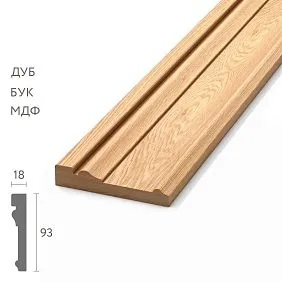

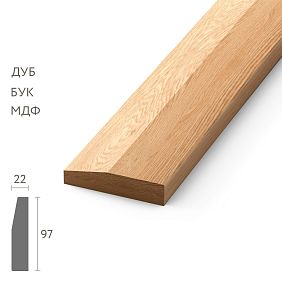


Why a classic door portal often falls apart precisely on the profiles
Let's honestly examine the root of the problem. Most people, when arranging an interior in a classic spirit, choose the architrave, baseboard, and pilaster separately. They look at the beauty of each. Check the material. Assess the price. Ask if it suits classic style. Receive an affirmative answer — and buy.
But classic style is not a set of items labeled 'suitable for classic'. It is a system of proportions, profiles, and rhythms, where each element is coordinated with the neighboring one in the geometry of its cross-section.
What specifically creates the mismatch?
Different profile molding. A casing with soft, rounded transitions—and a baseboard with sharp, rectangular edges. Both are classic. But they speak different architectural dialects.
Different scale. A thin, delicateWooden casing60 mm wide—and a powerful 150 mm high baseboard with deep relief. One element overwhelms the other.
Different relief depth. A pilaster with a relief of 25 mm from the wall—and a casing with a relief of 12 mm. They are placed next to each other but 'project' from the wall differently, creating a stepped visual break.
Different ornament character. A casing with a carved floral pattern—and a pilaster with geometric fluting. Both are beautiful. Together—conflict.
That is why the task of assembling a classic door portal is not a task of 'choosing beautiful details,' but a task of building a profile system in which all elements speak the same language.




What in the portal is responsible for the vertical, base, and architectural linkage
A classic door portal is not just a door and a frame. It is an architectural statement about space. It has three functional levels:
Our factory also produces:


Wooden casing: door frame and vertical rhythm
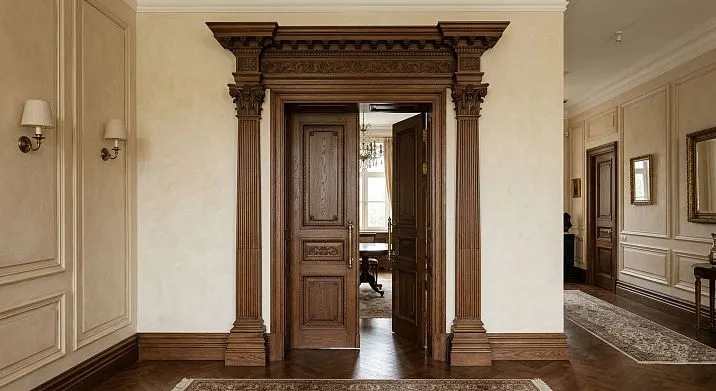
Wooden casing—is the vertical of the portal. It frames the door opening, conceals the gap between the wall and the jamb, and at the same time defines the character of the entire assembly. Everything is read from the casing: how active the profile is, how wide the element is, how pronounced the relief is.
(Article continuation)
(Continuing from the break point)
The door casing is the first thing the eye sees when looking at a door. It sets the scale. Everything else — baseboard, pilaster, moldings — must either follow this scale or consciously develop it.
The width of the casing for a classical portal is from 65 to 100 mm. Wider — a more ceremonial accent. Narrower — a modest background element. Both are acceptable, but each requires an appropriate surrounding.
Get Consultation
Pilaster: reinforcing the vertical and framing the opening
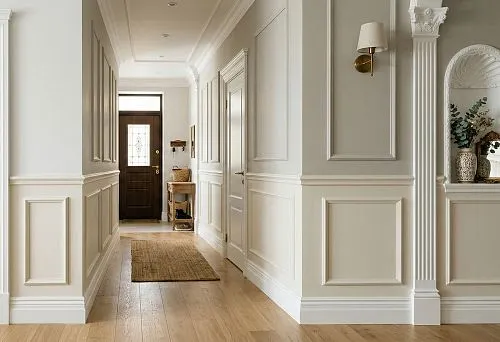
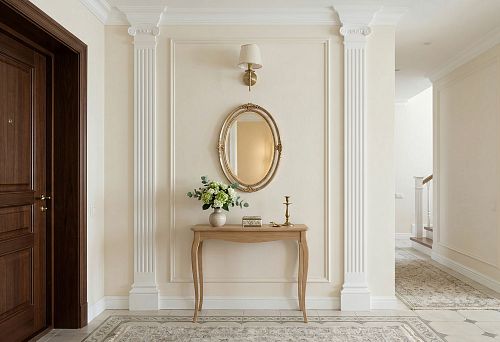
PilasterIn a classical door portal — it's not just a decorative detail. It is an architectural tool that reinforces the door's verticality and gives the opening monumentality. The pilaster is located on the sides of the door casing — either flush against it or with a small offset.
The main function of a pilaster in a portal: to create 'legs' for the architrave completion at the top. In a simplified version — to reinforce the verticality of the casing, adding architectural weight to it. The pilaster does not duplicate the casing — it supports it.
Wooden baseboard: the lower base of the room and support for the portal
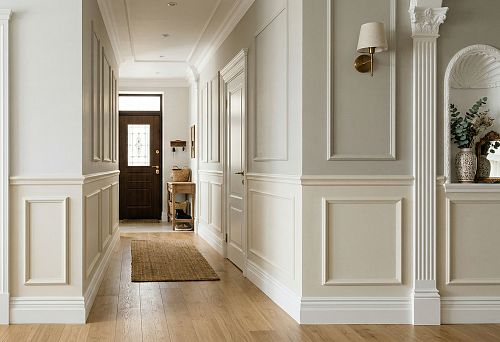
Wooden baseboard— is the foundation of the wall system. It is the lower horizontal line that 'grounds' the entire interior. In the area of the door portal, the baseboard solves a special task: it either runs into the casing or meets the pilaster flush from below — and this joint is either read as neat or creates a visual break.
The joint of the baseboard with the casing or pilaster is one of the most vulnerable points in a classical portal. This is where inconsistency most often manifests: if the profiles are not coordinated, the joint looks like an unfinished detail. If coordinated — it becomes a natural transition that you simply don't notice.
Profile Logic: How Three Elements Communicate
A profile is a cross-section of an element perpendicular to its length. It is through the profile that the eye 'reads' the architectural language of the element: soft or rigid, baroque or strict, rich or laconic.
WhenWooden casingandWooden baseboardhave a related profile — identical or similar rounding radii, the same ratio of convex and concave parts, similar depth — they are perceived as part of a single system. The eye registers a familiar rhythm and 'trusts' the interior.
When profiles are incompatible — the eye notices the discrepancy, even if a person cannot articulate it in words. A vague 'something is off' arises.
How to choose a wooden casing for a classical portal
wooden casingfor classical style — this is not a detail you buy 'by eye,' relying only on appearance. Specific characteristics are important here, which will then become the starting point for selecting the rest of the portal.
Casing width and its influence on the portal
The width of the casing sets the scale of the entire door zone. Let's consider practical guidelines:
| Sticker Width | Character of the portal | What to match nearby |
|---|---|---|
| 50–65 mm | Modest, background | Light pilaster, low baseboard |
| 65–85 mm | Standard classic | Medium-width pilaster, baseboard 80–100 mm |
| 85–110 mm | Expressive, formal | More robust pilaster, baseboard from 100 mm |
| 110 mm and above | Monumental | Full-fledged pilaster, high baseboard 120–150 mm |
Profile depth: what determines the 'weight' of a casing
Casing profile depth is the distance from the wall to the most protruding edge of the relief. It is this parameter that determines the element's 'weight' in space.
For a classic interior with ceilings 2.7–3 m high, the optimal architrave profile depth is 18–28 mm. A deeper relief is for high rooms from 3 m. A flatter one is for modern neoclassicism emphasizing conciseness.
Important: the relief depth of the architrave must be coordinated with the relief depth of the pilaster. If the architrave protrudes 20 mm from the wall, and the adjacent pilaster protrudes 35 mm, a step is created between them, which disrupts the portal silhouette.
Character of the pattern: calm or active profile
In classicism, there are two fundamental types of architrave profile:
Calm profile — one or two smooth lines, minimal bends, no ornament. This is neoclassicism, moderate classicism, interiors with subtle expressiveness. Such an architrave easily 'gets along' with almost any baseboard and pilaster of the same character.
Active profile — several bends, possible ornamental element, pronounced three-dimensionality. This is classicism with a claim to grandeur. Requires appropriate surroundings: baseboard with a rich profile, pilaster with a capital.
Rule: the more active the architrave profile, the more coordinated in activity the baseboard and pilaster should be.
Architrave for a classic door: proportions
Additional guideline — the proportions of the architrave relative to the door leaf. Standard door width 700–900 mm: architrave 65–85 mm. Door width 900–1100 mm: architrave 80–100 mm. Double-leaf door or opening 1200 mm and wider: architrave 100–120 mm plus pilaster as a mandatory element.
How to choose a wooden baseboard so it doesn't clash with the door unit
with a classic profile creates a sense of solidity, reliability.— is the lower boundary of the entire interior. It runs along the perimeter of the room, goes around every door, and approaches every wall. And it is precisely in the area of the door portal that the baseboard comes into direct visual contact with the casing and pilaster.
Baseboard height and its ratio to the casing
wooden baseboard— for a classic interior — from 80 to 150 mm. Height selection:
-
Baseboard 80–100 mm — with a casing width up to 80 mm. The ratio of baseboard height to casing width — at least 1:1. The baseboard is 'lower' than the casing in terms of activity — the base should be proportionate but not overwhelming.
-
Baseboard 100–120 mm — with a casing 80–100 mm. A good classic ratio.
-
Baseboard 120–150 mm — with a casing 100 mm and above, especially in the presence of an active pilaster. Here, the baseboard takes on the role of a plinth element, and its height corresponds to the monumental character of the portal.
Baseboard relief depth: the main coordination
The most important parameter when selectingwooden baseboard— for a specific door assembly — is the relief depth. It should be proportionate to the relief depth of the casing.
Practical rule: the relief depth of the baseboard — no more than 80% and no less than 60% of the relief depth of the casing. If the casing protrudes by 22 mm — the baseboard should protrude by 14–18 mm. This creates a visual hierarchy: the casing is active, the baseboard is supportive.
If the baseboard protrudes more than the casing, an inversion occurs: the lower base 'interrupts' the door's vertical line. Visually, this is perceived as a 'heavy bottom' and a 'weak door'.
The character of the baseboard profile and its coordination with the casing
Key question: Should the baseboard and casing have the same profile? No, not necessarily. But they should have a related character.
What does this mean in practice:
-
If the casing has a convex profile with soft transitions, the baseboard should also have rounded, not sharp edges
-
If the casing is strict with straight setbacks, the baseboard should have the same geometric pattern
-
If the casing is ornamental, the baseboard should be either more restrained (one or two lines) or of the same ornamental spirit
You cannot combine: a baroque rounded casing with a geometrically rigid baseboard, and vice versa—a strict classical casing with a lush baseboard profile featuring several curves of different characters.
When the baseboard should be calmer than the casing
If the door unit is the main accent of the wall (a wide main door, a bright portal, an active casing), thenWooden baseboardshould be subordinate: tall, but calm in profile. It creates a base but does not compete with the door.
If the door is restrained and the interior is rich in details, the baseboard can be slightly more expressive, balancing the calm vertical of the door with a more active horizontal at the floor.
How a pilaster works in a classical door portal
Pilaster— the most 'architectural' element of the portal. It is what elevates the door from the category of 'an opening in the wall' to the category of 'an architectural event.' But a pilaster only works when it is correctly related to the casing and the baseboard.
When a pilaster in a portal is truly needed
Not every door opening needs a pilaster. Here are scenarios where it is justified:
-
A door in a formal room (living room, study, dining room) with ceilings from 2.8 m
-
A wide opening from 900 mm, requiring visual 'support' on the sides
-
An interior with a pronounced classical or neoclassical character, where the walls already have architectural decor
-
A door as the main visual center of a wall
-
Double-leaf doors - here a pilaster is practically mandatory
When a pilaster is excessive: small doorways in compact spaces, interiors in modern neoclassicism with an emphasis on minimalism, narrow corridor doors.
Pilaster width: how to calculate it
Wooden pilasterin a door portal - is an architectural element whose width is determined by a proportion relative to the casing:
-
Pilaster width - from 1 to 1.5 times the width of the casing
-
With a 70 mm casing - pilaster 70–100 mm
-
With a 90 mm casing - pilaster 90–130 mm
-
With a 110 mm casing - pilaster 110–160 mm
A pilaster narrower than the casing - it loses its architectural role, looks like a decorative insert rather than a structural element. A pilaster significantly wider than the casing - it overwhelms the door's vertical line, 'consumes' it.
How a pilaster connects to a baseboard
Lower endpilasters— one of the key areas in a portal. Here the vertical meets the horizontal base. Solution options:
The pilaster rests on the baseboard. The lower end of the pilaster is placed on the top edge of the baseboard. This is a classic solution: the pilaster 'stands' on the base. It is important that the width of the baseboard and the thickness of the pilaster are coordinated — otherwise the pilaster 'hangs' over the baseboard or 'sinks' into it.
The pilaster goes into the floor through the baseboard. The baseboard wraps around the pilaster on the sides. The pilaster has its own plinth — a small base at the floor. This is a more solemn and architecturally complex solution, suitable for formal spaces.
The pilaster ends at the level of the top edge of the baseboard. A simple and clean solution for modern neoclassicism. Requires precise alignment of the baseboard height and the pilaster's lower end.
When a lightweight pilaster option is appropriate
If the interior aims for light neoclassicism — a narrow pilaster (40–55 mm) with minimal relief looks more tactful than a full-fledged classical one. It creates a vertical accent without weighing down the portal.Wooden trim in the form of a narrow strip with an expressive profile can replace a classical pilaster where the scale does not require monumentality.
How to combine profiles: casing, baseboard, and pilaster
Here is the central, most important part of the article. This is where the answer to the question posed in the title lies.
Matching profile: the safest solution
The ideal scenario —Casings, Skirtingand the pilaster belong to the same profile family: they have identical or very similar bend radii, the same ratio of convex to concave parts, and similar relief depth. This is a foolproof solution — the system always looks cohesive.
This is exactly how professional collections of wooden moldings and architectural decor are organized: all items in the line 'speak' the same language. If you take a casing, baseboard, and pilaster from the same series by one manufacturer — the issue of inconsistency resolves itself.
Related profiles: acceptable and interesting
Sometimes an exact match isn't available — and that's not a tragedy. Related profiles are profiles that share the same line nature but differ in saturation. For example:
-
A casing with two bends and a small ornamental band — and a baseboard with one bend of the same character, without ornamentation
-
A pilaster with flutes — and a casing with vertical ribs of the same spacing
-
A baseboard with a convex top edge and a flat body — and a casing with the same convex top edge, but a more saturated middle section
General principle: one type of curve in the cross-section. If the architrave is built on a large-radius arc — the baseboard and pilaster should also be built on arcs, not on sharp edges.
Different activity with the same logic
This is the most subtle and expressive option. The architrave — an active, rich profile. The baseboard — of the same character, but calmer: one or two lines instead of three or four. The pilaster — intermediate in richness.
This is how classical hierarchy works: the main element (architrave) — active, the supporting one (baseboard) — more restrained, the connecting one (pilaster) — proportionate to both. All three are read as part of one theme, with varying degrees of development.
What should never be mixed under any circumstances
-
Soft rounded profiles with sharp angular ones — this is a direct plastic conflict
-
Baroque profiles with an abundance of curves — and strict classical ones with straight setbacks
-
Profiles of different scales: a fine architrave pattern and a coarse baseboard with large elements
-
Products made from different wood species with different texture characters, if they are not painted the same color
How to check profile compatibility before purchase
Practical method: take end cuts (or cross-section photos) of selected products and compare them side by side. Ask: are they similar in curve character? Are they similar in depth? Do they belong to the same 'mood'? If the answer to all three questions is 'yes' — you can take them.
How to assemble a portal without the feeling of 'from different collections'
Besides coordinating profiles, there are several practical principles that make a portal cohesive.
Uniform wood species or visually close tone
IfWooden casingandWooden baseboardFrom the same wood species—oak, beech, ash, pine—the grain visually unites them even with slight profile variations. Different species are acceptable if the interior is painted a uniform color: then textural differences are neutralized, leaving only the profile.
Wooden itemsfor painting — an excellent option for those who want to assemble a perfectly coordinated portal without mandatory wood unity.
Coordinated element width: proportion as a system
In classic style, the rule of increasing scale from top to bottom is accepted:
-
Casing (vertical element) — sets the base width
-
Pilaster — equal to the casing or slightly wider
-
The skirting board is comparable in height to the width of the casing or slightly higher.
This creates a harmonious proportional system where all elements 'feel' each other.
Relief logic: repetition of radii and bevels.
Profile relief is not just about depth, but also the character of transitions. If the casing has a 45° bevel, a similar bevel should be present in at least one of the adjoining elements. If the skirting board profile has a rounded 8 mm radius, look for a similar radius in the casing or pilaster.
Repeating geometric profile elements is what creates a 'rhyme' between details and makes the system recognizable as a unified whole.
One architectural idea for the entire portal.
Before purchasing, formulate one sentence about your portal. 'Strict light classic with minimal decor.' 'Warm, formal neoclassical with pronounced verticality.' 'Laconic classicist portal with a strong horizontal base.'
This sentence is a filter. Check every element you pick up for compliance with this idea. If it doesn't comply, don't take it, even if you like it on its own.
Ready-made combination schemes: five scenarios for different tasks.
Scheme 1: Calm Classic
Character: light interior, white products, ceilings 2.7–2.8 m, modern neoclassicism.
Contents:
-
Wooden casing70 mm, calm profile with one convex edge, depth 16 mm
-
Wooden baseboard90 mm, profile with a soft upper edge of the same character, depth 14 mm
-
Without pilaster or narrow 60 mm pilaster as a light vertical accent
-
All products — white enamel
Result: clean, light, modern classical portal.
Scheme 2: Formal portal with pilasters
Character: living room, ceilings 3 m and above, warm tones, pronounced classicism.
Contents:
-
Wooden casing95 mm, rich profile with three lines, depth 24 mm
-
wooden baseboard120 mm, profile of a related character, depth 18–20 mm
-
Pilaster100–120 mm, depth 22–24 mm, rests on the baseboard
-
Wooden moldinghorizontal above the door — architrave
-
Toning "like walnut" or "like oak"
Result: a solemn, formal portal with full architectural logic.
Scheme 3: Narrow portal with a lightweight pilaster
Character: opening 700–800 mm, compact space, neoclassical.
Contents:
-
Casing 60 mm, light profile
-
Baseboard 80 mm, coordinated profile
-
Pilaster 55–65 mm, minimal relief — more of a vertical overlay strip than a classic pilaster
-
Everything — in the same color as the wall or slightly more contrasting
Result: a delicate accent without heaviness. The narrow space is not compromised.
Scheme 4: High portal with a reinforced base
Character: ceilings 3.2–3.5 m, high door, formal rooms.
Contents:
-
Casing 100 mm, deep profile 26–28 mm
-
Wooden baseboard140–150 mm, powerful profile with two to three lines
-
Pilaster 120–140 mm, with a pronounced base at the floor
-
wooden corniceCeiling molding as a finishing horizontal line
-
Dark tinting or contrast of a light door and a dark portal
Result: a monumental portal, proportionate to the high room.
Scheme 5: Active door and calm baseboard
Character: a door with rich decor — panels, relief, carving. The interior is moderate.
Contents:
-
Casing 80–90 mm with a moderate profile — it does not compete with the door but supports it.
-
wooden baseboards for floor90–100 mm, a very calm profile — it fades into the background.
-
Pilaster is light or absent — the door itself is a sufficient accent.
-
All elements are in the same tone, the door — in contrast to the wall.
Result: the door remains the main element, everything else works as a supporting context.
Common mistakes when assembling a classic door portal.
Too complex a baseboard under a simple casing.
If the casing is calm, with one or two lines, andWooden baseboard— with five curves and an ornamental frieze, the base 'overpowers' the door. The gaze lingers on the baseboard and loses interest in the portal. This is a hierarchy inversion.
A pilaster of a different character than the door
Pilasterin the Baroque spirit next to a casing in the spirit of strict Empire. Both are beautiful. Together — a historical conflict. The pilaster must belong to the same stylistic register as the casing.
Different radius and plasticity of profiles
Casing with soft arcs and a baseboard with sharp straight ledges. This is the most common and least noticeable mismatch to the untrained eye. But it is precisely this that creates that very 'something is off'.
Heavy bottom and weak top
Monumentalwooden baseboard150 mm high — and a thin 55 mm casing. The base presses down, the door's verticality is lost. The portal seems to have 'sunk' downward.
Narrow casing next to a powerful pilaster
Pilaster 140 mm — and casing 60 mm. The pilaster swallows the casing, the door opening loses its frame. Instead of a 'portal with pilasters,' you get 'pilasters with a door hole between them.'
A mix of products from different styles
A 'Provence-style' casing with a soft, sagging profile — and a pilaster in the spirit of strict Empire style. Or a baseboard with a rustic texture — and a casing with glossy milling. All this is a random mixture that lacks architectural meaning.
What to look for in the catalog to assemble a classic portal
Wooden casings create a frame around the opening, visually highlighting it from the wall plane. A classic casing has a profiled section that corresponds to the profiles of baseboards and moldings.— a complete catalog of solid wood door casings. The first element from which portal assembly begins.
Wooden pilaster — complete section— pilasters and columns made of solid wood. Selection by width, profile, and height.
Pilasters — filter by product type— only pilasters without columns, convenient for comparison.
solid wood baseboard— floor baseboards made of natural wood. Various heights and profiles.
Wooden molding— horizontal profiles for architraves and wall belts.
Wooden moldings — all types— expanded catalog of wooden moldings.
Wooden cornice— ceiling cornice for finishing the portal at the top.
Wooden cornice — all types— full catalog of wooden cornices.
solid wood millwork— millwork products from natural wood: baseboards, moldings, architraves, cornices in a unified system.
Wooden products — full catalog— full range of wooden architectural products.
FAQ: Answers to Key Questions
How to match a wooden architrave to a pilaster?
Widthpilasters— from equal to 1.5 times the width of the architrave. The depth of the pilaster relief is close to the depth of the architrave (±20%). The profile character is the same curve nature: both soft or both geometric. Species or color — unified.
Which baseboard suits a classical door portal?
Wooden baseboard90–130 mm in height with a profile of the same character as the architrave. Relief depth is 60–80% of the architrave depth. One type of curve in cross-section with the architrave and pilaster.
Should the skirting board and architrave have the same profile?
The same profile is a safe bet, but not mandatory. A related character of the profile is sufficient: the same nature of curves, similar depth, and no plastic conflict between the elements.
Can a simple skirting board be combined with a more active pilaster?
Yes, provided the architrave occupies an intermediate position in terms of activity: it is more complex than the skirting board and simpler than the pilaster. This creates a progression from the base to the vertical accent.
When is a pilaster next to a door really needed?
For openings from 900 mm, ceilings from 2.8 m, in formal rooms, and in the presence of other architectural elements on the wall (cornices, moldings, wall frames). In compact rooms with low ceilings, a pilaster is often excessive.
How to avoid mismatched profiles in classic style?
ChooseCasings, SkirtingandpilasterFrom one production series. Or select by cross-sections: compare the character of curves, depth, and the ratio of convex/concave parts. Never buy based on the principle 'both are classic, so they'll match.'
What to choose first: the door, architrave, or skirting board?
Optimal order: door → casing → pilaster → baseboard. The door sets the scale. The casing defines the portal's character. The pilaster coordinates with the casing. The baseboard is last, it submits to the entire system.
Is a cornice or molding needed to complete a classical portal?
HorizontalWooden moldingabove the door (architrave) completes the portal from the top and gives it a finished look. For formal portals — practically mandatory. For light neoclassicism — not mandatory, but desirable. Ceilingwooden cornicecompletes the top line of the entire room and unites the portal with the space.
About the Company
To assemble a classical door portal without mismatched profiles means working with a manufacturer whose casing, baseboard, pilaster, moldings, and cornices are created within a unified architectural logic and are coordinated with each other in terms of profile character, scale, and style.
STAVROS — manufacturer of solid wood architectural products: casings, pilasters, baseboards, moldings, cornices, wooden millwork. All STAVROS products are developed with the principle of systemic compatibility in mind: profiles within one series are coordinated, elements combine with each other without conflict, joints work cleanly. This allows designing classical and neoclassical interiors not by trial and error, but by clear architectural logic — choosing each element as part of a single ensemble, not as a random find.