












































































Article Contents:
- When standard solutions don't work: the need for exclusivity
- From idea to sketch: the process of developing a unique design
- Concept formulation
- Creating a sketch: bringing the idea to paper
- Technical documentation: from sketch to production
- Carving with custom ornament: technologies for embodying uniqueness
- Hand carving: tradition and unparalleled detail
- CNC milling: precision and repeatability
- Combined approach: the best of both worlds
- Non-standard sizes and shapes: freedom from catalog limitations
- Wide baseboards: when standard 120 mm is not enough
- Non-standard length: minimizing joints
- Curvilinear elements: baseboards for bay windows and radius walls
- Carved frames of non-standard shapes: ovals, polygons, asymmetry
- Unified carving on baseboards and frames: creating an ensemble
- Developing a unified ornamental motif
- Adapting the ornament to the element's function
- Technical aspects of serial production for unique ornaments
- Production timelines: realistic expectations
- Stages and their duration
- Factors affecting timelines
- Accelerated production: is it possible and what does it cost
- Custom solutions workshop: production capabilities
- Pricing for exclusive products: an investment in uniqueness
- Factors shaping the cost
- Comparative cost of various options
- Savings without losing exclusivity
- Frequently asked questions about custom orders
- Can threading be ordered on already installed elements?
- How much does it cost to develop a unique ornament?
- Is it possible to replicate carving from a photograph?
- How long is custom order data retained?
- Can one sample be ordered before the main batch?
- What guarantees are provided for custom-made elements?
- Is return possible for custom-made products?
- How to choose a contractor for a custom order?
- Conclusion: Uniqueness as an interior philosophy
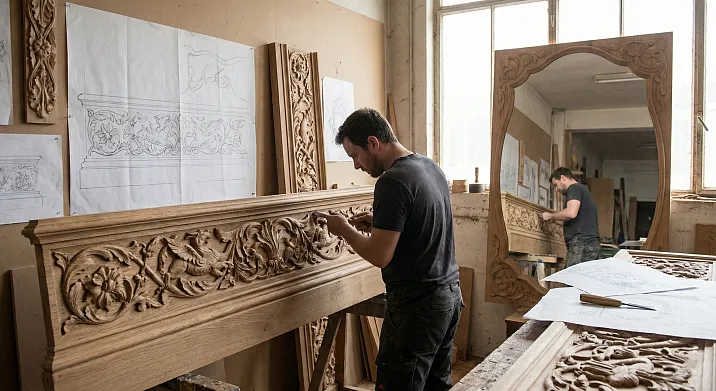
Standard solutions are good for typical housing, but an authorial interior requires exclusive elements. When a designer dreams of a baseboard with an ornament repeating the pattern of an antique fireplace, whenmirror in a carved framemust reflect the concept of the entire space, when every detail is subordinated to a single philosophy — custom ordering comes to the rescue. The possibility tobuy a mirror in a carved wooden frame, created from a unique sketch, or to orderWide Wooden Skirting Boardof a non-standard profile transforms the interior into a work of art. This is not a luxury for millionaires, but an accessible reality for those who value individuality.


When standard solutions don't work: The need for exclusivity
Standard manufacturer catalogs offer dozens of baseboard profiles, hundreds of mirror frame options. For most interiors, this is sufficient — a competent designer selects ready-made elements so that the result looks cohesive and well-considered. But there are situations where catalog solutions are powerless, where a project requires absolutely unique details.
Restoration of historical buildings is the first and most obvious application of custom ordering. A 19th-century mansion, an apartment in a Stalin-era building with original stucco, an estate with wooden carved elements — all these objects require the recreation of lost details in exact accordance with the original. Modern standard profiles look alien in such interiors, destroy authenticity, and reveal the restoration.Custom wood carvingallows for the reproduction of historical elements with millimeter precision, preserving the spirit of the era.
Authorial design projects are often based on a unique concept that requires unconventional solutions at all levels. When an entire interior is built around a specific pattern, when every element—from door handles to textiles—is subordinated to a single idea, baseboards and mirror frames cannot be an exception. Ordering custom decorative elements completes the concept, makes it cohesive, and transforms the interior into a manifesto.
Non-standard architecture requires adapted solutions. Rooms with ceilings over four meters high need wider baseboards than the standard 120 mm — otherwise, proportions are disrupted, and elements are lost in the scale of the space. Rooms with complex geometry, curved walls, niches, and bay windows require elements adapted to the architecture.wooden skirting board purchaseof standard size can always be purchased, but this does not solve the problem of non-standard volumes.
Commercial interiors — restaurants, hotels, boutiques, representative-class offices — use unique decor as a tool to create a memorable image. When a brand is built on exclusivity, when every detail must emphasize status and distinction from competitors, custom ordering becomes a necessity. A carved mirror frame with the company logo, a baseboard with a proprietary ornament, unique moldings — all of this works for recognition and prestige.
A client's personal passion for a certain style, era, or culture generates a desire to surround themselves with corresponding objects. An admirer of Japanese aesthetics dreams of decor with motifs of sakura and bamboo. A lover of Art Nouveau wants the vegetal lines of modernism to permeate all interior details. A collector of African art strives to integrate ethnic motifs into a European space. Custom ordering embodies these dreams into material objects.




From idea to sketch: The process of developing a unique design
The path from a vague desire for 'something special' to a technical drawing from which a craftsman will create the product consists of several stages. Each is important; skipping any leads to a result that does not meet expectations.
Our factory also produces:


Concept formulation
Before drawing sketches, it is necessary to clearly understand what exactly you want. This is not just a 'beautiful baseboard' or an 'unusual frame.' These are answers to specific questions: what interior style, what era, what cultural references, what emotions should the element evoke, what is its role in the overall composition. Write down keywords, gather references — photos of interiors, ornament samples, historical examples. This preparatory work saves months of wandering in search of the right solution.
Space analysis determines the technical parameters of future elements. Ceiling height dictates the minimum and maximum width of the baseboard — too narrow will be lost, too wide will create disproportion. The scale of the room affects the detailing of the carving — a small ornament in a huge hall is not readable, a large one in a small room is oppressive. Existing architectural details — cornices, stucco, door portals — set stylistic frameworks that new elements must correspond to.
Functional requirements are no less important than aesthetic ones. A baseboard in a high-traffic area must withstand mechanical impacts — deep openwork carving is inappropriate here; it will quickly get damaged. A mirror frame in a bathroom requires moisture-resistant wood or special treatment.Custom wood carving productstake into account all operational features.
Get Consultation
Sketch creation: bringing an idea to paper
A professional designer translates the concept into visual images. Initial sketches are done by hand — quick drafts, searching for form, proportions, and the character of lines. This is the creative stage where options are born, unsuccessful ideas are discarded, and the direction crystallizes. Dozens of sketches precede one successful solution.
Detailed development of the chosen option includes drawing ornaments, determining relief depth, and selecting element proportions. At this stage, the sketch becomes technically meaningful — manufacturing capabilities, strength characteristics, and ergonomics are considered. A beautiful pattern on paper may prove unfeasible in wood or too fragile for practical use.
Digitizing the sketch in 3D modeling software allows seeing the future product in volume, evaluating the play of light and shadow on the relief, and checking proportion compliance. The three-dimensional model is rotated, viewed from different angles, and integrated into a photograph of a real room to assess appropriateness. Modern technology eliminates unpleasant surprises at the finished product stage.
Approval with the client is a critical moment. The designer presents options, explains the logic of decisions, and listens to wishes. It is important that the client understands exactly what they will receive — dimensions, detailing, and the nature of the carving. Misunderstanding at this stage leads to disappointment upon receiving the finished product. Several approval iterations and detail adjustments are normal practice for custom orders.
Technical documentation: from sketch to production
An artistic sketch cannot be directly transferred to production — the craftsman needs precise dimensions, cross-sections, and material specifications. A designer develops working drawings indicating all dimensions accurate to the millimeter, angles, and radii of curvature. For complex profiles, cross-section drawings are created at specific intervals, showing shape changes along the product length.
The material specification defines the wood species, quality class (presence of knots, texture uniformity), moisture content, and selection requirements. For exotic species, the country of origin is indicated. If a finish is provided — the type of coating, color according to the catalog, and gloss level are described. Detailed specification eliminates ambiguity and guarantees receiving exactly what was intended.
The process sheet describes the sequence of manufacturing operations. For carved elements, it specifies which sections are performed on CNC machines and which require manual finishing. Processing modes, cutter types, and feed speeds are determined. This documentation is necessary for accurately calculating production timelines and costs.
Carving according to a custom ornament: technologies for embodying uniqueness
Creating carved decor based on an author's sketch is a symbiosis of traditional craftsmanship and modern technologies. Each method has its own area of application, advantages, and limitations.
Hand carving: tradition and unsurpassed detailing
The work of a wood carver is an ancient craft where the tool is controlled not by a program, but by the hand of the master, guided by experience and a feel for the material. Hand carving creates uniqueness in the literal sense — two absolutely identical elements are impossible; each bears the imprint of the hand's movement, micro-nuances of pressure, and an individual interpretation of the ornament.
Deep relief carving, where height variations reach 30-50 mm, requires sequential removal of large volumes of wood. The carver works with a set of chisels of various widths and profiles — straight, semicircular, angular. Large tools remove the main mass, then increasingly finer ones work out details, create texture, and polish transitions. Creating one square meter of complex relief carving takes an experienced master 40-60 hours of pure work.
Openwork carving, where the background is completely removed, creating a through ornament, requires maximum precision and understanding of structural strength. Too thin connecting elements break under their own weight or during installation. The master calculates element thickness, considers wood grain direction, and anticipates weak points. OpenworkCarved Mouldings— is an example of such mastery.
Flat-relief carving with shallow relief depth (5-15 mm) creates delicate, elegant ornaments where the delicacy of lines is more important than dramatic light and shadow. This type of carving is common in Eastern art, Scandinavian traditions, and Japanese aesthetics. Flat-relief carving requires absolute clarity of every stroke — an error is not masked, stands out, and spoils the overall picture.
Milling on CNC machines: precision and repeatability
Computer Numerical Control revolutionized the production of carved elements. What took weeks to create by hand, the machine accomplishes in hours. The three-dimensional model of the ornament, created in software, is converted into control code that directs the cutter's movement with an accuracy of up to 0.1 mm.
Multi-axis milling centers can process complex three-dimensional surfaces, create deep reliefs, and work at various angles. A five-axis machine rotates the workpiece and tool, providing access to any area. This allows cutting such complex shapes that are either impossible by hand or require dozens of hours of work.
Ornament libraries accumulated by manufacturers contain thousands of classical and modern patterns. The designer combines ready-made elements, modifies them, and creates new compositions. This speeds up the development process but does not exclude the possibility of creating a completely unique ornament from scratch.
Limitations of CNC processing are related to tool geometry. The cutter has a specific diameter, which limits the minimum radius of internal corners and groove widths. Very thin, delicate details, and sharp angles often require manual finishing after machine processing.Decor with hand-carved workoften combines both methods.
Combined approach: the best of both worlds
Modern production of exclusive carved elements combines machine processing and manual finishing. The CNC machine performs the main work — cuts the overall shape, creates the main relief, and processes repeating elements. This ensures precision, saves time, and reduces cost.
Manual finishing adds individuality, removes tool marks, adds details impossible for the machine. The carver manually works on sharp corners, creates texture (imitation of bark, leaves, feathers), adds small elements that bring liveliness. Final manual sanding smooths transitions and creates a pleasant-to-touch surface.
This approach is optimal in terms of price-quality-timeline ratio. The cost is 2-3 times lower than fully manual work, timelines are halved, but the result retains the soulfulness and uniqueness of manual labor. For most orders, combined technology is the ideal solution.
Non-standard sizes and shapes: freedom from catalog limitations
Standardization simplifies production and reduces cost, but limits design possibilities. Custom orders remove these limitations, allowing the creation of elements precisely tailored to a specific space and purpose.
Wide skirting boards: when standard 120 mm is not enough
High ceilings require proportionally wider skirting boards. A room with ceilings of 3.5-4 meters with a standard 100-120 mm skirting board looks inharmonious — the element gets lost and fails to perform its architectural function of visually completing the wall.Wide Wooden Skirting Board180-250 mm restores proportions and creates a worthy framing of the space.
Historical interiors often used skirting boards 200-300 mm wide with a multi-step profile, including several beads, projections, and decorative bands. Recreating an authentic historical interior requires manufacturing such elements based on preserved samples or archival drawings. Modern manufacturers are capable of reproducing any historical profile.
Panel skirting boards 400-600 mm high, covering the lower part of the wall, create the special atmosphere of classic English interiors and American colonial houses. Such elements protect walls from damage, provide additional thermal insulation, but most importantly — form a characteristic visual image. Custom manufacturing allows for precise reproduction of authentic proportions and profiling.
Non-standard length: minimizing joints
The standard skirting board length of 2-2.4 meters is due to ease of transportation and storage. But for rooms with long walls (halls, corridors, open-space), every joint is a potential problem. Over time, wood dries slightly, joints separate, and gaps form. The fewer the joints, the more monolithic the framing looks.
Manufacturing skirting boards 3, 4, even 6 meters long is technically possible but creates logistical difficulties. Transporting long items requires special vehicles, bringing them into a room through standard doors is problematic, and the risk of damage during transportation is higher. Nevertheless, for elite projects where flawless execution is important, ordering long-length elements is justified.
Lengthwise splicing from several short blanks is an alternative technology for obtaining long skirting boards. The connection is made with a micro-tenon and waterproof glue, the joint area is sanded and becomes almost invisible. This technology is cheaper than manufacturing from a solid long board but requires high skill to make the joints unnoticeable.
Curvilinear elements: skirting boards for bay windows and radius walls
Bay windows, round rooms, radius walls require curved skirting boards that follow the curvature of the architecture. Standard straight elements cannot be used — an attempt to bend a thick skirting board will cause it to crack. Special technologies allow for the creation of curved wooden elements.
Steaming wood followed by bending on a template is a traditional technology used in shipbuilding and furniture production. The blank is placed in a steam chamber where, under the influence of temperature and humidity, the lignin in the wood softens. The softened blank is bent on a form, fixed, and dried. After drying, the wood retains the given shape.
Kerfing — creating multiple cuts on the back side of the skirting board, allowing it to be bent without cracking. Cuts are made to 2/3 of the thickness with a pitch of 10-30 mm depending on the bending radius. The bent element is reinforced with a flexible strip glued to the back. The technology is simpler than steaming but is only suitable for tight radii.
Gluing from thin lamellas is the most reliable technology for creating curved elements. The skirting board is sawn into thin strips 3-5 mm thick, which are glued together in a bundle on a radius form. The resulting element has high strength, is not prone to cracking, and accurately follows the specified radius. The technology is expensive, but the result is flawless.
Carved frames of non-standard shapes: ovals, polygons, asymmetry
Rectangular and square frames are simple to manufacture — four strips, cut at 45 degrees. Oval, round, octagonal, asymmetrical shapes require completely different technologies and significantly greater labor intensity.
Oval frames are turned from a solid piece of wood or glued together from segments with subsequent processing. Carving on an oval frame follows the curvature of the form, which requires special skill from the carver — the ornament must flow smoothly, maintaining rhythm and proportions. An oval frame adds softness, elegance, and is often used in Baroque, Rococo, and Art Nouveau style interiors.
Polygonal frames (hexagonal, octagonal, dodecagonal) create geometricity, structure, and work well in modern and ethnic interiors. Each facet is precisely calculated, angles are cut with the highest accuracy — an error in a degree accumulates, and the last facet will not meet. A polygonal shape with carved decor is the most complex task, requiring jeweler-like precision.
Asymmetrical, fantasy shapes are the pinnacle of craftsmanship. A frame in the shape of a tree branch, a cloud, a stylized animal first requires creating a model, based on which the final product is then made. Such frames turnmirror in a carved frameinto an art object, a dominant feature of the interior, a piece of applied art.
Unified carving on skirting boards and frames: creating an ensemble
The highest level of individual approach is when all decorative elements of a room are united by a single ornament, creating an integral composition. Skirting boards, mirror frames, moldings, architraves, cornices carry one pattern, varying it depending on the function of the element. This creates a sense of thoughtfulness, completeness, and authorship.
Development of a unified ornamental motif
The basic motif is a repeating element that will form the basis of all carved details. It can be a stylized flower, geometric pattern, plant shoot, abstract shape. The motif must be simple enough for readability but interesting enough not to look primitive. Finding such a balance is a creative task for the designer.
Scaling the motif for various elements takes into account the size of the carrier. On a wide skirting board, the ornament is larger and more detailed; on a narrow mirror frame — more compact and concise. It is important to maintain recognizability — all elements should be perceived as parts of one family but not be monotonous copies.
Rhythmic structure determines how the motif repeats, alternates, and develops along the element. Simple rhythmic repetition creates calmness and regularity. Variations, where each repetition is slightly different, add dynamics and interest. Increasing intensity of the ornament towards corners or the center creates focal points and directs attention.
Adaptation of the ornament to the function of the element
The skirting board works as a horizontal strip; the ornament develops in length. Extended patterns are optimal — shoots, waves, interweavings. Vertical elements (rosettes, heraldry) are used as accents in corners or on significant sections. The depth of the relief is limited by strength considerations — carving that is too deep on a skirting board is fragile and easily damaged.
Mirror frames require richer decoration — they are at eye level and viewed up close. Deep relief carving, detailing, and multi-layering are appropriate here. The corners of frames are zones of concentrated decor, often adorned with rosettes, cartouches, and complex elements. Straight sections carry a repeating ornament that connects the corners.
moldings on wallsThey create frames for panels, paintings, and mirrors. The ornament here is delicate, not distracting from the framed object. Molding is an accompaniment, not a soloist. Fine carving, shallow relief, and conciseness are characteristic features of molding decor.
Cornices complete a room in the upper zone, working at the boundary between the wall and ceiling. The cornice ornament is viewed from below, often from a considerable distance. Large details and clear silhouettes are necessary. Fine, delicate carving that looks good up close on a frame will turn into an indistinct blur on a cornice.
Technical aspects of serial production for unique ornamentation
Producing dozens of linear meters of baseboard with identical carving, several frames, and numerous moldings requires ensuring repeatability. Creating absolutely identical elements by hand is impossible and unnecessary—slight variation adds liveliness. However, the basic form, proportions, and character must be preserved.
CNC machining solves the repeatability task. One control program creates any number of identical elements. For comprehensive room decoration, a library of programs is created for all element types—baseboard, frame, molding, cornice. Any can be reproduced in the future if repairs or interior expansion are needed.
Manual finishing of each element in serial production is performed using unified templates. The carver receives a reference sample and repeats the final processing on all products. This ensures recognizability of the handiwork while preserving a slight individuality for each element.
Production timelines: realistic expectations
A custom order requires time. Understanding the logic behind timeline formation helps to adequately plan the project and avoid disappointment and conflicts.
Stages and their duration
Design development and approval — 1-3 weeks depending on task complexity and customer feedback responsiveness. A simple baseboard profile can be designed in a few days. A complex carved composition for an entire room requires weeks of designer work. Numerous adjustments and concept changes prolong this stage.
Production preparation includes creating control programs for machines, manufacturing special tools (if required), and selecting and preparing materials. For standard technologies, this takes 3-5 days. If unique cutters, molds, or templates are needed — up to two weeks. Exotic wood species not in stock are ordered separately, adding 1-2 weeks.
The manufacturing itself depends on volume and complexity. A small batch (20-30 meters of baseboard, 2-3 frames) with machine carving is produced in a week. Large orders (100+ meters of baseboard, many frames, moldings, cornices) require 2-3 weeks. Hand carving multiplies the timelines — fully manual work on one complex frame takes 1-2 weeks of pure time.
Finishing — painting, patination, varnishing — adds 5-10 days. Multi-layer techniques with intermediate sanding require more time. Complex decorative techniques (gilding, multi-color finishes, artificial aging) extend this stage to 2-3 weeks.
Factors affecting timelines
Production workload — a seasonal factor. The spring-summer period (April-August) is the peak demand for wooden decor. Production capacity is loaded, and order queues stretch timelines. The winter period (November-February) is more available, and custom orders are completed faster. Planning an order for the low season provides advantages in timelines and sometimes in price.
Carving complexity is directly proportional to manufacturing time. Simple geometric relief with a depth of 5-10 mm is created quickly. Complex multi-level carving with depths up to 50 mm, many small details, and manual finishing requires significantly more time. When discussing a project, it's worth asking how simplifying the ornament will affect timelines — sometimes a small adjustment saves weeks.
The need for prototyping lengthens the process but increases satisfaction guarantees. For very expensive or large orders, it makes sense to produce a sample — one meter of baseboard, one frame. The customer evaluates the real product, not a picture, and may request adjustments. A prototype is created in 1-2 weeks, approved, after which main production is launched. This adds time but eliminates costly reworks.
Accelerated production: is it possible and at what cost
Rush jobs, force majeure, plan changes — situations when you need it "done yesterday." Production can accelerate, but this has consequences. Working on weekends, overtime, and reassigning craftsmen from other projects increases the cost by 30-50%. Quality may suffer — haste is the enemy of thoroughness.
Simplifying the project to reduce timelines is a reasonable alternative. Replacing hand carving with machine carving saves weeks. Reducing the depth and detail of the relief speeds up processing. Abandoning complex finishing techniques in favor of simple painting cuts the final stage in half. Dialogue with the manufacturer about possible compromises often finds a solution.
Workshop of individual solutions: production capabilities
Not every enterprise can fulfill exclusive orders. A combination of modern equipment, qualified craftsmen, and flexible production organization is required. What distinguishes a workshop specializing in custom orders?
Technological equipment includes CNC machines for precise carving of complex ornaments, traditional woodworking equipment for basic processing, tools for hand carving and finishing, and paint booths for high-quality finishing. Investments in equipment pay off through the ability to undertake complex projects unavailable to competitors.
Personnel composition — a mix of young technologists proficient in digital technologies and experienced master carvers preserving craft traditions. Designers with artistic education develop ornaments, understanding composition laws and style history. Engineers translate artistic ideas into technically feasible solutions. Technologists optimize production processes, ensuring economic efficiency.
Portfolio of completed projects — the best proof of competence. Photos of realized interiors, customer reviews, examples of various styles and complexities show the workshop's real capabilities. When choosing a contractor for a custom order, studying the portfolio is critically important — it will show if the company can realize your idea.
Pricing for exclusive products: an investment in uniqueness
A custom order is more expensive than buying catalog items. How much more expensive and what makes up the price? Understanding the cost structure helps make informed decisions and find a balance between desires and budget.
Factors forming the cost
Design work is evaluated separately or included in the product cost. Creating a unique ornament from scratch, detailing all elements, approvals, and adjustments — intellectual labor requiring payment. The cost of design for a complex project (baseboards, frames, moldings, cornices for a room) ranges from 50-150 thousand rubles depending on the scope of work.
Material — wood species, its quality, and volume. Exotic species (teak, rosewood, wenge) cost 3-5 times more than common ones (oak, ash, beech). The highest grade without knots and defects is 30-40% more expensive than the second grade. Volume has a non-linear effect — wholesale batches are cheaper per unit, small volumes are more expensive.
Manufacturing complexity is the main pricing factor. A simple profiled skirting board without carving costs 1500-3000 rubles per linear meter. Skirting with medium-complexity machine carving — 3000-6000 rubles. With complex multi-level carving and manual finishing — 8000-15000 rubles. Fully manual carving can reach 25000-40000 rubles per meter for the highest complexity.
Final finishing varies from simple oil coating at 200-300 rubles per linear meter to complex multi-layer patination and gilding at 2000-5000 rubles. The choice of finish significantly affects both the final cost and the visual effect.
Comparative cost of various options
Let's consider the cost of a 120 mm high skirting board for a room with a perimeter of 20 meters:
| Option | Price per meter | Total cost |
|---|---|---|
| Standard catalog without carving | 1800 rub | 36,000 rub |
| Custom profile without carving | 2500 rub | 50,000 rub |
| Standard with simple machine carving | 3500 rub | 70,000 rub |
| Custom ornament, machine carving | 5500 rub | 110,000 rub |
| Custom ornament, combined technology | 9000 rub | 180,000 rub |
| Fully manual complex carving | 18000 rub | 360,000 rub |
The difference between the minimum and maximum option is tenfold. The choice depends on budget, importance of uniqueness, and overall interior cost. For an apartment worth 30 million rubles, skirting boards costing 360 thousand are an adequate proportion. For budget renovations, it's wiser to limit yourself to the first options.
Saving without losing exclusivity
Combining standard and exclusive elements is a strategy for reasonable savings. In main rooms — living room, hallway — elements with author's carving are installed. In bedrooms, utility rooms — catalog analogs close in style. Visually, the interior is perceived as a cohesive exclusive, while the budget is reduced by 30-40%.
Simplifying the ornament at the design stage reduces cost without losing authorship. Instead of deep multi-level carving — a flatter relief. Instead of an abundance of small details — large expressive forms. A professional designer knows how to create impressive ornaments without excessive complexity.
Abandoning exotic species in favor of refined local ones is another way to save. Oak, stained to resemble wenge, is visually indistinguishable from real African wood but costs three times less. Ash, patinated and painted, imitates teak. Professional finishing works wonders of transformation.
Frequently asked questions about custom orders
Is it possible to order carving on already installed elements?
Theoretically possible, but extremely difficult and expensive. Carving on a fixed baseboard requires on-site work, which limits the use of machines. Manual carving on a mounted element is inconvenient, and the risk of damaging walls and floors is high. It is more practical to manufacture new elements with carving and replace the existing ones.
How much does it cost to develop a unique ornament?
Depends on complexity. Simple adaptation of an existing classical ornament — 15-25 thousand rubles. Creation of an author's ornament of medium complexity — 40-70 thousand. Development of a complex multi-component decorative system for an entire room — 100-200 thousand. The cost includes sketches, 3D visualizations, working drawings, and approvals.
Is it possible to replicate carving from a photograph?
Yes, an experienced carver or 3D modeler can recreate an ornament from a high-quality photograph. Several shots from different angles are required, preferably with a ruler for scale. Reproduction accuracy is 90-95% — absolute identity without a physical sample is unattainable, but visually the result will be as close as possible.
How long is custom order data stored?
Serious manufacturers archive all projects for at least 10 years. CNC machine control programs, drawings, and samples are stored, allowing for reordering elements during repairs or interior expansion in the future. When placing an order, clarify the data retention policy; this is important for the long term.
Is it possible to order one sample before the main batch?
Not only is it possible, but it is also recommended for expensive, complex projects. A prototype allows you to evaluate the actual product, ensure it meets expectations, and make adjustments before launching the series. The cost of the sample is usually included in the cost of the main order when it is placed.
What guarantees are provided for custom-made elements?
The guarantee for manufacturing quality (absence of cracks, chips, processing defects) is standard — 12 months. For accuracy of compliance with the approved project — the manufacturer's responsibility is unconditional. The guarantee does not cover changes in geometry due to improper use (excessive humidity, mechanical damage) or defects arising from installation by third parties.
Is it possible to return custom-made products?
Products made to individual order are not subject to return according to consumer protection laws. Exception — if the finished product does not match the approved project. Therefore, the stage of approving sketches and, preferably, a sample is critically important.
How to choose a contractor for a custom order?
Study the portfolio — real photos of completed works, not pictures from the internet. Read reviews on independent platforms. Visit the production facility if possible — this gives an idea of scale, equipment, and production culture. Ask for contacts of previous clients, talk to them. Check the company's legal status and time in the market. Do not choose based on the 'lowest price' criterion — in custom orders, cheapness often means low quality.
Conclusion: Uniqueness as an interior philosophy
Custom ordering decorative elements is not a whim of wealthy people, but a conscious choice of those who understand the value of an authorial approach. Whenwooden skirting board purchaseyou can choose from a catalog, but none match your vision, whenbuy a mirror in a carved wooden frameyou want not just beauty, but something carrying a specific idea — a custom order is the only solution.
The process of creating unique elements requires time, patience, and investment. But the result pays off many times over — the interior gains soul, character, and uniqueness. Guests don't just admire the beauty; they feel the thoughtfulness, authorship, and see the reflection of the owner's personality in every detail. This is something never achievable with catalog solutions, no matter how high-quality they are.
Technology makes the individual approach more accessible. CNC machines reduce the cost of complex carving, 3D visualization allows seeing the result before manufacturing, and a digital project archive ensures the possibility of reordering years later. The barrier to entering the world of exclusive decor has lowered, but the value of uniqueness remains unchanged.
STAVROS possesses all the competencies to implement custom projects of any complexity. Its own design bureau develops unique solutions, considering client wishes and technological capabilities.carved elements according to individual sketches— a specialization honed over years of work on exclusive projects.
STAVROS's production base includes modern CNC milling centers for precise machine carving, manual carving workshops staffed by hereditary masters, and painting sections with professional equipment for complex finishing techniques. This combination of technology and traditional craftsmanship ensures the highest quality result.
STAVROS's portfolio demonstrates the diversity of completed projects — from classical palace interiors to ultra-modern minimalist spaces. Residences, boutique hotels, restaurants, private apartments — each project is unique, each carries the company's signature, expressed in impeccable execution quality and attention to detail.
The process of working on a custom order at STAVROS begins with a detailed consultation. A designer listens to wishes, studies the object's features, and proposes solution options. Several sketches are created, details are discussed, and adjustments are made. Only after the concept is fully approved does production begin. This approach eliminates misunderstandings and guarantees alignment with expectations.
Lead times for custom orders at STAVROS start from three weeks for relatively simple projects. Complex, comprehensive orders with extensive manual carving may require two to three months. The company openly indicates realistic timelines, without making impossible promises. Missed deadlines are the enemy of trust; STAVROS values reputation more than immediate profit.
Pricing is transparent and understandable. After sketch approval, a detailed estimate is calculated, including all works and materials. The fixed price does not change during production unless the client makes changes to the project. This provides budget confidence and eliminates unpleasant surprises.
Delivery and installation are organized by STAVROS or recommended partners. Custom-made elements require special care during transportation — each is packaged individually and protected from damage. Installation is best entrusted to professionals who know the specifics of working with carved elements, ensuring flawless installation.
After-sales service includes care consultations, recommendations for maintaining the original appearance, and assistance with any necessary repairs or restoration. The project archive is stored for years, allowing for reordering of elements when expanding the interior or replacing damaged sections. STAVROS accompanies the project throughout the entire lifespan of the interior.
Investing in custom decor is an investment in lasting beauty. High-qualitycarved mirror frames, uniquewide baseboardsserve for decades without losing relevance. Authorial design is not subject to fashion—it is timeless because it reflects the owner's personality, not temporary trends. In twenty years, such an interior will be perceived as fresh because it was never a copy of others' ideas from the start.
Create spaces that tell your story. Surround yourself with objects that carry meaning and emotion. Choose uniqueness, reject average solutions. STAVROS helps bring the boldest ideas into the material reality of your home, turning design fantasies into tangible beauty that will delight you and your loved ones for many years. A personalized approach is not just a service but a philosophy that STAVROS follows when creating each piece.


