Article Contents:
- Engineering Philosophy of Installation: Understanding the Basics
- Structural Logic of Stair Railing Systems
- Material science aspects
- Pre-Installation Preparation: Guarantee of Successful Result
- Design and Calculations
- Tool Preparation
- Technological Options for Mounting
- Classic Mounting on Shanks
- Metallic fastening systems
- Innovative Fastening Solutions
- Step-by-step installation technology
- Marking and Preparation of the Base
- Preparation of balusters for installation
- Installation Process of Balusters
- Features of Installation for Different Types of Stairs
- Staircases on stringers
- Staircases on treads
- Helical and L-shaped Stairs
- Quality Control and Work Acceptance
- Geometric parameters
- Fastening Strength
- Final Finishing and Protection
- Preparation for Finishing
- Application of protective coatings
- Typical Errors and Ways to Prevent Them
- Planning mistakes
- Technological violations
- Maintenance and Operation
- Regular Inspection
- Preventive maintenance
- Modern Trends and Innovations
- New materials and technologies
- Digital technologies in design
- Economic Aspects
- Cost of Different Installation Options
- Long-Term Economic Efficiency
- Conclusion
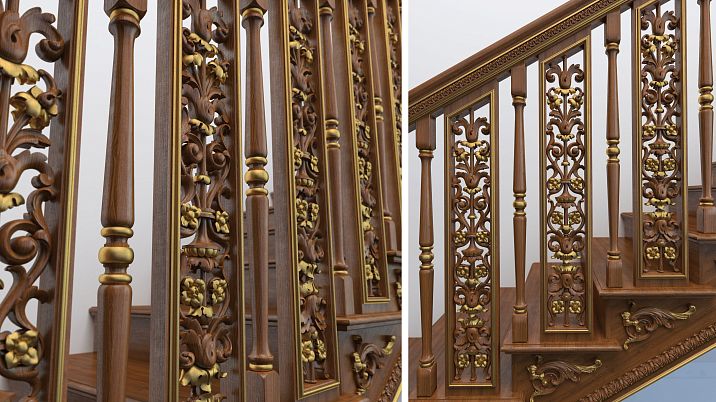
Transforming an ordinary staircase into an architectural work of art — a task that requires not only skill but also a deep understanding of technological nuances. Installing balusters on stairs Installing balusters on stairs is a complex process where every detail is critical for safety, durability, and aesthetic perfection. Properly installed balusters transform a functional element into an elegant interior decoration, creating a harmonious blend of beauty and reliability.
Many homeowners underestimate the complexity of this process, believing that simply screwing vertical posts to the treads is sufficient. However, a professional approach to installing balusters requires consideration of multiple factors: from selecting the correct fasteners to precisely adhering to angles of inclination and distances between elements. Any error during installation can result not only in aesthetic flaws but also serious safety issues.


Engineering Philosophy of Installation: Understanding the Basics




Structural Logic of Stair Railing Systems
Before beginning practical actions, it is necessary to understand the fundamental principles of stair railing operation. Balusters perform a triple function: ensuring user safety, providing a rigid structural base for handrails, and forming the visual rhythm of the entire staircase composition. Each element must be installed with mathematical precision, as even minor deviations can disrupt the overall harmony of the structure.
Modern building codes establish clear requirements for the distance between balusters — no more than 120 millimeters between the centers of adjacent elements. This requirement is not only aesthetic but also safety-related, especially in homes where children reside. Proper installation of balusters on stairs must ensure compliance with all regulatory requirements while preserving architectural expressiveness.
Our factory also produces:


Material Science Aspects
The choice of baluster material determines not only their appearance but also the installation technology. Wooden balusters require special attention to the direction of wood grain, material moisture, and fastening methods. Metal elements impose different requirements on tools and fastening systems. Combined constructions, combining different materials, require consideration of various coefficients of thermal expansion and coating compatibility.
Get Consultation
Pre-Installation Preparation: Guarantee of Successful Result
Design and Calculations
Quality installation of balusters on stairs begins long before the first tool appears. Detailed design includes creating precise drawings indicating all dimensions, angles, and distances. It is necessary to consider the specific characteristics of the staircase structure: type of load-bearing elements (stringers or treads), angle of inclination of the flight, tread width, and rise height.
The number of balusters is calculated based on the length of the stair flight and the chosen installation spacing. A reserve of 10-15% must be added to the calculated number to account for possible material defects or errors during work. Accurate calculations help avoid work stoppages and additional costs for purchasing materials.
Tool Preparation
Professional installation requires appropriate tools. The basic set includes high-precision measuring instruments: laser level, metal tape measure at least 5 meters long, carpenter's square, plumb bob. Cutting tools must ensure clean and accurate cuts: circular saw with fine-toothed blade, electric jigsaw with a set of wood-cutting blades of various configurations.
Technological Methods of Fastening
Modern metal fastening systems offer high reliability and the possibility of concealed mounting. Threaded rods with a diameter of 8–10 millimeters provide exceptional connection strength and allow for disassembly of elements without damaging the main structure. Installing balusters on a staircase using metal fasteners requires precise adherence to drilling and installation technology.
Classic Mortise-and-Tenon Fastening
Mortise-and-tenon joint is a traditional carpentry method providing strong and aesthetically pleasing fastening. Tenons with a diameter of 8-10 mm are made from hardwood and ensure reliable connection of elements. The drilling process requires high precision — even the slightest deviation may cause the baluster to be misaligned or weaken the joint.
Metal Fastening Systems
Modern metal fastening systems offer high reliability and the possibility of concealed installation. Threaded rods with a diameter of 8-10 mm provide exceptional joint strength and allow for disassembly of elements without damaging the main structure. Installing balusters on stairs using metal fasteners requires precise adherence to drilling and installation technology.
Quick-release fastening systems are becoming increasingly popular in modern construction. They allow for easy disassembly of individual elements for repair or replacement without compromising the integrity of the entire structure. Such systems are especially valuable in commercial buildings, where regular maintenance of stair structures is required.
Screw rods with combined thread are a universal solution for various types of bases. Metric thread ensures secure fastening to the base, self-tapping thread — to the baluster. This system allows height adjustment and compensates for minor manufacturing inaccuracies of elements.
Innovative Fastening Solutions
Fast-release fastening systems are becoming increasingly popular in modern construction. They allow easy disassembly of individual elements for repair or replacement without compromising the integrity of the entire structure. Such systems are especially valuable in commercial buildings, where regular maintenance of stair structures is required.
The quality of baluster installation on staircases is evaluated based on several criteria. Vertical alignment is checked using a plumb bob or laser level — deviations must not exceed 2 millimeters per meter of height. The distances between the axes of adjacent balusters must be equal, with a tolerance of no more than 3 millimeters.
Step-by-step installation technology
Marking and Foundation Preparation
Accurate marking is the foundation of quality installation. The process begins with installing the outer support posts, which serve as reference points for all other elements. A control string is stretched between the support posts at the level of future upper ends of balusters. This string helps control the height of installation of all intermediate elements.
Marking locations for baluster installation is done using a special template or a measuring ruler with markings. The distance between baluster axes must be strictly uniform along the entire length of the stair run. Deviations exceeding 2-3 mm will be noticeable to the naked eye and will spoil the overall impression of the structure.
Preparation of balusters for installation
Each baluster must be carefully prepared before installation. The ends of elements are checked for perpendicularity to the axis and adjusted if necessary. For staircases with stringers, the lower ends of balusters are beveled at an angle corresponding to the slope of the stair run. The accuracy of this angle is critically important for correct installation of elements.
The surface of balusters should be sanded to a smooth finish. Initial processing is done with 120-150 grit sandpaper, final processing — 220-320. The quality of sanding directly affects the appearance of the finished structure and the durability of the protective coating.
Installation Process of Balusters
Installing balusters on stairs Installation is carried out step by step, starting with the outermost elements. The first baluster is installed strictly vertically with position control in two planes. A plumb bob or laser level is used to ensure installation accuracy. After securing the first element, the last baluster of the run is installed, and a control string is stretched between them.
Intermediate balusters are installed sequentially with constant verticality and control string alignment checks. Each element must be securely fastened before moving to the next. Rushing at this stage is unacceptable — any error will require redoing already completed work.
Installation Features for Different Types of Stairs
Stairs with Stringers
Stair structures with stringers provide the most convenient conditions for installing balusters. Steps are laid horizontally, simplifying marking and installation of vertical elements. Balusters are attached directly to treads using various types of fasteners depending on the material of the steps and balusters.
When attaching to wooden treads, it is preferable to use dowels or threaded rods with adhesive reinforcement. For stone or concrete treads, anchor bolts or chemical anchors are used. It is important to ensure secure fastening, as balusters bear not only vertical but also horizontal loads from handrails.
Stairs with Stringers
Baluster installation on staircases with stringers requires additional preparation of elements. The lower ends of balusters must be beveled at an angle corresponding to the slope of the stringer. This angle is calculated based on the geometric parameters of the staircase and must be maintained with high precision.
Fastening to the stringer can be done in several ways: directly to the stringer surface, to a special baluster mounting plate, or to the side faces of the load-bearing element. Each method has its advantages and limitations, and the choice depends on specific project conditions and aesthetic requirements.
Helical and L-shaped Stairs
Stairs with complex configurations impose special requirements on baluster installation. Helical stairs require an individual approach to each element — the bevel angles of ends and position of balusters are determined separately for each step. L-shaped steps also require special attention to the geometry of installation.
Special mounting systems are often used for such staircases, allowing balusters to be installed at various angles. Adjustable connectors enable precise adjustment of each element's position according to the geometry of a specific step.
Quality control and acceptance of work
Geometric Parameters
The quality of baluster installation on the staircase is evaluated based on several criteria. The verticality of installation is checked using a plumb bob or laser level — deviations must not exceed 2 millimeters per meter of height. The distances between the axes of adjacent balusters should be equal, with a tolerance of no more than 3 millimeters.
The height of installation of all balusters should be identical, checked by stretching a control string or using a laser level. Height differences exceeding 5 millimeters will be visually noticeable and require adjustment. Special attention is given to checking the angles of end cuts — they must precisely match the staircase's geometry.
Mounting Strength
Mounting reliability is checked by applying controlled loads to each baluster. The element must not wobble or bend under a horizontal force of 50–70 kilograms. Any signs of weakened mounting require immediate correction.
Special attention is given to checking the mounting of support posts, which bear the main loads from the entire railing system. These elements must be absolutely immobile when subjected to calculated loads. Weak mounting of support posts may lead to the destruction of the entire railing structure.
Final finishing and protection
Preparation for Finishing
After completing the installation, all railing elements undergo final finishing. Connection points are carefully sanded to remove glue residue and level the surface. Special attention is given to the ends of balusters — they must be perfectly smooth with no chips or burrs.
The entire surface of balusters is sanded with fine-grit sandpaper to create uniform roughness, ensuring good adhesion of the protective coating. After sanding, the surface is thoroughly cleaned of dust using a vacuum cleaner and a lint-free cloth.
Application of Protective Coatings
The choice of protective coating depends on the operating conditions of the staircase and aesthetic preferences. Lacquers create a durable protective film and highlight the natural wood texture. Oil-based compositions provide deep penetration into the material and create a more natural appearance.
Coating is applied in several thin layers with intermediate sanding using fine-grit sandpaper. Each layer must be fully dry before applying the next. Quality coating not only protects wood from external influences but also significantly simplifies maintenance during the staircase's operation.
Typical errors and ways to prevent them
Planning errors
Insufficient planning is the primary cause of problems during the installation of stair railings. Lack of a detailed project leads to errors in material calculations, incorrect selection of mounting systems, and violation of the technological sequence of work. Saving time during the planning stage results in significant losses during implementation.
Ignoring construction norms and safety regulations may result in creating an unsafe structure. The height of the railing, spacing between balusters, and mounting strength — all these parameters are strictly regulated by normative documents and must be strictly observed.
Technological violations
Violation of mounting technology is a common cause of premature failure of stair railings. Using inappropriate fasteners, insufficient hole drilling depth, neglecting adhesive reinforcement of joints — all this leads to weakening of the structure and the need for expensive repairs.
Incorrect surface preparation before applying protective coating leads to its premature failure. Insufficient cleaning from dust, uneven sanding, applying coating on a wet surface — typical errors that can easily be avoided by following the technology.
Maintenance and Operation
Regular Inspection
Installed railings require regular technical maintenance to keep them in good condition. Visual inspection of the structure should be conducted at least once every six months. Special attention is given to the condition of mounting elements, integrity of the protective coating, absence of cracks and deformations.
The strength of mounting is checked by applying light pressure to each baluster. Any signs of loosening or weakening of connections require immediate correction. Timely detection and correction of minor defects prevent the development of serious damage.
Preventive Maintenance
Regular cleaning of the railing from dust and dirt extends the service life of the protective coating. Special compositions, free of aggressive chemicals, are used for caring for wooden surfaces. Abrasive materials and stiff brushes may damage the coating and should be excluded from maintenance tools.
Periodic tightening of mounting elements compensates for natural wood shrinkage and temperature deformations. However, excessive tightening may damage the material, so this operation must be performed with great care.
Modern trends and innovations
New materials and technologies
Advances in materials science open new possibilities for creating stair railings. Composite materials based on wood fibers and polymer binders combine the beauty of natural wood with improved performance characteristics. Such materials are resistant to rot, require no regular maintenance, and have stable geometric dimensions.
Innovative mounting systems simplify the installation process and increase connection reliability. Self-regulating fasteners automatically compensate for temperature deformations, while quick-release systems allow easy removal of individual elements for maintenance or replacement.
Digital Technologies in Design
Modern 3D modeling programs revolutionize the design process of stair structures. Virtual reality allows clients to see the future staircase before construction begins and make necessary adjustments to the project. Parametric design automates the creation of working drawings and material specifications.
Augmented reality technologies are used during installation, allowing workers to see virtual reference points and control points directly on the object. This significantly improves the accuracy of work and reduces the likelihood of errors.
Economic Aspects
Cost of Different Installation Options
The cost of installing balusters on a staircase varies widely depending on the chosen technology, materials, and complexity of the structure. Simple options using self-tapping screws cost 200–300 rubles per baluster, including labor. Premium technologies using hidden fasteners and special connectors may cost 1000–1500 rubles per element.
DIY installation can save 40–60% of professional installation costs. However, this requires appropriate skills, tools, and significant time investment. Mistakes during DIY installation may result in additional expenses for correcting defects.
Long-term economic efficiency
Investments in quality installation pay off through the longevity and reliability of the structure. Properly installed balusters serve for decades without requiring repair or replacement. Cutting corners on mounting quality or violating installation technology leads to premature railing failure and costly repairs.
Quality railing increases property value and makes it more attractive to potential buyers. A beautiful and reliable staircase becomes a home’s calling card and a source of pride for the owner.
Conclusion
Installing balusters on stairs Represents a complex technological process requiring professional knowledge, quality materials, and precise adherence to technology. Each stage of work — from design to final finishing — is critically important for achieving an ideal result.
Modern technologies and materials open up new possibilities for creating unique stair constructions that combine functionality, safety, and aesthetic perfection. Proper choice of installation technology, quality materials, and professional execution ensure the longevity and reliability of the stair railing.
Investing in quality baluster installation is investing in the safety, comfort, and beauty of your home. Each element, installed in accordance with all technical requirements, will serve for many years, pleasing the eye and ensuring the safety of all stair users.
For many years, STAVROS has remained a leader in producing high-quality stair components and providing professional installation services. Rich experience, modern technologies, and strict adherence to quality standards allow STAVROS to create stair constructions that become a decoration of any interior. Choosing STAVROS means choosing reliability, quality, and professionalism, proven over time and by thousands of satisfied customers.