Article Contents:
- What are moldings in interior design and why are they needed
- Molding as a tool for working with light
- Molding as an architectural tool
- Molding as a compositional anchor
- Where moldings are used in interior design
- Walls: from frames to boiserie
- Ceilings: cornices and transitions
- Furniture: molding as furniture decor
- Doors and window openings
- Decorative frames and accent zones
- Which moldings to choose for interior design: breakdown by materials
- Wooden molding in the interior: when there is no alternative
- MDF molding: the perfect tool for monochrome design
- Polyurethane moldings in the interior: technology and versatility
- Material Comparison
- Moldings in classic and modern design
- Moldings in classic interior
- Moldings in neoclassical design
- Moldings in modern interior
- Moldings for light and dark interiors
- Moldings and other decorative elements in design
- Moldings and stucco
- Moldings and wooden baguettes
- Moldings and layout
- Moldings and stucco decor
- How to use moldings in wall design: practical schemes
- Accent Wall with Moldings
- Moldings in living room design
- Moldings in hallway design
- Wall design with moldings: proportions and rules
- Moldings in furniture design: a separate topic and a separate language
- How Molding Transforms Furniture
- Types of Furniture Applications
- Furniture Molding and Furniture Material
- Where to Buy Moldings for Interior Design
- Wooden Moldings and MDF
- Polyurethane moldings
- What to Check When Choosing a Supplier
- Mistakes in Using Moldings in Design
- Surface Overload
- Scale mismatch
- Using One Profile Everywhere
- Ignoring the System
- FAQ: Moldings in Interior Design
- STAVROS: Moldings for Interior Design — From Profile to Space
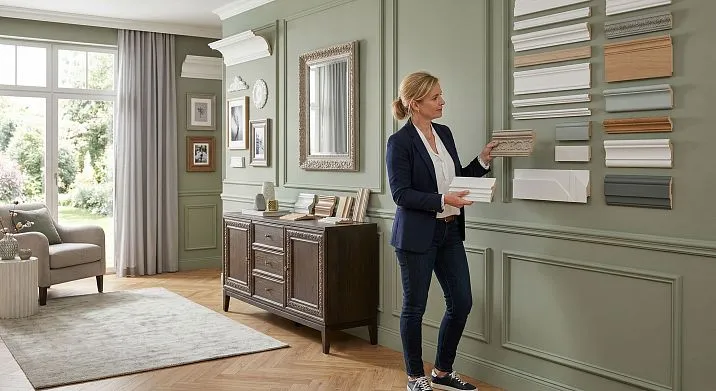
Interior design is a language. And as in any language, there are words that carry meaning and words that merely fill pauses. Molding is not a filler. It is one of those rare words in the interior language that works on several levels at once: it shapes the architecture of a surface, sets the rhythm of a space, creates shadow and depth where there was only a flat plane.
When a professional designer talks aboutmoldings for interiors, they don't mean just a decorative strip on the wall. They are talking about a tool — a profiled trim with a shaped cross-section that can turn a featureless room box into an architecturally finished space. And the same thing is on the mind of a person buyingdecorative moldingfor their apartment for the first time: to change something, to add something, to make the walls come alive.
Molding for design is a tool with a five-hundred-year history. It was used in Versailles and St. Petersburg palaces, in English country houses and New York townhouses. Today it is used in modern apartments, neoclassical mansions, and wood-paneled offices. Why? Because the task hasn't changed: to make a space legible, complete, beautiful.
But Polyurethane decor for interiorsopened a new chapter for molding — light, technological, accessible. Today you have a choice: wood, MDF, polyurethane. And each material has its own area of correct application.
How not to get confused? How to choose exactly what your specific space needs? Let's break it down for real — without generalities and marketing phrasing.


What are moldings in interior design and why are they needed
Let's start with the main question that often goes unanswered honestly: why are decorative moldings needed in an interior at all, if the walls stand perfectly fine without them?
The answer is paradoxical: precisely because they stand. They simply stand—and that's all. A bare, flat surface conveys no visual message beyond 'I am a wall.' It creates no scale, sets no proportions, interacts with no light. It is functional—and nothing more.
Molding changes that. How exactly?




Molding as a tool for working with light
Any profile with relief is a system of shadows. The deeper the relief, the more contrasting the shadows. The smoother the cross-section, the softer the transition. When a room has side lighting—sconces, floor lamps, wall lights—the molding 'comes alive': in the morning and evening it looks different, changes with the sun's position, creates a tactile sensation of the surface.
This is what distinguishes an 'expensive' interior from a 'cheap' one—not the price of materials, but the presence of relief details that interact with light.
Our factory also produces:


Molding as an architectural tool
In interior design, molding plays the same role as cornices and profiles in facade architecture: it sets scale, creates proportions, divides, and frames. A horizontal belt around the perimeter of a room divides the wall into upper and lower zones, creating an architectural rhythm. A frame system turns a flat plane into an ordered surface with internal structure. A cornice molding at the junction of wall and ceiling creates a smooth transition where there was a technical seam.
Get Consultation
Molding as a compositional anchor
Every room has focal points—places where the eye naturally lands first. Moldings allow you to create and control these points. A frame around the TV integrates it into the architectural composition. Framing a niche turns it into a true decorative element. An accent wall with a molding system instantly becomes the main feature.
This is what molding for design truly means—a tool for spatial composition.
Where moldings are used in interior design
The scope of molding applications in design is significantly broader than it might seem at first glance. Let's break it down by zones and scenarios.
Walls: from frames to boiserie
Walls are the primary and most obvious zone. Here, moldings are used in several scenarios.
Frame systems—molding creates geometric rectangular frames on the wall surface. Inside the frames, there can be a different color, a different texture, a mirror, or simply the same finish. Frames create the feeling of a paneled interior without actual panels.
Horizontal belts—a single profile running along the perimeter of the room at a specified height (90–110 cm or 160–180 cm). A classic technique that divides the wall into two zones with different characteristics.
Boiserie—complete wooden wall paneling. The lower zone from the floor to a height of 90–110 cm is covered with wooden panels, which are divided and framedwooden moldings. This is a Venetian and French classic technique that works at any scale—from a small study to a grand hall.
Vertical profiles - molding is used not as a frame, but as a vertical surface divider. Several parallel profiles on one wall create a graphic vertical rhythm.
Ceilings: cornices and transitions
Moldings in ceiling perimeter design are cornice profiles. They serve a dual function: concealing the technical wall-ceiling seam and creating an architectural wall finish.
A cornice molding can be simple: a single profile 40–60 mm wide. Or composite - two or three profiles at different levels, creating an elaborate cornice as in classical architecture. For high ceilings (from 3 m), composite cornice is standard in classical and neoclassical design.
A separate scenario - niches and coffers. Molding around the perimeter of a ceiling niche or coffer insert transforms a structural element into an architectural accent.
Furniture: molding as furniture decor
Molding for furniture design is a separate and very broad topic. Here the profile is used:
-
On cabinet and dresser fronts - creating a framed effect on a flat front. Furniture instantly acquires a classical character
-
On cornice finishes - a profile along the top edge of the cabinet mimics an architectural cornice
-
On ends - molding along the side edge gives furniture a finished silhouette
-
In frame-and-panel constructions—where the facade literally consists of a frame (stile and rail) and a panel (insert), molding frames the transition between them.
furniture moldings—is a miniature version of architectural profiles. Width is 10–45 mm compared to 40–150 mm for wall moldings. But the requirements for precision are maximal here: a furniture facade is viewed from arm's length, and any inaccuracy in the profile geometry will be noticeable.
Furniture molding—is not just a small wall molding. It has a special profile proportion, calibrated to the scale of the furniture piece. The same cross-section design in 15 mm and 80 mm formats looks completely different.
Doors and window openings
Casing is molding in its original purpose: framing the transition between the wall and the opening. In classical and neoclassical interiors, wooden casing is a mandatory element. It is what turns a technical opening into an architectural detail.
For door casings, medium-width profiles (40–80 mm) with historical cross-sections or more modern rectangular shapes are used. The casing must always be made of the same material and within the same finishing system as the door leaf.
Decorative frames and accent zones
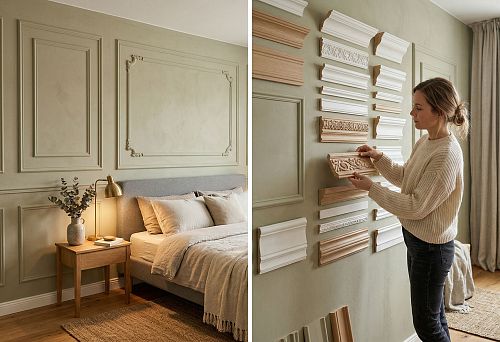
Molding for interior decor in the form of decorative frames is one of the most popular modern techniques. A rectangular frame made from a profile, mounted on a wall without any inserts—just a contour on a flat surface—creates the feel of a paneled interior for a minimal budget.
This technique works in any room: living room, bedroom, hallway, study. Three to five frames in a row on one wall—and the space acquires a completely different character.
Which moldings to choose for interior design: breakdown by materials
Material selection is the first and most fundamental decision. The three main options differ fundamentally in properties, application area, and visual result.
Wooden molding in interior design: when there is no alternative
Wooden moldingSolid oak, beech, or ash — this is a choice where the naturalness of the material is a valuable argument in itself. Wood breathes, it shimmers in the light differently than any synthetic material, its texture is unique — no two veneer sheets are identical.
Wooden molding in an interior carries temperature. Literally — tactile: touching a wooden profile, you feel the material, not the finish. In interiors where wood is the main theme — wooden floors, wooden furniture, wooden doors — solid wood molding creates material coherence, a unified language for the entire space.
Technical specifications:
-
Density of oak: 670–720 kg/m³
-
Density of beech: 680–750 kg/m³
-
Moisture content after kiln drying: 8–12%
-
Profile tolerance: ±0.1 mm/m
Wood finishing — without limitations:
-
Clear varnish — preserves the texture
-
Oil finish — matte warm surface
-
Tinting — color shift with pattern preservation
-
White and colored enamel — monochrome system
-
Patina — aging for Provence and country styles
MDF molding: the perfect tool for monochrome design
High-density MDF (750–850 kg/m³) is recycled wood without grain or pores. Perfectly uniform surface, absolutely precise profile geometry, ready for painting without additional preparation.
In design, paintable MDF molding is the standard for modern neoclassicism. White or monochrome frame system where the profile matches the wall color — zero color contrast, pure relief effect. MDF delivers perfect results in such systems: enamel applies evenly, without drips or grain highlighting.
MDF is cheaper than solid wood with an identical profile, making it optimal for projects with extensive linear footage — multi-room apartments, offices, hotels.
Polyurethane moldings in interiors: technology and versatility
Polyurethane decor for interiors— this is a fundamentally different technology. Polyurethane is poured into molds, meaning it reproduces any profile of any complexity: finest curls, ornamental bas-reliefs, multi-level composite cornices. Doing this manually in wood would cost an order of magnitude more.
Polyurethane density 400–600 kg/m³ — 2–3 times lighter than wood. Installation — adhesive only. Moisture resistance — absolute. Operating temperature range — from −40 to +80°C.
In interior design, polyurethane moldings are appropriate:
-
In Baroque and Empire-style projects (complex ornamentation without manual labor)
-
In ceiling systems (low weight is critically important)
-
In kitchens and bathrooms (moisture resistance)
-
In projects with fast installation (adhesive instead of fasteners)
A fundamental point:molding and decormade of polyurethane is no longer just a molding. It's a complete decorative system: cornices, moldings, rosettes, medallions, cartouches, corner blocks. All of this comes together into a unified molding program for the interior.
Material Comparison
| Criterion | Solid wood | MDF | Polyurethane |
|---|---|---|---|
| Natural texture | ✓ | ✗ | ✗ |
| For painting | Good | Excellent | Excellent |
| Complex ornament | Limited | Good | Excellent |
| Moisture resistance | Medium | Low | High |
| Weight | High | Medium | Low |
| Installation | Adhesive + fasteners | Adhesive + fasteners | Adhesive only |
| Repairability | Good | Good | Limited |
| Compatibility with wooden interiors | Good | Good | Neutral |
Moldings in classic and contemporary design
Molding is one of the few decorative tools that is equally organic in both historical and contemporary interiors. But the method of application differs radically.
Moldings in a classic interior
Classicism is historical profiles in historical proportions. Ovolo, cavetto, scotia, astragal — all these sections have existed for millennia and carry architectural memory. Moldings in a classic interior are used systematically: a horizontal belt around the entire perimeter, a cornice molding near the ceiling, boiserie on the lower part of the walls, architraves on all doors and windows.
For classic furniture design, moldings are a basic structural element. A wardrobe without a cornice, a chest of drawers without molding framing on the fronts — in the context of classicism, this is an unfinished product. Here, classic furniture design — an understanding of how the molding fits into the overall language of the style — helps.
The material for classicism is solid oak in a dark or medium tone or white enamel on MDF. Polyurethane is for complex ornamental cornices where hand carving is not justified by the budget.
Moldings in neoclassical design
Neoclassicism is an adaptation of the classical language to modern spaces. The same profiles, but thinner, lighter, cleaner. White moldings on white or light gray walls — a monochrome relief system that works in apartments of any size with ceilings from 2.7 m.
Key feature: the molding and the wall are the same color. There is no color contrast, only a play of relief and shadows. This is precisely what creates that 'expensive' look associated with classic European interiors.
For neoclassicism, MDF molding under white enamel is ideal. The profile width is 25–60 mm depending on the scale of the room.
Moldings in Modern Interiors
Moldings in modern interiors function differently than in classic styles. Here, the profile is not a historical stylistic marker but a geometric tool. Rectangular, slightly beveled, or with a soft roll cross-section. Minimum width is 10–20 mm. No ornamentation.
Modern molding adds a tactile accent and delineates plane boundaries without stylistic references. In Scandinavian style—a narrow white profile along the perimeter of frames. In Japanese minimalism—an almost invisible molding, barely indicating wall zoning.
Moldings for Light and Dark Interiors
Light interior: molding matching the wall color—zero contrast, pure relief. Or white molding on cream, wheat, light gray walls—light contrast, sufficient for a clear frame pattern.
Dark interior: dark walls (deep blue, green, khaki, anthracite) + white molding—high contrast, very expressive effect. Or molding matching the dark wall color—maximally restrained, almost architectural result.
In design, moldings for dark interiors represent a distinct aesthetic: nocturnal classic, luxurious study, cozy library.
Moldings and Other Decorative Elements in Design
Molding rarely exists in an interior by itself. It functions within a system alongside other decorative elements—and understanding this system distinguishes good design from a random assortment of details.
Moldings and stucco
Molding on the Wall— is volumetric decor: rosettes, medallions, cartouches, bas-reliefs. Molding is linear decor: profile, frame, cornice. They play different roles within the same system.
A classic technique: molding creates a frame, while plasterwork decorates its corner or center. A corner polyurethane block is placed where molding frames meet. A medallion is positioned in the center of a ceiling frame or above the headboard.Plasterwork designhelps understand how to properly combine linear and three-dimensional decor.
Moldings and wooden picture frame molding
Wooden Picture Frameis a specialized molding profile designed for framing paintings, mirrors, and photographs. In construction, it resembles wall molding but features a groove for holding glass and cardboard.
In interior design, picture frame molding and wall molding can work in the same stylistic register: wooden picture frames made from the same solid wood as wall moldings create a unified material system.Wooden trim— both moldings, picture frame molding, and cornices belong to a single product category and should be considered as such when assembling a project.
Moldings and glazing bead
Wooden moldingis a functional profile for holding inserts: glass in door panels, mirrors in furniture fronts, decorative panels in wall systems. Molding is a decorative profile for creating relief.
In complex framing systems, they often work together: the glazing bead holds the insert from the inside, while the molding finishes the transition on the outside. Understanding this functional distinction allows for the correct product selection for each specific task.
Moldings and plaster decor
Buy moldingsIn a broad sense — means acquiring the entire arsenal of polyurethane decor: from simple molding profiles to complex ornamental systems. Molding here is the basic linear element, to which volumetric components are added: overlays, rosettes, corner blocks.
Relief Decoration— point decor installed in specific places: in the center of a frame, at a corner joint, in the center of the ceiling. This is the logic of a constructor: linear molding + point decor = a full-fledged plaster interior program.
How to use moldings in wall design: practical schemes
This section is for those who have already decided on moldings and are thinking about specific implementation.
Accent wall with moldings
An accent wall is one surface in a room highlighted with special decor. Moldings are ideal for this task.
Scheme 1 — "frames in a row": three to five rectangular molding frames horizontally in a row. The simplest solution that works in any style. Frame height — 60–80% of the wall height.
Scheme 2 — "large frame": one large frame occupying almost the entire wall. Inside — a different color or texture. Above the sofa, behind the bed — an accent zone with architectural framing.
Scheme 3 — "hierarchy of frames": a central large frame and symmetrical side frames of smaller size. A classic Baroque technique.
Moldings in living room design
The living room is the broadest canvas for molding solutions. Here, the following work:
-
TV area — a frame system around the screen, turning it into an architectural accent
-
Wall behind the sofa — horizontally elongated frames creating a 'backdrop' for the relaxation zone
-
Cornice molding — along the entire ceiling perimeter, providing architectural completion
-
Symmetrical side wall — a frame system supporting the focal wall
Moldings in hallway design
The hallway is the first impression zone. Moldings in hallway design address specific tasks:
-
A horizontal belt at a height of 90–100 cm separates the lower 'working' zone from the upper decorative one
-
A frame molding on the wall opposite the entrance creates the first architectural impression
-
Framing a mirror with a molding profile turns a functional element into a decorative one
For the hallway, it's better to choose hardwoods (oak) or MDF with a high-quality finish — the lower zone is subject to mechanical contact.
Wall design with moldings: proportions and rules
Several practical principles that have stood the test of time:
Rule of frame proportions. Frame width to height ratio: from 1:1.2 to 1:2. A frame that's too square looks bulky; one that's too elongated appears unstable.
Rule of spacing. The distance from the edge of the frame to the corner of the wall or to another frame should be at least the width of the molding × 3–4. Frames that 'cling' to corners lose their sense of airiness.
Rule of uniform profile. One type of molding per system. Mixing different profiles creates chaos.
Rule of scale. The width of the molding in a frame system should not exceed 1/10 of the frame width. For a frame 50 cm wide — molding no wider than 50 mm.
Moldings in furniture design: a separate topic and a separate language
Furniture molding is not a scaled-down copy of wall molding. It is an independent tool with its own logic.
How molding transforms furniture
Let's take a specific example: a flat LDF or MDF facade measuring 60×90 cm. Without molding — just a rectangle of material. With a molding frame around the perimeter — a frame-and-panel structure, visually indistinguishable from solid classic furniture.
This is exactly howfurniture moldingswork: they take a simple plane and turn it into a complex, visually architectural detail. This is the principle of 'making more from less,' which works flawlessly in furniture design.
Types of Furniture Application
Cornice molding on furniture — a horizontal profile along the top edge of a cabinet or dresser. Imitates an architectural cornice, provides a finishing touch to the product. Without it, furniture looks 'cut off.'
Frame molding on facades — around the perimeter of facade panels. Width 15–35 mm. Creates a frame-and-panel structure.
Molding on edges — along the side faces of the body. Gives the product an architectural silhouette, conceals the edge.
Molding in a cornice-plinth system — a set of a cornice profile at the top and a plinth molding at the bottom. Classic 'clothing' for built-in or freestanding furniture.
Furniture Molding and Furniture Material
Furniture moldingshould be made from the same material as the furniture — or from a visually compatible one. Oak wooden furniture — oak molding. MDF furniture for painting — MDF molding. Polyurethane decor on furniture — only in specific baroque projects.
Where to buy moldings for interior design
Now — to practice. You've decided on the material and profile. It remains to find the right source.
Wooden moldings and MDF
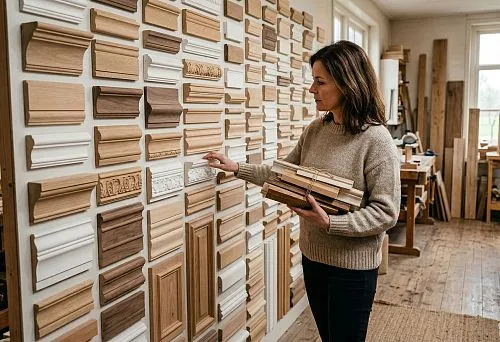
molding catalogSTAVROS is a specialized section of wooden and MDF profiles, filtered by product type. Here are collected moldings of different widths, several types of sections, made of oak, beech and high-density MDF.
Product technical specifications:
-
Solid wood moisture content: 8–12% (kiln-dried)
-
Profile tolerance: ±0.1 mm/m
-
Surface: sanded, ready for coating
To order wooden moldings for interior design, furniture and decor —Buy wooden moldingswith a sample in hand: be sure to see the actual profile before purchasing a batch.
Polyurethane moldings
Buy polyurethane moldings— a wide selection of profiles from simple frame to complex baroque cornices. All products are primed, ready for painting.
To polyurethane moldings, it is organically complemented byRelief Decoration: overlays, corner blocks, medallions — a complete set for a stucco program of any complexity.
What to check when choosing a supplier
-
Own production — only the manufacturer controls the moisture content of the solid wood and the accuracy of the profile
-
Samples in stock — without a sample, choosing a profile is comparable to buying paint without a sample
-
Batch consistency — all items in a batch must have an identical profile; different batches may vary slightly
-
Ability to manufacture according to drawings — for non-standard projects
Errors in using moldings in design
Overloading the surface
Moldings on all four walls, the ceiling, and furniture simultaneously—that's not design, it's chaos. Rule: introduce a molding system selectively, on one or two surfaces. The rest should be a neutral background.
Mismatch in scale
A wide, elaborate 120 mm cornice in an apartment with 2.5 m ceilings works against the space. Guideline: the total height of the cornice molding (including all profiles of a composite cornice) should not exceed 4–5% of the wall height.
Using the same profile everywhere
A detail that looks good on a wall isn't always good on furniture. Furniture molding has its own width, scale, and proportion. Wall molding on a furniture facade looks disproportionate.
Ignoring the system
Molding is not a separate detail but an element of a system. If a project includes architraves, cornices, wall frames, and furniture decor, they should be made from the same material, the same profile (or from a coordinated set of profiles). Disparate moldings from different sources create a sense of randomness.
FAQ: moldings in interior design
Which moldings are best for interior design?
It depends on the style and task. For classic and neoclassical styles—wooden or MDF for painting with historical cross-sections. For modern interiors—simple rectangular or with a soft profile, narrow. For baroque ornamentation—polyurethane. A universal choice for most projects is MDF for white enamel.
What to choose: wood or polyurethane for moldings?
Wood — if natural texture is important, if the interior has wooden furniture and floors, if repairability is needed. Polyurethane — if a complex pattern, quick installation, moisture resistance, or lightweight ceiling systems are needed.
Where to use moldings in the interior?
On walls (frames, belts, wainscoting), on the ceiling perimeter (cornices), on furniture (facades, cornice finishes), on door and window trims. The most expressive effect is on an accent wall.
How does molding differ from stucco?
Molding is a linear profile that creates horizontal and framing rhythm. Stucco is a three-dimensional decor (rosettes, medallions, overlays) that works as a point accent. In a good classical interior, they work together: molding builds the frame, stucco decorates its centers and corners.
How is molding different from picture frame molding?
Picture frame molding is a molding profile specifically for framing paintings and mirrors. It has a groove for glass, cardboard, or canvas. Wall molding does not have such a groove — it creates architectural relief on the surface. Both products belong towooden trim, but solve different tasks.
Where to buy decorative moldings?
Buy decorative molding in the STAVROS catalog — wooden and MDF profiles with precise geometry and readiness for coating. Polyurethane moldings are in the corresponding section.
Can moldings be used in modern design?
Yes, and it's one of the main trends of recent years. Modern neoclassicism with white molding frames on light walls is one of the most popular design techniques. Molding in a modern interior is not a historical sign, but a geometric tool.
How to choose the width of molding for an interior?
Guideline: the width of the profile for a frame system is 1/8–1/10 of the frame width. For a standard 50–60 cm frame — molding 20–35 mm. For cornice molding — 1/20–1/25 of the wall height. With 2.7 m ceilings — cornice molding up to 55–65 mm.
STAVROS: moldings for interior design — from profile to space
Professional design begins with professional materials. Not with a concept and not with a moodboard — but with what will actually go on the wall, become part of the furniture, and frame the cornice. With a product that has precise geometry, correct moisture content, and surface quality that requires no additional work.
STAVROS is a Russian manufacturer of wooden architectural elements and polyurethane stucco decor. Full cycle from raw material to finished product: chamber drying, profile processing with a tolerance of ±0.1 mm, sanding for coating. Own line of polyurethane moldings and decor — for complex ornamental programs.
For designers, architects, and private clients in the STAVROS catalog:
-
Wooden moldings— full range of wooden and MDF profiles by product type
-
Wooden trim— baguettes, cornices, glazing beads, adjacent profiles in one system
-
Relief Decoration— polyurethane overlays, sockets, corner elements for comprehensive molding programs
-
Buy moldings— full section of polyurethane decor
Molding for design is not a random detail. It is a deliberate choice made once and works for years. Choose precisely.