Article Contents:
- What is Wood Molding
- Types of Wood Molding Profiles
- What Types of Wood Are Used for Moldings
- Where Wood Moldings Are Used
- Walls
- Furniture
- Doors and Window Frames
- Ceiling Transitions
- Decor in Classical and Neoclassical Interiors
- Why Choose Wood Moldings Specifically
- Natural texture as a competitive advantage
- Possibility of Any Finish Treatment
- Durability and Repairability
- Compatibility with arrays
- Relevance in premium and classic segments
- How to choose wooden molding
- By width
- By pattern and profile shape
- By thickness (relief depth)
- By style and application area
- By compatibility with other wooden elements
- How wooden molding differs from other wooden profiles
- Molding vs wooden baguette
- Molding vs wooden layout
- Molding vs cove and baseboard
- Molding vs overlays
- Where to buy wooden moldings
- Wooden molding in interior design: practical scenarios
- Scenario 1. Classic living room with boiserie
- Scenario 2. Modern neoclassical bedroom
- Scenario 3. Kitchen with moldings on facades
- Scenario 4. Art Deco style study
- Mistakes when choosing wooden molding
- Mistake 1. Too heavy profile
- Error 2. Poor compatibility with finishes
- Error 3. Confusion between molding, cornice, and baseboard
- Error 4. Choosing based only on appearance without considering wood species
- Error 5. Overloading with wood texture
- FAQ: Most Frequently Asked Questions
- STAVROS: wooden moldings from the manufacturer

Imagine two identical houses. Same area, same windows, same ceilings. In the first one — clean walls, neat furniture, everything functional and correct. In the second — the same walls, but with thin wooden profiles running along them, framing panels, creating horizontal accents, giving each surface meaning and architectural rhythm. Two interiors — and a chasm between them. The reason for this chasm —Wooden moldings.
This is not decoration for decoration's sake. It is a language. A language of space in which every line says something: about style, about the owner's character, about the fact that here they thought not only about square footage but also about beauty. And this language has existed for exactly as long as there have been houses worthy of being called homes.
Why wood specifically? Why not plaster, not polyurethane, not PVC? The answer sounds simple, but behind it lies centuries of history: because wood is alive. It breathes, shimmers in the light, holds shadows in a special way — softly, without harsh contrasts. Becausewooden moldingit looks the same after twenty years as on the day of installation — if chosen correctly and installed properly. And because synthetic materials, no matter how hard they try, remain imitations. And an imitation is always slightly less than the original.
This article is a detailed discussion about wooden moldings: what they are, where they are used, how to choose, how they differ from related products, and where to findmolding catalogwith a real assortment for any project.



What is wood molding
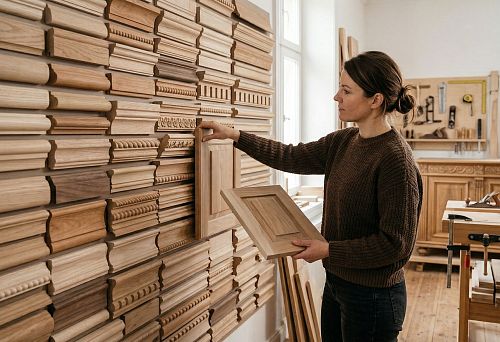
Molding is a word borrowed from English 'moulding', which literally means 'forming' or 'profiling'. Behind this term lies a specific object: a longitudinal strip with a shaped cross-section, made of solid wood or MDF, intended for decorative surface finishing.
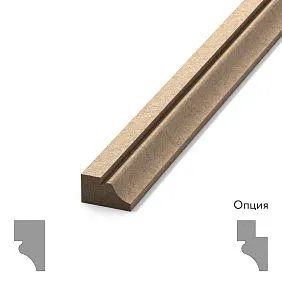
The key word here is profile. It is the cross-section that distinguishes molding from an ordinary slat. The section can be convex, concave, stepped, shaped, composite — and it is its shape that determines how the molding interacts with light, what shadows it casts, and what style it corresponds to.
Wooden moldings are linear products: they are produced and sold by the linear meter. Depending on the task, they are cut, joined, spliced at corners at 45 or 90 degrees, combined with other profiles in a single system.




What types of profiles do wooden moldings have
The classic typology of profiles includes several dozen historically established forms:
-
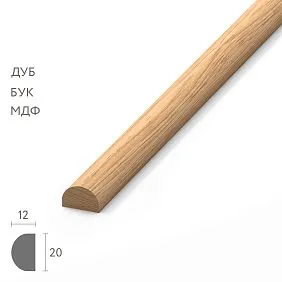
Bead (torus, astragal) — a convex semicircular section, soft and classic
-
Ogee — an S-shaped profile: the lower part is convex, the upper part is concave
-
Reverse ogee (cyma reversa) — a mirror opposite of the ogee
-
Ogee (cyma recta) — concave beginning, convex ending
-
Scotia — a concave groove creating deep shadow
-
Quarter round — a convex section in the shape of a quarter circle
-
Quarter hollow — a concave quarter circle
-
Flat (fascia) — rectangular section without relief
-
Carved composite — a combination of several profiles with ornamental inserts
Each of these profiles carries historical memory. Ogee is Greek classicism. Cyma reversa is Baroque and Rococo. Scotia is Renaissance and classicism. Flat rectangular is modern classic and minimalism.
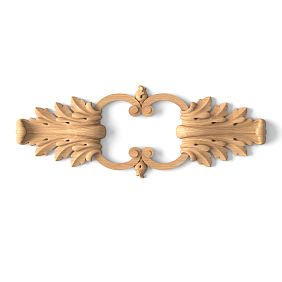
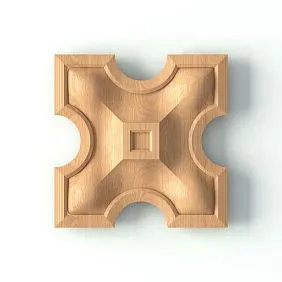
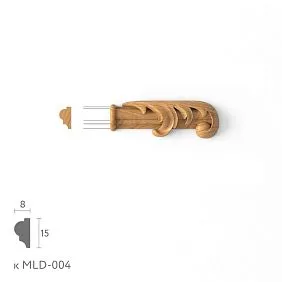
Our factory also produces:



What types of wood are used to make wooden molding
The choice of wood species is not only about aesthetics but also the physical properties of the product.
Oak — a wood species with a density of 670–720 kg/m³, high hardness, and a characteristic grain with medullary rays. Oak molding means durability, resistance to mechanical impact, and expressive texture. Optimal for living rooms, kitchens, hallways.
Beech – density 680–750 kg/m³, fine uniform grain, perfectly smooth surface after processing. Beech easily accepts any coating – varnish, oil, enamel, tint. The best choice for molding for painting.
MDF (high-density) – density 750–850 kg/m³, no pores, no grain pattern. Ideal profile geometry, absolutely smooth surface for painting. Optimal for modern interiors in white tones and monochrome projects.
Get Consultation
Where is wooden molding used
The scope of application of wooden moldings covers almost the entire interior space – from floor skirting to ceiling cornice. Let's break it down by application zones.
Walls
Wall – the main 'canvas' for wooden molding. Here, molding works in several roles simultaneously.
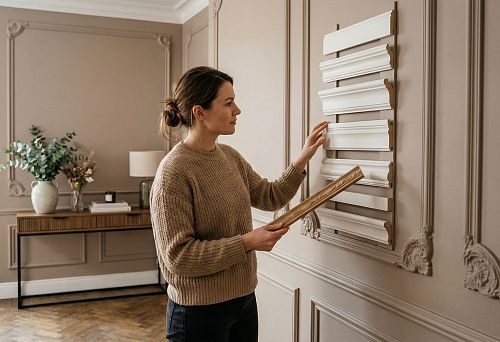
Panel systems (boiserie) – continuous wall decoration with wooden panels, divided and framed by moldings. Lower zone (dado) – from floor to height 90–110 cm. Middle zone – up to height 180–220 cm. Upper belt – up to ceiling. Wooden wall molding creates horizontal dividers between zones and vertical frames within each.
Decorative frames – molding is mounted on a flat wall, forming geometric frames without any inserts. Inside the frame, the wall can be painted a different tone, wallpapered, or simply left in the base color. Effect – instant architectural articulation of an empty plane.
Horizontal belts – a single molding running horizontally along the entire perimeter of the room at a given height. Divides the wall into upper and lower zones, creates a visual horizon.
Framing openings – doors, windows, arches, niches.Wooden molding for interiorHere it serves as a casing, turning the technical transition between the wall and the opening into an architectural accent.
Furniture
Furniture moldings are a separate and very important application segment. Wooden moldings for furniture are used for:
-
frame decoration of facades — creating a panel effect on the flat facade of a cabinet, chest of drawers, or kitchen set
-
cornice finishing — a horizontal profile along the top edge of case furniture imitates an architectural cornice
-
decorating edges — molding along the side edges gives furniture a finished silhouette
-
masking joints — in places where parts connect, molding conceals the technological seam
furniture moldingsThey differ from architectural ones primarily in scale: width 10–45 mm compared to 40–200 mm for wall and ceiling profiles. But the requirements for geometric precision in furniture moldings are the highest: the facade is viewed from arm's length, and any inaccuracy will be noticeable.
Doors and window frames
Door and window casings are historically the first area of application for wooden moldings. Before the advent of smooth plastic slopes, decorative wooden profiles were the only way to beautifully and durably frame an opening. Today, in classic and neoclassical interiors, wooden casings are once again in first place.
Ceiling transitions
The junction between wall and ceiling is a zone that is either addressed or ignored. Wooden cornice molding addresses it beautifully: it creates a smooth architectural transition, adds visual height to the room, and defines the upper boundary of wall panels.
Decor in classic and neoclassical interiors
A classic interior without wooden molding for finishing is an architectural nonsense. Moldings here are not an option, but a mandatory element of the style's language. Neoclassicism works with the same vocabulary of profiles, but in a more modern, lighter interpretation: thinner, cleaner, without Baroque overload.
Why choose wooden moldings specifically
Here it's worth speaking honestly and without marketing clichés. Why still wood — in a world full of accessible synthetic alternatives?
Natural texture as a competitive advantage
Wood is the only material where the grain pattern is unique to each piece. Two moldings from the same batch of oak will be similar, but not identical. This is not a defect — it's a value. That very 'liveliness' which any artificial material imitates but never quite achieves.
Light interaction is another argument. The surface of natural wood diffuses light softly, creating matte transitions and delicate shadows. A polyurethane profile of the same pattern will glow more evenly, sometimes giving an unwanted gloss.
Possibility of any finishing treatment
Decorative wooden moldingaccepts any finish without restrictions:
-
Clear varnish — reveals the natural wood grain
-
Oil finish — provides a matte, 'warm' surface with emphasized texture
-
Toning — shifts the wood color in the desired direction without losing the grain
-
White and colored enamel — monochrome finish for modern classic style
-
Patina — aging for retro, country, or Provence styles
-
Gilding — for Baroque and Empire projects
Synthetic molding, especially PVC, accepts finishes poorly and requires a special primer. Polyurethane does not tolerate repainting well.
Durability and repairability
Properly dried and finished oak or beech serves for decades without losing shape. A scratch or chip on wooden molding is fixed with spot restoration — sanding, touch-up, local application of finish. A polyurethane profile with similar damage typically requires complete replacement of the fragment.
Compatibility with solid wood
If solid wood of a specific species — oak, beech, ash, walnut — is used in the interior or furniture project, molding from the same solid wood creates material unity in the system. Identical wood movement with changes in temperature and humidity, identical response to finishing, a unified visual language.
Solid wood molding— it's not just decor. It's part of a unified wooden interior ecosystem.
Relevance in premium and classic segments
In business-class and premium segment projects, wooden molding is standard. Not because it's customary, but because natural material is a visually perceived marker of quality. Wood in details says: they didn't skimp on the small things here.
How to choose wooden molding
The right choice of wooden molding is the intersection of several parameters. Let's consider each.
By width
Molding width is the main proportional parameter. General rule: the profile width should be proportionate to the plane it frames or divides.
Guidelines:
-
For furniture fronts 300–600 mm wide — molding 15–40 mm
-
For wall frame systems in rooms with ceiling heights of 2.7–3 m — 40–70 mm
-
For horizontal wall belts — 30–60 mm
-
For cornice finishes at the ceiling — 60–120 mm or more
The wider the molding, the more it reads as an independent architectural element. A narrow profile works as an accent, a wide one — as a full-fledged architectural detail.
By pattern and profile shape
Cross-sectional shape is a stylistic choice. We borrow a simple rule from interior theory: the profile's cross-section should belong to the same historical vocabulary as the interior style.
-
Classicism, Empire — ogee, scotia, Lesbian cymatium
-
Baroque, Rococo — talon, carved composite profiles
-
Neoclassicism, modern classicism — softened versions of classical profiles, astragal
-
Art Deco — rectangular stepped cross-sections with geometric logic
-
Minimalism, Scandinavian style — flat rectangular or slightly beveled profile
Carved wooden molding — for projects with a rich decorative program. Smooth wooden molding — for restrained, modern solutions.
By thickness (relief depth)
The thickness of the molding determines the expressiveness of the shadows. Deep relief (15–30 mm) creates contrasting shadows, visible in any lighting. Shallow relief (6–12 mm) works subtly, almost imperceptible in diffused light — but sometimes that's exactly what's needed.
Proportion: molding width to thickness — from 3:1 to 5:1. Violating the proportion in either direction looks unnatural.
By style and place of application
Kitchen — oak or beech molding with a moisture-resistant coating is preferable. Bedroom and living room — a wide choice of wood species and profiles, guided by the furniture style. Hallway — hardwoods resistant to mechanical contact. Study — strict profiles, dark tint.
By compatibility with other wooden elements
If the project uses wooden furniture legs, wooden furniture handlesorWooden Inlays — the molding must be from the same wood species and the same tinting system. This creates material coherence — when all the wood in the space "sounds" the same.
How wooden molding differs from other wooden profiles
Molding is not the only linear wooden decor. Alongside it, there are several related products that are often confused. Let's clarify clearly.
Molding vs wooden picture frame
Wooden Picture Frame— a profiled strip for framing paintings, mirrors, photographs. Historically, this is one of the oldest types of wooden decoration. A picture frame differs from molding primarily in scale and proportions: it is designed for framing a flat object, where the depth of the 'groove' for placing glass and cardboard is important.
Molding — for architectural surfaces and furniture. It does not hold glass; it creates relief and rhythm. Both products belong towooden trim, both are made from solid wood, but their purposes and construction are different.
Molding vs wooden glazing bead
Wooden molding— is a simplified profile, traditionally used to hold inserts in frame constructions: glass in door panels, mirrors in furniture fronts, decorative panels in wall systems. Glazing bead is predominantly functional.
Molding — is decorative. Yes, it can also perform a fastening function, but its main task is to create a visual effect: shadow, relief, frame, border.Decorative wooden glazing beadcan be used together with molding in one system — the glazing bead holds the insert, the molding frames it from the outside.
Molding vs cove and baseboard
Cove molding (wooden) is a corner profile for finishing the internal angle between planes: wall and floor, wall and ceiling, two walls. Its task is to conceal the corner. Molding works on a plane.
Wooden baseboard— a specialized profile for the wall/floor transition. It has a specific design with a groove for hiding cables and a gap for floor covering movement. Molding does not have such technical functions — it is purely decorative.
Comparison table:
| Product | Main function | Place of application | Scale |
|---|---|---|---|
| Molding | Decoration, relief, frame | Walls, furniture, facades | 10–150 mm |
| Molding | Framing of paintings and mirrors | Paintings, mirrors, photos | 15–80 mm |
| Layout | Insert retention | Doors, furniture | 8–25 mm |
| Cove molding | Corner finishing | Corner transitions | 10–40 mm |
| Baseboard | Wall/floor transition | Floor zones | 40–120 mm |
Molding vs overlays
Decorative Inserts— these are three-dimensional decorative elements: rosettes, cartouches, corner accents, medallions. They function as point decor, creating a visual accent in a specific location.
Molding is a linear element. It works along a length, creating an extended rhythm. Overlay and molding are different tools of the same language. A classic technique: molding forms a frame, an overlay decorates its corner or center.
Where to buy wooden moldings
This question naturally arises after understanding the required profile, material, and scale. Here, not only the assortment is important but also the quality of manufacturing.
Buy wooden moldingBuying from a manufacturer is a fundamentally different experience compared to buying from an intermediary. The manufacturer controls wood moisture, profile accuracy, and sanding quality. An intermediary typically does not measure or guarantee these parameters.
What is critical when buying wooden molding:
-
Moisture — the acceptable range for interior products is 8–12%. At moisture above 14%, the molding will dry out and warp after installation.
-
Profile accuracy — tolerance of ±0.1 mm per linear meter. Exceeding tolerance leads to visible discrepancies in corners and joints.
-
Sanding — the surface should be ready for coating without additional processing.
-
Batch consistency — all items in a batch should have an identical profile. Different batches may vary slightly, so it's important to order with a surplus.
buy wooden moldingsWorking with samples is the best way to ensure the real product matches the stated characteristics. A sample allows you to assess texture, profile accuracy, surface quality, and check compatibility with other project materials.
inin the molding catalogmust be presented:
-
profiles of different widths — from 10 to 100 mm and more
-
several types of cross-sections — from simple rectangular to complex composite
-
different wood species — at least oak and beech, ideally also MDF
-
sanded blanks for painting and products for tinting/varnishing
For those undertaking a large-scale project — restoration, mansion construction, hotel facility outfitting — the possibility of custom profile manufacturing is important. When the standard range doesn't meet the task, a manufacturer with their own milling equipment will produce a profile according to drawings or samples.
Wood molding in interior design: practical scenarios
Theory is good. But let's see how wood molding works in real interior tasks.
Scenario 1. Classic living room with boiserie
Room height 3.2 m. Task — decorate walls in French classic style.
Solution:
-
Horizontal belt at 90 cm height — 50 mm molding, 'gusyok' profile
-
Lower zone up to 90 cm — smooth paintable panel, framed with 40 mm molding
-
Middle zone — vertical frames with 60–80 cm spacing, 35 mm molding
-
Upper cornice — composite molding 80–100 mm
-
All in uniform white enamel — monochrome sculptural effect
Molding consumption: for wall area of 60 m² — approximately 180–220 linear meters total for all zones.
Scenario 2. Modern neoclassical bedroom
Room 4×5 m, ceiling height 2.8 m. Accent — wall behind the bed headboard.
Solution:
-
Three vertical frames made of 30 mm molding, 'astragal' profile in a restrained version
-
Wall painted in light gray tone
-
Moldings in wall color — relief without color contrast
-
Two side walls — only a horizontal belt at 80 cm height
Effect: the wall behind the bed reads as a custom architectural element, designed specifically for this space.
Scenario 3. Kitchen with moldings on the facades
Standard kitchen in a U-shaped configuration. MDF facades, white enamel.
Solution:
-
Beech molding 20 mm around the perimeter of each facade, creating a frame effect
-
Moldings painted in white enamel along with the facades — a monolithic effect
-
The upper row of cabinets is finished with a 30 mm horizontal profile as a cornice
Effect: a serial kitchen acquires the appearance of custom joinery.
Scenario 4. Study in Art Deco style
Rectangular stepped profiles. Contrast of dark and light: dark oak moldings on walls painted ivory. Geometric vertical rhythms. Molding as the main graphic element.
Mistakes when choosing wooden molding
Observing mistakes in others' projects is more useful than making them in your own. Here are the most common ones.
Mistake 1. Too heavy a profile
A powerful composite profile 100–150 mm is beautiful in a spacious hall with 4 m ceilings. In a standard apartment with 2.6–2.7 m ceilings, it creates a pressing, overloaded effect. The wall 'looms,' the ceiling seems lower. The scale of the profile must match the scale of the space.
Mistake 2. Poor compatibility with the finish
Molding always exists in context. Its texture, tone, and profile must be in dialogue with the material of the wall or facade. Dark oak on a light wall is a strong contrast that needs to be supported by other dark accents. Light molding on a dark wall is an undesirable scattering of attention.
Mistake 3. Confusion between molding, cornice, and baseboard
Installing a cornice as wall molding is a typical mistake of amateur renovators. A cornice is not intended for mounting on walls: it has the wrong profile, lacks a flat back side for reliable gluing. Each product should be used for its intended purpose.
Mistake 4. Choosing based only on appearance without considering the wood species
"I liked the drawing" is not a sufficient reason for choosing a wood species. If the kitchen furniture is made of oak and the molding is ordered from pine, in a year, with changes in humidity, they will start to behave differently: the pine molding will warp, the oak will remain stable. The result is gaps and deformation.
Mistake 5. Overloading with wood grain texture
Wall moldings + wooden ceiling + wooden furniture + wooden handles + wooden floor — all this without pause and contrast gives the feeling of a wooden hut, not a refined classic interior. Wood needs to breathe. Pauses are needed: painted surfaces, a neutral background.
FAQ: most frequently asked questions
What is better: wood or polyurethane molding?
If the budget allows — wood is always preferable. Natural texture, durability, repairability, possibility of any finish treatment. Polyurethane is a more affordable alternative, but is inferior in durability and looks less "expensive" upon close inspection.
Where to buy wooden molding?
inin the STAVROS wooden molding catalog— over 40 profiles in oak, beech and MDF with guaranteed geometry and humidity. Sample ordering and custom profile manufacturing are possible.
How is molding different from picture frame molding?
Molding — for walls, furniture, facades. Creates relief and frames on surfaces.Wooden Picture Frame— for framing paintings, mirrors, photos. Has a specific design with a groove for glass. Different tasks, different construction.
How does molding differ from layout?
Wooden molding— a rectangular strip for holding inserts in frame structures. Functional. Molding is decorative, has a profile cross-section, creates a visual effect.
Can wooden molding be used for furniture?
Yes, and this is one of its main applications. Furniture molding is a scaled version of architectural profile. Width 10–45 mm, high geometric precision. Ideal for kitchen fronts, cabinets, dressers.
Is wooden molding suitable for walls?
Yes. Wooden molding for walls is the basis of panel systems (boiserie), decorative frames, horizontal belts. Used in residential interiors of any style—from classic to modern neoclassical.
Which wooden molding to choose for a classic interior?
For classic style—'gooseneck' or 'heel' profile made of solid oak. Width 40–70 mm for wall systems, 25–45 mm for furniture. Stained dark wood or white enamel.
What is wood molding?
Sometimes the phrase 'molding for wood' is used to describe a profile intended for installation on wooden surfaces. Essentially, it's the same wooden molding used for finishing solid wood or MDF surfaces. It's more accurate to say 'moldings made of wood' or 'wooden molding'.
Can custom profile molding be ordered?
Yes. Manufacturers with their own milling equipment produce profiles based on provided drawings or samples. This is relevant for custom projects, restoration, and large-scale projects.
STAVROS: Wooden moldings from the manufacturer
Choosing wooden molding is a decision that will live in your interior for many years. A profile that looks the same after twenty years as it did on the day of installation is not a coincidence—it's a production standard.
STAVROS is a Russian manufacturer of wooden architectural elements and furniture decor with a full technological cycle. Chamber drying to 8–12% moisture content. Profile processing with a tolerance of ±0.1 mm. Sanded blanks ready for painting, tinting, and varnishing without additional preparation.
In the STAVROS production line:
-
Wooden moldings— over 40 standard profiles made of oak, beech, and high-density MDF
-
Moldings and rails— an expanded section of profiles for walls and furniture
-
Wooden trim— baguettes, layouts, profiles for comprehensive design
-
Wooden Skirting Boards— to complete the flooring area in a unified material key
-
Wooden molding— functional profile for frame structures
-
Decorative Appliques— volumetric decor for facades and wall panels
-
wooden furniture handles— for creating a unified wooden decorative system
STAVROS works with private clients, designers, architects, and furniture manufacturers. Profile samples — upon request. Custom profile manufacturing — for projects where the standard range is insufficient.
When every line in the interior is precise — you can feel it. Start with the right profile.