Article Contents:
- What is wall panel molding and why is it needed
- Which wall panels can be decorated with molding
- Smooth wall panels
- MDF Panels
- Decorative panels with texture
- Paint-ready panels
- Classic framed walls and boiserie
- Panels in living room, bedroom, hallway
- How to choose molding for wall panels
- By profile thickness
- By width
- By style
- By wall height
- By room type
- By finishing material
- Materials: which moldings are suitable for wall panels
- Solid wood moldings
- MDF molding
- Polyurethane molding
- Molding or slatted panels: which solution to choose for the wall
- When to choose molding
- When to choose slatted panels
- Comparison by Key Parameters
- How to combine molding and slatted panels in one project
- Molding as framing, slatted panels as accent
- TV Area
- Entry Hall
- Bedroom: Headboard
- Space zoning
- Where to buy molding for wall panels
- Mistakes when choosing molding for wall panels
- Too small profile
- Too large profile
- Poor frame proportion
- Conflict with panel texture
- Attempt to replace molding with slat panels
- Mixing two solutions without composition
- FAQ: popular questions about molding for wall panels
- STAVROS: where quality finishing begins
A wall is not just an enclosing structure. It is a plane that sets the tone for the entire interior, creates accents, and establishes the atmosphere. And it is preciselyMolding for wall panelstransforms an ordinary plastered surface into a work of architectural art — with clear frames, precise proportions, and a visual rhythm that is immediately apparent from the threshold.
If you are currently considering wall finishing — in the living room, bedroom, hallway, or study — and want a result that won't become tiresome after a year, read carefully. This article will cover everything: which profile to choose, how it pairs with different types of panels, the most common mistakes, and where to find a catalog of moldings with ready-made solutions for any style.
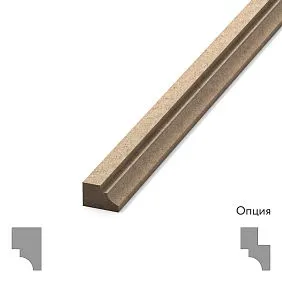

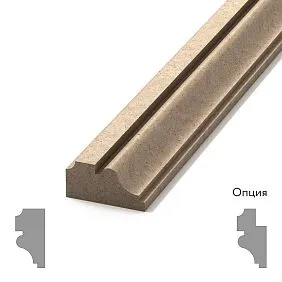
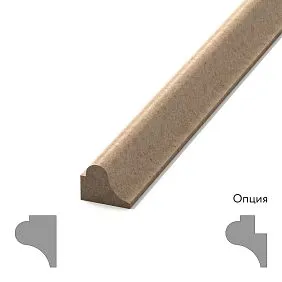
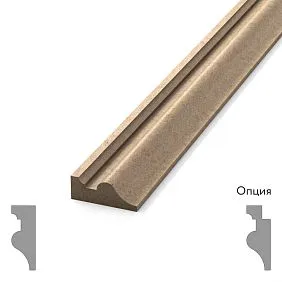
What is molding for wall panels and why is it needed
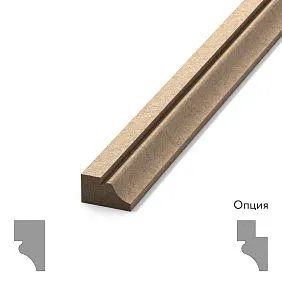
Strictly speaking, molding is a shaped decorative strip that frames, borders, or divides wall elements. But this definition is too dry for what molding actually does.
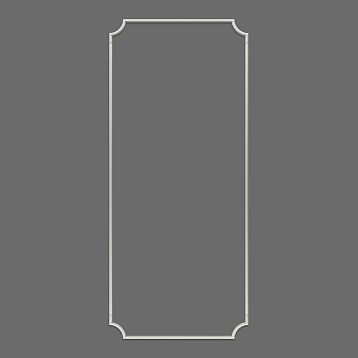
Look at a wall without molding: even high-quality paint or expensive wallpaper simply provides a flat plane. Add a frame system ofdecorative moldings— and the wall instantly gains depth, structure, rhythm. Panels, frames, and height divisions appear. The eye begins to travel across the surface, not just slide past.
Here is what molding for wall panels specifically accomplishes:
-
Framing — creates finished panel blocks with clear visual boundaries
-
Plane division — divides the wall into zones: lower panel, middle zone, upper band
-
Wall rhythm — establishes a repeating module that unifies the space
-
Accent on panels — highlights decorative inserts, niches, textural fragments
-
Visual upscaling — even inexpensive painting under moldings looks like expensive finishing
-
Architectural connection — links the wall with the ceiling cornice and floor baseboard into a unified system
That is why wall moldings are not decoration for decoration's sake. They are an architectural tool that works for the space. Professional designers have long known: an interior without molding is an unfinished interior.
The concept of boiserie — the classic French system of wooden panels with frame moldings, which is currently experiencing a true revival — deserves special mention. Boiserie is not just a style; it is a philosophy of treating the wall as a full-fledged architectural object. And at the center of this system are always interior moldings — precisely selected by profile, proportion, and material.




Which wall panels can be decorated with molding
This is a question almost everyone asks. We answer honestly: molding is compatible with the vast majority of wall panel types. But compatibility varies — it's important to understand the nuances of each combination.
Our factory also produces:
Smooth wall panels
The most obvious and rewarding option. A smooth surface is the perfect canvas for molding. On it, the profile reads with maximum clarity, shadows work expressively, and the proportions of the frame are visible in all their glory. Here, molding for wall panels acts as the main decorative element, and the panel itself is merely the background.
Get Consultation
MDF panels
Molding for MDF wall panels— one of the most popular combinations in modern interiors. MDF provides a perfectly smooth surface, holds glue and fasteners well, and paints excellently. Wooden molding on an MDF panel creates an interesting material dialogue: the linear texture of wood against the uniform plane of MDF. It's important to choose a medium-width profile—40–70 mm—so as not to overload the surface.
Decorative panels with texture
Caution is needed here. Molding for decorative panels with a pronounced texture—stone, brick, bark, concrete—should either fully contrast in texture (pure wood against a rough surface) or be neutral in form. A too ornate profile on a textured background creates visual noise.
Panels for painting
A separate story. Molding for panels intended for painting is about the unity of material and color. When both the panel and the molding are painted the same tone, the wall turns into a sculptural relief: the form is there, but there's no color break. This technique is actively used in modern neoclassical interiors—white wall, white moldings, white panels, and only the play of shadows creates volume.
Classical framed walls and boiserie
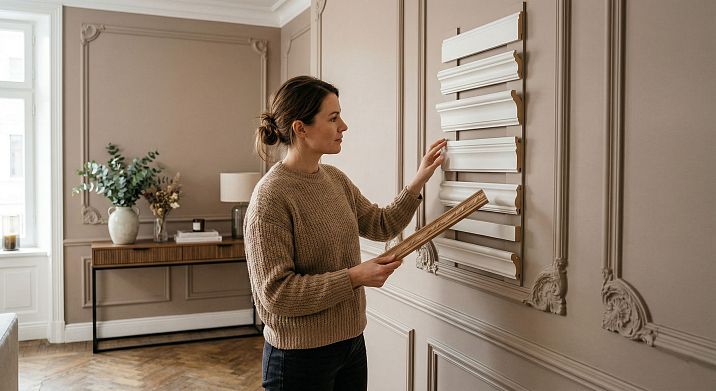
This is historically the main area of application for molding on wall panels in interiors. The boiserie system involves covering the wall entirely with wooden panels, divided and framed by moldings. The lower panel—the dado—goes up to a height of approximately 90–100 cm from the floor. Above that is the middle zone. Near the ceiling is the upper belt with a cornice. All this is tied together by profiles that set the scale and rhythm of the system.buy moldingsfor full-fledged boiserie—means choosing several types of profiles of different widths, working in a unified stylistic key.
Panels in the living room, bedroom, hallway
The area of application determines the requirements for the profile. In the living room—larger frames, a more pronounced profile. In the bedroom—softer, calmer, without sharp shadows. In the hallway—resistance to mechanical contact, so the lower zone should be made of a sufficiently durable material. Moldings for walls in the interior of any room should be proportional to the volume of the space—more on this in the selection section.
How to choose molding for wall panels
Perhaps the most important section. This is where most people make mistakes that later cost nerves and money. Let's break it down by parameters.
By profile thickness
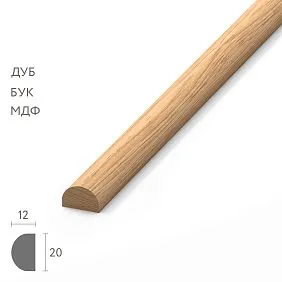
Molding thickness is the depth of its relief. The greater the thickness, the more expressive the shadows and the 'louder' the element. For modern interiors in a minimalist key, a thickness of 8–15 mm is optimal. For classic and neoclassical styles — 15–30 mm and more. Boiserie in the Baroque spirit can use profiles with a thickness of 40–50 mm.
Important rule: the thickness of the molding should be proportional to the width. A thin and wide profile looks flat and cheap. A narrow and deep one looks overloaded. The optimal width-to-thickness ratio is from 3:1 to 5:1.
By width
Profile width determines the scale of the frame. For creating panel frames on a standard wall 2.7–3 m high, the optimal molding width is 40–80 mm. Narrower profiles (20–35 mm) are used as internal outlines in complex multi-layer systems. Wide ones (90–150 mm) — for architectural accents: fireplace portals, framing niches, large decorative elements.
By style
The molding profile speaks about the interior style no less than the furniture.
-
Rectangular flat — minimalism, Scandinavian style, loft
-
Semi-circular (astragal) — neoclassicism, transitional styles
-
Cyma recta and cyma reversa — classic, Baroque
-
Ogee and reverse ogee — Renaissance, classicism
-
Complex composite profiles — Baroque, Rococo, Historicism
If you are unsure about the choice — explore the molding catalog with real profiles and visually compare how a particular profile looks in different stylistic contexts.
By wall height
This is perhaps the most practical selection criterion. For wall heights up to 2.7 m, small profiles of 30–50 mm work best, with no more than two horizontal bands. For 2.8–3.2 m — a standard system with lower and upper panels, profiles 50–80 mm. For heights from 3.5 m — you can build a full three-tier boiserie with large profiles of 80–120 mm.
By room type
The living room requires representativeness — choose a pronounced profile with good shadow play. The bedroom — softness and unobtrusiveness, flat or slightly relief profiles. The study — strictness and clarity of lines. The hallway — practicality and durability. The children's room — simple, safe profiles without sharp protrusions.
By finishing material
If the walls are planned to be painted — choose paintable molding made of MDF or solid wood. If the walls are covered with veneer or natural wood — look for molding made of the same wood species for texture unity. For walls with wallpaper, molding is installed on top and should be dense enough to adhere reliably to the surface.
Materials: which moldings are suitable for wall panels
Material selection is not just a budget question. It's a question of durability, aesthetics, and compatibility with operating conditions. Let's examine the main options.
Solid wood moldings
Wooden moldingsSolid wood is the benchmark. Oak, beech, ash, walnut — each species carries its own character, its own texture, its own temperature tone. Oak — powerful, expressive, durable for 50+ years. Beech — flexible, bends well, provides a perfectly smooth surface for painting. Solid wood can be sanded, tinted, varnished, stained — in short, tailored to any color concept.
The main advantage of solid wood wall molding is its repairability. A scratch, chip, or wear mark — all of this can be fixed with local restoration without replacing the entire element. Its service life with proper care is measured in decades.
MDF molding
Moldings for wall decorationMDF offers the optimal price-to-quality ratio for most residential projects. Dense MDF (750–850 kg/m³) holds the profile shape excellently even in the thinnest sections, doesn't crack or warp in a stable climate. The MDF surface accepts any enamels, primers, and decorative coatings with virtually no preparation.
MDF molding for painting is the best choice for projects where the wall and all its elements are painted a single color. The perfectly even, pore-free surface provides an absolutely smooth paint finish.
Polyurethane molding
Polyurethane molding is lightweight, inexpensive, and available in a huge assortment of profiles. It's well-suited for projects with a limited budget. However, there are significant limitations: polyurethane cannot be restored, doesn't recover from mechanical impact, and may yellow over time under direct sunlight.
If you're looking for a long-term solution that will last 20–30 years, solid wood or MDF moldings for wall panels are definitely preferable. You can view a wide assortment of profiles in the section moldings, cornices, and baseboardsfeaturing products of various sizes and profiles — from compact strips to representative architectural elements.
Molding or slatted panels: which solution to choose for the wall
This is a question that naturally arises for anyone seriously engaged in wall finishing. And it's the right question — because both solutions work, but they work differently.
Molding and slatted panels are not competitors. They are tools with different logic, different visual mechanics, and different application scenarios.
When to choose molding
Molding for wall panels is your choice if you need a framed, classical rhythm for the wall. You want to see clear rectangular panels framed by profiles. You are working in a classical, neoclassical, art deco, or transitional style. The strictness of proportions, monumentality, and architectural completeness are important to you.
Molding gives the wall a vertical-horizontal grid, where each element occupies its place. This is a solution that works over time — in 10 years, it will look just as relevant as it does now.
When to choose slatted panels
slatted panels for walls— a choice for a linear, modern rhythm. Vertical battens create a rhythmic, almost musical structure on the surface. Light falling on the slats creates a play of shadows that changes throughout the day. This solution is organic for Scandinavian minimalism, modern neoclassicism, loft, and the Japanese wabi-sabi style.
If you wantbuy slatted panelsfor painting or tinting natural wood — is a separate, self-sufficient solution with its own logic.
Comparison by key parameters
| Parameter | Wall panel molding | Slat panels |
|---|---|---|
| Visual rhythm | Framed, geometric | Linear, vertical |
| Style | Classic, neoclassicism, art deco | Minimalism, Scandinavian, loft |
| Installation difficulty | Medium (requires precise marking) | Low (adhesive or frame) |
| Finishing flexibility | For painting, tinting, varnish | For painting, tinting, varnish |
| Radius surfaces | Limited (curved elements) | Excellent (flexible panels) |
| Historical context | Boiserie, classicism, baroque | Modern design |
If you can't make a definitive choice — the correct answer is most likely in the next section.
How to combine molding and slatted panels in one project
One of the most interesting techniques in modern interior design is the deliberate combination of two systems in one space. Not a haphazard mix, but a clear delineation of zones and functions.
Molding as framing, slatted panels as accent
Classic scenario: three walls in a room are decorated with frame moldings for painting. The fourth — accent — is covered withdecorative slatted panelssolid oak. Molding creates a calm background and architectural connection, the slatted panel — the main visual object. Result: an interior with a clear focus and rich depth.
TV area
One of the most popular requests today: how to beautifully decorate the wall under the TV. Molding for the TV area creates a geometric frame around the niche or the entire plane. A slatted panel covers the area around or behind the screen, adding a textural accent. This combination of molding and slatted panels gives the living room visual completeness and a sense of a designed, not just assembled, interior.
Entryway
The lower zone of the wall — up to a height of 90–100 cm — is decorated with moldings and panels for painting in a dark tone (practical and beautiful). The upper zone —MDF Plank Panelsfor painting in a light tone. A horizontal molding at the level of 90–100 cm serves as a dividing line. The hallway gets a multi-layered finish, resistant to mechanical impacts in the lower zone and light, airy — in the upper.
Bedroom: headboard
Molding for wall panels in the living room or bedroom in the headboard area is a classic solution. And the combination: on the sides of the bed — frame moldings, behind the headboard — an accent slatted panel made of oak — gives a sense of a custom interior, made to order.
Space Zoning
In open layouts, molding and slatted panels can divide zones not with walls, but with visual signals. Dining room — moldings on the walls. Living room — slatted panel behind the sofa. Different solutions for different functional zones create a sense of separate rooms without losing openness.
wooden lath panelsfor painting or tinting, in combination with moldings in a single color scheme, give a result that is difficult to achieve with any single solution.
Where to buy molding for wall panels
If you've read this far, you already have an understanding of what you need. All that's left is to make the right choice.
buy moldingsfor wall panels can be found in the STAVROS catalog — a manufacturer of wooden architectural elements made of solid oak, beech, and MDF. This is not a middleman, not a reseller — it's a production with a full technological cycle: from wood drying to the finishing of the ready profile.
What's important to know aboutin the molding catalog STAVROS:
-
Over 40 standard profiles of different widths, thicknesses, and stylistic categories
-
Materials — solid oak, solid beech, high-density MDF
-
Surface treatment — sanded blanks ready for painting, tinting, or varnishing
-
Geometric precision — tolerance of ±0.1 mm per linear meter, which is critical for joining profiles at corners
-
Wood moisture content — stabilized to 8–12%, preventing warping after installation
For a wide selection — wall trim moldings along with cornices, baseboards, and millwork — there is a full sectionmoldings, cornices, and baseboardswhere the entire range of millwork products is collected. This is convenient when you need to select a unified system: baseboard for the floor, molding for the wall, cornice for the ceiling — all in one place, all in a single stylistic key.
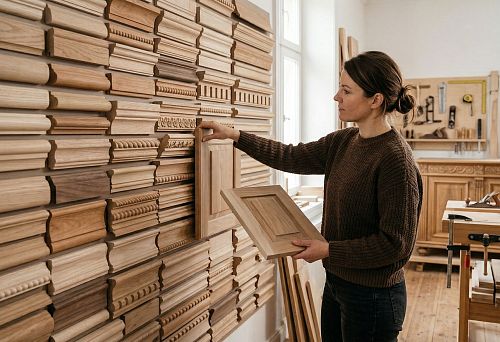
If you are looking forbuy panel moldingwith an understanding of how exactly the profile will work on your wall — take advantage of the opportunity to order samples. This will allow you to evaluate the actual profile, texture, weight, and quality of processing before starting installation work.
For those who have already made a decision and are looking forbuy decorative moldingsin bulk or retail for a specific project — STAVROS managers will help calculate the required linear meters, select accompanying profiles, and determine the optimal fastening option.
Mistakes when choosing molding for wall panels
Experience from observing thousands of completed projects allows us to highlight mistakes that repeat again and again. Knowing about them will save both money and time.
Too small a profile
This is perhaps the most common mistake. A person chooses a thin, elegant molding, hoping for a delicate result. But delicacy and inconspicuousness are different things. A 15 mm wide molding on a 3 m high wall looks like a random line, not an architectural element. How to choose molding for a panel correctly? Follow the rule: the width of the molding should be proportional to the area of the panel it frames. A 50×80 cm panel — 30–40 mm molding. A 100×150 cm panel — 50–70 mm.
Too large a profile
The opposite mistake. A massive 100–120 mm profile in a room with 2.6 m ceilings creates a oppressive effect. The wall 'looms,' the space shrinks. Large molding requires scale — high ceilings, spacious rooms, space for shadows to play.
Poor frame proportions
Molding frames should be proportional. Square frames suit some styles, vertically elongated ones suit others, horizontal ones suit others. The main thing is the logic of repetition. If you started with vertical 1:2 panels, maintain this ratio across the entire wall. Chaotic mixing of proportions disrupts the rhythm.
Conflict with the panel texture
Moldings for wall panels with pronounced texture in interiors require special attention. A complex profile against a rough surface creates visual 'clutter'. The rule is simple: the richer the panel texture, the simpler the molding should be.
Attempt to replace molding with slat panels
Sometimes clients try to create a framing effect using slat panels. This is technically possible but logically incorrect. A slat panel on a wall is a linear rhythm, not a frame. If you need a frame — you need molding. If you need a linear rhythm — you need a slat. What's better — molding or slat panels — depends not on taste, but on the task.
Mixing two solutions without composition
Molding and slat panels in one space is wonderful. But only when there is clear architectural logic between them. If moldings and slats are simply scattered across walls without a system, the result will look like unfinished renovation, not a design solution.
FAQ: popular questions about molding for wall panels
Which molding is best for wall panels?
The best molding is one that is proportional to your wall and matches the interior style. For classic — shaped profiles from solid oak. For modern interiors — flat or slightly relief MDF profiles for painting. Solid wood wins in durability and restoration possibilities.
Where to buy moldings for wall panels?
In the STAVROS catalog —molding catalog— features wooden profiles from solid oak, beech, and MDF in over 40 standard types. You can also order samples there to evaluate the actual material.
What moldings are suitable for MDF panels?
For MDF panels intended for painting, moldings from the same paintable MDF system are best—this ensures the entire surface is painted in a uniform tone. If texture is desired, a wooden molding made of beech or oak creates a contrast with the smooth MDF.
Can molding be used for panels intended for painting?
Yes, and it's one of the best options. A uniform color for the wall, panels, and molding creates the effect of a relief monochrome surface—a modern and very effective technique in neoclassical interiors.
What is better for a wall: molding or slatted panels?
It depends on the style and task. Molding is for a framed, classical rhythm.slatted panels for walls—for a linear, modern rhythm. These solutions are not mutually exclusive—they can be combined in one project.
Can molding and slatted panels be combined?
Yes, and it's a very winning technique. Moldings on three walls + a slatted panel on an accent wall—a classic designer solution. It's important to maintain a unified color scheme and material logic.
What slatted panels are suitable for moldings?
Best of all —Paintable lath panelsmade of MDF, painted in the same tone as the moldings. Or oak panels — if the moldings are also made of oak.
Where to search for 'buy slatted wall panels'?
To the STAVROS slatted panels catalog:Buy slatted panels for walls— here you'll find rigid and flexible panels made of MDF and solid oak.
Where to search for 'buy wall moldings'?
To the moldings, cornices, and baseboards section:Moldings for walls to buy— a wide range of trim for any style and budget.
How to choose a profile for decorative wall finishing?
Focus on four parameters: wall height, interior style, panel type (smooth, textured, MDF), and coating type (paint, tint, varnish). If in doubt — order samples and evaluate the profile in person on your wall under real lighting.
STAVROS: where quality finishing begins
Walls with properly selected molding aren't just beautiful. It's architectural thinking embodied in material. And for the result to match the vision, you need a manufacturer who understands details at a professional level.
STAVROS is a Russian manufacturer of wooden architectural elements with a full production cycle. Drying in specialized chambers to 8–12% humidity, four-sided planing on German equipment, geometric tolerance of ±0.1 mm per linear meter — these aren't marketing promises but technical standards that determine the result on your wall.
In the STAVROS catalog, you will find:
-
Moldings from solid wood— over 40 profiles in oak, beech, and MDF for any style
-
moldings, cornices, and baseboards— complete trim system for comprehensive room design
-
Rafter panels— rigid and flexible, in MDF and solid oak, for accent walls and curved surfaces
STAVROS works with both private clients and designers, architects, and construction companies. Projects of any scale can be equipped — from a single room to an apartment building or commercial property.
Start with the catalog. Evaluate the profiles. Order samples. And let your walls finally speak in full voice.