Article Contents:
- Why you can't choose a handle separately from the relief on a decorative facade
- What makes up the facade image: handle, relief, overlays, moldings
- Handle
- Overlay
- Molding
- Facade frame
- Relief and center of composition
- How to choose furniture handles for a facade with decorative elements
- By style
- By shape
- By size
- By opening type
- By installation location
- Relief and grip: when a beautiful handle becomes uncomfortable
- Grip depth
- Distance to overlay
- Handle protrusion above plane
- Handles on drawers and doors: different logic
- Scale: how not to lose the facade and not overload it with handles
- Small facade and small drawer
- Wide facade and large door
- Tall cabinet
- Commode
- Facade with active threading
- Which handles work best with moldings and overlays
- Push handle on a facade with molding
- Pull handle and furniture molding
- Recessed handle on a facade with overlays
- Long handles and moldings: a hidden mistake
- Symmetrical solutions: two handles
- How to combine furniture decor and handles in a classic facade
- Strict Classic
- Neoclassicism: more freedom
- Light facade
- Dark facade
- Facade with carved ornament
- Ready-made combination schemes: five specific scenarios
- Scheme 1: Cabinet with frame facade and molding
- Scheme 2: Dresser with central overlay
- Scheme 3: Kitchen facade with light relief
- Scheme 4: Classic cabinet with symmetrical handles
- Scheme 5: Facade with vertical decor
- Common mistakes when selecting handles for decorative facades
- Handle clashes with overlay
- Too small handle on a large facade
- Too active decor and heavy hardware
- Uncomfortable grip near the relief
- Different styles of handle and decor
- Incorrect handle alignment along the axis
- What to look for in the catalog when selecting handles and decor
- FAQ: Answers to Popular Questions
- How to match furniture handles to a facade with decorative elements?
- What is more important: beautiful relief or comfortable grip?
- Which handles are suitable for classic furniture?
- Can long handles be installed on facades with moldings?
- How to avoid overloading the facade with decor and hardware?
- What is better for a relief facade: a knob handle or a pull handle?
- Where to place the handle if there is already an overlay on the facade?
- Which decorative elements pair best with wooden handles?
- About the company
There is one detail in a furniture project that can ruin even the most beautiful facades — the wrong handle. Not a bad one, not a cheap one, but simply one that doesn't suit the relief, scale, and character of the decor. This happens more often than you think: a person choosesFurniture Handlesseparately,decorative elements— separately, and then looks at the finished furniture and feels something is off. The facade is there, the relief is there, the handles are installed — but there is no integrity.
The problem is almost always the same: the handle, the furniture decor, and the facade relief are not three independent decisions. They are a single composition where each element influences the others. Properly selected furniture decor elements paired with a handle create a facade you want to look at. Incorrect ones turn the facade into a collection of random details that interfere with each other.
This article provides a complete breakdown: how this system works, which handles suit facades with relief, moldings, and overlays, how to avoid mistakes with scale, and maintain a comfortable grip with any decor.
Continuing the article from where it left off and completing it fully:



Why you can't choose a handle separately from the relief on a decorative facade
Let's start with a question rarely asked out loud, but which determines everything. What is a furniture facade? It is a plane — but not an empty one. It is a plane with architecture: moldings, frames, overlays, ornament, relief. And when a handle appears on this plane, it either integrates into this architecture or conflicts with it.
Let's take a specific example. A classic-style cabinet front: a frame construction withfurniture molding, a central decorative overlay with a floral pattern, a tinted surface. A long metal bracket in a loft style is placed on this front. The bracket itself is good. The front itself is beautiful. Together—a catastrophe. Because the handle and the relief belong to different stylistic worlds and different scale logics.
Furniture Handleson a decorative front—is not just a functional element. It is the final point in the composition of the front. It is the handle that 'signs' the entire solution: it either confirms the style or destroys it. This understanding is the starting point for correct selection.
Three things that determine the compatibility of a handle and a front:
-
Style: which decorative language both elements belong to
-
Scale: whether the dimensions of the handle correspond to the dimensions of the front and relief
-
Grip: whether the relief interferes with a comfortable grip of the handle
Each of these three parameters is a separate story. And it is their interaction that creates either a cohesive image or decorative chaos.




What makes up the front image: handle, relief, overlays, moldings
Before discussing selection, it's important to understand the composition of the 'system'. A furniture front with decor is not just a decorated door. It's a multi-layered structure where each layer has its own function.
Our factory also produces:




Handle
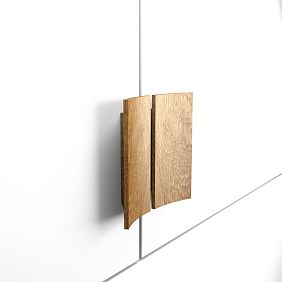
The handle is the only element of the front that a person physically interacts with every day. It's the point of contact. That's why it must meet two requirements that often contradict each other: it must be both comfortable and beautiful.decor for furnitureThe decor can be as complex as you like — the handle must still provide a confident, comfortable grip.
Get Consultation
Overlay
An overlay is an applied decorative element that is attached directly to the surface of the front. A rosette, medallion, corner ornament, floral motif, cartouche — all of these are overlays. They create relief where there is none structurally, adding volume, shadow, and visual complexity.applied decoration for furnitureThe overlay is the most flexible tool: it can be applied precisely, enhancing specific areas of the front.
Molding
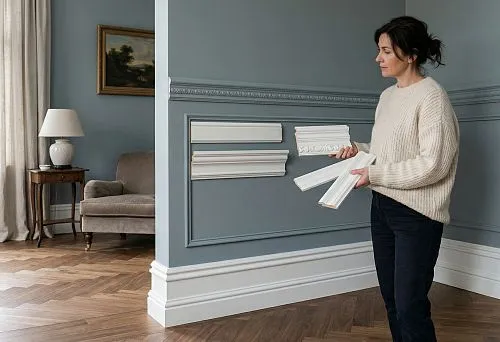
Wooden moldingMolding on a furniture front is a linear element that creates frames, divides the plane into zones, and forms the 'map' of the front. Moldings set the rhythm: where the center is, where the periphery is, where each zone begins and ends.furniture moldingsMolding is the architecture of the front in the literal sense.
Front frame
Frame facade — a structural frame made of solid wood or MDF with a central panel. The frame itself creates relief, dividing the facade into clear zones. Moldings and overlays are added on top of this structure.
Relief and center of the composition
A facade with several decorative elements always has a center. This could be a central overlay, a large ornament, or the intersection of molding frames. It is relative to this center that the placement of the handle, its size, and its visual weight are correctly determined.
Now ask yourself: when was the last time you chose a handle while thinking about all these layers simultaneously? Most likely — never. And that's exactly how it should be done.
How to choose furniture handles for a facade with decorative elements
Selection does not start with a catalog of handles. It begins with an analysis of the facade. What is on it, how active is the relief, what is its style, where are the decorative accents located.
By style
The style of the handle and the style of the facade decor should belong to the same 'dictionary'. This does not mean everything should be identical — it means there should be no conflict.
-
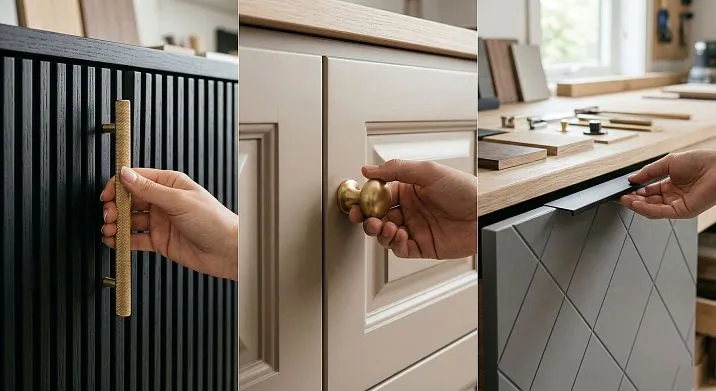
Classical facade with ornamental overlays:wooden furniture handleswith a turned or carved profile, shape — a knob, a small bracket with smooth curves
-
Neoclassical with frame molding: a laconic wooden bracket handle with a neat curve, without excessive ornamentation
-
Facade with active carved decor: a maximally simple handle — so as not to compete with the ornament
-
Geometric modern facade with light molding: straight bracket, vertical recessed handle, restrained minimalist profile
Rule: the richer the facade relief, the simpler the handle should be. The calmer the facade — the more freedom the handle has to be expressive.
By shape
There are several fundamentally different types of furniture handles:
-
Button handle — a small protruding element, attached at one point. Works well on small facades, dresser drawers, small doors with active decor.
-
Bracket handle — an arc-shaped handle with two mounting points. Universal, works well on medium and large facades.Wooden pull handle— a classic option for framed facades.
-
Long vertical or horizontal handle — works on tall cabinet doors, creates an expressive vertical or horizontal accent.
-
Recessed handle — set into the plane of the facade. Ideal for facades with active relief, where a protruding handle would create visual overload.Wooden recessed handles— are especially valuable in this scenario.
By size
The size of the handle is determined by the scale of the facade and the scale of the relief. This is a separate topic — we'll cover it in detail in the next section. The basic rule: the handle should neither be lost on the facade nor dominate it.
By opening type
A cabinet door opens differently than a drawer. On a door, leverage is important — that's why handles on doors are often longer and larger. On a drawer, a direct grip is important — a pull or a button in the center.Wooden drawer handle— this is a separate category with special ergonomic requirements.
By installation location
The handle is placed along the axis of the facade: on a door — along the vertical axis, closer to the opening edge; on a drawer — along the horizontal axis, in the center. Decorative elements must be taken into account: if there is an overlay in the center of the facade, the handle should be shifted away from it — or integrated into the overall symmetry.
Relief and grip: when a beautiful handle becomes inconvenient
This is the moment where practice sharply diverges from theory. A beautiful handle on a beautiful facade — and yet it's inconvenient to use. Why? Because the relief interferes with the grip.
Grip depth
Grip is the space between the body of the handle and the surface of the facade. This is where the fingers go when grasping. If there is an overlay, molding, or any other protruding element near the handle, it can physically reduce this space.
The minimum comfortable clearance between the handle body and the nearest protruding element of the facade is at least 20–25 mm. With a smaller distance, the hand begins to catch on the decor, which creates a feeling of discomfort and gradually damages the surface.
Distance to the overlay
IfCarved furniture decoris positioned symmetrically relative to the center of the facade, the handle should be installed either strictly in the center (which functionally disrupts symmetry) or offset while maintaining visual balance. In this case, a more compact or recessed handle is chosen, which does not disrupt either the relief or the functional clearance.
Handle projection above the plane
A bracket handle with a high lift above the facade plane is convenient for gripping, but with active relief it creates visual 'noise': several protruding elements of different heights overload perception. For facades with rich relief, it is better to choose handles with a low lift or, as already mentioned, recessed ones.
Handles on drawers and on doors: different logic
On a drawer, the grip is direct — fingers go behind the bracket or under the button and pull horizontally. On a door, the grip is lever-based — the hand grabs the handle and pulls in an arc. This means that on a drawer, the distance to the decor above and below is critical, while on a door, it is the distance to the left and right of the handle.
Always check: does the hand catch on a decorative element when opening? This is easy to check manually during fitting, but almost impossible to predict from a drawing alone.
Scale: how not to lose the facade and not overload it with the handle
Scale is the most subtle of the three axes because mistakes here are the least obvious but the most destructive to the overall impression.
Small front and small drawer
A drawer front 300–400 mm wide is a small front. The right handle here is a compact knob or a small bracket with a center-to-center distance of 32–64 mm. A large handle on a small drawer looks like an anchor on a boat: excessive, awkward, disproportionate.
At the same time, if the drawer front hasto buy, which will allow you to transform your furniture using carved wooden elements. You can use the C-003-3 decor set to decorate furniture, walls, doors, or any other surface. The C-003-3 decor set is made of oak or beech, known for their strength, durability, and beauty. You can buy the C-003-3 decor set at the Stavros decor store, which specializes in producing and selling decorative elements and hardware for furniture and interiors. At the Stavros decor store, you will find a wide selection of decor sets of various shapes, sizes, and styles. You can choose— a small central overlay — then the handle should be even more compact. The decor and handle in this case together occupy the central zone: two active elements on a small field require minimal individual scale with maximum stylistic precision.
Wide front and large door
A cabinet front 600–800 mm wide is already a large plane. Here, a small knob will be lost: it is not visible, its presence in the overall architecture of the front is not felt. For this scale, a long vertical handle (from 120–160 mm) or a bracket with a wide center-to-center distance is needed.
If this front also has an activedecorative elements for furniture— molding frames, corner overlays — the handle should be noticeable but not aggressive. A vertical bracket in the center of the door is often the perfect solution: it fits into the axis of symmetry, does not compete with the decor horizontally, and provides a comfortable grip.
Tall cabinet
For a tall cabinet or high cabinet (door height from 1200 mm) — the handle should be long. Not only because it looks good: a long handle provides a wider range of grip along the height, which is important for repeated opening. A verticalwooden long handle200–300 mm — the correct scale for a tall front.
If there are decorative moldings dividing the door into horizontal zones, the handle should be placed in the zone that is at a comfortable gripping height — approximately 900–1100 mm from the floor.
Chest of drawers
Chest of drawers — a special case: several drawers of different heights. Here, the logic of scale works differently. Wide lower drawers can have larger handles, narrow upper ones — compact ones. It is important that the handles belong to the same series: different shapes and sizes on one product is a mistake.
Front with active carving
When the front has deep carving — three-dimensional ornament with a relief difference of 10 mm or more — the handle should be as laconic and small as possible. The carving itself is the main decorative event.Wooden handleA simple button form or a minimal bracket here is the right choice. It is present functionally, does not claim the role of decor, and does not compete with the ornament.
Which handles work better with moldings and overlays
This is the most practical question in the entire article. Let's break it down by handle types — with specific scenarios.
Push-button handle on a molded facade
Moldings for furnitureThey create a frame structure on the facade — an inner zone and a border. The push-button handle is placed in the center of this inner zone. This is a classic solution for dresser drawers with framed facades: a button in the center, molding as the border.
Important: the button must be expressive enough to be visible against the frame. A small flat button on a large molding is almost unnoticeable and looks accidental.
Pull handle and furniture molding
A pull handle on a facade with moldings is the most common combination. It works well under one condition: the handle must be installed along the axis of the molding frame, not intersecting it. If the handle overlaps the molding, it violates both the composition and the installation.
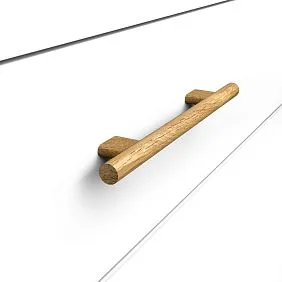
Wooden pull handleOn a facade with frame molding — when properly installed in the lower or central part of the inner field — looks organic and elegant. This is a 'quiet' option: the handle is present but doesn't shout.
Recessed handle on a facade with overlays
If the facade is saturated withwood furniture decor— overlays at multiple points, corner rosettes, ornamental details — a recessed handle becomes the perfect solution. It doesn't add a new visual element 'on top' of an already complex surface, but goes inside the plane, freeing the relief from competition.
Wooden recessed handlesare cut into the facade and visually 'do not take up space' on the surface. This allows all the decor to remain untouched.
Long handles and moldings: a hidden mistake
A long vertical handle on a facade with horizontal molding belts is a potential conflict. The vertical line of the handle intersects the horizontal lines of the decor, creating a sense of disunity. The best solution: place a long handle on facades with vertical or neutral moldings, or—if the moldings are horizontal—use a horizontal bracket in the center.
Symmetrical solutions: two handles
On a double-door cabinet, handle symmetry is a mandatory condition. Two identical handles, mirror-positioned relative to the vertical axis, create a sense of architectural order. Decorative elements on the doors should also be mirrored—otherwise, the overall symmetry is broken.
How to combine furniture decor and handles on a classic facade
Classicism is a style where everything is built on proportions, symmetry, and hierarchy of elements. It is here that selecting handles tofurniture decoris most demanding—and most rewarding if done correctly.
Strict classicism
In strict classicism, the facade has a clear hierarchy: frame, molding, center overlay, handle. The handle here is the final element, and it must be subordinate to all the others. The correct choice: a small wooden knob or a compact bracket with a classic profile, made from the same wood species as the main solid wood of the facade.
Classic Furniturewith carved ornamentation requires handles with a wooden body and possible metal accents (ring, bronze base) — but without metal dominance. Wood should be the main material of the hardware, as well as the entire facade.
Neoclassicism: more freedom
Neoclassicism allows handles to be slightly more expressive. Here, Round wooden handlewith a turned body, a bracket with smooth curves on two points, a handle with a clearly readable profile. But the principle of subordination to the relief remains: the more saturated applied decoration for furniture, the more restrained the handle should be.
Light facade
On a light or white classic facade, a wooden handle made of light woods — beech, ash, birch — creates a subtle 'natural' note without disrupting the overall palette. A dark handle on a light facade is always a strong accent: it must be justified by the style or color concept of the entire interior.
Dark facade
On a dark facade — made of dark oak, walnut, or stained solid wood — the handle should either match the tone (dark wood) or create a justified contrast. Light wood on a dark facade is a risky solution that works only with impeccable stylistic precision.
Facade with carved ornamentation
This is a special case. A carved facade is a facade where the relief is the main message.Classic Furniturewith carved ornamentation is a work of art, not just a product. The handle here should be present discreetly: a small button at the bottom of the facade, an inset handle, a small bracket in a neutral location. Nothing should distract the eye from the ornament.
Ready-made combination schemes: five specific scenarios
Now — the most practical part: ready-made solutions that can be applied directly.
Scheme 1: Cabinet with a framed facade and molding
Facade: framed construction,Furniture moldingaround the perimeter of the inner panel, neutral center.
Handle: wooden bracket, center-to-center distance 96–128 mm, installed in the center of the inner zone. Concise profile, matte finish matching the facade.
Why it works: the molding creates a frame, the handle is the central accent. No overload, no conflict. Symmetry and function are maintained.
Scheme 2: Dresser with a central overlay
Facade: flat surface of each drawer, centered —decorative elementsin the form of a small leafy rosette.
Handle: small button, installed symmetrically below the overlay, or the overlay moves to the top part of the facade, handle — centered.
Why it works: the overlay and handle occupy different zones of the facade and do not compete for attention. Both are present, each in its place.
Scheme 3: Kitchen facade with light relief
Facade: milled relief — light geometric grooves along the perimeter, light coating.
Handle: long horizontal or verticalWooden Handle, installed on the lower third of the facade. Material — light beech or birch.
Why it works: light geometric relief does not claim the role of the main accent. The long handle adds an expressive vertical or horizontal stroke.
Scheme 4: Classic cabinet with symmetrical handles
Facade: double-leaf cabinet, each leaf is a frame facade withfurniture moldingsand corner overlays.
Handles: two identical wooden brackets, installed mirror-symmetrically along the vertical axis of each leaf. Center-to-center distance 64–96 mm.
Why it works: the symmetry of the handles repeats the symmetry of the decor. Unified style, correct proportions, elegant result.
Scheme 5: Facade with vertical decor
Facade: vertical decorative strip in the center with ornamental overlays at the top and bottom.
Handle: recessed handle in the central neutral zone, or a horizontal bracket below the bottom overlay.
Why it works: the vertical decor occupies the center. The handle integrates into the free zone without intersecting decorative elements.
Common mistakes when selecting handles for decorative facades
The errors here are systemic—they repeat from project to project. Knowing them allows you to avoid obvious pitfalls.
The handle clashes with the overlay
The most common mistake.Carved furniture decorIn the center of the facade and nearby—a large, expressive handle with ornamentation. Two active decorative elements in one zone create 'noise': it's unclear where to look. Solution: separate them vertically or make one of them significantly less expressive.
Too small a handle on a large facade
A 25 mm diameter button on a cabinet door 700 mm wide—looks lost. Visually, the facade is 'ungrounded'; it lacks a clear functional point. The scale of the handle must correspond to the scale of the facade.
Too active decor and heavy hardware
Large overlay + moldings + large figured handle on one facade—that's already too much. The facade loses air, becomes heavy and oppressive. The 'less is more' rule works strictly for decorative facades.
Inconvenient grip near relief
The handle is placed 10 mm from the edge of the molding, and fingers constantly touch the frame when gripping. Over time—damage to the lacquer, wear, a feeling of discomfort. Always check the physical clearance during installation.
Different handle styles and decor
Furniture Decoration from WoodClassical ornamental style + industrial metal handle = complete incompatibility. The material, shape, and style of the handle must belong to the same stylistic world as the decor.
Incorrect handle alignment on axis
A handle offset from the center or edge of the facade without architectural justification looks like a mounting error—even if done intentionally. All deviations from symmetrical axes must be motivated by relief or style—and visually read as an intentional decision.
What to look for in the catalog when selecting handles and decor
For comprehensive selection—both handles and decor—it's important to work with a unified catalog where elements are coordinated by material and style.
Furniture Handles— complete line of wooden handles: pulls, knobs, long handles, handles with and without coating. Selection by size, shape, and facade type.
Wooden handles with coating— for facades requiring coordination with lacquered or tinted surfaces.
Wooden handle without coating— for independent finishing to match the facade color.
applied decoration for furniture— carved and turned overlays, rosettes, corner elements, ornamental details for creating relief on the facade.
furniture moldings— frame profiles for dividing the facade into zones.
Classic Furniture— ready-made solutions with coordinated decor, handles, and facades.
FAQ: Answers to popular questions
How to choose furniture handles for a facade with decorative elements?
First — analyze the facade: how active is the relief, where are the decorative elements located, what is the style. Then — choose along three axes: the handle style matches the decor, the handle scale matches the facade scale, and the grip is ensured by a physical gap from the relief.
What is more important: beautiful relief or comfortable grip?
Both are equally important. It's not a choice: the design task is to ensure they don't conflict. If the relief interferes with the grip — the relief needs to be reconsidered or a recessed handle that doesn't require a gap should be chosen.
What handles are suitable for classic furniture?
Wooden handles — knobs, brackets with a classic profile, small turned shapes. Made from the same wood species as the main solid wood, or with a coordinated finish. For furniture in a classic style, metal handles are acceptable only as a supporting accent, not as the main material.
Can long handles be placed on facades with moldings?
Yes — with proper axial logic. A long vertical handle works well with vertical moldings or a neutral frame facade. A long handle crossing a horizontal molding is a mistake.
How to avoid overloading the facade with decor and hardware?
Hierarchy rule: each facade has only one main decorative accent. Everything else is subordinate. If the main accent is an overlay, the handle should be restrained. If the main accent is the handle, the decor should be minimal.
What is better for a relief facade: a push-button handle or a pull handle?
Depends on the size of the facade. On a small facade with active relief — a push-button: it takes up less space and does not create additional visual load. On a medium or large relief facade — a pull handle with a compact lift or an inset handle.
Where to place the handle if the facade already has an overlay?
Either in a different zone (overlay at the top — handle at the bottom, and vice versa), or choose an inset handle that does not add a new protruding element. Never place it right next to the overlay.
Which decorative elements pair best with wooden handles?
Wooden overlays and wooden moldings are the most organic pair for wooden handles. A unified material creates internal consistency. Metal accents are acceptable as an additional element, but not as the main 'field' of decor.
About the Company
When the task is not just to install a handle, but to build a cohesive furniture facade with decor, moldings, and proper hardware, it is important that all elements come from a single source.
STAVROS — manufacturer of wooden furniture handles, decorative overlays, moldings, and architectural elements for furniture. The STAVROS catalog offers a complete system: from wooden handles in various shapes and finishes to carved furniture decor, furniture moldings, and classic solid wood products. All elements are coordinated by wood species, profiles, and style — which makes it possible to assemble a truly cohesive facade, not a set of random parts. STAVROS — the choice of those who understand: details make all the difference.