Article Contents:
- When You Need Custom Furniture Legs, Not Ready-Made Ones from a Catalog
- Non-Standard Product Height
- Rare Shape Not Available in the Catalog
- Need to Replicate an Existing Model
- Restoration of Old and Antique Furniture
- Design and Architectural Project
- Small Series for Furniture Production
- What Furniture Legs Can Be Made to Order
- Straight and tapered legs
- Turned legs by profile
- Carved legs
- Figurative and geometric models
- Massive load-bearing legs
- Legs with or without finished coating
- For which furniture legs are most often ordered
- Custom table legs
- Custom sofa legs
- Custom bed legs
- Custom legs for cabinets and dressers
- Custom legs for wardrobes
- Legs for custom and designer furniture
- Parameters for custom-made furniture legs
- Materials for custom furniture legs: oak and beech
- Oak — status and durability
- Beech — ease of processing and rich finishing
- What to choose for different tasks
- How to correctly calculate leg dimensions before ordering
- How to determine the required leg height
- How to choose the cross-section
- What data must be provided to the manufacturer
- How to choose leg shape and style to match the interior
- Classic and neoclassic
- Modern style and minimalism
- Provence and rustic
- Art Deco and eclecticism
- How to combine legs with handles and facades
- Custom leg mounting: what to choose
- Stud (screw-in bolt)
- Mounting plate
- Hidden mounting
- Reinforced mounting for heavy furniture
- What to prepare before placing an order: a complete checklist
- Can legs be ordered by photo, drawing, or sample?
- By photo
- By sketch
- By technical specification
- By old sample
- What is important for an accurate result
- How custom furniture legs are made: step by step
- Step 1. Initial request
- Step 2. Shape approval
- Step 3. Material and Coating Selection
- Step 4. Prototype Manufacturing
- Step 5. Batch Production
- Step 6. Finishing
- Step 7. Quality Control
- Step 8. Packaging, Hardware Kitting, and Delivery
- What Affects the Cost of Custom Furniture Legs
- Common Mistakes When Ordering Furniture Legs
- Incorrect Height Calculation
- Ignoring the Mounting Type
- Incorrect load assessment
- Choosing form based only on picture
- Inconsistent coverage
- Sending photos without dimensions
- Confusion between leg height and final product height
- Misunderstanding the difference between decorative and load-bearing legs
- Why custom furniture legs are better than standard solutions
- Who especially benefits from custom production
- For private customers
- For interior designers
- For furniture workshops and small manufacturers
- For large furniture manufacturers
- For restorers
- FAQ: popular questions about ordering furniture legs
- Conclusion
There are situations when a catalog doesn't help. When you know exactly what you need — a specific height, a particular shape, a strict match with the style of existing furniture — and you understand that standard options aren't enough. It's at this moment that the request arises:custom furniture legs.
This isn't a 'I want to choose something' request. It's a specific task: to manufacture supports according to my parameters. And this task has its own logic, its own mistakes, its own calculation rules, and its own criteria for choosing a manufacturer. This entire article is dedicated to that logic.
Who will find it useful? A private client who is updating antique furniture and can't find the right leg shape on the open market. An interior designer who needs supports for an author's collection. A furniture maker or carpentry workshop that produces furniture in series and doesn't want to overpay for non-standard items. A restorer who needs to reproduce a lost leg from a sample or measurement.
For each of them — a different scenario. Let's examine them all.


When you specifically need custom furniture legs, not ready-made ones from a catalog




Non-standard product height
This is the most common reason. Furniture is made for a specific person: height, workplace ergonomics, kitchen unit height, non-standard room space. A dining table for a tall or short person requires supports not available in the standard range. The same applies to children's furniture, furniture for people with disabilities, and non-standard interior solutions.Custom wooden furniture legsprovide the exact size without compromises.
Our factory also produces:


A rare shape not found in the catalog
The designer developed a leg silhouette that perfectly fits into the interior concept. Or there is a need to reproduce a historical shape—an S-shaped cabriole characteristic of 18th-century furniture, a figured profile in the Renaissance style, a specific type of turned baluster. Even the richest catalogs of ready-made collections do not always cover the entire range of shapes. This is precisely why custom production exists.
Get Consultation
The need to replicate an existing model
One leg out of four broke—and the entire furniture literally 'limps.' Buying a similar one in a store is almost impossible: the size won't match, the profile is different, the finish is different. The only correct solution is to make an exact copy from a sample. This is a standard task for a manufacturer who works with custom orders.
Restoration of old and antique furniture
Antique furniture requires a delicate approach. A lost leg must be reproduced as close to the original as possible: shape, wood species, profile, size, surface character. This is a task for a specialist with precise equipment—lathe, milling, carving. This is exactly the production potential a professional manufacturer haslegs for solid wood furniture.
Design and architectural project
Custom furniture for restaurants, hotels, and living spaces is always a unique product. Legs here are part of the signature style: they must be consistent in quality across the entire batch, replicate the shape in each piece, and match the unified style of the space. Serial production according to an approved sample is exactly what is needed in such projects.
Small series for furniture production
A furniture workshop produces a small line of products with custom legs. There is no point in organizing your own lathe production—it is expensive and impractical. Outsourcing the manufacturing of wooden supports to a specialized producer is a standard and economically justified practice in the industry.
What furniture legs can be custom-made
Straight and tapered supports
The most common forms are straight cylindrical or square legs and tapered supports that narrow toward the bottom. Straight legs convey a sense of strictness and monumentality, while tapered ones suggest lightness and dynamism. Both options work well in modern and Scandinavian styles. Diameter, cross-section, height—everything is specified according to the customer's parameters.
Turned legs by profile
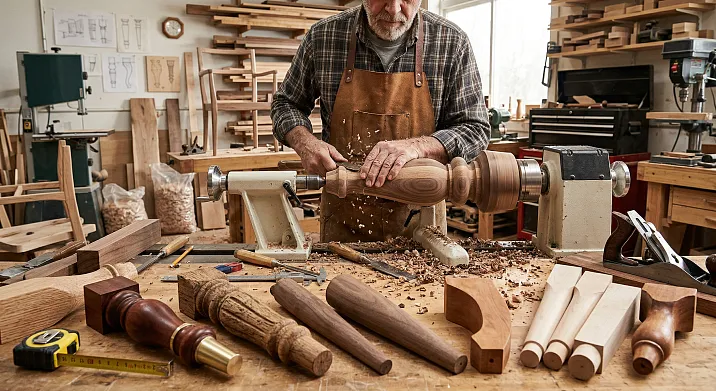
Turning is work done on a lathe. The workpiece rotates, and the cutting tool removes material, forming the desired profile: barrels, discs, tapers, transitions. Turned legs can be classical (balusters with a traditional rhythm of elements) or custom—with a unique silhouette developed for a specific project. When ordering, a profile drawing or sample is provided.
Carved supports
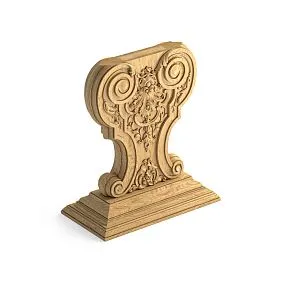
Wood carving is a complex process that requires either the manual work of a master carver or high-precision CNC equipment.Custom carved furniture legsare made to a sketch or drawing: ornaments, leaves, scrolls, geometric patterns. This is the most decoratively rich option, suitable for classical, baroque, and exotic interiors.
Figurative and geometric models
Geometric legs — square, polygonal, with chamfers, stepped transitions — are produced by milling. Figurative supports can combine several techniques: the base is turned, the decor is carved. Such products are suitable for Art Deco, eclecticism, and authorial design.
Massive load-bearing supports
For heavy tables, massive case goods, and bar counters, supports with an increased cross-section — from 70 mm and above — are needed. The standard catalog often does not cover extra-large sizes. Custom ordering by parameters solves this task: the required height, the required cross-section, the required wood species.
Legs with a ready finish or without
A custom manufacturing order allows you to choose the final finish: unpaintedfurniture legs for paintingtinted, lacquered, patinated, with decorative finishes. This is critical when it is necessary to precisely match the color and texture of existing furniture.
For which furniture are legs most often ordered?
Custom table legs
Tables are the most common case for custom leg orders. A dining table at a non-standard height, a desk tailored to the ergonomics of a specific user, a designer coffee table, a console table with decorative turned supports. For each type—its own height, its own cross-section, its own profile.
A dining table typically assumes a height of 720–760 mm including the tabletop. If the top thickness is 40 mm—legs of 680–720 mm are needed. If the owner is tall and prefers a table at 800 mm—the legs are calculated individually. This is a direct argument in favor of custom production.
Custom sofa legs
Sofa legs are a visible detail. They shape the 'stance' of the piece above the floor, define its character—heavy or light, classic or modern. The standard height is 80–150 mm, but when replacing legs on a sofa, the exact size must be matched, otherwise the seat height and ergonomics will change.
Custom wooden sofa legs—this also involves attachment via a mounting plate to the wooden frame of the piece. The plate size, hole placement, bolt diameter—all of this is agreed upon before production.
Custom bed legs
Bed legs bear dynamic loads: sitting down, standing up, moving on the bed. The support height here ranges from 80–200 mm. When restoring an old bed, the shape of the lost leg must be precisely reproduced. When making a new one, choose the height for a specific mattress and the users' height.
Custom legs for chests of drawers and dressers
Case furniture with legs looks fundamentally different than 'baseboard' furniture. Legs for a chest of drawers are 60–100 mm, for a dresser 80–150 mm. The style of the support should match the style of the case. When ordering new legs for an existing piece, it is important to provide the manufacturer with a photo of the furniture and precise dimensions.
Custom legs for wardrobes
Wardrobes on legs are a trend that's here to stay. But there's a nuance here: the legs under a wardrobe bear an enormous load, especially with filled shelves. It's necessary to correctly calculate the cross-section, choose oak as a stronger wood species, and provide for the correct system of attachment to the wardrobe base.
Legs for custom and designer furniture
This is the most creative scenario. The designer develops furniture from scratch; the legs are part of the author's concept. The form is created from a sketch or 3D model and produced according to specifications. Such a task requires a manufacturer with engineering capabilities: not just a lathe workshop, but the ability to work with drawings and approve a prototype.
By what parameters are custom furniture legs manufactured?
Before placing an order, it's important to clearly define the set of parameters. Here is a complete list of what needs to be agreed upon:
| Parameter | What to consider |
|---|---|
| Height | Including cover, frame, mounting plate |
| Cross-section / diameter | Based on load and visual proportions |
| Shape | Straight, conical, turned, carved, shaped |
| Style | Classic, contemporary, minimalism, art deco |
| Wood Species | Oak or beech depending on the task |
| Finish | Unpainted, tinting, varnish, patina |
| Mounting type | Stud, plate, concealed mounting |
| Load | Light furniture or loaded products |
| Print run | Single unit, small series, production batch |
| Lead time | Standard or expedited |
Materials for custom furniture legs: oak and beech
Oak — status and durability
Oak is the choice for those who think decades ahead. Density around 700 kg/m³, high hardness, pronounced texture with beautiful grain pattern. Oak supports don't sag under load, don't lose geometry with humidity changes, take stains and varnish well. Over time, oak develops a noble patina that only makes furniture more beautiful.
Oak is the right choice for heavily loaded products: massive dining tables, cabinets, work desks, case furniture with significant weight.Solid oak furniture legs— is a guarantee that the support will last as long as the product itself.
Beech — ease of processing and richness of finish
Beech has slightly lower density than oak (around 650 kg/m³), but its uniform fine-grained structure makes it an ideal material for turning and carving. Beech legs come out with clean edges, without 'tear-outs' or fuzziness. Takes stains, tints, and varnish excellently — from beech it's easy to achieve shades like 'dark walnut', 'wenge', or 'ash'.
Beech is preferred for carved models, turned supports with complex profiles, furniture with bright colored finishes.Unpainted beech furniture legs— the standard choice for those who want to do the finishing themselves or for a specific project.
What to choose for different tasks
The rule is simple: for maximum load — oak with an increased cross-section. For complex carving and colored coating — beech. For restoring antique furniture — the species that was in the original. If there is no data — a specialist can help determine by the appearance of the wood.
How to correctly calculate leg dimensions before ordering
This is the most critical point. An error of 20 mm — and the table height is wrong, the sofa 'sags', the chest of drawers looks awkward. Here is a step-by-step calculation.
How to determine the required leg height
-
Determine the desired final height of the product (for example, a dining table — 740 mm)
-
Subtract the thickness of the tabletop (for example, 30 mm)
-
Subtract the thickness of the mounting plate or mounting element (10–15 mm)
-
Result: 740 − 30 − 15 = 695 mm — required leg height
For upholstered furniture, the scheme is the same, but the seat height (usually 420–450 mm from the floor) minus the seat cushion height is taken into account.
How to choose the cross-section
The cross-section of the leg depends on two things: load and visual proportions. A thin leg under a heavy chest of drawers is aesthetically incorrect and structurally dangerous. A massive support under an elegant coffee table ruins the entire look.
Guidelines:
-
Coffee table, pouf, bench — diameter 35–45 mm
-
Sofa, armchair — 45–55 mm
-
Dining table — 55–70 mm
-
Chest of drawers, wardrobe — 55–65 mm
-
Bar counter, work desk — from 70 mm
What data must be provided to the manufacturer
-
Exact leg height in mm
-
Cross-section (diameter or dimensions)
-
Shape (description, sketch, sample photo, drawing)
-
Wood species
-
Coating type
-
Mounting type
-
Quantity of pieces
-
Production time
How to choose leg shape and style to match the interior
Classicism and neoclassicism
Turned balusters, S-shaped profiles, carved decor, oak stained to dark walnut or gold with patina. Classic style demands richness of detail: a leg doesn't just support furniture, it participates in the architectural rhythm of the interior. For a classic living room, study, or boudoir—this is precisely the approach.
Modern style and minimalism
Clean lines, square or tapered profiles without decoration, matte neutral finishes. In a modern interior, a leg is a quiet, confident accent that doesn't overpower the overall look. Light beech, natural untinted oak, black matte enamel — this is the palette of minimalism.
Provence and rustic
Slightly 'distressed' surfaces, white or cream paint with artificial aging, light patina on protruding elements. Legs are thin, elegant, often tapered. The wood here 'speaks' softly but convincingly.
Art Deco and eclecticism
Geometry, contrast, unexpected proportions. Legs with chamfers, stepped transitions, atypical cross-sections. It is here that custom orders truly shine: non-standard shapes, unusual finishes, combinations of wood species.
How to match legs with handles and fronts
The only rule: either everything from the same series (wood species, finish, proportions), or a deliberate contrast (white fronts + dark oak supports). Intermediate options — 'similar but not quite' — create visual discomfort that's hard to articulate but easy to feel. STAVROS offers complete solutions:legs and handles from a unified series, which eliminates inconsistency.
Custom leg mounting: what to choose
Mounting is what people think about last and what becomes a problem first. If the mounting type isn't agreed upon before production, the finished leg might not fit the furniture due to the configuration of the mounting assembly.
Stud (screw-in bolt)
The most universal option. An M8 or M10 metal stud is screwed or pressed into the end of the leg. It is screwed into an embedded nut, pre-installed in the furniture body or frame. Strong, reliable, detachable. Suitable for tables, case furniture, beds.
Mounting plate
A metal plate with four holes is screwed to the furniture frame or base. The leg is secured through it with screws or a bolt. Especially common in upholstered furniture: the plate is screwed into the wooden frame of a sofa or armchair. Reliable, fast, no special tools required.
Hidden fastening
The leg is attached without visible metal elements—via a wooden tenon or an insert bushing. Used in luxury-class products where every detail matters, including the absence of visible hardware.
Reinforced mounting for heavy furniture
Cabinets, massive dining tables, workbenches—here a standard bolt is insufficient. Reinforced plates with additional mounting points, larger diameter bolts, metal insert nuts with a large bearing area are used. This is agreed upon with the manufacturer at the technical specification stage.
What to prepare before placing an order: a complete checklist
Here is a specific list of data the manufacturer must receive from you for accurate order fulfillment:
Geometry:
-
Exact height in mm
-
Diameter (for round) or cross-section (for square/rectangular)
-
Diameter of mounting base and top platform
Shape and style:
-
Shape description or model name
-
Photo, sketch, or drawing (if non-standard)
-
Sample (if exact replication is required)
Material and finish:
-
Wood species (oak / beech)
-
Coating type (uncoated / tint / varnish / patina / enamel)
-
Shade or color code (if available)
Mounting:
-
Mounting type (stud / plate / concealed)
-
Stud diameter if needed
-
Location of mounting holes on the plate
Organizational:
-
Quantity of pieces
-
Need a prototype (yes / no)
-
Production time
Can legs be ordered by photo, drawing, or sample
Yes — and this is one of the main advantages of custom manufacturing.
By photo
If you have a high-quality photo of the leg with multiple angles and at least one dimensional reference (a ruler nearby, or a known furniture size), the manufacturer can recreate the profile. This is an approximate but workable method for simple shapes.
From a sketch
A hand-drawn sketch with key dimensions is sufficient for producing straight, tapered, and geometric legs. For carved legs, a more detailed drawing or vector file is needed.
From technical specifications
Technical specifications are a comprehensive document with dimensions, shape description, material requirements, finish, and mounting details. This format is used for B2B orders: furniture factories, design studios, architectural bureaus.
From an existing sample
Bringing or sending an actual leg is the most accurate method for replication. The manufacturer takes measurements, reproduces the profile, and creates an exact copy. Important: specify whether exact identity is required (for restoration) or if minor interpretation of the shape is acceptable.
What's important for an accurate result
Any visual material works better if accompanied by at least basic dimensions. A photo without dimensions gives the silhouette but not the scale. A drawing with dimensions is already precise technical specifications that the manufacturer can work with without unnecessary iterations.
How custom furniture leg manufacturing works: step by step
Understanding the process reduces anxiety and makes communication with the manufacturer more effective.
Step 1. Initial Request
You describe the task: dimensions, shape, material, quantity, deadline. A specialist clarifies details and asks questions. At this stage, the main parameters and preliminary cost are determined.
Step 2. Form Approval
If the form is non-standard — the manufacturer offers options, sends photos of similar finished products for reference, or develops a drawing based on your sketch. This stage determines the final appearance of the leg.
Step 3. Material and Finish Selection
Oak or beech. Unpainted or with a finish. Toning, varnish, patina, enamel. If you need to match the color of existing furniture — send a sample or photo indicating the shade.
Step 4. Prototype Manufacturing
For non-standard orders, serial projects, and designer furniture, a prototype is highly recommended. This is a physical product that can be attached to furniture to evaluate the form, size, and surface quality. It's better to make adjustments on the prototype than to redo a finished batch.
Step 5. Batch Production
After approving the prototype, the manufacturing of the entire batch begins. Turning, milling, hand carving (if necessary), sanding. All products are made from technologically properly dried wood — this prevents deformation after manufacturing.
Step 6. Finishing
Application of the final coating according to approved samples. Toning, varnishing, patination — depending on the agreed option.
Step 7. Quality Control
Each leg is checked for geometry: height, cross-section, perpendicularity of ends, profile symmetry. This is especially important for serial orders, where all products must be identical.
Step 8. Packaging, assembly with hardware, and delivery
Legs are packaged, equipped with mounting hardware if necessary, and shipped to the specified address. STAVROS provides delivery across Russia, CIS countries, and European countries.
What affects the cost of custom furniture legs
The price range for custom legs is wide — from simple conical beech supports to hand-carved oak products. Here is the complete list of factors:
-
Wood species: oak is more expensive than beech
-
Complexity of shape: a straight leg is cheaper than a turned one, a turned leg is cheaper than a carved one
-
Threading and decor: handcrafted or CNC — significantly increase the price
-
Size: tall and massive supports require more material and time
-
Finish: unpainted is cheaper; patina, decorative painting, gilding — more expensive
-
Mounting type: a leg with a pre-installed stud or plate costs slightly more but saves installation time
-
Urgency: expedited production typically involves a surcharge
-
Quantity: a single order is more expensive per piece than a batch of 100–200 units
Common mistakes when ordering furniture legs
Incorrect height calculation
The most common mistake. Legs are ordered without accounting for the thickness of the tabletop and mounting plate. Result — the table is 4–5 cm higher than standard. Always calculate 'from the bottom up': desired final height minus everything above the leg.
Ignoring the mounting type
Purchased M8 stud legs, but the sofa frame only has a mounting plate. Incompatibility is discovered during installation. Solution: agree on the mounting type before production starts, not after.
Incorrect load assessment
For a massive dining table with a heavy top, thin beech legs with a 40 mm diameter were chosen. After a few months: loosening, micro-cracks, misalignment. For loaded products, always choose oak and increased cross-section.
Choosing shape only from a picture
Photos don't convey real proportions or scale. A leg that looks beautiful in an isolated shot may appear visually weak next to your furniture. Ask the manufacturer to show a photo of the product in the context of real furniture.
Uncoordinated finish
"Dark walnut" looks different from different manufacturers. If you need an exact color match, send a sample or RAL/NCS code.
Sending photos without dimensions
A beautiful photo without a single number is visual information, but not a technical specification. The manufacturer cannot make an accurate leg without dimensions.
Confusion between leg height and final product height
Leg 700 mm + top 40 mm = table 740 mm. Leg 700 mm is not a table height of 700 mm. This sounds obvious, but the mistake occurs regularly.
Misunderstanding the difference between decorative and load-bearing legs
Thin carved supports are decoration. For a light console or decorative table, they work great. Under a massive table or loaded cabinet — it's a disaster. Function and decor must match the load.
Why custom furniture legs are better than standard solutions
A direct answer to the question many don't dare to ask openly:
-
Exact dimensions — no compromises: no 'slightly higher', no 'almost that'
-
The right shape — not 'similar', but exactly the one needed
-
Style matching — the support is created for specific furniture and interior
-
Wood species selection — oak or beech for specific load and finish
-
Color-matched finish — matching the tone of existing furniture
-
Ability to replicate a sample — for restoration or continuing a series
-
Custom sizes — what you won't find in any ready-made catalog
-
Convenience for projects — from a single pair of legs to hundreds of units in a series
Who custom manufacturing is especially suitable for
Private clients
If you're updating furniture, having it custom-made by a carpenter, or doing restoration — custom legs give you full control over the result. You don't choose from what's available. You define what should be.
Interior designers
A designer is responsible for the integrity of the look. Standard catalog legs may not match the concept in shape, color, or proportions. Custom manufacturing is a tool that gives the designer the freedom to create, not just select.
Furniture workshops and small manufacturers
Having your own lathe and carving production is impractical for small volumes. Outsourcing manufacturingcustom wooden furniture legsfrom a specialized manufacturer — this means lower cost, consistent quality, and freedom from non-core equipment.
For large furniture manufacturers
For serial collections, legs with consistent quality in large volumes are needed. STAVROS works with factories on terms of serial supply: development of an exclusive model for the collection, a prototype, approval, series.
For restorers
Reproducing a lost support from a sample or measurement is a specialized task that only an experienced manufacturer with the right equipment can handle. This is precisely the approach to individual orders that STAVROS's full production cycle provides for.
FAQ: popular questions about ordering furniture legs
Can furniture legs be ordered to custom sizes?
Yes. This is the primary scenario for non-standard furniture, restoration, and design projects. Height, cross-section, shape, material, finish, and mounting type are specified.
What data is needed to manufacture custom legs?
Height in mm, cross-section (diameter or dimensions), description or sketch of the shape, wood species, type of finish, type of mounting, quantity of pieces, and deadline.
Can legs be made from a photo or an old sample?
Yes. From a photo with multiple angles and a size reference, from a real (physical) sample, or from a drawing. A prototype is recommended for complex shapes.
What materials are best suited for custom furniture legs?
Oak — for heavily loaded items, classic interiors, status furniture. Beech — for carved shapes, colored coatings, items with complex finishing.
Can I order just one pair of legs, not a large batch?
Yes. STAVROS accepts individual orders — including for restoration or replacement of a single broken leg.
What affects the production time?
Complexity of shape, availability of material in stock, need for drawing development and a prototype, current production load. Standard timeframe — from several working days to several weeks depending on the task.
Can I choose the finish and color?
Yes. Available: unfinished legs, tinting to the desired shade, varnishing, patination, decorative painting. For precise color matching — a sample or color code is provided.
Which legs are best suited for heavy furniture?
Oak legs with a diameter of at least 60 mm, with mounting via a reinforced stud or plate.
Can I order legs for restoring old furniture?
Yes. Based on a sample, measurements, or photo with dimensions, the manufacturer reproduces the required shape. The wood species is selected to match the original.
How to choose the mounting for legs in advance?
Determine what is present in your furniture's construction: an embedded nut for a stud, a wooden frame for a mounting plate, or no mounting assembly at all. Inform the manufacturer at the application stage — they will suggest the correct mounting option for your furniture.
Conclusion
Ordering furniture legs means getting exactly what you need, not just what's in stock. Custom manufacturing is always justified when standard sizes don't fit, when a rare shape is needed, when it's important to match the furniture's style, or to restore a lost element.
Three things to determine first: size (height and cross-section considering the product's construction), material (oak or beech for load and finish), mounting (type of installation for the specific furniture). Everything else — shape, style, coating, batch size — is built around these three parameters.
For non-standard tasks, custom production is more convenient, precise, and reliable than any ready-made catalog — because the result is created for your specific task, not for an average scenario.
STAVROS is a Russian manufacturer of wooden furniture legs and supports made of oak and beech. Over 130 ready-made models in the catalog, full-cycle custom manufacturing based on specifications, drawings, samples, and photos. 3D model development, prototype manufacturing, serial production, finishing, fastener kit assembly, delivery across Russia, CIS, and European countries. One source — a complete solution.