Article Contents:
- Furniture Hardware: The Invisible Foundation of Quality Furniture
- What is Furniture Hardware and Why Is It So Important
- Types of Furniture Hardware: From Functional to Decorative Elements
- Functional Hardware
- Decorative Hardware
- How to Choose Quality Furniture Hardware
- Quality Criteria: What to Pay Attention to When Choosing
- Materials and Finishes
- Functionality and ergonomics
- Reliability and durability
- Compatibility with Furniture Materials
- Design and Aesthetics
- Brands and Manufacturers: Who to Trust
- European manufacturers
- Asian Manufacturers
- Russian Manufacturers
- Price-to-Quality Ratio: How to Avoid Overpaying
- Define Priorities
- Invest in Key Elements
- Compare Offers from Different Suppliers
- Consider Hidden Costs
- Consider the Long-Term Perspective
- Perm: Where to Buy High-Quality Furniture Hardware
- Specialized Furniture Hardware Stores in Perm
- Online Stores: Convenience and Wide Selection
- Construction Markets and DIY Hypermarkets
- Manufacturers and Distributors: Direct Access to the Source
- Trends and Innovations in the World of Furniture Hardware
- Modern Trends in Hardware Design
- Minimalism and Hidden Solutions
- Natural materials and eco-friendliness
- Individualization and Personalization
- Retro Motifs and Vintage Style
- Technological Innovations: Smart Hardware
- Electronic Opening Systems
- Biometric Locks
- Integrated lighting
- Modular Systems
- Ecological Aspect: Sustainable Development in Furniture Hardware Production
- Use of recycled materials
- Avoid Harmful Coatings
- Energy-efficient production
- Biodegradable materials
- Practical Tips for Choosing and Installing Furniture Hardware
- How to Properly Select Hardware for a Specific Type of Furniture
- Kitchen furniture
- Closets and Sliding Wardrobes
- Children's Furniture
- Office Furniture
- Hardware and Materials for Installing Furniture Hardware
- Basic toolset
- Color Revolution: Painting Techniques for Stylish Refresh
- Fasteners
- Auxiliary Materials
- Step-by-Step Guide to Installing Main Types of Furniture Hardware
- Installing Hinges
- Installing Drawer Guides
- Installing Handles
- Care and Maintenance of Furniture Hardware
- Regular Cleaning

Have you ever wondered why some furniture lasts for decades, maintaining its functionality and attractive appearance, while others quickly lose their qualities? Why do doors on some cabinets open smoothly and silently, while others constantly creak and misalign? The secret lies in the details — specifically, in furniture hardware, that invisible hero which determines the comfort, durability, and aesthetics of your furniture.
Perm, as a dynamically developing city with rich industrial traditions, offers wide opportunities for those seeking quality furniture hardware. But how not to get lost in the variety of offerings? How to choose exactly those components that will last long and please the eye? And most importantly — Perm: Where to Buy Furniture Hardware of the highest quality at a reasonable price? Let’s figure it out together.


Furniture Hardware: The Invisible Foundation of Quality Furniture




What is furniture hardware and why is it so important
Furniture hardware is a collection of components that ensure the functionality, reliability, and aesthetic qualities of furniture. It is a kind of 'skeleton' and 'nervous system' of any interior item, from a simple shelf to a complex modular set.
Furniture hardware includes:
- Hinges for Swing Doors
- Guides for drawers
- Lift mechanisms
- Handles and knobs
- Locks and Latches
- Supports and legs
- Connecting Elements (Conformers, Eccentrics, Dowels)
- Furniture lighting
- Hooks and Hooks
- Decorative Elements (Moldings, Inserts, Profiles)
The quality of furniture hardware directly affects the functionality, durability, and aesthetics of furniture. Even the most expensive materials and flawless cabinet construction will not save furniture if hinges loosen quickly, guides misalign, and handles fall off.
Imagine a kitchen set with hinges that cannot support the weight of the door, or a sliding wardrobe with guides that jam every time you open it. Such furniture will quickly turn from a source of pride into a constant source of irritation.
Quality hardware, on the contrary, makes using furniture comfortable and pleasant. Smooth and silent closing of doors, easy drawer extraction, reliable fixation of elements — all this creates a sense of sturdiness and reliability, which is so valued in good furniture.
Our factory also produces:


Types of Furniture Hardware: From Functional to Decorative Elements
Furniture hardware is extremely diverse and can be classified by various criteria. Let’s consider the main types of hardware and their features.
Get Consultation
Functional Hardware
Hinges are hinge mechanisms that enable opening and closing doors. Modern hinges are high-tech products that may have many additional functions:
- Hinges with a closer ensure smooth and silent door closing
- Hinges with a damper prevent door slamming
- Hinges with a self-closing function automatically close the door if it is open less than 70 degrees
- Hinges with three-plane adjustment allow precise adjustment of the door position
Hinges differ by mounting type (surface-mounted, semi-surface-mounted, inset), opening angle (90, 110, 165, 180 degrees), material (steel, zinc alloy, brass) and finish (nickel, chrome, bronze, gold).
Drawer slides ensure smooth and easy drawer extraction. They come in:
- Ball-bearing – budget option, providing basic functionality
- Ball-bearing – more advanced system, providing smooth operation and withstanding significant loads
- Hidden – installed under the drawer bottom, ensuring an aesthetic appearance
- Full-extension slides – allow complete drawer extraction, ensuring access to all contents
- Slides with soft-close – ensure smooth and quiet closing
- Slides with push-to-open system – allow opening drawers with a light press on the front panel
Modern premium slides can withstand loads up to 80 kg, allowing their use even in industrial furniture.
Lift mechanisms are used to open doors upward, not sideways. They are especially popular in kitchen cabinets, where space-saving is of primary importance. Lift mechanisms come in:
- Folding – the door folds in half when opened
- Overhead – the door opens upward and locks in a horizontal position
- Swing-over – the door first rotates, then swings outward
- Parallel – the door lifts parallel to the furniture frame
Modern lift mechanisms are equipped with soft-close systems, adjustable opening force, and electric drives.
Decorative hardware
Handles and knobs – these are not only functional elements but also important decorative accents capable of completely transforming the appearance of furniture. They come in:
- Bar handles – classic variant, consisting of a curved or straight bar with two mounting points
- Button handles – compact elements with one mounting point
- Inset handles – recessed into the front panel, not protruding beyond its edges
- Profiled handles – integrated into the front panel construction
- Rail handles – long horizontal elements
Materials for making handles also impress with variety: metal (brass, stainless steel, aluminum), wood, glass, ceramic, plastic, leather.
Decorative appliqués and moldings give furniture a finished look and stylistic expressiveness. They can be made from various materials – wood, MDF, polyurethane, metal – and have varying degrees of decorative appeal.
Furniture lighting – these are not just additional light sources, but also powerful tools for creating atmosphere and highlighting interior features. They come in:
- Spotlights – for illuminating specific zones
- Linear – for even surface illumination
- Sensory – activate upon touch or motion
- LED strips – for creating even backlighting
How to choose quality furniture hardware
Quality criteria: what to pay attention to when choosing
Choosing quality furniture hardware is a task requiring attention to detail and understanding of key quality criteria. Here’s what to pay attention to:
Materials and Finishes
The material from which the hardware is made determines its strength, durability, and appearance. For functional hardware (hinges, guides), the optimal materials are:
- Steel with anti-corrosion coating – provides high strength and resistance to loads
- Zinc alloy – combines sufficient strength with the ability to create complex shapes
- Aluminum alloys – lightweight and corrosion-resistant
For decorative hardware (handles, overlays), the choice of materials is broader:
- Brass – a strong and malleable material with a noble appearance
- Stainless steel – a practical and durable material
- Wood – a warm and eco-friendly material
- Glass and crystal – refined materials for elegant furniture
- Ceramic – a material that allows creating bright and original designs
The coating of the hardware should be even, without drips, bubbles, or scratches. Quality coating not only improves appearance but also protects hardware from corrosion and mechanical damage.
Functionality and ergonomics
Functionality – a key criterion when choosing furniture hardware. Hinges should ensure smooth and silent opening/closing, guides – smooth and even drawer extension, handles – comfortable grip.
Ergonomics is especially important for elements that users interact with directly – handles, buttons, locks. They should be easy to use, conform to hand anatomy, and have no sharp edges or protrusions.
To evaluate functionality and ergonomics, it’s best to test the hardware 'in action' – open/close a door, pull out a drawer, grip a handle. Quality hardware operates smoothly, without sticking, jerking, or squeaking.
Reliability and durability
The reliability and durability of hardware are determined not only by materials but also by manufacturing quality, precision of part fitting, presence and effectiveness of damping and adjustment systems.
Quality hinges and guides must withstand multiple opening/closing cycles (up to 200,000 cycles for premium models) without losing functionality. They should have a safety margin exceeding expected loads.
Fastening elements (screws, bolts, anchors) must be made of quality materials, have correct threading, and match the type of material into which they will be screwed.
Compatibility with furniture materials
Hardware must be compatible with the materials from which the furniture is made. For example, heavy wooden doors require reinforced hinges capable of supporting significant weight. Glass doors require special hinges with soft pads to prevent glass damage.
Fastening elements must match the type of material – different types of fasteners are required for particleboard, MDF, solid wood, and glass. Incorrectly chosen fasteners may not provide secure fixation or damage the material.
Design and aesthetics
Hardware design should harmonize with the overall style of the furniture and interior. This does not mean the hardware should be inconspicuous – on the contrary, it can become a striking accent, highlighting the uniqueness of the space.
For classic furniture, elegant brass or bronze handles with patina or gold plating are suitable. For modern furniture – minimalist chrome or matte metal elements. For Provence or country-style furniture – ceramic handles with painted designs or wooden handles with a distressed finish.
The color of the hardware can either harmonize with the main color of the furniture, creating a cohesive look, or contrast with it, becoming a striking accent.
Brands and manufacturers: who to trust
The market offers hundreds of furniture hardware manufacturers from different countries, with varying quality levels and pricing policies. Let’s consider the most well-known and reliable brands.
European manufacturers
European furniture hardware manufacturers set quality and innovation standards in the industry. Their products are distinguished by impeccable quality, thoughtful design, and high functionality.
Blum (Austria) – one of the world's leading manufacturers of hinges, lifting mechanisms, and sliding systems. Blum's products are distinguished by innovative technologies, impeccable quality, and thoughtful ergonomics. The proprietary BLUMOTION systems ensure smooth and silent closing, while the TIP-ON technology allows opening furniture without handles.
Hettich (Germany) – one of the largest furniture hardware manufacturers with over 125 years of history. The company offers a wide range of hinges, guides, lifting mechanisms, and decorative hardware. The InnoTech and ArciTech sliding systems, as well as Sensys hinges with integrated stop, have gained particular popularity.
Hafele (Germany) – a company with a rich history, offering comprehensive solutions for furniture and interiors. The product range includes not only traditional hardware but also lighting systems, electronic locks, and storage systems. Hafele is known for its innovative solutions for small spaces and transformable furniture.
Grass (Austria) – a company specializing in the production of high-quality sliding systems and hinges. Grass products are distinguished by elegant design, smooth operation, and durability. The Nova Pro and Vionaro sliding systems, as well as Tiomos hinges, have gained particular popularity.
Asian manufacturers
Asian furniture hardware manufacturers have made significant quality leaps in recent years, offering products that combine affordable pricing with respectable quality.
FGV (China) – one of the largest furniture hardware manufacturers in Asia, offering a wide range of hinges, guides, and decorative hardware. FGV's products are distinguished by good price-to-quality ratio, making them popular among mid-range furniture manufacturers.
GTV (Poland-China) – a company offering a wide range of furniture hardware produced in factories in Poland and China. GTV is known for its innovative solutions in furniture lighting and storage systems. The company’s products combine European design with affordable pricing.
Boyard (Russia-China) – a company offering a wide range of furniture hardware produced in Chinese factories according to Russian technical specifications. Boyard is known for its stylish collections of handles, as well as functional hardware adapted to Russian operating conditions.
Russian manufacturers
Russian furniture hardware manufacturers are actively developing, offering products adapted to the specifics of the Russian market.
Valmax – one of the largest Russian furniture hardware manufacturers, offering a wide range of hinges, guides, handles, and decorative elements. Valmax products are distinguished by good price-to-quality ratio and adaptation to Russian operating conditions.
TD "Ferum" – a Russian company specializing in the production of furniture handles, hooks, supports, and decorative elements. TD "Ferum" products are distinguished by original design, quality execution, and affordable pricing.
MacMart – a major Russian distributor of furniture hardware, developing its own production. The company offers a wide range of hardware across various price categories, from budget to premium solutions.
Price-to-quality ratio: how not to overpay
Furniture hardware is available in a wide price range – from budget models to premium solutions with corresponding cost. How to find the optimal price-to-quality ratio?
Define priorities
First, determine which hardware features are most important for your project. For kitchen furniture, which is used intensively, functionality and durability will be the priority. For living rooms or bedrooms, where furniture is used less frequently but plays an important aesthetic role, design and appearance may take precedence.
Invest in key elements
Not all hardware elements are equally important in terms of functionality and furniture longevity. Invest in key elements – hinges, guides, lifting mechanisms – which determine ease of use and furniture lifespan. You can save on decorative elements that do not bear functional load.
Compare offers from different suppliers
Prices for the same hardware from different suppliers can vary significantly. Compare offers, paying attention not only to cost but also to delivery terms, warranties, and return or exchange possibilities.
Consider hidden costs
When calculating hardware costs, consider not only the price of the items themselves but also associated expenses – delivery, installation, and possible need to purchase additional components or tools for mounting.
Consider long-term perspective
Cheap hardware may require replacement within a short time, leading to additional expenses and hassle. Quality hardware will serve for many years, maintaining functionality and attractive appearance. Consider purchasing quality hardware as an investment in the longevity and comfort of your furniture.
Perm: where to buy high-quality furniture hardware
Specialized furniture hardware stores in Perm
Perm, as a major industrial and cultural center, offers wide opportunities to purchase quality furniture hardware. The city has dozens of specialized stores offering a broad range of furniture components.
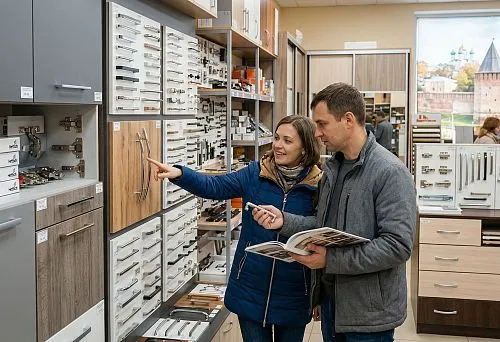
Specialized stores are the optimal choice for those who value the opportunity to see and touch the product before purchasing, receive professional consultation, and buy everything needed in one place.
In Perm, stores specializing in various types of furniture hardware—from basic components to exclusive designer solutions—operate. Many of them are located in areas traditionally characterized by high concentrations of furniture manufacturing and construction markets—Industrial District, Park Microdistrict, Hasan Heroes Street.
Advantages of specialized stores:
- Ability to see and touch the product before purchasing
- Professional consultation from specialists
- Availability of samples and demonstration stands
- The opportunity to purchase everything needed in one place
- Guarantee of product authenticity
Online stores: convenience and wide selection
Online trading opens new horizons for those who are looking, Perm: Where to Buy Furniture Hardware With maximum convenience and choice. Online stores offer an enormous assortment, convenient search, and the ability to compare different options.
Advantages of online purchases:
- Access to catalogs 24/7 without needing to visit a physical store
- Ability to quickly compare prices and features
- Delivery of the order to your home or pickup point
- Access to reviews from other customers
- Often lower prices due to the absence of costs for maintaining retail spaces
When choosing an online store, it is important to pay attention to the seller's reputation, presence of detailed product descriptions and high-quality photos, delivery and return conditions, as well as availability of technical support that can advise on selecting and installing hardware.
Many Perm furniture hardware stores today are developing an omnichannel sales model combining the advantages of offline and online retail. This allows customers to view products in a showroom, receive specialist consultation, and then place an order online with delivery to their home.
Construction markets and DIY hypermarkets
Construction markets and large DIY hypermarkets (Leroy Merlin, Castorama, Maxidom) offer a wide range of basic furniture hardware at affordable prices. This is the optimal choice for standard solutions and budget projects.
Advantages of DIY hypermarkets:
- Affordable prices
- Availability of product "here and now"
- Ability to purchase accompanying items (tools, fasteners)
- Convenient location in different city districts
- Extended operating hours, often 24/7
Such stores typically offer hardware in the mid-price segment, aimed at mass consumers. It is difficult to find exclusive designer solutions or specialized hardware for non-standard projects, but for most standard tasks, the assortment is quite sufficient.
Manufacturers and distributors: direct access to the source
For professionals in the furniture industry and large projects, the optimal solution may be direct cooperation with furniture hardware manufacturers or their official distributors.
Advantages of working with manufacturers:
- Guarantee of product authenticity
- Access to the full assortment, including novelties and specialized solutions
- Ability to receive technical support from the manufacturer
- Optimal prices without intermediary markups
- Ability to order custom solutions
In Perm, offices of many leading furniture hardware manufacturers operate, as well as local manufacturers offering quality products adapted to Russian operating conditions.
Trends and innovations in the world of furniture hardware
Modern trends in furniture hardware design
Furniture hardware design, like interior design as a whole, is subject to fashion trends. Here are several current trends:
Minimalism and hidden solutions
Modern design leans toward clean lines, absence of unnecessary details, visual lightness. This is reflected in the popularity of hidden hardware—hinges that are not visible when the door is closed, recessed handles that do not protrude beyond the facade, push-to-open systems that allow opening furniture without visible handles.
Minimalist hardware does not draw attention, allowing focus on the shape and texture of the furniture itself. This is especially relevant for modern interiors in minimalist, high-tech, and Scandinavian styles.
Natural Materials and Eco-friendliness
The ecological trend is manifested in the use of natural materials—wood, stone, leather—as well as natural forms and textures. Popular are handles made of untreated wood, preserving the natural texture and color, or natural stone, with its unique pattern and texture.
Ecological aspects are not only reflected in materials but also in production technologies—use of safe dyes and coatings, energy-efficient processes, and the possibility of recycling products after the end of their service life.
Individualization and personalization
Demand is growing for unique, personalized solutions reflecting the owner's individuality. This may include custom-made hardware with monograms, logos, or using unusual materials or color combinations.
3D printing technologies open new possibilities for creating hardware with complex shapes and unique designs. This allows implementing the most daring design ideas and creating truly unique furniture.
Retro motifs and vintage style
Interest is reviving in designs from past eras—Art Deco, modernism, Scandinavian design of the 1950s–60s. This is reflected in the use of characteristic forms, materials, and color combinations.
Handles with patina, imitating natural metal aging, with a worn effect, using traditional techniques—engraving, embossing, inlay.
Technological Innovations: Smart Hardware
Technological progress has not bypassed furniture hardware. Innovative solutions are emerging that make furniture use more comfortable and functional:
Electronic opening systems
Electronic systems allow opening furniture using a remote control, smartphone, or voice commands. This is especially relevant for kitchen cabinets, where hands are often occupied or dirty, and for tall cabinets that are difficult to reach.
Systems can be integrated into the smart home ecosystem, allowing control of furniture together with other devices — lighting, climate control, security systems.
Biometric locks
Biometric locks provide access to furniture contents via fingerprint, eye retina scan, or facial recognition. This is an ideal solution for storing valuables, confidential documents, hazardous items that need to be protected from children.
Modern biometric locks are compact, energy-efficient, highly reliable, and can be integrated into various types of furniture — from office cabinets to home safes.
Integrated lighting
Lighting systems integrated into furniture hardware automatically turn on when a cabinet is opened or when approaching it. This not only enhances user comfort but also contributes to energy savings.
Modern LED systems provide even, eye-friendly lighting, may have brightness and color temperature adjustment, and operate on batteries or accumulators, simplifying their installation and use.
Modular systems
Modular systems allow easily transforming and adapting furniture to changing needs. This is especially relevant for small spaces, where every centimeter counts.
Modern modular systems include various types of guides, fasteners, and connecting elements that allow quickly and without special tools to change furniture configuration, add or remove elements, adjust shelf and drawer heights.
Ecological Aspect: Sustainable Development in Hardware Production
Ecological awareness is becoming an important factor when choosing furniture hardware:
Use of recycled materials
More and more manufacturers use recycled materials to produce hardware, thereby reducing the product's ecological footprint. These can be recycled metals, plastics, glass, which do not fall short of primary materials in terms of properties.
Elimination of harmful coatings
Modern technologies allow creating protective and decorative coatings without using heavy metals and other harmful substances. This makes hardware safe for health and the environment.
Natural coatings are gaining popularity — oils, waxes, water-based lacquers, which highlight the natural beauty of materials and do not emit harmful substances.
Energy-efficient production
Leading manufacturers are implementing technologies that reduce energy consumption during hardware production. This includes using renewable energy sources, optimizing production processes, and minimizing waste.
Biodegradable materials
Innovative polymer-based plant materials are gradually finding application in the production of certain types of hardware. They degrade naturally without harming the environment and possess sufficient strength and durability for use in furniture.
Practical tips for selecting and installing furniture hardware
How to properly choose hardware for a specific type of furniture
Choosing hardware should begin with analyzing the type of furniture, its purpose, materials it is made from, style, and operating conditions.
Kitchen Furniture
Kitchen furniture is used under conditions of high humidity, temperature fluctuations, steam, and grease. Hardware for kitchens should be:
- Resistant to moisture and corrosion (stainless steel, brass with protective coating)
- Strong and durable (kitchen cabinets open and close up to 50 times per day)
- Functional (full-extension systems for drawers, lifting mechanisms for upper cabinets)
- Easy to maintain (smooth surfaces that are easy to clean from dirt)
For kitchen fronts, optimal hinges with dampers, preventing door slamming, and three-plane adjustment, allowing precise door positioning. For drawers — full-extension guides with soft-close systems.
Closets and sliding wardrobes
Closets and sliding wardrobes are designed for storing clothing, shoes, accessories. Hardware for them should be:
- Durable and reliable (especially for sliding doors, which may have significant weight)
- Silent (especially important for bedrooms)
- Functional (storage systems, pull-out baskets, pantographs for raising clothes)
- Ergonomic (comfortable handles, optimal placement height of elements)
For sliding doors, the quality of roller mechanisms is important, ensuring smooth and silent movement. For hinged doors – hinges with wide opening angles (165-180 degrees), ensuring convenient access to contents.
Children's furniture
Children's furniture must be safe, functional, and age-appropriate. Hardware for children's furniture should be:
- Safe (without sharp edges or small parts that may detach)
- Durable (children often use furniture not as intended)
- Easy to use (children should easily open/close cabinets and drawers)
- Bright and attractive (especially for younger children)
For children's furniture, hinges with opening limiters are recommended, preventing finger pinching, and with dampers to prevent door slamming. Handles should be comfortable for small hands, without sharp edges or protrusions.
Office furniture
Office furniture is heavily used and must ensure efficient work. Hardware for office furniture should be:
- High-strength (office cabinets and drawers are opened/closed hundreds of times daily)
- Functional (archiving systems, pull-out keyboard trays, cable channels)
- Ergonomic (comfortable handles, optimal placement height of elements)
- Aesthetically pleasing (matching corporate style)
For office cabinets and drawers, reinforced hinges and guides are recommended, capable of withstanding heavy use. For protecting confidential information – quality locks, possibly with electronic or biometric access systems.
Tools and materials for installing hardware
Installing furniture hardware is a process requiring care, precision, and appropriate tools and materials.
Basic tool set
- Drill or screwdriver – for drilling holes and tightening fasteners
- Drill bit set – various diameters, for different types of materials
- Screwdrivers – Phillips and flathead, various sizes
- Ruler, tape measure, square – for precise measurements and marking
- Pencil, marker – for marking
- Marking templates – special tools that simplify marking holes for hinges, handles, guides
- Hammer – for driving in dowels, installing certain types of fasteners
- Pliers, wire cutters – for working with wire, small parts
- Level – for checking horizontal/vertical alignment
Specialized Tools
- Drilling guide – ensures accurate drill positioning and correct drilling angle
- Router – for cutting slots for hinges, locks, handles
- Press for installing eccentric bolts – ensures correct installation of eccentric bolts
- Templates for installing hinges – ensure precise positioning of hinges
- Glass suction cups – for safe handling of glass elements
Fastening elements
- Screws, bolts – various sizes and types, for attaching hardware to different materials
- Anchors – for mounting into walls, concrete, brick
- Conformers – special screws for connecting particleboard and MDF parts
- Eccentric bolts – for detachable connections of parts
- Shanks – wooden or plastic pins for strengthening connections
- Angles, plates – for additional reinforcement of connections
Auxiliary materials
- Wood glue – for strengthening connections
- Silicone sealant – for sealing connections in high-humidity areas
- Wax, furniture marker – for masking minor defects and scratches
- Lubricant – for hinges, guides, locks
- Protective caps – to prevent scratches on furniture and floor
Step-by-step instructions for installing various types of hardware
Hinge Installation
- Marking
- Determine the position of hinges on the door and cabinet body
- Using a template and pencil, mark the locations for drilling holes
- Check the accuracy of the markings using a level
- Drill hole preparation
- For cup hinges, drill a hole for the cup using a special drill-bit
- For surface-mounted hinges, drill holes for the mounting screws
- Clean the holes of chips and dust
- Installing Hinges
- Insert the hinge cup into the prepared hole and secure with screws
- Install the return plate on the cabinet body
- Connect the hinge parts and test functionality
- Adjustment
- Use adjustment screws to set the door position in three planes
- Check that the door opens and closes smoothly without sticking
- Ensure that the gaps between the door and the frame are even
Installing drawer guides
- Marking
- Determine the position of the guides on the side walls of the frame and drawer
- Mark the mounting locations using a ruler and pencil
- Check the parallelism of the marking lines
- Mounting guides to the frame
- Align the guide with the marked line
- Secure it with screws, starting from the outermost holes
- Repeat the procedure for the second guide
- Mounting guides to the drawer
- Align the guide's mounting part with the side wall of the drawer
- Secure it with screws, ensuring correct alignment
- Repeat the procedure for the other side
- Installing the drawer
- Insert the drawer into the frame, aligning the guide parts
- Check the smooth operation of the drawer
- Adjust the guide position if necessary
Installing handles
- Marking
- Determine the optimal handle position on the front panel
- Using a template and pencil, mark the locations for drilling holes
- Check the accuracy of the markings using a level
- Drilling Holes
- Select a drill bit matching the diameter of the handle's mounting hardware
- Drill holes at the marked locations
- Clean the holes of chips and dust
- Installing the handle
- Insert the mounting hardware (screws, screws) into the handle's holes
- Align the handle with the front panel, matching the mounting hardware with the drilled holes
- Secure the handle from the inside of the front panel by tightening the nuts or screwing in the screws
- Inspection
- Ensure the handle is securely fastened
- Check for absence of play or wobbling
- Tighten the mounting hardware if necessary
Care and maintenance of furniture hardware
Proper care of furniture hardware extends its lifespan and maintains its attractive appearance.
Regular cleaning
- Metal parts should be wiped with a soft dry cloth. For removing dirt, a mild soapy solution can be used, followed by thorough drying of the surface. Avoid abrasive cleaning agents that may damage the finish.
- Wooden parts require careful handling. They should be wiped with slightly damp cloth, avoiding excess moisture. Periodically, it is recommended to treat them with special waxes or wood oils that protect the surface and enhance the natural beauty of the wood texture.
- Plastic parts can be cleaned with mild detergents, avoiding aggressive chemical compounds that may cause clouding or cracking of the plastic.