Article Contents:
- Specifics of loads on sofa legs
- Weight distribution: physics of stability
- Leg materials: strength under load
- Cross-section and height: engineering calculation
- Types of mounting to the sofa frame
- Frame reinforcement: systematic approach to strength
- Height adjustment and floor protection
- Sofa leg styling
- Leg replacement: restoration and upgrade
- Frequently Asked Questions
- Conclusion

A sofa is not a decorative interior element, but a working horse of the home space, where people spend hours daily, sit down with momentum, children jump, sometimes lay down guests weighing up to one hundred kilograms.furniture hardware legs for a sofaThey not only bear the static weight of the structure and seated individuals, but also dynamic impacts, vibrations, alternating loads during standing-up and sitting-down, lateral forces when leaning on armrests. An error in choosing legs results in frame loosening, furniture sagging, creaking with every movement, premature failure of expensive upholstery and filling. Real use is merciless to weak structural elements — where engineering calculation yields to cost-saving or aesthetic compromises, furniture breaks down within one or two years instead of decades of service.


Specifics of loads on sofa legs
A sofa weighs from eighty to one hundred fifty kilograms depending on size, frame, filling. A two-seater with wooden frame and spring block — about ninety kilograms. A three-seater corner model with transformation mechanism — up to one hundred forty. To its own weight is added useful load: two to three people totaling one hundred fifty to two hundred twenty kilograms. In total, for four to sixof furniture legsit amounts to two hundred fifty to three hundred sixty kilograms under normal usage.
But reality is more complex than static calculation. A person does not smoothly settle onto a sofa, but falls with free-fall acceleration, creating impact load twice to three times their weight. A child jumps on the seat — impulse force reaches four to five times body mass. Two adults simultaneously sit on one end of a corner sofa — load concentration on two adjacent legs, each instantly bearing one hundred to one hundred twenty kilograms instead of calculated forty.
Dynamic forces arise constantly. A person stands up, leaning on armrests — lateral force seeks to overturn the structure. Someone suddenly lies down, throwing themselves onto the backrest — the frame bends, legs work in tension on one side and compression on the other. The sofa’s unfolding mechanism creates alternating loads — tension during extension, compression during folding. Each cycle — microscopic damage to fasteners, accumulating until critical mass.
Vibration from seated movements, from a nearby washing machine, from trucks passing by outside gradually loosens connections. Threaded fasteners weaken, glued joints break, wood compresses in contact zones. After one year of intensive use, the sofa begins to creak, after two — it rocks, after three — it requires repair.legs for sofa to buy in MoscowInsufficient strength — means planting a time bomb under the furniture for thirty to fifty thousand rubles.




Weight distribution: physics of stability
A sofa on four legs seems stable, but weight distribution is rarely even. The center of gravity shifts toward the back — where the mass of the frame, spring block, and cushions concentrates. Rear legs are loaded 20–30% more than front ones. If the structure has solid wood armrests, side legs bear additional load. A corner sofa with ottoman creates asymmetric distribution — the long side requires more legs or a reinforced frame.
Number of legs is determined by sofa length and base stiffness. A compact two-seater 140 cm wide is stable on four legs at the corners — two on front and rear lines. A three-seater 200–220 cm requires six legs: three along front and rear edges. Without a central leg, the base sags in the middle under seated weight, the spring block deforms unevenly, creating a dip in the seat center.
Distance between legs along one line should not exceed 70–80 cm for 12 mm plywood or 16 mm MDF base. Greater distance causes sagging, even if legs are sufficiently strong.Furniture legsLegs are positioned according to zones of maximum load — under seating areas, at frame corners, at intersections of load-bearing elements.
Corner sofas are especially demanding regarding leg placement. L-shaped configuration creates a long lever arm — if a person sits at the far end of the ottoman, a moment arises seeking to overturn the entire structure relative to the nearest leg. A central leg in the corner zone is critical — it bears a significant portion of the load, acts as a fulcrum point, stabilizing the system. Without it, the sofa rocks, the frame experiences bending stresses, connections loosen.
Seat height affects stability through center of gravity position. A low sofa with 35 cm seat height from floor has low center of gravity — hard to overturn, better lateral load handling. A high classic-style sofa with 45–50 cm seat height is less stable — center of gravity is raised, overturning lever is longer. Either wider leg spacing, more legs, or anchoring to floor via special anchors is required.
Our factory also produces:


Leg materials: strength under load
Hardwood — oak, beech, ash — is classic material forsofa legsDensity of 700–800 kg/m³ provides sufficient strength at reasonable dimensions. A 50 mm diameter oak leg can withstand axial compressive load up to one ton — far exceeding requirements for household furniture. However, a sofa operates not only under compression — bending under lateral loads and torsion under uneven weight distribution create more complex stress states.
Oak legs are maximally strong but heavy and expensive. A sofa on six oak legs, 50x50 mm in cross-section and 200 mm high each, weighs 3–4 kg more than a similar model on beech. For furniture not intended to be frequently moved, this is insignificant. For lightweight modular sofas, beech or ash are preferable — slightly less strong but significantly lighter.
Metal legs surpass wooden ones in strength at smaller cross-sections. A steel tube with 30 mm diameter and 2 mm wall thickness withstands a load that would require a 45–50 mm diameter wooden leg. This allows creating visually light structures where thin metal legs are almost invisible, creating an illusion of a floating sofa.Table legsMetal legs for sofas are typical for modern interiors in high-tech, loft, and minimalist styles.
Steel is strong but heavy and prone to corrosion. Protective coating is required — powder coating, chrome plating, or nickel plating. Aluminum is three times lighter than steel, does not rust, but is less strong — requires larger cross-section. Stainless steel combines strength and corrosion resistance, but is expensive. For luxury furniture — a justified choice; for mass-market — excessive.
Combined legs combine materials: a steel rod inside a wooden shell provides metal strength with wood aesthetics. A metal tube, turned with wood on the outside, looks like a solid block but performs the load-bearing function via metal. Such a construction is more expensive than solid wood, but justified for heavy sofas where a solid wood of required cross-section would appear bulky.
Plastic legs are used sparingly — only for lightweight sofas without transformation mechanisms, garden furniture, or children’s models. Reinforced polypropylene withstands up to 70 kg per leg, sufficient for a 50 kg two-seater sofa with 120 kg load — two slender persons. For standard three-seater sofas, plastic is not strong enough.
Get Consultation
Cross-section and height: engineering calculation
Minimum wooden leg cross-section for a sofa is determined by load calculation. A three-seater sofa weighing 120 kg, three adults totaling 240 kg, dynamic coefficient 2, safety factor 1.5. Total calculated load: 360 × 2 × 1.5 = 1,800 kg. Six legs, uneven distribution — calculate for four legs (6 - 2). Each leg: 1,800 ÷ 4 = 450 kg.
A 50 mm diameter oak leg withstands axial compression of about one ton — safety margin nearly fourfold, sufficient. But bending is more dangerous than compression. A long thin leg under lateral load bends, working under bending where strength is lower. Forlegs for a sofa heightFor a height of 200 mm, a 50 mm diameter is sufficient. For a height of 300 mm, 55–60 mm or a 50x50 mm square cross-section is preferable.
Sofa seat height — distance from floor to top of seat — is determined by ergonomics and style. Standard height of 40–45 cm provides comfortable leg positioning for a person 165–180 cm tall. With seat thickness of 15–20 cm (frame, springs, foam, upholstery), leg height is 20–25 cm. Low lounge sofas with 35 cm seat height have legs 15–20 cm high.
Too short legs worsen ventilation under the sofa, complicate cleaning, and create a sense of heaviness. Too high legs make seating uncomfortable for short people, visually lighten the structure, but reduce stability. Compromise — 20–25 cm leg height for standard sofas, 15–20 cm for low models, 25–30 cm for high classic models.
Cross-section shape affects strength and aesthetics. Circular cross-section is isotropic — equal strength in all directions, suitable for legs loaded from different sides. Square cross-section, at equal area, is slightly stronger than circular under bending, but anisotropic. Rectangular cross-section, with longer side perpendicular to main load, efficiently distributes material. A 40x60 mm leg, installed with 60 mm side vertical, is stiffer than a 50x50 mm square leg at lower material cost.
Types of connection to sofa frame
The method of connecting the leg to the sofa frame determines the reliability of the joint. A sofa is mobile furniture, moved during cleaning, rearrangement, or repair. The connection must withstand multiple cycles of loading-unloading, vibrations, and minor impacts during floor movement. Weak connections loosen over months, causing creaking, rocking, and risk of sudden breakage.
Threaded bolt on leg end, screwed into threaded bushing in frame — common solution for factory furniture. Metal rod M8 or M10, 20–30 mm long, fixed at leg end with glue and reinforced by transverse dowel. Threaded bushing with flange — metal or plastic — is driven or screwed into frame. Leg is screwed into bushing, connection ready. Disassemblable, allows removing legs for transport.
Brace plate — L-shaped or T-shaped metal element screwed to frame with screws. Leg is attached to vertical plate part with bolts. Reliable, withstands heavy loads, but requires access from inner side for installation.Furniture SupportsPlates are used for heavy sofas where threaded connections may loosen.
Driven bushing — metal sleeve with internal thread, driven into pre-drilled hole in frame. External surface is ribbed, holds in wood by tension. Threaded bolt of leg is screwed into bushing. Simpler to install than screwed bushing, but less reliable under repeated unscrewing-screwing — bushing may turn or pop out of hole.
Dowel joint with glue — traditional carpentry technique, non-disassemblable, maximally strong. Dowel with rectangular or round cross-section at leg end fits into groove in frame, glued with PVA or polyurethane glue, additionally fixed with wooden dowel or screw through frame side wall. For stationary furniture not intended for disassembly, this is the most reliable option.furniture legsDowel joints serve for decades without loosening.
Combined connection combines methods: dowel with glue plus through bolt through frame and leg. Maximum reliability for heavily loaded furniture — sofas in public spaces, hotels, offices, where usage is intensive and users do not care about preservation.
Frame reinforcement: systematic approach to strength
Strong legs are useless if the sofa frame is not sufficiently rigid. An 8 mm thin plywood base deflects under load, even if legs are correctly calculated. Weak frame joint connections loosen, turning a rigid frame into a deformable structure. Frame reinforcement is a complex task where legs are only one element of the system.
Base under spring block or slatted base must be sufficiently thick and rigid. Plywood at least 12 mm, preferably 15 mm — standard for mid-priced sofas. MDF 16–18 mm — alternative, cheaper than plywood, but less durable, prone to delamination in humid conditions. Solid wood board — premium option, maximum strength, but expensive and heavy.
Struts — longitudinal and transverse beams forming frame perimeter — must have sufficient cross-section. For a 220 cm long three-seater sofa, minimum strut cross-section is 40x60 mm, beam installed with 60 mm side vertical. Smaller cross-section will cause strut bending under load, deforming the entire frame.PedestalTable and sofa frame are designed by similar principles — rigid perimeter from struts, legs at corners and along long sides.
Diagonal braces transform deformable rectangular frame into an unchangeable system of triangles. Beam connecting opposite base corners diagonally works under tension-compression, preventing geometric distortion. For long sofas, two diagonals intersecting at center create maximum rigidity. Visually, diagonals are hidden under upholstery, but structurally critically important.
Corner blocks — wooden or metal triangular elements screwed into the frame corners from the inside — reinforce the connection of the side rails, converting a hinge into a rigid joint. Without corner blocks, the connection of side rails via dowels or confirmations gradually weakens due to vibrations. A block screwed with self-tapping screws to both side rails distributes the load, fixes the right angle, and prevents loosening.
Central beam — a longitudinal block installed along the sofa's axis from front to rear rail — divides the long base into two spans, increasing stiffness. An additional support is installed under the central beam, bearing a significant portion of the load. For sofas longer than two hundred centimeters, a central beam is mandatory.
Height adjustment and floor protection
Floors are rarely perfectly level — a height difference of two to three millimeters over two meters is typical even for new screed. A sofa on four non-adjustable legs will rock if one leg does not touch the floor. The load is redistributed onto three legs, each overloaded by thirty-three percent, the connection joints experience additional stress, and loosening accelerates.
Adjustablebuy furniture legs— solution for uneven floors. The screw mechanism at the end of the support allows height adjustment by ten to twenty millimeters, which is sufficient to compensate for most unevenness. The foot is screwed in or unscrewed manually until the sofa stands level without rocking. Checking with a level confirms the seat's horizontality.
Adjustable support construction: a steel screw with external threads screwed into a threaded hole at the end of a wooden leg. The screw tip — a plastic or rubber pad — protects the floor. Material of the tip: for hard floors — rubber or felt; for soft carpeted surfaces — plastic with a wide bearing area. A metal tip without protection is unacceptable — it scratches parquet and punctures linoleum.
Felt pads on the ends of non-adjustable legs protect parquet and laminate from scratches. Felt pads, three to five millimeters thick on an adhesive base, are glued before installing the sofa. Soft, elastic, non-scratching, allows silent movement of furniture during cleaning.Buy legs— and immediately glue felt — mandatory procedure for expensive flooring.
Rubber tips are suitable for tiles, ceramic tiles, concrete. Rubber does not slip, dampens vibrations, protects the floor from scratches. Shape — a cap that fits over the leg end. Internal diameter must match the support's diameter. Rubber loses elasticity over time and requires replacement every few years.
Plastic feet with wide bearing area are used for sofas on soft surfaces — carpet, thick rugs. Wide bearing surface distributes load, preventing puncturing. Material — polypropylene, polyamide, wear-resistant ABS plastic. Mounting — tensioned, the foot is slipped onto the leg end with force, held by material elasticity.
Sofa leg styling
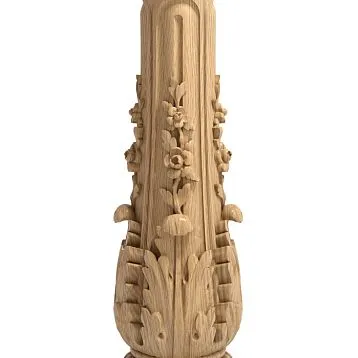
Classic style requires turned legs with characteristic elements.Wooden balusters— and sofa legs are executed in a unified style, creating architectural unity in the interior. Profile is complex, alternating thickening and recesses, balusters, capitals. Material — oak, beech, walnut. Finish — lacquer highlighting texture, or patina imitating aging.
Baroque and Rococo push decorative elements to the extreme. Legs are curved, carved, with plant motifs and scrolls. Gilding, patina, abundant carving. Cabriole — S-shaped curve resembling an animal's leg — characteristic element.Buy Baroque furniture— with corresponding legs creates an atmosphere of palace luxury.
Modern uses smooth curved lines, natural motifs. Legs have the shape of plant stems, curved and widened at the bottom. Carving is stylized, graphic. Color is dark or contrasting.Carved— elements emphasize the organic nature of forms.
Minimalism requires simplicity. Straight cylindrical or prismatic legs, smooth surface, no decoration. Metal in black or chrome. Light-colored wood with natural finish. Thin elegant legs create an illusion of floating furniture.Legs for a stool to buy— geometric shape — equivalent to sofa legs in minimalist style.
Scandinavian style combines simplicity with warmth of wood. Conical legs from light species — birch, ash, pine. Oil or wax finish preserving texture. Medium height, light proportions.Wooden boards in interior— and sofa legs in Scandinavian style create an atmosphere of light and coziness.
Loft and industrial styles use metal. Black steel pipes, sometimes with visible weld seams. Rough texture, deliberately industrial look. Wood-metal combinations — wooden frame on steel legs.Wooden beam— and brutal metal legs — characteristic elements of loft.
Leg replacement: restoration and upgrade
A sofa with worn or broken legs does not necessarily need to be discarded. Leg replacement is an operation restoring functionality, sometimes improving aesthetics. Factory legs are not always optimal — manufacturer's cost-saving leads to use of material with minimal strength. Replacing with higher-quality legs extends furniture lifespan by years.
Diagnosis begins with identifying the cause of the problem. Creaking during movement — loose connections, requiring tightening of threaded joints or re-gluing dowels. Rocking sofa — one leg is shorter than others or floor is uneven, solved by adjustment or shims. Crack in leg — structural damage, requires replacement. Sagging on one side — broken leg or damaged connection, requires repair.
Disassembly of old legs depends on the type of connection. Threaded connection — unscrewing the leg from the bushing, sometimes requiring penetrating lubricant WD-40 if threads are seized. Dowel on glue — cutting the leg flush with the frame, drilling out the remaining dowel from the hole. Mounting plate — unscrewing self-tapping screws or bolts, removing the leg together with the plate.
Selecting new legs requires precise measurements. Height of old legs is measured from floor to attachment point on the frame. If height needs to be changed, ergonomics of seating is considered. Type of connection must match existing frame — threaded bushing requires a leg with a corresponding diameter dowel. Style of new legs must match sofa design — classic turned legs are inappropriate for modern sofas.Buy furniture legs— of the required type and install yourself — a task that a home handyman can perform.
Installation of new legs is the reverse of disassembly. Threaded legs are screwed into sleeves until fully seated and tightened by hand without tools — excessive force will split the wood. Dowel legs are glued with PVA, the dowel is coated with glue, inserted into the socket, and tapped into place with a mallet until fully seated. Excess glue is wiped off with a damp cloth before it dries. The glue polymerization time is one day, during which the sofa should not be loaded.
Upgrade — replacing standard legs with higher-quality or more stylish ones. A factory-made sofa with plastic legs receives solid oak legs — increasing strength and improving appearance. Low sofas can be raised by installing taller supports — improving ventilation, simplifying cleaning, and altering visual perception. Replacing non-adjustable legs with adjustable ones solves the problem of rocking on uneven floors.
Frequently asked questions
What is the minimum leg cross-section required for a three-seater sofa?
For a three-seater sofa weighing 120 kg with a load of two to three people (240 kg) on six supports, the minimum diameter of round oak or beech legs is 45 mm, height up to 250 mm. Square cross-section — 40x40 mm. For heights above 250 mm, a 50 mm diameter or 50x50 square is preferred. Calculations include dynamic and safety factors.
How many legs are needed for an angular sofa?
It depends on configuration and size. A compact angular sofa measuring 2x2 meters requires a minimum of six legs: two on each outer side plus two in the corner zone. A large angular sofa measuring 2.5x3 meters requires eight to ten legs. The distance between legs along one line should not exceed 70–80 cm. A central leg in the corner zone is critically important for stability.
Can wooden legs be replaced with metal ones?
Yes, if the mounting method is compatible or can be adapted. Threaded metal legs with M8 or M10 bolts fit into sleeves for wooden legs. Metal legs with flanges require drilling holes in the frame for screws. It is important to ensure sufficient mounting strength — metal legs are heavier than wooden ones, and the joint experiences greater load. Visual compatibility with the sofa’s style is also critical.
How to eliminate rocking of a sofa on an uneven floor?
Three methods: install adjustable legs with screw-mounted feet to adjust each leg’s height; place pads of appropriate thickness under short legs — plywood, plastic, rubber; level the floor in the area where the sofa will be placed. The first method is preferable — it provides precise adjustment, does not require selecting pads, and looks aesthetically pleasing. Adjustable legs are sold separately, and installation is simple.
What is the optimal sofa seat height?
A standard seat height of 40–45 cm provides comfort for people 165–180 cm tall. At this height, seated legs rest fully on the floor, the thigh is horizontal, and the knee is bent at a right angle. Low lounge sofas with a 35 cm height require a semi-reclined position. High classic sofas with a 50 cm height are suitable for older individuals, who find it easier to rise from a high seat.
Are protective caps needed on sofa legs?
Required to protect flooring. Parquet, laminate, and linoleum are scratched by hard legs without protection. Wool caps for hard floors, rubber for tiles, wide plastic for carpet. Caps also reduce noise during sofa movement and dampen vibrations. Adjustable legs are usually supplied with plastic caps, additional protection is not required.
How to determine if sofa legs require replacement?
Signs: visible cracks in leg material; loose joints not fixable by tightening; deformation — bending or warping under load; worn protective caps down to metal or wood; sagging on one side of the sofa while the frame remains intact; creaking or cracking under load originating from legs. If any sign is detected, inspect all legs — if one is damaged, others may be close to failure.
Can a sofa be raised by replacing legs with taller ones?
Yes, replacing standard legs with taller ones will raise the sofa. A height increase of 5–10 cm is practical — improves ventilation, simplifies cleaning, and alters visual perception. However, consider ergonomics: a too-high seat is uncomfortable for short individuals. Stability also decreases — a high center of gravity makes the sofa less stable. For height increases above 10 cm, it is advisable to increase leg cross-section or number of legs.
Conclusion
furniture hardware legs for a sofa— not a decorative element, but a load-bearing structure, the strength of which determines the furniture’s longevity for tens of thousands of rubles. Load on a leg includes the sofa’s own weight, weight of seated individuals, dynamic forces during movement, lateral loads during leaning. Weight distribution is rarely uniform — concentrated load on individual legs requires a safety factor. Material — solid hardwood or metal — is selected based on required load-bearing capacity and style. Cross-section is calculated based on furniture weight, useful load, dynamic and safety factors. Seat height is determined by ergonomics and preferences, affecting comfort and stability. Frame reinforcement — adequate cross-section stringers, diagonal braces, corner blocks, central beam — is a systemic approach, where strong legs work in conjunction with a rigid base. Mounting method to the frame — threaded, plates, dowel — determines joint reliability and disassembly possibility. Protective caps and height adjustment improve practicality, protect the floor, and compensate for unevenness. Leg style matches interior design — from classic turned to minimalist metal. Replacing worn legs or upgrading standard legs extends sofa lifespan, improves functionality and appearance.
for sofas of any type and style. The assortment includes classic turned legs with balusters made of oak, beech, and ash, modern geometric shapes — conical, prismatic, cylindrical. Height range covers 100 to 400 mm, cross-sections from 30 to 70 mm. Hardwoods are air-dried to 8–10% moisture, ensuring dimensional stability and no deformation. Various finishes are available: polyurethane lacquering from matte to glossy, oil treatment, wax polishing, tinting, RAL color painting, patination. Adjustable legs with screw mechanisms for compensating floor unevenness. Various mounting types: M8 and M10 threaded bolts, mounting plates, dowel elements with glue. In-house production on CNC machines allows custom orders based on sketches within one week. Technical department advises on calculating required leg characteristics for specific sofas, material selection, and mounting methods. Moscow warehouse ensures availability of popular models for immediate shipment. Self-pickup Monday to Friday 9 AM to 6 PM, Saturdays until 11 AM. Courier delivery in Moscow — 400 rubles, free for orders over 15,000 rubles. STAVROS works with furniture manufacturers, restoration workshops, designers, and private clients. Certificates of conformity, sanitary-epidemiological conclusions, and test protocols are provided. One-year warranty covers manufacturing defects. The assortment alsoFurniture Legs and Supportsenables implementing comprehensive projects in a unified style.balusters for staircases, table bases for tables, decorative elements, Baseboards, Moldingsfrom STAVROS — proven durability through real-world use, quality materials and processing, professional service, and 20 years of reputation as a reliable supplier.furniture hardware legs for a sofaFrom STAVROS — this is durability proven by real-world use, quality of materials and processing, professional service, and a twenty-year reputation as a reliable supplier.