Article Contents:
- What is classic furniture: distinctive features
- Main characteristics of classic furniture
- Styles of classic furniture
- Baroque: lavish luxury of the 17th century
- Rococo: elegant lightness of the 18th century
- Neoclassicism: strict harmony of the end of the 18th century
- Empire: imperial grandeur of the beginning of the 19th century
- Neoclassicism: modern interpretation of classicism
- Materials of classic furniture
- Solid wood: the basis of classicism
- Upholstery: fabrics and leather
- Hardware and decorative elements
- Classic style furniture for the living room
- Sofa: the centerpiece
- Chairs: paired elements
- Coffee table: functional accent
- Bookcase or display cabinet: vertical accent
- Commode or console: additional storage
- Classic style furniture for the bedroom
- Bed: the centerpiece of the bedroom
- Nightstands: paired elements
- Dresser: clothing storage
- Makeup table: feminine zone
- Banquette or ottoman: additional seating
- Colors of classic furniture
- How to choose classic furniture: practical tips
- Define Your Style
- Measure the room
- Maintain symmetry
- Choose quality
- Check comfort
- Coordinate with interior
- Consider budget
- Where to buy classic style furniture
- Classical furniture boutiques
- Furniture manufacturers
- Online stores
- Antique Shops
- Custom furniture
- Care for classic furniture
- Solid wood furniture
- Soft furniture
- Conclusion: Classicism — an investment in quality of life
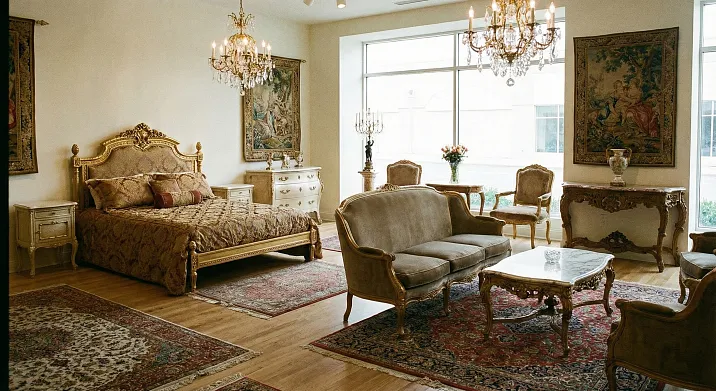
Enter the living room with a classic interior. A sofa with curved armrests, burgundy velvet upholstery, carved legs with gilding. Chairs around the fireplace — high backs, wings protecting from drafts, the same velvet upholstery. A coffee table — marble top, carved oak base with gold patina. A bookcase along the wall — reaching ceiling height, with cornice, columns, glass doors revealing book spines, figurines, porcelain.
This is not a museum, not a palace. This is a modern apartment where the owners choseClassic FurnitureThey chose timelessness over fleeting trends, quality over cheapness, beauty over functionality. Classic furniture is an investment in longevity, prestige, and aesthetic pleasure.
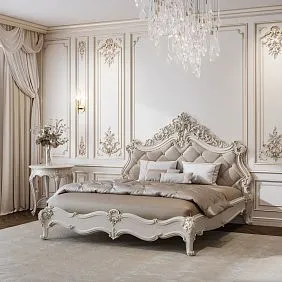
creates an atmosphere of luxury, coziness, and tranquility. It’s pleasant to wake up in the morning and to fall asleep in the evening here. This is not just a bedroom — it’s a personal palace, where every detail contributes to comfort, beauty, and self-respect.
Furniture for bedrooms in classic style creates an atmosphere of luxury, coziness, and tranquility. It’s pleasant to wake up in the morning and to fall asleep in the evening here. This is not just a bedroom — it’s a personal palace, where every detail contributes to comfort, beauty, and self-respect.
This article is a professional guide to the world of classic furniture from a specialist with fifty years of experience in antique furniture, interior design, and furniture manufacturing. We will cover classic furniture styles from Baroque to Neoclassicism, discuss materials and finishes, show how to choose furniture for the living room and bedroom, explain pricing and care.
Ready to dive into the world of classic elegance? Let’s begin.


What is classic furniture: key characteristics
Classic furniture is furniture made in styles that emerged in European architecture and art from the 17th to 19th centuries (Baroque, Rococo, Classicism, Empire) and their modern interpretations (Neoclassicism). It is characterized by natural materials, proportionality, symmetry, decorative elements, and high-quality craftsmanship.




Main characteristics of classic furniture
Natural materials. Solid wood of valuable species (oak, walnut, beech, ash, mahogany) — the foundation of classic furniture. No particleboard or MDF in visible parts (only in internal structures, hidden from view). Upholstery made of natural fabrics (velvet, satin, silk, jacquard, leather). Hardware made of metal (brass, bronze), often with patina or gilding.
Proportionality and symmetry. Classic furniture adheres to proportions established since antiquity (golden ratio, modular design). Each element is proportionally matched to others, creating harmony. Symmetry is a key principle in arranging furniture in a classic interior (chairs placed in pairs opposite each other, commodes on either side of the fireplace, nightstands on either side of the bed).
Decorativeness. Classic furniture is not merely a functional item, but a piece of decorative-applied art. Wood carving (vegetal motifs, acanthus leaves, rosettes, scrolls), inlay (inserts of precious woods, mother-of-pearl, metal), patination (gilding, silvering, artificial aging), rich upholstery (with patterns, embroidery, horsehair stitching) — all of this creates visual luxury, depth, and expressiveness.
Quality of manufacture. Classic furniture is crafted by highly skilled carpenters, often by hand or with minimal mechanization. Joinery using dowels (no nails or screws visible), precise fitting of parts, multi-layer finishing (priming, sanding, lacquering or patination in 5–10 layers) — this guarantees durability, reliability, and beauty.
Massiveness and monumentality. Classic furniture is large, heavy, and imposing. Heavy commodes, massive beds, large wardrobes, spacious sofas — this is furniture for spacious rooms with high ceilings, where small items would be lost.
Functionality with comfort. Despite its decorative nature, classic furniture is functional. Wardrobes are spacious, sofas are comfortable (deep seating, soft armrests), beds are comfortable (high headboards to lean on, spacious sleeping areas). Classicism values not only beauty, but also the comfort of life.
Timelessness. Classic furniture is not subject to fashion trends. What was beautiful 100 years ago remains beautiful today and will be beautiful 100 years from now. This is furniture for generations, passed down through inheritance, preserving and increasing its value over time.
Our factory also produces:


Styles of classic furniture
Get Consultation
Baroque: opulent luxury of the 17th century
Baroque (Italian: barocco — peculiar, strange) — a style that originated in Italy at the end of the 16th century and reached its peak in the 17th century. Characterized by maximum ornamentation, opulence, theatricality, contrasts of light and shadow, dynamic forms.
Characteristics of Baroque furniture:
Shapes: curved, wavy, asymmetrical. Legs are S-shaped or cabriole (curved upwards and downwards), chair backs are curved, commode fronts are convex (bombé).
Carving: abundant, deep relief. Motifs — acanthus leaves, shells (rocaille — precursor to rococo), scrolls, volutes, angels, putti (cherubic infants), grapevines, flowers. Carving covers almost the entire surface of the furniture — legs, armrests, backs, fronts.
Finishing: gilding (electrum gold or gold patina), silvering, bright colors (red, blue, green on white or cream backgrounds). Often polychrome (multi-colored) painting.
Upholstery: expensive fabrics — velvet, satin, brocade, tapestry. Colors are rich — burgundy, emerald, sapphire, purple, gold. Often with patterns — floral ornaments, narrative scenes (tapestry).
Wood species: walnut (most popular for Baroque — dark, noble), oak, mahogany, rosewood. Often wood is stained, gilded, carved — natural texture is hidden by decoration.
Elements:baroque furnitureIncludes chairs with high carved backs, armrests, curved legs; sofas are plush, with carved backs and many cushions; commodes with convex fronts (bombé), carved handles, marble tops; beds with canopies, high carved headboards; tables with carved bases, marble or wooden tops with inlays; cabinets are massive, with cornices, carved doors.
Where it is applied: palace interiors, luxurious drawing rooms, dining rooms, bedrooms in large houses, apartments (minimum 40-50 m² per room — Baroque requires space). Suitable for people who appreciate luxury, theatricality, maximum ornamentation.
Prices:Buy Baroque furniture— expensive segment. Baroque chair from solid walnut with carving and gilding — 150,000–400,000 rubles, three-seater sofa — 400,000–1,000,000 rubles, commode — 250,000–600,000 rubles, double bed with canopy — 500,000–1,500,000 rubles. High price is due to handcraft (carving, gilding), expensive materials, labor-intensive production.
Rococo: elegant lightness of the 18th century
Rococo (from French rocaille — shell) — style that replaced Baroque in the first half of the 18th century in France. Characterized by greater lightness, elegance, intimacy, asymmetry, pastel tones.
Characteristics: shapes are even more curved than in Baroque, but thinner, more delicate; carving is more refined, filigree — shells, scrolls, flowers, amorini; colors are pastel — blue, pink, pistachio, white, gold; furniture is smaller than Baroque, more intimate; upholstery from silk, satin, pastel tones, often with floral patterns.
Application: boudoirs, ladies’ rooms, small salons. Less common in modern interiors than Baroque (too intimate, decorative).
Neoclassicism: strict harmony of the late 18th century
Neoclassicism — style that emerged as a reaction to the excessive ornamentation of Baroque and Rococo. Inspired by antiquity (Ancient Greece, Rome), characterized by strictness, symmetry, proportionality, restrained ornamentation.
Characteristics: shapes are straight, geometric, symmetrical; legs are straight, conical (narrowing at the bottom), fluted (with vertical grooves — like on ancient columns); carving is restrained — rosettes, laurel wreaths, meanders, ancient ornaments, but without excess; finishing is calm — natural wood with varnish or light paint (white, cream), moderate gilding; upholstery from solid-colored fabrics or with geometric ornaments, colors are calm — white, cream, blue, green.
Wood species: mahogany (favorite wood of Neoclassicism), oak, walnut, light species (birch, beech for furniture with white paint).
Application: strict elegant drawing rooms, offices, libraries. For people who appreciate harmony, proportionality, restrained elegance without excess.
Empire: imperial grandeur of the early 19th century
Empire (from French empire — empire) — style of the era of Napoleon I, characterized by monumentality, solemnity, military symbolism, use of ancient, Egyptian, Roman motifs.
Characteristics: shapes are massive, monumental, straight; legs are shaped like columns, griffins, sphinxes, lion paws; carving with imperial symbolism — eagles, wreaths, torches, swords, laurels, sphinxes; finishing with abundant gilding, bronze inlays; upholstery from expensive fabrics — velvet, silk, rich colors — red, blue, green, purple with gold; inlays of bronze, brass.
Wood species: mahogany, walnut, dark-toned oak.
Application: representative interiors, offices of leaders, halls, drawing rooms in large houses. Suitable for people who appreciate monumentality, power, solemnity.
Neoclassicism: modern interpretation of classicism
Neoclassicism (or modern classicism) — style that emerged at the end of the 20th — beginning of the 21st century as an adaptation of classical styles to modern living conditions, room sizes, functional requirements.
Characteristics: shapes are classical (symmetry, proportionality, elegance), but simplified — less carving, decoration, gilding; sizes are smaller (Neoclassical furniture is more compact than traditional classicism — suitable for standard apartments); colors are light —White classic furniture— beige, cream, light gray (Neoclassicism values lightness, airiness, unlike dark traditional classicism); upholstery from modern fabrics (high-tech fabrics with stain-resistant coating, durable), colors are calm neutral; functionality is increased (built-in storage systems, transformable elements, ergonomics).
Wood species: light (bleached oak, beech, birch) or painted white, cream, light gray.
Application: universal — suitable for apartments and houses of any size, living rooms, bedrooms, offices, dining rooms. The most popular classic style in modern interiors (combines classic elegance with modern functionality and compactness).
Prices:Classic furniture pricesIn neoclassicism, it is 30-50% lower than in traditional styles. Three-seater sofa in neoclassicism — 120,000–350,000 rubles, armchair — 50,000–150,000 rubles, chest of drawers — 80,000–250,000 rubles, double bed — 150,000–500,000 rubles.
Materials of classic furniture
Solid wood: the foundation of classicism
Oak: a hard, durable species, expressive texture, noble tones. Oak furniture is the benchmark of longevity (lasts for centuries) and prestige. Used for case furniture (wardrobes, chests of drawers, tables), frames of upholstered furniture (sofas, armchairs, beds). Color ranges from light (bleached oak for neoclassicism) to dark (mahogany oak for Empire). Price is high (chest of drawers 120×50×90 cm from solid oak — 150,000–400,000 rubles depending on carving and finish).
Beech: dense species, fine uniform texture, pinkish color. Strong, durable, easy to cut (suitable for carved elements). Often stained or painted (for neoclassicism — white paint). 30–40% cheaper than oak. Used for case and frame furniture. Price is moderate (chest of drawers from solid beech — 100,000–300,000 rubles).
Walnut: premium species, beautiful texture with brown tones, medium hardness. Traditional species for Baroque and Classicism. Visually luxurious and prestigious. Price is high (chest of drawers from walnut — 200,000–600,000 rubles).
Ash: hardness close to oak, lighter with a grayish tint. Suitable for neoclassicism and Scandinavian classicism. Visually lighter than oak. Price 15–25% lower than oak.
Redwood (mahogany): exotic species, reddish-brown color, noble texture. Traditional species for Classicism, Empire, English classicism. Very prestigious and expensive. Currently rare (due to logging bans), often replaced by other reddish species (sapele, meranti). Price is very high (chest of drawers from mahogany — 300,000–800,000+ rubles).
Birch: medium hardness, light, fine texture. Affordable and common in Russia. Often used for painted finishes (white classic furniture from birch is 40–50% cheaper than oak). Price is low (painted chest of drawers from birch — 60,000–200,000 rubles).
Upholstery: fabrics and leather
Velvet: plush fabric, soft with deep color, luxurious. Traditional fabric for Baroque, Classicism, Empire. Colors are rich — burgundy, emerald, sapphire, purple. Drawback — stains easily (pile collects dust, stains are hard to remove), wears out over time (pile flattens in areas of heavy use). Price is high (three-seater sofa with velvet upholstery — 300,000–700,000 rubles).
Jacquard: fabric with woven pattern (pattern created by interlacing threads of different colors, not printed). Durable, wear-resistant, with beautiful ornaments (floral patterns, damask, geometric patterns). Popular for classic furniture (combines beauty with practicality). Price is moderate (three-seater sofa with jacquard upholstery — 200,000–500,000 rubles).
Silk, satin: luxurious shiny fabrics, smooth to the touch. Traditional for Rococo and neoclassicism (pastel tones). Drawback — delicate (tears from nails, stains hard to remove), slippery (cushions slide). Used for formal furniture, not intended for heavy use. Price is high.
Leather: natural leather — prestigious upholstery material. Strong, durable (lasts for decades), easy to clean (stains wipe off with a damp cloth), pleasant to the touch, develops a noble patina over time. Traditional for office furniture (executive chairs, sofas in offices), English classicism. Colors — brown (from light brandy to dark chocolate), black, burgundy. Drawback — expensive (leather sofa 30–50% more than fabric), cold in winter (requires room heating). Price is very high (three-seater sofa with natural leather upholstery — 400,000–1,000,000+ rubles).
Gobelin: thick woven fabric with narrative or ornamental patterns. Traditional for Baroque (scenes — mythological, hunting, pastoral). Strong, wear-resistant, decorative. Currently rare (expensive, labor-intensive to produce), often replaced by jacquard with gobelin-style patterns.
Hardware and decorative elements
Handles: carved wooden (from the same wood as the furniture or contrasting), metallic (brass, bronze) with patina or gilding. Classic shapes — rings, loops, rosettes with rings. Large and noticeable (unlike modern furniture, where handles are minimalist and inconspicuous).
Decorative appliqués: carved wooden or metallic (bronze, brass) appliqués on furniture facades — rosettes, scrolls, floral patterns, emblems. Add extra decorative appeal and luxury.
Legs: carved, turned, curved (cabriole for Baroque), straight fluted (for Classicism), in the shape of lion paws or griffins (for Empire). Often gilded or patinated.
Crown moldings: upper part of cabinets and chests decorated with crown moldings (projecting profiled strips) and moldings (decorative strips), creating architectural completeness and monumentality.
Living room furniture in classic style
Living room — central room of the house, place for receiving guests, family evenings, relaxation. Classic furniture creates an atmosphere of elegance, comfort, and prestige in the living room.
Sofa: compositional center
Classic sofa — straight or slightly curved, three-seater (rarely two- or four-seater), with high back, carved armrests, curved or straight legs. Upholstery in velvet, jacquard, or leather. Colors depend on style — rich (burgundy, emerald, blue) for Baroque and Empire, pastel or neutral (beige, cream, gray) for neoclassicism.
Dimensions: length 200–250 cm (three-seater), seat depth 60–80 cm (deep seating — comfort), back height 90–110 cm.
Price: three-seater Baroque sofa with carving and gilding — 400,000–1,000,000 rubles, neoclassicism — 120,000–350,000 rubles.
Location: central position in the living room — opposite the fireplace, TV, window (depending on layout).
Armchairs: paired elements
Classic armchairs — high backs, armrests, carved legs, upholstery matching the sofa. Traditionally placed in pairs — on either side of the sofa, on either side of the fireplace, facing each other (symmetry — key principle of classicism).
Types: wingback chairs — with high side panels (wings) protecting from drafts and creating intimacy and comfort (traditional for English classicism); bergere chairs — wide, with soft armrests and deep seating (French classicism); Voltaire chairs — high straight backs with armrests on supports (Neoclassicism).
Price: Baroque chair — 150000–400000 rub, Neoclassicism — 50000–150000 rub.
Coffee table: functional accent
Classic coffee tables — medium size (80–120 cm length), rectangular or oval, with carved base, marble, wood with inlay, or glass tops. Legs are carved or straight, often gilded.
Price: Baroque coffee table with marble top — 80000–250000 rub, Neoclassicism — 30000–100000 rub.
Placement: in front of the sofa, in the center of the lounge area.
Bookcase or display cabinet: vertical accent
Classic bookcases — tall (up to ceiling or 200–240 cm), with cornices, moldings, columns (half-columns), glazed doors (for displaying books, porcelain, collections). Massive, monumental, create vertical accent and architectural structure.
Display cabinets: cabinets with glass doors and sides, for displaying collections (porcelain, crystal, figurines). Often with internal lighting.
Price: Baroque bookcase from walnut wood with carving — 300000–800000 rub, Neoclassicism — 150000–450000 rub.
Placement: along the wall, symmetrically (one cabinet centered on the wall or two cabinets on either side of a window or door).
Commode or console: additional storage
Classic commodes — low (80–100 cm height), wide (100–150 cm), with 3–4 drawers, carved fronts, marble or wooden tops, carved handles, legs. Baroque commodes with convex fronts (bombé), Neoclassical commodes with straight fronts.
Consoles: narrow tables (depth 30–50 cm), placed against walls, under mirrors, for vases, lamps, decorative items. Often on curved carved legs, with marble tops.
Price: Baroque commode — 250000–600000 rub, Neoclassicism — 80000–250000 rub.
Placement: commodes against walls (between windows, beside fireplace), consoles under mirrors, in alcoves.
Furniture for the bedroom in classic style
Furniture for bedrooms in classic styleCreates an atmosphere of luxury, tranquility, intimacy. The bedroom is a personal space where one can allow maximum comfort and beauty.
Bed: center of the bedroom
Classic bed — double (160, 180, 200 cm width), with high carved headboard (120–160 cm height), often with canopy (frame for drapes over the bed), with carved legs or without visible legs (bed on platform).
Headboard: carved from solid wood (Baroque, Empire) with rich decoration (acanthus leaves, scrolls, rosettes, gilding), or upholstered (fabric or leather, with carriage lacing — buttons creating relief) — Neoclassicism.
Canopy: frame of four posts at the corners of the bed (or semicircular frame attached to the wall above the headboard), to which heavy drapes (velvet, satin, organza) are hung. The canopy creates intimacy, protection, luxury. Traditional for Baroque, Empire, romantic bedrooms. Used less often in modern interiors (takes space, visually heavy), but in spacious bedrooms with high ceilings creates an impressive effect.
Price: Baroque bed with carved headboard and canopy 180×200 cm — 500000–1500000 rub, Neoclassicism with upholstered headboard without canopy — 150000–500000 rub.
Placement: in the center of the bedroom, headboard facing the wall (usually the wall opposite the entrance), symmetrically (nightstands on either side).
Nightstands: paired elements
Classic nightstands — small (40–60 cm width, 50–70 cm height), with 1–3 drawers or doors, carved fronts, tops (for lamps, books, alarm clocks). Placed in pairs on either side of the bed — symmetry.
Price: Baroque nightstand — 50000–150000 rub each (pair — 100000–300000 rub), Neoclassicism — 20000–70000 rub each.
Dresser: clothing storage
Classic dresser — large (width 150–250 cm, height 200–240 cm), with swing doors (2–4 panels), cornices, moldings, mirrored inserts on doors (for visual space expansion, ease of trying on). Inside — hanging rods, shelves, sometimes drawers.
Alternative: walk-in closet (if space allows) — separate room or niche, where clothing is stored on open systems (rods, shelves). More functional than a dresser (more capacity, easier access), frees the bedroom from bulky furniture.
Price: Baroque wardrobe 200 cm width — 300000-800000 rub, Neoclassicism — 150000-450000 rub.
Placement: along the wall, preferably not opposite the bed (a heavy wardrobe opposite the bed creates pressure and disrupts rest).
Makeup table: women's zone
Classic makeup table (trèlèj) — a small table with a mirror, pull-out drawers for cosmetics and jewelry, an elegant chair or settee in front. A traditional element of the women's bedroom.
Mirror: on the makeup table — three-panel (central mirror + two side-rotating mirrors, allowing to see hairstyle from different angles) or oval in a carved frame on a stand.
Price: Baroque makeup table with mirror and chair — 100000-300000 rub, Neoclassicism — 50000-150000 rub.
Placement: against the wall (between windows, against a side wall), preferably with natural lighting (by the window).
Settee or ottoman: additional seating
Settee — a soft bench without backrest, upholstered, with carved legs. Ottoman — the same, but larger, can be used as a lounge chair. Placed at the foot of the bed (for clothes before bedtime, for sitting while putting on shoes), near the makeup table, or by the window.
Price: Baroque settee — 40000-120000 rub, Neoclassicism — 20000-60000 rub.
Colors of classical furniture
Dark noble: walnut, mahogany, cherry wood (mahogany), veneer — traditional colors for Baroque, Classicism, Empire, English Classicism. Create monumentality, seriousness, luxury. Suitable for spacious rooms with good lighting (dark furniture in a small dark room creates gloom).
Light natural: light oak, beech, birch — for Neoclassicism, Scandinavian Classicism. Create lightness, airiness, visually expand space. Suitable for standard apartments, small rooms.
White and pastel:White classic furnitureCream, beige, light gray — popular in Neoclassicism, Provence, French Classicism. Creates purity, freshness, elegance. Visually expands space, brightens the interior. Practical (light tones heat less in the sun, less hot in summer). Shortcoming — prone to stains (spills more noticeable, requires regular care). White furniture is often patinated (artificial aging — gold or silver patina on carved elements, wear marks), adding depth, volume, history.
Colored painted: rarely — blue, pistachio, pink (Provence, Rococo), black (Art Deco, modern Classicism with contrasts). Used as accent (one piece of colored furniture, others neutral).
How to choose classical furniture: practical tips
Define the style
Classicism is multifaceted — Baroque, Rococo, Classicism, Empire, Neoclassicism. Determine which style suits you best by spirit, room scale, and budget. Baroque and Empire require spacious rooms (40+ m² per room), high ceilings (3+ m), significant budget (furniture is expensive). Neoclassicism is universal — suitable for standard apartments, houses, medium budgets.
Measure the room
Classical furniture is large. Before purchasing, accurately measure the room, draw a plan (on graph paper or in computer software), place furniture on the plan, check passageways (at least 80-100 cm should remain for free movement between items). Consider doors (opening cabinet doors, room doors should not interfere with each other).
Observe symmetry
Classic interiors are built on symmetry. Determine the composition center (fireplace, window, bed in the bedroom, sofa in the living room), place furniture symmetrically from it — pairs of chairs on either side, nightstands on either side of the bed, chests on either side of the fireplace.
Choose quality
Classical furniture is an investment for decades. Do not economize on quality. Check materials (solid wood in visible parts, no particleboard on fronts), joints (dowel, strong), finish (smooth, no drips, pooling), hardware (metal, smoothly moving), upholstery (natural fabric, tightly stretched, no wrinkles). Quality furniture lasts 30-50+ years and can be passed down as inheritance.
Check comfort
Classical furniture should be not only beautiful but also comfortable. Sit on the sofa, chair — check seat depth (should be 55-65 cm for comfortable sitting with back support), seat height (40-45 cm from floor — optimal for most people), firmness (moderately soft — not collapsing, but not as hard as a stool). Lie on the bed — check size (sleeping space should be 15-20 cm larger than your height), mattress comfort.
Coordinate with interior
Furniture should harmonize with room finishes (walls, ceiling, floor), doors, windows, decor. Choose furniture color to match parquet (or contrast — light furniture on dark floor, dark on light) or door color. Furniture style should match architectural elements (ceiling moldings — Baroque or Classicism, smooth walls — Neoclassicism).
Consider budget
Classic furniture pricesPrices vary widely — from 100,000 rubles for a neoclassical sofa made of beech with fabric upholstery to 1,000,000+ rubles for a Baroque sofa made of walnut with carving, gilding, and velvet upholstery. Set your budget in advance, allocate it (usually 40-50% for soft furniture — sofas, chairs; 30-40% for case goods — wardrobes, chests; 10-20% for additional elements — tables, ottomans, decor). Don’t try to furnish everything at once — better to buy a few quality pieces and gradually complete the interior, rather than many cheap, low-quality items.
Where to buy classic-style furniture
Classic furniture boutiques
Specialized boutiques selling classic furniture from European or Russian manufacturers. Wide selection, you can see it in person, sit down, check the quality, and get a designer consultation. Minus — prices are often inflated (boutique markup 30-50%).
Furniture manufacturers
buy classic style furnitureDirectly from the manufacturer — lower price (no intermediaries), option to order furniture to custom dimensions, choose upholstery fabric, finish, carving. Minuses — need to travel to the factory (usually to the Moscow region or other areas), smaller selection of ready-made models (much is made to order — production time 4-12 weeks).
Online stores
Convenience of ordering, sometimes lower prices. Minus — can’t see in person, can’t check comfort or quality (photos may distort color, size, texture). Order only from verified sellers with good reviews, warranty, and return policy.
Antique boutiques
For genuine antique furniture (18th-19th centuries) — contact antique boutiques. Furniture is unique, with history, a true work of art. Minuses — very expensive (an 18th-century Baroque armchair — 500,000–3,000,000+ rubles), requires restoration (old furniture is often damaged — needs professional restoration), not always comfortable (antique furniture was designed for people of shorter stature, different comfort standards).
Custom-made furniture
For unique furniture based on an individual project — contact woodworking workshops or furniture ateliers. The designer will create a sketch tailored to your interior, dimensions, taste; carpenters will handcraft the furniture. Timeline 2-6 months, price is high (50-100% higher than mass-produced), but the result is unique.
Care for classic furniture
Solid wood case goods
Regular cleaning: once a week, wipe with a dry soft cloth, removing dust. Carved elements — with a soft brush.
Wet cleaning: once a month, wipe with a slightly damp (well-wrung) cloth using a gentle wood cleaner (or liquid soap). Do not soak thoroughly.
Sun protection: direct sunlight will fade wood and upholstery. Use curtains or blinds.
Humidity protection: wood reacts to humidity (absorbs moisture, swells at high humidity; releases moisture, dries out and cracks at low humidity). Maintain stable humidity at 40-60% (use humidifiers in winter, dehumidifiers in summer).
Finish renewal: after 10-15 years, varnish dulls and wears out. Hire a restorer who will sand and apply fresh varnish.
Soft furniture
Regular cleaning: once a week, vacuum upholstery (with a soft brush), removing dust and crumbs.
Stain cleaning: immediately after a stain appears, blot with a cloth (do not rub — it will spread), then clean with upholstery cleaner (appropriate for your fabric — special cleaners for velvet, others for jacquard). Follow the cleaner’s instructions.
Professional dry cleaning: once every 1-2 years, call a cleaning company for deep upholstery cleaning (removal of embedded dirt, color refresh).
Scratch protection: if you have cats — use covers for furniture or scratching posts (train the cat not to scratch furniture). Damaged upholstery can be reupholstered (fabric replacement — 30,000–80,000 rubles for a sofa).
Fluffing cushions: regularly fluff sofa cushions (restore shape and fullness).
Conclusion: classic style — an investment in quality of life
Classic furniture is more than interior decor. It’s a philosophy of life valuing quality over quantity, timelessness over fleeting trends, beauty over utility. It’s an investment in comfort, aesthetic pleasure, prestige, passed down through generations.
From opulent Baroque to elegant neoclassicism, from dark majestic walnut to light airy white furniture, from luxurious living rooms to cozy bedrooms — classic style is multifaceted, universal, and eternal.
Company STAVROS — a leading manufacturer of classic solid wood furniture with over 25 years of experience — offers professional solutions for any style and budget.buy classic style furnitureIn STAVROS — guarantee of quality, beauty, durability. Catalog includes living room furniture: three-seater and two-seater sofas in solid oak, beech, walnut, ash, in all major classic styles — Baroque with rich carving, gilding, velvet, jacquard upholstery; Classicism with restrained elegance, straight lines; Empire with monumentality, bronze inlays; Neoclassicism — universal for any room size, 180–250 cm length, over 100 fabric options — velvet, jacquard, silk, natural leather. Price: 120,000–1,000,000 rubles for sofas, depending on style, size, materials, finish. Chairs — classic, high backs, carved armrests, curved legs; wing chairs — Berger, Voltaire styles — price 50,000–400,000 rubles. Coffee tables — 80–120 cm length, carved bases, marble, wood, glass tops — price 30,000–250,000 rubles. Bookcases and display cabinets — 200–240 cm height, cornices, moldings, columns, glass doors, internal lighting — price 150,000–800,000 rubles. Chests and consoles — carved fronts, marble tops, drawers — price 80,000–600,000 rubles.
Furniture for bedrooms in classic styleIn STAVROS — popular neoclassic direction, made from solid oak, ash, birch, with professional Italian enamel finishes Sirca Sayerlack in white, milk, cream, light gray colors, with gold or silver patina or without — creating depth, volume, historical effect. Perfect for bright spacious interiors — visually expands space, brightens rooms, creates purity, freshness, elegance. Prices are 20–30% lower than dark furniture due to lower cost of light wood species for painting. Sofa — white, three-seater, neoclassic — 120,000–300,000 rubles. Chair — 50,000–120,000 rubles. Chest — 80,000–200,000 rubles. Bed — double, 150,000–400,000 rubles.
White classic furnitureIn STAVROS — popular neoclassic direction, made from solid oak, ash, birch, with professional Italian enamel finishes Sirca Sayerlack in white, milk, cream, light gray colors, with gold or silver patina or without — creating depth, volume, historical effect. Perfect for bright spacious interiors — visually expands space, brightens rooms, creates purity, freshness, elegance. Prices are 20–30% lower than dark furniture due to lower cost of light wood species for painting. Sofa — white, three-seater, neoclassic — 120,000–300,000 rubles. Chair — 50,000–120,000 rubles. Chest — 80,000–200,000 rubles. Bed — double, 150,000–400,000 rubles.
Buy Baroque furnitureAll STAVROS items are crafted from premium-grade solid wood with 8-12% moisture content after prolonged kiln drying, guaranteeing dimensional stability, absence of warping, cracking, or deformation. Production is carried out using Italian Biesse SCM equipment while adhering to classical joinery traditions (using dowels without visible fasteners), precise fitting of parts (tolerance no more than 0.5 mm), multi-layer finishing (priming, sanding, 5 stages of lacquering with Italian Hesse Lignal Sirca lacquers or enameling), patination, and gilding, all executed manually by skilled finishers, with a 15-20 year warranty on the durability and beauty of the finish. Upholstery is performed by master upholsterers using Italian, Spanish, and Turkish fabrics, Rubelli velvet, Sahco jacquard, premium natural leather from Italy and Germany, high-density hollofibre stuffing, independent Bonnel spring blocks, with a 10-15 year warranty on comfort and durability.
STAVROS offers a full range of services: professional consultation from furniture designers to help select furniture matching your interior style, room dimensions, budget, and lifestyle; 3D visualization of your interior with selected furniture to preview the result before purchase; selection of furniture sets for living rooms, bedrooms, dining rooms, and offices; full furniture installation "turnkey"; custom-made furniture to your dimensions and sketches; unique pieces with carving, inlay, and upholstery to individual order; production time 8-20 weeks; delivery across Russia; professional packaging with wooden crates and soft padding to ensure safe transport; on-site assembly by experienced furniture installers; installation and arrangement according to the design plan; 3-year official warranty on all solid wood furniture, guaranteeing absence of manufacturing defects, deformation, cracking, or finish peeling under proper use; post-warranty service including restoration, reupholstery, and repair of damages — we have been servicing STAVROS furniture for decades.
88.12 $ р.