Article Contents:
- 4. Criteria for choosing 'the right one' MDF skirting board
- 4.1. Interior style
- 4.2. Color and texture
- 4.3. Height and proportions
- 4.4. Budget
- 5.1. Preparation work
- 5.2. Tools and materials
- 5.3. Installation process
- 6.1. Daily cleaning
- 6.2. Protection from moisture and damage
- 6.3. Repair and replacement
- 7.1. Classic
- 7.2. Modern
- 7.3. Minimalism and high-tech
- 7.4. Loft
- 7.5. Provence and country
- 9.1. 'MDF is not eco-friendly'
- 9.2. 'MDF deteriorates quickly from moisture'
- 9.3. 'Installation is too complicated'
- 9.4. 'MDF looks cheap'
- 10.1. Color combinations
- 10.2. Smart decor
- 10.3. Sound insulation
- 10.4. Repairability
- 13.1. Door casings and thresholds
- 13.2. Mouldings and ceiling cornices
- 13.3. Furniture and textiles
- 14.1. Studio apartment in Scandinavian style
- 14.2. Country-style house in the countryside
- 14.3. Modern city apartment in high-tech style
In the world of interior design, there are many details that seem secondary at first glance. However, precisely such elements can fundamentally change the atmosphere of a room and give it a finished look. One such detail is skirting — an element that ensures a smooth transition between the floor and walls, protects joints from dust and moisture, and also adds aesthetic completeness to the interior. In recent years, among the variety of materials used to produce skirting, MDF — medium-density fiberboard — has taken a special place. If you want to find out whyMDF skirting for floor MDF skirting has become so popular, how to choose, install, and properly combine it with different styles, this article will be a detailed guide for you.


1. The role of skirting in overall interior design




1.1. Why skirting is so important
Skirting is not just a decorative strip hiding the gap between the wall and floor. Its functionality is much broader:
- Aesthetic role. Skirting completes the room's composition, making the transition between walls and flooring more seamless and neat. Without skirting, the interior looks unfinished, and the junction between the wall and floor appears sloppy.
- Wall protection. The lower part of walls is often exposed to moisture, impacts (during cleaning, furniture rearrangement, etc.). Skirting takes on the main load, keeping walls in perfect condition.
- Cable concealment. Some skirting models have special channels or grooves where wiring can be hidden, eliminating the need to cut into walls.
- Finished look. When skirting is properly selected by color, texture, and shape, it highlights the room's strengths and gives the interior harmony.
Our factory also produces:


1.2. The role of skirting material
Skirting can be made from various materials: wood, plastic, polyurethane, MDF, etc. The choice depends on budget, interior style, and usage conditions. MDF has become a real favorite in recent years, as it combines strength, affordable cost, aesthetics, and ease of installation. Moreover, modern technologies allow creating MDF skirting for floor in a wide variety of shapes and colors, simplifying the task for designers and homeowners.
2. What is MDF and its advantages
Get Consultation
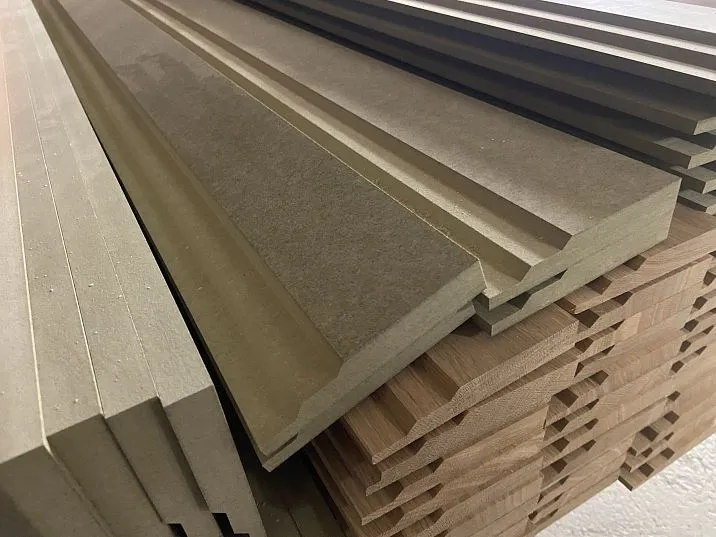
The abbreviation MDF stands for 'Medium Density Fiberboard' (medium-density fiberboard). This is a composite material obtained by pressing fine wood fibers at high temperature and pressure with binding resins. The result is a board with a uniform structure and stable physical and mechanical properties.
The abbreviation MDF stands for "Medium Density Fiberboard" (medium-density fiberboard). This is a composite material obtained by pressing fine wood fibers at high temperature and pressure with the addition of binding resins. The result is a board with a uniform structure and stable physical and mechanical properties.
2.2. Advantages of MDF skirting boards
- Economy. MDF skirting is cheaper than solid wood products, yet it does not significantly differ in appearance.
- Uniformity. Unlike natural wood, MDF does not have knots, cracks, or other defects. This simplifies processing and improves the aesthetics of the finished product.
- Strength. MDF skirting is sufficiently resistant to mechanical impacts, does not crack or warp under proper use.
- Moisture resistance. Modern manufacturing technologies allow achieving high resistance to moisture, especially if the skirting has an additional protective coating (lamination or paint).
- Wide design possibilities. MDF is easily painted, veneered, or laminated, offering unlimited design options. You can choose skirting that perfectly matches the wall or floor color, or, conversely, make it a bright accent.
- Ease of installation. Installing MDF skirting yourself is not difficult, and with proper care, the result will look professional.
3. Types of MDF skirting
Laminated. A special film (laminate) is applied to the surface of the board, protecting the material from moisture and minor scratches. Laminated baseboard can imitate wood, stone texture, or be solid-colored.
- Painted. These items are coated with varnish or paint to achieve the desired shade. White enamel is often used, as a white baseboard visually enlarges the space and matches most styles.
- Venewed. A thin layer of natural wood (veneer) is glued onto the MDF surface. Thus, the baseboard looks like solid wood but has better stability and lower cost.
- Paintable. Some models initially lack a finish coating, allowing the owner to paint them to match the desired color and harmonize with the interior.
- Paintable. Some models initially lack a finish coating, allowing the owner to paint them to match the desired color and harmonize with the interior.
3.2. By shape and height
● Classic (height 50–70 mm). A universal option suitable for most rooms.
● High (80–120 mm and above). Used in spacious rooms with high ceilings, creating a sense of grandeur and visually 'lifting' the walls.
● Flat. Often used in modern styles (high-tech, minimalism), they do not draw excessive attention.
● Decorative. May feature carved elements, relief, and decorative moldings. Suitable for classic interiors or country, Provence styles.
4. Criteria for choosing the right MDF baseboard
4.1. Interior style
Before purchasing, determine the dominant interior style in your home or apartment. For classic style, veneered baseboards with noble wood or decorative models are suitable. For modern style, minimalist options are preferable, possibly with solid glossy or matte finish.
4.2. Color and texture
● In the same tone as walls. This technique visually enlarges the space, making boundaries less noticeable.
● In the same tone as floor. A classic option that creates a unified floor covering and visually elongates the room.
● Contrasting. If you want to make a statement, choose a baseboard in bright color or, conversely, very light on a dark floor (or vice versa). A contrasting baseboard draws attention and emphasizes the room’s geometry.
4.3. Height and proportions
Baseboard height is directly related to room size. In spacious rooms with high ceilings, you can afford heavy baseboards (80 mm and above). In smaller rooms, bulky baseboards may look awkward, so 50–60 mm options are more appropriate.
4.4. Budget
MDF baseboards vary in price depending on brand, finish type, and shape. Laminated models are often cheaper than veneered ones, but appear simpler. If a luxurious look is important, consider veneered options. However, a laminated baseboard can look very impressive when the right color and texture are chosen.
5. Installing MDF baseboard: step-by-step guide
5.1. Preparation
- Measure room perimeter. Determine how many meters of baseboard you need. Add a small allowance (about 5–10%) for cutting.
- Prepare surfaces. Walls and floor should be relatively flat. If there are significant unevenness or cracks, fill them with putty or plaster beforehand.
- Adapt baseboard. It is recommended to bring the baseboard into the room one day before installation to allow it to acclimate to temperature and humidity.
5.2. Tools and materials
● Saw (hand saw) or miter saw for precise cutting at desired angles.
● Miter box (for manual cutting) for accurate angled cuts.
● Tape measure and pencil for marking.
● Construction adhesive or liquid nails.
● Drill, screws, and anchors (if additional fixation is needed).
● Level for controlling horizontal alignment.
● Sealant or filler (for filling small gaps at joints).
5.3. Installation Process
- Marking and cutting. Measure the required length of the skirting board and carefully cut it. When joining at internal corners, cut at a 45° angle (or another angle if the wall is not flat). For external corners, do the same but in the opposite direction.
- Applying adhesive. If the skirting board will be glued, apply the adhesive to the back using a thin line or dots, paying special attention to corners.
- Fixation. Press the skirting board against the wall and floor, ensuring it is level. If necessary, additionally secure it with screws or special clips (if provided by the design).
- Joining. At the junctions of two skirting boards, carefully fit the pieces together to avoid gaps. Small gaps can be filled with filler or sealant, and then painted to match if needed.
- Final finishing. After the adhesive (or sealant) has fully dried, inspect the skirting board around the entire perimeter. If noticeable defects are found, repair them using paint or other suitable materials.
6. Care for MDF Skirting Board
6.1. Daily Cleaning
MDF skirting board is relatively low-maintenance. Use a soft dry or slightly damp cloth to remove dust. If stains appear on the surface, use a mild soap solution, avoiding aggressive chemicals and stiff brushes.
6.2. Protection from Moisture and Damage
Although MDF is well protected by laminate or lacquer coating, prolonged contact with water should still be avoided. When cleaning floors, try not to leave puddles at the base of walls. If you notice the room is too humid, use a dehumidifier or ventilate more frequently.
6.3. Repair and replacement
If a section of the skirting board is severely damaged, you can replace only the damaged part by carefully cutting it out and installing a new piece. For minor scratches or chips, repainting them to match may be sufficient. Most manufacturers offer special repair kits including filler and paint.
7. Combining MDF Skirting Boards with Different Interior Styles
7.1. Classic
In classic interiors, elegance and refinement are valued. Here, veneered or decorative MDF skirting boards in warm tones are appropriate. Tall skirting boards (80–100 mm) with relief elements will beautifully complement solid wood furniture, parquet flooring, and luxurious textile draperies.
7.2. Modern
The modern style favors smooth lines, botanical motifs, and combinations of natural materials with modern technologies. In this case, you can choose an MDF skirting board with a gentle wave profile or a wood-like pattern. Colors are typically soft, pastel, or natural shades.
7.3. Minimalism and High-Tech
Here, simplicity and functionality prevail. A single-tone skirting board with a smooth surface and no unnecessary ornamentation is ideal. White, gray, or black colors will create a strict and elegant contrast with the floor, especially if it is laminate or ceramic tile.
7.4. Loft
In loft interiors, rugged and industrial elements — brick, concrete, metal — are appropriate. An MDF skirting board painted in dark tones (graphite, anthracite) or mimicking metal can become an organic detail in such an interior. Sometimes, a contrasting white skirting board is used to emphasize the uniqueness of the space.
7.5. Provence and Country
These styles lean toward coziness and naturalness. You can choose a skirting board with a subtle “aged” effect (patina) or pastel coloring (beige, milk, soft blue). Low-profile models look great, emphasizing home warmth and simplicity.
8. Where and How to Best Purchase MDF Skirting Board
Today, finding MDF skirting board for floors is not difficult. There are several main options for purchase:
- Construction hypermarkets. Here, a wide variety is available, allowing you to compare several brands and request advice from specialists.
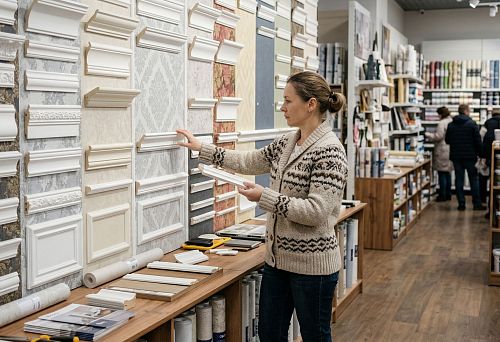
- Specialized stores. Sometimes, in showrooms specializing in flooring or finishing materials, the selection may be even richer, and the staff more knowledgeable about installation details.
- Online stores. More and more people appreciate the convenience of ordering online and receiving delivery to their home. When purchasing online, carefully read the product description, check reviews, and upon receipt, verify the quality and conformity to the order.
- Markets and construction bazaars. Sometimes, you can find good deals there, but be cautious about product quality and whether it matches the advertised specifications.
Before finalizing the purchase, be sure to confirm with the seller:
● Country of origin and brand reputation.
● Type of finish (laminate, paint, veneer).
● Presence of accompanying items (corners, caps, clips, etc.).
● Warranty terms and possibility of return in case of defects found.
9. Common misconceptions about MDF skirting boards
9.1. "MDF is not eco-friendly"
Modern technologies allow producing MDF with minimal content of harmful resins. Many factories use wood processing waste as raw material, helping preserve forest resources. It is important only to choose products meeting European ecological standards (E1, E0).
9.2. "MDF quickly deteriorates from moisture"
When properly installed and with normal room humidity, MDF skirting board will not be damaged. If, however, the room is constantly damp (bathroom, basement), you can additionally seal the ends with sealant or purchase a moisture-resistant variant with special impregnation.
9.3. "Installation is too complicated"
In fact, installing MDF skirting board is no more difficult than plastic or wooden ones. You just need to be careful when cutting and fitting corners. Many manufacturers offer convenient mounting systems that simplify installation.
9.4. "MDF looks cheap"
It depends on the quality of finish and design. Laminate skirting board with wood texture or veneered variant can look very respectable, sometimes indistinguishable from solid wood. Moreover, you can choose painted skirting board in any color, perfectly matching your interior.
10. Additional tips and tricks
10.1. Color combination
If you are unsure which color skirting board to choose, use test samples. Some stores allow you to take small pieces of skirting board home to compare them with floor and wall colors. This way, you avoid mistakes and can assess how each shade fits the room’s lighting.
10.2. Smart decoration
Sometimes, baseboard can be used as a decorative element if painted in a contrasting color or adorned with a simple pattern. The key is to maintain moderation so the interior does not appear overloaded.
10.3. Sound insulation
Although skirting board is not a full sound insulation element, some MDF models with additional inserts or seals may help reduce noise penetration through gaps between floor and wall. If sound insulation is especially important, consider such solutions or supplement installation with special soundproofing tapes.
10.4. Repairability
If you plan to periodically update your interior (change wallpaper, repaint walls), pay attention to mounting systems that allow you to easily remove the skirting board and reinstall it without damage. This way, you avoid additional costs during each renovation.
11. Operation and longevity
By following a few simple rules, MDF skirting board will serve for many years:
- Do not allow prolonged contact with water. Try to avoid flooding or large puddles during wet cleaning.
- Move furniture carefully. When moving cabinets or chairs, ensure that sharp edges do not hit the skirting board.
- Clean regularly. Dust and dirt not only spoil the appearance but can also gradually degrade the finish.
- Monitor humidity. The optimal humidity level in the room is 40–60%. Too dry air may cause slight material shrinkage, while excessive moisture may cause swelling.
12. Market prospects for MDF skirting boards
Modern MDF production technologies are constantly improving. Manufacturers introduce new methods of impregnation, processing, and finishing materials, allowing skirting boards to become even stronger, moisture-resistant, and more attractive. Models with integrated lighting, additional cable channels, and other useful features are appearing. Demand for quality and affordable skirting boards is growing, meaning the assortment will only expand.
13. How to properly combine MDF skirting with other interior elements
13.1. Door casings and architraves
The skirting will look especially harmonious if its texture and color match the door casings and architraves. Ideally, all these elements (and sometimes ceiling cornices) are executed in the same style and color palette.
13.2. Moldings and ceiling cornices
If you use moldings or ceiling cornices, it makes sense to choose them in the same style as the skirting. This will help create a unified decorative line, 'wrapping' the room from top to bottom. Particularly striking is the combination of white skirting and cornices against bright or dark walls.
13.3. Furniture and textiles
Although the skirting does not always need to match the color of the furniture, it is worth paying attention to the overall color scheme of the room. If the floor is light and the furniture is dark, the skirting can serve as a connecting element, provided you choose a shade that repeats in interior details (pillows, curtains, rug).
14. Practical examples of using MDF skirting
14.1. Studio apartment in Scandinavian style
In small studios, it is important to preserve the feeling of space and light. A white MDF skirting, 60–70 mm high, will be an excellent solution. White walls, light oak laminate, minimalist furniture, and minimal decor — all of this will harmoniously unite thanks to the light skirting, which visually expands the space.
14.2. Country-style house in the countryside
For wooden houses with solid furniture and abundant textiles, skirting with a natural wood imitation is suitable. A veneered MDF skirting with a subtle relief, painted in a warm brown tone, will emphasize the naturalness of the finish and add coziness.
14.3. Modern city apartment in high-tech style
Black-and-white palette, glass, metal — such spaces require strict forms and clear lines. An MDF skirting with a smooth surface, painted white or gray, will be an ideal finish for flooring (e.g., concrete-style laminate or monochromatic vinyl).
15. Conclusion
ChoosingMDF skirting for floor This is not just purchasing another finishing material, but an important step in creating a stylish, functional, and comfortable interior. MDF skirtings combine durability, affordability, aesthetics, and ease of installation. They allow you to highlight the beauty of the flooring, protect walls from damage, and conceal wires, making the space more neat and orderly.
Here are several key points that will help you avoid mistakes when choosing:
- Assess the style. Choose the skirting's shape and color according to the overall interior direction: classic, minimalism, Provence, high-tech, etc.
- Consider room dimensions. The higher the ceiling and the more spacious the room, the more high and decorative skirtings you can afford.
- Choose the color. It can blend with walls, continue the floor tone, or create a contrasting accent.
- Check the quality. Carefully inspect the skirting for chips, unevenness, and coating defects.
- Follow installation recommendations. Proper wall preparation, careful cutting of angles, and precise fixation will ensure a flawless result.
- Regular maintenance. Clean dust and promptly remove stains. Avoid excessive moisture or mechanical damage.
If everything is done correctly, the MDF skirting will become not just a functional element, but also an eye-catching accent that highlights the uniqueness of your home. It will delight you for many years, maintaining its original appearance and harmoniously blending into the interior.
So, if you plan to renovate your floor or simply want to give your room a finished look, pay attention to MDF skirting for floors. A wide range of designs, colors, and textures allows for experimentation, while the simplicity of installation and maintenance makes this option one of the most practical and popular. Let your interior reflect your taste and lifestyle — with quality and reliable materials that create an atmosphere of comfort and harmony.