Article Contents:
- Wood: Eternal Classic in Modern Interpretation
- Solid Wood: Natural Perfection
- Veneer: A Reasonable Compromise
- Panel Materials: Technological and Practical
- MDF: Accessibility and Functionality
- MDF: Superior Technology
- Plywood: Strength of Layered Structure
- Where to Buy Furniture Materials: Market Navigator
- Specialized Furniture Centers: Comprehensive Approach
- Online Platforms: Convenience and Wide Selection
- Furniture Manufacturers: Direct Access to Materials
- Construction Hypermarkets: Accessibility and Basic Assortment
- Innovative Materials: The Future of the Furniture Industry
- Acrylic Surfaces: Flawless Gloss
- Artificial Stone: Practical Luxury
- Composite Materials: Lightness and Strength
- Ecology and Safety: Conscious Choice
- Ecological standards and certification
- Natural and recycled materials
- Durability as an ecological factor
- Choosing Materials for Different Types of Furniture
- Kitchen Furniture: Durability Under Stress
- Soft Furniture: Comfort and Longevity
- Cabinet Furniture: Balance of Aesthetics and Functionality
- Children's Furniture: Safety and Adaptability
- Where to Buy Furniture Materials: Practical Tips
- Calculating required material quantities
- Transportation and Storage: Preserving Quality
- Tools and Equipment for Processing
- Trends and Innovations: Looking Ahead to Furniture Materials
- Smart Materials: Functionality at a New Level
- Sustainable Development: Materials with Minimal Ecological Footprint
- Personalization: Materials Adapting to Individual Needs
- Conclusion: The Art of Choosing to Create the Perfect Furniture

Furniture is not just functional interior items. It is silent witnesses of our lives, keepers of coziness, expressers of style and individuality. When we touch the smooth surface of a table, feel the softness of a sofa, or admire the texture of a cabinet, we interact with the materials from which they are made. It is precisely the material that determines not only the appearance and tactile sensations, but also the durability, ecological safety, and practicality of furniture. Let us dive into the fascinating world of furniture materials and figure out how to make a choice that will delight you for many years.


Wood: Eternal Classic in Modern Interpretation
Wood - the oldest and perhaps the most noble material for furniture making. Its warmth, natural beauty, and unique texture create a special atmosphere in any interior. But not all wooden surfaces are the same, and choosing a specific species can significantly affect your furniture's characteristics.




Solid wood: natural perfection
Solid wood is whole timber processed and prepared for furniture production. Each piece made from solid wood is unique, like a fingerprint, due to its distinctive grain pattern.
Oak - the king among furniture woods. Its exceptional density (700-800 kg/m³) ensures outstanding strength and durability. Furniture made from oak can withstand significant loads and serve for centuries - antique oak pieces often outlive their owners by several generations. The characteristic golden-brown hue with pronounced annual ring texture gives interiors a sense of solidity and nobility.
Walnut - embodiment of luxury and elegance. Its chocolate-brown wood with a purple undertone and silky sheen creates a sense of sophistication. With a density of about 650 kg/m³, walnut is strong yet easy to work with, allowing for intricate carved details. Walnut furniture is traditionally associated with the premium segment and often becomes a focal point in interiors.
Beech - a universal material with an excellent price-to-quality ratio. Its uniform structure and light pinkish hue make it ideal for modern minimalist interiors. Beech's density (650-750 kg/m³) ensures high wear resistance, and its ability to take stain well allows it to imitate more expensive species. Beech furniture is especially suitable for high-traffic areas - it withstands intensive use.
Spruce - an affordable option for those who value naturalness but are budget-conscious. Soft (density 400-500 kg/m³) and easy to work with, spruce allows for creating accessible furniture with a characteristic light tone and prominent knots. However, it should be noted that spruce is relatively soft - spruce furniture is more susceptible to mechanical damage and requires careful handling.
Our factory also produces:




Veneer: a sensible compromise
Veneer consists of thin (0.5-3 mm) sheets of natural wood that are glued onto a base made of more affordable materials. This allows combining the aesthetics of natural wood with the cost-effectiveness and technological efficiency of modern production.
Sawn veneer is obtained by sawing logs with special knives. The thickness of such veneer is 0.5-2 mm, allowing its use for covering curved surfaces. Due to the manufacturing method, the natural wood grain pattern is preserved, making the furniture visually indistinguishable from solid wood.
Rotary veneer is produced by rotating logs around their axis and cutting a continuous strip of wood. This method is more economical but yields a less expressive grain pattern. The thickness of rotary veneer is usually 0.1-0.5 mm, requiring special care during processing.
Fine-line veneer is an engineered veneer created by gluing and pressing multiple layers of wood, followed by cutting into thin sheets. This allows obtaining a material with a regular, predictable grain pattern, which is especially valuable when creating furniture sets, where visual consistency of all elements is crucial.
The advantages of veneered furniture are obvious: the appearance of natural wood at significantly lower cost, resistance to deformation and cracking, and the possibility of using rare and exotic species for decorative elements.
Get Consultation
Panel Materials: Technological Efficiency and Practicality
Modern furniture production cannot be imagined without panel materials - they form the basis of most cabinet furniture due to their accessibility, technological efficiency, and dimensional stability.
MDF: accessibility and functionality
Particleboard (MDF) is a material created by pressing wood particles with the addition of binding resins. Modern technologies have significantly improved the characteristics of this material compared to its earlier versions.
Laminated particleboard (Laminated MDF) is the most common material for cabinet furniture. The board is covered with a decorative paper-resin film and a protective melamine resin layer. This coating provides resistance to abrasion (wear resistance class from 1 to 5 on Taber scale), moisture, and ultraviolet light. Modern Laminated MDF collections include hundreds of decorative finishes, imitating various wood species, stone, metal, and fantasy textures.
HPL-coated particleboard has increased strength and moisture resistance. The plastic layer, 0.5-1 mm thick, is applied under high pressure, providing exceptional resistance to mechanical impacts and aggressive environments. This material is ideal for kitchen countertops and furniture in high-moisture areas.
Sanded particleboard is used as a base for veneer, plastic, or painting finishes. Its smooth surface ensures quality adhesion to finishing materials.
When choosing furniture made of particleboard, pay attention to the formaldehyde emission class - an indicator of environmental safety. Modern standards require the use of boards of class E1 (up to 8 mg/100 g) or E0.5 (up to 4 mg/100 g), which are considered safe for residential use.
MDF: superiority of technology
Medium-density fiberboard (MDF) is produced by pressing wood fibers with the addition of binding agents. Due to its uniform structure and absence of internal voids, MDF has several advantages over particleboard.
MDF facades - a hallmark of modern kitchen furniture. The material easily accepts shaped processing, allowing for complex profiles and decorative elements. The thickness of the board for facades is usually 16-19 mm, providing sufficient rigidity and enabling hinge installation.
MDF with PVC film - a popular solution for facades in the mid-price segment. Thermoplastic film, 0.35-0.8 mm thick, tightly conforms to all curves of the milled surface, creating a seamless finish. Modern PVC films imitate various materials, from wood to metal, and exhibit high resistance to fading and moisture.
Painted MDF - a premium solution for modern interiors. Multi-layer paint coating (primer, enamel, lacquer) creates a perfectly smooth surface with deep, rich color. The painting technology allows achieving various effects - from glossy finish (gloss level up to 95 units) to velvet matte (5-10 units) or currently trendy semi-matte (20-30 units) finish.
MDF surpasses particleboard in bending strength (24-30 MPa vs. 16-18 MPa), moisture resistance, and processing capabilities. However, these advantages are reflected in the price - MDF furniture is typically 30-50% more expensive than particleboard equivalents.
Plywood: strength of layered structure
Plywood is a material consisting of several veneer layers glued together with fibers oriented perpendicularly. This structure provides exceptional strength and dimensional stability.
Furniture-grade plywood is made from hardwood species (usually birch) and has higher quality requirements for the face layer. Grades A/AB and B/BV are used for visible furniture elements, while grades C/CR are used for internal structures.
Flexible plywood (royal) has a thickness of 3-8 mm and is used for creating curved furniture elements. Due to thin veneer layers (0.8-1.5 mm) and special adhesive compositions, such plywood easily takes the desired shape while maintaining high strength.
Laminated plywood is covered with melamine film, which increases its moisture resistance and provides decorative properties. This material is often used for making furniture in Scandinavian style, where the natural beauty of layered structure is appreciated.
Plywood surpasses MDF and particleboard in flexural strength (45-60 MPa), impact toughness, and ability to hold fasteners. This makes it an ideal material for structures subjected to significant loads — sofa frames, bed frames, chair frames.
Where to buy furniture materialsMarket navigator
Choosing suppliers of materials is no less important than choosing the materials themselves. The reliability, assortment, and service of the seller not only affect the quality of the final product but also the convenience of the entire process of creating or updating furniture.
Specialized furniture centers: comprehensive approach
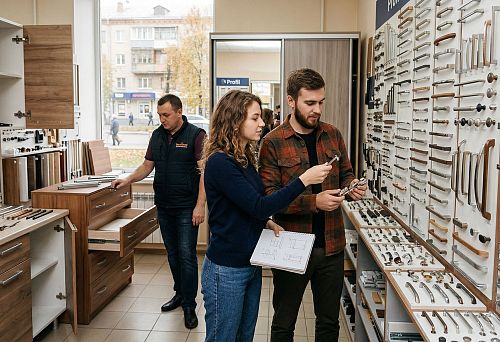
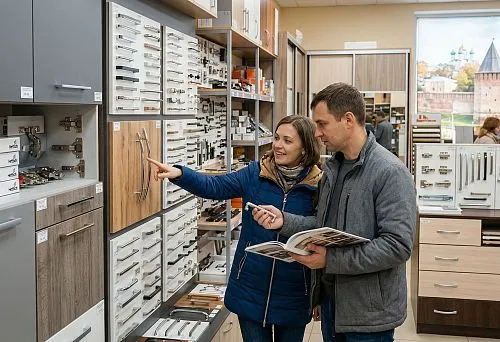
Furniture centers offer a wide range of materials "under one roof," which is especially convenient for comprehensive projects. Here you will find everything needed — from sheet materials to hardware and finishing components.
Advantages:
- Ability to see and evaluate materials in person
- Professional consultations from specialists
- Service services (cutting, edge banding, assembly)
- Delivery and lifting to the floor
Features of selection:
Pay attention to the availability of full-size samples — small fragments do not provide a complete picture of the material, especially if it comes to large-patterned decor. Request information on delivery times for non-standard items — some materials may be available only upon order with a wait of up to 4-6 weeks.
Online platforms: convenience and wide selection
Online stores for furniture materials offer unprecedented opportunities to choose and compare various options without leaving home. This is especially relevant for those who value their time or live far from large shopping centers.
Advantages:
- 24/7 access to catalogs and information
- Ability to compare prices and features
- Delivery at a convenient time
- Often lower prices due to the absence of costs for maintaining retail spaces
Features of selection:
When ordering online, it is critically important to study the return and exchange policy, especially for color-dependent materials. Many serious online platforms offer the service of ordering samples before purchasing a large quantity — it is definitely worth taking advantage of this.
Furniture manufacturers: direct access to materials
Some furniture factories offer purchasing materials used in their production. This may be advantageous if you want to create furniture that harmonizes with existing interior items.
Advantages:
- Guaranteed compatibility with furniture from this manufacturer
- Often exclusive decor and textures
- Professional recommendations for processing and care
- Ability to purchase exact amount of material without excess
Features of selection:
Check whether the manufacturer provides technical documentation and processing instructions for materials. Some specific coatings may require special storage and installation conditions.
Construction hypermarkets: accessibility and basic assortment
Large construction stores usually offer a basic set of furniture materials aimed at mass demand. This is a convenient option for standard solutions and small projects.
Advantages:
- Wide network of stores and convenient location
- Ability to purchase accompanying items (tools, fasteners)
- Regular promotions and discounts
- Often availability of cutting and delivery services
Features of selection:
The assortment in such stores is usually limited to popular items, and consultants may not have deep knowledge of furniture materials specifics. Before purchasing, it is advisable to independently study the characteristics of the materials you are interested in.
Innovative materials: the future of the furniture industry
The furniture industry is not standing still, constantly offering new materials that combine aesthetics, functionality, and eco-friendliness. These innovations expand design possibilities and respond to modern challenges.
Acrylic surfaces: flawless gloss
Acrylic panels are multi-layer materials with a top layer of polymethyl methacrylate (PMMA), providing exceptional gloss and color depth.
Features:
- Gloss level up to 97 units (for comparison, a mirror has 100 units)
- Acrylic layer thickness 0.5-2 mm, providing high scratch resistance
- UV resistance - no fading for 10+ years
- Polishability for removing minor damage
Acrylic facades create a sense of depth and volume, visually expanding the space. They are especially effective in modern minimalist interiors, where clean lines and reflective surfaces are prized.
Artificial stone: practical luxury
Acrylic and quartz artificial stone have revolutionized kitchen countertops and bathroom designs, offering a practical alternative to natural stone.
Acrylic stone (Corian, Staron, Hi-Macs) consists of mineral fillers (60-70%) and acrylic resins (30-40%). Its main advantages:
- Seamless joining of elements, creating a monolithic surface of any shape and size
- Warm to the touch surface, comfortable to use
- Thermoforming capability - creating curved elements
- Repairability - damage can be sanded and polished
Quartz aggregate (Caesarstone, Silestone) contains up to 93% quartz, providing exceptional strength:
- Hardness 6-7 on the Mohs scale (for comparison, diamond has 10)
- Scratch, impact, and high-temperature resistance (up to 180°C)
- Zero porosity, preventing liquid absorption and bacterial growth
- Wide color range, including marble, granite, and exotic stone imitations
Artificial stone allows creating seamless countertops up to 3.6 m long without visible seams, with integrated sinks and edges - solutions impossible with most other materials.
Composite materials: lightness and strength
Aluminum, fiberglass, and carbon fiber composites open new horizons in furniture design, combining minimal weight with high strength.
Aluminum composite panels (Dibond, Alucobond) consist of two aluminum layers with a polymer core between them. At a thickness of 3-6 mm, they have stiffness comparable to 4-mm steel sheet, but weigh 2.5 times less. These panels are used to create ultra-thin facades that do not require heavy frames.
Fiber cement panels combine cement with cellulose fibers, creating a material with concrete-like texture but significantly lighter and easier to process. A thickness of 8-12 mm provides sufficient strength for facades and countertops, and special impregnations make the material resistant to moisture and stains.
Carbon fiber (carbon) - material of the future, gradually entering the furniture industry from the aerospace sector. Its unique properties:
- Tensile strength up to 2000 MPa (5 times higher than steel)
- Density only 1.5 g/cm³ (5 times less than steel)
- Ability to create complex organic shapes
- Characteristic texture of interwoven carbon fibers, becoming a symbol of advanced technology
Composite materials allow creating furniture with previously impossible characteristics - ultra-thin countertops, cantilevered structures without visible supports, items with complex geometry.
Ecological safety: conscious choice
In an era of growing environmental awareness, questions of material safety and their impact on the environment become increasingly important when choosing furniture.
Ecological standards and certification
International and national standards help orient users regarding the ecological characteristics of materials:
Formaldehyde emission class - key indicator for wood-based panels:
- E0 (up to 3 mg/100 g) - highest standard, recommended for children's rooms and bedrooms
- E1 (up to 8 mg/100 g) - EU standard, considered safe for living spaces
- E2 (up to 30 mg/100 g) - allowed only for non-living spaces or with reliable sealing
FSC certification (Forest Stewardship Council) guarantees that wood is sourced from responsibly managed forests adhering to ecological and social standards. This certificate is especially important when selecting solid wood and veneer of rare species.
GREENGUARD - standard assessing the emission of volatile organic compounds (VOCs) from materials. The GREENGUARD Gold certification imposes even stricter requirements, making materials safe even for children and individuals with heightened sensitivity.
Natural and recycled materials
The modern furniture industry offers an increasing number of eco-friendly alternatives to traditional materials:
Bio-composites combine natural fibers (linen, hemp, jute) with biodegradable plant-based polymers. These materials have a 30-50% lower carbon footprint compared to traditional oil-based composites.
Recycled plastic receives a second life as furniture panels with high strength and water resistance. The technology allows creating materials with interesting textures and color effects, turning an eco-choice into a design advantage.
Regenerated wood is an innovative material created from wood waste without using formaldehyde resins. Instead of chemical binders, natural lignins are used, activated under high pressure and temperature, making the material fully natural and safe.
Longevity as an Ecological Factor
Often overlooked, the longevity of furniture is also an ecological factor. Items that serve for decades reduce resource consumption and waste generation.
Factors of longevity:
- Material quality and suitability for operating conditions
- Structural solutions ensuring strength and repairability
- Timeless design, not subject to rapid fashion trends
- Possibility of updating and restoration (especially for solid wood)
Investments in quality materials pay off not only financially, but also in terms of ecological responsibility.
Material selection for different types of furniture
Each type of furniture has its own functional characteristics and operating conditions, which determine the optimal material choice.
Kitchen furniture: resistance to tests
The kitchen is the most demanding space in the home, where furniture is exposed to moisture, steam, high temperatures, and mechanical stress.
Kitchen cabinet carcasses are typically made of moisture-resistant MDF boards 16-18 mm thick with swelling not exceeding 8% (for standard MDF, this figure is 15-20%). For base cabinets, aluminum or plastic kickboards are recommended, fully resistant to moisture during cleaning.
Countertops must withstand contact with water, high temperatures, and sharp objects:
- Post-forming (MDF with plastic coating) - budget-friendly solution with thickness 28-38 mm and front edge radius 3-10 mm
- Artificial stone - premium option with thickness 12-40 mm, capable of creating seamless surfaces and integrated sinks
- Ceramic - ultra-durable material with thickness 10-20 mm, completely resistant to scratches and temperatures up to 300°C
Fronts determine the kitchen's appearance and must combine aesthetics with practicality:
- MDF with PVC film - optimal price-to-quality ratio, moisture resistance, easy maintenance
- Painted MDF - premium solution with unlimited color options, requires more careful handling
- Solid wood - classic option requiring regular care and protection from moisture with special compounds
High-quality hardware is critical for kitchen furniture - hinges with dampers that withstand up to 200,000 open/close cycles, full-extension guides with load capacity up to 80 kg for lower drawers.
Soft furniture: comfort and durability
Sofas and chairs consist of several key components, each affecting comfort and furniture lifespan.
Frame - the foundation determining structural strength:
- Solid wood (oak, beech, pine) - traditional material ensuring longevity with proper construction
- Plywood - modern alternative offering dimensional stability and resistance to deformation
- Metal frame - solution for modern models with sleek lines and cantilever elements
Fillers create comfort and determine ergonomics:
- Polyurethane foam (PU) of various densities (25-50 kg/m³) - most common material offering various levels of firmness
- Latex - premium filler with enhanced elasticity and longevity (service life up to 15 years)
- Spring blocks - classic solution providing support and ventilation
Upholstery materials determine not only the appearance but also the practicality of furniture:
- Natural leather 1.2-1.6 mm thick - luxurious and durable material that develops a noble patina over time
- Eco-leather - modern fabric-based material with polyurethane coating 0.8-1.2 mm thick, combining leather aesthetics with practicality and affordable price
- Velvet and microvelvet with Martindale abrasion resistance of 15,000-40,000 cycles - soft, pleasant-to-touch fabrics creating a cozy atmosphere
- Rug and shenille with density 280-450 g/m² - textured fabrics with high durability, suitable for families with children and pets
When choosing soft furniture, pay attention to removable covers (allowing dry cleaning or washing) and presence of special treatments protecting against stains and moisture.
Cabinet furniture: balance of aesthetics and functionality
Cabinets, chests, shelves, and other cabinet furniture form the basis of interior design and storage systems in the home.
Cabinet materials:
- Laminate board 16-18 mm thick - standard solution with optimal price-to-quality ratio
- MDF 16-22 mm thick - stronger and more moisture-resistant material for premium furniture
- Plywood 15-18 mm thick - choice for eco-friendly furniture in Scandinavian or Japanese style
Facade materials:
- Laminate with ABS edge 0.5-2 mm thick - practical solution for modern interiors
- MDF with various finishes - wide decorative options, from matte enamel to glossy acrylic
- Glass in aluminum frame - elegant solution visually lightening heavy cabinets
Back panels of cabinet furniture are typically made of 3-4 mm thick particleboard or thin laminate (8-10 mm) for more premium models. This element is critical for structural rigidity, so material quality and fastening should not be underestimated.
High-quality hardware is essential for cabinet furniture, especially sliding-door cabinets and wardrobe systems - smooth-running sliding door guides, adjustable hinges, strong shelf supports capable of holding up to 15-20 kg per shelf.
Children's furniture: safety and adaptability
Furniture for children's rooms must meet the highest safety standards and account for the child's rapid growth and changing needs.
Ecological materials:
- MDF or E0/E1 emission class laminate - basic safe option
- MDF with water-based finishes and paints - more eco-friendly alternative
- Solid pine or birch with natural protective finishes - premium solution for nature lovers
Safe construction:
- Rounded corners with radius of at least 2 mm to prevent injuries
- Stable construction with low center of gravity to prevent tipping
- Secure wall mounting for tall cabinets and shelves
- Hardware with finger protection and child safety locks
Transformability - key feature of modern children's furniture, allowing adaptation to a growing child:
- Cots that transform, "growing" from infancy to adolescence
- Tables with adjustable height (adjustment range 15-30 cm)
- Modular storage systems that can be reconfigured as needs change
Children's furniture must be not only safe but also easy to maintain - surfaces must withstand wet cleaning and treatment with child-safe disinfectants.
Where to buy furniture materials: practical tips
Purchasing quality materials is only the first step. For successful implementation of the furniture project, it is important to correctly calculate quantities, organize delivery and storage, and prepare for material processing.
Calculation of required materials
Accurate calculation will help avoid both material shortages and excesses:
For sheet materials:
- Consider standard sheet sizes (usually 2800×2070 mm for MDF and laminate)
- Add allowances for processing (typically 5 mm on each side when cutting)
- Optimize cutting using specialized software to minimize waste
- Order 5-10% extra to compensate for possible defects and errors
For cladding materials:
- For edge banding, calculate the length of all visible ends plus 10% for trimming
- For veneer, consider grain direction and the need to match patterns
- For decorative panels, plan for pattern alignment on adjacent elements
For fasteners and hardware:
- Prepare a detailed specification indicating the type and quantity of each item
- Consider construction specifics (e.g., number of hinges depends on facade size and weight)
- Purchase small items with a small surplus, as they are easy to lose during assembly
A professional approach to material calculation not only saves money but also minimizes the project's ecological footprint by reducing waste.
Transportation and storage: preserving quality
Proper transportation and storage are critically important for preserving material quality:
Transportation:
- Panel materials must be transported horizontally on a flat surface
- Protection from moisture and mechanical damage using packaging materials
- Secure fastening to prevent shifting and friction during transit
- Use of specialized covered transport to protect from weather
Storage:
- Horizontal storage of panel materials on a flat surface to prevent deformation
- Maintain optimal conditions: temperature 18-22°C, humidity 45-65%
- Protection from direct sunlight, which can cause fading and deformation
- Acclimatize materials for 48-72 hours in the room where processing and installation will take place
Natural materials (solid wood, veneer) and certain types of finishes (glossy films, acrylic) are especially sensitive to storage conditions.
Tools and equipment for processing
Quality material processing requires appropriate tools:
Basic tool set:
- Circular saw with a guide rail for precise cutting
- Edge banding machine or manual edge bander for finishing end edges
- Router with a set of bits for creating joints and decorative elements
- Various types of sanders for preparing surfaces for finishing
Consumables:
- Tipped saw blades with carbide for clean cuts without chipping
- Edge banding material matching the decor of panel materials
- Adhesives, putties, and sealants for various types of joints
- Abrasive materials of various grits for progressive sanding
Protective equipment:
- Respirators with filters for protection against dust
- Safety goggles and gloves
- Hearing protection when working with noisy equipment
Investments in quality tools pay off through precise processing, reduced scrap, and consequently, savings in materials and time.
Trends and Innovations: A Look at the Future of Furniture Materials
The furniture industry constantly evolves, offering new materials and technologies that respond to changing consumer needs and values.
Smart materials: a new level of functionality
Integrating technology into materials opens new possibilities for furniture functionality:
Self-healing coatings contain microcapsules with polymers that are released upon damage and "heal" scratches. Such coatings can remove minor damage under the influence of heat or ultraviolet light, significantly extending the aesthetic lifespan of furniture.
Thermoregulating materials contain phase-change components that absorb or release heat when temperature changes. This allows creating furniture that remains comfortable to the touch regardless of ambient conditions — chairs and armrests do not feel cold in winter or become hot in summer.
Antibacterial surfaces with silver or copper ions actively suppress bacterial and fungal growth, which is especially important for kitchen furniture and furniture in medical facilities. Such materials destroy up to 99.9% of bacteria within 24 hours of contact.
Integrated sensor systems — materials with embedded sensors and conductors — enable the creation of interactive furniture that responds to touch, changes in lighting, or temperature. This technology opens new possibilities for integrating furniture into "smart home" systems.
Sustainable Development: Materials with Minimal Environmental Footprint
Environmental responsibility is no longer just a trend but a necessity shaping new approaches to producing furniture materials:
Mycelium-based biodegradable composites offer an alternative to traditional wood panels. Mycelium is grown on agricultural waste, forming a strong structure that, after thermal treatment, becomes a lightweight, durable, and fully biodegradable material.
Recycled ocean plastics receive a second life as decorative panels and structural elements. The technology allows creating materials with unique textures and color gradients, turning an ecological initiative into a design advantage.
Fast-growing alternatives to wood — materials based on bamboo, algae, hemp, and other rapidly renewable resources. For example, bamboo grows 30 times faster than hardwoods, reaching maturity in 3–5 years, and possesses comparable mechanical properties.
Water-free production technologies significantly reduce water and energy consumption during material manufacturing. For example, innovative textile dyeing methods using supercritical CO₂ instead of water reduce water consumption by 90% and energy use by 60%.
Personalization: Materials Adapting to Individual Needs
Mass customization has become a new norm, enabling the creation of unique solutions without significant cost increases:
Digital printing on various materials allows creating individual designs with photographic quality. Modern technologies ensure high durability of images against abrasion and ultraviolet exposure, preserving color vibrancy throughout the furniture’s lifespan.
Parametric design combined with additive technologies (3D printing) opens opportunities to create furniture elements with optimized structures, tailored to specific loads and ergonomic user requirements.
Adaptive materials change their properties depending on usage conditions. For example, "smart" fabrics can adjust stiffness based on body temperature, providing optimal support in any condition.
Materials with customizable tactile properties allow creating surfaces that are pleasant to the touch and match individual preferences. Micro-texturing technologies provide various tactile sensations — from silky smoothness to soft velvet — while maintaining practicality and durability.
Conclusion: The Art of Selection for Creating the Perfect Furniture
Choosing materials for furniture is an art of balancing aesthetics, functionality, durability, and eco-friendliness. This decision will affect your comfort, health, and emotional well-being for many years.
Understanding the properties, advantages, and limitations of various materials allows making an informed choice aligned with your values, lifestyle, and budget. Whether you prefer timeless elegance of natural wood, practicality of modern composites, or innovative solutions of the future, quality remains the key factor.
Knowing that Where to buy furniture materials Quality is the decisive factor in the success of your furniture project. Reliable suppliers with proven reputations, wide assortments, and professional service form the foundation for quality furniture.
Remember that furniture is not just interior items, but elements of the space where your life unfolds. They witness your daily rituals, family celebrations, moments of creativity, and relaxation. Choosing materials for your furniture with care and awareness is investing in the quality of your life and creating a legacy for future generations.