Article Contents:
- Revolution in Understanding Furniture Materials
- Evolution of Materials Science in the Furniture Industry
- Classification of Modern Furniture Materials
- Wood and Wood Materials: Foundation of Cabinetmaking Craft
- Solid Wood: Nobility and Nature's Caprices
- Engineered Wood Materials
- Veneer and Its Variants
- Modern Composite and Synthetic Materials
- Plastics and Their Use in Furniture
- Next-Generation Composites
- Metals in Modern Furniture
- Steel: Strength and Technological Advancement
- Aluminum and its alloys
- Textile Materials in Furniture Production
- Natural Upholstery Fabrics
- Synthetic Upholstery Materials
- Hardware as a Material Supply Element for Projects
- Hinge Systems
- Guides for sliding elements
- Handles and Decorative Furniture Hardware
- Support Elements and Structural Components
- Traditional Wooden Legs
- Metal Support Systems
- Adjustable Supports
- Decorative Materials and Finishing Systems
- Moldings and Profile Elements
- Plates and Receptacles
- Edge banding materials
- Innovative Materials and Technologies of the Future
- Nanomaterials in Furniture Production
- Biomaterials
- Smart Materials
- Ecological Aspects of Material Selection
- Certification and Standards
- Renewable resources
- Recycling Technologies
- Economic Aspects of Material Selection
- Lifecycle Cost Analysis
- Procurement Optimization
- Material Quality Management
- Technological Aspects of Working with Materials
- Equipment for Material Processing
- Joints and Fasteners
- Finishing Technologies
- Logistics and Management of Material Flows
- Planning Material Requirements
- Warehouse logistics
- Quality Control During Storage
- Frequently Asked Questions

What exactlymaterials for furniture makerWhat specific materials can turn an ordinary project into a masterpiece of furniture art? This question concerns every designer and manufacturer striving to create not just functional furniture, but true works that combine beauty, durability, and innovative solutions. In the world of modern furniture production, the right choice of materials determines not only the aesthetic qualities of the product, but also its durability, production cost, and market competitiveness.
The modern furniture industry is experiencing a period of rapid technological development. Traditional materials are supplemented by innovative composites, ecological requirements are becoming stricter, and consumers are demanding higher standards of quality and functionality. Under these conditions, knowledge of the characteristics of different materials, understanding their compatibility, and optimal application become critically important for successful work.
Professional furniture design requires a deep understanding of material properties, their behavior under various operating conditions, processing and decorating capabilities. An experienced furniture maker knows: the success of a project depends 70% on the correct choice of materials and only 30% on the craftsmanship.


Revolution in Understanding Furniture Materials
Furniture production of the 21st century fundamentally differs from the craft traditions of the past. A century ago, the craftsman worked primarily with solid wood of several local species, while the modern designer has access to hundreds of materials with different characteristics.




Evolution of Materials Science in the Furniture Industry
The history of furniture materials development is the history of human technological progress. From primitive processing of solid wood, we have come to the creation of complex composite materials that surpass natural analogs in many parameters. Understanding thatWhat new-generation furniture is made of — a question customers must receive comprehensive answers to. Eco-friendliness, durability, ease of care — specific advantages speak louder than abstract 'innovation'.in modern conditions, requires familiarity with achievements in chemistry, physics, and materials engineering.
The emergence of MDF in the mid-20th century marked the first revolution in furniture materials science. The ability to use wood waste to create a strong sheet material opened new horizons for mass production. The next stage was the development of MDF — a material combining the ecological properties of wood with the technological advantages of production.
The modern stage is characterized by the emergence of 'smart' materials capable of changing their properties depending on operating conditions. Self-healing coatings, antibacterial surfaces, shape-memory materials — all of this is no longer science fiction, but reality of modern furniture production.
Our factory also produces:


Classification of Modern Furniture Materials
Systematizing the vast diversity of modern materials is no simple task. Each material has numerous characteristics, and classification can be based on different principles: origin, structure, method of production, areas of application.
By origin, materials are divided into natural, modified natural, and synthetic. Natural materials include solid wood, natural leather, stone. Modified materials are veneer, thermowood, pressed materials based on wood. Synthetic materials are polymers, composites, metal alloys.
By structure, materials are classified as monolithic, layered, and porous. Monolithic materials have a uniform structure throughout their volume, layered materials consist of several layers with different properties, porous materials contain numerous air inclusions, which affect their thermal and acoustic insulation properties.
By functional purpose, materials are divided into structural, finishing, fastening, and auxiliary. Structural materials ensure the strength of the product, finishing materials determine its appearance, fastening materials ensure reliable connections, and auxiliary materials perform special functions.
Get Consultation
Wood and Wood Materials: The Foundation of Furniture Craftsmanship
Despite the emergence of numerous alternative materials, wood remains the basis of furniture production. Understanding the characteristics of different wood species, their processing methods, and applications is critically important for creating quality furniture.
Solid Wood: The Grandeur and Caprices of Nature
Working with solid wood requires deep knowledge of the properties of different species, their reactions to changes in humidity and temperature, and compatibility with various types of finishes.what materials are used to make wooden furnitureIt depends not only on the appearance of the product, but also on its durability, cost, and ecological characteristics.
Oak is the king of furniture woods. Its hardness, beautiful texture, and high resistance to wear make it ideal for producing luxury furniture. However, working with oak requires special equipment and highly skilled craftsmen. The material is fussy to process and prone to cracking if dried improperly.
Beech has a uniform structure and is easy to work with. It takes staining and toning well, allowing it to imitate more expensive woods. However, beech is hygroscopic and requires careful protection from moisture.
Spruce is the most affordable wood for furniture production. It is soft, easy to process, and has a pleasant resinous aroma. Its drawbacks include a tendency to form resin pockets, low hardness, and susceptibility to mechanical damage.
Engineered wood materials
MDF, particleboard, OSB — these abbreviations are familiar to anyone involved in furniture production. However, understanding the specific characteristics, advantages, and limitations of each material requires deeper study.
Particleboard (particleboard) is produced by pressing wood particles with synthetic binders. The material is inexpensive, technologically convenient, and has stable dimensions. Main drawbacks: low moisture resistance, formaldehyde emissions, limited mechanical processing capabilities.
MDF (medium-density fiberboard) is made from wood fibers, providing a more uniform structure and better mechanical properties. The material is well-suited for milling and allows for creating complex profiles. Its ecological characteristics are better than those of particleboard.
Veneer is a multi-layer material made of thin wood sheets glued with fibers arranged perpendicularly. High strength, dimensional stability, and the ability to produce bent parts make veneer indispensable for many applications.
Veneer and its varieties
Veneer allows combining the cost-effectiveness of panel materials with the beauty of natural wood. There are different types of veneer: planed, peeled, and sawn, each with its own characteristics.
Planed veneer is obtained by planing logs with special knives. This method allows for a beautiful texture, but the productivity is low, and the thickness of the sheets is limited.
Peeled veneer is produced by peeling logs on special machines. The method is highly productive, but the texture is less expressive. Peeled veneer is primarily used for producing plywood.
Fine-line veneer is a reconstructed veneer obtained from fast-growing tree species. The technology allows mimicking the texture of valuable species and creating fantasy patterns not found in nature.
Modern composite and synthetic materials
The development of polymer chemistry has opened new possibilities for furniture design. Modern synthetic materials often surpass natural materials in performance characteristics, opening new horizons for creativity.
Plastics and their applications in furniture
Acrylic (PMMA) has high transparency comparable to glass, but is significantly safer and more technologically convenient to process. The material is well-suited for mechanical processing, gluing, and thermoforming. It is used to manufacture transparent and semi-transparent furniture elements.
Polycarbonate combines transparency with exceptional impact resistance. The material is 200 times stronger than glass at comparable transparency. It is widely used in office furniture and children's furniture, where safety is crucial.
ABS plastic has good mechanical properties, is easily colored, and is suitable for various surface treatments. The material is widely used for manufacturing hardware, decorative elements, and structural parts.
New-generation composites
Wood-polymer composites (WPC) combine the naturalness of wood with the practicality of plastics. The material is resistant to rot, does not require protective treatment, and has stable dimensions. It is widely used for garden furniture and exterior elements.
Epoxy and polyester-based glass-reinforced plastics have exceptional strength at low weight. The ability to create complex-shaped parts through molding opens new possibilities for designers.
Acrylic-based mineral composites mimic natural stone but surpass it in technological convenience. The material is non-porous, hygienic, and repairable. It is widely used for countertops, window sills, and decorative elements.
Metals in modern furniture
The use of metals in furniture production is not limited to hardware. Modern metal processing technologies allow creating complex structures combining strength with elegant forms.
Steel: strength and technological convenience
Structural steel provides maximum strength with minimal cross-section of elements. The possibility of creating welded, bolted, and glued connections makes steel a universal structural material. The main drawback is susceptibility to corrosion, requiring protective coatings.
Stainless steel combines strength with corrosion resistance. The material is hygienic, easy to clean, and has a modern appearance. It is widely used in kitchen furniture, medical furniture, and public interiors.
Powder coatings on steel provide not only corrosion protection but also decorative properties. The ability to achieve various colors and textures makes painted steel attractive to designers.
Aluminum and Its Alloys
Aluminum combines lightness with corrosion resistance. The material is easily machinable, anodizable, and paintable. Extruded aluminum profiles are widely used in office furniture and retail equipment.
Aluminum alloys offer increased strength while retaining the main advantages of pure aluminum. Aviation alloys are used in exclusive furniture, where the combination of strength and lightness is crucial.
Anodizing aluminum creates a protective-decorative coating with unique properties. Anodized surfaces are harder than steel, scratch-resistant, non-fading, and can have various colors and textures.
Textile materials in furniture manufacturing
Upholstery materials determine not only the appearance of soft furniture but also its consumer properties: comfort, durability, and ease of care. Choosing fabric requires consideration of multiple factors.
Natural upholstery fabrics
Natural leather remains the standard of luxury and comfort. The material "breathes," is pleasant to the touch, and develops a noble patina with age. Leather types include aniline, semi-aniline, and pigmented. Each type has specific care and usage characteristics.
Wool fabrics provide excellent thermal regulation and have natural antibacterial properties. High-quality merino wool, cashmere, and alpaca are used in premium furniture.
Linen fabrics are attractive for their eco-friendliness and hygienic properties. Linen has natural antibacterial properties, effectively wicks moisture, and is durable. The downside is its tendency to crease.
Synthetic upholstery materials
Modern synthetic fabrics often surpass natural ones in performance characteristics. Microfiber, artificial leather, and high-tech polymer materials open new possibilities for designers.
Polyester microfiber mimics natural suede but surpasses it in durability and ease of care. The material does not absorb odors, is easy to clean, and does not fade in sunlight.
New-generation artificial leather is virtually indistinguishable from natural leather in appearance and tactile sensation. The material is more resistant to wear, requires no special care, and can have any color and texture.
Blended fabrics combine the advantages of natural and synthetic fibers. A properly selected composition ensures optimal balance of comfort, durability, and practicality.
Hardware as part of material support for projects
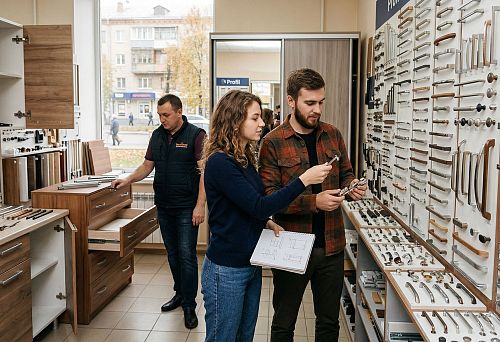
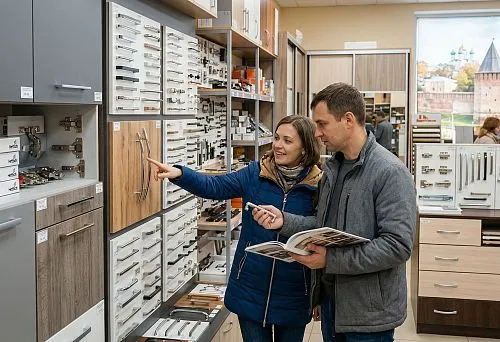
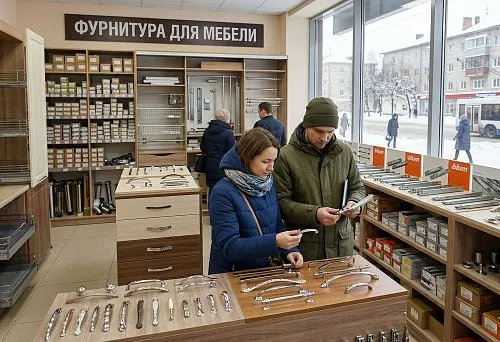
Furniture hardware for base cabinet makers— these are not just fastening elements, but complex mechanical systems ensuring the functionality of modern furniture. The quality of hardware largely determines the consumer properties of the finished product.
Hinge Systems
Modern furniture hinges are high-tech products ensuring smooth, quiet door opening with adjustable settings in three planes. There are surface-mounted, semi-surface-mounted, and recessed hinges for different facade types.
Soft-close systems dramatically enhance furniture usability. Hydraulic or pneumatic dampers ensure smooth door closure in the final centimeters of travel.
Push-to-open hinges allow doors to open with a light press, especially relevant for minimalist facades without handles. The system combines aesthetics with functionality.
Guides for sliding elements
Full-extension ball-bearing guides ensure smooth movement of drawers with high load capacity. Quality guides withstand tens of thousands of opening cycles without losing performance.
Hidden-mount tandem guides provide maximum aesthetics while retaining all functional advantages. The absence of visible mounting elements creates an impression of "floating" drawers.
Guides with auto-stop mechanisms automatically pull drawers into the final centimeters of travel, ensuring gentle closure and precise positioning.
Handles and furniture hardware for decoration
Handles for Basis Furniture Designer— serve not only functional but also decorative purposes. Modern handles are made from various materials — metal, wood, plastic, glass, leather.
Surface-mounted handles are easy to install and replace, providing secure grip. The variety of shapes and materials allows selecting handles for any interior style.
Recessed handles create a minimalist appearance but require more complex installation. Handles integrated into the facade provide maximum aesthetics.
Rail handles are popular in modern interiors. Horizontal or vertical profiles create a graphic facade pattern, emphasizing contemporary design.
Support elements and structural components
Legs base furniture makerand other support elements play an important role not only in ensuring furniture stability but also in shaping its stylistic appearance.
Traditional wooden legs
Turned solid wood legs create a classic style atmosphere. Various profiles — balusters, cones, cylinders — allow creating furniture in different historical styles.
Carved legs are works of decorative applied art. Hand-carved designs create unique, one-of-a-kind pieces, but require highly skilled craftsmen and significant time investment.
Bent legs, manufactured using wood bending technology, combine strength with elegant forms. The technology allows creating complex curved profiles without joints.
Metallic support systems
Steel legs provide maximum strength and stability. The ability to create complex welded structures opens new possibilities for designers.
Aluminum profiles combine lightness with corrosion resistance. Extrusion technology allows creating profiles with complex cross-sections and integrated channels for communications.
Chromed legs create an accent in modern interiors. The mirror-like chrome surface visually lightens the structure, creating a sense of weightlessness.
Adjustable Supports
Furniture legs with height adjustment compensate for floor unevenness, ensuring precise furniture positioning. Particularly relevant for kitchen sets and built-in furniture.
Anti-vibration legs reduce vibration transmission from household appliances to the furniture body. Used in kitchen sets for installing washing machines and dishwashers.
Furniture casters provide mobility for heavy furniture items. Quality casters have locking mechanisms, leave no marks on the floor, and operate silently.
Decorative materials and finishing systems
where to buy furniture decor— a question that interests many manufacturers striving to give their products uniqueness and expressiveness.
Moldings and profile elements
where to buy moldings for decorationdepends on the material and style of finish. Wooden moldings create a classic look, polyurethane ones are practical and durable, metallic ones emphasize modern design.
Facade moldings serve not only decorative but also functional roles, concealing joints between parts and creating a finished appearance of the item. Properly selected profiles can visually alter the proportions of furniture.
Ceiling moldings in cabinet furniture create an effect of integration, blending with the room's architecture. Complex multi-level profiles give furniture a monumental and solid appearance.
Decorative inserts and outlets
Decorative inserts allow creating accents on smooth facade surfaces. Carved elements, patinated details, and contrasting inserts give furniture individuality.
Corner inserts conceal manufacturing features, creating an impression of structural monolithism. Particularly relevant for furniture made from panel materials.
Central outlets are traditionally placed at the geometric center of facades, creating a symmetrical composition. They can be functional (hiding keyholes) or purely decorative.
Edge banding materials
PVC edge banding is the most common material for covering ends of panel materials. The variety of colors and textures allows selecting an edge banding to match or contrast the main material.
Melamine edge banding is more economical, but less durable. It is primarily used for concealed ends, not subjected to intensive wear.
ABS edge banding has increased resistance to impacts and scratches. The material better withstands temperature fluctuations, which is important for kitchen furniture.
Wooden edge banding creates an impression of the item's massiveness. Veneered edge banding allows precisely matching the color and texture to the main facade material.
Innovative materials and future technologies
The furniture industry is not standing still. The development of nanotechnology, bioengineering, and "smart" materials opens new horizons for designers and manufacturers.
Nanomaterials in furniture production
Nanocoatings provide unique surface properties — self-cleaning, antibacterial effect, increased wear resistance. Titanium dioxide nanoparticles create a photocatalytic effect, breaking down organic contaminants.
Nanocomposites combine properties of different materials at the molecular level. Carbon nanotubes in a polymer matrix create materials of exceptional strength with minimal weight.
Nanocellulose from wood surpasses steel in strength while being significantly lighter. The material is biodegradable and renewable, opening new possibilities for eco-friendly design.
Biomaterials
Mycelial mycelium can be grown in any configuration, creating lightweight, strong, fully biodegradable materials. The technology is still in development, but the prospects are impressive.
Bio-plastics from plant-based raw materials allow creating polymer materials with specified biodegradation properties. After their service life, such materials fully decompose under natural conditions.
Wood modified by biological methods acquires new properties — increased density, moisture resistance, altered color. Natural enzymes alter the wood structure at the cellular level.
Smart materials
Shape-memory materials can change their configuration under the influence of temperature, humidity, or electric current. Furniture made from such materials can adapt to user needs.
Thermochromic materials change color depending on temperature. Countertops made from such materials can visualize hot zones, warning of possible burns.
Piezoelectric materials generate electricity under mechanical stress. When integrated into furniture, they can power LED lighting, sensors, and other electronic devices.
Ecological aspects of material selection
Environmental responsibility is becoming an increasingly important factor when selecting materials. Consumers demand not only aesthetically pleasing and functional furniture, but also products that are safe for health and the environment.
Certification and Standards
FSC (Forest Stewardship Council) certification guarantees that the wood comes from responsibly managed forests. The use of FSC-certified materials is becoming a requirement for many clients.
GREENGUARD certification confirms low chemical emissions from materials. Especially important for children's furniture and bedroom furniture.
CARB (California Air Resources Board) sets strict requirements for formaldehyde emissions from wood materials. Compliance with CARB standards is mandatory for exporting to the United States.
Renewable resources
Bamboo grows 30 times faster than trees, reaching maturity in 3-5 years. The material is stronger than many types of wood, has antibacterial properties, and is fully renewable.
Cork is the bark of cork oak, which regenerates every 9 years without harming the tree. The material is lightweight, elastic, and has excellent thermal and acoustic insulation properties.
Recycled materials allow waste from production and consumption to be given a second life. Plastic from recycled bottles, particleboard from paper waste, aluminum from secondary raw materials.
Recycling technologies
Design for disassembly — a principle of furniture design that considers easy disassembly at the end of the product's life cycle. Use of detachable joints instead of adhesives, material labeling for sorting.
Cradle to cradle — a concept of a closed-loop cycle, where waste from one production becomes raw material for another. Furniture is designed with full recyclability of all components in mind.
Upcycling — transforming materials into higher-quality products. Old furniture becomes raw material for new design solutions, preserving the material's history and character.
Economic aspects of material selection
The cost of materials constitutes a significant portion of furniture's cost. Optimizing material costs without compromising quality is a key challenge for manufacturers.
Life Cycle Cost Analysis
Life Cycle Cost (LCC) considers not only the initial material cost but also all costs over the product's lifetime. Expensive but durable materials may prove more economically advantageous than cheaper alternatives.
Maintenance cost includes expenses for cleaning, repairs, and replacing worn components. Materials requiring minimal maintenance reduce overall operating costs.
Residual value — the price of materials after the end of the product's life. Metals and high-quality wood may have significant residual value.
Procurement Optimization
Centralized procurement of large volumes of materials allows manufacturers to obtain significant discounts from suppliers. However, it requires large storage areas and working capital.
Just-in-time deliveries minimize inventory levels but require reliable suppliers and precise production planning. Delivery delays can halt the entire production process.
Local suppliers reduce transportation costs and delivery time, but may offer limited product variety or higher prices. Balancing cost and reliability of deliveries.
Material quality management
Incoming material inspection prevents the use of substandard raw materials but requires additional resources. The cost of scrap is always higher than the cost of inspection.
Supplier certification allows reducing incoming inspection levels for trusted partners. Long-term relationships with reliable suppliers are more beneficial than constant partner changes.
Quality management system (ISO 9001) ensures stable material characteristics and reduces variability in the quality of finished products.
Technological aspects of working with materials
Material selection is inseparably linked to production technological capabilities. The best material is useless if there is no technology to process it properly.
Material processing equipment
CNC machines revolutionized furniture production, providing high precision and repeatability of processing. Programming machines requires specialized knowledge, but it pays off in terms of quality and speed of production.
Laser cutting allows processing thin materials with exceptional precision. The absence of mechanical contact eliminates deformation, and the narrow cut minimizes material waste.
Edge banding machines provide high-quality finishing of the ends of panel materials. Modern machines automatically adjust processing parameters depending on the edge material.
Joints and fasteners
Conformers are special screws for joining parts made of wood materials. They provide a strong detachable connection but require precise marking and drilling.
Eccentric fasteners create strong clamping force with minimal fastener size. Essential for assembled furniture, they ensure quick assembly and disassembly.
Shanks are a traditional method of joining solid wood parts. Glued joints on shanks are stronger than solid wood in the direction perpendicular to the grain.
Lamellae allow creating strong joints at various angles. Routing grooves for lamellae requires special equipment but ensures high-quality joints.
Finishing Technologies
Lacquering is a traditional method of protecting and decorating wood. Modern water-based lacquers are more eco-friendly but require special drying techniques.
Staining changes the color of wood, highlighting its texture. Different staining application methods allow achieving various effects — from even coloring to complex tonal transitions.
Patination creates an aging effect, giving furniture historical character and elegance. The technique requires high craftsmanship, but the result justifies the effort.
Film lamination is an economical way to decorate panel materials. Modern films accurately mimic various materials — wood, stone, metal.
Logistics and Material Flow Management
Effective organization of material supply and storage is critically important for production profitability. Downtime due to lack of materials can cost more than the materials themselves.
Material Requirement Planning
MRP (Material Requirements Planning) systems automatically calculate material requirements based on the production plan. They consider delivery time, minimum order quantities, and safety stock.
ABC material analysis allows focusing efforts on managing the most critical items. A-category (20% of items, 80% of cost) requires special attention.
Demand forecasting based on historical data and market trends allows planning purchases in advance, securing better prices and ensuring material availability.
Warehouse Logistics
FIFO (First In, First Out) — a principle critically important for materials with limited shelf life. Glues and coatings must be used in the order they arrive.
Warehouse zoning by material type ensures efficient storage and retrieval. Fast-moving items are placed closer to the shipping zone.
Automated storage systems increase space efficiency, reduce damage losses, and speed up receiving and shipping operations.
Quality Control During Storage
Climate control is critically important for many materials. Wood requires stable humidity, adhesives — specific temperature, metals — protection from condensation.
Inventory allows controlling material availability and condition, identifying discrepancies, and planning purchases. Modern systems use barcodes and RFID tags.
Stock rotation ensures materials are used before their expiration date. Especially important for organic materials susceptible to biological decomposition.
Frequently asked questions
What materials are best to choose for a beginner furniture maker?
Beginners are advised to start with technologically convenient materials — MDF, particleboard, furniture-grade plywood. These materials forgive processing errors, have stable dimensions, and do not require complex equipment. As experience accumulates, one can move on to more complex materials — solid wood, composites.
How to choose quality hardware?
Quality hardware should have compliance certificates, manufacturer warranties, and smooth mechanisms. Pay attention to the material — stainless steel is preferable to regular steel, brass to zinc alloys. Test mechanisms before purchasing large quantities.
Is it worth saving on materials?
Saving on materials is justified only if the required quality of the finished product is maintained. Using substandard materials may lead to complaints, reputation loss, and additional costs. It is better to optimize the product design than to save on material quality.
Wood materials require stable air humidity of 45-65%, protection from direct sunlight. Metals must be protected from moisture and condensation. Adhesives and coatings should be stored at the temperature specified by the manufacturer. FIFO principle must be strictly followed.
Current material trends include eco-friendliness, functionality, and technological innovation. Demand is growing for certified materials, biodegradable composites, and recycled materials. "Smart" materials with variable properties and nanocoatings with special characteristics are popular.
What are the current trends in materials?
Main trends — eco-friendliness, functionality, technology. Demand is growing for certified materials, biodegradable composites, recycled materials. "Smart" materials with variable properties and nanocoatings with special properties are popular.
How to organize effective material procurement?
Create a database of reliable suppliers, track prices and quality for each supplier. Plan purchases based on the production schedule, use ABC analysis for prioritization. Consider long-term contracts with key suppliers to secure better terms.
Smart selectionmaterials for Basis Furniture Designer— this is the foundation of successful furniture production. The modern market offers a vast variety of solutions for any task and budget. The key is to understand the characteristics of each material, its advantages and limitations, and to properly combine different materials in a single product.
Technological progress never stands still. New materials with unique properties are emerging, processing technologies are improving, and consumer requirements are changing. A successful furniture designer must constantly monitor these changes, adapt their technologies, and master new materials.
Libraries for Basis-Mebelshchik— must be continuously updated with new materials, reflecting modern trends and possibilities. Only then can furniture be created that meets the demands of the time.
STAVROS understands the importance of quality materials for furniture production. For many years, we have helped furniture manufacturers create high-quality products by offering a wide range of materials, components, and technical support. Our experience and knowledge are available to anyone striving for excellence in the furniture industry.