Article Contents:
- Why in neoclassicism the door cannot be considered separately from the wall and ceiling
- What makes an interior neoclassical: vertical, frame, top line, base
- Verticality
- Frame
- Top line
- Base
- How they work together
- Where polyurethane moldings work in this node
- Wall frames
- Upper transition to the ceiling
- Area above the door
- Decorative wall plane enhancement
- Why a wooden casing is needed in this solution
- Verticality of the door unit
- Visual weight of the door
- Connection with the floor, furniture, and wood in the interior
- When it's better to make the casing wider
- How to link wall molding and wooden casing
- By thickness (profile height from the wall)
- By scale
- By profile style
- By rhythm
- By height
- How to connect a door frame to the ceiling via a cornice
- Upper interior line
- Transition from door to ceiling
- When the cornice should be calm
- When a more pronounced profile is acceptable
- How to connect the door to the wall and floor via moldings and baseboard
- Wall frame
- Lower base of the room
- Baseboard height
- Connection with the cashier
- Unified profile or related profiles
- Ready-made schemes for neoclassicism: five scenarios
- Scheme 1: Calm light neoclassicism
- Scheme 2: Interior with pronounced casings as the main accent
- Scheme 3: Door as an accent in the bedroom
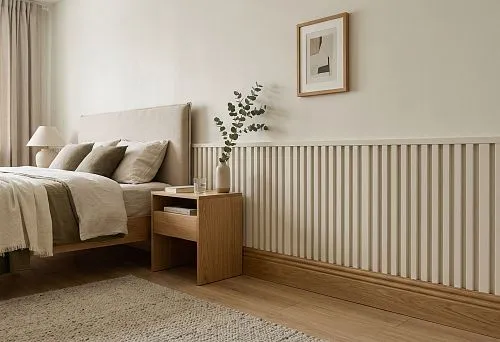
- Scheme 4: Soft wall decor without active casing
- Scheme 5: High ceiling and active cornice
- Mistakes that cause the composition to fall apart
- Thin molding next to heavy casing
- Active cornice and weak door zone
- Too many different profiles
- Polyurethane and wood in different styles
- Different scale logic between wall and door
- Unconnected baseboard
- What to look for in the catalog to assemble such a unit
- FAQ: Answers to Key Questions
- How to combine polyurethane molding and wooden trim?
- Is polyurethane molding suitable for neoclassicism?
- How to link door, wall, and ceiling in one style?
- What to choose first: trim, molding, or cornice?
- Can wood and polyurethane be combined in one interior?
- What kind of baseboard is needed for a wooden casing and molding?
- Is molding needed on all walls if only the door is decorated?
- How not to overload neoclassicism with decor?
- About the company
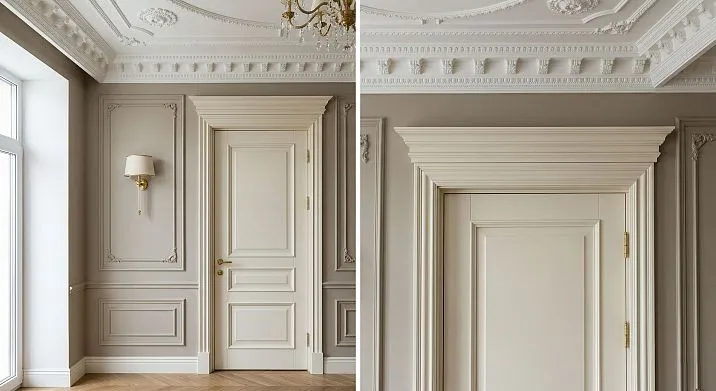
There is a question that is rarely asked out loud, but which lies behind every failed neoclassical interior: why do beautiful details not add up to a beautiful whole? The answer is always the same. BecauseMoldingswas chosen separately,Wooden casing— separately, the cornice and baseboard — at the very last, 'to cover the joints.' And as a result, the wall, door, and ceiling exist as three independent objects in one room. Not as architecture — as a set.
This article is about how to fix that. About howPolyurethane moldingsand wooden casing work not separately, but as parts of one architectural unit. About how neoclassicism is not decor on top of walls, but logic within walls.


Why in neoclassicism the door cannot be considered separately from the wall and ceiling
Neoclassicism is a style where the architecture of the space is more important than the furniture. This is a fundamental difference from most contemporary trends, where the interior is built around objects. In neoclassicism, it's the opposite: first the walls, ceiling, floor, doorways. Then everything else.
And the door unit in this system is not just a place where a door stands. It is an architectural point where three planes converge: the wall, the door frame, and the ceiling. How this point is designed is how the entire space is perceived.
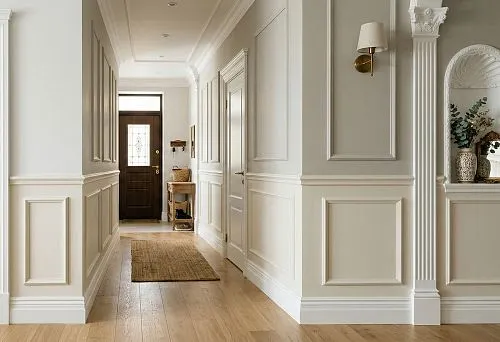
Look at any classic interior — a real one, not hastily stylized to look classic. The door there is not 'inserted' into the wall; it is integrated into it.Wall moldingscreates a context for the door. The casing continues this context, transitioning from the wall decor to the door plane. The cornice at the top completes the vertical and leads it into the horizontal of the ceiling. The baseboard at the bottom provides a foundation. This is not a random coincidence of details — it is an architectural system.
It is precisely this system that we will analyze.




What makes an interior neoclassical: verticality, frame, top line, base
Before talking about specific elements, it's important to understand the logic of the neoclassical wall. It is built on four principles.
Our factory also produces:


Verticality
Verticality is the main visual vector of neoclassicism. Tall doors, tall casings, vertically oriented wall panels, columns, pilasters. Verticality creates a sense of solemnity, height, and architectural scale. In this logic, the casing is the main carrier of verticality at the doorway.
Get Consultation
Frame
A neoclassical interior is an interior of frames. The wall is divided into fields, each field is framedmoldings. The door is framed by casing. The ceiling is framed by a cornice. The floor is bounded by a baseboard. This system of frames creates a sense of order, proportion, and architectural control.
Top line
Ceiling cornice is a horizontal line that 'closes' the space from above. It's not just a decorative element: it creates a boundary between the wall and ceiling, giving the room a sense of completion.Wooden corniceor polyurethane cornice is the most important element of the top line.
Base
Base is the lower part of the wall.Wooden baseboardin neoclassicism is not just covering the joint between wall and floor. It's the architectural plinth of the room. Its height, profile and scale are coordinated with the scale of the entire system.
How they work together
Casing, wall molding, cornice and baseboard create a closed system. Casing leads the vertical. Molding structures the wall field. Cornice completes the vertical, transitioning to horizontal. Baseboard provides the foundation. This system is not just beautiful — it's architecturally logical. And it's precisely when it's disrupted (one element stands out from the system in scale, profile or style) that the interior 'falls apart' even with expensive materials.
Where polyurethane molding works in this node
Polyurethane in decorative architecture is a material that reconciled accessibility with quality.Polyurethane moldingsreproduces the plasticity of plaster and stucco decor with an accuracy that was considered impossible for industrial production just twenty years ago. Lightweight, moisture-resistant, and requiring no special knowledge for installation—it confidently and uncompromisingly takes its place in a neoclassical interior.
But where exactly in the door assembly does it workPolyurethane Decor? Let's break it down zone by zone.
Wall frames
The main tool of a neoclassical wall is the wall frame. It is a molding perimeter that transforms a flat wall into an architecturally organized surface.Wall moldingsin the form of frames made from polyurethane molding profiles is a direct answer to this task.
The frame is created from four segments of molding profile, joined at a 45° angle. Inside the frame is a clean plastered or painted wall surface. Outside is the profile with shadow and relief. This is architectural magic, accessible to any builder with basic skills.
For the door assembly, wall frames are placed symmetrically on the sides of the door opening and above it. Thus, the door casing 'fits' into the rhythm of the wall frames—becoming one element of the overall system, not an extraneous object.
Upper transition to the ceiling
The zone between the top point of the casing and the ceiling cornice is critically important. This is where a 'void' most often forms: the casing ends, the cornice begins, and there is nothing in between. In neoclassicism, this transition is filled.
polyurethane decorin the form of a stucco frieze or wide molding above the door opening covers this area. It creates a visual bridge between the vertical casing and the horizontal cornice.
The area above the door
Entablature — in classical architecture, this is the horizontal part above the columns. In the neoclassical interior node, the function of the entablature is performed by a horizontal element above the door opening: it can be a wideMolding on the Wallin the form of an ornamental strip, a decorative rosette in the center, or a cartouche with a floral ornament.
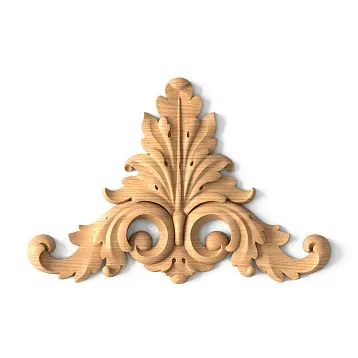
Polyurethane Items— rosettes, overlays, ornamental fragments — find their perfect place here. They do not require plastering skills, are glued with acrylic adhesive, and can be painted with any paint.
Decorative enhancement of the wall plane
Whenwall moldingis placed not only in the door area but also on adjacent walls — following the same system of frames, with the same profiles — the entire wall plane acquires a unified character. The door node ceases to be a local 'decoration' and becomes part of the overall architectural solution.
Why is a wooden casing needed in this solution
The question of the role of wood in neoclassicism is a question about the nature of warmth in the interior. Polyurethane is impeccable in plasticity and precise in profile, but it lacks one thing: the natural texture and tangible warmth of a living material. This is precisely whereWooden casingtakes its irreplaceable place.
Door unit verticality
A wooden door casing is a vertical architectural element that visually 'supports' the door opening. Its height matches the height of the door frame. Its profile creates shadow and volume on the wall plane. Its material—wood—adds a natural touch to the formal neoclassical context, without which the interior risks becoming cold.
The width of the casing is a critical parameter. In neoclassicism, the casing cannot be narrow: 60–80 mm is the minimum for rooms with average ceiling height (2.7–3 m). For high rooms (from 3.2 m), the casing width should be from 100 mm—otherwise it 'gets lost' against the backdrop of a large architectural context.
Visual weight of the door
A door in neoclassicism is an event. Not just an opening in the wall, but an architectural accent. The casing creates this visual weight: it frames the door, makes it significant, gives it a sense of monumentality—proportional, of course, to the scale of the room.
Widewooden casingwith an expressive profile—stepped, with a bead, with a quarter—creates a multi-layered transition from the plane of the door to the plane of the wall. This is not just a strip of wood at the joint—it is an architectural element with its own relief anatomy.
Connection with the floor, furniture, and wood in the interior
Wood is a recurring material in classical interiors: floor, furniture, frames, doors. A wooden door casing fits organically into this system. It connects the door with the floor through material kinship, creating continuity of the wooden language in the interior.
At the same time, the tone and wood species of the casing should be coordinated with the tone of the wooden baseboard and, if possible, with the tone of the flooring. This does not mean that everything should be identical—it means that everything should belong to the same color and material logic.
When it's better to make the casing wider
Situations requiring wide door trim:
-
High ceilings (from 3 m): the scale of the room requires larger framing
-
Active wall molding: the trim must be proportionate to the decorative weight of the wall background
-
Double doors: a wide opening requires more substantial framing
-
Accent door as the main architectural element of the room: the trim emphasizes its significance
How to link wall molding and wooden door trim
This is the central technical question of the article. And here, what matters is not intuition but a system. The connection betweenstucco on wallsand wooden door trim is built on five parameters.
By thickness (profile height from the wall)
Molding is relief. Door trim is also relief. The height of the relief from the wall for these two elements must be coordinated. If the wall frame molding protrudes 12–15 mm from the wall plane, the trim should protrude by a comparable or similar amount. Trim with a 5 mm protrusion next to molding with a 30 mm protrusion is a visual disproportion.
Practical rule: the height of the architrave relative to the relief should either be close to the wall decoration (±5 mm) or noticeably larger (the architrave as the main accent, the molding as a subordinate element).
By scale
Scale is the proportion of an element relative to the room and other details. Delicate, elegant wall molding with a subtle profile of 20×15 mm—and next to it a massive architrave with a heavy stepped profile of 100×40 mm—creates a conflict of scales. Both elements are correct in their own way, but together they do not create unity.
The scale of the molding and architrave should belong to the same level: delicate decor + delicate architrave, monumental decor + monumental architrave.
By profile style
Profile is the cross-sectional shape. In classical architecture, there are basic profile elements: ovolo, quarter-round, straight step, flute, astragal. When the architrave profile and the wall molding profile use the same basic elements, they create stylistic kinship. When one profile is strictly geometric and the other features floral ornamentation, they speak different languages.
By rhythm
Rhythm is the distance between repeating elements. Wall frames made ofstucco decorationon either side of the doorway create a certain rhythm. The architrave, adjacent to the outermost frame, should 'rhyme' with it in width or be a multiple of the frame profile's width.
By height
Wall frames made of molding end at a certain height. This height should align with the height of the architrave or its characteristic points (e.g., the architrave's crossbar). Otherwise, the horizontal line where the wall decoration ends 'cuts' the vertical architrave at a random point, creating an uncomfortable break.
How to connect the architrave to the ceiling via a cornice
The upper line of the interior is the line created by the ceilingCorniceIt is this line that 'closes' the room from above, giving it completeness. And it is with this line that the upper end of the architrave must be aligned.
The upper line of the interior
wooden corniceis installed along the perimeter of the ceiling. Its profile is the last thing the eye sees as it moves up the wall. If the architrave carries a vertical impulse—upward movement—the cornice receives this impulse and translates it into the horizontal. This is the architectural 'junction' of two directions: the vertical of the door and the horizontal of the ceiling.
For this junction to work, the cornice must be sufficiently large. The minimum profile height for a neoclassical cornice with a ceiling height of 2.7 m is 50–60 mm. For 3 m and above—80–120 mm or more.
Transition from door to ceiling
In an ideal neoclassical composition, a horizontal decorative element—a molded frieze, ornamental strip, or wide profile—is placed above the door opening, visually connecting the upper end of the architrave with the lower edge of the cornice. This element does not necessarily have to be large: a molded profile 40–60 mm wide, running along the wall at the height of the upper end of the door opening around the entire perimeter of the room, is sufficient.
Such a horizontal belt is an 'entablature' on an interior scale. It connects all door and window openings into a single horizontal register, which creates the feeling of classical architectural logic.
When the cornice should be calm
If the door is the main focal point of the room (wide casing, prominent molding around the opening, decorative lintel above the door) — the cornice should be subdued. A simple profile without ornamentation, a restrained projection — in this case, the cornice creates a 'frame' for the space, without vying for an independent role.
When a more pronounced profile is permissible
If the door area is designed concisely (simple casing, minimal molding) — the cornice can take on a greater role. An expressiveWooden cornicewith a multi-level profile will become the main decorative accent of the upper part of the room.
How to connect the door with the wall and floor through moldings and baseboard
The lower part of the door assembly is the zone where the vertical of the casing meets the horizontal of the baseboard. This is another critical point that is often 'resolved' carelessly.
Wall frame
Wooden moldingor a polyurethane molding, forming wall frames on either side of the door, should descend to the baseboard line or to its top edge. This creates a continuous vertical line from the cornice to the baseboard — just as in classical architecture a column stands on a plinth and carries an entablature.
Moldingsof the wall frames andBaseboardsshould 'meet' at the bottom point without a gap and without overlap: their horizontal profiles are aligned in height.
Base of the room
Wooden baseboardIn neoclassicism, it is not a technical element, but an architectural one. Its height should be proportionate to the ceiling height and the scale of the entire system: with a ceiling of 2.7 m — a baseboard from 80 mm, with a ceiling of 3 m and above — from 100–120 mm.
The baseboard profile should use the same basic elements as the cornice. In a classical system, the cornice and baseboard are 'mirror' elements: the cornice finishes the wall at the top, the baseboard — at the bottom, and their profiles are built according to the same logic.
Baseboard height
A common mistake is a baseboard that is too low for a tall casing. If the casing is visually 'heavy' and wide, and the baseboard is a narrow 40 mm strip, this creates a feeling of instability: a heavy door frame stands on a flimsy base. The baseboard should provide a 'base' proportionate to the scale of the casing.
Connection with the casing
At the point where the lower end of the casing meets the upper edge of the baseboard, one of two scenarios occurs:
-
The casing rests on the baseboard (the lower end of the casing is cut to match the baseboard profile and overlaps it)
-
The casing and baseboard meet in a separate nodal element — a pedestal or plinth block
The second option is classical and most correct from an architectural point of view. The plinth block at the base of the casing (a small square block into which both the casing and the baseboard abut) is an element found in all classical interiors. It conceals the complex joint, gives the system completeness and — most importantly — allows the use of casings and baseboards of different widths without losing harmony.
Unified profile or similar profiles
The ideal option for neoclassicism is when all wooden trim elements (casing, baseboard, cornice, wall moldings) belong to the same series: one manufacturer, one wood species, one profile system. This ensures not only stylistic unity but also material unity: uniform wood tone, uniform texture, uniform behavior during finishing.
Ready-made schemes for neoclassicism: five scenarios
Theory without practice is empty words. Here are five specific scenarios for different types of neoclassical interiors.
Scheme 1: Calm light neoclassicism
Context: apartment with ceilings 2.7–2.8 m, light walls, light oak parquet, light wood doors.
Solution:
-
wall molding— thin polyurethane profiles 20×15 mm, forming rectangular frames on walls
-
Wooden casing — light oak, width 65–70 mm, profile with one bead, laconic
-
wooden cornice— low, up to 60 mm, simple two-level profile
-
Wooden baseboard— 80 mm, smooth or with one step
Result: airy, calm composition. Moldings create rhythm without pressure. Casing delicately frames the door. Cornice closes the top line without pomp.
Scheme 2: Interior with prominent architraves as the main accent
Context: classic living room, ceiling height 3 m, doors are central architectural accents.
Solution:
-
Relief Decorationon the walls — calm frames without ornament, thin profile 25×20 mm
-
Wooden architrave — wide, 100–120 mm, stepped profile with a 30–35 mm projection from the wall
-
Above the doorway — horizontal cornice projection, continuing the architrave profile
-
wooden corniceceiling — 80–100 mm, coordinated in profile with the architrave
-
Baseboard — 100 mm, plinth at the base of the architrave
Result: monumental door zone as an architectural accent. Molding creates a calm wall background, not competing with the architraves.
Scheme 3: Door as an accent in the bedroom
Context: bedroom with a soft interior, neutral walls, wooden furniture.
Solution:
-
Decorative stuccoonly in the doorway area: a frame around the door made of polyurethane profile
-
Casing — wooden, 80 mm wide, warm wood tone, soft profile
-
Cornice — lightweight, 50 mm, simple
-
Baseboard — 80 mm, matching the casing tone
Result: the door looks like an architectural event in the intimate space of the bedroom, without overloading it.
Scheme 4: Soft wall decor without active casing
Context: modern neoclassicism, minimalist interpretation of the style, a tendency towards purity of lines.
Solution:
-
Wall molding— wide frames with large spacing, profile 30×20 mm, ornament in the corners of the frames
-
Casing — wooden, narrow, 50–55 mm, strict rectangular profile
-
Ceiling cornice — 70–80 mm, with a small ornamental frieze
-
Baseboard — 90 mm, smooth
Result: active wall decor and restrained architrave. Balance achieved through scale difference: molding — background, architrave — quiet detail.
Scheme 5: High ceiling and active cornice
Context: room with ceilings 3.5 m and above, large area, representative interior.
Solution:
-
Polyurethane moldings— active wall frames, ornamental overlays in frame corners, horizontal frieze at 2.5 m height
-
Wooden architrave — 120–140 mm, multi-level profile
-
Wooden cornice — 130–150 mm, with developed profile, several levels
-
Baseboard — 120 mm, plinth at architrave base is mandatory
-
Polyurethane Decor— ceiling rosettes at room center
Result: full classical architectural system, proportionate to high ceilings. Each element works for the overall scale.
Errors that cause the composition to fall apart
Knowing the rules, it's also useful to know the anti-rules. Here are the most common mistakes in neoclassical door compositions.
Delicate molding next to a heavy door casing
If the profile of the wall frame molding is thin, 15×10 mm, and the casing is wide, 120 mm, with a 35 mm projection — this is a scale conflict. The thinDecorative stuccoliterally 'dissolves' next to the monumental casing. Either increase the profile of the molding or reduce the scale of the casing.
Prominent cornice and weak door zone
A large, developedwooden corniceis a strong horizontal accent. If against its background the door zone is weak (narrow casing, minimal molding) — the eye 'drifts' to the cornice, and the door looks like a random hole in the wall. The scale of the cornice and the scale of the door composition must be coordinated.
Too many different profiles
Five different profiles in one room — casing, three types of moldings for wall frames, a cornice with an incompatible profile, a baseboard from another series — this is chaos, even if each element is beautiful individually. The number of profile forms used should be limited: two or three basic elements, varying in scale but not in style.
Polyurethane and wood in different styles
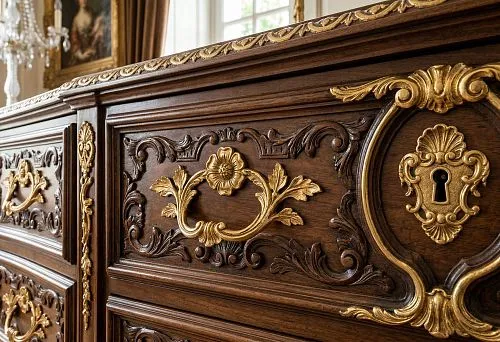
Polyurethane ItemsBaroque style with lavish ornamentation and a wooden casing in a strict classical profile — two different styles in one space. Polyurethane decor and wooden moldings should belong to the same stylistic register: both strict, both with ornamentation, both minimalist.
Different scale logic between the wall and the door
Large wall frames made ofstucco decorationand small, almost unnoticeable wall frames directly around the door — a disruption of rhythm. The scale of the decor should be consistent: the same or increasing towards the focal point (the door).
Unrelated baseboard
Wooden baseboardfrom a different series, different width, with a different profile logic — this is an error that destroys the lower base of the entire system. The baseboard is not a technical element; it should continue the overall architectural logic of the door unit and wall.
What to look for in the catalog to assemble such a unit
The correct approach is to work with the catalog of a single manufacturer, where all elements are coordinated in material and style.
Polyurethane molding — catalogFull range of decorative moldings for walls and ceilings, trim, overlays, rosettes.
Molded decor — overlaysPolyurethane overlay elements for walls, frame systems, areas above doorways.
Polyurethane products — rosettesCeiling and wall rosettes, ornamental accents.
Wooden casings create a frame around the opening, visually highlighting it from the wall plane. A classic casing has a profiled section that corresponds to the profiles of baseboards and moldings.Wooden architraves made of solid wood in various profiles and species.
Wooden moldingsProfile trim products for wall frames and borders.
Wooden beamsCeiling cornices made of solid wood, different profiles and heights.
Wooden baseboardWooden baseboards made of solid wood for creating the architectural base of a room.
FAQ: Answers to Key Questions
How to combine polyurethane moldings and wooden architraves?
By coordinating scale (similar relief height or larger architrave), profile (same basic elements), style (both in classical or neoclassical register), and color (polyurethane painted to match wall tone or white, wood to match overall wooden finish).
Is polyurethane molding suitable for neoclassicism?
Yes, and very well. Polyurethane accurately reproduces classical profiles, does not require special installation skills, and allows for any finish.Decorative stuccoPolyurethane in a neoclassical interior is a smart compromise between historical quality and modern renovation realities.
How to link the door, wall, and ceiling in the same style?
Through a system of interconnected elements: the casing frames the door, wall moldings structure the wall surface, a horizontal belt connects the upper ends of the casings with the lower edge of the cornice, and the cornice finishes the wall at the top. All elements must belong to the same profile 'vocabulary'.
What should be selected first: casing, molding, or cornice?
It's better to start with the casing—it determines the scale of the entire system. The casing is chosen based on the height and scale of the room, then the wall frame moldings, cornice, and baseboard are coordinated with it.
Can wood and polyurethane be combined in one interior?
Not only can they—they should. Wood provides warmth, natural texture, and tactility. Polyurethane offers precision in reproducing classical profiles and affordability. They do not compete but complement each other if they belong to the same stylistic register.
What baseboard is needed for a wooden casing and molding?
Wooden baseboardIn the same tone as the architrave, height — proportionate to the scale of the system. For a room height of 2.7–3 m — 80–100 mm. For higher ceilings — 100–120 mm. The profile of the skirting board should echo the profile of the cornice.
Is molding needed on all walls if only the door is decorated?
No, molding does not have to be everywhere. A sequence is sufficient: if there are molded frames on one wall by the door, a similar rhythm should be present at least fragmentarily on adjacent walls — otherwise, the door area looks like a local 'slapping on' of decoration.
How to avoid overloading Neoclassicism with decor?
Principle of hierarchy: in each room, one main decorative accent — either the door area, or the ceiling cornice, or a wall system of frames. Everything else is subordinate elements. The number of profile forms — no more than three in one room. Scale — sequential, without sharp contrasts.
About the Company
When the task is to assemble a cohesive Neoclassical interior, wherePolyurethane moldingsand wooden architraves, cornices, and skirting boards work as a single architectural system, — it is important to find a manufacturer that has this entire range of products in coordinated quality.
STAVROS — production of wooden and polyurethane products for interiors: architraves, moldings, cornices, solid wood skirting boards, as well as polyurethane molded decor for walls and ceilings. All STAVROS products are manufactured considering the architectural logic of Neoclassicism: coordinated profiles, proportions, and scale, allowing the assembly of a cohesive interior node from individual elements. This is not just the production of parts — it is a system in which the door, wall, and ceiling speak the same language.