Article Contents:
- Total Cost of Ownership: The True Price of Owning an Item
- Calculation Formula: What Goes Into the Real Cost
- Hidden Costs: Repair, Replacement, Frustration
- Inflation and Price Growth: Furniture as an Asset
- Twenty-Year Period Math: Real Numbers
- Scenario A: Cheap Furniture
- Scenario B: Quality Solid Wood Furniture
- Comparison: Where Are the Savings?
- Quality Depreciation: What Happens to Furniture Over Time
- Cheap Furniture Degradation Curve
- Quality Furniture Maturation Curve
- Economics of Quality: Why Producing Well is More Profitable
- Cost Structure: Materials vs. Waste
- Environmental Footprint: Deferred Costs
- Psychology of Purchase: Why People Choose Cheap
- Immediate Cost Effect
- Lack of Financial Literacy
- "Temporary Housing" Syndrome
- Real-Life Cases: Stories of Savings and Ruin
- Story One: The Ivanov Family and Chairs for Half a Century
- Story Two: A Startup Office and Saving on Furnishings
- Financial Literacy in Interior Design: How to Make Decisions
- Pre-Purchase Checklist
- Phased Replacement Strategy
- Psychology of Refusing the New
- Frequently Asked Questions About the Economics of Durable Furniture
- If I Live in a Rented Apartment, Does It Make Sense to Buy Expensive Furniture?
- How to Determine if Furniture is Truly Quality, Not Just Expensive?
- Does quality furniture ever go out of style?
- Is it possible to find quality furniture cheaper than from renowned manufacturers?
- How to care for quality furniture so that it lasts a long time?
- What to do if the budget absolutely does not allow buying quality furniture?
- Is furniture really passed down through generations or is it a myth?
- How to sell quality furniture if it is no longer needed?
- Conclusion: The Choice That Shapes the Future
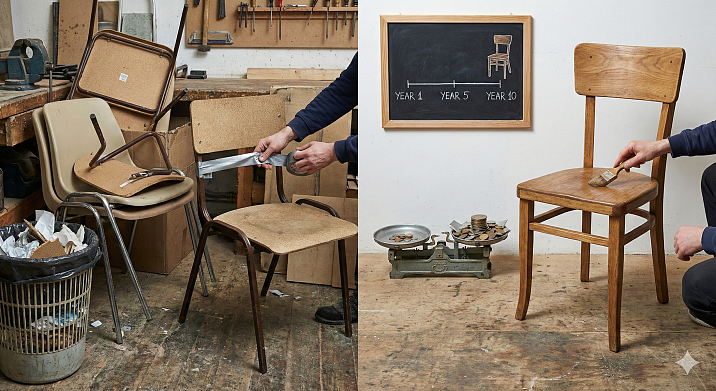
The paradox of modern consumption lies in the inability to calculate. A person who buys a chair for 5,000 rubles is sure they saved 45,000 compared to a price tag of 50,000. Three years later, when the chair has become wobbly, the seat has sagged, and the upholstery is worn, they buy a new one — again for 5,000. Another three years later, the story repeats. Over twenty years, they will spend 35,000 rubles, receiving in return a series of mediocre items with questionable comfort. And the person who boughtclassic furniturefor 50,000, after the same twenty years, is still sitting on the same chair, which looks dignified, serves impeccably, and is now worth on the secondary market no less than 40,000 thanks to inflation and rising prices for quality furniture.
This is not just the arithmetic of purchase. It's quantum economics — a calculation system that considers not only the initial price but also service life, cost of ownership, depreciation, inflation, emotional value, environmental footprint. When all factors are combined into a single formula, expensive turns out to be cheap, and cheap — an unaffordable luxury.Furniture durability— is not an abstract quality category, but a concrete financial instrument determining a family's well-being for decades ahead.


Total Cost of Ownership: the true cost of owning an item
The TCO (Total Cost of Ownership) concept came from corporate finance, where when purchasing equipment, they calculate not only the purchase cost but also expenses for operation, repair, maintenance, disposal. Applying this methodology to furniture yields shocking results.




Calculation formula: what is included in the real cost
Furniture TCO includes several components. The first is the purchase price (P), that very sum a person pays in the store. For a cheap chair, it's 5,000₽, for a qualityof the classic chair — 50 000₽.
The second component is service life (L). Cheap furniture made of chipboard, plywood, with low-quality hardware lasts 3-5 years.Chairs made of solid woodwith traditional joinery last 50-100 years. This is not an exaggeration — chairs from the 18th-19th centuries preserved in museums and private collections are still functional.
The third component is the cost per year of ownership (CPY — Cost Per Year). This is the key metric showing how much it actually costs to sit on this chair each year. The formula is simple: CPY = P / L.
For a cheap chair: CPY = 5,000₽ / 4 years = 1,250₽ per year.
For a quality chair: CPY = 50,000₽ / 50 years = 1,000₽ per year.
Even at the first level of calculation, quality furniture is 20% cheaper. But this is just the beginning.
Our factory also produces:


Hidden costs: repair, replacement, irritation
Cheap furniture breaks. A chair leg becomes wobbly after a year. At first, it's barely noticeable, but gradually turns into an irritating factor: the chair creaks, wobbles, creates a feeling of unreliability. You can try to fix it — tighten bolts, add glue, reinforce joints. This takes time (yours or a craftsman's), and time is money. A home visit by a craftsman costs from 2,000₽, repair can take an hour of work (another 1,500₽). Total 3,500₽ to repair a chair bought for 5,000₽.
Or you can buy a new one. But purchasing also involves hidden costs: time spent searching, traveling to the store (transport, gasoline), waiting for delivery, assembly, disposal of the old chair. In the Moscow region, removal of old furniture costs from 1,000₽ per item. These micro-costs are unnoticeable individually, but over twenty years they amount to tens of thousands of rubles.
Quality furniture does not require repair for decades. Mortise and tenon and rail joints, glued with wood glue, do not become loose. Solid wood does not dry out (with proper kiln drying to 8-10% moisture content). Professional-grade lacquer coating does not wear off or chip.Investments in the homein the form of quality furniture — are investments in the absence of problems, and the absence of problems saves time, nerves, money.
Get Consultation
Inflation and price growth: furniture as an asset
Russian inflation over the past 20 years averaged 8-10% annually. But prices for quality solid wood furniture grew faster — at 10-12% annually. Reasons: rising timber prices (deforestation, export restrictions), rising cost of skilled labor (shortage of cabinetmakers), overall increase in demand for premium goods.
A chair purchased for 50,000₽ in 2006 would be worth about 350,000₽ in 2026 (a 7-fold increase). Real data from the furniture market confirms: antique and quality classic chairs from the mid-20th century sell for prices many times higher than the original, adjusted for inflation.
Cheap furniture has no residual value. After 4 years, it ends up in a landfill with zero price. Moreover, you have to pay for disposal. Quality furniture retains and even increases in value. A family that purchased a set classic furniture twenty years ago owns an asset that can be sold, passed on to children, or used as collateral. This is not an expense — it is the capitalization of funds in tangible form.
The mathematics of a twenty-year period: real figures
Let's take a typical family of four furnishing an apartment. They need 6 dining chairs, a dining table, a double bed, two bedside dressers, a wardrobe, a coffee table, a bookcase. Basic furnishing, without excess.
Scenario A: cheap furniture
Chairs: 6 × 5,000₽ = 30,000₽, lifespan 4 years. Over 20 years, 5 replacements needed = 150,000₽.
Dining table (folding, chipboard): 25,000₽, lifespan 7 years. Over 20 years — 3 tables = 75,000₽.
Bed (metal frame + chipboard): 20,000₽, lifespan 8 years. Over 20 years — 2.5 purchases = 50,000₽.
Dressers (chipboard, 2 pcs.): 15,000₽ each, lifespan 6 years. Over 20 years — 3.3 replacements = 100,000₽.
Wardrobe (chipboard): 40,000₽, lifespan 10 years. Over 20 years — 2 wardrobes = 80,000₽.
Coffee table (chipboard/glass): 8,000₽, lifespan 5 years. Over 20 years — 4 purchases = 32,000₽.
Bookcase (chipboard): 20,000₽, lifespan 8 years. Over 20 years — 2.5 purchases = 50,000₽.
Total over 20 years: 537,000₽ (excluding deliveries, assembly, disposal — add 15% = 617,000₽).
Scenario B: quality solid wood furniture
Chairs: 6 × 50,000₽ = 300,000₽, lifespan 50+ years. Over 20 years — one purchase = 300,000₽.
Solid wood dining table: 180,000₽, lifespan 100+ years. Over 20 years — one purchase = 180,000₽.
solid wood bed: 150,000₽, lifespan 50+ years. Over 20 years — one purchase = 150,000₽.
Solid wood dressers (2 pcs.): 80,000₽ each, lifespan 50+ years. Over 20 years — 160,000₽.
Wooden wardrobe: 250,000₽, lifespan 100+ years. Over 20 years — one purchase = 250,000₽.
Coffee table (solid wood): 60,000₽, lifespan 50+ years. Over 20 years — one purchase = 60,000₽.
Bookcase (solid wood): 120,000₽, lifespan 100+ years. Over 20 years — one purchase = 120,000₽.
Total over 20 years: 1,220,000₽ (delivery included in the price, assembly not required or included, no disposal).
Comparison: where is the savings?
At first glance, Scenario A (617,000₽) is cheaper than Scenario B (1,220,000₽) by 603,000₽. But this is a false conclusion that does not account for critical factors.
The first factor is residual value. After 20 years, in Scenario A, you have trash with zero value. In Scenario B — a set solid wood furniture, which has served only a third to half of its lifespan. With an inflation rate of 8% per annum, this set will be worth at least 5,700,000₽ (a 4.66-fold increase over 20 years). Even selling it for half its new price (2,850,000₽), the owner will receive a net profit of 1,630,000₽.
The second factor is the hidden costs of Scenario A. Deliveries (on average 3,000₽ per time, multiplied by 17 purchases = 51,000₽). Assemblies (2,000₽ per time × 17 = 34,000₽). Disposal (1,000₽ per unit × approximately 15 items = 15,000₽). Minor repairs (on average 10,000₽ over 20 years). Total additional 110,000₽. The total amount for Scenario A increases to 727,000₽.
The third factor is the loss of time. Each purchase of cheap furniture is at least 5-10 hours (searching, comparing, traveling, waiting for delivery, assembly, installation). For 17 purchases, that's 85-170 hours, or 2-4 weeks of continuous time. If you value your time at a modest 1,000₽ per hour, that's another 85,000-170,000₽ in lost opportunity. Adjusted cost of Scenario A: 812,000-897,000₽.
The fourth factor is emotional costs. Constant irritation from squeaky chairs, wobbly tables, crooked cabinet doors. Shame in front of guests for the cheap look of the furnishings. Inability to sell, pass on to children, or take pride in your belongings. These costs have no monetary expression, but they destroy the quality of life.
The fifth factor is the residual value of Scenario B. Selling the set after 20 years for 2,850,000₽, the net costs will be: 1,220,000₽ - 2,850,000₽ = -1,630,000₽. The minus means profit. Buying quality furniture not only didn't cost a penny, but also brought income.
Final balance: Scenario A cost 812,000-897,000₽ with no possibility of getting the money back. Scenario B brought a profit of 1,630,000₽. The difference: 2,442,000 - 2,527,000₽ in favor of quality furniture.
Amortization of quality: what happens to furniture over time
Furniture does not age equally. Cheap furniture degrades exponentially: the first year — unnoticeable changes, the second — slight loosening, the third — noticeable problems, the fourth — critical condition. The graph of quality decline is a steep downward parabola.
Cheap furniture degradation curve
Chipboard (particle board) is a material made of pressed sawdust glued with formaldehyde resins. It fears moisture (swells), mechanical loads (crumbles at screw fastening points), and time (the glue loses strength). The laminated coating on chipboard peels at the corners, scratches, and fades in the sun.
Hinges on cheap cabinets are stamped metal 1-1.5 mm thick. They deform under the weight of the doors, become loose in the mounting holes, and break. Replacing hinges costs from 500₽ per piece plus the craftsman's labor. A wardrobe has 6-8 hinges — repairs will cost 5,000-7,000₽, which is comparable to the price of a new cheap wardrobe.
Drawer slides are another point of failure. Cheap roller slides become loose, the drawer warps, falls out of the grooves, and jams. After 3-5 years, half of the drawers require hardware replacement or need to be used with force (you pull until it opens).
Upholstery on cheap chairs is synthetic fabric over thin foam. The foam compresses within 2-3 years, forming pits in areas of maximum load (the center of the seat). Sitting becomes uncomfortable, back pain appears. The upholstery wears thin, tears, and frays. Reupholstering costs from 3,000₽ per chair — more expensive than buying a new cheap one.
By the end of the estimated service life (4-5 years), cheap furniture looks depressing: worn, wobbly, with traces of repairs, with parts falling off. It's embarrassing to show to guests, it doesn't create coziness, it's a source of constant irritation.
Quality furniture maturation curve
Furniture made of natural woodQuality furniture undergoes the opposite process. The first years it 'settles' into the home, adapting to the microclimate. Wood gains or releases moisture, reaching equilibrium with the environment. Properly dried (to 8-10% moisture content) wood does not warp, but only stabilizes.
The varnish or oil finish gradually hardens over the first 5-10 years, gaining strength. Professional multi-layer coatings (3-5 layers of varnish with interlayer sanding) create a 0.3-0.5 mm thick protection that does not wear out for decades. Even with active use, only minor scratches appear, not penetrating to the wood, easily fixed by polishing.
Mortise and tenon and rail joints become stronger over the years. PVA (polyvinyl acetate) wood glue fully polymerizes in 6-12 months, after which its strength exceeds that of the wood itself. A wooden tenon glued into a mortise forms a monolithic joint that does not loosen even after 100 years.
Aesthetically, solid wood is ennobled by time. Patina — the natural darkening of wood under the influence of light and air — gives furniture a noble appearance and depth of color.Solid Wood FurnitureAfter 20-30 years, it acquires antique status, its value increases not only financially but also culturally.
Hardware for quality furniture — brass, bronze, stainless steel 3-5 mm thick — does not wear out. Hinges withstand hundreds of thousands of open-close cycles. Drawer slides — telescopic on ball bearings — operate smoothly after 20, 30, 50 years.
By the twenty-year mark, quality furniture looks 'lived-in,' but not old. It has history, character, soul. Scratches and wear are perceived not as defects, but as traces of life, the patina of time. You don't want to replace such furniture — you want to preserve it, pass it on to children.
The economics of quality: why producing well is more profitable
The paradox of the furniture industry: producing quality furniture is economically more profitable than producing cheap furniture. But the profit is spread over time and requires reputational capital, which mass producers lack.
Cost structure: materials vs. waste
Cheap furniture is made from chipboard — pressed sawdust and shavings, woodworking waste. It seems cheap. But the chipboard production process is energy-intensive: grinding wood, drying, pressing at high temperature (200°C) and pressure (3-5 MPa), cooling, cutting, laminating. The production cost of a square meter of 18 mm thick chipboard is about 350-450₽.
Solid wood is more expensive: a square meter of 20 mm thick oak board costs 2,500-3,500₽. 7-10 times more expensive than chipboard. But the yield of finished products is fundamentally different.
Chipboard has low strength, especially in tension and bending. The structure has to be reinforced with additional elements, thickness increased, and many fasteners used (screws, eccentric fasteners, ties). Each connection is a potential point of failure. Complex hardware (slides, hinges, handles) is expensive. As a result, the cost of a cheap chipboard wardrobe is 15,000-20,000₽, retail price — 40,000-50,000₽.
Solid wood is strong on its own. The design is simpler: boards are joined with mortise and tenon, glued, and tightened. Minimum hardware, minimum fasteners. The cost of a quality solid wood wardrobe is 80,000-120,000₽, retail price — 250,000-350,000₽.
The margin on quality furniture is higher: 100-150% versus 80-120% for cheap furniture. But the main thing is reputation. A quality furniture manufacturer builds a brand that works for decades. Customers return, recommend, pass on contacts through generations.Cost of ownershipIt also matters for the manufacturer: no returns, complaints, or warranty repairs. The furniture goes to the client and lasts half a century without causing problems.
Environmental footprint: deferred costs
Particleboard production uses formaldehyde resins—toxic substances that release into the air for years (emission class E1, E2). Disposal of particleboard requires special conditions—incineration with emission filtration or burial in specialized landfills. The cost of disposal is shifted onto society through taxes, environmental fees, and medical expenses.
Solid wood is an absolutely eco-friendly material. The growing tree absorbed carbon dioxide, furniture made from it stores this carbon for decades, and after the end of its service life, the wood burns without harmful emissions or decomposes naturally.The economics of quality—is economics that accounts for the full life cycle, including disposal.
If the real environmental costs (health harm from formaldehyde, disposal costs, carbon footprint) were factored into the price of cheap furniture, it would be more expensive than quality furniture. But these costs are hidden, distributed across society, and the buyer doesn't see them.
The psychology of purchase: why people choose cheap
If the math is so obvious, why does the overwhelming majority buy cheap furniture? The reasons lie in cognitive biases, financial illiteracy, and marketing manipulations.
The effect of immediate costs
The human brain is evolutionarily tuned to minimize immediate costs. Paying 50,000₽ now is psychologically more painful than paying 5,000₽ seven times over twenty years, even if the total amount is larger. This is called 'temporal discounting'—devaluing future events.
The buyer sees a price tag of 5,000₽ and a price tag of 50,000₽. The brain screams: 'A difference of 45,000! Savings!' The TCO calculation, spread over two decades, seems abstract, distant, unreliable. Logic loses to emotion.
Marketing exacerbates the effect. Cheap furniture is sold with promotions, discounts, installment plans: 'Only 417₽ per month!' The brain perceives 417₽ as a negligible amount, ignoring the total overpayment and short service life.
Quality furniture is sold without tricks. The price is high, but honest. The manufacturer doesn't manipulate, deceive, or mask costs. Paradoxically, honesty in marketing loses to manipulations in the short run.
Lack of financial literacy
The concept of TCO, depreciation, residual value is unfamiliar to most people. They aren't taught in school to calculate the cost of ownership of things. Financial literacy is limited to basic arithmetic: '50,000 is more than 5,000, so it's more expensive.'
The notion of 'investment in the home' is perceived as a marketing metaphor, not a real financial tool. MeanwhileClassic Furniture—is an asset that preserves and increases value. For wealthy families, buying quality furniture is a way to diversify capital, protect against inflation, and pass wealth to generations.
The 'temporary housing' syndrome
Many people live with a sense of temporariness: 'I'm living in a rented apartment for now, why buy expensive furniture?', 'We'll move in a couple of years, we'll buy later', 'Not the time for furniture now, other priorities.' 'Temporary' stretches for 5, 10, 15 years. During that time, several sets of cheap furniture are bought and thrown away, tens of thousands of rubles are lost.
Quality furniture is portable.solid wood tables, chairs, dressers are easily transported when moving. They don't lose their appearance, don't break during transportation. In contrast, cheap particleboard furniture crumbles at the fastener points during disassembly and reassembly, often not surviving a second move.
By investing in quality furniture right away, a person creates mobile comfort that follows them from home to home, from city to city. It's not an attachment to a place, but the creation of portable coziness.
Real-life cases: stories of savings and ruin
Abstract calculations come to life in specific stories.
First story: the Ivanov family and chairs for half a century
The Ivanov spouses were furnishing their apartment in 2005. A young family, limited budget, a school-age daughter. They faced a dilemma: six chairs at 3,500₽ each (total 21,000₽) or six classic STAVROS chairs at 38,000₽ each (total 228,000₽). A difference of 207,000₽—a huge sum for a family with an income of 80,000₽ per month.
They decided to take the quality ones. They arranged an installment plan for a year (no overpayment, the manufacturer offered such a format), paid 19,000₽ per month. The year was tight, but they managed.
Twenty years passed. The daughter grew up, got married, had a grandchild. The chairs are like new. The younger grandson (3 years old) climbs on them, tries to rock them—the chairs are immovable. The daughter liked the chairs, she asked to buy the same ones for herself. The price now is 295,000₽ per chair. The parents offered to give three chairs to the daughter (the family is now three people, six chairs aren't needed). The daughter received a gift of furniture worth 885,000₽.
For the Ivanovs, chairs for 228,000₽ in 2005 turned into an asset of 1,770,000₽ in 2025 (six chairs at 295,000₽ each). Net gain—1,542,000₽ over 20 years. That's 10.3% annual return in rubles, higher than bank deposits and inflation.
The Ivanovs' neighbors bought chairs for 3,500 each at the same time. After 5 years, they replaced them (the chairs fell apart). Then again. And again. Over 20 years, they spent about 105,000₽ (four replacements of six chairs, accounting for inflation). In their hands - a worn-out set with zero value. The loss relative to the Ivanovs is 1,647,000₽ (the Ivanovs' assets minus the neighbors' expenses).
Second story: a startup office and saving on furnishings
A tech startup in 2015 rented an office for 30 people. They needed 30 desks, 60 chairs (office + meeting room), document cabinets, and meeting room furniture. The budget was limited, all money went into the product.
They bought furniture from IKEA and Russian analogues. Desks for 6,000₽, chairs for 4,000₽, cabinets for 15,000₽. Total about 600,000₽.
After 3 years, the furniture started breaking. Desks wobbled, tabletop surfaces peeled. Chairs squeaked, gas lifts sagged. The company grew to 50 people and moved to a larger office. The old furniture had to be thrown away (bringing it to the new office was embarrassing, it looked terrible). They purchased new, similar furniture. Another 800,000₽ (inflation).
Another 4 years later - another move (now 80 people). Another furniture purchase, again about 1,200,000₽. Over 10 years - three full sets, 2,600,000₽.
Alternative: buy quality furniture right away. Solid wood desks for 35,000₽, classic chairs for 45,000₽, wooden cabinets for 80,000₽. Initial investment - 2,500,000₽. Expensive, but over 10 years the furniture didn't require replacement. They moved it during relocations. After 10 years, it looked solid, emphasizing the company's status (now not a startup, but a mature business).
Moreover: when moving to a new office for 80 people, the old furniture (30 desks, 60 chairs) was sold to another startup for 1,200,000₽ (a market for premium used furniture exists, and demand is high). Net expenses - 2,500,000 - 1,200,000 = 1,300,000₽. For the new office, they purchased an additional 50 workstations for 2,000,000₽.
Total over 10 years: 3,300,000₽ versus 2,600,000₽ for cheap furniture. But in the first case, the company owns an asset worth at least 4,000,000₽ (current furniture value considering price increases), which can be sold, relocated, used. In the second case - nothing but a history of expenses.
Financial literacy in interior design: how to make decisions
Buying furniture is a financial decision requiring methodology.
Checklist before purchase
First question: what is the real service life? Not what the seller promises, but the real one, based on materials and construction. Particleboard, plastic, weak hardware - 3-7 years. Solid wood, metal, quality hardware - 50-100 years.
Second question: what is the cost per year of ownership (CPY)? Divide the price by the service life. If the CPY of quality furniture is lower or comparable to cheap furniture - quality is more profitable.
Third question: is there residual value? Can this furniture be sold in 10, 20, 30 years? If yes - it's an asset. If no - it's an expense.
Fourth question: what are the hidden costs? Delivery, assembly, repairs, hardware replacements, disposal. Add them up over the calculation period.
Fifth question: what is your time worth? Every new purchase means hours of searching, traveling, waiting, and assembling. Multiply that by the cost of your hour.
Sixth question: what is the emotional value? Do you want to be proud of your furniture, show it to guests, pass it on to children? Or is it just a temporary utilitarian object?
Adding up the answers, you get the true cost of ownership.
Strategy of phased replacement
If the budget doesn't allow buying the entire set of quality furniture at once, apply a phased replacement strategy. Start with key items: dining table (center of family life), chairs (used daily, affect health), bed (a third of life). These items have the highest TCO in cheap versions.
Less critical furniture (coffee table, decorative consoles, additional cabinets) can remain budget-friendly for now or be omitted altogether.
Every 1-2 years, replace one element of cheap furniture with a quality one. In 5-7 years, the entire home will be furnished with furniture that will last decades. Total costs are spread over time, but the final benefit is huge.
Psychology of rejecting the new
Modern consumer culture dictates: new is better than old. Furniture becomes 'outdated' in 5-7 years, time to replace. This is an artificially created need, generating sales.
Quality furniture doesn't become outdated. Classic design is timeless.Table in Baroque styleA classic chair made today will look just as relevant in 50 years. Trends come and go, classics remain.
Accepting furniture durability as a value means rejecting the race for novelties, it means peace, stability, confidence. Your home is not a showroom changing every five years. It's a living space, filled with items with history and soul.
Frequently asked questions about the economics of durable furniture
If I live in a rented apartment, does it make sense to buy expensive furniture?
Yes, and even more so — quality furniture is more important in rental housing. You don't control the quality of construction, finishing, or utilities. But you control the furniture. Quality furniture retains its appearance and function during moves, creating a sense of stability, of home, despite the change of address. Cheap furniture often breaks during a move and has to be thrown away.
How can you tell if furniture is truly high-quality, and not just expensive?
Look at the materials (solid wood, not veneered particleboard), joinery (mortise and tenon, not screws and cam locks), hardware (brass, bronze, stainless steel 3+ mm thick), finish (multi-layer lacquer or oil, not film). Ask about wood moisture content (should be 8-10%), drying technology (kiln-dried), warranty (quality furniture comes with a 5-10 year or longer guarantee).
Doesn't quality furniture go out of style?
Trendy furniture goes out of style. Classic does not. A chair, table, or wardrobe of classic design remains relevant for centuries. Fashion in furniture is predominantly in the cheap segment, where new 'collections' are launched annually to stimulate repeat purchases. Quality furniture exists outside of fashion, in the realm of timeless values.
Can you find quality furniture cheaper than from well-known manufacturers?
Rarely. Quality is the sum of materials (expensive), technologies (complex), craftsmanship (rare), and time (significant). The price can only be lowered by reducing one of these components, which inevitably compromises quality. There are exceptions — small workshops working without retail markup, selling directly. But even there, prices are comparable to factory ones.
How do you care for quality furniture to make it last?
Minimal care: wipe dust with a dry or slightly damp cloth once a week. Do not place hot items directly on surfaces (use coasters). Keep away from direct sunlight and heating appliances (to avoid drying out). Once a year, wipe with special wood oil or polish (restores shine). Following these simple rules, furniture lasts 50-100 years.
What to do if the budget absolutely does not allow buying quality furniture?
Apply a strategy of gradual replacement: first the most critical items (chairs, bed, dining table), then the rest. Consider the market for used quality furniture — it retains functionality for decades, prices on the secondary market are 30-50% lower than new. Consider credit or installment plans (the overpayment is offset by durability). The main thing is not to fall into the trap of repeatedly buying cheap items.
Is furniture really passed down through generations, or is that a myth?
It's real. In European and American families, passing furniture from generation to generation is normal. Antique chests of drawers, tables, and chairs from the 18th-19th centuries are still used in homes today. Furniture carries not only function but also family history. Your grandchildren will sit on the same chairs you sat on, and their children will too. This is not sentimentality — it's economic and cultural value.
How do you sell quality furniture if it's no longer needed?
Specialized websites (Avito, Yula in the 'Antiques' or 'Premium Furniture' categories), auctions, consignment stores for quality furniture. Demand for used solid wood furniture is consistently high. Price depends on condition, brand, age. On average, quality furniture 10-20 years old sells for 40-60% of its new price (accounting for inflation, this may be more than the original purchase cost).
Conclusion: the choice that shapes the future
Every purchase is a vote with your ruble for the world we want to live in. Buying cheap, disposable furniture, we vote for a throwaway economy, for overflowing landfills, for deforestation for particleboard chips, for formaldehyde in the air of our homes, for the endless cycle of buy-discard-buy.
By purchasingquality solid wood furniture, we vote for an economy of durability, for the craftsmanship of cabinetmakers, for forests used wisely, for homes filled with objects with history, for a future where our children and grandchildren will use what we bought today.
The math is merciless: a chair for 50,000₽ is 2.5 times cheaper than a chair for 5,000₽ over a twenty-year period. But it's not just about the math. It's about quality of life. Sitting on a sturdy, beautiful, comfortable chair, knowing it will last half a century, being proud of it, showing it to guests — that's a different level of comfort compared to a creaky temporary seat that's embarrassing and uncomfortable.
Classic Furniture— is an investment not only in your home but in yourself. It's a decision to live not temporarily, but substantially. It's a rejection of the hustle of endless replacements in favor of the tranquility of owning things that will outlive you.
For over twenty years, STAVROS has been creatingfurniture that serves for generations. Every chair, table, wardrobe, chest of drawers is crafted from select solid oak, beech, or ash using traditional technologies, with modern equipment, under the supervision of masters with decades of experience. Mortise and tenon joinery, glued with wood glue, multi-layer lacquer finish, brass and bronze hardware — every detail is designed for a service life of at least 50 years.
STAVROS does not produce cheap furniture. It does not use particleboard, plywood, or plastic. It does not skimp on materials, technologies, or time. Every STAVROS product embodies a philosophy of quality without compromise, whereFurniture durabilityis not a marketing promise, but a guaranteed result, confirmed by decades of use in thousands of homes.
Choosing STAVROS, you choose not just furniture. You choose economic rationality (TCO lower than cheap alternatives), aesthetic pleasure (classic design, the nobility of natural wood), emotional comfort (pride in your home, no repair problems), environmental responsibility (minimal carbon footprint, no toxic materials), cultural value (furniture you can pass to your children as part of a family legacy).
The Quantum Economy of Durability is not an abstract theory. It's your decision today, determining your well-being tomorrow. A chair for 50,000₽ that lasts half a century is cheaper than a chair for 5,000₽ that breaks in three years. Not because we want to believe it. But because that's how math, economics, the physics of materials, and reality work. Recognizing this reality is the first step towards financial literacy in interior design and towards a life based not on the illusion of savings, but on the true rationality of choice.