Article Contents:
- Evolution of the square shape in architecture
- From Antiquity to the Present Day
- Technological Breakthrough in Production
- Constructive features of square balusters
- Geometric parameters and proportions
- Structural Solutions
- Material science for square balusters
- Choosing Wood Species
- Technical requirements for the material
- Manufacturing Technologies
- Preparation of blanks
- Mechanical processing
- Quality Control
- Design solutions with square balusters
- Minimalist style
- Modern classicism
- Industrial Style
- Technical aspects of installation
- Methods of attaching to the base
- Installing Handrails
- Features of Working with Square Cross-Section
- Protective Coatings and Finishing
- Surface Preparation
- Types of Protective Coatings
- Color solutions
- Production Technologies
- Strength Properties
- Durability of the structure
- Economic Aspects
- Production Cost
- Comparative economic efficiency
- Investment attractiveness
- Modern Trends and Innovations
- Technological innovations
- Ecological Aspects
- Integration of smart technologies
- Conclusion

When it comes to creating stair railings that combine the rigor of form and the elegance of execution, Square balusters they become the ideal choice for modern interiors. These architectural elements embody the philosophy of minimalism and functionality, where every edge and angle conforms to the laws of geometric harmony.
Imagine a staircase where each vertical support is an ideal parallelepiped, creating a rhythmic composition of strict lines. Square balusters do not merely support handrails — they form the architectural character of the entire space, transforming an ordinary functional structure into an element of modern design.
In an era when architectural trends strive for purity of form and conciseness of solutions, the square cross-section of balusters becomes a manifesto of modernity. This is the choice of those who value precision, symmetry, and flawless execution in every detail of the interior.


Evolution of the square shape in architecture




From antiquity to modernity
The history of square supports traces back to ancient architecture, where rectangular columns and pilasters served as the foundation for monumental structures. However, the application of a square cross-section in balusters is a relatively modern phenomenon, emerging with the advent of precise wood processing technologies.
The philosophy of the square in architecture symbolizes stability, order, and rationality. Unlike circular forms, associated with natural lines, square elements emphasize craftsmanship and technological perfection of the construction. This is especially relevant in the context of modern interiors, where geometric purity and minimalist aesthetics are valued.
The psychological impact of square forms on humans has been studied by modern science. Straight angles and parallel lines create a sense of order and control, which is especially important in living spaces. Square balusters are subconsciously perceived as symbols of reliability and stability.
Our factory also produces:



Technological Breakthrough in Production
Mass production square balusters This became possible due to the development of woodworking technologies. Modern four-sided planers allow obtaining blanks with perfectly parallel faces and precise dimensions.
CNC milling machines have opened new possibilities for creating complex profiles on square blanks. The ability to program allows creating repeating elements with micron accuracy, which is critically important for achieving visual harmony in the finished structure.
Laser processing has added new possibilities for decorating square balusters. The precision of the laser beam allows creating complex ornaments and textures on the surface without disturbing the geometry of the basic shape.
Get Consultation
Constructive features of square balusters
Geometric parameters and proportions
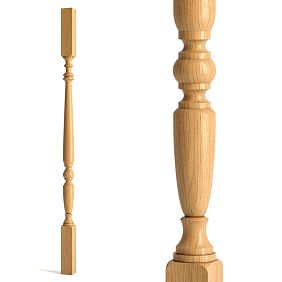
The standard cross-section of square balusters varies from 40×40 mm to 100×100 mm, with the most popular sizes being 50×50 mm and 60×60 mm. The choice of cross-section depends on the overall proportions of the staircase, the height of the railing, and the stylistic requirements of the project.
The height of balusters is usually 900 mm from the step surface to the top of the handrail, corresponding to ergonomic requirements and building standards. However, depending on the designer's intent, this parameter may vary within the range of 800–1100 mm.
The proportionality of elements plays a key role in the perception of square balusters. The ratio of cross-section to height should create a visually harmonious composition. Too thin balusters appear fragile, overly massive ones — cumbersome.
Constructive Solutions
Solid square balusters are made from a single piece of wood, ensuring maximum strength and material homogeneity. This approach is preferable for critical structures where high reliability is required.
Composite constructions allow combining different wood species or creating complex decorative elements. For example, the base can be made of economical pine, while decorative inserts — from premium species.
Hollow balusters are used to reduce the weight of the structure or to lay communications. Modern gluing technologies allow creating hollow elements that do not compromise on strength compared to solid counterparts.
Material science for square balusters
Wood species selection
Oak remains the benchmark of quality for manufacturing square balusters. Its density of 700 kg/m³ and high hardness ensure the longevity of the structure. The expressive texture of oak looks especially effective on the flat faces of square elements.
Ash is attracted by its light color and high strength. This species is ideal for modern interiors in Scandinavian style, where the natural beauty of light wood is valued.
Beech has a uniform structure and lacks a pronounced texture, making it ideal for painting. Beech square balusters can imitate any premium species or be painted in any color.
Pine represents an economical segment without compromising on functionality. Modern processing technologies allow creating high-quality square balusters from pine at an affordable price.
Technical Requirements for the Material
The moisture content of wood for square balusters should be 8–12% to ensure dimensional stability. Exceeding this value may lead to deformation of elements after installation.
The grade of the material determines the presence of defects and the overall quality of the products. For square balusters, it is especially important to have no knots or cracks on visible faces, as any defects are immediately noticeable.
The grain direction must be strictly vertical to ensure maximum bending strength. Deviations in grain direction may cause warping of the elements.
Manufacturing Technologies
Preparation of blanks
Manufacturing high-quality square balusters begins with careful preparation of blanks. Cutting of lumber is performed taking into account the grain direction and location of defects. Each blank undergoes visual inspection to ensure compliance with quality requirements.
Blanks are dried in special chambers with controlled temperature and humidity regimes. The process may take from several days to several weeks depending on the wood species and initial moisture content.
Material stabilization includes holding dried blanks under conditions close to operational ones. This allows revealing hidden stresses and preventing deformation of finished products.
Mechanical processing
Four-sided planing is a key operation in manufacturing square balusters. Modern machines provide processing accuracy up to ±0.1 mm, which is critically important for achieving perfectly parallel faces.
Ends of blanks are milled on special machines ensuring perpendicularity of ends to the longitudinal axis. The quality of end milling affects the tightness of balusters' fit to the base and handrails.
Milling decorative elements may include creating chamfers, grooves, relief patterns, or other decorative features. Modern milling machines allow creating complex profiles with high repeatability.
Quality control
Geometric control includes checking dimensions of cross-section, length, straightness, and perpendicularity of ends. Deviations from specified parameters must not exceed established tolerances.
Moisture content is checked using electronic moisture meters on each batch of finished products. Exceeding the allowable moisture level is grounds for rejecting the product.
Visual inspection reveals surface defects, chips, scratches, and other flaws affecting the appearance of finished products.
Design solutions with square balusters
Minimalist style
Square balusters fit perfectly into the concept of minimalism, where simplicity of forms and functionality are valued. Clean lines and strict geometry create a sense of order and calmness in the interior.
Monochromatic solutions are especially effective with square balusters. White or gray elements against dark steps create a contrasting composition that highlights the architectural expressiveness of the staircase.
The rhythmic arrangement of square elements creates a visual metronome setting the pace of the entire composition. Even intervals between balusters form a harmonious railing structure.
Modern classic
Neoclassical style allows using square balusters with decorative elements. Chamfers at corners, shallow grooves, or relief panels add elegance to strict forms.
Proportional systems of classical architecture adapt to square forms. Ratios based on the golden section create visually perfect compositions.
Symmetry and balance are primary principles when designing staircases with square balusters in classical style. Each element must be in harmony with the overall composition.
Industrial style
Loft aesthetics combine beautifully with square balusters, especially when combined with metallic elements. Rough surface treatment emphasizes the industrial character of the interior.
Combined materials open new creative possibilities. Wooden square balusters combined with metal handrails or glass panels create modern compositions.
Contrasting combinations of dark wood with light structural elements highlight the geometry of square forms and create expressive visual effects.
Technical aspects of installation
Methods of Mounting to the Base
Through-fixing through the tread ensures maximum secure fixation of square balusters. The threaded bolt passes through the entire tread thickness and is secured with a nut on the opposite side.
Shank fixing represents a traditional carpentry method ensuring strong connection without visible fasteners. Wooden shanks ensure full material compatibility.
Corner brackets are used for mounting to the stringer or underbaluster. Special metal elements ensure secure fixation while retaining the possibility of disassembly.
Installing handrails
Milling a groove at the bottom of the handrail ensures precise fitting onto square balusters. The groove depth should be 15-20 mm for secure fixation.
Adhesive bonding complements mechanical fastening, creating a monolithic structure. Modern polyurethane adhesives provide bond strength exceeding the strength of the wood itself.
Hidden screw fastening is performed from below at an angle through the baluster body into the handrail. This method ensures strong connection while preserving the structure's aesthetics.
Features of working with a square cross-section
Precise positioning of square balusters requires special attention to element orientation. All faces must be strictly parallel or perpendicular to the main staircase axes.
Verticality is checked in two planes using precise measuring tools. Deviations from verticality become immediately noticeable due to the geometry of the square cross-section.
Joint fitting requires high-precision processing of end surfaces. Any gaps or poor fitting will disrupt the overall geometry of the structure.
Protective coatings and finishing
Surface preparation
The edges of square balusters are ground sequentially using abrasives of different grits. Special attention is paid to processing corners, where chipping and scratches are possible.
Removing chamfers along the edges prevents chipping during use and gives the elements a softer appearance. The chamfer size is usually 1-2 mm.
Surface dust removal before applying coatings is performed using a vacuum cleaner and adhesive cloth. The quality of cleaning critically affects the adhesion of protective coatings.
Types of Protective Coatings
Polyurethane varnishes provide maximum protection for square balusters against mechanical damage and moisture. Matte finishes highlight the natural wood texture.
Oil-based finishes penetrate into the wood structure, preserving its natural tactile properties. They are especially effective on flat faces of square elements.
Wax-based finishes create a pleasant-to-touch surface and emphasize the natural beauty of wood. Wax can be easily renewed as needed.
Color Solutions
Natural tones highlight the natural beauty of wood and create a sense of warmth in interiors. Transparent finishes preserve the visibility of the material's texture.
Tinted finishes allow changing the color of wood while preserving its texture. Popular tones include gray, white, and black, aligning with modern trends.
Enamel finishes completely hide the wood texture, creating a uniform colored surface. Such finishes are especially effective in minimalist interiors.
Operational characteristics
Strength properties
The load-bearing capacity of square balusters depends on the cross-section of the elements and the type of wood. Standard balusters with a 50×50 mm cross-section can withstand horizontal loads up to 100 kg.
Square-section balusters have higher resistance to bending compared to round equivalents of the same material volume. This is due to a more rational distribution of material relative to the neutral axis.
Square elements also exhibit higher resistance to twisting due to a greater moment of inertia of the cross-section. This is especially important for tall balusters.
Structural durability
Service life of quality square balusters made from hardwood can exceed 50 years with proper care. This makes them an economically advantageous solution.
Repairability of wooden elements allows restoring their appearance by sanding and reapplying finishes. Local damage can be easily repaired without replacing the entire element.
The geometric stability of properly manufactured and installed square balusters is maintained throughout their service life under proper operating conditions.
Economic Aspects
Production cost
The technological manufacturability of square balusters ensures their competitive pricing. Ease of processing on standard equipment reduces production costs.
Material consumption in manufacturing square elements is minimal due to rational use of the blank's cross-section. Production waste is easily recycled or repurposed.
Automation of processes allows reducing labor costs and improving product quality. Modern lines can produce square balusters with minimal human involvement.
Comparative economic efficiency
|
Parameter |
Square balusters |
Round balusters |
Carved balusters |
|
Manufacturing cost |
Low |
Medium |
High |
|
Production speed |
High |
Medium |
Low |
|
Material Consumption |
Minimum |
Average |
High |
|
Installation complexity |
Low |
Medium |
High |
Investment Appeal
The return on investment in quality square balusters occurs due to their longevity and minimal operating costs. Initial expenses are offset by their long service life.
The impact on property value of a staircase with square balusters can be 3-5% of the total property cost.
Modern trends and innovations
Technological innovations
Digital design allows precise calculation of square baluster parameters for a specific project. 3D modeling helps visualize the result before production begins.
Automated production using robotic lines ensures consistent quality and high productivity. Vision systems monitor quality at every stage.
New materials include composite wood materials with improved properties. Laminated balusters from lamellas have enhanced dimensional stability.
Ecological aspects
Certified wood from sustainably managed forests has become the standard in producing square balusters. Environmental certifications confirm responsible forestry practices.
Zero-waste technologies allow the use of all parts of wood, including sawdust and shavings, for producing other materials or energy.
Water-based eco-friendly coatings replace traditional formulations with high volatile organic compound content.
Integration of smart technologies
Built-in lighting in square balusters creates an eye-catching illumination effect for staircases. LED strips are integrated into special grooves.
Sensory systems can be embedded in balusters for automatic control of lighting or other smart home systems.
Monitoring the condition of the structure using built-in sensors allows control of loads and timely detection of problems.
Conclusion
World square balusters It represents a remarkable combination of geometric precision and functional beauty. These architectural elements embody modern design philosophy, where simplicity of form becomes a source of aesthetic pleasure.
Choosing square balusters is choosing rationality, technology, and modernity. They fit perfectly into minimalist interior concepts, where every detail must be both functional and beautiful.
Technological capabilities of modern production allow creating Square balusters exceptional quality, combining strength, durability, and aesthetic appeal. Investments in quality materials and professional manufacturing pay off multiple times due to long service life and minimal operating costs.
The future of square balusters is linked to the development of new technologies, eco-friendly materials, and integration of smart systems. However, core principles — quality, functionality, and beauty — remain unchanged guiding principles for anyone striving to create perfect architectural solutions.
In today's world, where individuality and craftsmanship are valued, square balusters become a choice for those who understand the true value of geometric perfection. They create spaces where comfort combines with aesthetics, and functionality merges with beauty.
For many years, STAVROS has remained a leader in creating staircase structures, offering a full range of solutions for the most demanding clients. Deep understanding of working with various materials, mastery of modern production technologies, and extensive experience in implementing projects of any complexity make STAVROS a reliable partner for those striving for perfection. STAVROS specialists know that square balusters require a special approach to design and manufacturing, where every detail — from material selection to final finishing — matters. Choosing STAVROS means you get not just quality products, but a comprehensive solution that will become a long-lasting decoration of your home, embodying the ideals of modern architecture and design.