Article Contents:
- Why legs are not a trifle: the philosophy of detail
- Typology of wooden table legs: from straight to turned
- Straight legs: clarity without compromise
- Tapered legs: movement inscribed in the vertical
- Turned legs: classic as absolute
- Figurative legs with decor: when the support itself is a work of art
- Spherical and geometric supports: bold solutions
- Underframes: when you need a system, not four points
- Wood species: three candidates and the logic of choice
- Beech: the gold standard of furniture production
- Oak: the choice of those who know the value of texture
- Pine: lightness and affordability for cottage style
- Table legs by purpose: kitchen, dining area, living room
- Kitchen table legs: practicality prioritized
- Dining table legs: scale and dignity
- Coffee table legs: playing with lightness
- Console table legs: minimal load, maximum effect
- How to install table legs: from marking to first use
- Step one: determining the mounting system
- Step two: marking leg positions
- Step three: installing fasteners
- Step four: screwing on legs and checking level
- Step five: checking stability under load
- Finishing table legs: how to paint them yourself
- About STAVROS: experience that produces table legs worthy of homes
- FAQ: The Most Important Questions About Furniture Legs
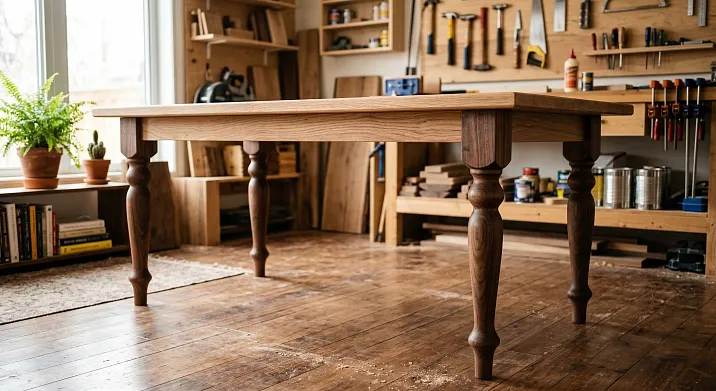
Four wooden legs under a tabletop are not a technical component or a line in a specification. They are the first thing the eye notices when passing by. They determine whether a table looks heavy or airy, archaic or modern, cheap or expensive. Table legs are an interior code that is read instantly, before a person consciously pays attention to them.
Replacing the legs on an existing tabletop transforms it into a different object. A new table in place of the old one—without any significant investment, simply by choosing the right wooden supports. That is why the topic of furniture legs deserves a serious, thoughtful conversation.
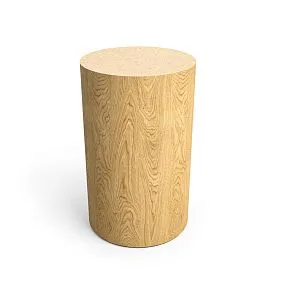
Todaybuy legs for a tableCrafting from solid wood means creating a product with an inimitable character. The living texture of the fibers, the warmth of the surface, the sound when tapped—all of this distinguishes real wood from any polymer imitation. And this distinction is precisely what makes wooden furniture what it is: a lasting value in the home.




Why Legs Are Not a Detail: The Philosophy of the Component
There is a belief that in interior design, the big decisions matter: wall finishes, floor color, ceiling shape. Details come later, funded from what's left over. Practice disproves this logic time and again.
Imagine a dining table with a solid oak top, set on square metal supports of unpainted steel. Now imagine the same table—on turned wooden oak legs, 710 mm high, with a slight conical taper towards the bottom. These are different objects. Different character, different feel in the space, a different place in the room's interior system.
Table legs define the silhouette. The silhouette is the architecture of the object. The architecture of the object is what we remember about a room after leaving it.
Wooden legs for tableThey combine a structural function—holding the tabletop at the desired height, bearing the load—with a decorative one: being part of the interior, engaging in dialogue with other objects, creating spatial unity.
And that is precisely why their selection should be approached as seriously as the choice of the tabletop itself.




Typology of Wooden Table Legs: From Straight to Turned
AssortmentSTAVROS furniture legsincludes over 130 models. This is not just a lot—it's a comprehensive typological library of forms where you can find support for a table of any purpose, any style, any scale. Let's examine the main types.
Our factory also produces:


Straight Legs: Clarity Without Compromise
A straight leg—cylindrical or square in cross-section, without tapers or flares—is perhaps the most honest form. No unnecessary moves, no decorative ambitions. Just the vertical.
Such legs dominate in Scandinavian design, Japanese minimalism, and modern classicism. They work where the tabletop is the main object, and the support should be invisible, serving the form without claiming its own statement.
Geometric furniture leg MN-146— rectangular cross-section, strict geometry. From 490 rubles—one of the most affordable items in the line.MN-192— similar philosophy, slightly different proportions.MN-193— a compact square support for small tables.
A straight square leg under white enamel on a dining table with a white top—that's Scandinavian restraint. The same leg under clear oil on an oak top with an open grain—that's a different statement: organic and simplicity in equal measure.
Get Consultation
Tapered Legs: Movement Inscribed in the Vertical
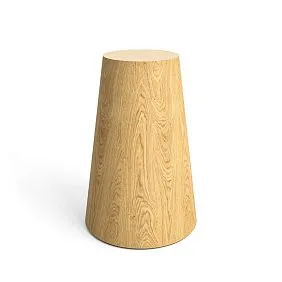
A tapered leg—narrowing towards the bottom. The most recognizable design move of mid-century modern furniture: sofas and armchairs from the 1950s–60s on slender tapered legs of light wood became the image of an entire era.
The taper creates an illusion of lightness: the furniture seems to stand on tiptoes, not weighing down the space but floating above it. At the same time, the structural strength of a beech tapered leg is not inferior to a straight one—the cross-section at the top (at the attachment point) is sufficient to bear the load.
Modern Furniture Leg MN-226— tapered form with a pronounced narrowing, from 4,190 rubles. Good for a dining table in a retro or modern classic style.MN-241— a larger tapered support, from 12,850 rubles, with an increased upper cross-section—for massive tables and seating.MN-237— a tapered form in a modern interpretation, from 8,270 rubles.
On a kitchen table, tapered beech legs under a light tint or clear oil create a light, airy feeling in a small room. It is precisely this spatial generosity that makes the taper so popular in the kitchens of city apartments.
Turned Legs: Classic as Absolute
A turned leg is the result of work on a lathe. A cylindrical blank acquires a complex profile: thickenings and tapers, disks and balls, fillets and rings. From this set of elements, a form is composed that we instantly recognize as a 'classical furniture leg.'
The history of the turned leg goes back to the Renaissance era. Italian masters of the 15th–16th centuries discovered that a lathe allowed creating from a single piece of wood a form that could only be carved by hand—expensively and slowly. The turned leg democratized the classical style.
turned furniture leg MN-145— a STAVROS bestseller, from 490 rubles. An elegant, refined profile for tables, cabinets, coffee tables.MN-221— a more complex, pronounced classical profile, from 3,470 rubles.MN-233— a modern interpretation of the turned form, from 2,310 rubles.MN-239— a representative support with a developed profile, from 5,640 rubles.
A turned leg with golden tinting or an aged finish — this is an interior in the spirit of French Provence or Italian rustic classicism. The same legs in dark walnut — English colonial style. Under white enamel with gilded bands — Louis XVI in a modern reinterpretation.
Figurative legs with decor: when the support itself is a work of art
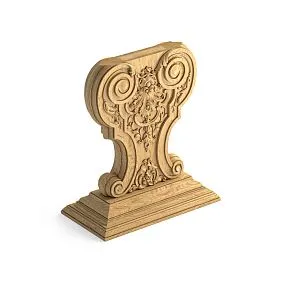
There are legs that not only support the tabletop but also adorn the space beneath it. Figurative supports with carved or cast decorative elements — this is the level at which a table transforms from furniture into an object of interior art.
Turned leg with decor MN-148— a lathe-turned profile, supplemented with a decorative element, from 1,310 rubles.MN-149— a similar approach with a different decorative program, from 1,430 rubles.Leg with polyurethane decor MN-152— a combined product: a wooden lathe-turned base with a polyurethane decorative element, from 2,100 rubles.
Next towooden decorative overlayson furniture fronts andwooden moldingson walls — figurative legs organically fit into a unified decorative program of the space. This is no longer just a table — it is an element of an interior symphony.
Spherical and geometric supports: bold solutions
A separate category — legs with non-standard geometry: a large sphere as the main form, pyramidal and trapezoidal cross-sections, multifaceted profiles.
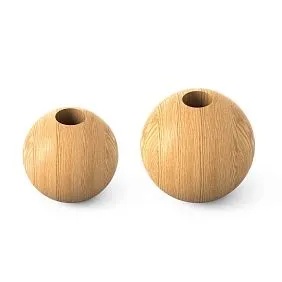
Spherical Furniture Leg MN-235— a large spherical element at the base of the support, from 9,230 rubles. Such a leg on a coffee table creates a sculptural object.MN-186— a geometric leg, a bestseller, from 1,040 rubles, a four-sided shape with pronounced edges.MN-186-2— an enlarged version of the same profile, from 7,200 rubles, for heavy furniture.
Under-table frames: when you need a system, not four points
For large dining tables (from 160×90 cm and larger), four separate legs may be insufficient — both structurally and visually. Here, under-table frames come to the rescue: unified support frames that distribute the load more evenly.
Under-table frame STL-041— from 45,340 rubles.STL-042— from 45,110 rubles. These are already professional structural solutions for monumental dining tables: a wooden under-table frame made of solid wood, which in itself is a design statement.
Wood species: three candidates and the logic of choice
Beech: the gold standard of furniture production
Beech occupies first place in the production of furniture legs — and this is no coincidence. Its density (680–720 kg/m³) provides excellent load-bearing capacity. The uniform fine-grained structure without large pores is ideal for precise lathe turning: the profile comes out clear, with smooth transitions. The color — a neutral light beige — makes it absolutely universal in relation to the color of the tabletop and finish.
Under transparent oil, beech remains warm and light. Under any tinting — it takes on the shade evenly, without spots or variations. Under white enamel — an ideal, even surface. Beech table legs are a choice that is correct in most projects.
What is especially valuable in beech is its stability: when properly dried to 8–12% moisture content and under standard residential interior conditions, a beech leg does not warp, crack, or change geometry for years.
Oak: the choice of those who know the value of texture
Wooden legs made of oak— this is a different level of visual expressiveness. Oak has large open pores and medullary rays, which under transparent oil give a feeling of a living, voluminous, 'breathing' surface. Two oak products never look absolutely identical — each has its own pattern.
The density of oak is 700–750 kg/m³. Hardness — one of the highest among Russian species. Oak legs for a dining table — a choice for those building not for five years, but for fifty.
Oak paired with an oak countertop creates a monolithic look. Oak finished with natural oil alongsideoak staircase balustersandwooden oak skirting boardsaround the perimeter forms an interior system of unified material, where wood speaks consistently and convincingly.
Pine: lightness and affordability for cottage style
Pine legs are the most affordable option. The softness of pine (350–450 kg/m³) means that dents may appear on the surface over time — but for country interiors, summer houses, or budget projects, this is not only acceptable but sometimes desirable: the aged look of pine appears organic and lively.
Table legs by purpose: kitchen, dining area, living room
One of the most common mistakes when choosing is ignoring the purpose. A leg that looks great on a coffee table is structurally unsuitable for a dining table.
Kitchen table legs: practicality is the priority
A kitchen table is used intensively: daily breakfasts, lunches, work sessions. Loads are static (weight of the countertop and items) and dynamic (leaning, light impacts).legs for a kitchen tableshould be sturdy enough, have no complex turned elements in the lower part (where feet can easily hit), and accept moisture-containing finishes well.
Optimal choice: geometric (MN-146, MN-192) or conical (MN-226) legs with a height of 700–730 mm (working height of a kitchen table is 740–760 mm). Finish — matte polyurethane varnish or hard oil with wax.
Standard kitchen table height is 750–760 mm. Leg height with a countertop thickness of 20–25 mm: 730–740 mm. If the countertop is thicker (35–40 mm) — the leg is correspondingly shorter.
Dining table legs: scale and dignity
A dining table is the central object in a dining room or living room. It can be designed for 6, 8, 10, or more seats. This is a large countertop — and the legs must be proportionate to it in mass and character.
For a diningtable made of woodfor 6–8 people: legs with a diameter in the upper part of at least 60–70 mm, height 700–730 mm.MN-221— a turned leg with an expressive profile, the optimal choice.MN-239— a more representative support for a monumental dining table.
For a dining table in a classic interior withwooden decorative overlayson furniture andcarved cornices— turned legs with a developed profile in dark walnut or with gilded bands create a unified decorative language for the space.
Coffee table legs: playing with lightness
A coffee table is the most design-free piece of furniture in the living room. It is low (380–480 mm), does not bear serious loads, and can afford the boldest forms.
Geometric leg MN-186with a height of 400 mm — on a coffee table creates a concise modern look.Spherical leg MN-235— a sculptural option for interiors with character.Turned MN-145— in a modest height, it's airy classicism.
Legs for a console table: minimal load, maximum effect
A console is a wall-mounted table that bears only decorative and light functional load. It's a space for maximum decorative freedom: the legs can be the most expressive, the most intricate, the most unconventional.
For a console, we recommendMN-149 with decororMN-152 with polyurethane element— the decorative richness of these supports is fully appropriate here.
How to install table legs: from marking to first use
Installing furniture legs yourself is a task anyone who can hold a drill straight can handle. It requires precision and the correct sequence of actions.
Step one: determining the mounting system
Wooden furniture legs are installed in several ways. An M8 or M10 threaded stud is the most common option. The leg has a glued-in nut with internal thread (an insert nut) in its top end. A mounting hole of the required diameter is drilled in the tabletop, and a special screw-bolt with M8/M10 thread is screwed in.
Mounting plate — an alternative for cases when the tabletop is thin and drilling a through socket is undesirable. A metal plate is attached to the back surface of the tabletop with four self-tapping screws. A leg with a stud is screwed into the center of the plate.
Direct tenon — a traditional joinery method: a square or round tenon on the top of the leg fits into a groove in the tabletop and is fixed with glue. The most durable, but non-demountable option.
Step two: marking the leg positions
Turn the tabletop over with its back side up. Mark the leg axes with a pencil. Standard for a rectangular table: legs are offset from the edge by 50–100 mm — far enough so a seated person doesn't bump into them with their feet, but not so far that the table loses stability.
Check the symmetry of the markings: the diagonals from the tabletop corner to the nearest point of the leg should be equal. Neglecting this check results in a visually 'crooked' table when viewed from above.
Step three: installing the fasteners
For the threaded method: drill mounting holes with a diameter corresponding to the fastener (usually 8–10 mm), depth 25–30 mm. Not all the way through. Install a fastener bolt with a wide washer into the hole or mount a stud with an intermediate threaded bushing.
When using mounting plates: mark the plate positions, drill holes for the self-tapping screws, attach the plates to the back surface of the tabletop. The tightening must be secure: the plate should not have any play.
Step four: screwing on the legs and checking for level
Screw on the legs. Turn the table into its working position. Check the levelness of the tabletop with a level. If one leg is shorter or the threaded connection went deeper — place a felt foot pad of the required thickness under the leg.
Felt or silicone foot pads are a mandatory element: they protect the floor covering from scratches and allow for easy level adjustment.
Step five: checking stability under load
Press down on the middle of the tabletop from above with a force of 30–40 kg. The table should not wobble. Press on a corner — the same. If there is play — check the tightness of the fasteners. Properly installedWooden legs for tableprovide an absolutely rigid structure without any wobble.
Finishing Treatment for Table Legs: How to Paint Them Yourself
Unfinished legs are blanks awaiting your decision. STAVROS offers both unfinished and pre-finished legs — but if you choose unfinished ones, here's how to achieve a professional result yourself.
For clear oil: sanding with 180 grit, then 240 grit. Applying oil with a brush or cloth, rubbing in with circular motions. Dwell time 20–30 minutes, remove excess. Repeat after 12–24 hours. Result: a lively, warm surface with emphasized texture.
For tinting: sanding with 150 grit, then 220 grit. Application of stain or tinted oil in the desired color. Drying. Final varnish or oil-wax.
For white enamel: sanding with 150 grit. Acrylic primer in one coat. Drying for 4 hours. Sanding with 220 grit. Enamel in two coats with intermediate sanding using 320 grit between coats. Result: a smooth matte or glossy white surface.
For gilding: primer. Sanding with 320 grit. Acrylic mordant. Application of gold leaf. Final varnish in one coat — protection and shine.
About STAVROS: experience that produces table legs worthy of homes
Behind everyfurniture legfrom the STAVROS catalog lies a production culture that doesn't emerge in a year and can't be bought with money. The STAVROS company was founded in 2002 in St. Petersburg by artists Andrey Ragozin and Evgeny Tsapko, who from day one approached wood not as raw material, but as a language.
Twenty years — restoration of the Konstantinovsky Palace, the Hermitage, the Alexander Palace, hundreds of private interiors. Each project is a lesson: what geometric precision means, what humidity stability means, what coordination of all elements in a wooden interior system means.
Today, STAVROS production is equipped with CNC lathes and milling machines, its own drying chambers with humidity control down to 8–14%, and a modern sanding line. Over 130 models of furniture legs made of beech and oak — unfinished and with finishes, in stock and made to order.
Buy wooden table legsfrom STAVROS means getting a product that will serve for decades. Showrooms in Moscow and St. Petersburg, delivery across Russia and CIS, orders from a single piece, specialist consultation on selection and installation.
FAQ: the most important questions about furniture supports
What is the standard height for dining table legs?
Standard dining table height is 740–760 mm. Leg height = table height minus tabletop thickness. With a 25 mm tabletop — leg is 715–735 mm. With a 40 mm tabletop — leg is 700–720 mm. Always check considering the specific thickness of your tabletop.
How many legs are needed for a dining table?
For a rectangular table, typically four legs at the corners. For a round table — three or four. For a large table (over 200 cm in length) — possibly six legs or central ties. For monumental tables — underframesSTL-041 and STL-042.
What load can wooden legs withstand?
A beech leg with a 50×50 mm cross-section at the lower part can withstand a static load of 200–250 kg. An oak leg of similar cross-section — 260–300 kg. For a dining table with a load of 80–120 kg — any standard STAVROS leg is more than sufficient.
Can legs be installed on an existing IKEA tabletop?
Yes. IKEA tabletops typically have a back surface made of chipboard or MDF with sufficient thickness (16–25 mm) for installing mounting plates or threaded bolts. Choose a mounting plate — this is the most universal method, not requiring a deep socket.
Should legs be painted before or after installation?
Professionals paint before installation: this ensures even coverage of the entire surface, including the top end. After installation, apply one thin finishing coat over the entire leg surface — to unify the tone with already installed elements.
How to match legs to existing furniture in the home?
Focus on three parameters: wood species (or its imitation), finish tone, style of form (classic / modern / geometric). The best match is when the new table legs are of the same species and tint as other wooden elements in the room: floor,Skirting, frames.
How to avoid mistakes with height when ordering legs online?
Measure your tabletop thickness with a tape measure. Determine the desired finished table height (standard — 750 mm for dining, 400–460 mm for coffee tables, 900–1050 mm for bar tables). Subtract: leg height = table height − tabletop thickness. Specify this value when ordering or choose a model with a suitable height range from the STAVROS catalog.