Article Contents:
- Anatomy of Modern Kitchen Hardware
- Hinges and Soft-Close Mechanisms: Invisible Guardians of Order
- Pull-Out Systems: Comfort in Every Movement
- Lift Mechanisms: Revolution in Upper Cabinets
- Handles and Buttons: Tactile Pleasure
- Organization Systems: Order in Every Centimeter
- Innovations in the World of Kitchen Hardware
- Silent-Close Systems: Silence as Luxury
- Electronic Opening Systems: The Future is Here
- Eco-Friendly Materials and Technologies: Care for the Planet
- Integration with Smart Home Systems: The Kitchen of the Future
- How to Choose the Perfect Kitchen Hardware
- Style Compatibility: Harmony in Details
- Functional Requirements: What Really Matters
- Technical Specifications: What to Pay Attention To
- Brand and Manufacturer Reputation: Guarantee of Quality
- Where to Buy Kitchen Hardware: Overview of Options
- Specialized Stores: Professional Approach
- Online Stores: Convenience and Variety
- Manufacturers and Official Distributors: Guarantee of Authenticity
- Construction Markets and Hypermarkets: Accessibility and Mass Availability
- Leading Kitchen Hardware Manufacturers
- European Brands: Traditions of Quality
- Asian Manufacturers: Balance of Price and Quality
- Russian Companies: Adaptation to Local Conditions
- Practical Tips for Choosing and Installing Kitchen Hardware
- Preparation for purchase: what to know in advance
- Choosing a Reliable Supplier: What to Pay Attention To
- Assembly and compatibility: important nuances
- Installation and maintenance: extending service life
- Economic aspects of choosing kitchen hardware
- Price Categories: From Budget to Premium Solutions
- Factors Affecting Cost
- Long-Term Savings: Investing in Quality
- Design Trends in Kitchen Hardware: What’s Trending Today
- Minimalism and hidden solutions: aesthetics of clean lines
- Natural Materials and Eco-Friendliness: Returning to Nature
- Technological Innovation and Smart Solutions: Comfort in Every Movement
- Customization and Personalization: Uniqueness in Details

The kitchen is the heart of the home, the place of power and creativity, where culinary masterpieces are born and the whole family gathers. But what transforms ordinary wooden or MDF panels into a convenient, functional, and aesthetically pleasing kitchen? The secret lies in the details — kitchen hardware, which, like the nervous system of the human body, ensures smooth operation of all elements of the kitchen space.
Modern kitchen hardware is a complex engineering system that includes hinges and soft-close mechanisms, pull-out systems and lift mechanisms, handles and mounting elements. The quality of these components determines not only the convenience of using the kitchen, but also its durability, safety, and even the aesthetic perception of the entire interior.
The question of where to buy kitchen hardwarebecomes key for those planning to create or update a kitchen space. After all, properly selected hardware can turn an ordinary kitchen into a work of art, where every movement brings pleasure and every detail delights the eye.
In this article, we will dive into the world of kitchen hardware, reveal the secrets of its selection, discuss the latest trends and innovations, and share practical tips that will help you create your dream kitchen.


Anatomy of Modern Kitchen Hardware
Kitchen hardware is not just a set of metal parts, but a carefully designed system, each element of which performs an important function. Understanding the features and capabilities of different types of hardware will help make an informed choice and create a truly functional kitchen.




Hinges and soft-close mechanisms: invisible guardians of order
Hinges are the foundation of functionality for any kitchen cabinet. Modern hinges are high-tech devices that ensure smooth and silent opening and closing of doors.
Surface-mounted hinges are installed on the outer side of the cabinet body and facade, fully visible when the door is closed. Their advantage is ease of installation and adjustment, while their drawback is visibility on the facade.
Half-surface hinges are partially visible when the door is closed. They are used when the facade partially overlaps the cabinet body.
Inset hinges are completely hidden when the door is closed, creating a "clean" facade effect. They require more precise installation but provide a flawless kitchen appearance.
Hinges with soft-close mechanisms are equipped with a special mechanism that ensures smooth and silent closing of the door in the last few centimeters of travel. This not only enhances user comfort but also extends the lifespan of facades, preventing impacts and vibrations.
Hinges with Push-to-open open with a light press on the facade, allowing the creation of kitchens without handles — an ideal solution for minimalist interiors.
Technical specifications of modern hinges:
- Opening angle: from 95° to 175°
- Adjustment in three planes: height (±2 mm), width (±2 mm), depth (±2 mm)
- Load capacity: up to 20 kg per pair of hinges
- Service life: up to 200,000 opening/closing cycles
- Material: zinc alloy, steel, plastic (for decorative covers)
Our factory also produces:


Pull-out systems: comfort in every movement
Pull-out systems are the heart of a functional kitchen, providing easy access to drawer contents and space organization.
Ball-bearing guides — a basic solution providing partial drawer extension (up to 75% of depth). They are affordable but have limited load capacity and shorter service life.
Roller guides provide smoother operation but also allow only partial drawer extension.
Telescopic guides allow full drawer extension, providing access to all contents. They have higher load capacity and longer service life.
Hidden guides are installed under the drawer bottom, creating a "floating" drawer effect and ensuring maximum aesthetics.
Systems with soft-close ensure smooth and silent drawer closure in the last few centimeters of travel.
Push-to-open systems allow drawers to be opened with a light press on the facade, ideal for handleless kitchens.
Technical specifications of modern pull-out systems:
- Load capacity: from 25 to 80 kg
- Full extension: access to 100% of contents
- Adjustment in three planes
- Service life: up to 100,000 opening/closing cycles
- Material: galvanized steel, stainless steel, aluminum
Get Consultation
Lift mechanisms: revolutionizing upper cabinets
Lift mechanisms have changed the perception of kitchen upper cabinets, making their use convenient and safe.
Hinged mechanisms allow the facade to open upward at an angle up to 90°. They are compact and easy to install, but require free space above the cabinet.
Folding mechanisms allow the facade to fold in half when opening, saving space above the cabinet.
Parallel lifters move the facade parallel to the cabinet body, which is especially convenient for tall facades.
Vertical lifters raise the facade vertically upward, ideal for cabinets with limited space above.
Technical specifications of modern lifting mechanisms:
- Load capacity: from 3 to 20 kg (depending on type and model)
- Opening angle: up to 107°
- Built-in stoppers and latches in the open position
- Adjustable opening/closing force
- Material: steel, aluminum, plastic (for decorative elements)
Handles and buttons: tactile pleasure
Handles are not only a functional element but also an important design detail of the kitchen, which can become its accent or harmoniously blend into the overall style.
Hooks - a classic handle variant, consisting of a curved piece secured to the facade with two screws.
Buttons - compact handles mounted with one screw and minimally protruding above the facade surface.
Profiled handles are integrated into the edge of the facade, creating a "clean" design effect.
Inset handles are installed into a special recess in the facade, not protruding above its surface.
Technical specifications of modern handles:
- Material: stainless steel, aluminum, brass, zinc alloy, plastic, glass, ceramic
- Finish: chrome, satin, bronze, gold, enamel, powder coating
- Center-to-center distance: from 16 to 320 mm (for hooks)
- Mounting method: screw, adhesive, inset
Organizational systems: order in every centimeter
Organizational systems transform kitchen space into ergonomic and functional areas where every item has its place.
Pull-out baskets provide convenient access to cabinet contents and allow maximum use of cabinet depth.
Cargo - special systems for narrow cabinets that provide access to all contents when pulled out.
Bottle holders - narrow pull-out systems for storing bottles, spices, and other tall items.
Corner systems (magic corners, carousels) transform hard-to-reach corner cabinets into functional space.
Drawer dividers allow organizing space inside drawers, creating separate compartments for different items.
Technical specifications of organizational systems:
- Material: stainless steel, chrome-plated steel, aluminum, plastic
- Load capacity: from 15 to 50 kg
- Adjustable elements for adaptation to various sizes
- Anti-slip coating for safe dish storage
Innovations in kitchen hardware
Modern kitchen hardware are high-tech products embodying the latest achievements of engineering thought. Innovations are aimed at enhancing comfort, functionality, and aesthetics of the kitchen space.
Silent closing systems: silence as luxury
In today's world, where noise pollution is becoming an increasingly relevant problem, silent closing systems are transforming from luxury into necessity.
Integrated closers are built directly into hinges or guides, providing smooth and silent closing without additional devices.
Adaptive systems automatically adjust braking force depending on the weight of the facade or drawer and closing speed.
Multi-stage closers provide smooth braking over several stages of closing, preventing even minimal noise.
Advantages of silent closing systems:
- Reduction of noise load in the room
- Prevention of facade damage from impacts
- Increased comfort of kitchen use
- Increased lifespan of furniture
Electronic opening systems: the future is here
Electronic opening systems are the next step in the evolution of kitchen hardware, combining mechanics with electronics to create the most convenient user experience.
Sensory systems react to a light touch on the facade, activating the opening mechanism.
Gesture recognition systems allow opening cabinets and drawers without physical contact, which is especially convenient when hands are dirty or occupied.
Voice control integrates with "smart home" systems, allowing users to open and close kitchen elements using voice commands.
Automatic systems with presence sensors open cabinets and drawers when you approach them with a specific intent.
Advantages of electronic systems:
- Enhanced user comfort
- Hygiene (no need to touch surfaces)
- Ability to integrate with other "smart home" systems
- Accessibility for people with disabilities
Eco-friendly materials and technologies: care for the planet
Modern kitchen hardware manufacturers are paying more attention to ecological aspects of production and operation of their products.
Safe materials free of harmful substances (lead, cadmium, formaldehyde) ensure user health safety.
Recycled materials are used to produce some hardware components, reducing environmental impact.
Energy-efficient production technologies reduce the carbon footprint of products.
Durable solutions with long service life reduce waste and the need for replacement.
Advantages of eco-friendly solutions:
- Safety for user health
- Reduction of negative impact on the environment
- Compliance with modern environmental standards and requirements
- Enhancing the kitchen's value as a responsible choice
Integration with "smart home" systems: the kitchen of the future
Modern kitchen hardware is increasingly becoming part of the "smart home" ecosystem, providing a new level of comfort and functionality.
Control via mobile applications allows remote monitoring of kitchen systems.
Integration with voice assistants (Amazon Alexa, Google Assistant, Yandex.Alice) enables voice control of kitchen elements.
Automation of scenarios allows configuring sequences of actions (e.g., automatic closing of all cabinets and drawers before leaving home).
Security systems warn about unsecured cabinets or drawers, preventing potential hazardous situations.
Advantages of integration:
- Enhanced user comfort
- Time-saving due to automation of routine tasks
- Increased safety
- Ability to adapt the kitchen to individual user needs
How to choose the ideal kitchen hardware
Choosing kitchen hardware is a responsible process requiring consideration of multiple factors. The right choice affects not only the kitchen's aesthetics but also its functionality, durability, and user comfort.
Style compatibility: harmony in details
Hardware should harmoniously fit into the overall kitchen style, highlighting its features and creating a cohesive impression.
For a classic kitchen, brass or bronze handles with patina, decorative elements, and engraving are suitable. Hinges and guides may be visible but should match the style.
For a modern kitchen, minimalist forms in stainless steel or aluminum with matte or glossy finish are optimal. Concealed hinges and guides are preferred, creating a "clean lines" effect.
For a loft-style kitchen, rough metallic elements, untreated steel, and weathered surfaces are suitable, emphasizing an industrial aesthetic.
Scandinavian kitchens feature simple forms, natural materials (wood, leather), and light tones, creating a sense of lightness and naturalness.
For a Provence-style kitchen, handles with an aged effect, ceramic knobs with painted designs, and wrought iron elements are appropriate, highlighting rustic charm.
Functional requirements: what really matters
When choosing hardware, it is necessary to consider operating conditions and functional requirements:
Intensity of use - for elements used daily (e.g., cutlery drawer), hardware with increased durability and long service life is required.
Load - the weight of facades and contents of drawers determines requirements for hinge, guide, and other component strength. For example, drawers with pots require guides with increased load capacity.
Operating conditions - kitchens are characterized by high humidity, temperature fluctuations, steam, and grease exposure, requiring materials resistant to these factors.
Ergonomics - placement of handles, height of pull-out elements, force required to open and close - all of these affect kitchen usability comfort.
Safety is especially important for families with children. Finger protection systems, child locks, and prevention of accidental opening — these features may be critically important.
Technical Specifications: What to Pay Attention To
When choosing kitchen hardware, it is important to consider technical parameters that determine its durability and functionality:
Material and coating — must be resistant to corrosion, household chemicals, and temperature fluctuations. The optimal choice is stainless steel, aluminum, and quality polymers.
Load capacity - hinges, guides, lifting mechanisms have weight limits they can withstand. Exceeding these limits leads to rapid wear and failure.
Service life — the number of opening/closing cycles guaranteed by the manufacturer. For frequently used components, this parameter is especially important.
Adjustments — the ability to precisely adjust the position of doors and drawers ensures perfect alignment and smooth operation.
Compatibility — the hardware must be compatible with the material and construction of the kitchen furniture. Some hinges are designed for specific door thicknesses, and guides are for specific drawer depths.
Brand and manufacturer reputation: guarantee of quality
Choosing hardware from a well-known manufacturer with a good reputation is an investment in the quality and longevity of your kitchen.
Established manufacturers have years of experience in developing and producing hardware, ensuring high quality and reliability of their products.
Warranty obligations — reputable manufacturers provide long-term warranties on their products, indicating confidence in their quality.
After-sales service — the ability to obtain technical support, spare parts, and components even years after purchase.
Innovative developments — leading manufacturers continuously improve their products by incorporating new technologies and materials.
Compliance with international standards — quality, environmental safety certifications, adherence to ISO standards and other international norms.
Where to buy kitchen hardware: overview of options
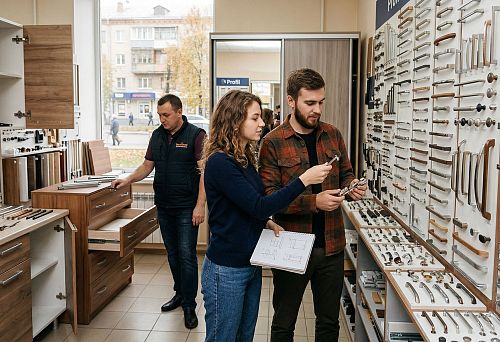
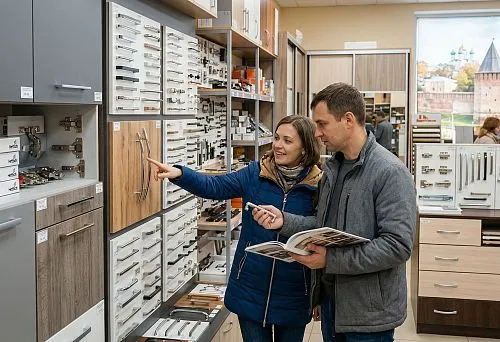
The question of where to buy kitchen hardwarehas many options. Each option has its own advantages and disadvantages that are important to consider when choosing.
Specialized stores: professional approach
Specialized kitchen hardware stores offer a wide range and professional consultation:
Advantages:
- Ability to see and touch the product before purchasing
- Professional consultation from specialists
- Guarantee of product authenticity and quality
- Ability to purchase all necessary components in one place
- Demonstration of mechanism operation on display samples
Disadvantages:
- Higher prices compared to online stores
- Limited selection due to physical store space
- Need for personal visit
Online stores: convenience and variety
Online shopping is becoming an increasingly popular way to purchase kitchen hardware:
Advantages:
- Extensive selection, including rare and specialized items
- Ability to compare prices and features
- Convenience of ordering anytime of day
- Delivery to home or pickup point
- Often lower prices due to the absence of costs for maintaining retail spaces
Disadvantages:
- Inability to physically assess product quality before purchase
- Risk of receiving a product that does not match photos or description
- Delivery waiting time
- Difficulties with returns if product does not meet expectations
Manufacturers and official distributors: guarantee of authenticity
Purchasing hardware directly from manufacturers or their official representatives has its own features:
Advantages:
- Guarantee of product authenticity and quality
- Full range of brand products
- Professional technical support
- Ability to order custom solutions
- Direct deliveries without intermediaries
Disadvantages:
- Usually higher prices
- Limited product range to one brand only
- Not always convenient location of branded stores
Construction markets and hypermarkets: accessibility and mass availability
Major home improvement and furniture hypermarkets also offer a wide selection of kitchen hardware:
Advantages:
- Accessibility and convenience of location
- Ability to purchase hardware along with other construction and finishing materials
- Regular promotions and discounts
- Availability of product "here and now"
Disadvantages:
- Limited selection, predominantly mass-market models
- Not always high-quality consultation
- Risk of purchasing questionable quality products
- No possibility to order non-standard solutions
Leading manufacturers of kitchen hardware
The market offers many brands of kitchen hardware, but only some have earned the unquestioned trust of professionals and demanding consumers.
European brands: traditions of quality
Blum (Austria) — one of the world’s leading manufacturers of high-quality kitchen hardware. The company specializes in hinges, lifting mechanisms, and sliding systems. Blum’s products are distinguished by innovative technologies, flawless quality, and long service life. The company’s proprietary technologies — BLUMOTION (soft-close system), TIP-ON (mechanical opening without handles), and SERVO-DRIVE (electric opening) — have become industry standards for quality in furniture manufacturing.
Hettich (Germany) — a company with over 125 years of history, offering comprehensive solutions for kitchen furniture. Hettich’s product range includes hinges, guides, lifting mechanisms, sliding door systems, and more. The company places special emphasis on the ergonomics and functionality of its products.
Häfele (Germany) — an international group specializing in furniture and construction hardware. The company offers over 150,000 product items, ranging from basic fasteners to complex electronic systems. Häfele is known for its innovative solutions for optimizing space and enhancing kitchen functionality.
Grass (Austria) — a manufacturer of premium kitchen hardware with a focus on design and innovation. The company specializes in sliding systems, hinges, and lifting mechanisms. Grass’s products are distinguished by elegant design, smooth operation, and durability.
Asian manufacturers: price and quality balance
FGV (China/Italy) - a company combining Italian design and Chinese manufacturing. FGV offers a wide range of hinges, guides, and lifting mechanisms at affordable prices while maintaining decent quality.
GTV (Poland/China) — a manufacturer offering a full range of kitchen hardware, from basic models to premium lines. The company actively develops its own innovative technologies and strives for optimal price-to-quality ratios.
Boyard (Russia/China) — one of the largest suppliers of furniture hardware in the Russian market. The company offers a wide range of products for kitchen furniture, combining affordable prices with decent quality.
Russian companies: adaptation to local conditions
Domestic manufacturers of kitchen hardware are actively developing, offering products adapted to Russian operating conditions and market requirements.
Valmax - one of the largest Russian manufacturers of furniture hardware. The company offers a wide range of products: from simple hinges and guides to complex lifting mechanisms and storage systems.
Kolchuga - a Russian manufacturer and supplier of furniture hardware, offering both its own products and those of international partners. The company specializes in hardware for kitchen furniture, paying special attention to quality and functionality.
Makmart - a major Russian supplier of furniture hardware, offering a wide range of products for kitchens of various price categories. The company collaborates with leading global manufacturers and develops its own product lines.
Practical tips for choosing and installing kitchen hardware
Choosing and installing kitchen hardware is a process requiring attention to detail and understanding of basic principles. Here are several practical tips to help you make the right choice and avoid common mistakes.
Pre-purchase preparation: what to know in advance
Before heading to the store or opening a website with questions about where to buy kitchen hardware, you must carry out preparatory work:
Measurements - accurately measure all necessary parameters: door panel thickness, drawer depth, door height and width. For some types of hardware (e.g., hinges) specific measurements are required, such as the overlap of the door panel with the cabinet body.
Weight - determine the approximate weight of door panels and drawer contents. This is critically important for selecting hinges, lift mechanisms, and guides with appropriate load capacity.
Usage intensity - assess how intensively each kitchen element will be used. Elements with high usage intensity (e.g., cutlery drawer) require hardware with increased durability.
Style and color scheme - determine what style and color of hardware will harmonize with your kitchen. Collect samples of materials and colors of door panels, countertops, and walls for comparison with the hardware.
Budget - determine how much you are willing to spend on hardware. Remember that this is a long-term investment, and cutting corners on quality may lead to additional expenses in the future.
Choosing a reliable supplier: what to pay attention to
The question of where to buy kitchen hardware, is directly related to choosing a reliable supplier:
Reputation and experience - preference should be given to companies with long-standing experience and positive customer reviews.
Assortment - a wide assortment allows you to choose the optimal solution for a specific task and purchase all necessary components in one place.
Consultations - the opportunity to receive professional consultation on selecting and installing hardware significantly reduces the risk of errors.
Warranties and service - the presence of product warranty and service support ensures protection of your investments.
Price-to-quality ratio - the most expensive hardware is not always the optimal choice, and the cheapest may turn out to be unnecessarily expensive in the long run due to low quality and short service life.
Kitting and compatibility: important nuances
When choosing kitchen hardware, it is important to consider issues of compatibility and compatibility:
Kit completeness - some manufacturers include in the kit all necessary fasteners, installation templates, and instructions, while others sell these components separately.
Compatibility with furniture material - different types of hardware are designed for different materials (solid wood, MDF, particleboard) and have specific mounting requirements.
Compatibility between components - if you are purchasing different hardware components (hinges, handles, guides), ensure they are compatible with each other and with the structure of your kitchen furniture.
Replacement parts - confirm whether replacement parts are available for the selected hardware and how long the manufacturer plans to keep this model in stock.
Installation and maintenance: extending service life
Proper installation and regular maintenance significantly extend the lifespan of kitchen hardware:
Professional installation - for complex mechanisms (lift systems, synchronized pull-out systems) it is recommended to entrust installation to professionals.
Strict adherence to instructions - if you are installing hardware yourself, carefully study the instructions and follow all manufacturer recommendations.
Regular maintenance - periodic lubrication of moving parts, checking and tightening fasteners, and adjusting mechanisms maintain optimal hardware performance.
Proper operation - following recommendations for maximum load, avoiding sudden movements and impacts, and careful handling of mechanisms significantly extend the service life of hardware.
Economic aspects of choosing kitchen hardware
The question of where to buy kitchen hardwareClosely related to financial aspects. The cost of kitchen hardware can vary within a very wide range, and it is important to understand what affects the price and how to find the optimal price-to-quality ratio.
Price Categories: From Budget to Premium Solutions
Budget segment - basic-level hardware, usually produced in China, Turkey, Russia. Characterized by low cost, basic functionality, limited durability (up to 20,000 open/close cycles). Suitable for kitchens with low usage intensity or temporary solutions.
Mid-range segment - optimal price-to-quality ratio. Products from well-known mid-range brands or basic lines of premium manufacturers. Provides reliable operation, sufficient durability (40,000–60,000 cycles), and good aesthetic qualities.
Premium segment — high-quality hardware from leading global manufacturers. Features flawless craftsmanship, innovative technologies, long lifespan (100,000 cycles and more), extended warranty, exclusive design.
Factors Affecting Cost
Brand and country of origin — products from European manufacturers (Austria, Germany, Italy) traditionally cost more than Asian equivalents.
Materials and technologies — use of high-quality materials, innovative technologies, and complex engineering solutions increases cost.
Functionality — the more additional features (smooth closing, electric drive, synchronization), the higher the price.
Design and finish — exclusive design, handcrafted elements, decorative features significantly increase cost.
Packaging — some manufacturers include all necessary mounting hardware and templates in the package, which may affect the final price.
Long-term savings: Investing in Quality
When choosing kitchen hardware, it is important to think strategically and evaluate not only initial costs but also long-term economic consequences:
Service life - quality hardware will last 3-5 times longer than budget alternatives, making it a more economical solution in the long run.
Maintenance and repair costs — high-quality mechanisms require minimal maintenance and rarely fail, reducing operational costs.
Preserving kitchen value - quality hardware maintains the functionality and aesthetics of the kitchen throughout its lifespan, preserving its resale value.
Comfort of use - investments in quality hardware pay off in daily kitchen comfort, which is difficult to quantify in monetary terms but has immense importance for quality of life.
Trends in kitchen hardware design: what is current today
Kitchen hardware, like any interior element, is subject to fashion trends. Current design trends in kitchen hardware reflect general directions in architecture and interior design.
Minimalism and hidden solutions: the aesthetics of clean lines
One of the dominant trends of recent years remains minimalism, with its clean lines and simple forms:
Hidden hinges - completely invisible when the door is closed, they create a "floating" facade effect and emphasize the cleanliness of kitchen lines.
Integrated handles - profiled handles built into the edge of the door panel or forming a recess in its surface, minimally disrupting the overall design.
Handleless opening systems - push-to-open and electric drive technologies allow complete elimination of visible hardware components, creating a monolithic surface effect.
Hidden guides - systems that are not visible when the drawer is closed, supporting the overall concept of minimalism.
Advantages of minimalist solutions:
- Creating a visually clean and organized space
- Focus on facade materials and textures
- Ease of maintenance for smooth surfaces
- Modern and elegant外观
Natural materials and eco-friendliness: returning to nature
Returning to nature and ecological awareness is reflected in kitchen hardware design:
Natural materials - wood, leather, stone are used both in their pure form and in combination with metal.
Eco-friendly coatings - abandoning toxic varnishes and paints in favor of natural oils, waxes, and eco-friendly coatings.
Recycled materials - using secondary raw materials to produce some hardware components.
Biodegradable components - replacing plastic elements with biodegradable alternatives from plant-based materials.
Advantages of eco-friendly solutions:
- Safety for user health
- Reduction of negative impact on the environment
- Pleasant tactile sensations from natural materials
- Uniqueness of each item due to natural textures
Technological and smart solutions: comfort in every movement
Modern technologies are actively integrated into kitchen hardware:
Electronic opening systems - touch-sensitive, gesture recognition, voice-controlled.
Automation - synchronization of movement of multiple elements, automatic lighting activation upon opening.
Integration with "smart home" systems - control via mobile apps, voice assistants.
Adaptive systems - automatic adjustment of opening/closing force depending on the weight of the contents.
Advantages of technological solutions:
- Enhanced user comfort
- Ability to customize according to individual needs
- Time-saving due to automation of routine tasks
- Accessibility for people with disabilities
Individualization and customization: uniqueness in details
The pursuit of uniqueness and personalization is reflected in kitchen hardware:
Modular systems - allow combining different elements and creating unique solutions.
Interchangeable decorative elements - ability to change the appearance of hardware without replacing the entire mechanism.
Custom design - services for creating hardware according to individual orders, taking into account all client preferences.
3D printing - technology enabling the creation of unique hardware elements with virtually unlimited design possibilities.
Advantages of customization:
- Creating a unique interior reflecting the owner's personality
- Ability to perfectly match hardware with the overall kitchen design
- Adaptation to specific needs and preferences
- Enhancing emotional attachment to space