Article Contents:
- What are furniture handles and what problem do they solve
- Front Furniture Hardware
- Ease of opening
- Impact on the appearance of the facade
- The role of handles in furniture style
- What types of furniture handles are there
- Bracket handles
- Button Handles
- Round handles
- Oval handles
- Rectangular handles
- Long handles
- Overlay models and shell handles
- Why wooden furniture handles are a strong solution
- Natural material
- Visual Warmth
- Combination with solid wood, veneer, painted fronts
- Durability and reliability
- Ecological safety
- Tactility
- Which handles to choose: with coating or without coating
- Painted models: turnkey ready solution
- Unpainted models: space for creativity
- How coating affects appearance and care
- How to choose the shape of a furniture handle
- Bracket handles: universal classic
- Push handles: a laconic accent
- Long models: rhythm and scale
- Compact models: proportionality of detail
- Grip ergonomics
- Horizontal and vertical installation
- How to choose handles for specific furniture
- For Kitchen
- For cabinets
- For dressers
- For cabinets
- For drawers
- For hinged fronts
- How to choose furniture handles by interior style
- Minimalism
- Modern Interior
- Classic
- Eco-style
- Scandinavian Style
- What to look for before buying furniture handles
- Material
- Size and center-to-center distance
- Shape
- Installation method
- Color and Finish
- Compatibility with the facade
- Ease of grip
- Mounting hardware kit
- What mistakes are most often made when choosing handles
- Choosing only by photo
- Not considering the size of the facade
- Not considering the weight of the drawer or door
- Not checking the ease of grip
- Do not think through the style
- Choose a form that is inconvenient for daily use
- For which furniture are wooden handles best suited
- Kitchen cabinets
- Cabinets
- Chests of drawers
- Chests of drawers
- Cabinet Furniture
- Solid wood furniture
- FAQ: Answers to Common Questions About Furniture Handles
- Which furniture handles are best to choose for the kitchen?
- What is better: bracket handles or push handles?
- Which handles are suitable for cabinets?
- How to choose wooden furniture handles?
- Is it better to take handles with or without coating?
- Are wooden handles suitable for modern furniture?
- Can furniture handles be purchased individually?
- How long do wooden furniture handles last?
- Conclusion
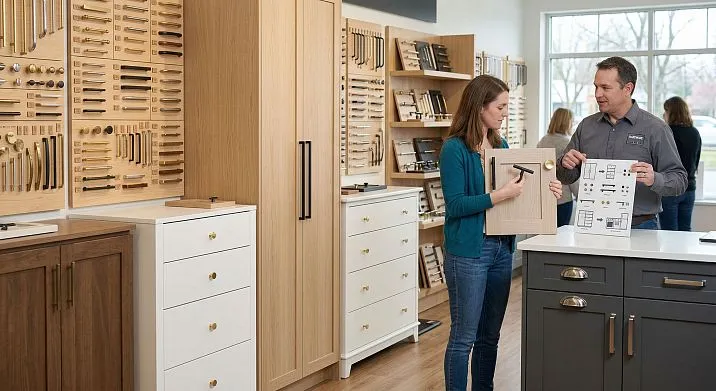
A furniture handle is simultaneously the smallest and most eloquent element of the entire interior. It is the one your hand reaches for every day, the first thing your eye registers, and often it is what decides whether furniture looks expensive or cheap, cohesive or disjointed. Yet, furniture handles still remain the element that gets attention last—after choosing the fronts, color, and hardware. And that's a mistake.
Today, the furniture handle market offers thousands of options. Metal, plastic, ceramic, integrated. But there is one class of products that consistently stands out from the rest—solid wood furniture handles. The tactile warmth of natural material, the living texture of the fibers, the natural organic feel—all this makes wooden handles not just a functional element, but a full-fledged part of the design concept. It is precisely such handles that are becoming the choice today for those who think of an interior as a cohesive statement, not as a collection of random parts.
This article is a sequential practical breakdown: what furniture hardware handles are as a category, how to choose the shape, size, and coating, for which products and which styles wooden handles are best suited—and what mistakes to avoid when purchasing.


What are furniture handles and what problem do they solve
Handles belong to the so-called front furniture hardware—that which is on the surface of the product, visible and felt directly. Unlike hinges, slides, and fasteners, a handle works not only mechanically but also visually. It is the boundary where function meets aesthetics.




Face furniture hardware
Front hardware is everything that is located on the furniture front and is perceived as part of its external appearance. Handles occupy a central place in this group. They simultaneously solve three tasks: they provide convenient opening, protect the front surface from dirt and scratches in the hand contact area, and create a visual accent on the front.
Our factory also produces:




Ease of opening
A good handle is comfortable to grip. This may sound trivial, but in practice, it's the shape and size of the handle that determine how comfortable it is to open a cabinet or drawer. A handle that's too small on a heavy front panel strains the fingers. A crossbar that's too thin is awkward to grip. A voluminous, ergonomic shape with a clearly readable profile is exactly what's needed for daily use.
Get Consultation
Impact on the appearance of the front panel
The handle is a visual accent on the front panel. It can be neutral and delicate, almost blending into the surface, or it can become a standalone design statement. A wooden handle on a minimalist front panel creates a powerful natural contrast. A wooden handle on a veneer front panel achieves an organic unity of materials.
The role of handles in furniture style
Change the handles, and the furniture will literally transform. It's the simplest way to update a kitchen or cabinet without a full restoration. WoodenFurniture Handleshandles can transform a neutral white-gray kitchen into a warm Scandinavian space, add an eco-note to a minimalist interior, or give cabinet furniture the character of an expensive custom piece.
What types of furniture handles exist
Before discussing wooden handles specifically, it's important to understand what types exist in principle—so you can make an informed choice that solves your task.
Pull handles (bail handles)
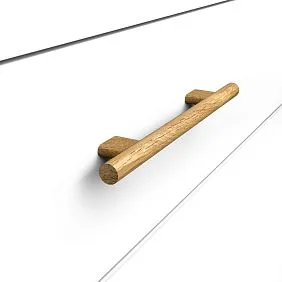
Pull handles (brackets) are the most common type. These are arc-shaped or U-shaped products with two mounting points. The center-to-center distance between the mounting holes is the key dimensional parameter: 32, 64, 96, 128, 160, 192, 224, 256, 320 mm. It's the bracket that provides the most convenient and natural grip for opening. Solid wood pull handles are a separate class of products: a solid profile without seams, live wood grain, reliable mounting.
Button Handles
Knobs are mounted at a single point. Compact form, laconic volume. Ideal for small front panels: dresser drawers, cabinet doors, wall cabinets. A wooden knob with a polished surface is an impeccable choice for Scandinavian and natural interiors. Round, oval, triangular—the shape of the knob greatly influences the character of the piece.
Round handles
Round volumetric handles hold a special place in the assortment: they are visually softer, provide tactile comfort, and work well on both horizontal and vertical surfaces. A wooden round button made of beech or oak is one of the most organic choices for furniture in a natural style.
Oval handles
Solid wood oval handles feature an elongated, concise shape that looks great on medium-width facades. Comfortable grip along the entire profile length, smooth silhouette without sharp corners. Installed horizontally on hinged cabinet doors or vertically on drawer fronts.
Rectangular handles
Rectangular profile — strictness and geometric clarity. Such wooden handles are organic for modern and minimalist interiors. The straight line maintains rhythm across a row of facades, creating a visually precise horizontal accent.
Long handles
Long wooden handles from 200 to 320 mm are a designer tool for creating horizontal rhythm on facades. They visually expand the kitchen space, establishing a strict yet warm character. Installation requires precise marking: misalignment on a long handle is immediately noticeable.
Overlay models and shell handles
Shell handles — an asymmetrical shape with a curved profile, inspired by natural forms. They look both sculptural and functional. Great for custom projects, eco-style, and interiors where furniture carries artistic significance.
Why Wooden Furniture Handles Are a Strong Solution
The question 'why wood?' seems simple, but the answer is multi-layered. Wood as a material for handles is not just an aesthetic choice, but a whole complex of functional and design advantages.
Natural Material
Wood is the only structural material with a living organic structure. Beech and oak, from whichwooden furniture handlesare made, have high density — 650–750 kg/m³ — and mechanical strength comparable to hardwoods. When kiln-dried to 8–10% moisture content, wood does not warp, twist, or crack — it lasts for decades.
Visual warmth
Neither metal nor plastic provides the warmth that wood creates. The natural color of beech is creamy pink with soft transitions, light and airy. Oak has an expressive texture with clear grain and a rich, warm tone. This is not an 'imitation of nature' — it is nature itself, only precisely processed.
Combination with Solid Wood, Veneer, Painted Fronts
A wooden handle is organic on a solid wood front — it's a unity of material. But it also works beautifully on veneered fronts, enhancing the natural character of the coating. And surprisingly — wooden handles provide a lively, warm accent on solid-color painted fronts: white, gray, green, blue. The natural contrast with a painted surface is one of the strongest design techniques in modern interiors.
Durability and Reliability
Handles made from kiln-dried oak and beech, when properly processed, last for many years without deformation or loss of appearance. Oak is especially valued for its moisture resistance and durability against mechanical impact. Handles are produced using CNC 3D milling — ensuring the geometric precision of each item and the stability of the center-to-center distance.
Ecological safety
Natural wood is an impeccable choice for those who value the eco-friendliness of living space. No synthetic polymers, no volatile compounds. The finish — oil, wax, natural lacquer — enhances protection and preserves the natural character of the surface.
Tactility
It is tactility — that quality of a wooden handle that cannot be conveyed in a photo. The warm surface of wood under your hand — a sensation fundamentally different from cold metal. The fine-porous surface of beech after polishing — a silky smoothness. The textured surface of oak — a living natural relief. This creates a special connection between a person and their furniture.
Which handles to choose: with a finish or without a finish
In the catalogsolid wood furniture handlesThere are two fundamentally different options: handles with a pre-applied finish and unfinished models. This is not just a question of aesthetics — it is a question of final finishing strategy.
Finished models: a turnkey ready-made solution
Handles with a finish are products with a final finish already applied. The basic palette includes several options: clear varnish, emphasizing the natural color of the wood; white finish for light Scandinavian and minimalist interiors; dark tones for rich, expressive solutions. Such handles are supplied ready for installation — nothing additional needs to be done.
When to choose handles with a finish:
-
You want a specific color that will exactly match your cabinet fronts;
-
There is no opportunity or desire to apply the finish yourself;
-
You need a quick, predictable solution with a guaranteed result.
Unpainted models: space for creativity
Unpainted handles made of natural wood— these are products ready for independent finishing. You can coat them with any composition of your choice: oil, wax, varnish, paint, stain. This opens up the possibility to precisely match the tone of the facades — even if the color is non-standard.
When to choose unpainted handles:
-
You want to paint the handles to match the color of your facades;
-
You are using a non-standard shade or your own wood oil;
-
Working on a custom project where every element is unique;
-
You plan to apply the same oil used to treat all other solid wood furniture.
How coating affects appearance and care
Varnish coating creates a protective film that simplifies care — the surface is easy to wipe. Oil coating deeply penetrates the wood structure, maintains a matte finish and tactile contact with the wood, but requires periodic renewal every few years. Wax coating provides a pleasant silk sheen and good protection against dirt. For kitchens, varnish or oil coating with moisture-resistant characteristics is recommended.
How to choose the shape of a furniture handle
Shape is the first thing the eye perceives and the last thing considered when choosing. Yet, the shape of a handle directly determines both the aesthetics of the product and the ergonomics of daily use.
Pull handles: universal classics
A pull handle is a two-point mounting with an arched or U-shaped profile. Convenient grip along the entire length of the crossbar, stable mounting, scalable format from 64 to 320 mm center-to-center distance. A wooden pull handle made of beech or oak is a monolithic product without joints or weak points. Installed horizontally on hinged fronts or vertically — depending on the project.
Knob handles: a laconic accent
A knob is a single-point mounting with a voluminous body. Takes up minimal space on the front, creates a point accent. Round, oval, triangular asymmetric — different shapes give different characters. A solid wood knob is a delicate yet expressive detail.
Long models: rhythm and scale
Long wooden handles from 200 mm are a tool for working with the scale of the front. One horizontal profile across the entire width of the door or drawer creates a sense of solidity. Good for wide lower kitchen cabinets, tall cabinet doors, accent fronts.
Compact models: proportionality of detail
Small handles with a center-to-center distance of 32–64 mm are for miniature fronts, small drawers, bedside tables. Proportionality is most important here: a large handle on a small front looks absurd.
Ergonomic Grip
The rule for a comfortable grip is simple: the handle bar should provide enough space for four fingers when opening a heavy cabinet door. For light drawers, a two-finger grip is sufficient. The minimum gap between the bar and the cabinet surface is 25–30 mm: anything less is uncomfortable for the hand.
Horizontal and Vertical Installation
Most solid wood handles allow installation in three positions: horizontal, vertical, and angled. This is important flexibility for design. Horizontal installation is standard for wall-mounted kitchen cabinets. Vertical installation is for tall cabinet swing doors. Angled installation is for non-standard design solutions.
How to Choose Handles for Specific Furniture
Now, let's get specific. Each type of furniture has its own requirements for handles: size, shape, grip comfort, and visual logic.
For Kitchen
Kitchen furniture has the toughest operating conditions. Handles for kitchen furniture are opened dozens of times a day and accumulate grease aerosol and steam. Wooden handles for kitchens must have a moisture-resistant coating—oil or varnish with protective characteristics.
Kitchen recommendations:
-
For wall cabinets: a bracket or long handle with horizontal installation, center-to-center distance 96–160 mm;
-
For base cabinets: a long handle 160–256 mm, installed horizontally;
-
For drawers: a bracket or long handle proportional to the drawer width;
-
Finish: moisture-resistant oil or hard lacquer.
Beech wooden handles for kitchens are an especially good choice: uniform dense structure, smooth surface after sanding, holds any finish well.
For wardrobes
Cabinets are opened less often than kitchens, but door panels are heavier. Cabinet handles must provide a secure grip when opening a heavy door. Long wooden handles 200–320 mm look proportional on tall cabinet fronts and offer a comfortable grip at any installation height. Oak wooden handles with expressive texture are a strong accent on a cabinet front.
For dressers
A chest of drawers is furniture where the handle becomes a design statement. A bolder shape is appropriate here: an asymmetrical shell, a relief button, an original bracket. A wooden handle on a painted chest of drawers front is a natural contrast that turns an ordinary piece into an author's object.
For cabinets
Bedside and shoe cabinets are small-scale furniture. A compact wooden button or small bracket with a center-to-center distance of 32–64 mm is a proportionate choice. A wooden handle in a warm tone pairs excellently with solid wood nightstands.
For drawers
On drawers, the handle bears the greatest mechanical load per opening. Reliability of fastening and convenience of pulling force are important. A horizontal bracket or long handle with two fixation points is the optimal choice. Check the length of the mounting bolts: they must match the thickness of the drawer front.
For hinged fronts
A hinged door opens with a pulling motion to the side. The shape that provides a 'pull' grip rather than a 'pinch' grip is especially important here. A bracket with a deep crossbar overhang or a long rail is the correct choice. A small button on a heavy hinged door is a mistake.
How to choose furniture handles to match the interior style
Style is not fashion, it is logic. Every stylistic decision has its own internal logic of details. Wooden handles are a surprisingly versatile material: depending on their shape and finish, they organically fit into a wide variety of interior contexts.
Minimalism
Minimalism requires precise geometry and the absence of excess. A wooden handle in this style is a rectangular profile, a clear matte finish, minimal decoration. A long horizontal oak bracket with a clear oil finish on a white or grey-beige door is a powerful and laconic image.
Modern interior
Contemporary style allows for a greater range of forms. Dark wooden handles on light doors, contrasting natural accents, combining wood with matte metal – all of this is appropriate. A beech bracket with a dark finish on a white kitchen is a popular and expressive technique.
Classic
For classic interiors, detailing is important. Wooden handles with a turned profile, a softly curved bracket, a shade of dark walnut or natural oak are organic in a classic setting. Here, the wooden handle does not compete with gilded details, but creates a lively, natural balance.
Eco-style
Eco-interior is the native territory for wooden handles. The natural color of beech without dye, an oil finish, a shape with soft curves – this is the quintessence of natural aesthetics. Wooden beech button handles on solid wood furniture – this is an interior where every detail speaks the same language.
Scandinavian style
Scandinavian style values simplicity, lightness, and natural materials. Light beech, a clear finish, rounded or oval shapes – a perfect match. Beech handles with their creamy-pink hue and uniform fine texture are literally made for Scandinavian interiors.
What to look for before buying furniture handles
A clear checklist before placing an order is not a formality, but a practical insurance against mistakes.
Material
Specify the wood species. Oak and beech have different characteristics: oak has a more pronounced texture and is slightly harder, beech is more uniform and lighter. For kitchens, oak with a moisture-resistant coating is preferable.
Size and center-to-center distance
Handle size is not the same as center-to-center distance. Center-to-center is the distance between the centers of two mounting holes. Measure it accurately before ordering. Standard range: 32, 64, 96, 128, 160, 192, 256, 320 mm. An error in the center-to-center size means the handle cannot be installed without drilling new holes.
Shape
Mentally try the shape on a specific cabinet front. A pull bar is a horizontal accent. A knob is a point accent. A long handle creates a horizontal rhythm. Proportionality is the main criterion.
Mounting method
Most solid wood handles allow for vertical, horizontal, and diagonal mounting. Confirm before ordering.
Color and Coating
Choose: pre-finished in the desired shade or unfinished for your own finishing. If choosing pre-finished, confirm the exact color to match your cabinet front program.
Compatibility with the facade
Cabinet front thickness affects the length of mounting bolts. Standard particleboard thickness is 16–18 mm. Non-standard thicknesses or double fronts require bolts of different lengths.
Grip comfort
If possible, hold the handle in your hand before buying or request a sample. This is especially important for profiles you are using for the first time.
Mounting hardware kit
Mounting hardware is included in the delivery set. Check the bolt length and the presence of all necessary elements — this will save you extra trips to the store on installation day.
Most common mistakes when choosing handles
Mistakes when choosing handles are repeated so regularly that they are worth examining separately.
Choosing based only on photos
A photograph conveys the shape, but not the exact shade of the finish, the tactile feel of the surface, or the actual scale. 'It looked different on screen' is a very common story. Request samples when selecting key items.
Not considering the size of the facade
A handle proportionate to the facade is a rule whose violation is immediately visible. A small knob on a wide kitchen door looks forlorn. A long handle on a narrow drawer looks absurd. Consider the width of the facade when choosing the handle length: the handle should occupy 30–60% of the facade width.
Not considering the weight of the drawer or door
A small button with a single-point mount is not suitable for a heavy front. For a door weighing over 5–6 kg, a bracket with two fixation points is needed, providing stable pulling force.
They don't check the convenience of gripping.
A 'pinch' grip on a small button for a heavy door is a strain every time you open the cabinet. Think not only about how the handle looks, but also about how it feels in your hand.
They don't think through the style.
A wooden handle in a forged style on an ultra-modern matte black kitchen is a mismatch of languages. Choose the shape and finish of the handle in line with the logic of the entire interior style.
They choose a shape that is inconvenient for daily use.
An original asymmetrical shape is beautiful. But if it's inconvenient to use in the morning when you reach for coffee, beauty quickly turns into irritation. Practicality is more important than originality.
For which furniture wooden handles are best suited
Solid wood handles are one of the most versatile types of front hardware. But there are types of furniture and styles where they work especially well.
Kitchen cabinets
A wooden handle in the kitchen is warmth in the most literal sense: warm material, warm tone, warm feeling. A white kitchen with beech handles is a classic Scandinavian approach. A gray or green kitchen with oak handles is a modern natural aesthetic.
Cabinets
On tall cabinets, long wooden handles 200–320 mm create an architectural accent. They set a vertical or horizontal rhythm on the facades and give the furniture a lightness that a monolithic body without handles lacks.
Chests of Drawers
A chest of drawers is a place to experiment with handle shape. A shell, an asymmetrical knob, an original bracket — here you can allow more. A dark wooden knob on an ivory-colored chest of drawers is a strong designer image.
Nightstands
Bedside tables are furniture seen every night and morning. A small beech knob on an oak veneer nightstand — natural unity.
Cabinet Furniture
Case furniture made of chipboard and MDF often looks neutral. A wooden handle is the simplest way to add character, a natural accent, and visual value without changing the entire product.
Solid wood furniture
Here, a wooden handle is the only organic choice. The same wood species — unity. A contrasting wood species — an expressive dialogue of materials.
FAQ: answers to frequently asked questions about furniture handles
Which furniture handles are best to choose for the kitchen?
For the kitchen, handles made of oak with moisture-resistant varnish or oil coating are recommended. Shape — horizontal bracket or long handle with two mounting points. Center-to-center distance for wall cabinets — 96–128 mm, for base cabinets and drawers — 128–256 mm.
What's better: pull handles or push handles?
Pull handles are for fronts with active daily use: kitchen, cabinet, dresser with heavy drawers. Push handles are for small fronts and light drawers. For a heavy door, a pull handle is better: two fixing points provide stable pulling force.
Which handles are suitable for cabinets?
For cabinets, long wooden pull handles 200–320 mm with horizontal or vertical installation are optimal. For classic cabinets – handles with a decorative profile in dark oak tone. For modern ones – rectangular or oval profile with a transparent finish.
How to choose wooden furniture handles?
Determine: wood species (oak or beech), shape (pull handle, push handle, long), center-to-center distance (measure before ordering), finish (pre-finished or for your own finishing), installation type (horizontal, vertical, or angled). Get ones with a durability margin for active areas.
Is it better to get handles with or without a finish?
With a pre-applied finish – quick, predictable, installation immediately upon receipt. Without finish – flexibility: you can apply any shade matching your fronts. If you have a non-standard furniture color – get unfinished ones and bring them to the desired tone yourself.
Are wooden handles suitable for modern furniture?
Absolutely. A wooden handle is one of the main techniques in modern interiors: natural material creates a contrast with lacquered painted fronts. A long beech handle on a white kitchen in a modern style – a classic that remains relevant.
Can furniture handles be purchased individually?
Yes.Furniture handles by STAVROSare available for order from one piece. This is especially convenient for private customers who need to replace a single handle or select a sample before a large order.
How long do wooden furniture handles last?
With proper finishing and normal operating conditions — for decades. Kiln-dried oak and beech with 8–10% moisture content do not warp or crack. Important: kitchen handles require a moisture-protective coating, which needs to be renewed every few years with an oil finish.
Conclusion
Natural wood furniture hardware handles are not just an element for opening facades. It is a conscious choice in favor of natural materials, tactile comfort, and design precision. Oak and beech, 3D milling, 32 models of different shapes, options with and without coating — this is not a random assortment, but a thoughtful system for real tasks: kitchen, wardrobe, chest of drawers, case furniture, solid wood furniture.
Choose the shape for the task, measure the center-to-center distance before ordering, choose the coating consciously — and then the wooden handle will work and delight for years.
The company STAVROS manufactures woodenSolid oak and beech furniture handlesusing CNC 3D milling — with precise adherence to stated dimensions, a rich selection of shapes, and two delivery formats: with a ready-made coating and unpainted. Orders are possible from one piece, delivery throughout Russia and CIS, pickup in Moscow and St. Petersburg. STAVROS — the choice of private customers, furniture manufacturers, and designers who understand: details decide everything.