Article Contents:
- Anatomy of the joint: understanding loads and stresses
- Physics of wooden structures
- Choosing wood species and its impact on fastening
- Traditional fastening methods: time-tested
- Dowel joints: classic joinery craftsmanship
- “Birdsmouth” joint: maximum strength
- Modern fastening technologies
- Metallic fastening systems
- Hidden mounting systems
- Preparation work: the basis of quality results
- Precise marking and planning
- Tool and Material Preparation
- Step-by-step mounting technology
- Preparation of balusters for installation
- Preparing the Handrail
- Assembly and fixation process
- Features of working with different constructions
- Straight stair treads
- Spiral and Curved Stairs
- Quality control and defect elimination
- Methods of joint diagnostics
- Typical Defects and Ways to Eliminate Them
- Final Finishing and Protection
- Preparation for finishing
- Protective Coatings
- Modern Trends and Innovations
- Digital Technologies in Carpentry
- New materials and technologies
- Economic Aspects of the Project
- Budget Planning
- Comparative analysis of methods
- Conclusion
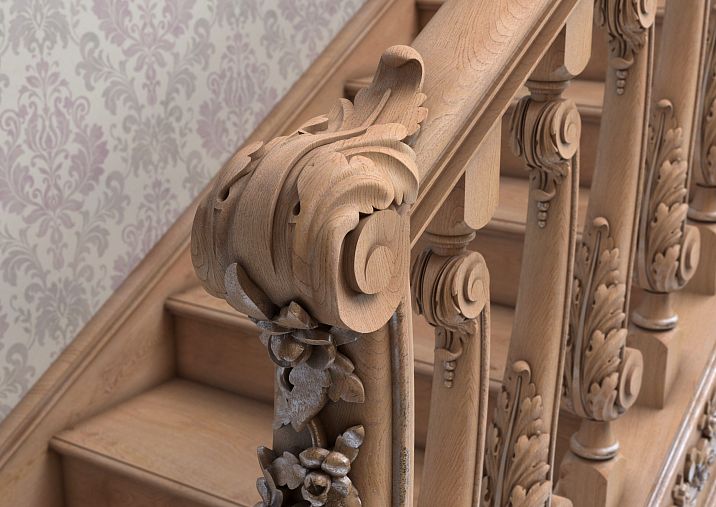
a wooden staircase without elegant balusters is like a painting without a frame. It loses its completeness, elegance, and, critically, safety. The question of how to mount balusters to wooden handrails, concerns everyone who strives to create not just a functional structure, but a true masterpiece of joinery art.
After half a century of working with wood, I understood one simple truth: the quality of baluster attachment to railings determines not only the appearance of the staircase but also its longevity. Improper fastening can lead to loosening of the structure, squeaking, and, in the worst case, injuries. That is why every joint must be executed with jewel-like precision and an understanding of load physics.
Modern technologies offer numerous fastening methods, from traditional dowels to innovative metal systems. Each method has its advantages and specific applications. The choice depends on the wood species, staircase style, expected loads, and, of course, the craftsman's skill. In this material, I will reveal all the nuances of a professional approach to baluster fastening, share secrets that will allow you to create a reliable and beautiful structure.


Anatomy of the joint: understanding loads and stresses




Physics of wooden structures
Before picking up the tools, it is necessary to understand what forces will act on the baluster-to-railing joint. This is not just a static load from the handrail's weight — here, complex force vectors act, including lateral pressures, vibrations from footsteps, and temperature-induced wood deformations.
Wood is an anisotropic material, meaning its mechanical properties vary depending on the direction of the fibers. Compressive strength along the grain may exceed transverse strength by 10-15 times. This feature is critically important when designing connection nodes. Incorrect load direction may cause wood splitting even under minor forces.
Moisture-induced deformations play a key role in the longevity of joints. Wood constantly 'breathes,' changing its dimensions depending on air humidity. The linear expansion coefficient across the grain may reach 0.3-0.5%, which for 3-meter-long railings results in dimensional changes up to 15 mm. A quality joint must compensate for these movements without losing strength.
Dynamic loads from human movement create variable stresses at the connection nodes. This is especially noticeable in homes with children — they may generate loads several times exceeding calculated values. Therefore, the safety factor of the joint must be at least three times the nominal load.
Our factory also produces:


Choosing wood species and its impact on fastening
Each wood species has its own characteristics that must be considered when choosing a fastening method. Hardwood species — oak, beech, ash — provide maximum joint strength but require pre-drilling all holes for fasteners.
Oak, with its density of 700 kg/m³ and high tannin content, is an ideal material for critical structures. However, its hardness requires the use of sharp tools and precise adherence to technology. Attempting to rush the process may result in chips and cracks.
Coniferous species — pine, spruce — are more workable but less strong. Their soft structure allows screwing in self-tapping screws without pre-drilling, but they hold less securely. Resin can cause problems when gluing — surfaces must be degreased.
Exotic species such as teak or mahogany have unique properties but require a special approach. High oil content makes them moisture-resistant but hinders gluing. Some species contain acids that may corrode metal fasteners.
Get Consultation
Traditional fastening methods: time-tested
Dowel joints: the classic of carpentry craftsmanship
Wooden dowels are the soul of traditional carpentry. A properly executed dowel joint can last for centuries, becoming even stronger over time. The secret lies in precise manufacturing and understanding the principles of wood behavior.
The dowel diameter should be approximately one-third of the thickness of the joined parts. For standard balusters with a 50×50 mm cross-section, dowels with a diameter of 12–16 mm are optimal. The length is calculated so that the dowel penetrates each part to a depth of at least two diameters — this ensures sufficient gluing surface area.
The technology of drilling holes for dowels requires jewel-like precision. The slightest deviation from coaxial alignment will result in an impossible assembly or weakened joint. I use special dowel guides — fixtures that ensure perfect coaxial alignment of holes in the joined parts.
The glue joint enhances the mechanical bond between the dowel and the wood. Modern PVA wood glues provide strength exceeding the strength of the wood itself. Glue is applied both into the hole and onto the dowel surface. It is important not to overdo it — excess glue may prevent full seating of the parts.
"Birdsmouth" joint: maximum strength
Connection "tail of a swallow": maximum strength
The "birdsmouth" joint represents the pinnacle of carpentry craftsmanship. The trapezoidal shape of the mortise eliminates the possibility of pulling out the baluster from the railing even under significant loads. This method is especially effective for attaching heavy balusters to thick handrails.
Manufacturing such a joint requires high skill and special tools. The mortise is cut with a router using a guide template, and the corresponding part on the baluster is shaped with hand chisels. The fit must be perfect — clearance should not exceed 0.1 mm.
The angle of the side walls is usually 10–15 degrees. A larger angle weakens the structure, while a smaller one complicates assembly. The depth of the mortise should not exceed half the thickness of the handrail to avoid weakening it.
Assembly is performed with light pressure — parts should fit tightly but without excessive force. Additional gluing is not always necessary — the mechanical bond is so strong that it may suffice without glue.
Modern Fastening Technologies
Modern metal fastening systems offer high reliability and the possibility of concealed installation. Threaded rods with a diameter of 8-10 mm provide exceptional joint strength and allow for disassembly of elements without damaging the main structure. Installing balusters on stairs using metal fasteners requires precise adherence to drilling and installation technology.
Stainless steel threaded rods provide maximum joint strength and allow for subsequent adjustment. This method is especially popular in modern construction due to its reliability and technological efficiency.
The rod diameter is chosen based on the baluster size and expected loads. For standard constructions, M8 or M10 is sufficient. The length is calculated considering the depth of insertion into the baluster (40–50 mm), the handrail thickness, and the allowance for the nut with washer.
Installation technology begins with precise drilling. In the baluster, a blind hole is drilled 1 mm smaller in diameter than the rod — this ensures reliable thread engagement. In the handrail, a through hole is drilled 1–2 mm larger to allow free passage of the fastener.
The thread is cut with a tap or self-tapping rod. It is important to ensure strict perpendicularity of the thread to the surface — any misalignment will weaken the joint. Lubricating the thread with soap or wax facilitates insertion and prevents seizing.
Hidden fastening systems
Modern industry offers specialized concealed fastening systems that combine the reliability of metal joints with the aesthetics of traditional methods. These systems are especially popular in luxury construction.
Insertion systems consist of metal sleeves with internal threads that are glued into the end of the baluster. The handrail is equipped with corresponding threaded elements. The joint becomes disassemblable and very strong.
Magnetic fastening systems — an innovation of recent years. Powerful neodymium magnets provide secure fixation without visible fasteners. Such systems are currently expensive, but they open new possibilities for designers.
Pneumatic fasteners use compressed air for securing elements. Special chambers in the handrail create a vacuum that holds the balusters. The system allows for quick disassembly of elements for maintenance or replacement.
Preparation work: the foundation of quality result
Precise marking and planning
Quality fastening begins with careful preparation. All dimensions must be verified to the millimeter, since errors at this stage can only be corrected by completely redoing the work.
The distance between balusters is determined not only by aesthetic considerations but also by safety requirements. Building codes require that the gap not exceed 150 mm in clear span. For children’s facilities, this distance is even smaller — 100 mm.
The height of the balusters is calculated based on the handrail thickness and the required height of the railing. Standard railing height is 900 mm for residential buildings and 1200 mm for public buildings. Balusters should be 20–30 mm taller to allow insertion into the handrail.
Marking is performed using a laser level and precise measuring tools. Each mark is checked twice — an error in marking may ruin expensive material.
Tool and material preparation
Quality tools are the guarantee of professional results. Dull drill bits do not cut but tear fibers, creating loose holes. Inaccurate measuring instruments lead to dimensional errors.
Wood drill bits must be made of high-quality steel and properly sharpened. Spiral grooves should be polished for easy chip removal. The centering tip ensures accurate positioning.
Router bits for mortise cutting require special attention to the sharpness of cutting edges. A dull router bit leaves ragged edges and may cause chipping. Regular sharpening is a mandatory condition for quality work.
Measuring tools must be calibrated and accurate. Vernier calipers for checking hole diameters, protractors for checking angles, tape measures for linear dimensions — each tool performs its own function.
Step-by-step assembly technology
Preparation of balusters for installation
Before fastening, all balusters must be carefully prepared. Ends are squared on a miter saw, surfaces are sanded to perfect smoothness. Any defects — knots, cracks, irregularities — must be removed or accounted for in the fastening planning.
Drilling holes in the ends of balusters requires special precision. The center of the hole must exactly coincide with the geometric center of the end. For this, I use special dowel guides or marking fixtures.
The depth of the hole depends on the chosen fastening method. For dowels — half the dowel length plus 2-3 mm for glue. For threaded connections — 40-50 mm for secure fastener retention.
Hole quality is checked visually and by touch. Walls must be smooth, without scratches or chips. Diameter must exactly match the fastener element size.
Handrail Preparation
The handrail requires no less careful preparation. Locations for baluster mounting are marked with high precision. Distances between centers must be equal, with a tolerance of no more than 1 mm.
The fastening method to the handrail depends on its construction and chosen technology. For dowel connections, blind holes of appropriate diameter are drilled. For threaded connections — through holes followed by installation of nuts or bushings.
When using a 'birdsmouth' joint in the handrail, trapezoidal grooves are milled. Manufacturing accuracy must be perfect — even minor deviations will weaken the joint.
Trial assembly allows identifying and eliminating defects before final installation. All joints must fit tightly, but without excessive force.
Assembly and Fixation Process
Mounting Wooden Balusters to Railing Begins with installing end elements. They serve as references for all other balusters and must be installed with maximum precision.
When using adhesive joints, it is important to follow adhesive application technology. It must cover the entire contact surface but not squeeze out during assembly. The adhesive's working time is limited — usually 15-20 minutes.
Assembly sequence depends on staircase construction and chosen fastening method. With a large number of balusters, an assistant may be needed to hold elements during fixation.
Assembly quality control includes checking verticality of each baluster, uniformity of distances between them, absence of play in joints. All defects must be corrected before adhesive sets or final tightening of fasteners.
Working with Different Structures
Straight Staircase Runs
Straight runs represent the simplest case for baluster mounting. All elements have the same height, angles are right, marking is simplified. However, there are nuances even here.
Handrail deflection compensation is especially important for long spans. Wood may sag under its own weight and load from balusters. To compensate, the handrail is installed with a slight rise in the center — 2-3 mm per meter of length.
Temperature deformations must also be considered. With changes in air humidity, the handrail may change length by 10-15 mm. Joints must allow these movements without damaging the connections.
Vibrations from footsteps are transmitted through treads to balusters and the handrail. Rigid joints may lead to cracks in wood. Some joint flexibility is even beneficial — it dampens vibrations and extends the structure's service life.
Helical and Curved Staircases
Helical staircases require special approaches to baluster mounting. Each baluster has its own incline angle, the handrail is curved in space, and marking becomes significantly more complex.
Template fabrication is a mandatory step when working with curved structures. The template allows accurately determining the bevel angle of each baluster and its mounting position on the handrail.
Handrail bending requires special technologies. A solid handrail bends poorly and may crack. Often, laminated constructions from thin laminates or composite handrails made of separate segments are used.
Joints in curved structures experience additional stresses from bending moments. Joints must be reinforced or special methods compensating for these loads must be used.
Quality control and defect elimination
Joint Diagnosis Methods
After completing installation, a comprehensive quality check of all joints must be performed. Visual inspection reveals obvious defects — gaps, unevenness, deviations from verticality.
Load tests are conducted by applying controlled forces to each baluster. A horizontal load of 30 kg should not cause visible deformations or play. Any movement indicates a defective joint.
Sound diagnosis helps identify hidden defects. Tapping a baluster with a hammer should produce a clear sound. A dull sound indicates the presence of voids or weakened joints.
Measurement control includes checking verticality of each baluster, uniformity of distances between them, compliance with project height dimensions. Deviations must be within tolerances.
Typical defects and methods of their elimination
Over the years of practice, I have encountered numerous defects in baluster mounting. Most of them arise from violating technology or using low-quality materials.
Play in joints is the most common problem. Causes may vary: inaccurate hole manufacturing, wood shrinkage, loosening of fasteners. Minor play can be corrected by tightening fasteners or adding adhesive.
Gaps in joints arise due to inaccurate fitting of parts. Small gaps are filled with matching-colored wood putty. Large gaps require redoing the joint.
Deviations from verticality are usually the result of installation errors. Minor deviations can be corrected by adjusting fasteners. Significant deviations require reinstalling the baluster.
Final finishing and protection
Preparation for Finishing
After assembly completion, all joints must be carefully cleaned and prepared for final finishing. Glue residues are removed with a chisel or sander. Mounting areas are spackled and sanded flush.
Sanding is performed in stages, starting with coarse abrasives and ending with fine ones. The sanding direction should align with the wood grain. Crosswise scratches will become visible after applying a transparent finish.
Dust removal is a critically important stage. Even the smallest dust particles will create defects in the finish. I use an industrial vacuum cleaner, followed by a sticky cloth for final cleaning.
Priming equalizes the wood's absorption capacity and ensures better adhesion of the final finish. This is especially important at joints, where areas with different densities may exist.
Protective coatings
The choice of protective finish depends on usage conditions and aesthetic preferences. Lacquered finishes provide maximum protection against mechanical damage and moisture.
Oil-based finishes penetrate deeply into the wood structure, highlighting its natural beauty. They do not form a surface film, preserving the tactile sensation of touching wood.
Wax-based finishes provide a silky sheen and pleasant texture. Wax protects against moisture and dirt, allowing wood to "breathe". Particularly popular in eco-oriented interiors.
Combined systems combine the advantages of different types of finishes. Oil impregnation followed by lacquer application provides deep protection and an attractive appearance.
Modern trends and innovations
Digital technologies in carpentry
Modern technologies have fundamentally changed approaches to manufacturing and installing stair structures. 3D modeling allows visualizing the future structure and identifying potential issues during the design phase.
CNC machines provide ideal precision for processing parts. Programmable centers can perform complex operations with accuracy down to hundredths of a millimeter. This is especially important when manufacturing "birdsmouth" joints.
Laser measurement systems allow controlling the geometry of products during manufacturing. Any deviations from specified parameters are immediately detected and corrected.
Robotic assembly systems are beginning to find application in mass production of stair structures. Robots ensure consistent assembly quality and eliminate human factors.
New materials and technologies
Advances in materials science have led to the emergence of new types of wood materials with improved properties. Thermally modified wood has increased dimensional stability and resistance to biological damage.
Glued constructions from laminated timber allow creating long elements without defects. The grain direction in adjacent layers is mutually perpendicular, preventing warping and cracking.
Composite materials based on wood fibers combine the beauty of natural wood with the practicality of modern technologies. They are resistant to rot, do not require protective treatment, and maintain dimensional stability.
Nanomaterials open new possibilities for wood protection. Nanoparticles penetrate deeply into the material structure, creating an invisible protective barrier with unique properties.
Economic aspects of the project
Budget planning
The cost of attaching balusters to handrails consists of several components: materials, fasteners, tools, labor. Proper planning allows optimizing costs without compromising quality.
The choice of fastening method significantly affects the overall cost. Traditional mortise-and-tenon joints require more time to manufacture but are cheaper in materials. Modern metal systems are more expensive but faster to install.
Material quality determines the longevity of the structure. Saving on fasteners may result in costly repairs several years later. High-quality stainless steel fasteners cost 3-4 times more than standard ones but last for decades.
Investments in professional tools pay off already on the second or third project. Accurate and reliable tools not only speed up work but also ensure higher quality results.
Comparative analysis of methods
|
Mounting method |
Cost of materials |
Time to manufacture |
Strength |
Durability |
Repairability |
|
Shanks + glue |
Low |
High |
MDF with film |
50+ years |
Low |
|
Threaded rods |
Medium |
Average |
High |
30+ years |
High |
|
Birdsmouth joint |
Low |
Very high |
Very high |
100+ years |
Low |
|
Modern systems |
High |
Low |
High |
25+ years |
MDF with film |
The choice of the optimal method depends on project priorities, budget, and requirements for longevity. For luxury projects, traditional methods are recommended; for mass construction, modern systems are preferred.
Conclusion
Art baluster attachment to wooden handrails Represents a harmonious blend of traditional craftsmanship and modern technologies. After half a century of working with wood, I realized the main thing: the quality of a joint is determined not only by technical skills, but also by understanding the material, respect for traditions, and striving for perfection.
Each fastening method has its advantages and area of application. Traditional pegged joints provide maximum durability and aesthetics. Modern metal systems simplify installation and allow for disassemblable structures. The choice depends on the specific conditions of the project and the client's preferences.
Quality fastening is an investment in the safety and longevity of the staircase. Saving on materials or violating technology may lead to serious consequences. It is better to spend more time and money on proper execution of work than to fix mistakes later.
The future of the industry is tied to the further development of digital technologies and new materials. But the foundations of craftsmanship remain unchanged: understanding the properties of wood, precision in manufacturing, attention to detail. These principles I pass on to young masters, and they will pass them on further.
Modern technologies do not replace craftsmanship, but complement it. CNC machines can ensure ideal processing accuracy, but the choice of fastening method, quality control, and final finishing — all of this remains the domain of the craftsman.
STAVROS Company, with its rich experience in woodworking, understands the importance of quality fastening of staircase elements. The combination of traditional craftsmanship with modern technologies allows STAVROS to create products of the highest quality. Every STAVROS project is a manifestation of years of experience and a commitment to perfection in every detail.