Article Contents:
- The Philosophy of Natural Wood in the Modern World
- Return to the Roots
- Ecological Awareness and Sustainable Development
- Technological Aspects of Processing Natural Wood
- Raw material selection and preparation
- Processing and Shaping
- Protection and Finishing
- Wood Species: Characteristics and Applications
- Fine Hardwoods
- Coniferous species: accessibility and practicality
- Exotic Species: Exclusivity and Uniqueness
- Design Styles and Their Interpretation in Wood
- Classic Directions
- Modern minimalism
- Ecological Style
- Joinery and Construction Technologies
- Traditional methods
- Modern Technologies
- Computer-aided design
- Quality Control and Production Standards
- Raw Material Incoming Inspection
- Control of technological processes
- Final Inspection
- Personalization and individual approach
- Custom-Sized Furniture
- Choosing Wood Species and Finishes
- Exclusive Solutions
- Care and Use of Furniture Made from Natural Wood
- Features of maintenance
- Restoration and renovation
- Prevention of Damage
- Economic Aspects of Production
- Investments in Equipment
- Cost and Pricing
- Market and competition
- Industry Development Prospects
- Technological Innovations
- Ecological requirements
- Personalization and customization
- The Role of Design in Modern Production
- From Function to Emotion
- Integration with modern technologies
- Cultural Influences
- Conclusion: craftsmanship proven by time
What makes a home a home? Perhaps it’s the warmth of a family hearth, the smell of freshly baked bread, or... the touch of living wood under your palm? When we talk about production of furniture from natural wood, we open pages of the oldest craft, which has become a high art of modernity.
In an era of mass production and synthetic materials, natural wood remains a symbol of authenticity, quality, and timeless beauty. Each wood fiber carries the history of decades of growth, each pattern is unique, like a fingerprint. That’s why furniture made from solid wood is valued not only for its functionality, but also for the soul it brings into the interior.


The Philosophy of Natural Wood in the Modern World




Return to the roots
Why, in the age of high technology, do we turn back to materials our ancestors used? The answer lies in the very nature of humanity. We instinctively reach for the natural, the living, the real. Wood breathes with us, responds to climate changes, ages gracefully, acquiring the patina of time.
Modern production of furniture from natural wood is not just material processing. It is a dialogue between the craftsman and nature, where every branch, every growth ring becomes part of the artistic concept. Producers have learned to read the language of wood, understand its character, and use its natural features to create unique works.
Our factory also produces:


Ecological Awareness and Sustainable Development
In the context of global ecological challenges, choosing natural wood becomes an act of responsibility. Properly managed forestry turns wood into a renewable resource. Trees grown in managed forests not only provide raw material for the furniture industry, but also actively absorb carbon dioxide from the atmosphere.
Quality solid wood furniture serves for decades, sometimes even centuries. This is radically different from mass-produced products, which end up in landfills within a few years. Investing in natural wood means choosing the philosophy of 'slow life,' where value is measured not by the speed of trend changes, but by the depth and longevity of relationships with objects.
Get Consultation
Technological Aspects of Processing Natural Wood
Raw material selection and preparation
The journey from a tree in the forest to an elegant piece of furniture begins with careful selection. Masters evaluate not only the wood species, but also the growth conditions, density of growth rings, absence of defects. Moisture is a critical parameter determining the future of the product. Natural drying may take years, but it ensures material stability.
Modern technologies allow accelerating the process without compromising quality. Chamber drying under controlled conditions, vacuum treatment, special stabilization compounds — the arsenal of modern manufacturers has significantly expanded. However, the essence remains unchanged: respect for the natural properties of the material and understanding its needs.
Processing and Shaping
Each wood species requires an individual approach. Oak — noble and stubborn — demands special cutting and sanding techniques. Beech is more pliable but sensitive to humidity. Ash impresses with its flexibility and strength, but requires special protection against pests.
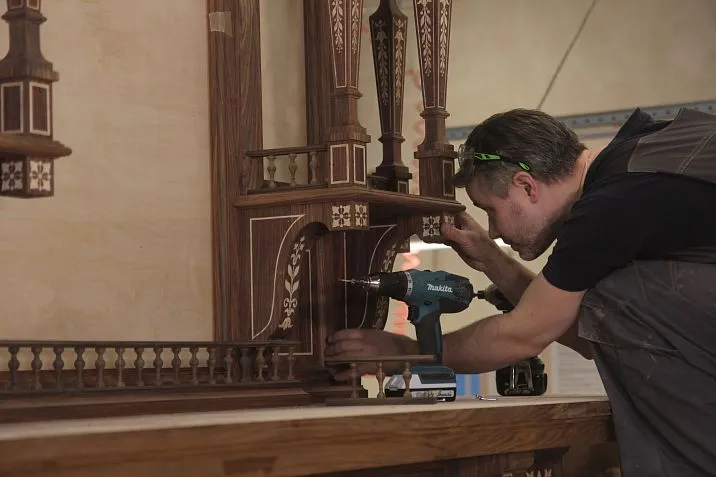
Modern CNC machines allow achieving jewel-like precision in processing. However, final operations — sanding, fitting, assembly — still require human hands and the eye of a master. A machine can repeat a given program, but only a human can sense the character of a specific board and make a creative decision.
Protection and Finishing
Natural wood requires protection. But modern finishes differ radically from heavy lacquers of the past. Oils, waxes, modern polyurethane compounds not only protect wood but also highlight its natural beauty. Properly chosen finishing allows wood to 'breathe,' preserving its living properties.
Staining and patination open up boundless possibilities for design solutions. One can emphasize the natural color of the species or radically alter the appearance of the item. Techniques of artificial aging allow new furniture to acquire the nobility of antique pieces.
Wood species: characteristics and application
Fine Hardwoods
Oak remains the king of furniture production. Its dense structure, expressive grain, and exceptional durability make it the ideal material for creating custom wooden furnitureOak furniture can serve for centuries, passing from generation to generation. Tannins contained in the wood impart it a natural resistance to decay and pests.
Ash attracts manufacturers with its strength and flexibility. This species is ideal for making chairs, especially with bent elements. Ash's light-colored wood takes staining well, expanding design possibilities.
Walnut is the aristocrat among wood species. Its dark, noble wood with an expressive grain is traditionally used for making elite furniture. Walnut is easy to process, polishes well, and develops an even richer color with age.
Coniferous species: accessibility and practicality
Pine and spruce were long undervalued in furniture production. However, modern processing technologies allow fully utilizing their advantages: accessibility, ease of processing, pleasant aroma. Properly processed coniferous wood can become the basis for creating quality furniture in Scandinavian or country styles.
Larch holds a special place among coniferous species. Its density approaches that of hardwoods, and its natural resinous nature provides resistance to moisture and pests. This makes larch an excellent choice for garden furniture and items intended for use in high-humidity conditions.
Exotic species: exclusivity and uniqueness
The development of international trade has opened access to exotic wood species. Teak, mahogany, zebrawood — these names sound like music to connoisseurs of elite furniture. Each exotic species possesses unique properties: teak practically does not rot, mahogany does not warp, zebrawood impresses with its contrasting grain.
However, using exotic species requires special responsibility. It is important to ensure that the wood is sourced from sustainable sources and that harvesting does not harm tropical forests.
Design Styles and Their Interpretation in Wood
Classic styles
Classic style in natural wood furniture is a triumph of proportions, symmetry, and the nobility of the material. Here, clear lines, precise forms, traditional decorative techniques prevail. Carving, inlay, patination — an arsenal of techniques refined over centuries.
Producing classic furniture requires special craftsmanship. Each element must be flawlessly executed, every detail thought out to the smallest detail. This is not mass production, but bespoke work, where each item is a work of art.
Modern minimalism
At first glance, minimalism and natural wood seem incompatible concepts. However, modern designers prove the opposite. Clean lines, absence of ornamentation, functionality — these principles harmonize beautifully with the beauty of natural material.
In minimalist furniture, the texture of wood becomes the main decorative element. No unnecessary details — only perfect proportions and flawless execution quality. Such an approach demands the highest craftsmanship from the manufacturer, as any flaw will be immediately noticeable.
Ecological Style
Eco-style in furniture is not just a fashionable trend, but a philosophy of life. Here, naturalness, authenticity, and connection with nature are valued. Eco-furniture manufacturers strive to preserve the natural properties of wood as much as possible, using minimal processing and eco-friendly finishes.
Such furniture often retains the natural forms of wood, including bark elements, knots, and irregularities. This is not a manufacturing defect, but a deliberate design choice emphasizing the connection with nature.
Joinery and Construction Technologies
Traditional methods
For centuries, furniture makers have perfected methods of joining wooden parts. Mortise-and-tenon, dovetail, and lap joints — these connections not only ensure structural strength but also serve as decorative elements. A master skilled in traditional techniques can create furniture without a single nail or screw, using only the properties of the wood itself.
Such joints require the highest level of manufacturing precision. Even the slightest error may weaken the structure or create gaps. Therefore, traditional methods remain a measure of the manufacturer's skill.
Modern technologies
The development of the chemical industry has given furniture makers new opportunities. Modern adhesives surpass wood in strength. This allows creating structures that were impossible in the past.
Laminating — bonding thin wood veneers — allows obtaining blanks of any size and shape. Bent-laminated elements combine the strength of solid wood with the flexibility unattainable through traditional processing.
Computer Design
Modern It is impossible to imagine without computer technologies. CAD systems allow creating an accurate model of the future product, calculating loads, and optimizing material cutting. Three-dimensional modeling allows the customer to see the future furniture even before production begins. One can experiment with shapes, colors, textures, finding the optimal solution.
Quality of the finished furniture is established at the stage of raw material selection. Each board undergoes careful inspection: moisture is measured, hidden defects are identified, and compliance with technical requirements is assessed.
Quality control and production standards
Incoming Raw Material Control
Modern non-destructive control methods allow looking inside the wood, detecting hidden defects that may appear during operation. X-ray tomography, ultrasonic probing — the arsenal of modern quality control is constantly expanding.
Modern non-destructive testing methods allow us to look inside wood, detect hidden defects that may manifest during operation. X-ray tomography, ultrasonic probing — the arsenal of modern quality control is constantly expanding.
Control of technological processes
Each operation in furniture production has its own quality criteria. Accuracy of dimensions, surface cleanliness, correctness of joints — all of this is controlled at every stage.
Statistical quality control methods allow not only to detect defects, but also to prevent their occurrence. Trend analysis, control charts, sampling plans — modern production relies on a scientific approach to ensuring quality.
Final Control
The finished product undergoes comprehensive inspection. Not only the appearance, but also functionality is assessed: smooth drawer operation, secure fastenings, compliance with project dimensions.
Tests for strength, durability, resistance to various influences — modern standards require quality confirmation not only in words, but also in numbers.
Personalization and Individual Approach
Custom-sized furniture
One of the main advantages of working with natural wood is the ability to create furniture tailored to the customer's needs. Non-standard room sizes, special requirements for functionality, personal design preferences — all of this can be taken into account during custom manufacturing.
Custom Production of wooden tables from natural wood It allows creating an item that will perfectly fit a specific interior and fully meet the user's needs. This can be a large conference table or a compact desk for a small apartment — possibilities are limited only by the customer's imagination and the craftsman's skill.
Wood species and finish selection
Personalization begins with material selection. Each wood species has its own character, advantages, and application specifics. Consultations with a designer help find the optimal solution that will meet both aesthetic preferences and practical requirements.
Finish is another level of personalization. Matte or glossy surface, natural color or staining, traditional or modern decorative techniques — the choice is vast.
Exclusive solutions
For the most demanding customers, exclusive solutions are possible: use of rare wood species, author decorative techniques, inclusion of elements made from other materials. Such furniture becomes not just an interior item, but a work of art.
Care and use of furniture made of natural wood
Special maintenance requirements
Furniture made of natural wood requires special care. It is not plastic that can be washed with any means. Wood lives, breathes, and reacts to changes in humidity and temperature.
Proper care begins with understanding the properties of the material. Different species require different approaches. What is good for oak may harm birch. Regular cleaning with special agents, maintaining optimal air humidity, protection from direct sunlight — these are the foundations of long-lasting wooden furniture.
Restoration and restoration
One of the advantages of quality solid wood furniture is the possibility of restoration. Scratches can be sanded, worn areas can be polished again, damaged elements can be replaced.
Restoration of antique furniture is a special art. Here, it is important not only to restore functionality, but also to preserve the historical value of the item. Modern masters are skilled in traditional techniques that allow returning old furniture to its original appearance.
Damage Prevention
The best way to preserve furniture is to prevent damage. Using stands for hot items, protective films, regular dust cleaning — simple measures that significantly extend the life of wooden furniture.
Control of the microclimate in the room is especially important for expensive furniture made of natural wood. Sudden fluctuations in humidity may lead to cracking, warping, and weakening of joints.
Economic Aspects of Production
Investment in equipment
Modern furniture production requires significant investment in equipment. High-precision machines, dust extraction systems, drying chambers — the cost of a complete set may reach millions of rubles.
However, quality equipment pays off through increased productivity, improved product quality, and expanded production capabilities. Modern machines allow performing operations that previously required highly skilled operators.
Cost and Pricing
The cost of furniture made of natural wood consists of many factors: cost of raw materials, energy consumption, equipment depreciation, personnel wages. Expensive wood species may constitute a significant portion of the finished product's cost.
Pricing in this segment has its own characteristics. The buyer of quality furniture is willing to pay for uniqueness, durability, prestige. Here, not only economic, but also psychological factors are at work.
Market and Competition
The market for furniture made of natural wood is segmented. There is mass production of affordable furniture made of pine and birch, and there are elite manufacturers working with expensive species. Each segment has its own competition characteristics.
Competitive advantages can vary: price, quality, design, service, speed of order fulfillment. Successful manufacturers know how to find their niche and fully leverage their strengths.
Industry Development Prospects
Technological Innovations
The development of technology opens new opportunities for furniture manufacturers. 3D wood printing, laser processing, robotic assembly systems — the future is already here.
Artificial intelligence can help optimize cutting, predict material behavior, and manage quality. Big data allows better understanding of customer needs and forecasting trends.
Ecological Requirements
Stricter environmental requirements affect the entire industry. Manufacturers are forced to seek more eco-friendly materials and technologies. This applies not only to wood, but also to adhesives, paints, and packaging materials.
FSC and PEFC certification is no longer just desirable, but necessary for operation on many markets. Consumers are paying more attention to the eco-friendliness of products.
Personalization and Customization
The trend toward personalization will only intensify. Consumers want unique furniture that reflects their individuality. This creates new opportunities for manufacturers willing to work with custom orders.
Digital technologies make customization more accessible. Online configurators allow customers to independently choose sizes, materials, finishes, immediately seeing the result and price.
The Role of Design in Modern Production
From Function to Emotion
Modern furniture must not only perform its function, but also evoke emotions. Design has become a key factor for success. Beautiful, stylish furniture can become the centerpiece of an interior, a source of pride for the owner.
Designers work not only with shape and color, but also with tactile sensations, scent, even sound. Touching natural wood should be pleasurable, creating a sense of warmth and coziness.
Integration with modern technologies
Modern furniture is increasingly integrated with electronics. Built-in lighting, wireless charging, smart home systems — the boundaries between furniture and technology are blurring.
Designers seek ways to harmoniously integrate technology into traditional forms. Wires should be hidden, electronic components unobtrusive, and controls intuitive.
Cultural Influences
Globalization has led to the blending of styles and traditions. Scandinavian minimalism coexists with Eastern philosophy, American pragmatism combines with European elegance.
Designers draw inspiration from different cultures, creating new styles that reflect today's multicultural worldview.
Conclusion: craftsmanship, proven over time
In a world of rapidly changing technologies and fleeting trends It is impossible to imagine without computer technologies. CAD systems allow creating an accurate model of the future product, calculating loads, and optimizing material cutting. it remains an island of stability and quality. This is a craft where modern technologies serve ancient traditions, where innovations help unlock the potential inherent in nature itself.
Every piece made of natural wood carries a fragment of the craftsman's soul and the living energy of the forest. This is not just furniture — it is a story told in the language of wooden fibers, a bridge between past and future, between nature and civilization.
For more than two decades, STAVROS has proven that quality furniture made of natural wood has not lost its relevance. By combining traditional craftsmanship with modern technologies, STAVROS creates pieces that will become family heirlooms for future generations. In every table, every chair, every decorative element, there lives a passion for perfection and respect for the noble material — natural wood.