Article Contents:
- Balusters: Architectural Pearls of Your Staircase
- History and Origin of Balusters
- Functional Significance of Balusters
- Types of Wooden Newel Posts: Variety of Forms and Styles
- Advantages of Wooden Balusters and Handrails
- Aesthetic advantages
- Ecological advantages
- Practical advantages
- Choosing wood for balusters
- Technical aspects of baluster selection and installation
- Calculation of baluster quantity and dimensions
- Safety requirements
- Installation features of wooden balusters
- Design Solutions for Wooden Stairs
- Classic Wooden Stairs
- Modern Minimalist Solutions
- Combined Stair Railing Systems
- Care for Wooden Stairs and Extending Their Lifespan
- Protective Coatings for Wooden Elements
- Regular care and maintenance
- Solving the Problem of Wooden Stair Creaking
- Choosing the Perfect Staircase for Your Home
- Style Compatibility with Interior
- Considering room-specific features
- Ordering and installation process
- Innovations in the Production of Wooden Stair Components
- Modern Wood Processing Technologies
- Eco-Friendly Materials and Coatings
- Economic Aspects of Choosing Wooden Stairs
- Price-to-Quality Ratio
- Long-Term Benefits of Investing in a Quality Staircase
- Conclusion: Why Wooden Stairs Remain Unrivaled
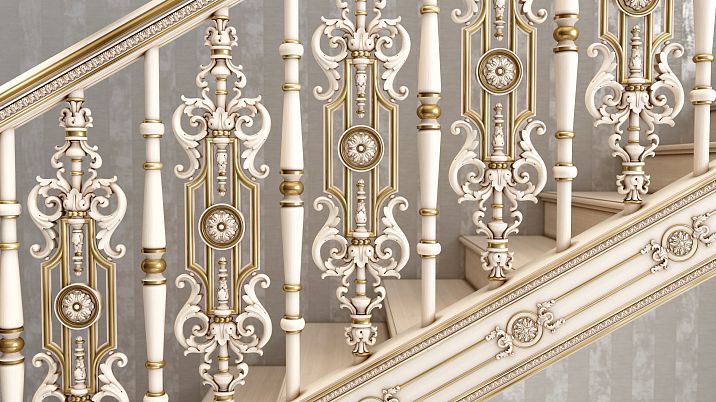
In the world of architectural elements, there are special details capable of transforming an ordinary structure into a work of art. Staircase, balusters, and handrails made of wood They are not just functional components, but true artistic accents that give the interior a unique character and style. A wooden staircase with elegant balusters can become a central design element, attracting admiring glances and creating an atmosphere of nobility and comfort.
Imagine this: you enter your home, and the first thing that catches your attention is a majestic wooden staircase with carved balusters, rising to the upper floors like a path to heaven. Such a staircase does not merely connect the levels of the house—it tells a story about the taste and status of its owners, their relationship to tradition and beauty.
Let's dive into the wonderful world of wooden staircase constructions and uncover the secrets of their charm, functionality, and durability.


Balusters: Architectural Pearls of Your Staircase
What are balusters and why are they so important for staircase construction? Balusters are vertical support elements that hold up the handrail of the staircase. But their significance goes far beyond simple functionality.




History and Origin of Balusters
Interestingly, balusters have a rich history dating back to the Renaissance era. It is believed that the name 'baluster' comes from the shape of a flower bud, which they resemble. Alternatively, balusters are considered miniature copies of architectural columns.
Amazingly, balusters did not exist in ancient Rome or ancient Greece, despite the widespread use of columns and pilasters. In architecture, they appeared only during the Renaissance, initially used exclusively for balcony railings. Balusters were only applied to staircases in the 15th century, and from the end of that century, they became an indispensable part of architectural design.
Our factory also produces:


Functional role of balusters
Staircase, balusters, and handrails made of wood They perform three main functions:
- Safety and structural rigidity — balusters create a reliable barrier, preventing falls while ascending or descending the stairs.
- Decorative function — they add aesthetic appeal to the staircase, becoming a key design element.
- Structural support — balusters provide additional rigidity to the entire staircase structure.
The human reflex to hold onto handrails while moving down stairs makes balusters not just decorative, but a vital element of safety. Properly installed balusters transform a staircase into a reliable and safe structure, allowing comfortable movement for people of all ages.
Get Consultation
Types of wooden balusters: variety of shapes and styles
Wooden balusters impress with their variety of shapes and design solutions. Let's consider the main types:
By shape, balusters are divided into:
- Flat - made from plywood or solid wood and decorated with patterns and ornaments. They are ideally suited for modern minimalist interiors.
- Round - have a strictly cylindrical shape with a cross-section of 2.5-4 cm. Made exclusively from natural wood, they give the staircase a classic look.
- Figurative - produced both manually and using special equipment. Their complex shape with curves and recesses creates a unique artistic effect.
By method of manufacture, they are distinguished as:
- Milled balusters - distinguished by original decorations created using longitudinal or helical cutting. Their attractive appearance makes them especially popular.
- Turned balusters - have an original shape due to turning and creating radial grooves and recesses on a lathe.
- Balusters with carved elements - true works of art with hand or machine carving, giving them a unique character.
Using various woodworking techniques allows creating diverse baluster constructions, from simple and minimalist to complex and refined. This enables selecting the ideal option for any interior and architectural style.
Advantages of wooden balusters and handrails
Why Staircase, balusters, and handrails made of wood remain so popular for centuries? Let's consider their indisputable advantages.
Aesthetic advantages
Wooden balusters give the staircase an aesthetic and traditional look that cannot be achieved with other materials. The natural beauty of wood, with its unique grain pattern, creates a sense of warmth and coziness.
They literally radiate warmth, not to mention the impressive beauty of natural wood grain. Even the simplest staircase with wooden balusters becomes exclusive due to the unique patterns gifted by nature.
Environmental advantages
Ecological safety is one of the main advantages of wooden balusters. Natural wood does not emit harmful substances, and the essential oils and organic resins it contains have healing properties, positively affecting the microclimate in the house.
Practical Advantages
Wooden balusters have a whole range of practical advantages:
- Low weight - facilitates transportation and installation
- Ease of processing - possibility of creating any shapes and designs
- Simple maintenance - just regularly wipe with a damp cloth
- Durability - with proper treatment and care, they last for decades
- Versatility - compatible with various materials and interior styles
- Strength - provide reliable support for handrails
Selection of wood for balusters
Various types of wood are used to make balusters, each with its own characteristics:
- Oak - distinguished by exceptional strength and durability, has a beautiful texture and noble color. Oak balusters are an investment for decades.
- Beech - a hard wood with uniform structure, easy to process, and has a pleasant light tone.
- Ash - strong and elastic wood with a distinct texture, resistant to mechanical impacts.
- Spruce - an affordable and easy-to-process wood, suitable for creating both simple and complex shapes.
- Birch - has a light tone and uniform structure, easily stains.
- Larch - distinguished by high density and moisture resistance, ideal for rooms with high humidity.
The choice of wood species affects not only the appearance of balusters but also their performance characteristics and cost. The most durable and reliable species, such as oak, have the highest price but also provide maximum longevity.
Technical aspects of baluster selection and installation
Correct selection and installation of balusters are essential for the safety and aesthetic appeal of the staircase. Let us consider the technical nuances that must be taken into account.
Calculating the quantity and dimensions of balusters
The number of balusters is calculated based on the length of the staircase. The optimal distance between balusters is approximately 15 cm. This ensures not only aesthetic harmony but also structural safety, preventing the possibility of falling through the railing.
The standard height of handrails is 70-100 mm, and the size of balusters is selected based on these measurements. It is important to remember that installing balusters at greater distances from each other is not recommended, as this reduces safety and deteriorates the appearance of the staircase.
Safety requirements
Safety is a priority when designing staircase railings. Depending on the type of staircase, there are different requirements for the distance between balusters:
- For residential wooden staircases - no more than 15 cm
- For staircases with combined or screen railings - up to 30 cm
These norms ensure an optimal balance between aesthetics and safety, especially in homes where there are children.
Features of Installing Wooden Balusters
Installing wooden balusters requires certain skills and attention to detail. The process includes the following stages:
- Surface preparation - sanding and priming wooden elements
- Marking the installation locations of balusters with equal intervals
- Mounting balusters to treads and handrails using special fasteners
- Final finishing - coating with varnish, oil, or wax to protect against external influences
Properly installed balusters ensure not only safety but also the longevity of the entire staircase structure.
Design solutions for wooden staircases
Staircase, balusters, and handrails made of wood offer unlimited opportunities for design experimentation. Let us consider the most popular stylistic solutions.
Classic wooden staircases
Classic stair railings are artistic wrought iron and carved wooden balusters. They are distinguished by elegance, safety, and durability. Wooden balusters in a classic style may feature spiral grooves, finely turned elegance, or luxurious openwork carving.
Such staircases fit perfectly into interiors in the neoclassical, baroque, or empire styles, creating an atmosphere of luxury and nobility. They become a central design element, attracting attention and evoking admiration.
Modern minimalist solutions
Modern stair railings are characterized by simplicity and minimalism. These may be straight wooden planks or balusters, creating a sleek and stylish look.
In modern interiors, combined solutions are popular, where wooden elements are combined with glass, metal, or other materials. Such staircases appear light, airy, and fit perfectly into minimalist and high-tech interiors.
Combined stair railings
Complex stair railings may consist of a combination of wood and metal, where the upper part of the wooden baluster flows into a wrought iron pattern and ends with a wooden base. The handrails of such staircases are typically wooden, giving the structure warmth and coziness.
Combined solutions allow creating unique designer staircases that perfectly match the overall interior style and individual preferences of the owners.
Care for wooden staircases and extending their service life
Wooden staircases require certain care to maintain their beauty and functionality for many years.
Protective coatings for wooden elements
Ready-made balusters and other staircase elements can be coated with various protective compositions:
- Varnishes - provide protection against adverse environmental effects and give wood a glossy finish
- Oils - penetrate deeply into the wood structure, highlighting its natural beauty
- Waxes create a water-repellent layer and give the surface a pleasant silkiness
The choice of protective coating depends on the type of wood, operating conditions, and desired appearance of the staircase.
Regular care and maintenance
Wooden balusters require no special care during operation. Simply wipe them regularly with a damp cloth to remove dust and periodically renew the protective coating.
However, it should be remembered that wood is a living material that can react to changes in temperature and humidity. Therefore, it is important to maintain an optimal microclimate in the room, avoiding sharp fluctuations in temperature and humidity levels.
Solving the problem of squeaking wooden staircases
Squeaking is a common problem with wooden staircases, occurring when dried and moisture-filled parts of the structure begin to rub against each other. For some people, squeaking is a melodious and cozy sign of home comfort, while for others, this sound is irritating.
To eliminate squeaking, you can use special lubricants for wooden joints or carry out more serious repairs with reinforcement of the structure. Prevention of squeaking includes proper installation of the staircase, taking into account possible expansion and contraction of wood due to changes in humidity.
Choosing the ideal staircase for your home
Choosing a staircase is a responsible step requiring consideration of many factors.
Style compatibility with interior design
A wooden staircase should harmoniously fit into the overall interior style. Designers recommend preserving the natural wood structure as much as possible and never painting handrails and treads in the color of walls, doors, or window frames, to avoid overloading the space and cheapening the appearance of the staircase.
In classical interiors, carved balusters from precious wood are appropriate, in modern interiors — minimalist forms from light-colored woods, and in eclectic interiors — combined solutions using various materials.
Room-specific considerations
When choosing a staircase, it is necessary to consider the characteristics of the room: its size, ceiling height, location of windows and doors, lighting. In small rooms, compact staircases with light, airy railings are preferable, while in spacious rooms, you can afford heavy structures with elaborately decorated balusters.
Custom order vs ready-made solutions
A custom wooden staircase allows you to select any wooden handrails and balusters, creating a finished look perfectly matching your preferences. Such staircases are manufactured taking into account all the features of the room and the customer's wishes.
Ready-made solutions are more affordable in price and manufacturing time, but limit customization options. However, modern manufacturers offer a wide range of ready-made elements that allow creating diverse combinations.
Innovations in the production of wooden staircase elements
Modern technologies open up new possibilities in the production of wooden staircase elements.
Modern wood processing technologies
The use of computer modeling and CNC machines allows creating balusters of the most complex shapes with high precision. This expands design possibilities and improves the quality of finished products.
New drying and wood treatment methods increase its stability and durability, minimizing the risk of deformation and cracking.
Ecological materials and coatings
The modern industry offers environmentally friendly water-based protective coatings that do not emit harmful substances and are safe for health. Such coatings provide reliable protection for wood while preserving its natural beauty.
Technologies for producing composite materials based on wood are also developing, combining the ecological properties of natural wood with increased strength and stability.
Economic aspects of choosing wooden staircases
The cost of a wooden staircase depends on many factors.
Price-to-quality ratio
The price of a wooden staircase is determined by the following factors:
- Type of wood (exotic and valuable species are significantly more expensive)
- Complexity of construction and design
- Craftsmanship of Installation: From Idea to Realization
- Presence of additional elements and decor
It is important to understand that a quality wooden staircase is a long-term investment that will delight you with its beauty and reliability for many years.
Long-term benefits of investing in a quality staircase
Despite the higher initial cost, a quality wooden staircase has several long-term advantages:
- Durability - serves for decades without losing functionality
- Aesthetic appeal - over time, natural wood acquires an even more noble appearance
- Increases property value - a beautiful wooden staircase increases the home's market price
- Ecological safety - natural materials do not harm the environment or health
Conclusion: why wooden staircases remain unmatched in competition
Staircase, balusters, and handrails made of wood It is not just a functional interior element, but a true work of art capable of transforming space and creating a unique atmosphere of comfort and elegance.
Wooden staircases combine aesthetic appeal, ecological safety, strength, and durability. They seamlessly fit into any interior, from classic to modern, becoming its central element.
Choosing a wooden staircase is an investment in the beauty, comfort, and safety of your home for many years. The variety of design solutions allows you to create a unique staircase that reflects your individuality and style.
STAVROS Company offers a wide range of high-quality wooden balusters and other staircase elements. Years of experience, use of premium materials, and modern technologies enable us to create items combining beauty, reliability, and durability. Entrust the creation of your ideal staircase to STAVROS professionals — and the result will exceed all your expectations!