Article Contents:
- Why Wooden Decoration is Becoming the Trend of 2025
- Ecological and natural properties
- Tactile Pleasure and Visual Variety
- Acoustic Properties and Microclimate
- Variety of Wooden Decoration for Walls
- Carved Appliqués and Wall Panels
- Wooden Panels and Planks
- 3D Panels and 3D Compositions
- Choosing Wood Species for Decorative Elements
- Oak: nobility and durability
- Ash: flexibility and expressiveness
- Walnut: Warmth and Elegance
- Spruce and Pine: Affordable Classic
- Wooden Decoration in Various Interior Styles
- Classic Style: Elegance and Traditions
- Modern style: minimalism and functionality
- Eco-style: natural harmony
- Scandinavian style: bright simplicity
- Practical Aspects of Choosing and Placing Wooden Decoration
- Considering Proportions and Scale
- Creating Composition and Focal Point
- Combining with Other Materials and Textures
- Lighting and Its Impact on Perceiving Decoration
- Where to Buy Quality Wooden Decoration for Walls
- Specialized stores and boutiques
- Workshops and Individual Craftsmen
- Online stores and marketplaces
- Caring for Wooden Decoration: Preserving Beauty for Years
- Regular Cleaning from Dust and Dirt
- Protection from Moisture and Ultraviolet Rays
- Updating protective coating
- Repair of damage
- Conclusion: Wooden Decoration as an Investment in Beauty and Comfort
An empty wall is a blank canvas awaiting the artist's touch. But what if instead of paint, you use the texture, warmth, and energy of natural wood? Wooden wall decoration is not just a 2025 fashion trend, but a return to roots, to natural harmony that modern interiors, filled with plastic and synthetics, so desperately lack.
Over half a century of work in interior design, I have observed how trends have changed, how one material has replaced another, but wood has always remained timeless — a classic element that never goes out of style. It has merely transformed, adapted to new aesthetic requirements, yet remained the material capable of infusing life into the most mundane space.
If you are considering how to add character and individuality to your home, where to buy wooden wall decoration — a question that inevitably arises during the planning of interior updates. In this article, I will share my knowledge and experience, describe the variety of wooden decorative elements, their features, and application methods, as well as provide practical advice on selection and placement.


Why wooden decor is becoming the trend of 2025
In a world where digital technologies occupy an increasingly larger place in our lives, returning to natural materials becomes a natural human need. Wooden wall decor is not just a fashion statement, but a response to a deep need for connection with nature, tactile sensations, and surrounding ourselves with materials that 'breathe' and live alongside us.




Ecological and natural properties
Modern people are increasingly thinking about the ecological nature of their homes. Wooden decorative elements are an eco-friendly material that does not emit harmful substances, creates a favorable microclimate in the room, and is fully biodegradable. Unlike plastic or composite materials, wood is a renewable resource, and when used responsibly, it does not cause irreversible harm to the environment.
Our factory also produces:


Tactile pleasure and visual diversity
Wood is a material you want to touch. Its texture, warmth, and natural grain pattern create a unique atmosphere of coziness and comfort. Each wood species has its own character, color, and texture, allowing you to choose the exact variant that will perfectly fit your interior.
From light birch to dark wenge, from smooth surfaces to relief carving — the diversity of wooden decor allows you to realize the most daring design ideas.
Get Consultation
Acoustic properties and microclimate
In addition to aesthetic function, wooden decorative elements improve room acoustics by absorbing sound waves and reducing echo. This is especially important in modern interiors with large open spaces and hard surfaces, where sound can freely propagate, causing discomfort.
Moreover, wood has the ability to regulate humidity in the room, absorbing excess and releasing it when deficient, thus creating a more comfortable and healthy microclimate.
Variety of wooden decor for walls
The world of wooden decor is incredibly diverse. From miniature appliqués to large-scale panels — each element has its own character and purpose.
Carved appliqués and panels
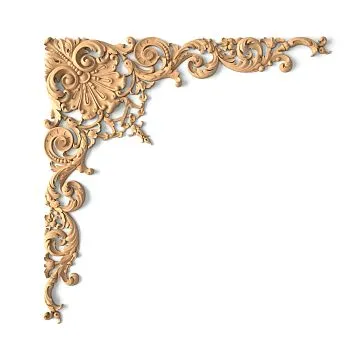
Carved appliqués are small decorative elements that can be used individually or in combination with other elements. They can have various shapes and levels of complexity — from simple geometric patterns to intricate floral or animal motifs.
Carved panels are larger decorative elements that form a complete composition. They can depict landscapes, still lifes, abstract patterns, or narrative scenes. Such panels often become the focal point of the interior, drawing attention and setting the tone for the entire space.
If you are wondering, where to buy wooden wall decoration In the form of carved appliqués or panels, pay attention to companies specializing in handcrafted items and offering unique, original pieces.
Wooden panels and planks
Wooden panels are a more substantial decor option that can cover a significant portion of a wall or even the entire wall. They can be smooth or textured, monochromatic or featuring a pronounced natural grain.
Planks are thin wooden strips that can be arranged vertically, horizontally, or at an angle, creating interesting geometric patterns. They can be installed with gaps, creating a light and airy effect, or closely together, forming a solid surface.
3D panels and volumetric compositions
Wooden 3D panels are a modern solution that adds depth and volume to the interior. They can have various geometries — from simple waves to complex multi-level constructions.
Volumetric compositions are original works that can combine various techniques and materials. For example, a wooden base can be complemented with metal elements, glass, or ceramic, creating unique, one-of-a-kind artworks.
Choosing wood species for decorative elements
Choosing wood species for decorative elements is not only an aesthetic question but also a matter of practicality, durability, and compatibility with the overall interior style.
Oak: nobility and durability
Oak is one of the most popular wood species for making decorative elements. It is characterized by high strength, moisture resistance, and a variety of shades — from light golden to dark brown. Oak decorative elements look solid and respectable, perfectly fitting both classic and modern interiors.
Ash: flexibility and expressiveness
Ash is a hard wood with a distinctive texture. Decorative elements made of ash vary from each other, but each is beautiful in its own way, allowing for unique compositions. Ash is also known for its flexibility, making it ideal for creating curved elements.
Walnut: warmth and elegance
Walnut is a wood species with a rich, warm tone and beautiful texture. Decorative elements made of walnut look elegant and refined, adding charm and sophistication to the interior. Walnut pairs well with other materials — metal, glass, leather — expanding its decorative possibilities.
Spruce and pine: affordable classic
Spruce and pine are the most accessible and common coniferous species. They are characterized by light color, pronounced texture, and the presence of knots, which can be either an advantage or a disadvantage depending on the interior style. Decorative elements made of spruce and pine create an atmosphere of coziness and warmth, especially well-suited for country, Provence, and Scandinavian interiors.
Wooden decor in various interior styles
Wooden decor is remarkably versatile — it can fit almost any interior style, from classic to avant-garde. Let’s consider how wooden elements can enhance and enrich various stylistic directions.
Classic style: elegance and tradition
In a classic interior, wooden decor plays a key role, emphasizing the owner’s status and taste. Here, ornate carved panels, cornices, pilasters, and rosettes are appropriate. Preference is given to noble wood species — oak, walnut, mahogany — with deep, rich textures.
The color palette of wooden decor in a classic interior is usually restrained - natural wood tones, sometimes with gold or patina. Carving may be either vegetal (acanthus leaves, rosettes, garlands) or geometric (meander, Ionic, ovals).
Modern style: minimalism and functionality
In modern interiors, wooden decor is used more sparingly, creating accents and focal points. Here, geometric shapes, clean lines, minimalist patterns are popular. Light wood species - birch, maple, beech - are preferred, or, conversely, very dark ones - wenge, ebony - which create contrast against light walls.
An interesting technique in modern interiors is using unprocessed, rough wood in combination with smooth, polished surfaces, creating a play of contrasts and adding depth and character to the interior.
Eco-style: Natural Harmony
Eco-style is a style aiming for harmony with nature, using natural materials, creating a healthy and comfortable living environment. Wooden decor is an ideal element for eco-interiors, as it emphasizes the connection with nature and adds warmth and authenticity.
In eco-interiors, wooden decor is usually used in its natural form, with minimal processing, to preserve the natural beauty and energy of the wood. Popular are elements made from logs, tree stumps, branches, which retain their natural shape and texture.
Scandinavian style: light simplicity
Scandinavian style, with its love for natural materials, light tones, and functionality, combines perfectly with wooden decor. In Scandinavian interiors, wooden elements are usually light - birch, pine, spruce, often bleached or painted white.
Decor in Scandinavian style is minimalist and functional - simple geometric shapes, minimal carving and ornamentation. Wooden panels, planks, shelves are popular, not only decorating walls but also serving for storage and display of items.
Practical aspects of choosing and placing wooden decor
Choosing and placing wooden decor is a creative process requiring attention to detail, understanding of proportions, and a sense of style. Let's consider some practical aspects that will help you create a harmonious and expressive space.
Considering proportions and scale
When choosing wooden decor, it is important to consider the proportions and scale of the room. In a small space, large, bulky elements will look cumbersome and inappropriate, while in a spacious hall, small details may disappear and fail to produce the desired effect.
It is also important to consider ceiling height - in rooms with low ceilings, vertical elements are better, visually 'lifting' the space, while in rooms with high ceilings, horizontal elements can create a sense of coziness and protection.
Creating composition and focal point
Wooden decor can be used to create a focal point in the interior - an element that attracts attention and sets the tone for the entire space. This can be a large carved panel, a three-dimensional composition, an accent wall decorated with wooden panels or planks.
When creating a composition from multiple elements, it is important to maintain balance and harmony - elements should complement each other, not compete for attention. You can use the principle of hierarchy, highlighting the main element and complementing it with secondary details.
Combining with other materials and textures
Wooden decor combines beautifully with other materials - stone, metal, glass, textiles - creating interesting contrasts and textural combinations. For example, rough, unprocessed wood looks great next to smooth, polished metal, while warm wood tones complement the cool texture of stone or glass.
When choosing combinations, it is important to consider not only the aesthetic aspect but also the practical one - some materials may interact with each other, affecting the durability and appearance of the decor. For example, metal may oxidize wood, while some types of stone may absorb moisture and transfer it to wooden elements.
Lighting and its effect on the perception of decor
Lighting plays a key role in perceiving wooden decor. Properly chosen lighting can highlight the texture of wood, emphasize carving, and create interesting light and shadow effects.
To illuminate wooden decor, various types of lighting can be used - general, accent, decorative. For example, directional spotlights can highlight individual elements, while hidden backlighting can create a floating effect for wooden panels or shelves.
Where to buy quality wooden decor for walls
Choosing where to buy wooden decor depends on many factors - your preferences, budget, requirements for quality and uniqueness of items.
Specialized Stores and Showrooms
Specialized stores and boutiques offer a wide range of wooden decor in various styles, sizes, and levels of complexity. Here you can receive professional consultation, see samples, evaluate material quality and craftsmanship.
If you are wondering, where to buy wooden wall decoration High-quality, pay attention to companies specializing in woodwork and having a good reputation in the market.
Workshops and individual artisans
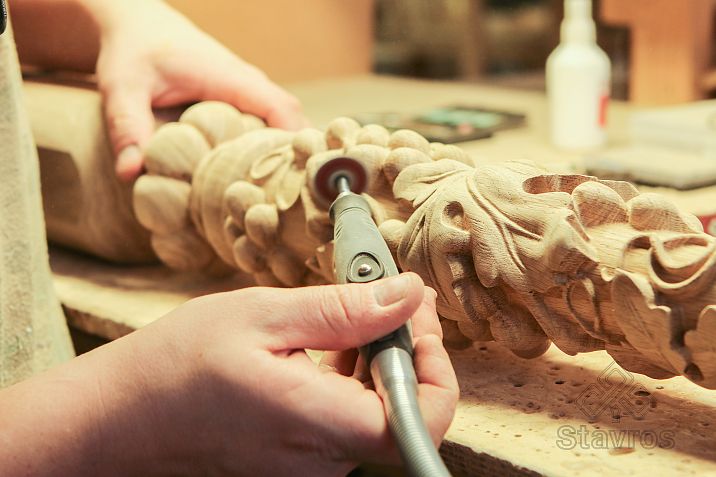
Workshops and individual artisans offer unique, original works that cannot be found in mass production. Working with an artisan allows you to order decor according to an individual project, taking into account all your preferences and the specifics of the interior.
Such an approach usually costs more, but the result often exceeds expectations - you get not just a decorative element, but a true work of art that will delight you for many years.
Online stores and marketplaces
Online stores and marketplaces offer a wide selection of wooden decor with the possibility of delivery directly to your home. This is a convenient option if you don't have time to visit physical stores or if you are looking for something specific that is hard to find in regular stores.
When choosing an online store, pay attention to the seller's reputation, customer reviews, delivery and return conditions, detailed product descriptions, and photos.
Caring for wooden decor: preserving beauty for years
Wooden decor is not just an interior element; it is a living material that requires proper care to maintain its beauty and functionality.
Regular cleaning from dust and dirt
Regular cleaning of wooden decor from dust and dirt is the foundation of its care. For this, you can use a soft brush, a vacuum cleaner with a soft attachment, or a microfiber cloth. Avoid using abrasive materials that may scratch the wood surface.
For deeper cleaning, you can use specialized wood surface care products or a simple solution of mild soap in warm water. After wet cleaning, be sure to wipe the decor with a dry, soft cloth to remove any remaining moisture.
Water and UV Protection
Wood is a material that can deform under the influence of moisture and fade under the influence of ultraviolet light. To protect wooden decor from these factors, use special protective compositions — varnishes, oils, waxes — that create a protective film on the wood surface.
The choice of protective composition depends on the type of wood, usage conditions, and desired visual effect. Some compositions highlight the natural texture of the wood, others change its color, and others create an aged or patina effect.
Updating the protective coating
Over time, the protective coating on wooden decor may wear down, fade, or lose its protective properties. In this case, it is necessary to renew the coating — apply a new layer of varnish, oil, or wax.
Before applying a new coating, it is necessary to thoroughly clean the surface from dust, dirt, and remnants of the old coating. In some cases, light sanding of the surface may be required to remove minor scratches, scuffs, or unevenness.
Minor scratches and scuffs are removed by local sanding and coating. Serious damage may require replacement of the affected area.
If wooden decor has suffered mechanical damage — scratches, chips, cracks — it is necessary to address them as soon as possible to prevent further deterioration of the wood.
For repairing minor damage, you can use special wax pencils, wood putty, or touch-up markers. For more serious damage, it may be necessary to replace the damaged element or consult a specialist.
Conclusion: wooden decor as an investment in beauty and comfort
Wooden wall decor is not just a fashionable trend — it is an investment in the beauty, comfort, and ecological quality of your interior. It is capable of dramatically transforming a space, adding depth, texture, and individuality.
Choosing wooden decor is a creative process that requires attention to detail, understanding of the characteristics of different wood species, consideration of interior style, and technical aspects of installation. But the result is worth the effort — an interior decorated with wooden elements will delight you with its beauty, uniqueness, and ecological qualities for many years.
If you are wondering, where to buy wooden wall decorationRemember that the quality of the material and craftsmanship plays a key role in the longevity and aesthetics of the decor. Choose reputable manufacturers, consult with specialists, and do not compromise on quality — your interior will not only be fashionable but truly unique, reflecting your individuality and lifestyle.