Article Contents:
- Wooden house as the ideal foundation for Russian style
- Philosophy of wooden architecture
- Architectural features as the basis of style
- Color symphony: natural shades as the basis of harmony
- Wooden palette as dominant
- Accent palette: from folk crafts to modernity
- Wood carving: poetry in material
- Traditional motifs in modern interpretation
- Modern technologies in service of traditions
- Furniture in a wooden house: function and beauty in unity
- Principles of selecting furniture for Russian style
- Traditional furniture items in modern interpretation
- Architectural decor: from functionality to beauty
- Constructive elements as decor
- Decorative elements of small forms
- Textiles: softness and warmth in a wooden house
- Traditional fabrics and their modern application
- Ornaments and patterns: language of symbols
- Lighting: play of light and shadow in a wooden house
- Natural lighting as the basis
- Artificial lighting: traditions and innovations
- Zonal planning: from general to specific
- Living room as the center of family life
- Kitchen: the heart of the home
- Bedroom: temple of rest
- Decorative accents: details that create atmosphere
- Ceramics and porcelain: traditional crafts in modern interior
- Metallic accents: from utility to beauty
- Plants in the interior: living nature in a wooden house
- Houseplants as decorative elements
- Seasonal compositions
- Modern technologies in traditional interior
- Hidden integration of modern systems
- Energy efficiency and eco-friendliness
- Seasonal transformations of the interior
- Winter coziness in a wooden house
- Summer transformations
- Regional features of Russian style in a wooden house
- Northern traditions
- Central traditions
- Southern motifs
- Creating a project: from idea to realization
- Planning and design
- Project implementation
- Conclusion
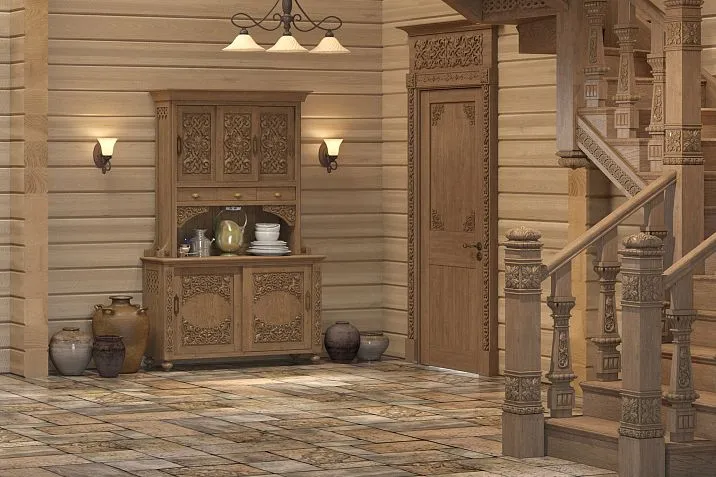
There is something magical in the moment when you step over the threshold of a wooden house, where every beam breathes history, and every carved element whispers tales of ancestors. Interior in Russian style in a wooden house — this is not just a design solution, but a philosophy of life, where modern comfort harmoniously intertwines with centuries-old traditions of Russian architecture.
Why is a wooden house the ideal canvas for embodying Russian style? The answer lies in the very nature of this material — living, breathing, capable of preserving the energy of generations. Wood is not merely a building material; it is a conduit between the past and the present, between man and nature, between dream and reality.
In an era of globalization and standardization, creating an authentic Russian interior in a wooden house becomes an act of creative resistance, a way to preserve cultural identity and pass it on to future generations. Here, every element carries meaning, every detail tells a story, and every space creates a unique atmosphere of connection with roots.


Wooden house as the ideal foundation for Russian style




Philosophy of wooden architecture
Russian wooden architecture is a unique phenomenon in world architecture, where functionality is inseparably linked with beauty, and practicality with poetry. In a wooden house, Russian style achieves its true form, as there is no contradiction between the material of the walls and the concept of the interior.
The organic nature of the material is the first and foremost advantage of a wooden house for Russian style. Walls made of logs or beams do not require additional finishing — their natural texture and color already create the ideal background for traditional decorative elements. Each ring on the cross-section of a log, each resinous vein tells its own story, making the interior alive and animated.
The microclimate of a wooden house contributes to creating a special atmosphere. Wood regulates humidity, absorbs excess moisture, and releases it when necessary, creating a comfortable living environment. This natural air conditioner works silently and effectively, ensuring healthy air in the house.
The energy of wood — a concept that may seem esoteric, but has a solid scientific basis. Wood continues to "live" even after becoming a building material, releasing phytoncides — natural antibiotics that purify the air and positively affect human health.
Our factory also produces:


Architectural features as the basis of style
A wooden house dictates its own rules for organizing interior space, and these rules remarkably precisely coincide with the principles of Russian style.
Constructive elements of a wooden house — beams, rafters, support columns — do not need to be hidden. On the contrary, they become important elements of the interior, creating the characteristic monumentality and solidity of Russian style. Decorative appliqués Russian style can turn utilitarian structures into works of art.
The natural geometry of a wooden house — simple, clear lines, straight angles, functional forms — fully corresponds to the aesthetics of Russian style, where beauty arises from practicality, not excessive ornamentation.
The scale of spaces in a wooden house is traditionally human-sized — not overly high ceilings, cozy room dimensions, wide windowsills. This creates an atmosphere of protection and home warmth, so characteristic of Russian dwellings.
Get Consultation
Color symphony: natural tones as the basis of harmony
Wooden palette as a dominant
In a wooden house, the color scheme of the interior in the Russian style is built around natural wood tones. This is not a limitation, but a rich palette where each shade has its own character and mood.
Light woods — birch, aspen, linden — create a sense of spaciousness and freshness. Their cream-white and light-yellow tones are ideal for rooms where visual lightness is important: bedrooms, children's rooms, summer verandas. These shades are especially good when combined with snowy linen textiles and ceramics in the white-blue Gzhel palette.
Medium tones of oak, beech, maple represent the golden middle — warm enough to create coziness, yet neutral enough to serve as a backdrop for bright accents. The golden-brown palette of these woods combines beautifully with traditional Russian colors: crimson red, emerald green, sapphire blue.
Dark woods — walnut, wenge, stained oak — give the interior a sense of solidity and respectability. Their chocolate-brown and nearly black shades create an atmosphere of an old estate, where every item breathes history and dignity.
Accent palette: from folk crafts to modernity
The Russian style is unthinkable without bright color accents, which, like precious stones, enliven the calm wooden base of the interior.
Red color in Russian tradition — is the color of life, joy, celebration. From the crimson of poppies to the deep burgundy of boyar's blankets — all this range finds its place in the interior of a wooden house. Red accents can appear in textiles, ceramics, carved elements, creating warm, lively spots against the calm wooden palette.
Blue color — from sky-blue to deep indigo — brings a sense of spaciousness and freedom into the interior. It is the color of Russian expanses, the color of Gzhel, the color of a field of violets. In a wooden house, blue accents are especially expressive against the warm wood background.
Green color in all its variety — from delicate salad to deep emerald — symbolizes connection with nature. In the interior of a wooden house, green accents can appear as live plants, textiles, ceramic items.
Gold color — symbol of spirituality and abundance — in a wooden house should be used especially delicately. This may be gilding on icons, golden Хохлома painting, bronze hardware — elements that add nobility to the interior without disturbing its naturalness.
Wood carving: poetry in material
Traditional motifs in modern execution
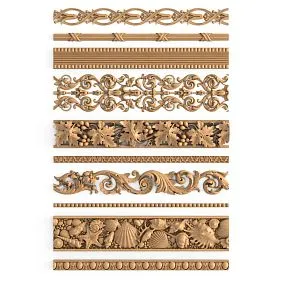
Wood carving is the language of Russian decorative-applied art. In a wooden house, carved elements acquire a special resonance, as they are made from the same material as the walls, creating a unified artistic whole.
Plant motifs — the most popular type of carving in the Russian style. The grapevine with its elegant swirls symbolizes abundance and joy of life. Oak leaves embody strength and longevity. Birch branches remind of native soil. Each motif carries deep symbolic meaning, transforming decorative elements into carriers of cultural information.
Geometric patterns — a more strict, but no less expressive type of ornament. Rhombuses, circles, spirals, meanders — these ancient symbols create rhythmic compositions that soothe the eye and set a contemplative mood. In a wooden house, geometric carving is especially organic, as it highlights the structural logic of the building.
Zoomorphic motifs — images of birds, animals, fish — connect humans with the natural world. Bear — symbol of strength and protection, bird — symbol of freedom and spirituality, fish — symbol of abundance. These images make the interior more lively and emotionally rich.
Modern technologies in service of traditions
Today, creating carved elements for a wooden house has become significantly more accessible thanks to modern technologies that allow maintaining high quality at a reasonable cost.
CNC milling allows reproducing the most complex ornaments with perfect accuracy. Computer programs enable creating three-dimensional models of carved elements, and high-precision machines bring them to life in wood with jewel-like precision. Brackets Russian styleMade using this technology, combine traditional beauty with modern quality.
Laser cutting allows creating delicate lace-like patterns unattainable by hand. This technology is especially good for creating openwork elements — grilles, panels, decorative inserts.
Combined technologies — machine processing followed by manual finishing — yield the best results. The machine ensures geometric precision, while the master’s hand adds liveliness and individuality to the piece.
Furniture in a wooden house: function and beauty in unity
Principles of selecting furniture for the Russian style
Furniture in a wooden house should not compete with walls but complement them, creating a harmonious ensemble. The Russian style dictates its requirements for the shape, material, and decoration of furniture.
Massiveness and solidity — the main characteristics of furniture in the Russian style. A large dining table where the whole family can gather, spacious cabinets for storing family heirlooms, wide benches for resting — all these items should convey a sense of reliability and durability.
The functionality of each item should be obvious. In Russian tradition, there is no place for furniture 'for beauty' — every chair must be comfortable for sitting, every table practical for work, every cabinet spacious for storage. Beauty arises from the perfection of function.
Natural materials — an absolute requirement of the Russian style. Solid wood, natural leather, linen and wool fabrics — only these materials can create the authentic atmosphere of a Russian home. Synthetic materials, even the highest quality, disrupt the energy of the space.
Traditional furniture items in modern interpretation
Furniture in a wooden house looks especially natural, possessing deep historical roots.
A chest is one of the most characteristic pieces of Russian furniture. In a modern interior, it can serve multiple functions: as a coffee table in the living room, storage for bedding in the bedroom, or a bench in the hallway. Carved chests with wrought-iron locks and hinges become true works of art.
A 'gorka' — a traditional cabinet for displaying fine tableware — takes on special significance in a wooden house. Behind glass doors, one can display a collection of folk ceramics, vintage samovars, and family silver. The gorka becomes not merely furniture, but an exhibition of family history.
A bench is a versatile piece of furniture that can serve as seating, a table, or a stand. In a wooden house, benches are especially appropriate — their simple, functional forms harmonize with the building’s architecture. Carved benches with high backs create cozy corners for rest and conversation.
A 'postavec' — an old-fashioned cabinet with open shelves — can be used in a modern home for storing and displaying books, souvenirs, and decorative items. Its open construction makes the interior feel more airy and less cluttered.
Architectural decoration: from functionality to beauty
Constructive elements as decoration
In a wooden house, the boundary between construction and decoration often blurs. Elements necessary for the building’s strength become important components of the interior.
Beam supports in a wooden house are not just load-bearing structures, but also expressive interior elements. Massive wooden beams create a rhythmic ceiling composition, emphasize the scale of the room, and add monumentality to the interior. Capitals Russian style They can transform simple support posts into elegant columns.
The staircase in a wooden house is always a central element of the interior. Carved balusters, massive handrails, and wide steps create a majestic atmosphere as one ascends to the second floor. The staircase can become a true masterpiece of carpentry.
In a wooden house, window and door openings are traditionally framed by cornices. These elements not only protect joints from drafts, but also serve as important decorative accents. Carved cornices can turn a simple window into a work of art.
Decorative elements of small scale
In addition to large architectural elements, the Russian style in a wooden house is created by numerous small details, each contributing to the overall atmosphere.
‘Podzory’ — decorative carved boards hanging beneath eaves, shelves, or balconies. In the interior of a wooden house, they create elegant transitions between different planes, adding lightness to massive structures.
‘Rosets’ — round carved elements — are used to decorate intersections of beams, centers of ceiling compositions, and furniture pediments. These small details create focal points that attract the eye and organize space.
‘Consoles’ — decorative elements projecting from the wall — can support shelves, lamps, or window sills. In a wooden house, carved consoles become sculptural accents, emphasizing vertical lines in the interior.
Textile: softness and warmth in a wooden house
Traditional fabrics and their modern application
Textile in the interior of a wooden house plays a special role — it softens the rigidity of wooden surfaces, adds color and warmth, and creates a cozy atmosphere. The Russian style implies the use of exclusively natural fabrics.
Linen — the king of Russian textiles. This fabric is ideal for wooden houses due to its natural properties: it breathes, regulates humidity, and has a natural lustrous sheen. Linen curtains, tablecloths, and bedding create an atmosphere of simple, refined beauty. Unbleached linen in its natural beige-gray color especially complements dark wood.
Cotton — a more democratic, yet no less important component of textile decoration. Cotton fabrics with traditional Russian patterns — floral motifs, geometric ornaments — are perfect for upholstering furniture, decorative cushions, and blankets.
Wool — an indispensable material for creating winter coziness in a wooden house. Wool blankets, rugs, and tapestries not only warm but also create a sense of protection and comfort. Natural wool, with its distinctive scent and tactile qualities, enhances the feeling of connection with nature.
Silk — for special occasions and formal rooms. In the Russian style, silk is used sparingly — for upholstering festive furniture, making decorative panels, and creating accent details. Its noble sheen and rich texture emphasize the solemnity of the moment.
Ornaments and patterns: the language of symbols
Russian textiles are unthinkable without ornaments — each pattern carries a specific meaning and creates a unique energy in the space.
Plant motifs — roses, cornflowers, daisies, oak and birch leaves — create a connection with nature, bringing freshness and vitality into the interior. These motifs are especially natural in a wooden house, where they harmonize with the natural material of the walls.
Geometric patterns — diamonds, crosses, stars — have ancient magical roots. In a modern interior, they create rhythmic compositions, soothe the eye, and introduce harmony and order into the space.
Narrative compositions — scenes from folk tales, images of birds and animals — make textiles more lively and emotional. These motifs are especially suitable for children’s rooms, where they stimulate imagination and create a fairy-tale atmosphere.
Lighting: play of light and shadow in a wooden house
Natural lighting as a foundation
A wooden house has special relationships with light. Wood absorbs part of the light rays, making the lighting softer and warmer. This creates a unique atmosphere but requires a thoughtful approach to lighting design.
Windows in a wooden house are traditionally large to compensate for the light absorption by wood. Wide window sills become additional surfaces for placing plants, decorative items, and creating cozy reading nooks.
Light wells are special architectural solutions that allow natural light to penetrate deep into a room. In a wooden house, these can be glazed galleries, atriums, or dormer windows, creating interesting lighting effects.
Reflective surfaces — mirrors, polished metal objects, light textiles — help distribute natural light throughout the room. In Russian style, such elements should be used delicately to avoid disrupting the natural atmosphere.
Artificial Lighting: Traditions and Innovations
Artificial lighting in a wooden house should complement natural light, preserving a warm, cozy atmosphere.
Chandeliers in Russian style are usually massive constructions made of wood, metal, and crystal. In a wooden house, chandeliers where these materials combine — wooden base with metal details and crystal pendants — create a rich interplay of light and shadow.
Wall-mounted fixtures — sconces, torches, lanterns — create localized lighting zones, highlight architectural details, and create an intimate atmosphere. In a wooden house, wall-mounted fixtures are often styled as vintage pieces.
Candles are an essential element of lighting in Russian style. A living flame creates a unique atmosphere of warmth and coziness that no electric lighting can replace. Wrought iron candlesticks, wooden candelabras, ceramic lanterns transform candle use into a ritual of beauty.
Zonal Planning: From General to Specific
Living room as the center of family life
In a wooden house, the living room acquires special significance — it is not merely a place for receiving guests, but the center of family life, where all household members gather.
A fireplace or stove is an essential element of the living room in Russian style. In a wooden house, a fireplace is especially harmonious — wood and fire create a natural combination. Modern fireplaces can be wood-burning or gas-powered, as long as the feeling of a living flame is preserved.
Soft furniture should be arranged to create a cozy zone for conversation. Large sofas, chairs with high backs, ottomans, and settees should be upholstered in natural fabrics and encourage long conversations.
The library zone is an indispensable part of a Russian living room. Bookshelves, display shelves, and reading nooks create an atmosphere of education and culture. In a wooden house, open bookshelves are especially good, where books become decorative elements.
Kitchen: The Heart of the Home
The kitchen in a wooden house is not merely a place for preparing food, but the center of home life, where not only food but also the atmosphere of family unity is prepared.
Working surfaces should be made of natural materials — wood, stone, ceramic. Solid wood countertops create unity with the overall style of the house, but require special care. Stone countertops are more practical but must harmonize with wooden elements.
Kitchen furniture in Russian style includes massive cabinets with latticed fronts, open shelves for displaying beautiful tableware, and a large dining table made of solid wood. Modern appliances should be seamlessly integrated into traditional furniture forms.
Textile decoration of the kitchen includes linen curtains, cotton tablecloths with traditional patterns, embroidered towels. These details create a homely coziness and emphasize the handmade quality of the space.
Bedroom: Temple of Rest
The bedroom in a wooden house should be a place of maximum comfort and relaxation. Russian style creates here a special atmosphere of protection and tranquility.
The bed — the central element of the bedroom — should be massive, made of natural wood, with a high headboard. Carved elements on the headboard, turned legs, quality hardware transform the bed into a piece of furniture art.
Textile decoration of the bedroom is especially important — linen bedding, wool blankets, cotton bedspreads create a multi-layered composition, where each element contributes to comfort.
Storage systems — wardrobes, chests of drawers, trunks — should be not only functional but also beautiful. Carved fronts, quality hardware, thoughtful internal organization turn these items into more than just furniture — they become family heirlooms.
Decorative accents: details that create atmosphere
Ceramics and porcelain: traditional crafts in modern interiors
Ceramic items play an important role in creating the atmosphere of Russian style in a wooden house. They add color, create textured accents, and demonstrate a connection to folk traditions.
Gzhel — blue-and-white ceramics — look especially expressive against natural wood. The contrast of cool blue tones and warm wood tones creates a picturesque composition. Gzhel items can be used both functionally (tableware) and decoratively (vases, figurines, panels).
Khokhloma — gold-red painting on wood — creates an interesting effect when rendered in ceramic. Khokhloma motifs on ceramics appear more vivid and contrasting than on wood, allowing for striking interior accents.
Dymkova toys — bright, festive ceramics — are perfect for children's rooms and play areas. Their cheerful color palette and naive beauty create an atmosphere of childhood and fairy tale.
Metallic accents: from utility to beauty
Metallic elements in the interior of a wooden house should be used delicately, as they may disrupt the natural harmony of the space.
Forged items — candlesticks, lamps, fireplace accessories — create expressive accents and emphasize the handcrafted nature of the interior. Black metal looks especially good combined with light wood.
Brass and bronze elements — handles, hinges, decorative inlays — add nobility and historical authenticity to the interior. Patinated surfaces create a sense of time and craftsmanship.
Samovars and copperware — traditional elements of Russian household — acquire a special resonance in a wooden house. The gleam of copper against matte wood creates a rich interplay of textures and tones.
Plants in the interior: living nature in a wooden house
Houseplants as decorative elements
In a wooden house, plants feel especially comfortable due to the healthy microclimate and natural humidity. Properly selected plants enhance the connection with nature and create living accents in the interior.
Traditional Russian plants — geraniums, violets, begonias — create the atmosphere of an old house. These low-maintenance plants thrive on wooden windowsills, adding coziness to the interior.
Medicinal herbs — aloe, kalanchoe, golden creeping Jenny — are not only beautiful but also beneficial. In Russian tradition, every home was a small pharmacy, where the housewife grew plants to treat her family.
Hanging plants — tradescantia, ivy, chlorophytum — create green cascades that soften the strict lines of wooden architecture. Suspended in planters or placed on high shelves, they create vertical accents in the interior.
Seasonal compositions
A wooden house is especially sensitive to seasonal changes, and plant compositions help emphasize this connection with natural cycles.
Spring compositions — branches of flowering trees, first blooms, young greenery — evoke a sense of awakening and renewal. In a wooden house, birch branches with young leaves are especially suitable.
Summer bouquets — field and garden flowers in simple wooden or ceramic vases — fill the house with fragrance and color. Cornflowers, daisies, and bellflowers create the atmosphere of a Russian summer.
Autumn compositions — branches with bright leaves, fruits, ears — highlight the richness of nature and readiness for winter. Rowan berries, maple leaves, pine cones create warm, cozy compositions.
Winter accents — evergreen branches, dried grasses, winter berries — maintain a connection with nature during cold months. Compositions with juniper, spruce, and blueberry are especially good.
Modern technologies in traditional interiors
Hidden integration of modern systems
Interior in Russian style in a wooden house Does not mean giving up modern conveniences. The key is to integrate them in a way that does not disrupt the traditional atmosphere.
A "smart home" system can be completely hidden from view, controlled via mobile apps or voice commands. Automatic control of lighting, climate, and security enhances comfort without affecting interior aesthetics.
Multimedia systems are concealed behind traditional furniture facades. A television can be built into a carved cabinet, an audio system integrated into ceiling beams, and a home theater disguised as a library.
Modern kitchen appliances are hidden behind wooden facades styled to resemble traditional furniture. Induction stoves, dishwashers, and refrigerators become invisible, preserving functionality while enhancing kitchen aesthetics.
Energy efficiency and eco-friendliness
A modern wooden house in Russian style must and should be energy-efficient and eco-friendly.
Heat recovery systems allow maximum utilization of energy spent on heating. Fresh air is warmed using the heat from exhaust air, significantly reducing energy consumption.
Solar collectors can be integrated into the roof without disrupting the traditional appearance of the house. They provide hot water and additional heating, reducing dependence on external energy sources.
Geothermal systems use the stable temperature of the earth for heating and cooling the house. These systems are completely invisible and do not affect the interior, but significantly enhance comfort and reduce operating costs.
Seasonal transformations of the interior
Winter coziness in a wooden house
Winter is a special time for a wooden house in Russian style. It is precisely in winter that all the advantages of this type of dwelling become apparent — the warmth of wood, coziness of natural materials, and the beauty of a live fire in the fireplace.
Textile accents in winter become warmer and denser. Woolen blankets, fur throws, and woolen rugs create additional layers of comfort. The color palette shifts toward deeper, richer tones — burgundy, emerald, dark blue.
Lighting in winter takes on special importance. A large number of candles, kerosene lamps, and a fireplace create warm, lively lighting that compensates for the lack of sunlight. The reflection of flames on wooden surfaces creates a cozy, intimate atmosphere.
Aromatherapy in winter is especially important. Essential oils from coniferous trees, dried herbs, and scented candles create a healing atmosphere that supports health and lifts mood during long winter evenings.
Summer transformations
In summer, the wooden house opens up to nature. Large windows are wide open, creating a direct connection with the garden. The interior becomes an extension of the landscape.
Textiles in summer become lighter and lighter. Linen curtains, cotton blankets, light shawls create a feeling of coolness and freshness. The color palette shifts toward light, natural tones — white, cream, light green.
Living plants in summer take center stage in the decor. Large bouquets of wildflowers, potted plants displayed on terraces create an atmosphere of a blooming garden inside the house.
Natural materials are especially actively used in summer. Woven furniture is brought into the house, creating light, airy compositions. Reed mats, jute rugs, linen runners emphasize the connection with nature.
Regional characteristics of Russian style in wooden houses
Northern Traditions
Wooden houses in northern regions of Russia have their own features, reflected in the interior.
The harsh beauty of the northern style is expressed in the simplicity of decor, functionality of each element, dominance of dark wood species. There is no room for excesses — every detail must be justified by practical necessity.
Constructive features of northern houses — thick walls, small windows, low ceilings — create a unique, intimate atmosphere. The interior is built on the contrast of light and dark surfaces, creating an expressive graphic of space.
Traditional crafts of the North — bone carving, wood painting, weaving — are reflected in interior decor. These elements add cultural depth and historical authenticity to the space.
Central Traditions
Wooden houses in central Russia represent a classic variant of Russian style, where all elements are in harmonious balance.
Balance is the main characteristic of the central style. There are no extremes — neither excessive luxury nor excessive austerity. Each element of the interior occupies its place in the overall composition.
Variety of materials — wood of different species, stone, ceramics, textiles — creates a rich palette of textures and colors. This diversity is unified by a common stylistic and color scheme.
Traditional crafts of central Russia — Хохлома, Гжель, Городец painting — are widely represented in the interior. These bright accents enliven the calm wooden base.
Southern motifs
Wooden houses in southern regions of Russia are influenced by neighboring cultures, which is reflected in a more vibrant, festive character of interiors.
Vibrancy of color — a characteristic feature of southern style. Red, yellow, blue, green accents are used more actively, creating a cheerful atmosphere.
Abundance of decor — carving, painting, textiles — makes the interior more festive and ornate. Here, rich ornaments, complex compositions, and numerous details are appropriate.
Influence of neighboring cultures — Ukrainian, Caucasian — enriches traditional Russian aesthetics with new motifs and techniques. This creates unique synthetic forms characteristic only of this region.
Project creation: from idea to realization
Planning and design
Creating an interior in Russian style in a wooden house is a complex process requiring a professional approach and deep understanding of traditions.
Analysis of architecture — the first step in creating a project. It is necessary to understand the constructive features of the house, its proportions, lighting, and functional needs. The interior should highlight the strengths of the architecture and conceal its shortcomings.
Space zoning must take into account both traditional principles of Russian dwellings and modern family needs. It is important to create logical connections between rooms, ensure convenient movement, and provide areas for various activities.
Material selection — a critically important stage. All materials must be compatible with wood, both physically and aesthetically. It is important to consider seasonal changes in humidity and temperature, typical for wooden houses.
Project implementation
Phased work — key to successful project implementation. First, all engineering systems are installed, then rough finishing, and only then decorative elements and furniture.
Quality control must be carried out at every stage. A wooden house is a living organism that may surprise during construction. It is important to adjust the project in a timely manner according to real conditions.
Collaboration among specialists — architects, designers, builders, masters of applied arts — ensures high-quality results. Each specialist must understand the overall project concept and their role in its implementation.
Conclusion
Creating an interior in Russian style in a wooden house is not just a design task, but a cultural mission to preserve and develop national traditions. In a world where standardization and globalization erase cultural differences, turning to roots becomes an act of creative resistance and search for one’s own identity.
A wooden house provides unique opportunities for realization interior in Russian styleHere, the material of the walls, the philosophy of space, and the energy of the dwelling work together to create a genuine Russian atmosphere. Every element — from massive beams to delicate carved details — tells the story of centuries-old culture, conveys the wisdom of generations, and creates a space for modern life in harmony with traditions.
Modern technologies do not contradict traditional aesthetics but enrich it, making it more durable, comfortable, and functional. The key is to preserve the spirit and philosophy of Russian style, its connection with nature, respect for materials, and understanding of beauty as harmony between function and form.
The result of such an approach is a home that offers not only physical comfort but also spiritual peace, not only beauty but also meaning, not only a place to live but also a space for the soul. In such a home, each day becomes a celebration of returning to roots, each evening a time of unity with family and traditions, and each morning the beginning of a new page in the centuries-long history of Russian culture.
For more than two decades, the company STAVROS has created decorative elements that help bring to life dreams of a genuine Russian home. The combination of deep understanding of traditions with modern manufacturing technologies, use of premium materials, and attention to every detail allows creating items that will become ornaments of any interior and serve many generations. The company’s catalog features thousands of carved decoration models, each created with an understanding of the deep principles of Russian aesthetics and modern requirements for quality and durability.