Article Contents:
- Norms and standards: safety above all
- State standards and their justification
- Differences in requirements for different types of buildings
- International standards and their features
- Mathematics of beauty: how to calculate ideal spacing
- Basic calculation formula and its application
- Accounting for structural and material specifics
- The golden ratio in architectural railings
- Practical aspects of baluster installation
- Methods of fastening and their influence on distance
- Compensation for installation errors
- Quality control and final inspection
- Aesthetic aspects of baluster spacing
- Visual rhythm and proportions
- Influence of interior style on spacing selection
- Optical illusions and visual effects
- Special cases and non-standard solutions
- Spiral and Curved Stairs
- Combined railings
- Children's and specialized rooms
- Innovative approaches and modern trends
- Digital technologies in railing design
- Ecological aspects and sustainable development
- Personalization and individual approach
- Practical recommendations for various situations
- Private home: combination of safety and aesthetics
- Public buildings: strict adherence to norms
- Restoration of historical buildings: compromise between tradition and safety
- Conclusion: harmony of form and function
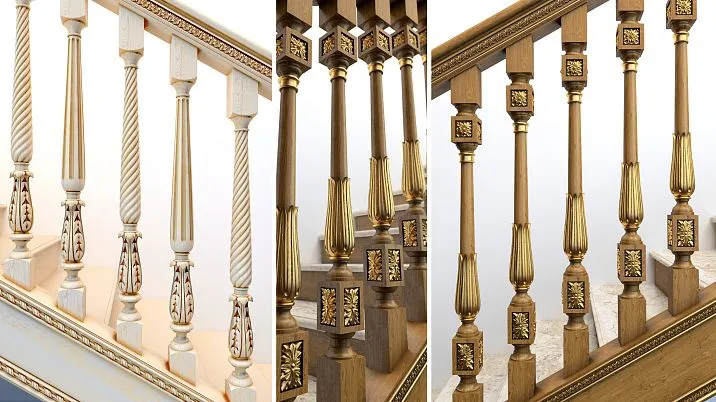
Have you ever noticed how some staircases literally capture your gaze, making you admire their elegance and harmony? The secret lies not only in materials or step forms, but in carefully calculated proportions of each element. Special attention is given to baluster spacing - that invisible architectural code that determines not only the safety of the structure, but also its visual perception.
Imagine: you ascend the stairs, your hand glides along smooth railings, and your gaze involuntarily notices the rhythmic alternation of vertical supports. This rhythm is not by chance, but the result of precise engineering calculations and the artistic touch of the master. Too large gaps will create a sense of vulnerability and disrupt visual continuity; too small gaps will make the structure bulky and disproportionate.
In this article, we will reveal the secrets of the ideal baluster spacing, discuss norms and recommendations, learn to calculate optimal proportions, and discover how to apply this knowledge in various architectural styles. We will immerse ourselves in a world where mathematical precision meets artistic taste, creating perfection in every detail.


Norms and standards: safety comes first
When it comes to stair railings, safety becomes the top priority. That is why there are strict regulations governing baluster spacing various types of buildings.




State standards and their justification
Building Codes and Rules (SNiP) and state standards (GOST) are not mere bureaucratic formalities—they are the result of years of research and analysis of accidents. The main document regulating stair railing parameters is GOST 25772-83, developed based on the earlier GOST 24772-83.
According to current regulations, a safe distance between balusters is one through which a spherical object with a diameter of 107 mm cannot pass. This is not a random number—it corresponds to the minimum size of a child’s head, preventing the possibility of a child getting stuck between supports.
In practical application, this means the optimal distance between balusters is 10–15 cm. For public and residential buildings, a gap up to 12 cm is permissible, and for childcare facilities, no more than 10 cm.
Our factory also produces:


Differences in requirements for different types of buildings
Interestingly, regulations vary depending on the building’s purpose:
Private residential homes:
- Optimal distance: 10–15 cm
- Permitted handrail height: 90–110 cm
- Recommended handrail width: 3–7 cm
Multi-apartment residential buildings:
- Standard distance: up to 12 cm
- Handrail height: strictly 90 cm
- Distance between support posts: no more than 50 cm
Childcare facilities:
- Maximum distance: 10 cm
- Main handrail height: up to 120 cm
- Additional handrails: at 50–55 cm for toddlers
Public buildings:
- Standard distance: 10–12 cm
- Handrail height: 90 cm
- Increased requirements for fastener strength
These differences are due to the specific operational characteristics and user categories. For example, additional safety measures are provided in childcare facilities, while private homes allow some flexibility in interpreting standards, although basic safety requirements remain unchanged.
Get Consultation
International standards and their features
It is interesting to compare domestic standards with international standards:
European Union (EN 1090):
- Maximum distance: 11 cm
- Railing height: 100-110 cm
- Special attention to anti-corrosion protection of metal elements
USA (International Building Code):
- Maximum distance: 4 inches (10.16 cm)
- Railing height: minimum 42 inches (106.7 cm) for commercial buildings
- Strict requirements for load tests
Canada (National Building Code):
- Maximum distance: 10 cm
- Railing height: 90-107 cm depending on building type
- Special requirements for regions with high seismic activity
Despite some differences, all international standards converge on one main point: the gap between balusters should not allow a child to fit their head through, and the structure must withstand significant lateral loads.
Mathematics of beauty: how to calculate the ideal distance
Determining the optimal baluster spacing This is not only a question of safety, but also aesthetics. Here, mathematical calculations meet principles of harmony and proportion.
Basic calculation formula and its application
To determine the optimal distance between balusters, the following formula is used:
R = (L - n × d) / (n - 1)
Where:
- R - distance between balusters
- L - total length of the railing
- n - number of balusters
- d - diameter or width of a baluster
Let's consider a practical example. Suppose we have a stair run 300 cm long, and we plan to install 15 balusters, each 4 cm in diameter:
R = (300 - 15 × 4) / (15 - 1) = (300 - 60) / 14 = 240 / 14 = 17.14 cm
The obtained value exceeds the recommended maximum of 15 cm, so it is necessary to increase the number of balusters. Recalculate for 18 balusters:
R = (300 - 18 × 4) / (18 - 1) = (300 - 72) / 17 = 228 / 17 = 13.41 cm
Now the result is within the norm and provides a safe and aesthetically pleasing railing.
Taking into account the features of the construction and materials
When calculating baluster spacing it is necessary to consider the specifics of the materials used and the structural features of the staircase:
Wooden balusters:
- For turned balusters, the maximum diameter is taken into account (usually 4-6 cm)
- For flat carved balusters, the average width is taken
- It is necessary to provide for compensation for possible wood expansion due to changes in humidity
Metallic balusters:
- For forged elements, the largest size of decorative elements is taken into account
- For simple posts, the diameter of the pipe is taken (usually 1.5-3 cm)
- It is important to provide additional space for welded joints or decorative connections
Glass panels:
- The calculation is done differently: the thickness of the glass and the method of mounting are taken into account
- Usually, full panels with minimal gaps are used
- It is necessary to provide for material thermal expansion
Combined constructions:
- When combining different materials, the calculation is performed based on the most massive elements
- The characteristics of connecting different materials are taken into account
- It is important to maintain visual rhythm even when using elements of different shapes
The Golden Ratio in architectural railings
It is interesting that the principles of the golden ratio (proportions approximately 1:1.618) are often applied in designing stair railings to achieve maximum harmony:
The ratio of height to width of balusters:
- Classic balusters often have proportions close to the golden ratio
- The height of the baluster relates to the height of its widest part as 1.618:1
- This creates a sense of natural harmony and balance
Rhythm of alternation:
- In some design solutions, unequal spacing between balusters is used
- The ratio between the larger and smaller gaps corresponds to the golden ratio
- Such an approach creates a dynamic yet harmonious composition
Proportions of the entire structure:
- The ratio of railing height to the distance between balusters may also follow the golden ratio principle
- This creates a unified perception of the railing as a single architectural element
Applying the principles of the golden ratio is a case where mathematical precision serves aesthetic perfection, transforming a functional element into a work of art.
Practical aspects of installing balusters
Theory and calculations are important, but equally significant are practical installation aspects that directly affect the safety and longevity of the structure.
Methods of fastening and their influence on spacing
The method of attaching balusters can significantly affect the final distance between them:
Attachment to the stringer:
- Balusters are installed into special holes in the stringer
- The distance is determined during stringer manufacturing and cannot be changed
- Ensures maximum structural rigidity
- Requires high precision in preliminary calculations
Attachment to the tread:
- Balusters are attached directly to the treads and risers
- Allows more flexible adjustment of distance during installation
- Often used with one baluster per tread, which automatically sets the rhythm
- For wide treads, two balusters may be required to meet standards
Attachment to the baluster rail:
- Balusters are installed on a horizontal rail (baluster rail)
- Provides maximum flexibility in adjusting the distance
- Allows easy replacement of individual elements if needed
- Requires additional strength calculations for the baluster rail
Side attachment:
- Balusters are attached to the stringer or stringer from the side
- Used less frequently due to installation complexity
- Allows creating unique design solutions
- Requires special attention to connection strength
Compensation for installation errors
Even with the most precise calculations, errors may occur during installation and must be accounted for:
Tread unevenness:
- In old houses or when building stairs independently, treads may have different widths
- In this case, the distance between balusters must be adjusted for each tread
- It is important to maintain visual rhythm even with different spacing
Material tolerances:
- Wooden balusters may have slight dimensional deviations
- Metal elements may slightly deform during welding
- A tolerance of 2-3 mm must be provided for each element
Features of staircase geometry:
- The distance between balusters may vary on turning sections and landing steps
- It is important to maintain a safe gap in such places, even if it disrupts the visual rhythm
- Sometimes special balusters of non-standard shape are required for complex sections
Quality control and final inspection
After installing balusters, a thorough check for compliance with standards must be conducted:
Gap inspection:
- Use a 107 mm diameter template (a ball can be used or a special template can be made)
- The template must not pass through any gap between balusters
- Pay special attention to non-standard sections (turns, start and end of the flight)
Strength test:
- Each baluster must withstand a lateral load of at least 50 kg
- Railings must withstand a vertical load of at least 100 kg
- The entire structure must not have play or squeaks under load
Final finishing:
- All wooden elements must be sanded after inspection
- Sharp edges and burrs must be removed
- All joints must be reliably protected from moisture and mechanical impacts
Only after passing all quality control stages can the staircase railing be considered safe and ready for use.
Aesthetic aspects of baluster spacing
In addition to technical and regulatory requirements, baluster spacing plays a key role in the aesthetic perception of the entire structure.
Visual rhythm and proportions
The human eye instinctively seeks patterns and rhythmic structures. Properly selected baluster spacing creates a visual rhythm perceived as harmonious and pleasant:
Uniform rhythm:
- Classic approach - equal spacing between all balusters
- Creates a sense of order, stability, and reliability
- Ideal for traditional and classic interiors
- The simplest option to calculate and implement
Accent rhythm:
- Alternating groups of balusters with different spacing
- Creates visual accents that attract attention
- Allows highlighting architectural features of the staircase
- Requires more complex calculations and artistic sense
Progressive rhythm:
- Gradual change in distance (increase or decrease)
- Creates a sense of movement and dynamism
- Can be used for visual expansion or narrowing of space
- Requires mathematically precise calculations to achieve a harmonious effect
Influence of interior style on distance selection
Different architectural styles dictate their own rules regarding baluster spacing:
Classicism and Empire:
- Strictly uniform spacing
- Mathematically precise proportions
- Often uses a 1:2 ratio between baluster width and spacing
- Emphasis on symmetry and order
Baroque and Rococo:
- More densely arranged, richly decorated balusters
- Gaps may be smaller than standard to create a sense of luxury
- Often uses complex compositions with accent elements
- Visual richness is more important than strict proportions
Modern and Art Deco:
- Asymmetric compositions with variable spacing
- Use of non-standard forms and materials
- Gaps may be part of the overall decorative solution
- Emphasis on originality and artistic expressiveness
Minimalism and High-Tech:
- Maximum allowable gaps to create a sense of lightness
- Often uses glass panels instead of traditional balusters
- Strict geometry and absence of decorative excesses
- Functionality and purity of lines take precedence
Optical illusions and visual effects
Thoughtfully selected baluster spacing can create interesting visual effects:
Perspective effect:
- Gradual reduction of distance can enhance the perspective of a long staircase
- Creates an illusion of greater spatial extent
- Especially effective in narrow spaces
Lightness effect:
- Increased distance between thin balusters creates a sense of airiness
- Allows visually "lightening" a heavy staircase
- Works well in small rooms where preserving a sense of space is important
Solidity effect:
- Reduced distance between thick balusters emphasizes the solidity of the structure
- Creates a sense of reliability and durability
- Suitable for formal rooms and classic interiors
Play of light and shadow:
- Properly selected distance creates expressive play of light and shadow
- Looks especially striking under side lighting
- Can become a key decorative element of the interior
Skillful use of these visual effects allows transforming a functional element into a true work of art, which not only ensures safety but also becomes a decoration of the interior.
Special cases and non-standard solutions
are not always applicable. Let's consider special cases requiring an individual approach. baluster spacing Special cases requiring an individual approach.
Helical and Curved Staircases
Calculating the distance between balusters for spiral and curved staircases presents a special challenge:
Geometric peculiarities:
- On the inner radius, the distance between balusters is less than on the outer radius
- Maintaining a uniform angular step will result in varying linear distances
- It is necessary to ensure a safe clearance in the narrowest part
Practical approach to calculation:
- Calculation is performed on the inner radius, where clearances are smallest
- The angle step is selected so that the gap at the inner radius does not exceed 10 cm
- To maintain visual harmony, balusters of variable cross-section are often used
Constructive solutions:
- For spiral staircases, special balusters with curved bases are often used
- In some cases, inclined balusters following the rise line are used
- Curved handrails and sub-baluster elements that replicate the staircase's curvature may be used
Combined railings
Modern design often implies combining different materials and forms in a single railing:
Wood and metal:
- Wooden balusters may alternate with metal inserts
- Spacing is selected taking into account the visual balance of different materials
- It is important to maintain a unified rhythm, regardless of the different thicknesses of elements
Glass and wood:
- Glass panels may replace groups of balusters on individual sections
- Calculation is performed separately for each type of railing
- The transition between different materials must be harmonious and safe
Combination of different types of balusters:
- Decorative and simple balusters may alternate in a certain order
- Spacing is selected taking into account the decorative effect
- Safe gaps must be maintained even in the most complex compositions
Children's and specialized rooms
Special requirements are imposed on railings in rooms where safety is of primary importance:
Childcare facilities:
- The maximum distance between balusters should not exceed 10 cm
- Additional horizontal elements (rails) are often used
- All angles and edges must be rounded to prevent injuries
- The height of handrails may vary for different age groups
Medical facilities:
- Railings must withstand increased loads
- Additional handrails at different heights are often installed
- The gaps between balusters may be reduced to increase safety
- Materials must be easily disinfectable
Rooms for people with disabilities:
- Special requirements for the height and shape of handrails
- The distance between balusters can be reduced for additional support
- Tactile elements are often used for navigation
- The structure must withstand the load from auxiliary devices
In these cases, aesthetic considerations give way to functionality and safety, although modern technologies allow creating solutions that combine both aspects.
Innovative approaches and modern trends
The world of architecture and design is not standing still, and approaches to designing railings are constantly evolving.
Digital technologies in railing design
Modern technologies open up new possibilities for calculation and visualization baluster spacing:
3D modeling:
- Allows visualizing the railing even during the design phase
- Enables experimenting with various spacing options
- Helps identify potential issues before installation begins
- Creates precise drawings for manufacturing all elements
Parametric design:
- Automatic calculation of optimal spacing considering all parameters
- Ability to quickly recalculate when any parameter changes
- Creation of unique baluster placement patterns
- Optimization of material usage and reduction of waste
Virtual reality:
- Ability to 'walk' down the stairs with different railing options
- Assessment of ergonomics and safety in virtual space
- Demonstrating various options to the client before production begins
- Testing visual effects under different lighting conditions
Ecological aspects and sustainable development
Modern railing design pays special attention to ecological aspects:
Ecological materials:
- Use of wood from responsibly managed forests
- Use of recycled materials for metal components
- Non-toxic paints and varnishes for finishing
- Long-lasting solutions requiring infrequent replacement
Resource Optimization:
- Calculation baluster spacing with waste minimization
- Modular systems allowing easy repair and updating of barriers
- Energy-efficient production technologies
- Local production to reduce transportation carbon footprint
Multifunctionality:
- Barriers combining protective function with others (e.g., integrated lighting)
- Integration of living plants into barrier construction
- Adaptive systems that change configuration based on needs
- Use of barriers as elements of passive conditioning
Personalization and Individual Approach
Modern technologies allow creating unique solutions for each project:
Custom design:
- Creation of unique baluster placement patterns
- Personalized decorative elements
- Adaptation of standard solutions to specific needs
- Combination of traditional techniques with modern materials
Adaptive solutions:
- Adjustable systems adapting to user growth
- Transformable barriers for multifunctional spaces
- Modular constructions allowing configuration changes
- Seasonal adaptations for open spaces
Integration with smart home:
- Built-in lighting responding to motion
- Security sensors integrated into barrier construction
- Heating systems for handrails in cold-climate regions
- Information displays embedded in barriers of public buildings
These innovative approaches do not negate basic safety principles, but expand possibilities for creating unique, functional, and aesthetically appealing solutions.
Practical recommendations for various situations
Let's consider specific recommendations for choosing baluster spacing for different types of staircases and spaces.
Private home: combination of safety and aesthetics
In a private home, you can afford more design freedom, but safety remains a priority:
Main staircase:
- Optimal distance: 12-15 cm
- Recommended railing height: 90-100 cm
- For homes with children: additional protection in the form of transparent inserts or reduced distance to 10 cm
- Accent balusters may be wider than standard, which should be considered in calculations
Outdoor staircases:
- Distance: 10-12 cm (less than indoors, due to increased risks)
- Railing height: 100-110 cm
- Materials must be resistant to atmospheric conditions
- Additional reinforcement is recommended for areas with strong winds
Decorative staircases:
- If the staircase is used infrequently and not intended for children, the distance may be increased to 15 cm
- Emphasis on aesthetics while maintaining basic safety requirements
- Use of non-standard forms and materials is possible
- Consulting a designer is recommended to create a harmonious composition
Public buildings: strict adherence to regulations
In public buildings, safety requirements are especially strict:
Office buildings:
- Strict adherence to regulation: 10-12 cm
- Railing height: exactly 90 cm
- Materials must be non-combustible and easy to clean
- Use of contrasting colors is recommended to improve visibility
Shopping centers:
- Distance: no more than 10 cm
- Reinforced structure designed for increased loads
- Additional safety measures on escalators and panoramic staircases
- Integration with evacuation and fire safety systems
Educational institutions:
- For schools: distance 10 cm
- For preschool institutions: no more than 10 cm with additional protective elements
- Railing height: differentiated (for different age groups)
- No sharp corners or protruding elements
Restoration of historical buildings: a compromise between tradition and safety
Historical buildings present a special case, where preserving authenticity is crucial:
Architectural monuments:
- Preservation of historical baluster spacing provided that it complies with modern safety standards
- If necessary - installation of additional protective elements, minimally affecting the外观
- Use of traditional technologies and materials
- Consultations with monument protection authorities
Adapted historical buildings:
- If the building is used as a museum or public space, modifications to historical railings may be required
- Installation of transparent protective screens preserving visibility of original elements
- Creation of modern railings styled to resemble historical ones
- Informational plaques explaining historical construction features
Private historical homes:
- More flexible approach taking into account the needs of owners
- Possibility of preserving original elements provided limited access
- Creation of modern safe replicas of historical railings
- Use of modern materials imitating historical ones
In each case, an individual approach is required, taking into account both safety requirements and aesthetic, historical, and functional aspects.
Conclusion: harmony of form and function
Choosing the optimal baluster spacing - is the art of balancing strict safety requirements with aesthetic principles. It is the field where engineering precision meets artistic sensibility, creating structures that not only protect but also adorn the space.
Proper spacing between balusters ensures:
- Safety for all user categories
- Visual harmony and proportionality
- Structural integrity and reliability of the construction
- Compliance with architectural style and overall interior concept
In today's world, where technologies are constantly evolving, new materials and design methods are emerging, the fundamental principles remain unchanged. Safety should never be sacrificed for aesthetics, but functionality should not become an excuse for creating featureless, impersonal structures.
STAVROS Company has been a leader in producing high-quality balusters and other staircase elements for many years. The company's specialists not only ensure compliance with all safety regulations but also pay special attention to the aesthetic aspect of each product. Thanks to the combination of traditional craftsmanship and modern technologies, STAVROS products are distinguished by impeccable quality, durability, and refined design.
Choosing balusters from STAVROS, you get not just functional railing elements, but true works of art that will become a decoration of your home for many years. Trust professionals, and your staircase will become not just a means of moving between floors, but a central architectural element setting the tone for the entire interior.