Article Contents:
- What are flexible slat panels and how are they constructed
- Slat panel construction on a flexible base
- Fabric base: what it provides
- Parameters to know before ordering
- Where flexible slat panels are needed first
- Columns: from cylinder to ellipse
- Arches and Arch Openings
- Radius Walls
- Niches with non-standard geometry
- Rounded corners and wavy partitions
- TV zones and accent walls
- Furniture Fronts with Curves
- How flexible panel-rails differ from rigid ones: an honest comparison
- By design
- On installation
- On joining
- Where rigid is better, where flexible is irreplaceable
- What types of flexible panel-rails exist: breakdown by materials and finishes
- MDF for painting: for precise color
- Solid oak: for natural texture
- Solid beech: soft uniformity
- Semi-circular profile: why it's the standard
- Primed panels: ready for finishing
- How to choose flexible slat panels for a specific task
- For apartments: accent and atmosphere
- For Country Houses
- For offices and meeting rooms
- For restaurants and hotels
- For narrow corridors
- For furniture: facades and bar counters
- For complex geometry: from arches to wavy partitions
- How flexible slat panels are installed: step-by-step guide
- Foundation Preparation
- Marking
- Cutting
- Applying adhesive
- Fixation and Curing
- Module joining
- Finishing corners and radii
- Transition from a radius surface to a flat one
- Mistakes when choosing and installing flexible slat panels
- Using rigid slats on a curved wall
- Ignoring radius when selecting a model
- Not planning joints in advance
- Choosing too active a rhythm for a small room
- Not considering the direction of the slats
- Not planning the transition to furniture or a niche
- Mounting on an unprepared surface
- What determines the price of flexible slat panels
- Slat material
- Priming
- Slat profile
- Gap spacing
- Order volume
- Surface complexity
- Logistics
- FAQ — answers to the most common questions
- What are flexible slat panels?
- How do flexible slat panels differ from rigid ones?
- Where are flexible slat panels used?
- Are flexible slat panels suitable for columns?
- Can flexible slat panels be used on furniture?
- Are flexible slat panels suitable for curved walls?
- Can flexible slat panels be painted?
- What should flexible slat panels be glued with?
- Are the joints between flexible slat panels visible?
- Is a batten needed for flexible slat panels?
- Can flexible slat panels be glued to drywall?
- Are flexible slat panels durable?
- How to care for flexible slat panels?
- Are flexible slat panels suitable for corridors?
- Can flexible slat panels be used in commercial interiors?
- Conclusion: when you specifically need flexible slat panels
- About the Company STAVROS
There comes a moment in any design project when a wonderful idea runs into an inconvenient reality. The wall isn't straight. The column is round. The transition from the wall to the niche is at an angle that just won't fit a standard size. This is precisely where a regular rigid slat panel reaches the end of its usefulness — and the conversation about flexible-based slat panels begins.
Flexible slat panels are not just 'another variety' of finishing material. They are a fundamentally different tool, with a different construction, a different logic of application, and different results on complex surfaces. To choose correctly, you need to understand what exactly makes a panel flexible, where this flexibility is truly needed, and how not to make a mistake with the material of the slats.
This guide is not about 'what slats are'. It's about how to choose: for which tasks, in which rooms, from which materials, and what to pay attention to so that the result is predictable.



What are flexible slat panels and how are they constructed
Let's start with the main thing: the construction. Because that's the whole explanation here.




Batten panel construction on a flexible base
A standard batten panel consists of wooden or MDF battens fixed to a rigid board: MDF, plywood, or dense particleboard. The construction is monolithic, geometrically precise, and completely resistant to deformation. However, it is entirely incapable of bending: an MDF board will break if you try to bend it to a radius of less than 3–4 meters. A column with a diameter of 30 cm? An arch with an inner curve? This construction simply doesn't work there.
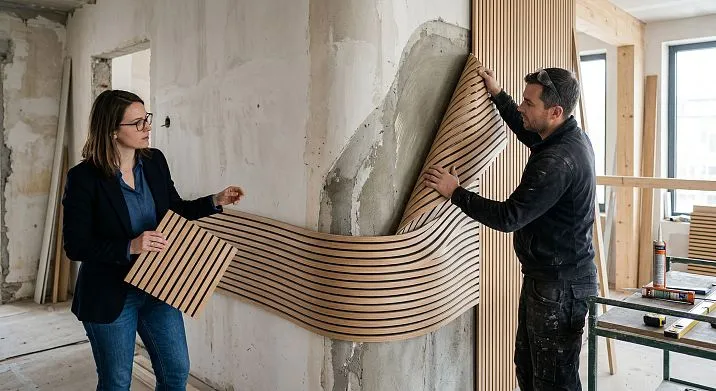
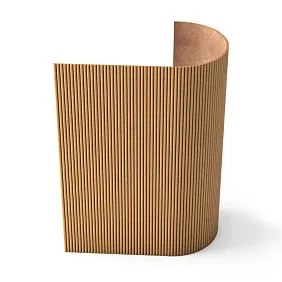
Flexible batten panels are constructed differently. The battens are attached not to a board, but to an elastic fabric or fiberglass base. There is free space between the battens, occupied only by the backing. This means each batten is not rigidly connected to its neighbors through a solid load-bearing layer: they are held together by fabric, which stretches, bends, and retains its shape without tearing. The construction bends to any radius—the battens remain parallel and straight, only the curvature of the base between them changes.
Minimum working radius—from 100–150 mm, depending on the width and thickness of the batten. This allows cladding a column with a diameter of 20–25 cm as a single module—a task impossible for rigid solutions.
Our factory also produces:




Fabric base: what it provides
The quality of the fabric backing is half the quality of the entire panel. The base is made from polyester mesh or non-woven material based on fiberglass. Requirements for it: elasticity when bending without permanent deformation (i.e., it should return to a flat state before installation), strength in holding the battens during transportation and installation, resistance to delamination under repeated bending. Base thickness—0.5–1.2 mm: an almost imperceptible layer that nevertheless determines how the panel will behave on a column or in a niche.
Get Consultation
Parameters important to know before ordering
-
Module width: standard—300 and 600 mm. For columns and arches, wider means fewer joints but higher requirements for base precision.
-
Module length: 1200, 2400, 2700 mm. Non-standard—available upon request.
-
Gap step between battens: 5, 8, or 10 mm—visually defines the 'density' or 'airiness' of the surface.
-
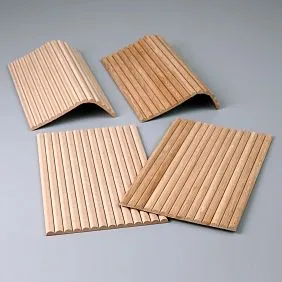
Slat profile: semicircular — standard, rectangular — more formal, custom — project-specific.
-
Slat material: paintable MDF or solid wood (oak, beech).
Where flexible slat panels are primarily needed
Flexible slat panels are irreplaceable where there is curvature. But specific application scenarios are important to analyze — each has its own logic.
Columns: from cylinder to ellipse
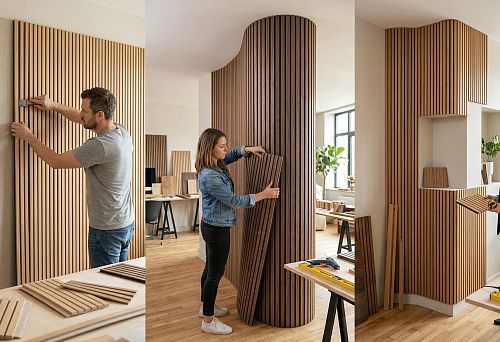
Cladding a column with wooden slats is an image that for decades required expensive carpentry work. Today, this is a task solved in a few hours.Flexible Slatted Panels for Columnsfollow round, square, or elliptical cross-sections without gaps or pattern distortion. A standard column 30–35 cm in diameter — that's 3–4 passes with a 300 mm wide panel and seamless vertical joining. The slat rhythm is maintained around the entire circumference: not a single batten breaks the geometry.
Important: on a column, pitch errors are especially noticeable. If the slat pitch is uneven — at the joint, the visual rhythm falls apart. This is not an installation error, but a production error. Choose panels with a pitch tolerance of ±0.2 mm.
Arches and arched openings
The inner surface of an arch is a curve for which there are no standard solutions from rigid material. Any attempt to clad an arched vault with a rigid slat ends either in material breakage or visible steps from small cut sections.Flexible slat panels for archesfollow the curve of the opening without steps, without gaps, without special equipment — only adhesive, precision, and an understanding of how to properly fit the module length to the arch width.
Radius walls
A smoothly rounded wall is a spatial characteristic that immediately defines its class. Hotel lobbies, apartments with signature architecture, designer restaurants — wherever there is a radius wall, slatted texture on it creates a monolithic wooden 'screen,' as if the slats grew directly from the room's form. Without seams, without breaks, without trimming for corners.
Niches with non-standard geometry
A niche always involves several surfaces: the back wall, side edges, possibly rounded transitions. A rigid panel works well on a straight niche, but if the niche has radius edges — only a flexible solution provides a unified texture without visible additional elements at the transitions.
Rounded corners and wave-shaped partitions
A rounded corner in a children's room, restaurant corridor, medical center — a common but technically complex scenario. Without a flexible panel, a special corner additional element is needed here, which still creates a visible seam. A flexible slatted panel simply wraps around the rounding — no additional elements, no seams.
A wave-shaped partition is already a design solution where flexible slatted panels become the only way to realize the concept: a sine wave of wooden slats in an office or restaurant enfilade — this is the result of skillful application of a fabric base, not joinery magic.
TV zones and accent walls
This is a straight, flat scenario. Here, the panel's flexibility is not needed — the slatted texture itself is needed. The vertical rhythm of the slats creates an accent, raises the ceiling, works as a 'wooden screen' behind the TV. On a straight wall, flexible and rigid panels provide the same visual result; the choice between them is a matter of construction, not design.
Furniture fronts with a curve
A curved bar counter facade, kitchen island, radius cabinet — previously, this meant ordering bent MDF from a joiner, long lead times, and high cost. Today, a flexible slatted panel solves the task in a few hours of installation. The slatted texture on a curved facade reads as custom furniture work — at a price significantly lower than joinery fabrication.
How flexible rail panels differ from rigid ones: an honest comparison
This question is key. And the answer should be specific, not marketing.
By construction
| Parameter | Rigid slatted panel | Flexible slatted panel |
|---|---|---|
| Base | MDF board / plywood | Elastic fabric |
| Bending | Impossible | Any radius from 100–150 mm |
| Application on columns | No | Main task |
| Application on arches | No | Yes |
| Application on flat walls | Ideally | Excellent |
| Installation on battens | Yes | Optional |
| Installation with adhesive | Yes | Preferred |
| Wall surface flatness accuracy | Maximum | Depends on the base |
| Joining | On the lathing | Slat to slat, without battens |
Installation
A rigid panel installed on an uneven substrate requires battens — otherwise the slab will replicate all irregularities. A flexible slat panel is installed with adhesive directly onto any shape: adhesive is applied to the fabric backing, and the panel is pressed onto the surface. On curved surfaces, temporary fixation with painter's tape is used until the adhesive fully polymerizes.
On joining
Rigid panels are joined via battens or special profiles — the joint always lands at a single point. Flexible panels are joined slat to slat: the end batten of one panel butts against the first batten of the next, with a gap equal to a standard inter-slat gap. When done correctly, the joint is visually imperceptible on any surface.
Where rigid is better, where flexible is the only option
Rigid is better:
-
on perfectly flat, straight walls — maximum geometry;
-
on ceilings with precise positioning on battens;
-
on furniture fronts without curves — higher rigidity and stability under load.
Flexible is the only option:
-
on any surface with a radius less than 3–4 m;
-
on columns, arches, rounded corners;
-
on wavy partitions;
-
on curved furniture fronts;
-
anywhere a seamless, uniform texture on a curved surface is needed.
Types of flexible slat panels: breakdown by materials and finishes
Choosing the slat material is both an aesthetic and practical decision.
MDF for painting: for precise color
MDF is a homogeneous medium-density fiberboard without pores or defects. MDF slats provide a perfectly smooth surface that accepts paint evenly along the entire length, without stains or inconsistencies. Any shade from RAL or NCS, any enamel — the result is predictable and precise.
Flexible slat panel PAN-002— This is deep-milled MDF on a fabric base with two layers of polyurethane primer-isolator. The surface is ready for final painting without additional on-site preparation. This is fundamentally important for projects with tight deadlines: no on-site priming, no intermediate steps — glue it, paint it, done.
Solid oak: for a natural texture
Oak is a living grain pattern, a warm hue, a tactile depth that cannot be achieved with MDF under any coating.Slatted panel PAN-001 made from solid oakis available with finish coating options: oil, wax, varnish, tinting. Each option highlights the natural structure in its own way: oil — soft depth and matte finish, wax — warm sheen, varnish — color richness and protection.
Solid beech: soft uniformity
Beech is lighter than oak, more uniform in grain. It takes tinting well, providing a restrained, 'calm' surface. Ideal for Scandinavian and Nordic styles — where texture is needed without a dominant grain pattern.
Semi-round profile: why it's the standard
The semi-circular cross-section of the batten is the most common in flexible-based slatted panels. It creates a pronounced play of light and shadow: with side lighting, each slat casts a soft shadow on the adjacent one — the surface 'comes to life,' gaining volume and depth. A rectangular profile is more strict, less 'warm,' suitable for minimalist and industrial interiors.
Primed panels: readiness for finish
Primed MDF panel is a special segment. Two layers of polyurethane primer seal the material's pores, level the surface, and create an ideal adhesion base for any enamel. This is a solution for interiors requiring a non-standard color and for commercial projects where installation speed without intermediate technological cycles is important.
How to choose flexible slat panels for a specific task
Now — from general to specific. Let's examine specific application scenarios.
For an apartment: accent and atmosphere
In apartment interiors, flexible slat panels are most commonly used in three scenarios:
Accent wall in the living room. Behind the sofa, behind the TV — a vertical slat rhythm raises the ceiling and creates structure. Oak with an oil finish — for a warm Scandinavian look. MDF in a contrasting color — for a modern minimalist style.
Headboard in the bedroom. A slat panel behind the bed replaces a panel and expensive finishing. Light beech or white MDF — does not overload the space.About decorative wooden panels for accent zones— a detailed breakdown for living spaces.
TV niche or decorative niche. Here it is especially important that the niche often has rounded or non-standard edges — and this is the first scenario where the flexibility of the panel is truly needed.
For a country house
In a country house, natural texture is important. Oak with an oil or wax finish is organic in a space with wooden ceiling beams, a stone fireplace, and linen curtains. Flexible oak panels for interior finishing of a wooden house are a way to add a wooden accent without heavy wooden cladding.
For offices and meeting rooms
In the office, slatted panels serve several functions simultaneously: visual accent, zoning, and creating a sense of 'cabinet-like' enclosure. MDF for painting in a dark neutral tone is for representative meeting rooms. Tinted oak is for the director's office.About flexible slatted panels for commercial and designer spaces— here, solutions for columns in halls and arched transitions are also described.
For restaurants and hotels
Commercial interiors have special requirements. Installation speed, durability of the finish, and the ability to work with complex building geometry. A reception desk with a radius front, a bar counter with a curved facade, an arched entrance group—all of this is implemented on flexible slatted panels without expensive joinery work. For restaurants—MDF in enamel is resistant to cleaning.
For a narrow corridor
A narrow corridor is an area where design mistakes are especially noticeable. Wide slats with large spacing will create an oppressive rhythm. The correct choice: narrow slats (20–25 mm), frequent spacing (5–8 mm), light shades. Vertical orientation—always: it visually elongates the space. Flexible slatted panels for corridors are especially useful if there are rounded corners—and in corridors, they are often found.
For furniture: facades and bar counters
A curved furniture facade made of wooden slats—a premium look at a reasonable cost. MDF slats with polyurethane enamel withstand repeated opening of the facade. Oak slats—for furniture where texture is important. It is important to clarify the minimum radius for the chosen finish when ordering: it differs between MDF and solid wood.
For complex geometry: from an arch to a wavy partition
This is the ultimate application scenario.Flexible slat panels for partitions and complex surfaces— here, the full range of non-standard tasks is revealed. A wavy partition in an office, a radius wall in an apartment, a dome in a niche — all of this is achievable with a fabric base and without special equipment.
How flexible slat panels are installed: a step-by-step guide
Installation is not just 'glue it on'. Every stage affects the outcome.
Foundation Preparation
Three requirements for the substrate: dryness (moisture up to 12–14%), strength (no flaking areas), flatness (within the adhesive's tolerance). Drywall and cement plaster are the best surfaces. Concrete, aerated concrete block — must be primed. Old plaster with cracks — first reinforce, then install.
No manufacturer can ensure quality installation on an unprepared substrate. This is an axiom.
Marking
The first vertical line sets the entire rhythm of the cladding. A 2 mm deviation at the start results in a noticeable skew by the third or fourth panel. Tools: laser level or bubble level with a plumb line. On columns — level by the first slat of the first module.
Cutting
Crosscut — with a utility knife along the fabric base (slats are carefully cut from the top). Rip cut and 45° miter cuts — miter saw or jigsaw. For finishing an external corner: cut both adjacent panels at 45° and join the ends.
Applying adhesive
Adhesive is applied to the fabric base — not to the wall. A notched trowel ensures an even layer without 'sinking' into the fabric texture. Recommended adhesives — polyurethane or acrylic-based. On flat walls, high-strength double-sided mounting tape is acceptable.
Securing and curing
On flat surfaces — roll with a hard roller for even pressure. On columns and arches — secure with painter's tape at 5–8 points for 20–40 minutes until strength is achieved. After removing the tape — complete fixation.
Module Joining
Joining — batten to batten: the first batten of the new panel adjoins the last batten of the previous one with the same gap as the standard batten spacing. This requires that the end battens of both modules be at the same distance from the edge of the fabric base — equal to half the standard gap. Only this design ensures a visually continuous rhythm.
Finishing corners and radii
-
External right angle: cut at 45°, join end-to-end;
-
Rounded corner: the panel wraps around the rounding without additional parts;
-
Transition from curve to plane: the last batten of the curved section butts against the first batten of the straight section — the gap is maintained;
-
Adjacency to the ceiling: skirting board or decorative profile matching the battens.
Transition from a radius surface to a flat one
This is a technically complex area that requires planning. The transition point should be chosen so that the panel 'unfolds' from the bend without deforming the battens. It is recommended: fix the last 5–7 cm of the curved section with adhesive having a longer open time — this allows for precise fitting.
Errors in selecting and installing flexible batten panels
This is practice gathered from real projects.
Using rigid battens on a curved wall
The most common mistake. Sometimes the seller 'didn't clarify', sometimes the buyer 'thought it would bend'. MDF backing breaks on a radius of less than 3–4 meters. The result is broken material, wasted time, and rework.
Not considering the radius when choosing a model
The minimum radius depends on the width and thickness of the batten. Narrow, thin moldings bend better than wide and thick ones. If your column is narrow, check the minimum radius of the specific model before ordering.
Not planning joints in advance
Joints should fall in technically justified or visually inconspicuous places: in corners, behind furniture, on neutral wall sections. A joint in the center of an accent wall, in the most visible spot, is a layout error that can only be fixed by redoing it.
Choosing too active a rhythm for a small room
Wide battens with large gap spacing in a small hallway or narrow niche overload the space. The scale of the batten should match the size of the room: narrow battens, frequent spacing for compact spaces.
Not thinking about the direction of the battens
Vertical lines raise the ceiling. Horizontal lines expand the space. Diagonal lines add dynamism and uniqueness. This is not a technical but an architectural choice that must be made before installation—not during.
Do not overlook the transition to furniture or a niche.
If slatted panels are to continue onto a furniture front or inside a niche, the slat spacing on the wall and the front must match. A discrepancy of 1–2 mm ruins the entire design concept of a unified space.
Mounting on an unprepared surface.
Again, because it's truly important: a poor-quality base is the main reason for peeling within 6–12 months. No adhesive can compensate for crumbling plaster or a 'greasy,' unpainted concrete surface.
What determines the price of flexible slatted panels.
Price is not arbitrary; it's a structure of production and logistics costs.
Material of the slats
MDF is the basic price level. Solid oak is 30–60% more expensive. Solid beech is in between. Rare species (walnut, ash, American maple) require individual calculation.
Priming
Primed MDF panels are more expensive than unprimed ones. However, when factoring in the cost of on-site priming, the difference typically favors factory priming. Two layers of polyurethane insulating primer applied under production conditions yield results that cannot be replicated on-site for a reasonable cost.
Profile of the slat
Standard semi-circular profile offers the optimal price. A custom profile for the project involves individual milling and a corresponding markup.
Gap step
A narrow gap (5 mm) creates a 'dense' surface with wood predominance. A wide gap (10 mm) creates an 'airy' surface with pronounced rhythm. Visually, these are very different results at the same cost.
Order volume
A large order from a manufacturer is always more cost-effective per square meter. For commercial projects — calculate the entire volume at once, order in a single batch.
Surface complexity
Installation on straight walls is standard. Installation on columns and arches has higher labor intensity. Wavy partitions are the highest complexity. This is factored into the installation cost.
Stavros organizes delivery within Moscow using its own transport or partners with logistics providers for delivery to regions. Packaging ensures the preservation of even delicate carved elements.
Panels 2700 mm long are long-length cargo. For regions, this is a separate budget item. Calculate the total cost including delivery, not just the product price.
FAQ — answers to the most common questions
What are flexible slat panels?
These are slat modules where wooden or MDF battens are glued onto an elastic fabric base at equal intervals. The structure bends to any radius — for cladding columns, arches, radius walls, and curved furniture fronts.
How do flexible slat panels differ from rigid ones?
Rigid panels are on a dense MDF board, only for flat surfaces. Flexible panels are on a fabric base, for any curved surfaces. The visual result is identical; the construction and application possibilities are different.
Where are flexible slat panels used?
Columns, arches, radius walls, rounded corners, niches with non-standard edges, curved furniture fronts, wave-shaped partitions, reception desks with a radius front, bar counters.
Are flexible slat panels suitable for columns?
Yes — this is one of the key tasks. A panel 300 mm wide wraps around a column 30–35 cm in diameter in 3–4 passes without visible seams.
Can flexible slat panels be used on furniture?
Yes. Curved furniture fronts — bar counters, islands, cabinets with a radius front — are a standard application scenario.
Are flexible slat panels suitable for radius walls?
Yes, that's exactly what they exist for. Minimum radius — from 100–150 mm depending on the model.
Can flexible slat panels be painted?
MDF slats can be painted with any enamel. The primed version PAN-002 is ready for finish painting without additional preparation.
What to glue flexible slat panels with?
Mounting adhesive on a polyurethane or acrylate base, applied to the fabric backing of the panel. No battens required.
Are the joints between flexible slat panels visible?
With proper joining — no. Joining is slat-to-slat, maintaining the standard spacing. The first module — strictly level.
Are battens needed under flexible slat panels?
No — installation with adhesive onto a prepared substrate. Battens are relevant for rigid panels on an uneven surface.
Can flexible slat panels be glued onto drywall?
Yes. Drywall is one of the best substrates for adhesive installation.
Are flexible slat panels durable?
Solid oak — decades with proper care. Painted MDF — long-term use without replacement. The key condition is quality installation onto a prepared substrate.
How to care for flexible slat panels?
Dry or slightly damp soft cloth. No abrasives. For solid wood with oil finish — oil renewal every few years.
Are flexible slat panels suitable for corridors?
Yes — especially with rounded corners. In narrow corridors: narrow slats, frequent spacing, light shades.
Can flexible slat panels be used in commercial interiors?
Yes. The durability of the finish (polyurethane enamel on MDF) allows them to be used in restaurants, hotels, offices, and retail spaces.
Summary: when flexible slat panels are specifically needed
The rule is simple. If the surface is straight — rigid slat panels provide better geometry and structural rigidity. For flat walls, straight furniture fronts, ceilings — this is the optimal choice.
If the surface is curved — flexible panels are irreplaceable. Columns, arches, radius walls, rounded corners, curved fronts — anywhere with a radius less than 3–4 meters, only fabric-backed flexible panels deliver results without visible seams or deformations.
Regarding slat material:
-
MDF for painting — when precise color is needed, monochrome interior, quick readiness for final painting;
-
Solid oak — when natural texture, live wood grain pattern, and oil, wax, or lacquer finish are important.
Full range of flexible and rigid slatted solutions — in STAVROS slatted panels catalog. To start — flexible panel PAN-001 made of solid oakandPrimed MDF panel PAN-002 — both options on a fabric base for any surfaces. Additional application context — in the complete guide to slatted panels and in the article about DIY installation of slatted panels.
About the company STAVROS
STAVROS is a Russian manufacturer of decorative products made from solid wood and MDF, specializing in slatted panels for interior finishing of residential and commercial spaces. The company's range includes rigid slatted modules for flat surfaces and flexible slat panels on a fabric base for columns, arches, curved walls, niches, and curved furniture fronts.
STAVROS produces panels from solid oak and beech, as well as paintable MDF — including primed modules ready for final finishing without on-site preparation. The company works with designers, architects, furniture manufacturers, and commercial clients across Russia, manufacturing products tailored to specific projects: material, slat profile, gap spacing, dimensions, and finish coating — all customized to the client's requirements.