Article Contents:
- Flexible slat panels: what they are and where they're truly needed
- Three situations where flexible slat panels are the only correct answer
- Flexible slat panels for walls: how they're better than regular slats
- Where flexible slat panels are used: a complete overview of applications
- Flexible slat panels for columns
- Flexible slat panels for arches
- Flexible slat panels for niches
- Flexible slat panels for radius walls
- Flexible slatted panels for furniture fronts
- Straight walls: TV area, headboard, accent wall
- Commercial spaces: office, reception, restaurant
- What flexible slatted panels are available: materials, construction, formats
- Flexible MDF slatted panels
- Flexible slatted panels on fabric base made of solid oak
- For painting or wood finish
- Slat profiles: rectangular and semicircular
- How to choose flexible slatted panels by material
- How to choose flexible slatted panels for complex surfaces
- Flexible slat panels for columns
- Flexible slat panels for arches
- Flexible slat panels for niches with rounded corners
- Flexible slat panels for radius walls
- Flexible slat panels for furniture fronts
- How to choose based on interior design task
- What to check before purchase: 10 essential parameters
- Installation of flexible slat panels: key considerations before purchase
- Surface Preparation
- Adhesive Selection
- Cutting
- Mounting on curved surfaces
- Module joining
- Typical installation mistakes
- What determines the price of flexible slat panels
- Mistakes when choosing flexible slat panels: honest checklist
- What to choose for different scenarios
- Flexible Slatted Panels and Lighting: An Unobvious Union
- Flexible Slatted Panels and Acoustics: A Practical Bonus
- Internal Linking: Related Materials on the Topic
- FAQ: answers to the most frequently asked questions
- Conclusion: Flexible Slatted Panels — When Exactly Are They Needed
- About the Company STAVROS
There are questions that seem technical, but behind them lies a real interior design challenge. 'Flexible slatted panels' is exactly such a request. The person has already seen slatted finishes, already understood that they want exactly that — but encountered an obstacle: the wall curves, leads into an arch, transitions into a column. And a regular rigid panel simply doesn't work here.
Flexible slatted panels— is the answer to the challenge that the rigid format cannot solve. In this article, we'll cover everything: construction, materials, application by surface type, installation nuances, pricing factors, and the most common mistakes when choosing. No fluff, with specifics — for those who have already made the decision and are now thinking about how to implement it precisely.


Flexible Slatted Panels: What They Are and Where They Are Truly Needed
Let's start with the construction — without this understanding, it's impossible to make an informed choice.
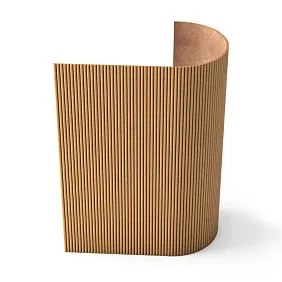
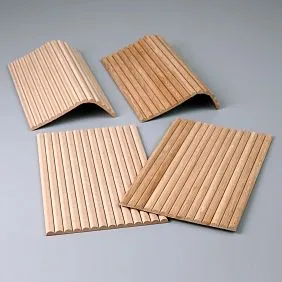
A flexible slatted panel is a construction where individual slats made of MDF or solid wood are fixed at equal intervals on an elastic fabric base. The gaps between the slats are not just decorative spaces. They are what provide the structure with its main functional property: to bend across, following a curved surface, while maintaining the unchanged rhythm and spacing of the slats.
This is a fundamentally different logic compared to a rigid panel. A rigid slatted module consists of slats glued or fixed onto an MDF board. A monolith. It is flawless on a flat plane, but when attempting to bend it along a radius, it immediately fails: the board cracks, the slats come loose. No flexibility — only a flat surface.
A flexible slatted panel works differently: the fabric base allows for transverse bending without stress or distortion of the pattern. One material works for a column, arch, radius wall, and flat plane simultaneously.
Hence the essence of the search query 'flexible slatted panels': it's not an attempt to find a review, it's a specific task with curved geometry and a search for a solution that can handle it.




Three situations where flexible slatted panels are the only correct answer
First. The surface curves. A radius wall, cylindrical column, arched vault, rounded corner—anything that isn't a flat vertical plane. A rigid panel requires manual cutting into narrow strips, fitting, and filling gaps. A flexible one lays over the form like a single sheet.
Second. Continuity of the slatted pattern across a transition is needed. For example, a straight wall transitions into an arched opening, and from it back into a straight one. A flexible panel creates a seamless rhythm of slats across the entire transition. A rigid format creates a visible joint at the transition point.
Third. A furniture front with curved geometry. A radius cabinet, a curved kitchen island, a rounded corner shelving unit—all require a panel that follows the form, not resists it.
Our factory also produces:

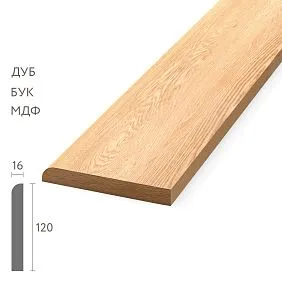


Flexible slatted panels for walls: how they are better than ordinary slats
A question many have: why use a panel at all? Why not assemble individual slats and glue them on one by one?
The answer is both technical and practical.
Individual slats require manual layout. Each one needs to be leveled, spaced evenly, and secured. On a flat wall, this is still tolerable. On a column or arched vault—it's work that requires a professional carpenter, marking tools, and several hours of precise labor.
A flexible slat panel is a ready-made module. The slat spacing is already maintained. The rhythm is already set. The ends are already prepared for joining. The installer works with a finished element, not assembling a puzzle from individual strips.
Module joining is seamless. With precise geometry of the panel ends, the slat-to-slat joint visually disappears—the surface is perceived as continuous. A set of individual slats does not achieve this result: deviations accumulate, and the longer the surface, the more noticeable the departure from the rhythm.
The fabric base is an additional load-bearing structure. It holds the slats at a uniform distance, preventing them from shifting during bending and thermal fluctuations. This is especially important on curved surfaces.
Thus,Flexible slatted panels— is not just 'slats on fabric'. It is a structurally verified finishing element with predictable behavior and precise geometry.
Get Consultation
Where flexible slat panels are used: a complete overview of applications
Before choosing the material and format—you need to understand exactly where the panel will be installed. Because the surface dictates the requirements for flexibility, size, installation method, and minimum working radius.
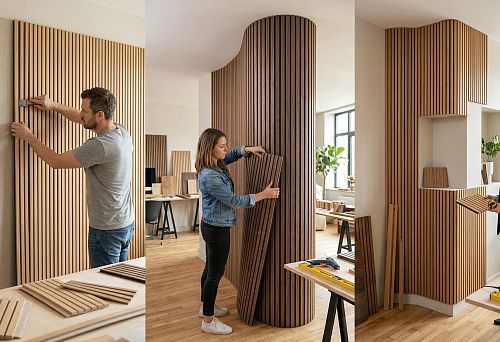
Flexible slat panels for columns
A cylindrical column is the absolute limit for any rigid panel. It is physically impossible to cover a closed cylinder with a monolithic module without visible, coarse seams.
A flexible slat panel wraps around the column along the entire perimeter. The only joint is hidden in the least noticeable point—usually on the side hidden from the main viewing angle. The decorative slat rhythm closes into a ring, and the column transforms from an architectural drawback into a full-fledged accent element.
Important technical note: before ordering, clarify the minimum working bending radius for the specific model. Not every flexible panel bends to a small radius—it all depends on the slat thickness, gap width, and density of the fabric base.
Flexible slat panels for arches
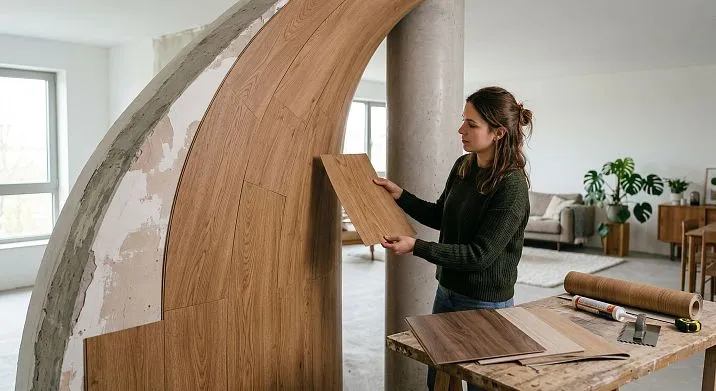
An arched opening with slat cladding is one of the most striking architectural techniques. The slats follow the curve of the vault, maintain an even spacing, and smoothly transition into the adjacent straight walls.
For an arch, precise layout is crucial: the slat rhythm must continue through the transition without shifting or disrupting the spacing. This requires proper fitting before installation and precise cutting at the transition points.
Flexible slat panels for niches
A flat niche with right angles is solved with a rigid format. A niche with rounded transitions requires a flexible one. Nuance: joints in a niche are more noticeable than on an open wall, so higher demands are placed on the accuracy of the end cuts.
Flexible slat panels for radius walls
A radius wall with a smooth curve—in an office, restaurant, or apartment with a non-standard layout—requires either manual cutting of a rigid panel into narrow strips or a flexible format. The second option yields a significantly cleaner result with less labor.
Flexible slat panels for furniture fronts
Radius cabinets, curved kitchen islands, rounded corner sections—a flexible slat panel on such fronts replaces expensive custom carpentry. One module wraps around the form and creates a single surface without fitting or assembly from fragments.
Straight walls: TV zone, headboard, accent wall
Hereflexible slat panels for wallsperform on par with rigid ones, and the format choice is determined by other factors — budget, installation preferences, planned lighting.
Commercial spaces: office, reception, restaurant
In commercial interiors, slat cladding serves a representative function. The flexible format is indispensable in spaces with radius walls, columns, arched transitions — and there are significantly more of these in commercial architecture than in standard residential construction.
What types of flexible slat panels exist: materials, construction, formats
Not all flexible slat panels are the same. Different constructions, different materials, different behavior during installation, and different visual results — all of this needs to be understood before ordering, not after.
Flexible MDF slat panels
MDF (medium-density fiberboard) — the main material for most market offerings. The structure is homogeneous and dense, the surface is smooth, without a natural grain pattern. This makes MDF an ideal material when:
-
precise, reproducible color is important — for painting according to RAL, NCS, Pantone;
-
uniformity of the batch without natural color variation is needed;
-
Repainting is planned in the future without dismantling;
-
The budget requires optimization.
In the STAVROS catalog, the flexible PAN-002 model is precisely a primed MDF panel on a fabric base, ready for the application of a finish coating. An ideal start for a color-accurate project.
Flexible slat panels on a fabric base made of solid oak
Solid wood is living texture, warmth, and durability. Oak with a density of 700–750 kg/m³ withstands the mechanical load of public spaces better than any MDF. Each slat carries a unique natural grain pattern that cannot be reproduced by film or veneer.
Under transparent oils, oak reveals a warm golden tone. Tinting oils provide a range from light Scandinavian to rich wenge.
The PAN-001 model from the STAVROS catalog is a slat panel on a fabric base, designed for both flat surfaces and curvilinear geometry. Used in residential and commercial interiors where natural texture is part of the design concept.
For painting or wood finish
Division by finish result is no less important than by material:
-
For painting — primed MDF, a uniform surface without texture. Complete freedom in color choice.
-
Under wood — solid oak or MDF with tinting. Natural or simulated wood grain texture.
It's important to understand: 'wood-like' is not about color, it's about the character of the surface. MDF can be painted any warm shade, but it won't have the natural fiber texture. If the goal is specifically a living texture — that's solid wood material.
Slat profiles: rectangular and semicircular
Rectangular profile (bead with straight edges) gives a rigid, architectural shadow — a clear boundary between the slat and the gap. Modern, strict character.
Semicircular profile (classical bead) gives soft, plastic chiaroscuro — a smooth transition from slat to gap. Warmer, more natural character.
Profile choice is a design decision. It determines the mood of the surface under accent lighting.
How to choose flexible slat panels by material
The selection system is simple if you approach it sequentially.
Step one. Determine whether you have a requirement for an exact color or if natural texture is important to you.
-
Exact color from palette → MDF for painting.
-
Natural texture, living fiber → solid oak.
Step two. Assess the operating conditions.
-
Residential interior with calm load → both materials are suitable.
-
Commercial space with high traffic → solid oak is preferable for strength.
Step three. Consider the features of the finish coating.
MDF for painting requires priming and paint application — this is work that needs to be planned separately. Primed models (like PAN-002 from STAVROS) are already ready for finishing without additional preparation.
Solid oak is supplied either without coating (finish application of oil or varnish on site) or with factory tinting. Clarify when ordering.
Step four. Correlate the budget with the task.
MDF — more affordable. Solid oak — more expensive. But don't look for 'the cheapest flexible slat panels': a panel with a loose fabric backing that tears when bent on a column costs significantly more — through rework, reinstallation, and lost time.
How to choose flexible slat panels for complex surfaces
This is the most important section for those dealing with non-standard geometry. We'll break it down by scenarios.
Flexible slat panels for columns
Requirements:
-
minimum working bend radius — must match the column radius;
-
end accuracy — the joint should be minimally noticeable;
-
strength of the fabric base — when wrapping around a cylinder, it experiences constant tension.
Practice: before ordering, measure the column diameter, calculate the radius (diameter / 2), and check with the manufacturer if the specific model works with this radius. Don't assume — ask directly.
Flexible slat panels for arches
Requirements:
-
uniform slat spacing along the entire arc;
-
smooth transition from the arch to adjacent straight walls without rhythm shift;
-
allowance for cutting — arched geometry produces more waste than straight.
Practice: make an arch template from cardboard, place it on the panel, and check the slat layout at transition points before starting installation.
Flexible slat panels for a niche with rounded corners
Requirements:
-
precise geometry of end faces at transition points;
-
seamless joining — in a niche any gap is more visible than on an open wall.
Practice: for a niche it is recommended to start the layout from the center — this guarantees symmetry of the slat rhythm.
Flexible slat panels for radius walls
For a smooth wall arc, the width of the gap between the slats is most important: the wider the gap — the smaller the bending radius is achieved without material stress. Specify the minimum working radius.
Flexible slat panels for furniture fronts
On furniture fronts, the panel faces increased requirements for adhesion: the surface is vertical, the load on the adhesive is constant. Use structural adhesive with high initial adhesion.
How to choose based on the interior design task
Different spaces — different priorities. A systematic view helps make a decision without unnecessary doubts.
Apartment. Accent wall in the living room, headboard in the bedroom, decoration of the hallway or corridor.Flexible wall panel slatsare needed where there are arched openings, rounded niches, or non-standard geometry. On straight walls — both rigid and flexible formats work.
Country house. Natural atmosphere, warmth of natural materials. Solid oak — an organic choice. Flexible format — for arched openings and rounded transitions, which are significantly more common in country houses than in standard apartments.
Office and meeting room. Representativeness, strictness, quality of first impression. Oak with dark tinting — a classic solution for meeting rooms. Neutral MDF panel — for work areas.
Reception. High traffic, visual focus, radius counters — all this requires a flexible format made of durable material. Solid oak is preferable here.
Restaurant, cafe, hotel. Atmosphere is created by texture and chiaroscuro. Flexible slatted panels for arched areas, columns, and radius walls — a standard tool for the project team.
Design project. For a professional, predictability of the material is important: precise end geometry, stable batch tone, possibility of ordering custom sizes.flexible panels on a fabric basefrom the STAVROS catalog meet exactly these requirements.
What to look for before buying: 10 essential parameters
System checklist — go through each item before placing an order.
1. Surface geometry. Is there curvature? If yes — specify the minimum radius of curvature when requesting.
2. Minimum working bend radius. Check for the specific model. Not all 'flexible' panels are equally flexible.
3. Slat material. MDF or solid oak. This is the first and key choice.
4. Slat width. Narrow (10–20 mm) — dense, detailed rhythm. Medium (25–40 mm) — universal scale for most living spaces. Wide (50+ mm) — brutal rhythm for spacious commercial halls.
5. Spacing between slats. Affects the visual density of the surface, the flexibility of the panel, and the acoustic scattering effect.
6. Slat profile. Rectangular — strict. Semi-circular — soft. Matches the interior style.
7. Fabric backing. Dense, durable fabric is a sign of quality. Check on a sample: stretch, bend, evaluate its behavior. Loose backing tears when bent.
8. End precision. Place two samples end-to-end: slat to slat, without a gap. This is the only way to check the joint before installation.
9. Length and format. Standard length or custom order. The longer the module — the fewer joints on a large surface.
10. Material calculation. Surface area + 8–12% for cutting and waste. Entire volume — from one production batch.
Installation of flexible slat panels: what to consider before purchase
Installation is a continuation of selection. A quality panel installed incorrectly won't deliver the desired result. Conversely: proper installation fully reveals the material's potential.
Surface preparation
This is the foundation — literally. Neglecting this stage means creating a problem with delayed manifestation.
The surface must be:
-
clean: free of previous coating residues, dust, grease;
-
dry: absence of residual moisture — mandatory;
-
strong: loose and crumbling surfaces are treated with deep penetration primer;
-
level: variations exceeding 5 mm per linear meter are leveled with putty.
Minor irregularities (up to 2–3 mm) are acceptable — adhesive will compensate for them when applied correctly.
Adhesive selection
Structural mounting adhesive with high initial adhesion — standard for slat panels on vertical surfaces. Important parameters:
-
High initial tack – to prevent the panel from sliding under its own weight before full curing;
-
Absence of aggressive solvents – some adhesives can attack the fabric backing;
-
Compatibility with the specific substrate type (concrete, drywall, plaster).
If in any doubt – check with the panel manufacturer for recommended adhesives.
Cutting
MDF slats are cut with a utility knife with a sharp blade along the fabric backing line – the cut is clean, without chips. Solid oak – use a fine-toothed saw or miter saw. The cut angle for end joints is strictly 90°. For mitered corners – 45° on both sides.
Installation on curved surfaces
On a straight wall: adhesive is applied in a zigzag pattern on the fabric backing, and the panel is pressed smoothly from one edge to the other.
On a column or arch: adhesive is applied to the backing and the surface. Work gradually, holding pressure for 5–10 seconds on each section of the curve. Do not try to fix the entire panel at once – the material should conform to the surface shape smoothly.
Module Joining
End to end, slat to slat – without gaps or overlaps. Check for levelness with a level after each module. While the adhesive is not set – the position can be adjusted.
Typical installation errors
-
Damp substrate – adhesive does not hold, the panel detaches after a few weeks;
-
Excess adhesive — seeps into gaps between slats, contaminates the surface;
-
Sharp bending on a small radius without checking the minimum working radius — pattern deformation;
-
Joining without checking the level — accumulated deviation is visible on a large surface.
What determines the price of flexible slat panels
Pricing is transparent — if you know what exactly affects the final cost.
Slat material. The main factor. MDF — more affordable. Solid oak — significantly more expensive. The difference is justified by the difference in aesthetics, tactile feel, and service life.
Slat width and profile. Non-standard profiles and non-standard width — more expensive than serial formats.
Coating. Without finishing — base. Primed surface — higher. Factory tinting or special coating — maximum.
Module length. Standard lengths — serial price. Non-standard lengths for a specific project — surcharge for custom production.
Order volume. Large batches — wholesale terms. For B2B inquiries (design studios, furniture manufacturers, developers) — clarify cooperation terms separately.
Delivery. In Moscow and across Russian regions — cost depends on volume and geography.
The principle is the same as with any purchase: don't look for 'the cheapest flexible slat panels' — look for the optimal solution for your specific task. A panel with a loose base that tears during installation on a column ends up costing more than any quality product. For more details on the current price range — see the article.flexible panels: priceon the STAVROS website.
Mistakes when choosing flexible slat panels: an honest list
These mistakes occur regularly — regardless of experience and budget.
1. Confusing decorative slats and full-fledged slat panels.
A thin decorative strip for a flat surface is not the same as a flexible slat panel on a fabric base. Different construction, different installation, different behavior when bending.
2. Ignoring the minimum working radius.
'Flexible panel' does not mean 'bends in any direction to any radius'. Each model has a technical limit. Ordering a panel without checking the radius is a risk.
3. Choosing based only on photos.
The photograph shows the color and rhythm of the slats. It does not convey the density of the fabric base, the precision of the ends, or the actual elasticity of the material. Request a sample before ordering a large volume.
4. They do not check the joint alignment.
Testing two samples end-to-end is a mandatory step before ordering. An imprecise end creates a visible gap that cannot be corrected during installation.
5. They do not account for cutting allowance.
For a straight wall — 8–10% allowance. For a curved wall, with arches, columns — 12–15%. If you don't account for it, you'll run out of material in the middle of installation.
6. The entire volume from different batches.
Especially critical for solid oak: the natural color variation between batches can be significant. Order the entire volume as one production order.
7. Incorrect choice of adhesive.
Adhesive not intended for vertical loads or incompatible with the fabric base is a direct path to delamination.
What is better to choose for different scenarios
| Surface / Task | Format | Material |
|---|---|---|
| Straight accent wall | Rigid or flexible | MDF or solid wood |
| TV zone | Rigid or flexible | MDF for painting |
| Bed headboard | Rigid or flexible | Solid wood or MDF |
| Column | Flexible only | Solid wood or primed MDF |
| Arch | Flexible only | Solid wood or MDF |
| Niche with rounded corners | Flexible only | MDF or solid wood |
| Radius wall | Flexible only | Based on budget and task |
| Straight furniture front | Rigid | MDF |
| Curved furniture front | Flexible only | MDF or solid wood |
| Reception, restaurant | Flexible (if bends are present) | Oak solid wood |
| Commercial office | Rigid or flexible | Solid wood or MDF |
Flexible slatted panels and lighting: an unobvious union
To talk about flexible slatted panels and not mention lighting is to miss half the effect. A slatted surface and directional light are a pair that work together.
Directional spotlight. At a sharp angle to the surface, spotlights create clear shadows in the gaps. Slats are strips of light, gaps are strips of shadow. The surface gains maximum volume.
LED strip in the gaps. If the cable route is laid before installation, an LED strip can be placed in the gaps. Soft glow from within is an atmospheric, delicate effect. Especially good for bedrooms and restaurant halls.
Backlighting behind the panel. When installed on a frame with an air gap, the LED strip behind the panel provides diffused ambient light that shines through the gaps between the slats. Effective for curved walls and columns.
Plan lighting and the panel simultaneously — adding hidden wiring after installation is significantly more difficult.
Flexible slatted panels and acoustics: a practical bonus
A slatted surface is not just about aesthetics. Vertical slats scatter sound waves, breaking up direct reflection from a flat wall. The result is reduced reverberation and improved acoustic comfort.
The effect is especially noticeable in rooms with high ceilings and hard surfaces: meeting rooms, restaurant halls, lobbies, open-space offices. When installed on a frame with acoustic absorber placed behind the panel, the effect is enhanced — decorative finishing turns into a functional acoustic solution.
Learn more about the application ofslatted panels for walls and ceilings— in a separate STAVROS article.
Internal linking: related materials on the topic
If you are studying the topic systematically, we recommend reviewing the complete set of materials:
-
Flexible wall panel for interior finishing— detailed breakdown of construction and selection parameters;
-
flexible wall panels for interior finishing— solutions for modern interiors;
-
Interior flexible wall panels— how to choose for a stylish and practical interior;
-
flexible panels: price— what determines the cost and how to choose without overpaying;
-
Application options for wall panels— ideas and solutions for residential and commercial interiors.
FAQ: answers to the most frequently asked questions
Can flexible slat panels be used on a column?
Yes. This is one of the main application scenarios. The panel wraps around the cylindrical column along the entire perimeter, with the only joint hidden in the least noticeable point. Please check the minimum working bending radius for the selected model beforehand.
Can it be installed on an arch?
Yes. An arch is a standard task for the flexible format. It's important to maintain the continuity of the slat rhythm when transitioning from the arch to the adjacent straight walls.
Can flexible MDF panels be painted?
Yes. Paint-grade MDF is specifically designed for this. Primer + two coats of finish paint. Subsequent repainting without dismantling is allowed.
Can it be used on furniture?
Yes. Flexible slat panels are actively used for curved furniture fronts, radius cabinets, curved kitchen islands, rounded shelving units.
Which material is better — MDF or solid oak?
Depends on the task. MDF — when precise color and budget are important. Oak — when natural texture, durability, and tactility are important. In commercial spaces with high traffic — oak is preferable.
How to calculate the number of panels?
Area of surfaces to be finished (in m²) + 8–12% margin for cutting and trimming. For complex geometry (arches, columns) allocate 12–15%. The entire volume should be from a single batch.
Are flexible slat panels suitable for complex geometry?
Specifically for it. Complex geometry is the primary use case for the flexible format. For a simple straight wall, the rigid format is even preferable in a number of parameters.
Can flexible and rigid slatted panels be combined in one interior?
Yes, and it is the optimal strategy. Use rigid modules on flat planes, and flexible ones on transitions and curved surfaces. With the same pitch and slat width, the transition between formats is visually unnoticeable.
What adhesive to use for installation?
Structural mounting adhesive with high initial adhesion, without aggressive solvents. Check the specific brand with the panel manufacturer — this guarantees compatibility with the fabric base.
Can flexible slat panels be installed independently?
Yes, if you have experience working with installation materials. Key skills: precise cutting, working with a level, correct adhesive application. For complex surfaces (columns, arches), it is recommended to involve an experienced installer.
Minimum bending radius — what is it and how to determine it?
Minimum working radius — the smallest value of the curvature radius at which the panel bends without deforming the pattern or damaging the base. Its value depends on the design of the specific model. Check with the manufacturer for each model separately.
Conclusion: flexible slat panels — when exactly are they needed
Let's summarize without unnecessary rhetoric.
Flexible slat panels are a tool for a specific task. They solve a problem that rigid formats cannot physically address: continuous slat finishing on curved surfaces. Columns, arches, radius walls, rounded niches, curved furniture fronts — this is where the flexible format is indispensable.
On a straight wall, it performs equally well as rigid panels and is often chosen for installation flexibility or future compatibility with curves.
The right choice involves consistently considering all parameters: surface geometry, slat material, width and spacing, profile, base type, end precision, volume calculation. Each parameter is important — and each affects the final result.
About the company STAVROS
When an interior task requires a precise technical solution — professionals turn to STAVROS.
STAVROS is a manufacturer of slat panels made of MDF and solid oak for interior finishing, including flexible modules on a fabric base for working with radius surfaces, columns, arches, niches, and curved furniture fronts. Production covers serial formats for residential and commercial interiors, as well as custom solutions for non-standard sizes, custom tinting, and project volumes.
STAVROS offers precise end geometry, stable batch tone, durable fabric base, surfaces ready for finishing coating. Delivery in Moscow and throughout Russia.
A complete catalog of current models, technical parameters, and professional consultation for your specific project — in the section Flexible slatted panels on the official website.