Article Contents:
- What are flexible wall panels for interior finishing
- What are the advantages of flexible wall panels
- Working with any geometry
- Decorative appeal without complications
- Wide range of textures
- Seamless joining
- Mounting with adhesive
- Where flexible panels are used in interior design
- Living room: TV zone and accent wall
- Bedroom: headboard as an architectural accent
- Hallway and corridor: complex architecture
- Study: seriousness without heaviness
- Columns: where rigid solutions are powerless
- Arches: unified rhythm from wall to vault
- Niches: rounded corners without patches
- Commercial spaces
- What types of flexible panels exist for interior wall finishing
- MDF slatted panels for painting
- Slatted panels made of solid oak
- Panels with semicircular profile (beads)
- Smooth and textured options
- Wide and narrow slats: a question of scale
- How to choose flexible panels by interior style
- Modern style
- Minimalism
- Neoclassicism and Modern Classicism
- Warm natural interior
- Loft and Industrial Style
- How to choose flexible panels by room type
- living room
- for the bedroom
- For the hallway
- For the corridor
- For Office
- For commercial areas
- How to choose flexible panels for your task
- For an accent wall
- For accent walls
- For an arch
- For a column
- For a niche
- For visual zoning
- Flexible panels vs traditional wall solutions: an honest analysis
- What to look for when choosing flexible panels: technical breakdown
- Wall preparation for flexible panels: what not to miss
- Substrate condition
- Surface evenness
- Moisture Content
- Layout and joint planning
- Installation of flexible panels on the wall: step-by-step instructions
- Step 1. Cutting
- Step 2. Dry fitting
- Step 3. Applying adhesive
- Step 4. Fixation
- Step 5. Joining
- Step 6. Corner finishing
- Step 7. Final processing
- Errors in selection and installation: what definitely not to do
- Error 1. Selection based only on picture
- Error 2. Rigid panel on curved surface
- Error 3. Poor surface preparation
- Error 4. No dry fitting
- Error 5. Scale error
- Mistake 6. Ignoring lighting
- Mistake 7. Weak adhesive
- What to combine flexible panels with in interior
- Painted Walls
- Natural Wood
- Metal
- Natural stone
- Textiles
- Lighting
- Hidden doors
- Who are flexible wall panels especially suitable for
- Designers and architects
- Furniture manufacturers
- Private clients with ambitions
- Those who are decorating complex geometry
- Those looking for a decorative and practical solution at the same time
- Conclusion: when flexible panels for interior wall finishing are the right choice
- FAQ: answers to the most frequently asked questions
- About the Company STAVROS

Imagine: you're standing in front of a wall with a curved transition, an arch, or a column. In your mind—a clear image of how the space should look. In your hands—a rigid panel that absolutely refuses to bend. Familiar situation? It's precisely for such tasks—and not only—thatflexible wall panels for interior finishingwere created. A material that doesn't fight architecture but works together with it.
Over the past decade, this type of finish has evolved from a niche designer tool into a comprehensive solution chosen by private clients, furniture manufacturers, and commercial interior projects alike. Why? Because modern interiors are increasingly moving away from perfectly straight lines. They thrive on curves, smooth transitions, and unconventional geometric solutions. And this is precisely where flexible wall panels provide an answer to a question that previously lacked a good solution.
This article provides a detailed breakdown: what this material is, where to use it, how to choose it, what to check before buying, how to install it, which mistakes cost the most, and what to pair it with in an interior. No fluff, no generalities — just practical information.
What are flexible wall panels for interior finishing?
Let's start with a definition that actually explains the essence, not just names the material.
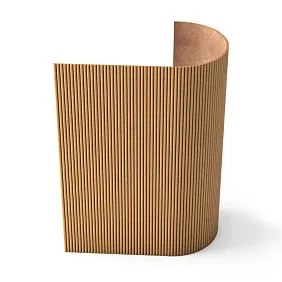
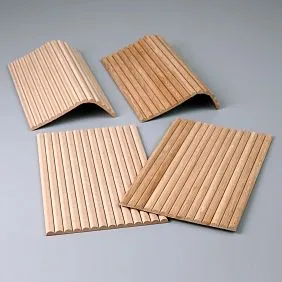
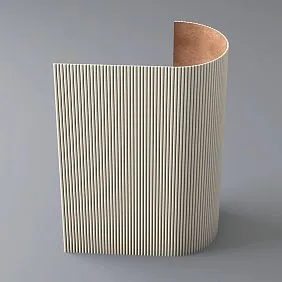
A flexible wall panel is a decorative structure where the main load-bearing element is not a rigid substrate, but an elastic fabric base. On this base, slats — wooden, MDF, with various profiles and widths — are fixed at a specified pitch and in strict parallel sequence. The fabric holds the slats in precise position, prevents them from shifting during bending, evenly distributes the load, and ensures adherence to surfaces of any geometry.
Here is the fundamental difference between a flexible panel and a rigid one. A rigid slatted panel is a monolithic module: slats plus an MDF board. Beautiful, precise, architecturally strict. But only on a flat surface. As soon as a curve appears, the rigid module becomes a problem: it cannot be bent, only sawn, fitted, assembled from fragments. The result is visible seams, huge material waste, and time consumption.
Flexible panels for interior finishingFlexible panels radically remove this limitation. The fabric bends to any radius while maintaining a uniform slatted pattern. No deformation, no cracks, no delamination — provided the panel is made with quality.
What tasks does this material solve in interior finishing?
-
Decorative finishing of accent walls with a slatted texture;
-
Cladding of radius walls, arched vaults, cylindrical columns;
-
Designing niches with rounded corners;
-
Furniture fronts with curved geometry;
-
Creating a continuous slatted surface that transitions from a flat wall to a curved one — without seams or adjustments.




What are the advantages of flexible wall panels
Before examining specific scenarios, let's establish what exactly makes this material attractive. Not abstractly, but in essence.
Our factory also produces:


Working with any geometry
This is the main, fundamental advantage. Where a rigid solution requires extremely complex fitting or is completely impossible, a flexible panel handles it in one motion. A column with a diameter of 25 centimeters? An arch with a variable radius? A niche with rounded interior corners? All of these are straightforward tasks for the flexible format.
Get Consultation
Decorative effect without complications
The slatted texture creates pronounced chiaroscuro, architectural rhythm, and visual depth. This is an expensive, professional appearance — with relatively simple installation. You get a designer result without a designer budget for construction work.
Wide range of textures
From smooth MDF ready for painting to natural oak with a pronounced wood grain pattern. From strict rectangular slats to soft semi-circular beading. For any style, any task, any budget — within its price range.
Seamless joining
A good flexible panel joins with the adjacent module without a visible gap. The end slats fit tightly, and the surface reads as a single canvas. This is a key quality for large areas and for transitions from one surface to another.
Mounting with adhesive
No guides, no dowels along the slats, no complex mounting systems. A prepared surface, mounting adhesive, a test fit — and the panel is on the wall. This is speed, less construction debris, and accessibility for DIY installation by a prepared customer.
Where flexible panels are used in interior design
Let's get specific. Where flexible wall panels are most often used — and why they are most fitting there.
Living room: TV zone and accent wall
The living room is a space that guests 'look at.' This is precisely where an accent wall with a slatted texture works to its maximum potential. A TV zone with flexible wall panels is not just a background for the TV. It's an architectural solution that structures the space, creates an 'anchor' point, and sets the visual tone for the entire room. With properly directed lighting, the vertical slats form a soft, continuous play of light and shadow, and the wall literally 'comes alive' as the angle of light changes throughout the day.
If the TV zone is framed by non-standard architectural elements — rounded niches, decorative columns — the flexible format becomes the only viable option.
Bedroom: headboard as an architectural accent
The bed headboard is the first and last thing a person sees during the day.decorative wall panelsIn this zone, they create the feeling of an architecturally designed space—even if there is no niche and the wall is completely ordinary. The panel behind the bed sets the scale, warmth, and texture. If the headboard is built into an arch or a rounded niche, the flexible panel solves this task as a single canvas, without seams on the curve.
Entryway and corridor: complex architecture
The entryway is the 'face' of the apartment. And often, it is precisely here that the architecture is most unpredictable: pillars, arched openings, rounded transitions between walls. For all of this, you needpanels for arches and columns, capable of following the form, not resisting it. An additional bonus: the slatted texture masks minor irregularities of old walls significantly better than paint or wallpaper.
Study: seriousness without heaviness
In a study or meeting area, walls carry semantic weight. They set the concentration, professionalism, and seriousness of the space. Dark oak with a matte oil finish, vertical slats with a clear pitch—this is the language of a high-level study interior. If the space has non-standard architectural elements, the flexible panel allows them to be finished with a single material without manual fitting.
Columns: where rigid solutions are powerless
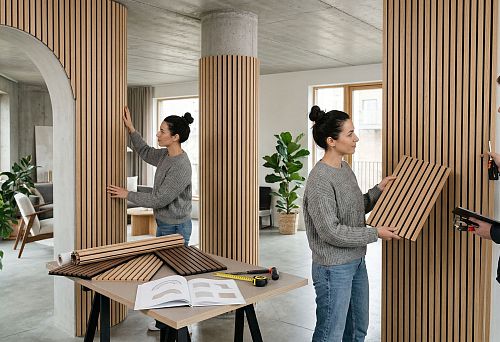
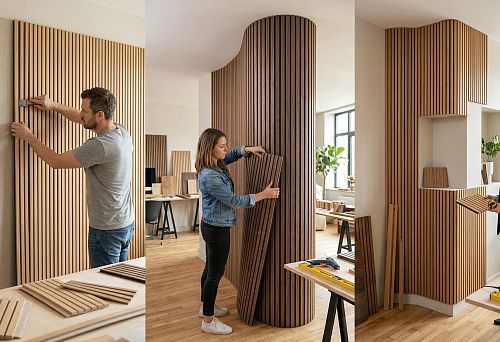
A cylindrical column is a closed radius. This is the absolute limit for applying a rigid panel: it is physically impossible to cover a cylindrical surface with a monolithic module without visible seams.Flexible wall panelssolve this task elegantly: the canvas wraps around the column along the entire perimeter, joins at the least noticeable point—and the result is a continuous slatted surface that cannot be distinguished from custom handiwork.
Arches: A Unified Rhythm from Wall to Vault
Cladding an arched vault with wooden elements in the traditional way is serious carpentry work. A flexible panel changes the calculation: the sheet is applied to the arch, bent to the shape of the vault, and fixed with adhesive. The slatted pattern maintains an even pitch across the entire curve. It is especially expressive when the arch smoothly transitions into the adjacent walls—and the slatted cladding continues uninterrupted.
Niches: Rounded Corners Without Patches
A niche with rounded interior corners is a typical task for a flexible panel. A single sheet wraps around the transitions, eliminating the complex assembly of corner elements and adjustments. The result is a monolithic, architecturally finished cladding.
Commercial spaces
Restaurant, hotel, showroom, office—commercial interiors thrive on non-standard geometry. Radius reception desks, decorative columns in the hall, arched transitions between zones. All this requires a material that follows the form.Interior Decorative Claddingat a professional level in a commercial space is unthinkable without the flexible format of wall panels.
What Types of Flexible Panels Exist for Interior Wall Cladding
Under the general term 'flexible panel' lie several fundamentally different solutions. We examine each one.
MDF slatted panels for painting
MDF (Medium-Density Fiberboard—pressed homogeneous wood mass) slats on a fabric backing. The MDF surface is porous, homogeneous, and perfectly accepts paint in any color. Priming plus two coats of finish paint—and the wall acquires the desired shade.
This solution is for those who want full control over color. White minimalism, saturated petrol, dark anthracite — all achievable with one base material. Another plus: after a few years, the wall can be repainted without dismantling the panels.
Solid oak slat panels
A different level of aesthetics. Natural oak is a living texture with a unique grain pattern, warm tone, and tactile depth of surface. Oak density is 700–750 kg/m³, making it one of the most durable species for interior applications. Coated with oil, wax, or clear lacquer depending on the desired level of sheen.
Oak is an investment: it's more expensive than MDF, but also lives incomparably longer, acquiring a noble patina over time. In commercial interiors — premium restaurants, hotels, showrooms — solid oak is preferred precisely for this reason.
Panels with semicircular profile (beads)
Battens with a semicircular cross-section create a special, almost tactile play of light and shadow. It's softer than a rectangular profile. Works especially well in spaces with diffused light — bedrooms, cozy studies, small living rooms. With side lighting, the beads create a wavy rhythm that gives the wall sculptural expressiveness.
Smooth and textured options
Smooth panels — for minimalist spaces where purity of form is important. Textured panels — for interiors where the surface must 'work' even under weak directional light. The more expressive the texture — the more active the play of light and shadow.
Wide battens and narrow: a question of scale
Wide spacing — a brutal rhythm, more air between battens. Loft, industrial style, spacious areas. Narrow spacing — refinement, dense structure, visual richness. Scandinavian minimalism, Japanese style, small rooms with high ceilings.
How to choose flexible panels according to interior style
Style is not just 'like/dislike'. It's a system of proportions, materials, and details that must work as a single organism. Here's how flexible wall panels fit into the main directions.
Modern style
Clean lines, neutral colors, minimal decor. Narrow battens with moderate spacing, white or gray MDF for painting, strict verticality. The battened surface here works as a subtle accent — without shouting, but with expressiveness.
Minimalism
Scandinavian and Japanese minimalism demand one thing from the material: not to overload the space. Very narrow slats, minimal spacing, oak with light bleaching or clear oil. The panel creates a rhythm that is almost invisible but felt as warmth and depth of the surface.
Neoclassicism and modern classicism
In neoclassicism, slatted paneling is often used as a lower frieze—below the cornice level, combined with moldings. Wide slats with dark-toned oak, paired with classic interior details.Wall finishing and decorationIn a neoclassical key, it requires precise scale and respect for proportions.
Warm natural interior
Natural oak with oil, semi-circular battens, organic niche shapes—all are part of the language of the 'natural' interior, which is currently at its peak of popularity. Flexible solid oak panels here serve as the base 'warm' material that sets the tone for the entire space.
Loft and industrial style
Wide slats, dark-painted MDF in anthracite or dark blue, deliberate brutality. Nearby—metal accents, exposed pipes, concrete surfaces. The slatted panel adds warmth and rhythm to this cocktail—without losing the 'character' of the space.
How to choose flexible panels based on room type
The rule is simple: the room dictates the requirements for the material. Not the other way around.
For the living room
Expressiveness and scale. Moderate slat width, pronounced spacing, good chiaroscuro with accent lighting. For a living room with straight geometry—both rigid and flexible formats can be used. For a living room with non-standard elements—only flexible.
For the bedroom
Calm and warmth. Narrow or moderate slats, soft oak tone or neutral painting in pastel shades. The panel should create coziness, not tension. Avoid contrasting dark paints in a small bedroom—they visually narrow the space.
For the hallway
Practicality and expressiveness. The material must withstand the load of first impressions well. Oak with oil is preferable here over paintable MDF: it is more resistant to accidental impacts and touches.
For the corridor
Corridors are often narrow and long. Horizontal slats visually expand the space. Vertical ones stretch it upward. The choice of orientation is a design decision made before purchase, not during installation.
For an office
Seriousness without heaviness. Dark oak with matte oil is the perfect material. Vertical slats with moderate spacing. An accent wall behind the desk or behind the bookshelf.
For commercial areas
Durability and representativeness. Solid oak is preferable to MDF: it withstands the load of public use and does not lose its appearance over time. For reception desks — only flexible format: straight counters are almost non-existent.
How to choose flexible panels for the task
This is perhaps the most practical section. If you know the task — you know the solution.
For an accent wall
The task is to create an expressive focal point of the space. Use slats with clear chiaroscuro: rectangular profile with moderate spacing, oak with matte oil or MDF in a rich neutral tone. Orientation — vertical for most living spaces.
For a background wall
The task is to create a textural background that does not dominate. Here, narrower slats are needed, minimal spacing, a neutral color matching the other walls. The panel works as a 'quiet accent' — noticeable upon detailed examination, unnoticeable from a distance.
For arch
Task: continuous slatted surface over a curved vault. Installation from center to edges, symmetrical layout, seamless joining on bends. Do not start without preliminary marking.
For a column
Task: closed slatted surface along the perimeter. Measure the perimeter, calculate the number of modules. Place the joint at the least noticeable point—typically at the back or side of the column. Use structural adhesive with high initial adhesion.
For niche
Task: finishing an interior surface with transitions. Flexible panel wraps around rounded corners without adjustments. Cutting from the back wall to the sides, joints—in the transition plane.
For visual zoning
Task: designate an area without a partition. An accent slatted surface on one wall instantly highlights a zone within an open space. Works in living rooms, open-plan offices, restaurant halls.
Flexible panels or conventional wall solutions: an honest analysis
This question arises for everyone considering flexible wall panels for the first time. Let's break it down substantively.
| Criterion | Flexible panels | Rigid slatted panels | MDF panels | Plaster | Paint | Wallpaper |
|---|---|---|---|---|---|---|
| Curvilinear surfaces | ✓ | ✗ | ✗ | ✓ | ✓ | Limited |
| Slatted texture | ✓ | ✓ | No | No | No | Imitation |
| Installation without guides | ✓ | Partially | ✓ | No | No | ✓ |
| Repainting | ✓ (MDF) | ✓ (MDF) | ✓ | ✓ | ✓ | ✗ |
| Natural texture | ✓ (oak) | ✓ (oak) | No | No | No | Imitation |
| Columns and Arches | ✓ | ✗ | ✗ | ✓ | ✓ | ✗ |
| Installation speed | High | High | Medium | Low | High | Medium |
| Visual depth | High | High | Medium | Medium | No | Low |
When to choose a flexible panel? Any bend, any radius, any curved surface — and also when you need fast installation and seamless joining.
When to choose a rigid one? Only straight walls + maximum geometric accuracy with mechanical fastening along guides is needed.
When to choose plaster? If you need a monolithic, plastic surface without a pronounced rhythm — and you have time and budget for technological pauses.
When to choose paint? If you want simplicity, the ability to change colors frequently, and there's no task to create texture.
What to look for when choosing flexible panels: a technical breakdown
Before buying — ten parameters that actually affect the result.
1. Wall geometry. Are there curves? If yes — only flexible format. If no — both options.
2. Fabric base. Should be dense, not loose. Check the sample: bend and unbend several times — the slats should not delaminate, the fabric should not tear.
3. End geometry. Place two samples end-to-end. A perfect joint — without a gap and without overlap. This is a sign of precise geometry and a guarantee of seamless installation.
4. Slat width and spacing. Proportion to the room. Wide spacing in a small room looks visually 'heavy'. Narrow spacing in a large hall makes the paneling 'get lost'.
5. Slat material. MDF for painting. Oak for natural aesthetics and long-term use.
6. Cutting quality. Ask to cut a sample. The cut should be clean: no chips for MDF, no burrs for oak.
7. Color and tone. Match with flooring and furniture. Warm oak + cold concrete floor is a contrast. Warm oak + warm parquet is harmony.
8. Lighting. The slatted texture is most expressive with directional light. Without accent lighting, a significant part of the effect is lost.
9. Batch consistency. The entire volume for one project should be from a single production batch. Different batches risk color variation.
10. Care. Painted MDF is wiped with a damp cloth without abrasives. Oiled oak requires periodic renewal of the oil layer every 2–3 years.
Wall preparation for flexible panels: what not to miss
Installation starts not with adhesive, but with the substrate. And it is the quality of preparation that determines how long the panels will stay on the wall.
Substrate condition
Loose, crumbling, damp, or greasy substrate is a direct path to delamination. Order of actions:
-
Remove everything that doesn't adhere well: old wallpaper, peeling paint, loose putty.
-
Dust the surface.
-
Apply deep-penetration primer — especially if the wall is loose or porous.
-
Allow the primer to dry completely.
Surface evenness
Minor irregularities (up to 3 mm) — acceptable. The slatted texture hides them. Critical variations (more than 5 mm per meter) — must be leveled with putty before installation. The panel is not putty and does not fill deep holes.
Foamed polystyrene is hygroscopic - it absorbs moisture from the air, albeit in small amounts. Long-term storage in a humid environment (basement, unheated warehouse in winter) may result in dark spots appearing on the surface.
The most important parameter. Installation on a damp substrate guarantees adhesive seam delamination within a few months. Especially critical in bathrooms and in apartments with external walls during cold seasons.
Marking and planning joints
Before applying adhesive, apply marking lines: vertical or horizontal guides, depending on the orientation of the slats. Mark joint points. On a column — mark the location of the main joint. On an arch — mark the center of the vault.Advice on finishing and installationThe STAVROS website will supplement this information with specific technical details.
Installation of flexible panels on the wall: step-by-step instructions
Seven steps that yield the correct result.
Step 1. Cutting
MDF — use a utility knife with a sharp blade along a ruler. Cut along the fabric backing: this makes the edge smoother. Oak — use a fine-toothed saw or a miter saw. Check the cut: burrs on the edge will create a visible seam.
Step 2. Dry Fitting
Lay out the cut modules on the surface without glue. Ensure the layout looks as intended. Mark reference points. This step cannot be skipped — it saves both time and material.
Step 3. Applying Adhesive
Mounting adhesive ("liquid nails" or parquet adhesive with high initial adhesion) is applied to the fabric backing of the panel — in a zigzag or dotted pattern. Not in a solid layer: excess will seep through the gaps between the slats. On vertical surfaces — additionally apply adhesive to the wall for double fixation.
Step 4. Fixation
Press the panel smoothly, from one edge to the other. Without slapping, without sudden movements. On curved surfaces — wrap gradually, holding the pressure for 5–10 seconds on each section.
Step 5. Joining
The next module is placed tightly — slat to slat. With precise edge geometry, the joint is invisible. On curved surfaces, check the uniformity of the radius before fixation.
Step 6. Corner Finishing
External corner: trimming ends at 45° and joining 'on the miter'. Internal corner: one panel flush against the other. Alternatively — a corner profile matching the panel color.
Step 7. Final Processing
After 24 hours of polymerization: MDF is primed and painted in two coats. Oak — treated with oil or varnish. Joints are refined if necessary with color-matched acrylic sealant.
Mistakes in selection and installation: what absolutely not to do
A list of seven mistakes, each of which occurs regularly — and each costs time, money, or nerves.
Mistake 1. Choosing based only on a picture
A picture doesn't convey scale, doesn't show the quality of the edges, and says nothing about the density of the fabric backing. Always order a sample before a major purchase.
Mistake 2. Rigid panel on a curved surface
Already discussed above, but let's repeat: a rigid MDF module does not bend. Attempting to fit it to a column results in ugly seams and double material consumption. If there's a curve — choose a flexible panel. No compromises.
Mistake 3. Poor surface preparation
Adhesive does not forgive loose and damp walls. Preparation takes time — but it is precisely what determines the durability of the result.
Error 4. Skipping the dry fit
Without a dry fit, the end panel is often cut poorly, joints end up in unexpected places, and the layout doesn't look symmetrical. 30 minutes of dry fitting = several hours of rework saved.
Error 5. Scale error
Large slats with wide spacing in a small room 'eat up' the space. Narrow slats in a spacious hall get lost. Match the scale of the slat pattern to the room.
Error 6. Ignoring lighting
Slatted texture is most expressive with directional lighting. If the room only has diffuse ceiling light, a significant part of the effect is lost. Plan accent lighting together with the panels, not after.
Error 7. Weak adhesive
Saving on the adhesive is a risk of peeling after a few months. Especially critical for vertical surfaces and rooms with unstable climates. Use only proven structural adhesive with high initial adhesion.
What to combine flexible panels with in the interior
A flexible wall panel is part of an ensemble. It works well in combination, and here's what with—best of all.
Painted walls
Accent slatted wall + other surfaces in a solid color paint—a classic. The paint should be slightly more saturated than it appears on the sample: the slatted texture absorbs some color due to shadows in the gaps.
Natural wood
Oak with oak, but in different formats and finishes. Oak slatted panel + ash parquet with a tint in the same palette = a cohesive, well-thought-out space.
Metal
Brass, copper, matte black metal—perfect accents. Metal fixtures, shelves, frames, handles create a rhythm that echoes the rhythm of the slats.
Natural Stone
Oak + marble — a contrast of warmth and cold that works flawlessly. Especially in bathrooms and commercial spaces.decorative wall finishingThe combination of stone and wood is one of the most relevant trends in professional interior design.
Textiles
Linen curtains, woolen blankets, velvet pillows — a tactile dialogue with the slatted surface. Both materials are textured, both create warmth — but in different ways.
Backlighting
LED lighting in front of the panel or behind it is one of the most powerful techniques. With directional lighting from bottom to top, it creates a 'floating' surface effect. Backlighting through gaps provides soft diffuse glow. Plan channels for lighting before installation.
Hidden doors
A slatted panel that 'hides' a concealed mounting door is a technique currently used in every second professional project. The door is integrated into a unified slatted rhythm and visually disappears into the wall.
Who flexible wall panels are especially suitable for
Designers and architects
For a professional, a flexible panel is a standard working tool. Any non-standard geometry in a project automatically means choosing a flexible format. The material allows working with the building's architecture, not against it.
Furniture manufacturers
Flexible slatted panelsfor furniture fronts — a ready-made solution for cladding curved side panels, radius cabinets, rounded kitchen islands. Replaces expensive manual assembly from individual elements.
For private clients with ambitions
For those who renovate consciously and want a designer result. Installing a flexible panel is manageable for a prepared person — provided thorough surface preparation and patience during the fitting stage.
For those who are designing complex geometry
If your space has at least one curved element — and you want to finish it with a single material, in a unified style with flat surfaces — a flexible panel is the only sensible answer.
For those seeking a decorative and practical solution simultaneously
The slatted surface is beautiful and functional. It masks imperfections, creates an accent, works with lighting. At the same time, maintenance is simple: a damp cloth and periodic re-oiling for oak — that's all.
Conclusion: when flexible panels for interior wall finishing are the right choice
Let's sum it up practically and concretely.
flexible wall panels for interior finishing— the right choice when:
-
The space features any curvature — a column, an arch, a radius niche, a rounded corner;
-
a continuous slatted surface without visible transitions is needed;
-
installation speed is important without complex angular adjustments;
-
A curved furniture front with slatted finish is planned;
-
The accent wall should transition into adjacent surfaces as a single material.
A rigid panel is the right choice when:
-
all surfaces are rectilinear and even;
-
Strict geometry with mechanical fastening along guides is needed.
In large-scale projects, both formats are used together: rigid ones on flat planes, flexible ones on transitions and curved surfaces. This is the optimal strategy.
FAQ: answers to the most frequently asked questions
What are flexible wall panels for interior finishing?
Decorative slatted panels on an elastic fabric backing. They can wrap around any curved surface without distorting the slatted pattern. Used in residential and commercial interiors.
How do flexible panels differ from regular wall panels?
Base: rigid panel — MDF board, flexible — elastic fabric backing. This changes everything: rigid works only on flat surfaces, flexible — on any.
Are flexible panels suitable for an apartment?
Yes, fully. Living room, bedroom, hallway, study — this is the primary area of application.
Can flexible panels be used in a living room?
Yes. TV zone, accent wall, column cladding, or decorative niches — flexible panels in the living room look expressive and professional.
Are they suitable for the bedroom?
Yes. The headboard is the most common area of application in the bedroom. The soft slatted rhythm creates tactile depth and warmth without being overwhelming.
Can they be used in the hallway?
Yes. Especially effective with non-standard hallway architecture — arched openings, pylons, rounded transitions.
Are flexible panels suitable for arches and columns?
Yes — and this is one of the key tasks. Arched vaults and cylindrical columns specifically require a flexible format.
What textures do flexible panels come in?
MDF for painting, solid oak, rectangular profile, semi-circular profile (beads), wide and narrow slats. For any style and task.
What is better to choose: wood-look panels or stone-look panels?
Depends on the interior style. Oak with oil — for warm, natural interiors. MDF for painting in a neutral tone — for modern minimalist spaces.
Can flexible panels be used for an accent wall?
Yes — this is one of the main scenarios. The slatted texture creates an accent through light and shadow and rhythm, not through color.
Is it difficult to install flexible panels on a wall?
No, if the base is properly prepared and a dry fitting is done. Installation with adhesive without complex tools.
Does the substrate need to be perfectly level?
No. Minor irregularities are hidden. Critical deviations of more than 5 mm per meter — are eliminated before installation.
How are flexible panels joined?
Seamlessly: end slats fit tightly without gaps. With precise end geometry, the joint visually disappears.
How to care for flexible panels?
MDF for painting — a damp cloth without abrasives. Oak with oil — periodic renewal of the oil coating every 2–3 years.
What is better: flexible panels or rigid wall panels?
Depends on the task. If there's a curve — only flexible. Everything is straight — both options. In complex projects, both formats are used together.
About the company STAVROS
When space demands not a standard, but a precise solution, when architecture dictates curves and non-standard transitions — professionals in Russia turn to STAVROS.
The company producesRafter panelsmade of MDF for painting and solid oak, including flexible modules on a fabric base for radius walls, columns, arches, and furniture fronts. A wide range covers tasks of any scale: from a decorative accent in a small apartment to full-scale finishing of commercial space with non-standard architecture.
STAVROS is precise geometry, proven materials, surfaces ready for finishing the first time. Full catalog,interior galleryand specialist consultation are available on the official website. If you need samples of decorative panels before making a decision — that's also solvable.
Choose a material that follows your architecture, not limits it. That's what proper interior finishing is called.