Article Contents:
- Why a wooden staircase is a choice that lasts generations
- Durability tested by centuries
- Noiselessness: a staircase that doesn't creak
- Warm to the touch: comfort for bare feet
- Eco-friendliness: breathe clean air
- Restorability: eternal youth
- Aesthetics: beauty that never gets old
- Types of wooden staircases: from straight flights to spiral staircases
- Straight flight staircases: classic reliability
- L-shaped staircases with 90° turn: space-saving
- U-shaped staircases with 180° turn: maximum compactness
- Spiral staircases: a spiral in space
- Bolted staircases: airy lightness
- Staircases with and without risers: closed or open construction
- Components for wooden staircases: what beauty is built from
- Steps: the foundation you step on
- Risers: vertical connection
- Stair balusters: rhythm and decor
- Stair posts: support columns
- Handrails: what you hold onto
- Stringers and carriages: load-bearing beams
- Ready-made staircase or components: what to choose
- Ready-made turnkey staircase: convenience and guarantee
- Components for self-assembly: savings and control
- Calculating the cost of a wooden staircase: what makes up the price
- Material: oak, beech, ash
- Configuration: straight, turning, spiral
- Decorativeness: simple balusters or carved
- Finishing: oil, varnish, patina, painting
- Installation: DIY or by professionals
- Approximate cost of finished staircases
- STAVROS: manufacturer of carved solid wood staircases
- Why STAVROS
- The process of ordering a staircase from STAVROS
- Warranty service
- Delivery across Russia
- Frequently Asked Questions
- How long does it take to manufacture a staircase?
- Can the staircase be installed independently?
- Will the staircase creak?
- Which wood is best for a staircase?
- Can a staircase be made to match a specific interior?
- How much does an oak staircase cost?
- Does STAVROS deliver to regions?
- Does a wooden staircase require special care?
- Conclusion: a staircase that lives with the house

A staircase is not just a way to get from the first floor to the second. It is the vertical artery of a house, its architectural heart, an element that either elevates the space to the level of art or remains an inconspicuous functional structure. Enter a country house with a solid wood staircase: carved balusters line up in a rhythmic row, a massive oak handrail lies warm and smooth in your hand, the steps creak almost inaudibly, in a homely way, wide turned newel posts support the structure with monumental confidence. Such a staircase is a statement: here they did not skimp, here they built seriously, here they value beauty and durability.
Now imagine a standard metal staircase with pine treads, bought from a construction hypermarket. Cold railings, thin metal posts, treads that sag under weight and creak alarmingly. Functionally, it works—you can go upstairs. But does it inspire admiration? Do you want to run your hand along the handrail, linger on the landing, admiring the structure? No. Because it is a utilitarian necessity, nothing more.
The difference between a staircase-as-function and a staircase-as-work-of-art lies in the material, craftsmanship, and attention to detail. A solid wood staircase made of oak or beech, with carved balusters, turned newel posts, wide treads, assembled using traditional joinery connections, is an investment for generations. It will last a hundred years, will not lose strength, will not go out of style, will become a point of pride shown to guests. And the question ofwhere to buy a wooden staircasechoosing a high-quality one, not made of knotty pine but of noble wood, from masters who understand structure and aesthetics, is a question that determines whether your house will be just a building or become a space with a soul.




Why a wooden staircase is a choice that outlives generations
Staircases come in different types: metal, concrete, glass, composite. Each has its advantages. But a solid wood staircase remains a classic, unsurpassed in its combination of qualities: strength, beauty, eco-friendliness, tactile comfort, and the possibility of restoration.




Strength, tested by centuries
Wooden staircases in old mansions built 100-200 years ago are still in use. They have withstood millions of steps, survived wars, floods, renovations. And they continue to serve. Why? Because solid oak or beech, dried to 8-10% moisture content, assembled with mortise and tenon and dowel joints, is a structure of incredible strength. Wood performs better under compression, bending, and impact than many modern materials. A 40-50 mm thick oak tread can withstand a load of 300-500 kg per square meter without deformation.
A metal staircase is also strong, but cold, clatters when walked on, and over time rusts (if not stainless steel). A concrete staircase is monumental but heavy, requires complex formwork, and lacks the warmth of wood. Glass treads are spectacular but psychologically fragile (people are afraid to step on glass, even tempered), and are unsuitable for classic interiors.
Wood is the golden mean. Strong as stone. Warm as fabric. Beautiful as sculpture.
Our factory also produces:


Silence: a staircase that does not creak
Staircase creaking is the bane of many structures. Metal creaks if connections loosen. Wood creaks if the staircase is poorly assembled (with nails, screws, without glue, without fitting). But a wooden staircase assembled correctly—with mortise and tenon, dowels, glued joints, and with risers (vertical boards between treads) installed—is absolutely silent. You walk up it, and the only sound is the light, soft tap of heels on wood. No creaking, humming, or vibration.
This is achieved by precision of joints (gaps no more than 0.1 mm), the use of high-quality glue, and the installation of risers (they rigidly connect the treads, preventing them from sagging and rubbing against the stringers or carriages).
Get Consultation
Warm to the touch: comfort for bare feet
Try walking barefoot on a metal staircase in winter. It's cold, unpleasant. On concrete—hard, cold. On wood—warm, pleasant. Wood does not chill; it retains heat, creating tactile comfort. This is important for country houses where people often walk barefoot, for families with children (children love running on staircases).
A wooden staircase, finished with oil or matte varnish, is pleasant to the touch. Your hand glides along the handrail, feeling the wood grain, a slight roughness. This tactile pleasure creates an emotional connection with the home.
Eco-friendliness: breathe clean air
Metal and concrete are inert but lifeless. Wood is a living material. It regulates humidity (absorbs excess, releases when dry), saturates the air with phytoncides (beneficial volatile substances that kill bacteria), and creates a healthy microclimate. A solid wood staircase is a piece of nature in your home.
Important: wood is eco-friendly only if it is not treated with toxic compounds. STAVROS uses eco-friendly oils, varnishes, and water-based stains, free of volatile organic compounds.
Restorability: eternal youth
Wooden stair treads wear down over time (especially in areas of highest load—the center of the tread). But this is not a problem. The tread is sanded (a 1-2 mm layer is removed), re-coated with oil or varnish—and it's like new. Solid wood treads can be sanded 5-10 times over their service life. That is, the staircase lives for 100 years but looks like new.
You cannot sand a metal staircase. Nor a concrete one. But a wooden one—yes. This gives the structure eternal youth.
Aesthetics: beauty that never goes out of style
Metal and glass represent modernity, high-tech, minimalism. They can go out of fashion (like the chrome handrails of the 90s already have). Wood is timeless. A classic wooden staircase with carved balusters is appropriate in a house built 200 years ago and in a house that will be built 200 years from now. Because wood is an eternal material, a language understood by all eras.
The texture of wood is unique. Each tread, baluster, and post has its own pattern of annual rings. Nature does not repeat itself. And your staircase is one of a kind in the world.
Types of wooden staircases: from straight flights to spiral staircases
Wooden staircasesvary in design, shape, and mounting method. The choice of type depends on the house layout, rise height, available space, and interior style.
Straight flight staircases: classic reliability
A straight flight staircase is one continuous flight (a row of steps) from the lower level to the upper. The simplest, most reliable, and convenient design.
Advantages:
-
Maximum climbing comfort (uniform steps, constant slope angle)
-
Simple design (easier to calculate, manufacture, and install)
-
High strength (no turning elements, winder steps)
-
Possibility of a wide flight (1200-1500 mm—convenient for moving furniture)
Disadvantages:
-
Requires a lot of space (for a 3-meter rise at a 35-40° angle, a projection length of 4-5 meters is needed)
Application: houses where there is space for a staircase (long hallway, spacious living room). A straight staircase is the choice for those who prioritize convenience over compactness.
Structural elements:
-
Steps (13-15 pieces for a 3-meter rise)
-
Risers (vertical planks between steps, creating a closed flight)
-
Stringers or carriages (load-bearing beams on the sides of the flight)
-
Balusters (vertical railing posts, 2-3 per step)
-
Handrail (top railing plank)
-
Newel posts (support posts at the beginning and end of the flight)
L-shaped staircases with a 90° turn: space-saving
An L-shaped staircase—two flights connected at a 90° angle, with an intermediate landing or winder steps. Saves space, fits into a room corner.
Advantages:
-
Compactness (takes up less space than a straight one)
-
Ability to be placed in a room corner
-
The landing in the middle is a place for rest and decoration (vase, painting).
Disadvantages:
-
More difficult to manufacture (the pivot joint requires precision).
-
Winder steps (if used instead of a landing) are less convenient (wedge-shaped, narrow at the inner edge).
Application: standard country houses, duplex apartments. An L-shaped staircase is a compromise between convenience and compactness.
Turn options:
-
With a landing: two straight flights connected by a square landing. Convenient, but requires more space.
-
With winder steps: instead of a landing, 3-5 wedge-shaped steps that smoothly turn the flight. More compact, but less convenient (especially when descending).
U-shaped stairs with a 180° turn: maximum compactness
A U-shaped staircase consists of two parallel flights connected by a landing with a 180° turn. The most compact configuration for large ascent heights.
Advantages:
-
Minimal footprint (flights run parallel, saving length)
-
Symmetry (looks beautiful in spacious halls)
-
Intermediate landing (convenient for rest, decoration, windows)
Disadvantages:
-
Requires a minimum ceiling height of 3 meters (to avoid cramped space under the upper flight)
-
More difficult to manufacture
Application: country houses with limited floor area but sufficient ceiling height. U-shaped stairs are often placed along a wall, creating a symmetrical composition.
Spiral staircases: a spiral in space
A spiral staircase consists of steps twisted around a central column (axis) in a spiral. The most compact, but least convenient design.
Advantages:
-
Minimal footprint (diameter from 1200 mm)
-
Spectacular appearance (the spiral attracts attention)
-
Suitable for limited spaces (attics, double-height spaces)
Disadvantages:
-
Inconvenient for climbing (steps are wedge-shaped, narrow at the center, requires getting used to)
-
Impossible to move large furniture (narrow opening)
-
Complexity of manufacturing (each step is unique)
Application: auxiliary staircases (to an attic, basement), houses with minimal space for a staircase, modern interiors (a spiral staircase made of metal and wood is a loft-style element).
Material: spiral staircases are often made as composites (central column metal, steps wood). A fully wooden spiral staircase is rare, requiring the highest craftsmanship.
Bolted staircases: airy lightness
Bolts are metal bolts that attach the steps to the wall on one side (on the other side, the steps are either free or connected by metal rods). A bolted staircase looks weightless — the steps seem to float in the air.
Advantages:
-
Visual lightness (no massive stringers, risers)
-
Modern look (suits minimalism, high-tech, loft)
-
Does not clutter the space (see-through view)
Disadvantages:
-
Requires a solid wall (concrete, brick, load-bearing wooden structure)
-
Feeling of insecurity (some people are psychologically uncomfortable on an open staircase)
-
Not suitable for classic interiors
Application: modern houses, studios with high ceilings, interiors where visual lightness is important.
Material: steps made of solid oak or ash (50-60 mm thick for strength without sagging), fasteners - stainless steel, railing - glass or metal cables.
Stairs with and without risers: closed or open construction
Staircase with risers (closed): vertical planks (risers) are installed between the steps, closing the space. Creates a monolithic, solid structure.
Advantages:
-
Strength (risers rigidly connect the steps, increase rigidity)
-
Noiselessness (steps do not sag, do not creak)
-
Safety (foot will not slip between steps)
-
Classic look (suitable for traditional interiors)
Disadvantages:
-
Visual massiveness (the staircase looks heavier)
-
Closes the space under the stairs
Staircase without risers (open): there is empty space between the steps, you can see through.
Advantages:
-
Visual lightness (the staircase does not clutter the space)
-
More light (light passes through the steps)
-
Modern look
Disadvantages:
-
Less rigidity (steps may sag, creak)
-
Psychological discomfort for some (fear of falling through)
-
Not suitable for homes with small children (danger)
Choice: for classic interiors, families with children, those who value reliability - a staircase with risers. For modern interiors, minimalism, small spaces - an open staircase.
Components for wooden stairs: what beauty is built from
A staircase is not a monolith. It is a structure made of many elements, each of which is important. The quality of a staircase is determined by the quality of its components.
Steps: the base you step on
A step is a horizontal plank that bears the main load. The durability and noiselessness of the staircase depend on the strength, thickness, and quality of processing of the steps.
Material: solid oak (best choice - maximum strength, wear resistance), solid beech (slightly softer, cheaper), solid ash (strong, light, beautiful texture).
Thickness: 40-50 mm for stairs with stringers, 50-60 mm for bolted stairs (steps work in bending without support from below, greater thickness is needed).
Width (tread depth): 250-300 mm (optimally 280 mm - comfortable for an adult's foot). Less than 250 mm - inconvenient, foot hangs over. More than 300 mm - requires taking two steps on one tread.
Length: depends on the flight width. Standard flight width 900-1000 mm (comfortable for one person), wide 1200-1500 mm (two people can pass, convenient for moving furniture).
Processing: steps are sanded to perfect smoothness (grit 220-320), coated with oil, wax, or varnish. The front edge of the step is often rounded (safety, aesthetics) or milled (creating a profile, decoration).
Solid-lamella steps: steps made of solid wood are glued together from several lamellas (planks) in width. This increases stability (a solid wide board can warp), but requires precise fitting and high-quality glue. STAVROS produces solid-lamella steps from oak and beech, glued with a micro-tenon (the joint is invisible, strength is maximum).
Risers: vertical connection
A riser is a vertical plank that covers the space between steps. The riser does not bear load but rigidly connects the steps to the stringers, increasing the strength of the structure.
Material: solid oak, beech (same as the steps, for consistency).
Thickness: 18-25 mm (sufficient for rigidity).
Height: depends on the step rise height (usually 150-200 mm).
Finishing: sanding, coating (same as steps).
Fastening: risers are attached to steps using dowels, screws (screws on the front side are covered with plugs or countersunk and filled).
Stair balusters: rhythm and decor
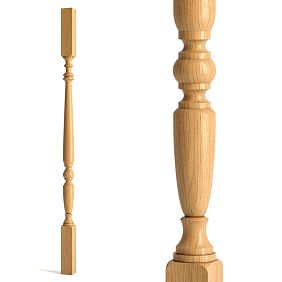
A baluster is a vertical railing post that fills the space between steps and the handrail.balusters for staircasesThey provide safety (prevent falls), rhythm (repeating elements organize the space), and decor (the shape of balusters defines the staircase style).
Material: solid oak, beech, ash, birch (for painting).
Shape: turned (on a lathe - classic), milled (square cross-section with milled edges - modern), carved (with three-dimensional carving - luxury).
Cross-section: 50×50 mm (square), diameter 40-60 mm (round turned).
Height: 900 mm (standard for stair railings, ensures safety).
Number per step: 2-3 balusters (for a flight width of 1000 mm - 2 balusters, for 1500 mm - 3). Distance between balusters - no more than 150 mm (safety requirement - a child should not be able to squeeze through).
Baluster styles:
-
Classical turned: alternating balusters, tori, disks, transitions. Symmetrical, elegant. Suitable for classical, neoclassical interiors.
-
Baroque carved: complex profiles, carving (leaves, scrolls). Luxurious, decorative.
-
Modern milled: simple shapes, straight lines, minimal decor. For minimalism, Scandinavian style, loft.
-
Cabriole: S-shaped curve (like furniture legs). Graceful, suitable for Rococo, Provence.
Baluster mounting:
-
On dowels: holes are drilled in the step and handrail, the baluster is inserted on wooden pins (dowels) and glued. Reliable, invisible.
-
On studs: metal threaded studs are screwed into the baluster from below and above, attached to the step and handrail. Faster, but less aesthetic (fasteners are visible).
Stair posts: support columns
A post (newel) is a massive support post installed at the beginning, end, and turns of a staircase.Posts for staircaseThey bear structural load (stringers and handrails are attached to them) and decorative (they accentuate and complete the composition).
Material: solid oak, beech (must be strong, withstand load).
Cross-section: 80×80 mm, 100×100 mm, 120×120 mm (the taller and more massive the staircase, the thicker the posts).
Height: from floor to top of handrail (usually 1100-1200 mm).
Shape:
-
Turned: like large balusters, with larger profile elements. Classic.
-
Square with milling: edges are rounded or milled, creating a decorative profile.
-
With carved capitals: the top of the post is adorned with a carved capital (finial) — a rosette, leaves, geometric ornament.
Mounting: posts are anchored to the floor, steps using anchors, bolts (concealed mounting), additionally glued.
Handrails: what you hold onto
Handrail — the top rail of the railing, held onto when ascending and descending. The handrail must be comfortable (correct shape, smooth), strong (withstand leaning), beautiful (part of the staircase decor).
Material: solid oak, beech, ash.
Cross-section: round (diameter 50-60 mm — comfortable to grip by hand), oval, shaped (with milling).
Length: along the length of the flight (handrail can be solid or consist of several sections joined at the seams).
Finishing: sanding to a silky smoothness (grit 320-400), coating with oil or matte varnish (pleasant-to-touch surface).
Mounting: handrail is attached to posts and balusters using dowels, screws (from the underside, invisible).
Turning elements: at staircase turns, the handrail must smoothly change direction. For this, bent sections of the handrail (made by bending steamed wood) or turning elements (milled parts connecting straight sections at an angle) are used.
Stringers and carriages: load-bearing beams
Stringer and carriage — load-bearing beams on which the steps rest. This is the power frame of the staircase.
Carriage: a beam with grooves into which steps and risers are inserted. Steps are hidden from the side, only the carriage is visible. Carriages are placed on both sides of the flight (double-carriage staircase) or on one side (one carriage against the wall, the other side — stringer or bolts).
Stringer: a beam with cutouts (comb) on which steps are laid. Steps are visible from the side. Stringers are placed as one (central, under the middle of the step) or two (at the edges).
Material: solid oak, beech (thickness 50-80 mm, width 250-400 mm). Stringers and carriages must be strong, without knots, cracks.
Finishing: sanding, coating (like other elements). Stringers are often made shaped (edge milling, creating waves, ornamentation) — this adds decorativeness.
Ready-made staircase or components: what to choose
There are two ways to get a wooden staircase: order a ready-made one (manufacturer produces, delivers, installs) or buystaircase componentsand assemble yourself (or hire an installer).
Ready-made turnkey staircase: convenience and guarantee
How it works:
-
You contact the manufacturer (STAVROS)
-
A specialist visits for measurement (measures ascent height, opening width, room configuration)
-
Designer creates a staircase project (step calculation, slope angle, 3D visualization)
-
You approve the project, choose material, finish, decor
-
Production manufactures the staircase (4-8 weeks)
-
Staircase is delivered and installed on site
Advantages:
-
Complete absence of hassle (you don't deal with calculations, purchasing, installation)
-
Guarantee (manufacturer is responsible for construction, quality, installation)
-
Accuracy (staircase is manufactured for your opening, fits perfectly)
-
Professional installation (the staircase is assembled correctly, does not creak, does not wobble)
Disadvantages:
-
Higher cost (you pay for design, installation)
-
Manufacturing time (4-8 weeks)
For whom: for those who value convenience, have no carpentry experience, want a guaranteed result.
Components for self-assembly: savings and control
How it works:
-
You design the staircase yourself (or hire a designer)
-
Calculate the number of steps, balusters, posts, length of handrails
-
Purchase components from the manufacturer (STAVROS)
-
Assemble the staircase yourself or hire an installer
Advantages:
-
Savings (components are cheaper than a turnkey finished staircase)
-
Process control (you choose the elements yourself, monitor the assembly quality)
-
Flexibility (components can be ordered in parts, as needed)
Disadvantages:
-
Experience required (need to be able to calculate the staircase, know assembly technology)
-
Risk of errors (incorrect calculation, poor-quality assembly can lead to creaking, wobbling)
-
No manufacturer's warranty (if you assembled it yourself, the manufacturer is not responsible for the result)
For whom: for experienced carpenters, craftsmen, those building a house with their own hands, those who want to save and have the skills.
What can be purchased separately from STAVROS:
-
Steps (any sizes, thickness)
-
Risers
-
Balusters (hundreds of models)
-
Posts (dozens of models)
-
Handrails (straight, curved, turning elements)
-
Stringers, carriages (to your dimensions)
-
Fasteners (dowels, studs, anchors, glue)
STAVROS also provides consultations: will help calculate the number of elements, suggest the optimal design, give recommendations for installation.
Calculating the cost of a wooden staircase: what makes up the price
The price of a staircase depends on many factors. Let's break down the main ones.
Material: oak, beech, ash
Oak: the most expensive wood (but also the strongest, most prestigious). An oak staircase is 30-50% more expensive than a beech one.
Beech: optimal price/quality ratio. Strong, beautiful, cheaper than oak.
Ash: light wood with beautiful grain, price close to oak.
Birch, pine: cheap, but not recommended for stairs (soft, wear out quickly, creak).
Approximate prices for treads (per piece):
-
Oak, 40 mm, 300×1000 mm — 3500-5000 rubles
-
Beech, 40 mm, 300×1000 mm — 2500-3500 rubles
Configuration: straight, turning, spiral
Straight staircase: the cheapest (simple design, uniform elements).
L-shaped, U-shaped: 20-30% more expensive (turning elements, landings, more complex installation).
Spiral: 50-100% more expensive (each step is unique, complex assembly).
Decorativeness: simple balusters or carved
Simple turned balusters: 800-1500 rubles/piece (oak).
Complex carved balusters: 2000-5000 rubles/piece.
Posts:
-
Simple turned — 3000-5000 rubles/piece
-
Carved with capitals — 8000-15000 rubles/piece
The more decorative the staircase, the more expensive. A staircase with simple balusters can cost 200,000 rubles, with carved ones — 400,000 rubles.
Finishing: oil, varnish, patina, painting
Oil, clear varnish: basic finishing, included in the price.
Toning (stain): +10-15% to the cost.
Patination: +20-30% (labor-intensive process).
Enamel painting: +15-20%.
Installation: DIY or by specialists
DIY installation: free (if you know how).
Installation by specialists: 30-50% of the staircase cost (for complex configurations — up to 70%).
Approximate cost of finished staircases
Straight beech staircase (13 steps, simple turned balusters, flight width 1000 mm, oil finish):
-
Components — 150,000 rubles
-
Turnkey with installation — 220,000 rubles
L-shaped oak staircase (15 steps with a turn, carved balusters, flight width 1200 mm, patination):
-
Components — 350,000 rubles
-
Turnkey with installation — 520,000 rubles
Spiral oak staircase (diameter 1500 mm, 12 steps, carved balusters):
-
Turnkey with installation — 450,000-700,000 rubles
Prices are approximate; exact cost is calculated after measurement and project approval.
STAVROS: manufacturer of carved solid wood staircases
Company STAVROS has been manufacturing solid wood staircases from oak, beech, and ash since the 1990s. Over this time, more than 500 staircases have been created for country houses, cottages, townhouses, and duplex apartments across Russia.
Why STAVROS
Experience: over 30 years of working with wood. STAVROS knows everything about staircase construction, load calculations, and installation nuances.
Own production: full cycle from wood procurement to staircase installation. Quality control at every stage.
Material: only solid oak, beech, ash. Chamber drying to 8-10% moisture content. Selection of wood without knots or cracks.
Technologies: modern equipment (4-sided planers, CNC milling machines, copy lathes) + manual work (sanding, fitting, finishing).
Assortment: hundreds of baluster and newel post models. Any treads (sizes, thickness). Straight and curved handrails. Everything for creating staircases of any configuration and style.
Custom projects: STAVROS develops staircases for your opening, your style, your wishes. 3D visualization before production starts — you see how the staircase will look.
Warranty: 3 years on structural elements. But the actual service life is decades.
Manufacturer's price: no intermediary markups. Savings of 30-50% compared to purchasing through showrooms.
The process of ordering a staircase from STAVROS
-
Request: you call, write, or leave a request on the website.
-
Consultation: manager clarifies parameters (rise height, opening width, desired configuration, style, budget).
-
Measurement: STAVROS specialist visits the site (Moscow, St. Petersburg — free; regions — travel costs, deducted from the order value). Measures all parameters, takes photos, consults on-site.
-
Design: designer creates a staircase project (calculation of number of steps, rise height per step, slope angle, railing structure, 3D visualization).
-
Approval: you receive the project, view the visualization, make edits (change baluster shape, add carving, change finish). The project is adjusted until you are completely satisfied.
-
Contract and prepayment: contract is signed, prepayment is made (usually 50%).
-
Production: staircase is manufactured at STAVROS production facility (timeline 4-8 weeks depending on complexity).
-
Test assembly: staircase is assembled at the production facility, geometry and connections are checked. This ensures everything fits perfectly on-site.
-
Delivery: staircase is packaged (treads, balusters, newel posts — in protective film and cardboard), loaded into a van, delivered to the site.
-
Installation: STAVROS specialists assemble the staircase on-site (2-5 days depending on configuration). Installation includes setting stringers/carriages, treads, risers, balusters, newel posts, handrails, final fitting, inspection.
-
Acceptance and payment: you accept the work, pay the balance.
Warranty Service
STAVROS provides a 3-year warranty. If defects are found during the warranty period (cracking, loose connections, finish defects), STAVROS fixes them free of charge.
What is not covered by the warranty: mechanical damage (scratches, chips from impacts), natural wear (tread wear from intensive use), consequences of improper use (flooding, extreme humidity).
Delivery throughout Russia
STAVROS delivers staircases across Russia. Moscow, St. Petersburg — with own transport (1-3 days). Regions — via transport companies (packaging in rigid crating, cargo insurance).
Frequently asked questions
How long does it take to manufacture a staircase?
4-8 weeks from project approval and prepayment. A simple straight staircase — 4 weeks. A complex U-shaped one with carved elements — 8 weeks.
Can the staircase be installed independently?
Technically yes, if you have carpentry experience. But we strongly recommend professional installation. A staircase is a complex structure; even minor errors lead to creaking, wobbling, and loss of safety. Installation by STAVROS specialists guarantees proper setup.
Will the staircase creak?
A properly assembled staircase (using tenons, dowels, glue, with risers installed, and precise fitting) does not creak. STAVROS guarantees a noiseless structure. If creaking appears during the warranty period, we fix it free of charge.
Which wood is best for a staircase?
Oak is the best choice (maximum strength, durability, prestige). Beech offers the optimal price/quality ratio. Ash is a beautiful light wood with strength comparable to oak. We do not recommend pine or birch (soft, wear out quickly).
Can a staircase be made to match a specific interior?
Yes, STAVROS manufactures custom staircases. You choose the style (classic, baroque, minimalism, Provence), baluster shape, decor, and finish. A designer creates a project and coordinates it with you. The staircase will perfectly match your interior.
How much does an oak staircase cost?
Depends on configuration, dimensions, and decor. A simple straight staircase (13 steps, 1000 mm width, simple balusters) — from 220,000 rubles turnkey. A complex L-shaped one with carved elements — from 400,000 rubles.
Does STAVROS deliver to regions?
Yes, delivery throughout Russia. The cost depends on the region and is calculated individually.
Does a wooden staircase require special care?
Minimal. Wipe the steps with a dry or slightly damp cloth. Refresh the oil finish (if the staircase has an oil finish) every 1-2 years. Avoid puddles of water on the steps. With proper use, the staircase lasts for decades without repair.
Conclusion: A staircase that lives with the house
A staircase is not just a structure for moving between floors. It is an architectural centerpiece, the calling card of a home, an element that sets the tone for the entire interior. A wooden staircase made of solid oak or beech with carved balusters, turned posts, and wide steps is a statement: here live people who value quality, beauty, and durability. Here, no one skimped on what will serve for generations.
A solid wood staircase is a hundred-year investment. It will not become outdated, break, or go out of style. It will delight you, your children, and your grandchildren. It will become part of your family history — the place where New Year photos were taken, where children learned to walk climbing the steps, where holiday decorations stood, where you ran your hand along the handrail every day going up to the bedroom.
STAVROS creates such staircases — genuine, made of solid wood, with soul, and with a quality guarantee. Every STAVROS staircase is the result of skilled craftsmen, precise calculations, quality materials, and traditional techniques. This is not assembly-line stamping — it is craftsmanship, where each element is hand-finished, every joint is fitted to within tenths of a millimeter, and final sanding brings the surface to a silky smoothness.
STAVROS offers a full cycle: from consultation and design to manufacturing and installation. You get a staircase that perfectly fits your opening, matches your style, and serves for decades without creaking or wobbling. Manufacturer's price, no intermediary markups. Quality guarantee from the source. Delivery and installation throughout Russia.
Whether you are building a new house, renovating an old one, or replacing a temporary staircase with a permanent one — STAVROS will create a staircase that becomes the pride of your home, an element that amazes guests and brings you joy every day. Because a real staircase is not just a way up. It is a path to beauty, quality, and durability. And that path begins with STAVROS.