Article Contents:
- Why openings and architraves are so important in neoclassicism
- The opening as a rhythmic element of interior
- Status without heaviness
- What to choose: architraves, molding frame, or a full portal
- First scenario: architraves are enough
- Second scenario: molding framing
- Third scenario: full portal
- What architraves in neoclassical style: profiles, width, materials
- Casing width
- Casing profile
- Casing material
- How to build a portal from moldings and cornice: geometry and proportions
- Vertical posts (pilasters)
- Horizontal top element (lintel, architrave)
- When a top cornice is needed
- Capitals: when appropriate and how to choose
- Opening without a door: when it looks good and how to design it
- When an opening without a door is appropriate
- Rectangular or arched opening
- How to connect a doorway without a door to adjacent walls
- How to combine a portal with wall moldings, baseboards, and cornices
- Principle of a unified profile family
- Height of horizontal lines as the key to the system
- Tone: unified or nuanced contrast
- How not to overload a doorway in a small apartment
- Principles for small spaces
- What to do in a small hallway
- Where a door portal is especially appropriate
- Transition from hallway to living room
- Transition from hallway or corridor to living room
- Study or Library
- Open-plan kitchen-dining room
- Ready-made portal or assembly by elements: an honest comparison
- Assemble by elements
- Ready-made portal solution
- Typical mistakes in door opening design
- About the Company STAVROS
- Frequently Asked Questions
Here's the paradox of modern interior design: people spend months choosing a sofa, weeks browsing tile collections, and hours coordinating wall colors—while the door opening gets ten minutes. They pick the first architraves that fit the width and forget about them immediately after installation. And then they can't understand why the interior looks like an unfinished sentence.
An opening is a boundary. A boundary between the hallway and living room, between the bedroom and corridor, between private and shared space. How it's designed determines whether the transition between spaces feels like an architectural event or a construction necessity. In neoclassicism, this question is especially acute: the style is built on system, rhythm, and symmetry, and an unadorned opening in a neoclassical interior looks like a missing word in a well-structured text.
Door portal in neoclassical style—is not an architectural luxury available only to large apartments with high ceilings. It's a tool that works in various layouts: from a compact one-bedroom to a spacious country house. The main thing is to understand which tool is needed in your specific situation: a classic architrave, molding framing, or a full-fledged portal with cornice and capitals.
This is exactly what this article is about. No unnecessary theory, no description of the 'history of the style,' but with specific diagrams, proportions, selection criteria, and practical answers to the most common questions.


Why openings and architraves are so important in Neoclassicism
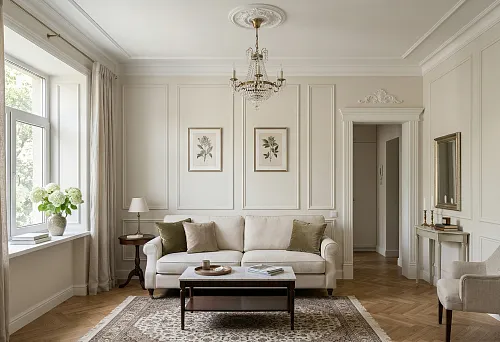
Neoclassicism is not a set of decorative elements, but an architectural logic. The style is based on the rhythm of horizontal and vertical lines, on symmetry, on the repetition of similar forms at different scales: the cornice echoes the baseboard, the wall molding frames resonate with door architraves, the console finds its reflection in the horizontals of profiles.
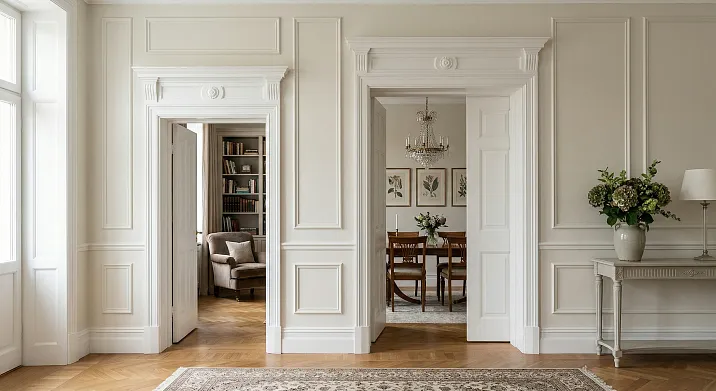
In this system, a door opening is one of the key points. It breaks the continuous plane of the wall and requires an architectural solution for this break. Without an architrave, the opening looks technical: wall — hole — wall. With a properly selecteddoor opening framed with molding— it is an event in the architecture of the wall, a framed transition that emphasizes the logic of the space.




The opening as a rhythmic element of the interior
Imagine a wall in a Neoclassical living room: a cornice around the perimeter, molding frames, a high baseboard. All of this is a system of rhythmic horizontal and vertical lines. Now, in this wall — a door opening. Bare. Without architraves.
Even if the door leaf is beautiful — an opening without framing breaks the system. It 'falls out' of the rhythm. An architrave is an element that integrates the opening into the overall grid of lines: its horizontal top element continues the logic of the moldings, its vertical posts resonate with the verticals of the wall panels.
Our factory also produces:
Prestige without heaviness
A common fear: 'A portal is heavy, lavish, palatial.' In fact, this is only true for Baroque or Rococo. Neoclassicism is a different story. Here, a portal can be made with a thin profile and minimal relief, yet it will carry full architectural meaning. Geometry is important, not ornamentation.
Framing doors with moldings and architravesIn modern neoclassicism, it is primarily a clear frame around the opening that completes the architectural image. The relief can be very delicate. The scale can be moderate. But the very fact of having a frame is fundamental.
Get Consultation
What to choose: architraves, a molding frame, or a full portal
This is the central choice. And it depends on three parameters: the character of the interior, the significance of the specific opening in the layout, and the desired result.
Scenario one: architraves are sufficient
A profiled architrave is the basic and most common scenario. It covers the technical joint between the door frame and the wall, creates a clear frame around the door, and integrates the opening into the interior style.
Wooden architraves for doors70–120 mm wide with a classic profile is the optimal choice for a neoclassical interior where the style is expressed moderately. The door is beautiful, the interior is calm, there are few moldings on the walls — a simple architrave handles the task and does not overload the space.
When an architrave is sufficient:
-
interior in the spirit of soft, modern neoclassicism;
-
there are several doors in the room, and giving each a portal means overloading the walls;
-
the door leaf itself is expressive (paneled, with carving, with a decorative insert);
-
a small room where a portal would feel oppressive.
Second scenario: molding framing
A molding frame around the opening is the next level. The idea is to connect the door framing with the wall molding system: if the walls already have decorative frames, then a similar profile around the door opening integrates it into a unified system.
The scheme is as follows: molding of the same profile used on the walls is mounted around the perimeter of the opening — two vertical posts and a horizontal top element. Corner joints — at 45° or with a decorative corner element-capital.
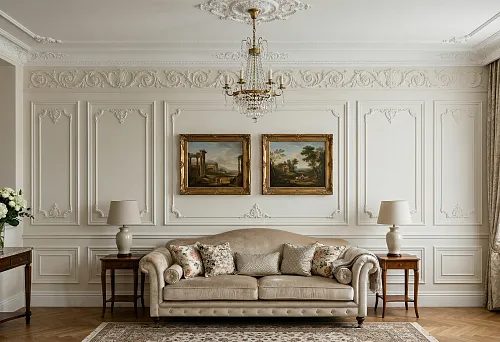
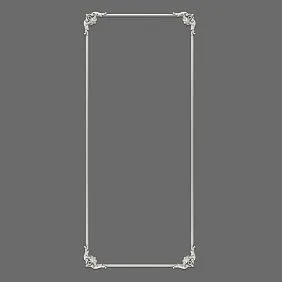
This option is especially good when the walls in the room are already decorated with moldings:wall decor with moldings and panelson the walls and a similar profile on the door create a cohesive architectural system, in which the opening is part of a common language, not a separate element.
Scenario three: full-fledged portal
A portal is when a doorway becomes the main architectural accent of a room or passage. The classic portal system consists of:
-
two vertical elements — pilasters or expressive casings with capitals;
-
a horizontal upper element — a lintel or pediment;
-
sometimes — an additional cornice above the lintel.
A portal is suitable when the opening is the semantic center of the space: the entrance from the hallway to the living room, the transition to the formal area, the main door of the study, the door to the hall. In these cases, the portal not only completes the wall architecture but also emphasizes the significance of the transition.
Important: a portal does not have to be heavy.decorative doorway framingIn modern neoclassicism — these are delicate pilasters with minimal relief, a horizontal lintel with a moderate profile. Architectural geometry without baroque opulence.
What casings are in the neoclassical style: profiles, width, materials
Let's break down the parameters concretely — because 'classical casing' can mean completely different things depending on scale and character.
Casing width
For a neoclassical interior, a standard 50–60 mm casing looks sparse. The style calls for more pronounced framing. The working range for neoclassicism:
-
70–90 mm — moderate framing, suitable for all rooms, including small ones;
-
90–120 mm — expressive framing for spacious rooms and significant openings;
-
120–150 mm — portal scale, for main openings in formal areas.
MDF baseboardsFor painting, widths of 70–120 mm are a practical solution for most neoclassical interiors: precise geometry, readiness for acrylic painting, stability under humidity fluctuations. No lengthwise deformation, no gaps in corners.
Casing profile
For neoclassicism — a profile with readable relief, but not overloaded. Several typical options:
Straight with bevel — minimal relief, modern neoclassicism. Clear geometry without ornament.
Classical stepped — two or three setbacks, creating shadow and depth. Well-defined under side lighting. A universal choice for neoclassicism.
Profile with ogee — one smooth curve along the width, classical yet light. Suitable for a soft version of the style.
Pronounced pilaster profile — for architraves 100 mm and wider, for grand entrance portals. Suitable for spacious rooms with high ceilings.
Architrave material
Solid oak —oak door architravecombines the aesthetics of natural wood, high strength, and durability. Suitable for tinting, varnishing, or painting. Fits well in interiors with natural materials — wooden floors, stone windowsills, solid wood furniture.
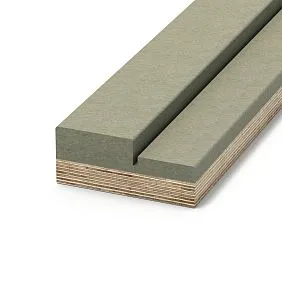
MDF for painting — precise geometry, smooth surface, ideal for white or light varnishes. The best choice when architraves are painted the same color as walls or doors (monochrome solution).
Polyurethane — for decorative elements (capitals, corner overlays, pediments). Reproduces relief with high accuracy, resistant to moisture, easy to install.
How to build a portal from moldings and cornices: geometry and proportions
This is the key practical block — specific portal anatomy with numbers.
Vertical posts (pilasters)
The vertical elements of the portal are either wide casings (100–150 mm) or full pilasters with a base, shaft, and capital. For modern neoclassicism, a simplified scheme is more common: a wide profiled casing with a decorative capital in the upper corner.
The width of the portal's vertical element is 90–150 mm. The height is from the floor to the bottom of the upper lintel, i.e., equal to the opening height minus the height of the upper horizontal element.
Important point: the lower part of the vertical element should not compete with the baseboard. Either the casing ends exactly above the baseboard (with a 5–10 mm gap), or it connects to it via a special transition element—a 'heel'.
Horizontal upper element (lintel, architrave)
The horizontal lintel above the doorway is a pediment or straight architrave. The height of this element (its vertical dimension) is 80–120 mm for a moderate portal, 120–200 mm for a more formal one.
The profile of the lintel should be of the same or related style as the vertical posts. A complete mismatch of profiles is the most common mistake when assembling a portal independently.
When an upper cornice is needed
The cornice above the lintel is the third element of the classical portal scheme. It creates completeness and formality. But this is precisely where scale errors are most often made: the cornice is too large, too protruding—and the portal begins to 'overwhelm' the opening.
For a neoclassical hallway or corridor—a cornice above the portal with a projection of no more than 20–30 mm. For a spacious living room with a ceiling of 2.8–3 m—a projection of 40–50 mm is acceptable. The smaller the space and the lower the ceiling—the more modest the upper cornice should be.
A good rule: if you're unsure whether a cornice is needed—it probably isn't. A portal without an upper cornice looks clean and modern. A portal with a cornice looks more classical and formal. The choice depends on the overall character of the interior.
Capitals: When Appropriate and How to Choose
A capital is a decorative overlay at the corners of a portal, where the vertical element meets the horizontal. It masks the joint of the corner connection and adds a classical character to the portal.
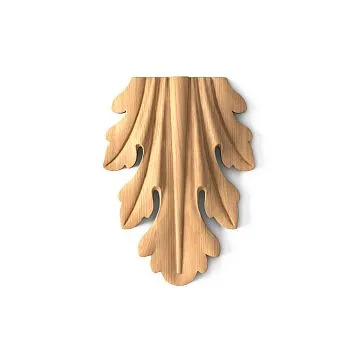
For neoclassicism — a capital with moderate relief: a small acanthus leaf, geometric ornament, a classical rosette. Not a full-width Baroque curl.
The size of the capital should correspond to the width of the vertical element: for a 90 mm casing — an 80–100 mm capital, for a 120 mm casing — 110–130 mm. A capital that is significantly wider than the casing looks disproportionate.
Doorway without a door: when it is beautiful and how to design it
One of the 'hottest' requests in interior design — and one of the most underrated scenarios for neoclassicism.
A doorway without a door between rooms is an architectural transition, open, light, and yet requiring no less attention than a doorway with a door leaf. It is here that casings and portals work especially powerfully: they create a framing for the transition, making it an architectural event, not just a hole in the wall.
When a doorway without a door is appropriate
-
transition between the living room and dining room or kitchen in an open-plan layout;
-
passage from the hallway to the corridor or living room, when a door is functionally unnecessary;
-
entrance to a study or library where openness is important, not isolation;
-
decorative niches or arched passageways.
In neoclassicism, a rectangular opening without a door is framed with casings on both sides of the wall — along the entire perimeter on both planes. This creates a complete decorative portal for a doorway, an architecturally designed passage. The width of the casings for such a portal is 100–150 mm, which emphasizes the significance of the opening.
Rectangular or arched opening
For modern neoclassicism, a rectangular opening is preferable. An arch is a more romantic, Mediterranean note that in a modern context requires careful coordination with the remaining elements. A rectangular opening with clear molding framing is a classic neoclassical technique that works in any context.
If an arch already exists (for example, in a house with vaulted ceilings) — it can be framed with smooth molding following the shape of the arch: curved molding or composite framing made from short elements.
How to connect a doorless opening with adjacent walls
The main rule: the framing of the opening should use the same or a related profile as the moldings on the walls in both rooms. If the living room has frames made of 25 mm molding, and the dining room has 20 mm, the portal between them should be made from a profile of the same family.
The baseboard continues from one room to another through an opening — this is a mandatory element of the system. A broken baseboard at an opening without a logical conclusion looks like a construction error.
How to combine a portal with wall moldings, baseboard, and cornice
This is where the main secret of a cohesive interior lies. A portal is not an independent object; it is part of a system. And how it relates to the other horizontal and vertical lines of the space determines whether the interior will look holistic or eclectic.
The principle of a unified profile family
All architectural elements in the space — cornice, wall moldings, architraves, baseboard — must belong to one 'profile family'. This does not mean the same size, but it does mean a unified profile style: the same character of relief, similar bevel angles, a unified ornamental language.
For example: a smooth cornice, smooth wall moldings, and smooth architraves — monochrome modern neoclassicism. Or: a cornice with a bead, moldings with a stepped profile, and architraves with a similar relief — a more pronounced classicism. Mixing — a smooth cornice, Baroque architraves, and a strict baseboard — is architectural chaos, not neoclassicism.
The height of horizontal lines as the key to the system
One of the most effective techniques for creating a cohesive interior is aligning horizontal lines. The upper architrave of the portal (horizontal lintel) should be either at the same height as the cornice or horizontal wall molding — or at the height of the door opening, which is already part of the system.
If in the living room a horizontal dividing molding runs at a height of 2.1 m, and the upper lintel of the portal is at a height of 2.05 m, these close but non-coinciding horizontals will compete. They must either coincide exactly or be spaced a significant distance apart.
Tone: unified or nuanced contrast
In neoclassical style, the same principles apply to door framing as to wall moldings:
-
Monochromatic solution (architraves and portal matching the wall or door color) — safe and elegant;
-
Nuanced contrast (white architraves on a cream wall) — delicate and beautiful;
-
Sharp contrast — only in spacious formal areas, very deliberately.
Moldings for interior doors and decorative architravesin most cases are painted the same color as the door leaf — this creates a sense of a 'system,' not a random set of details.
How to avoid overloading a door opening in a small apartment
The fear of overloading is understandable and justified. But most often, it leads people to abandon framing altogether, instead of finding the right scale.
Principles for small spaces
Narrow architrave instead of pilasters. For a standard-layout apartment with a 2.5 m ceiling, the optimal architrave width is 70–90 mm. This is enough to create a readable frame and not enough to 'eat up' wall space.
Minimal relief. A straight profile with a bevel or slight chamfer is ideal for small spaces. Baroque relief with multiple setbacks and ornamentation feels oppressive in a small area.
No capitals in very tight spaces. A capital adds a visual accent in the corner, which in a narrow hallway or small entryway creates a sense of narrowing. For such cases, a 45° joint without a decorative overlay.
One expressive opening per room. If there are two doorways in a living room, one gets a molding frame with an accent, the second gets a simple casing. Making both equally expressive means depriving the interior of hierarchy.
Light-colored framing. In a small space, a dark portal on a light wall creates a powerful contrast that visually shrinks the room. A light casing matching the wall or door color is the optimal solution.
What to do in a small entryway
The entryway is a special case. Space is limited, and there are often several doorways (entrance door, bathroom, hallway, living room). Here, a portal is appropriate only for one, the main opening—leading to the main part of the apartment. The rest are simple casings 70–80 mm of a uniform profile.
Portal in a small entryway: casing width no more than 90 mm, a horizontal lintel without a cornice, joints at 45°. No complex ornamentation. The result is an architectural frame that marks the main transition without a feeling of tightness.
Where a door portal is especially appropriate
Not every opening requires a portal. But there are places where it works exceptionally well.
Transition from the entryway to the living room
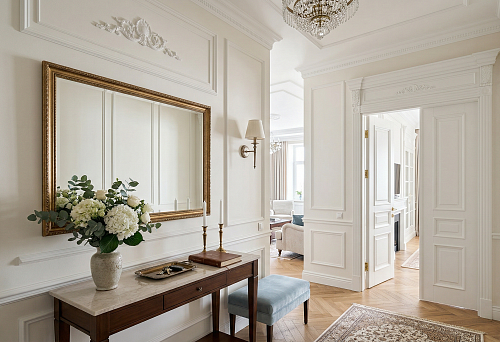
This is the main passageway in the apartment — the first one seen by guests and residents when moving into the house. The portal here functions as an 'architectural stage': it marks the transition from functional to living space, giving it significance. This is precisely whereWooden portalswith pronounced architraves of 100–120 mm and a neat horizontal lintel yield the best result.
Transition from hallway or corridor to living room
Similar logic. A formal opening into the main space of the apartment is always a good place for a portal. Pilasters, capitals, and a pronounced lintel are appropriate here.
Study or library
Doors to a study are often treated in a more conservative manner — as a separate, enclosed space. A portal in front of the study adds significance, emphasizing that it is a special place. Dark wood tones work well here — walnut, dark oak, wenge.
Open-plan kitchen-dining room
If the kitchen and dining area are combined into a single space, but there is an arched or rectangular opening to the corridor — framing it creates a visual 'stop' before the kitchen zone. Architraves of 80–100 mm on both sides of the wall are a clean and effective technique.
Ready-made portal or assembly by elements: an honest comparison
This question is always asked. The answer — as usual — depends on the situation.
Assemble by elements
Advantages:
-
Maximum flexibility in proportions
-
Can be precisely adjusted to a non-standard opening
-
Free choice of each profile
Disadvantages:
-
High risk of stylistic mismatch of elements
-
Harder to maintain a uniform scale
-
Requires experience or professional consultation
-
More time for selection, calculation, and purchase
Ready-made portal solution
Door portalsAs ready-made systems — these are coordinated sets: architraves, lintels, and capitals are selected in a unified style and scale. For neoclassicism, this is fundamentally important: the consistency of profiles is the main visual principle of the style.
Advantages:
-
Elements are already coordinated in style and proportions;
-
Lower risk of error with scale and profile;
-
Faster to select and calculate;
-
Predictable visual result.
Disadvantages:
-
Less flexibility for non-standard geometry;
-
Not always an exact fit for a custom project.
Conclusion for most: for standard openings in typical apartments — a ready-made solution is preferable. For design projects with non-standard geometry — assembly with professional consultation.
Typical mistakes when designing door openings
We compiled this list not because we want to list others' mistakes, but because they occur in 8 out of 10 interiors — and each one is easy to avoid if you know in advance.
Too narrow casing in an expressive interior. 50 mm casing in a neoclassical interior with decorative wall moldings looks like a technical detail. The style requires at least 70–80 mm — enough for the framing to be perceived as an architectural element.
Too heavy portal in a small apartment. Wide pilasters with rich relief, a massive cornice above the door in an apartment with 2.5 m ceilings — a classic mistake. The portal overwhelms the space instead of organizing it.
Mismatch between casings, baseboard, and cornice. A Baroque casing and a minimalist baseboard in the same room — this is an architectural disconnect. All elements should be from the same 'vocabulary'.
Capitals on all doors. Decorative overlays at the corners of a portal are effective precisely when they mark a significant opening. Capitals on all six doors of an apartment — this is no longer an accent, but background.
Uncoordinated color of casings and door leaf. White casings and a dark door — a contrast that requires a deliberate decision. If this is not intentional, but accidental — it creates dissonance.
Decorative top that 'presses' on the passage. A horizontal lintel with a large vertical dimension (200 mm or more) above a standard 2 m opening — creates a feeling of an overhanging element. The lintel should be proportional to the height of the opening, not dominate it.
Attempting to make every opening an accent. In an apartment with five doors — one portal on the main opening, four — with delicate casings of a unified style. Five portals — this is no longer a system, it's overload.
About the company STAVROS
A door opening is one of those details that either 'finishes' the interior to completeness or leaves it unfinished. The difference between a random casing and a correctly selected frame is not in price, but in precision. Precision of profile, width, style, and scale.
STAVROS — a Russian manufacturer of architectural decor: solid oak wooden casings, MDF casings for painting, decorative polyurethane capitals and corner elements, portals, moldings, cornices, and baseboards. Production in Russia, catalog — from simple classical profiles to expressive portals for formal areas.
STAVROS helps select a solution for a specific opening: standard or non-standard, hallway or formal hall, soft neoclassicism or pronounced classicism. Full catalog — Door and window casings, ready-made solutions for portals, decorative molding framing— on the STAVROS website.
If you've already decided on a portal and are now thinking about wall decoration — read aboutmoldings and stucco for the living room. If you need an entrance hall in neoclassical style — go to the article aboutslatted panels and stucco decor for the entrance area. And if you want to understand profile types from scratch — the complete guide topolyurethane moldings and stuccoexplains everything from material selection to installation.
Frequently asked questions
What kind of trims are suitable for neoclassicism?
Width 70–120 mm — depending on the scale of the room and the degree of style expression. Profile — with a readable relief: stepped, with a bead or with a chamfer. Material — solid oak for tinting or MDF for painting. Monochrome painting to match the wall color is a universal and elegant solution.
When is a portal needed, and when are trims sufficient?
Simple trims are sufficient for most openings in a standard apartment — bathroom, bedroom, small hallway. A portal is appropriate for main openings: the transition from the hallway to the living room, entrance to the formal area, main door of the study. Rule: one expressive portal per room — the remaining openings in simple trims.
Can an opening be decorated with moldings without a door?
Not only is it possible — it's an excellent technique. Trims on both sides of the wall around the perimeter of a doorless opening create an architectural transition portal. The width of the trim for such portals is 100–150 mm. This works in open floor plans, between the living room and dining room, in transitions between adjacent zones.
What kind of portal to choose for a small apartment?
Delicate: trim width 70–90 mm, horizontal lintel without a cornice, joints at 45° without capitals. Monochrome painting to match the wall or door color. One portal on the main opening — the rest in simple trims.
Do trims need to be coordinated with the baseboard?
Absolutely. Trims and baseboards should belong to the same 'profile family' — a unified style of relief and character of lines. A Baroque trim and a minimalist baseboard in the same room is architectural dissonance. A unified style for all profiles is the main principle of a cohesive interior.
What's better: a ready-made portal or assembly by elements?
For standard openings in typical apartments, a ready-made portal is preferable: the elements are coordinated, the risk of error is minimal, and the result is predictable. Assembly by elements is justified for non-standard geometry or when working with a designer who knows the exact proportions needed.
How to choose the width of the casing for a specific opening?
The guideline is simple: the width of the casing should not exceed 10% of the width of the door opening. For a standard 900 mm opening, casing up to 90 mm. For a 1200 mm opening, up to 120 mm. In small rooms, aim for the lower end of the range. In spacious ones, you can take the upper end.