Article Contents:
- Legacy of Masters: Traditions of Wooden Decoration in the Modern World
- Philosophy of Natural Material
- Emotional Impact of Wooden Decoration
- Material Science: Choosing the Species for Perfection
- Premium Species: Oak, Ash, Beech
- Exotic Solutions: Walnut, Cherry, Maple
- Coniferous Species: Pine, Larch, Cedar
- Technological processes: from raw material to masterpiece
- Raw material preparation: the foundation of quality
- Production Technologies: Precision and Craftsmanship
- Final finishing: last touches
- Stylistic Typology: From Classicism to Avant-Garde
- Historical Styles: Heritage of Centuries
- National Traditions: Russian Carving
- Modern Directions: From Modernism to High-Tech
- Practical Application: From Idea to Realization
- Planning Decorative Scheme
- Color solutions
- Lighting and Decorative Details
- Installation and Mounting: Technical Aspects
- Preparatory work
- Mounting methods
- Features of Installing Various Elements
- Care and Restoration: Preserving Beauty Forever
- Preventive care
- Restoration work
- Environmental Aspects and Certification
- Sustainable forestry
- Ecologically safe coatings
- Economic Aspects: Investment in Quality
- Impact on property value
- Long-Term Economic Efficiency
- Frequently Asked Questions
- Conclusion: choosing in favor of perfection
Have you ever encountered interiors that literally 'speak'? Spaces where every line, every curve tells a story about taste, style, and understanding of beauty? The secret to such interiors lies in the skillful use of wooden details for decorationthat transform an ordinary space into a work of art. In a world where plastic and synthetic materials are taking over more and more space, natural wood remains an island of authenticity, warmth, and natural beauty.
Wooden decorative elements are not just interior decoration — they are a philosophy of life, a choice in favor of ecology, quality, and longevity. Each detail carved from solid wood carries the energy of living material, its unique texture, aroma, and ability to create a special atmosphere in the home.


Legacy of Masters: Traditions of Wooden Decoration in the Modern World
Wood carving art in Russia has a thousand-year history. Masters passed down the secrets of the craft from generation to generation, perfecting techniques and creating unique stylistic directions. But why, in the 21st century, in the age of high technology and synthetic materials, wooden details for decoration have not lost their relevance, but are experiencing a true renaissance?




Philosophy of Natural Material
Wood is the only building material that grows on its own. Unlike metal, plastic, or composites, wood has a unique ability to 'breathe', react to changes in humidity and temperature, creating a special microclimate in the room. Carved Elements from Solid Wood not just decorate the interior — they live within it, changing over time, acquiring a noble patina, and becoming even more expressive.
Each type of wood has its own character and energy. Oak symbolizes strength and reliability, beech — home comfort and warmth, ash — flexibility and elegance. Choosing wooden decorative elements, we are not simply acquiring beautiful items — we are inviting a piece of nature into our home, with its wisdom and harmony.
Our factory also produces:


Emotional impact of wooden decor
Psychologists assert that natural materials positively affect a person's mental state. Wooden surfaces reduce stress levels, creating a sense of safety and comfort. It is no coincidence that premium hotels, restaurants, and private residences actively use them Decorative wooden inlays — their warmth and naturalness create an atmosphere of luxury and refinement.
The texture of wood, with its unique fiber pattern, acts as a natural antidepressant. The gaze gliding over the smooth lines of wooden ornamentation relaxes, and consciousness tunes into a positive state. This explains the popularity of wooden decor in spas, meditation spaces, and relaxation zones.
Get Consultation
Material science: choosing the species for perfection
The success of any decorative project begins with the correct choice of material. Modern technologies allow using almost any wood species to create decorative details, but each has its own characteristics, advantages, and areas of application.
Premium species: oak, beech, beech
Oak — the king among decorative species. Its exceptional hardness allows creating the finest carving details, which retain sharp contours for decades. Oak Moldings and cornices distinguish themselves by the nobility of color — from light honey to deep brown with golden hues. Over time, oak develops an even more expressive patina, becoming a true interior ornament.
Beech attracts designers with its bright, contrasting texture. Clearly defined annual rings create a dynamic pattern, especially effective in modern interiors. Beech readily accepts staining, allowing it to adapt to any color scheme.
Beech — material for perfectionists. Its uniform, fine-grained structure ensures an ideal smooth surface after processing. Beech easily takes on any tones — from pearl white to deep wenge — making it a universal choice for various stylistic directions.
Exotic solutions: walnut, cherry, maple
Walnut — the aristocrat among decorative species. Its complex, multi-colored texture, transitioning from light brown to dark chocolate, creates natural decorative effects without additional processing. Walnut details are especially prized in classical and antique interiors.
Cherry possesses a unique ability to change color under light exposure. Freshly cut cherry has a light pink hue, which darkens over time to a noble reddish-brown. This natural aging process imparts the interior with a special depth and character.
Maple — choice for modern interiors. Its light, almost white wood with delicate, elegant grain pattern is ideal for minimalist and Scandinavian styles. Maple accepts colored stains well, allowing for vibrant accents.
Coniferous species: pine, larch, cedar
Coniferous species are traditionally used in Russian wooden architecture and are experiencing a new wave of popularity today due to the ecological trend and accessibility.
Pine — a democratic, yet no less beautiful material. Its light wood with contrasting resin veins creates a cozy, homey atmosphere. Pine baseboards and door casings are ideally suited for country houses and cottages.
Larch combines the beauty of coniferous species with exceptional durability. Its natural resinous quality provides protection against moisture and biological damage, making larch an ideal choice for rooms with high humidity.
Cedar — material for elite projects. Its unique aroma, beautiful texture, and legendary durability justify its high cost. Cedar details create an atmosphere of luxury and exclusivity in interiors.
Technological processes: from rough material to masterpiece
Creating quality wooden details for decoration — this is a complex technological process involving multiple stages. Each is critically important for achieving the highest quality final result.
Raw Material Preparation: The Foundation of Quality
The process begins with careful selection of wood. For decorative elements, only first-grade material without knots, cracks, rot, or other defects is used. Each board undergoes visual inspection and instrumental moisture testing.
Drying is a critically important stage determining the stability of finished products. Modern drying chambers allow drying wood to an optimal moisture content of 8–12% with precision to tenths of a percent. Properly dried wood does not crack, warp, and maintains stable dimensions for decades.
Stabilization includes storing dried wood under controlled conditions to equalize internal stresses. This process may take several weeks, but it guarantees the absence of deformations in finished products.
Production technologies: precision and craftsmanship
Cutting is performed on high-precision equipment, taking into account the direction of fibers and texture characteristics. Each blank is oriented to maximize the beauty of the wood and ensure optimal strength properties.
Milling is the main technological operation for creating profiled elements. Modern CNC milling centers provide micron-level precision, enabling the creation of complex profiles with perfect repeatability. Decor for Molding Requires particularly precise milling to ensure ideal element alignment.
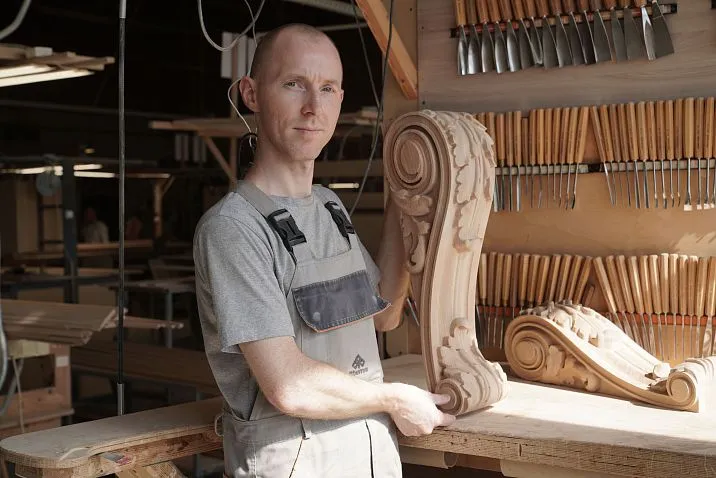
Carving is the pinnacle of woodworking craftsmanship. Despite advancements in automation, creating complex carved compositions still requires the involvement of skilled artisans. The combination of machine precision and human craftsmanship yields unparalleled results.
Final finishing: the last touches
Sanding is performed in several stages with gradually decreasing abrasive grit. Final polishing imparts a mirror-like smoothness to the surface and prepares it for application of protective and decorative coatings.
Staining allows highlighting the natural beauty of wood or achieving the desired shade. Modern water-based stains penetrate deeply into the wood structure, creating an even, durable coloration.
Finishing with varnish protects wood from external influences and imparts the desired gloss. Polyurethane varnishes provide exceptional resistance to abrasion and moisture, preserving the original appearance of elements for many years.
Stylistic typology: from classicism to avant-garde
Offers an impressive variety of design solutions. From minimalist, sleek forms to richly decorated baroque ornaments — every style finds its embodiment in polyurethane corner elements. This versatility opens boundless creative opportunities for designers and architects. wooden details for decoration Offers solutions for any stylistic preference — from strict classicism to bold avant-garde.
Historical styles: heritage of centuries
Baroque in wooden decor is a celebration of opulence and abundance. Complex carved compositions with numerous scrolls, rosettes, and cartouches create an atmosphere of palace luxury. Baroque elements require the highest level of craftsmanship — every detail must be executed with jewel-like precision.
Rococo brought lightness and playfulness to decorative arts. Asymmetric compositions, botanical motifs, gilded details create an atmosphere of French chic. Rocaille elements particularly stand out in boudoirs and salons.
Classicism leans toward strictness and symmetry. Classical motifs — palmettes, rosettes, meanders — are executed with mathematical precision. Classicist decor emphasizes the architectural logic of space and creates a sense of monumentality.
Empire uses decoration as a means to demonstrate power and grandeur. Military symbolism, imperial attributes, large-scale compositions — all of this requires large, expressive elements made from noble wood species.
National traditions: Russian carving
Russian wooden carving is a unique phenomenon in world decorative and applied art. Each region of Russia developed its own traditions and motifs, creating an unmistakable stylistic signature.
Domestic carving is distinguished by rich symbolism. Solar signs, botanical ornaments, zoomorphic motifs carry deep meanings connected to folk beliefs about the cosmos. Modern interpretations of Russian carving preserve symbolic content while adapting forms to contemporary interiors.
Iconic carving is renowned for its volume and realism. Masters create complex narrative compositions where each character is rendered with remarkable detail.
Gorodets wood painting combines carving with painting. Bright colors, fairy-tale scenes, botanical ornaments create a festive, joyful atmosphere.
Modern directions: from modernism to high-tech
Modernism brought a new understanding of form to wooden decor. Asymmetric compositions, stylized natural motifs, flowing lines create a sense of movement and life. Modernist elements particularly stand out when combined with contemporary materials — glass, metal, stone.
Art Deco is characterized by geometric stylization and luxurious materials. Zigzag lines, stepped forms, contrasting combinations create dynamic, memorable compositions.
Scandinavian style leans toward simplicity and functionality. Natural light-colored wood species, minimal decoration, emphasis on material quality and flawless execution — these are the core principles of the Scandinavian approach.
Minimalism uses wooden elements sparingly; each element must be functionally justified. Simple geometric forms, ideal proportions, absence of excess — these are the requirements of minimalist decor.
Practical application: from idea to realization
requires understanding of compositional laws. The size of decorative elements must correspond to the scale of the room and the objects they adorn. Too small elements will disappear in a large space, while overly large ones will overwhelm the interior. wooden details for decoration Requires understanding not only aesthetic but also practical aspects of their application.
Decorative scheme planning
Space analysis is the first step toward creating a harmonious decorative composition. Architectural features of the room, its dimensions, lighting, functional purpose — all of these influence the choice of type and scale of decorative elements.
High ceilings allow using large, expressive details — massive cornices, volumetric rosettes, extended moldings. In rooms of standard height, preference is given to more delicate elements that do not overwhelm the space with their scale.
Functional zoning using decorative elements allows organizing space without using partitions. Details varying in character and scale help define zones for relaxation, work, and dining within a single volume.
Color solutions
Monochromatic schemes are based on using various shades of one color. Natural wood provides the richest palette — from nearly white maple to dark wenge. Subtle play of shades creates refined, sophisticated interiors.
Contrasting combinations attract attention and create dynamism. Light details on a dark background or dark accents on light surfaces become compositional centers of the interior.
Color accents using stained wooden elements allow vibrant spots to be introduced into the interior without disrupting overall harmony. Modern stains enable wood to be colored almost any shade while preserving its texture.
Lighting and decorative details
Natural lighting reveals the beauty of different wood species in various ways. Oak and walnut especially look striking under side lighting, highlighting the relief of their texture. Lighter woods — maple, birch — are better suited for well-lit areas.
Artificial lighting allows for dramatic effects. Directional lights illuminating carved details create play of light and shadow, enhancing the decorative effect. Hidden backlighting of moldings and cornices creates a "floating" effect.
Installation and mounting: technical aspects
The quality of installation largely determines durability and aesthetics of wooden decorative detailsDifferent types of elements require specific mounting approaches.
Preparation Work
Surface preparation is a critically important stage. The base must be perfectly flat, dry, and strong. Irregularities exceeding 2 mm must be eliminated with putty or sanding. Dust and contaminants are removed using an industrial vacuum cleaner.
Marking is performed using laser levels and measuring tools. The accuracy of marking determines the quality of the final result. Especially important is precision when installing long elements — moldings, baseboards, cornices.
Acclimatizing wooden elements in the room before installation prevents deformation after mounting. Details must remain in the room for at least 48 hours at working temperature and humidity.
Methods of mounting
Mechanical mounting with screws and bolts is the most reliable method for heavy elements. Fasteners must be made of stainless steel to prevent corrosion and staining of the wood.
Adhesive mounting is suitable for light elements and complex-shaped details. Modern polyurethane adhesives provide bond strength comparable to mechanical mounting. It is important to choose an adhesive compatible with the base material.
Combined mounting combines mechanical and adhesive methods, ensuring maximum reliability. Initial fixation is performed with screws, final securing — with adhesive.
Features of installing various elements
Moldings require special attention to joints. Corners are cut at 45 degrees using a miter saw. Joints are filled with putty and sanded until completely invisible.
Cornices are installed with mandatory reinforcement of mounting points. For heavy elements, special brackets are used, distributing load over a larger area.
Carved appliqués are installed with special care to avoid damaging delicate carved elements. Special washers and torque limiters are used.
Care and restoration: preserving beauty forever
Proper care extends lifespan wooden decorative elements and preserves their original beauty for decades.
Preventive Care
Regular cleaning prevents dust and dirt accumulation in relief elements. Soft brushes or vacuum cleaners with crevice tools are used for carved details. Wet cleaning is permitted only for elements with quality lacquer finish.
Microclimate control is a key factor in preserving wooden elements. Optimal air humidity 45-65%, temperature 18-22°C. Sharp fluctuations in these parameters may lead to cracking and deformation of wood.
Protection from direct sunlight prevents wood from fading and drying out. UV filters on windows or special protective coatings are used.
Restoration work
Coating restoration is performed as needed, typically every 5-10 years depending on usage conditions. Old coating is removed with soft abrasives, the surface is prepared and covered with a new compound.
Damage repair includes filling chips, cracks, dents with specialized wood putty, followed by sanding and staining. Severe damage may require replacing individual elements.
Updating carvings is a delicate task requiring high craftsmanship. Worn details are restored using hand tools with precise reproduction of the original pattern.
Ecological Aspects and Certification
In the context of growing consumer environmental awareness, questions of origin and processing wooden details for decoration gain particular relevance.
Sustainable Forestry
FSC certification guarantees that the wood is harvested from forests managed according to sustainable forestry principles. Purchasing FSC-certified products supports responsible forestry practices and contributes to preserving forests for future generations.
Local species require lower transportation costs and are better adapted to the local climate. Using local wood reduces the product's carbon footprint and supports the regional economy.
Ecologically safe coatings
Water-based coatings do not contain volatile organic compounds, are safe for human health and the environment. Modern water-based finishes provide high-quality coverage, equal to traditional formulations.
Natural oils and waxes create breathable finishes that highlight the natural beauty of wood. They are easy to renew and fully biodegradable.
Economic aspects: investment in quality
Purchasing quality wooden details for decoration is a long-term investment that pays off not only aesthetically but also practically.
Impact on property value
Quality decor significantly increases property attractiveness in the market. Apartments and houses with thoughtful wooden decor sell faster and at higher prices than similar properties without decorative finishes.
The uniqueness of solutions creates additional value. Exclusive hand-carved elements transform ordinary housing into sought-after objects among connoisseurs of quality and beauty.
Long-term economic efficiency
The durability of quality wooden elements eliminates the need for frequent replacements and repairs. Properly manufactured and installed components serve 30-50 years without losing functional or aesthetic qualities.
The possibility of restoration allows updating elements as needed without full replacement. This is especially relevant for antique and exclusive items.
Frequently asked questions
How to determine the quality of wooden decor when purchasing?
Quality elements have a uniform structure without knots, cracks, or other defects. The surface should be perfectly finished, without tool marks or roughness. The geometry of the elements should be precise, and joints — tight. The wood moisture content should not exceed 12%.
What type of fastening to choose for heavy elements?
For elements weighing more than 5 kg, mechanical fastening with screws or anchors is recommended. Fasteners should be made of stainless steel. The spacing of fasteners depends on the weight and size of the element, usually 30-50 cm.
Can wooden decor be used in humid rooms?
Yes, but special preparation is required. The wood must be treated with moisture-protective compounds, and the finish must have enhanced moisture resistance. It is better to use durable species — larch, teak, or thermally treated wood.
How often should the finish on wooden elements be renewed?
Under normal operating conditions, a quality finish lasts 7-12 years. In rooms with high humidity or intensive use, more frequent renewal may be required — every 5-7 years.
Does the complexity of carving affect the strength of elements?
Complex carving with deep grooves may reduce mechanical strength, but proper design and quality execution minimize this effect. Modern technologies allow creating very complex yet strong elements.
Can natural wood be painted in bright colors?
Yes, modern stains and paints allow coloring wood in any color while preserving the texture. However, many designers prefer to highlight the natural beauty of wood using transparent finishes.
Conclusion: choosing in favor of perfection
Wooden decorative details is not just interior elements, but a choice of life philosophy. A philosophy that values quality over quantity, durability over fashion, beauty over practicality. In a world of mass production and synthetic materials, wooden decor remains an island of authenticity, craftsmanship, and natural beauty.
Every detail created from natural wood carries the energy of living material, the craftsmanship of human hands, and the traditions of generations. Choosing quality wooden elements means investing not only in the beauty of our homes, but also in preserving artisanal traditions, supporting environmentally responsible production, and creating a healthy living environment.
Modern technologies allow creating wooden decorative elements of any complexity, but the main thing remains understanding the material, sense of proportion, and striving for perfection. It is precisely these qualities that distinguish true masters from craftsmen.
STAVROS is a recognized leader in producing high-quality wooden decorative elements. Over many years of operation, STAVROS has earned a reputation as a reliable partner capable of bringing the most daring design ideas to life.
STAVROS masters work with the best wood grades, use advanced processing technologies, and strictly control quality at every stage of production. The result — products that become ornaments of the most refined interiors and serve for decades, delighting owners with their beauty and flawless quality.
By choosing STAVROS, clients receive not just decorative elements, but the opportunity to create a unique interior that reflects their individuality and good taste. Every STAVROS product is the result of meticulous work by professionals who invest not only skill but also soul into their work.
STAVROS is a guarantee of quality, reliability, and beauty. Choosing STAVROS means choosing the best for your home.