Article Contents:
- Material Unity: Why Wood Connects Space
- Wooden Floor Skirting: More Than a Decorative Strip
- Wood Species: Oak vs. Beech for Skirting and Handrails
- Skirting Dimensions: How to Choose Height and Thickness
- Skirting Profiles: From Simplicity to Complexity
- Round Handrail 50: The Standard for a Comfortable Grip
- Round Handrails for Stairs: Bent Elements for Turns
- Color Harmony: Toning Skirting and Handrails to a Unified Shade
- Wooden Skirting Price: What Makes Up the Cost
- Wooden Balusters: The Third Element of Harmony
- Skirting Installation: Concealed or Exposed Fastening
- Handrail Installation: Connection with Balusters
- Care for Wooden Skirting and Handrails
- How to Avoid Mistakes When Purchasing
- Frequently Asked Questions
- Conclusion: Integrity is Born in the Details

Construction or renovation is not a set of disparate operations, but the creation of a single organism where each element is connected to others by invisible threads of style, color, and texture. Stairs and floors, walls and ceilings—everything should resonate in unison. When you choosewooden skirting board purchase, and then select round handrails for the stairs made from the same wood species, with the same shade and finish, the magic of integrity emerges. The space ceases to be a sum of parts and transforms into a complete composition where every line, every curve works towards the overall impression. How to achieve this harmony? What nuances to consider when choosing materials? Why is it important to buy skirting and handrails from the same manufacturer? We examine in detail—with practical advice, technical details, and examples of successful solutions.





Material Unity: Why Wood Connects Space
Wooden baseboard at the base of the walls and a wooden handrail on the stairs create a visual rhyme—a repeating motif that soothes the eye and gives the interior order. When both elements are made from the same wood species, the texture echoes: the characteristic medullary rays of oak on the skirting are repeated on the handrail, the warm pinkish hue of beech below finds reflection above.
This is not just aesthetics, but the psychology of spatial perception. The human brain seeks patterns, motifs, repeating elements—they create a sense of order and comfort. Chaotic mixing of materials—plastic skirting, metal handrail, stone steps—causes subconscious unease. Wood, repeating in different zones, brings the space together, creating cohesion.
The practical aspect is also important. By purchasingWood skirting board and handrails from the same manufacturer, you guarantee not only the matching of the species but also the batch of wood. Oak from different forests can differ in shade by two or three tones—one with a golden sheen, another with a gray one. If the skirting and handrail are made from wood of the same batch, they are absolutely identical in color. After toning or painting, the difference is even less noticeable, but on natural wood, it is critical.




Wooden Floor Skirting: More Than a Decorative Strip
performs a whole range of functions. The first is protecting the joint between the wall and the floor. This is the most vulnerable spot: water gets here when washing floors, dust accumulates here, wallpaper or plaster on the lower section of the wall is subjected to mechanical impacts from shoes, furniture, vacuum cleaners. The skirting takes all the hits, preserving the wall finish.wooden skirting for the floorThe second function is hiding the expansion gap. Any wooden flooring (parquet, solid wood board, engineered board) is laid with a 10-15 millimeter gap from the wall—wood reacts to humidity, expands and contracts, the gap compensates for these movements. Without skirting, the gap looks untidy; with skirting, it is perfectly hidden. A skirting height of 80-100 millimeters completely masks the gap, creating visual completeness.
The second function is concealing the expansion gap. Any wooden flooring (parquet, solid wood board, engineered board) is installed with a 10-15 millimeter gap from the wall—wood reacts to humidity, expanding and contracting, and this gap compensates for these movements. Without a baseboard, the gap looks untidy; with a baseboard, it is perfectly concealed. A baseboard height of 80-100 millimeters completely masks the gap, creating visual completeness.
The third function is routing utilities. Modern skirting often has a cable channel—a groove on the back side where wires are laid: internet cables, telephone cords, antenna wires. This eliminates the need to chase walls, allows easy addition or removal of wires during use. Wooden skirting with cable channels is rare (more often the prerogative of MDF or plastic), but some manufacturers mill grooves in solid wood on request.
The fourth function is decorative. The skirting sets a horizontal line around the entire perimeter of the room, visually connects the walls, creates a frame for the floor. High skirting (120-160 millimeters) makes the room taller, visually stretches the walls. Low skirting (50-70 millimeters) suits rooms with low ceilings, does not overload the space.
Our factory also produces:


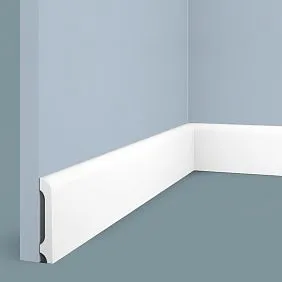
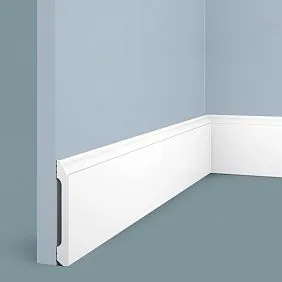
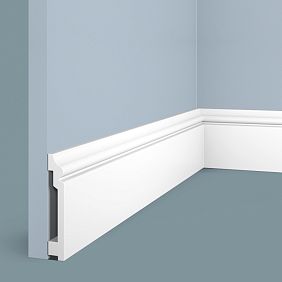
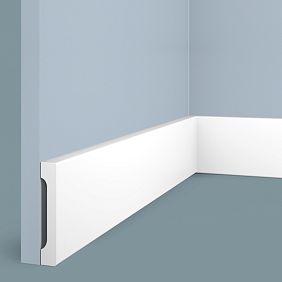

Wood Species: Oak vs. Beech for Baseboards and Handrails
Oak skirting— a choice for those who value durability and status. Oak wood is dense (700-800 kg/m³), hard (Brinell hardness about 3.7-4.0), and wear-resistant. An oak baseboard lasts for decades without losing its appearance—it can be sanded multiple times, refinished, without fear of wear. The grain is expressive: distinct annual rings, medullary rays (especially on radial cut), natural color ranging from light golden to dark brown depending on the wood's origin.
Oak pairs well with oak, ash, or exotic wood parquet. If the floor is dark (wenge, merbau, walnut), the oak baseboard can be stained to a matching shade—oak takes stains excellently, preserving the grain. For light floors (maple, whitewashed oak, ash), natural or lightly stained oak is suitable. Oak's versatility lies in its ability to adapt to any style: from classic to minimalism.
Oak skirting board— an alternative for those planning painting or preferring a calmer grain. Beech is dense (620-680 kg/m³), strong, but less visually expressive: the wood is uniform, fine-pored, with a pinkish or creamy hue. There are no bright annual rings, no medullary rays—the surface is calm, neutral. This is a plus if painting with enamel is planned: a beech baseboard under white, gray, or colored paint looks perfect, the grain doesn't show through, the color applies evenly.
Beech is 20-30 percent cheaper than oak with comparable strength characteristics. If the budget is limited but natural wood is desired, beech is the optimal choice. The only drawback is sensitivity to humidity. Beech reacts more strongly to changes in air humidity than oak: swelling coefficient of 0.40% per 1% humidity versus 0.25-0.30% for oak. In rooms with unstable climate (country houses without constant heating, humid regions), beech baseboards may warp. In urban apartments with central heating and stable humidity of 40-60%, beech performs flawlessly.
For handrails, the logic is the same: oak—maximum strength and status, beech—economy and the possibility of painting. If the staircase is outdoors (porch, terrace), the choice is clear—oak or larch. Beech outdoors deteriorates quickly.
Get Consultation
Baseboard Dimensions: How to Choose Height and Thickness
Baseboard height is determined by the scale of the room and interior style. Standard height is 80-100 millimeters, a universal option for rooms with ceilings 2.7-3.0 meters. An 80-millimeter baseboard is visually light, doesn't dominate, suitable for minimalism, Scandinavian style, modern interiors. A 100-millimeter baseboard is more noticeable, creates a clear horizontal line, good for neoclassicism, modern style.
Tall baseboards 120-160 millimeters—a sign of classic and historical styles. In rooms with ceilings above 3.2 meters, a 120-millimeter baseboard looks proportional, emphasizes status. In old mansions, palace interiors, baseboards 180-200 millimeters high are found—massive, richly profiled, sometimes with carved elements. Such baseboards become an architectural detail, shaping the room's style.
Low baseboards 50-70 millimeters are used in small apartments with low ceilings (2.4-2.5 meters). A tall baseboard in such a room will visually 'eat up' the height, make the space squat. A low baseboard is less noticeable, doesn't overload, preserves a sense of airiness. Low baseboards are also characteristic of loft style, where minimalism of details is valued.
Baseboard thickness (profile depth) is usually 12-22 millimeters. Thin baseboards 12-16 millimeters fit tightly to the wall, hardly protrude, suitable for perfectly flat walls. If walls are uneven (a common problem in old houses), a thin baseboard will follow the irregularities, look wavy. Thick baseboards 18-22 millimeters mask small wall irregularities due to their own rigidity, but require more material, cost more.
Baseboard Profiles: From Simplicity to Complexity
Simple rectangular baseboards—cross-section without shaped elements, pure geometry. The top edge may be rounded with a radius of 3-5 millimeters for safety and cleaning convenience (a right angle collects dust, a rounded one does not). Such baseboards suit minimalism, high-tech, Scandinavian style. Visually laconic, don't distract attention, serve as a neutral frame for the floor.
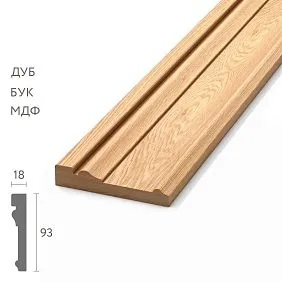
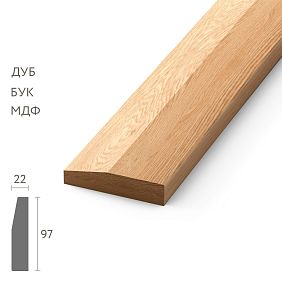
Baseboards with a chamfer—the top part is cut at a 45-degree angle, creating a beveled edge 10-20 millimeters wide. The chamfer adds dynamism, creates play of light and shadow, gives the baseboard volume. Style—modern classic, neoclassicism, contemporary. The chamfer can be single (only on top) or double (top and bottom), which enhances decorativeness.
Shaped profiled baseboards—complex curvilinear cross-sections with alternating convex and concave sections, beads, flutes, coves. Such profiles are characteristic of classic styles: Baroque, Rococo, Empire, Victorian style. A shaped baseboard is complex to manufacture (requires multi-pass milling), expensive, but creates a rich decorative effect. The profile is selected in accordance with the profile of cornices, moldings, casings—everything should be maintained in a unified style.
Baseboards with flutes—vertical grooves running along the entire height of the baseboard. A classic architectural element of columns, transferred to baseboards. Flutes create a vertical rhythm, visually elongate the wall. The number of grooves is usually 3-7, width of each 8-12 millimeters, depth 3-5 millimeters. Manufacturing on a CNC milling machine ensures precision and repeatability.
Round Handrail 50: Standard for Comfortable Grip
Round handrail 50millimeters in diameter—an ergonomic standard, proven by decades of use. A diameter of 50 millimeters is optimal for an adult hand to grip: fingers close comfortably, not excessively squeezed, not dangling. The grip is reliable, the hand doesn't tire during prolonged contact (relevant for elderly people who lean their full weight on the handrail when ascending).
Grip physiology: with a 50-millimeter diameter, the distance between the thumb and index finger of an average hand is 140-160 millimeters, which corresponds to the natural position of the hand. A smaller diameter (40-45 millimeters) requires greater finger compression, hand muscles tense more, the grip tires quickly. A larger diameter (60-70 millimeters) is difficult to grip fully, especially for people with small palms, the grip is less confident.
Round cross-section has an advantage over rectangular or oval: the hand contacts the handrail always under the same conditions regardless of the grip angle. A rectangular handrail may be convenient for a top grip but inconvenient for a side grip. Oval—a compromise, but still less universal than round. Round handrail—a classic, never goes out of style.
round handrails 50 mmare manufactured in two structural variants: solid and finger-jointed. Solid ones are turned from a single piece of wood, have continuous grain along the entire length, are maximally strong. Disadvantage—length limitation (usually up to 2.5-3.0 meters due to blank size) and risk of cracking with large humidity fluctuations (a long solid piece has internal stresses).
Finger-jointed handrails are assembled from short lamellas (30-60 centimeters long), glued end-to-end with a finger joint. Advantages: length is not limited (can manufacture a handrail 5-6 meters without joints), geometric stability (short lamellas have no internal stresses, don't crack), more uniform color (lamellas of similar shade can be selected). Disadvantage—visible joints between lamellas (although after staining or painting they are almost unnoticeable).
Round Handrails for Staircases: Bent Elements for Turns
round handrails for stairsfor straight flights—standard products. But staircases are rarely absolutely straight. There are turns, curves, spiral sections. How to make a handrail that smoothly goes around a turn, not breaking at an angle? Bent elements exist—sections of handrail, curved to a given radius.
Bent handrails are manufactured by bent lamination. Thin lamellas (3-5 millimeters thick) are glued together in a form, curved to the required radius. After the glue dries, the blank is removed from the form, processed on a lathe to a round cross-section of 50 millimeters. The result is a handrail that has a constant curve—the radius of curvature is the same along the entire length of the element.
Minimum bending radius depends on the wood species. For oak, the minimum is 600 millimeters (a smaller radius leads to rupture of lamellas on the outer side of the bend). For beech, thanks to its high plasticity after steaming, the minimum is 400 millimeters. This allows creating sharper turns, spiral staircases with a small diameter.
Bent elements are 50-100 percent more expensive than straight ones due to manufacturing complexity, need for special forms, manual finishing. But without them, it's impossible to make a quality staircase with turns—an angular connection of two straight handrails looks crude, creates discomfort when moving the hand (the hand stumbles on the corner).
Color Harmony: Staining Baseboards and Handrails to a Unified Tone
Even if baseboards and handrails are made from wood of the same species and batch, their natural color may slightly differ (one board lighter, another darker—this is normal for natural material). To create absolute unity, staining is applied—coloring the wood with stains that penetrate the structure, change the color, but preserve the visibility of the grain.
Staining is performed simultaneously for baseboards and handrails with the same composition. This guarantees identical shade. Water-based stains give natural tones (light walnut, medium oak, dark rosewood), alcohol-based—more saturated and fast-drying, oil-based—deep with maximum penetrating ability. The choice depends on the desired effect and type of finish coating.
After staining, a protective coating is applied: varnish or oil. Varnish creates a durable film that protects the wood from moisture, dirt, and abrasion. For skirting boards, polyurethane varnish is recommended — the most wear-resistant, it withstands floor washing, vacuum cleaner impacts, and does not yellow over time. For handrails — polyurethane or acrylic varnish, which is pleasant to the touch and does not feel like plastic.
Oil penetrates into the wood and does not form a surface film. The finish looks natural, emphasizes the grain, and is pleasant to the touch. The downside is less protection and the need for regular renewal (every 1-2 years for handrails, every 3-5 years for skirting boards). Oil is ideal for interiors where naturalness is valued and periodic maintenance is acceptable.
Wooden skirting board price: what makes up the cost
Wooden baseboard pricedepends on several factors. The first is the wood species. A pine skirting board costs 200-400 rubles per linear meter, beech — 500-800 rubles, oak — 800-1500 rubles. Exotic species (wenge, meranti, teak) are even more expensive — 2000-4000 rubles per meter. The difference is due to the cost of raw materials and processing complexity (hardwoods require more powerful equipment and expensive tools).
The second factor is size and profile complexity. A simple rectangular 50x12 mm oak skirting board costs 600-800 rubles per meter. A shaped 120x20 mm skirting board with a complex profile made of the same oak — 1200-1800 rubles. The more complex the profile, the more router passes, the higher the waste percentage, and the longer the processing — all of which increases the cost.
The third factor is the finish. An unfinished skirting board (raw, only sanded) is 20-30 percent cheaper but requires on-site finishing, which adds work. A varnished skirting board is ready for installation, costs more, but saves time. A stained skirting board is 15-25 percent more expensive than a natural one. A skirting board with a multi-layer finish (primer, stain, patina, varnish) is a premium segment, and the price can double.
The fourth factor is construction. A solid wood skirting board is 10-20 percent more expensive than a finger-jointed one of the same size and species. An MDF skirting board with wood veneer is 2-3 times cheaper than solid wood (200-400 rubles per meter for oak veneer) but is inferior in durability, repairability, and tactile feel.
For handrails, the logic is the same: oak is more expensive than beech, finger-jointed is cheaper than solid, unfinished is cheaper than finished. The average price for a 50 mm round oak handrail is 1200-1800 rubles per meter, beech — 800-1200 rubles. Curved elements are 1.5-2 times more expensive than straight ones.
Wooden balusters: the third element of harmony
If there is a staircase in the house,Wooden balustersbecome the third element of a unified ensemble: skirting board on the floor, balusters on the stairs, handrail on the railing. When all three elements are made from the same wood species, with the same stain and finish, absolute harmony is created. The eye moves from the skirting board to the balusters, from the balusters to the handrail — and everywhere sees familiar grain, a familiar shade, a unified style.
wooden balusters for staircasesare manufactured as turned or carved. Turned — a symmetrical profile with alternating balls, disks, cylinders, creating rhythmic vertical graphics. Carved — three-dimensional ornaments, floral motifs, geometric patterns, made on milling machines or by hand. The style of the balusters should match the interior style and the complexity of the skirting board profile.
If the skirting boards are simple rectangular, it's better to choose laconic balusters too — square section with chamfers or round with minimal decoration. If the skirting boards are shaped with a rich profile, the balusters can be complex carved — this will create stylistic unity. Mixing simple skirting boards and luxurious Baroque balusters looks disharmonious.
The standard height for balusters is 900 mm (providing a railing height of 900-950 mm including the handrail). The diameter or cross-section is selected based on the scale of the staircase: for narrow staircases (80-90 cm width), balusters with a diameter of 40-50 mm are sufficient; for wide grand staircases (120-150 cm), 60-70 mm is appropriate. Balusters that are too thin on a wide staircase get lost, while too thick ones on a narrow staircase overload it.
Skirting board installation: concealed or exposed fastening
Skirting boards are fastened using two main methods: with adhesive and with mechanical fasteners. Adhesive method — the skirting board is glued to the wall with polyurethane adhesive or liquid nails. Advantages: no visible fasteners, quick installation (apply adhesive, press, fix for an hour). Disadvantages: inability to remove without damaging the skirting board, requires a perfectly flat wall (otherwise the skirting board will detach in areas of poor adhesion).
Mechanical fasteners — the skirting board is screwed to the wall with screws or nailed with finishing nails. Advantages: reliability (the skirting board holds even on an uneven wall), possibility of removal and reinstallation. Disadvantages: visible fastener heads (they need to be masked with wood filler or decorative plugs). Fastener spacing — 40-50 cm for secure fixation.
Concealed fastening with clips — a modern technology. Special metal brackets (clips) are attached to the wall at 40-50 cm intervals. The skirting board has a groove on the back that snaps onto the clips. The fastening is invisible, removal is easy, but precise marking and a special skirting board profile are required (not all manufacturers produce skirting boards for clips).
Corner joints of skirting boards are a critical installation moment. Internal corners are joined in two ways: at a 45-degree angle (both skirting boards are cut at an angle, the joint is neat but requires precision) or with an overlap (one skirting board goes into the corner, the other butts against it end-on, the joint is covered with a decorative corner). External corners are always joined at a 45-degree angle — this is the only way to achieve an aesthetic appearance.
Handrail installation: connection with balusters
The handrail is installed on balusters in two ways: on a sub-rail or directly onto the baluster ends. A sub-rail is a horizontal board 18-25 mm thick and 80-100 mm wide, which is attached to the top ends of the balusters. A groove is milled along the entire length of the handrail, which fits over the sub-rail. The joint is glued for rigidity and noiselessness (no squeaks when moving a hand along the handrail).
Direct fastening — the handrail is laid directly onto the baluster ends and fixed with screws from below (the screw enters the baluster end from bottom to top, passes through the baluster, and enters the handrail). The fastener is invisible but requires precise marking — all balusters must be strictly the same height, otherwise the handrail will lie crooked. Additionally, the joint is glued for strength.
Joints in handrails on long runs are made with a miter cut (on a bevel) at a 30-45 degree angle. Such a joint is less noticeable than a straight one and stronger (larger gluing area). The joint is reinforced with a wooden dowel or a metal pin, which is glued into the ends of both parts, ensuring alignment and preventing shifting.
Connecting the handrail to newel posts is a key moment. Posts are usually 50-100 mm taller than balusters; the handrail enters the post with a side mortise (a groove is milled in the post into which the handrail end fits). The joint is glued and uses concealed fasteners (a dowel or screw entering from the handrail side into the post). The mortise area can be decorated with a carved rosette or left smooth — depending on the style.
Care for wooden skirting boards and handrails
Skirting boards require minimal care. Weekly dry cleaning with a soft cloth or vacuum with a soft brush removes dust. Monthly wiping with a well-wrung cloth (without excess water) maintains cleanliness. Do not use aggressive cleaners, abrasives, or steam cleaners — they damage the protective coating.
Handrails are in constant contact with hands, so they get dirty more intensively. Skin oils, sweat, and outdoor dirt settle on the surface. It is recommended to wipe the handrail with a damp cloth once a week, and once a month — with a small amount of special wood care product. The product creates a protective film, facilitates subsequent cleaning, and maintains the finish's shine.
Refinishing for skirting boards — every 7-10 years (with intensive use, every 5 years). The old varnish finish is removed by sanding (0.5-1 mm of skirting board thickness is lost), and fresh varnish is applied. Oil finish is renewed more easily — the surface is lightly sanded with fine abrasive (P320-P400), and a new layer of oil is applied over the old one. The procedure takes about an hour for a medium-sized room.
For handrails, refinishing is required more often — every 3-5 years for varnish, every 1-2 years for oil. The handrail is a place of constant contact, so the finish wears out faster. Signs that refinishing is needed: surface dullness in grip areas, roughness, darkening. The procedure is the same: sanding, applying a new layer.
How to avoid mistakes when purchasing
First mistake — buying skirting boards and handrails from different manufacturers. Even if the stated wood species is the same (oak), the wood may differ in shade, grain, and processing quality. One manufacturer's oak may be light golden, another's — dark with a grayish tint. After installation, the difference is glaring and creates disharmony. Buy skirting boards, handrails, and balusters from the same manufacturer, preferably from the same batch.
The second mistake is skimping on coating quality. A skirting board or handrail without a finish is cheaper but requires on-site processing—sanding, priming, varnishing. Doing this properly at home is difficult: you need tools, specific conditions (temperature, humidity, absence of dust), and skills. The result is often worse than factory-finished. It's better to buy products with a ready-made finish—the 20-30 percent premium is justified by quality and time saved.
The third mistake is ignoring wood moisture content. Skirting boards and handrails should have a moisture content of 8-12 percent—this is the equilibrium moisture content for use in heated interiors. If the wood is wetter (14-18 percent), after installation it will dry out, shrink in size, and gaps and cracks will appear. Demand a certificate from the seller specifying the moisture content or measure it with a moisture meter when purchasing.
The fourth mistake is incorrect quantity calculation. Measure the perimeter of all rooms where skirting boards are to be installed, add 10 percent for cutting and defects. For handrails, measure the length of all stair flights, account for curved elements (they are sold separately), add a 5-7 percent reserve. A shortage of material will cause delays (you'll have to buy more, possibly from a different batch with a different shade), an excess will lead to overpayment.
Frequently Asked Questions
Can beech skirting boards be used in damp rooms (bathroom, kitchen)? Yes, if proper waterproofing and ventilation are ensured. Beech is sensitive to moisture, so it requires a finish with moisture-resistant varnish or oil and regular maintenance. For bathrooms, oak or exotic moisture-resistant species (teak, meranti) are better.
How does a solid wood handrail differ from a finger-jointed one in terms of strength? The strength is the same; sometimes finger-jointed is even stronger because short lamellas have no internal stresses, and the micro-finger joint adhesive connection is very reliable. The main difference is appearance (solid has a continuous grain, finger-jointed has visible joints).
How long do wooden skirting boards last without replacement? With proper care, oak skirting boards last 50+ years, beech 30-40 years. They can be restored multiple times (sanded, refinished), extending their service life by decades.
Can natural skirting boards and handrails be painted white after installation? Yes, but it's more difficult than before installation. It will require removing the old finish by sanding, priming, and applying enamel in several coats. It's better to order products with factory enamel finish—the quality is higher, and time savings are significant.
Which skirting board profile is better for Scandinavian style? Simple rectangular or with one bevel, height 60-80 millimeters, painted white or light gray. Wood—beech or pine. No complex profiles or decoration—Scandinavian style values minimalism.
How to join a skirting board to a door casing? Two options: the skirting board meets the casing at a 90-degree angle and is cut flush, or at a 45-degree angle (like a miter joint). The first option is simpler, the second is more aesthetically pleasing. The gap is filled with acrylic sealant matching the wood color.
Should the wall be primed before gluing the skirting board? Yes, especially if the wall is painted or wallpapered. Primer improves adhesive adhesion, ensuring a reliable bond. Use a deep-penetration primer and let it dry before applying adhesive.
Can a handrail be bent on-site instead of buying a pre-bent one? Theoretically yes, but practically difficult and risky. The wood needs to be steamed, bent in a form, and dried under load. Without experience and equipment, the risk of cracking or uneven bending is high. It's easier to buy a ready-made bent element.
Which finish is better for a handrail—varnish or oil? Varnish is more durable, doesn't require frequent renewal, and offers better protection. Oil feels nicer to the touch, looks more natural, and is easier to maintain (can be renewed without sanding). For home stairs with moderate use, oil is optimal; for public spaces—varnish.
How much does installation of skirting boards and handrails cost? Skirting board installation—150-300 rubles per linear meter depending on complexity (simple installation or with miter cuts, many joints). Handrail installation with balusters—3000-5000 rubles per linear meter of staircase (including balusters). The exact price depends on the region and the craftsmen's qualifications.
Can oak skirting boards be combined with beech handrails? Yes, if both elements are stained the same color. Natural oak and natural beech differ in shade, but under a dark stain (walnut, wenge) the difference is unnoticeable. For contrasting combinations (e.g., light skirting boards, dark handrails) the combination is acceptable.
Conclusion: Integrity is born in the details
Interior is a symphony where every instrument must sound in unison. Skirting boards, handrails, balusters—are not secondary details, but notes of a single melody. When they are made from the same material, processed identically, installed professionally, the space gains completeness. You enter the house—and feel harmony, though you can't always explain what it consists of. And it is in the warm oak skirting board that smoothly flows into the texture of oak balusters, which support the oak handrail. Everything is connected, everything is one.
For over twenty years, the company STAVROS has been creating this harmony for thousands of homes. The STAVROS production program includes a full range of millwork products:wooden skirting board purchaseskirting boards from 50 to 200 millimeters in height, made of oak, beech, ash, MDF with various profiles—from minimalist to classic. Round handrails 50 millimeters in diameter, straight and bent, solid wood and finger-jointed, ready for installation with varnish finish or for custom staining.
STAVROS offers a comprehensive approach: you buy skirting boards, handrails, balusters, all staircase elements from wood of the same batch, with the same moisture content, processed at the same factory. This guarantees matching color, grain, and quality. STAVROS technologists will help select skirting board profiles to match baluster profiles, calculate the required material quantity, and suggest the optimal finish.
STAVROS production is equipped with modern machinery: four-sided planers ensure perfect skirting board geometry (tolerance ±0.1 millimeter), CNC lathes turn handrails with the highest precision, drying chambers bring wood moisture content to a stable 8-10 percent. Quality control at every stage—from raw material selection to packaging of finished products.
STAVROS works directly with clients across Russia and CIS countries. Delivery is organized by transport companies with careful packaging (corrugated cardboard, film, wooden crates for long items). For Moscow and St. Petersburg, pickup from warehouses is available. STAVROS consultants are always ready to answer questions, help with selection, and propose optimal solutions for specific projects.
Choosing STAVROS means choosing quality tested by time, materials that last for decades, service that values every client. Your home deserves the best—wooden skirting boards and handrails that create not just trim, but an atmosphere of nobility, warmth, and coziness. STAVROS embodies this atmosphere in wood.