Article Contents:
- Small room and low ceiling: why a narrow skirting board is needed
- Optics of space: what happens to the room
- Numbers: proportion rule for low ceilings
- Small room: additional limitation
- Wooden skirting board 45 mm: the most popular size and its reasons
- Why exactly 45 mm became the standard
- Technical parameters of wooden skirting board 45 mm
- Profiles for skirting board 45 mm: from simple to complex
- Skirting board 45 mm in different interior styles
- Square skirting board 25×25 and 30×30 mm: when minimalism is the goal
- What is a square wooden skirting board
- Where skirting board 25×25 and 30×30 mm is used
- Technical characteristics 25×25 and 30×30
- Installation of square skirting board: glue only
- Profile 50–55 mm: middle class with universal character
- Middle of the range — best fit for many
- Wooden skirting board 50 mm: detailed characteristics
- Wooden skirting board 55 mm: fine-tuning
- Comparison of profiles 45, 50 and 55 mm
- 45° miter angle and skirting board height 45 mm: common misconception
- Why this is confused — and why it's important not to confuse
- Where the confusion comes from
- Skirting board miter angles: short and clear
- Tool for cutting skirting board 45 mm
- Calculation of skirting board footage for a room 10–14 m²
- Why calculation is important and how to do it correctly
- Step 1: Measure the perimeter of the room
- Step 2: Account for margin on miter cuts
- Step 3: Account for the multiplicity of 2.2 m planks
- Calculation table for rooms 10–14 m²
- Special situations in calculation
- Narrow skirting board coverage: why it's more important than it seems
- Small skirting board — big responsibility
- Narrow skirting board color: strategy for a small room
- Wood vs PVC for narrow skirting board: a practical choice
- Where wood wins even at 45 mm
- Where PVC is a reasonable choice
- Narrow skirting board installation: step-by-step instructions
- Tools
- Step 1: Acclimatization
- Step 2: Marking and cutting
- Step 3: Fastening
- Step 4: Sealing
- Additional keys and application: wooden moldings in the system
- FAQ: Answers to Popular Questions
- About the Company STAVROS
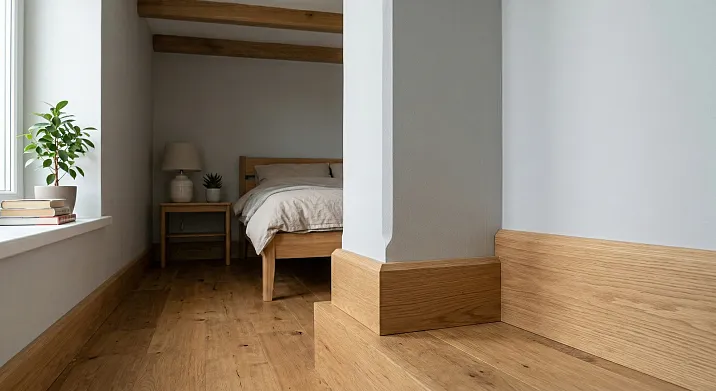
Khrushchyovka, Brezhnevka, standard nine-story panel building — three words that describe the housing stock of half of Russia. Ceilings 2.5 m, rooms 10–14 m², and the question that sooner or later arises for everyone doing renovations there: which skirting board to choose so the space doesn't become even smaller than it already is?
The correct answer is narrow. And this is not a compromise. It's the precise solution for a specific task.
45 mm wooden skirting board, square skirting board 30×30 and 25×25 mm, profiles 50–55 mm — small in height, but no less worthy because of it. They work exactly where needed: create a neat line at the base of the wall, don't 'weigh down' the room, and leave the walls their full height.
In this article — everything about the selection, application, installation, and calculation of small-sized skirting boards. No fluff, no unnecessary theory — only what's really needed when renovating a small apartment.





Small room and low ceiling: why a narrow skirting board is needed




Spatial optics: what happens to the room
Imagine a 12 m² room with 2.5 m ceilings. Install a 100 mm skirting board in it — and the ceiling will visually 'drop' even lower. The skirting board occupies 4% of the wall height, creates a dark (or light) horizontal line near the floor. The eye fixes on this horizontal line, registers the distance from it to the ceiling — and interprets the room as even more cramped.
Conversely: a narrow30 mm wooden skirting boardor 45 mm almost 'disappears' at the base of the wall. The eye doesn't linger on it, moves freely upward. The room subjectively feels more spacious and taller.
This isn't magic or an illusion — these are the laws of visual perception that designers account for in any project.
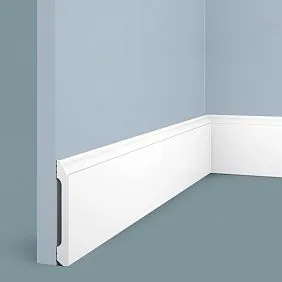
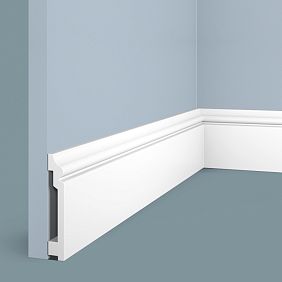
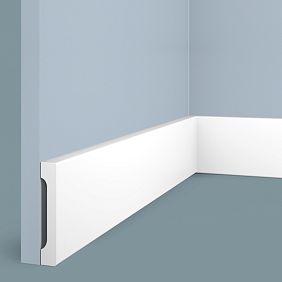
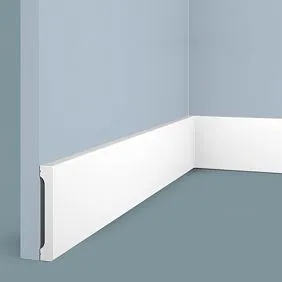
Our factory also produces:
Numbers: proportion rule for low ceilings
In architectural tradition, there's a guideline: skirting board height is about 1/40 of the ceiling height. For standard Russian ceilings, this gives:
| Ceiling height | Calculated skirting board height (1/40) | Practical range |
|---|---|---|
| 2.3 m (Khrushchyovka apartments, attics) | 57 мм | 35–45 mm |
| 2.5 m (standard panel buildings) | 62 мм | 40–50 mm |
| 2.6 m (Brezhnevka apartments) | 65 мм | 45–55 mm |
| 2.7 m (improved layout) | 67 мм | 50–60 mm |
Note: For ceilings 2.3–2.6 m, the practical range is shifted downward relative to the calculated one. This is a deliberate technique — for low rooms, it's better to take 10–15 mm 'less than the norm' to emphasize the wall height.
Get Consultation
Small room: additional limitation
In a room of 10–12 m², another rule applies for narrow baseboards: the smaller the area, the 'closer' the baseboard appears to the observer. A wide baseboard in a small room is perceived in detail — its relief, height, and presence are visible. A narrow one is delicate, not imposing.
Therefore, in one-room apartments, small children's rooms, kitchens of 6–9 m², narrow hallways —45 mm wooden skirting boardor less — a professional choice, not a budget-saving measure.
Wooden baseboard 45 mm: the most popular size and its reasons
Why exactly 45 mm became the standard
If you collect sales statistics for wooden moldings across Russia,wooden baseboard 45 mmwill be among the leaders. Not 40, not 50, but exactly 45. Why?
Because this size fits the 'golden ratio' of the Russian housing stock. Ceilings of 2.5–2.7 m are the standard for most apartments. Laminate 8–12 mm + expansion gap 10–12 mm = need to cover 20–24 mm at the wall. A 45 mm baseboard covers this gap with sufficient margin (≈20 mm 'visible' part) and does not 'eat up' the wall.
Moreover, 45 mm is the size at which a minimal figured profile is possible: a small bead or radius at the top. That is, the baseboard does not just 'cover the gap' but has character.
Technical parameters of wooden baseboard 45 mm
Height: 45 mm — from floor to top point
Thickness: 12–16 mm (depends on profile and manufacturer)
Strip length: standard 2.2 m
Wood species: beech, oak, pine
Weight per meter: 0.25–0.4 kg (depends on species and thickness)
Mounting: dowels 6×40 mm with spacing 50–60 cm + mounting adhesive
Profiles for baseboard 45 mm: from simple to complex
With a height of 45 mm, the following profiles are available:
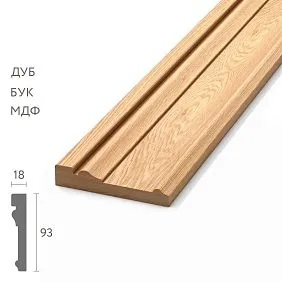
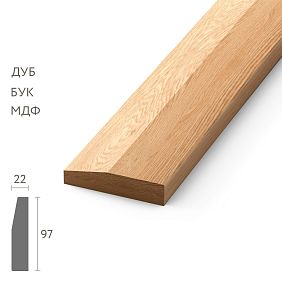
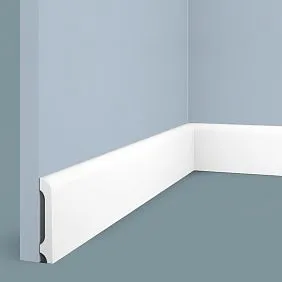
Rectangular (smooth). No relief — only rectangular cross-section. Laconic, universal. Suitable for minimalism, Scandinavian, modern style. When painted to match the wall color — almost invisible.
With top radius (bead). Lower 30 mm — straight vertical surface, upper 15 mm — radius transition. A light decorative element that adds 'traditionality' without heaviness.
With chamfer. Top corner cut at 30–45° — sharp diagonal line. Architectural, somewhat 'technical' look. Pairs well with modern furniture without legs.
Euro-profile 45 mm. Lower undercut 8–10 mm + vertical post 35 mm + top bevel. Fashionable, lightweight, 'floating'. Popular in new buildings with stylish renovations.
45 mm skirting board in various interior styles
The versatility of 45 mm is evident in its suitability for fundamentally different styles:
| Style | 45 mm profile | Color | Nuance |
|---|---|---|---|
| Minimalism | Rectangular | Wall color | Almost invisible |
| Scandinavian | Rectangular or torus | White | Simple and clean |
| Modern Classic | With torus | White or ivory | Light decor |
| Loft | Rectangular | Dark, anthracite | Clear line |
| Eco/natural | Any | Natural oil | Wood tone |
| Hi-tech | Euro-profile | White or gray | Pure geometry |
Square skirting board 25×25 and 30×30 mm: when minimalism is the goal
What is a square wooden skirting board
Wooden skirting board 30×30 mm— a corner profile with equal shelves: 30 mm vertically (on the wall) and 30 mm horizontally (on the floor). In cross-section — an isosceles right triangle or a right-angle corner.
Wooden skirting board 25×25 mm— a similar construction, even more miniature.
This is not a 'regular' skirting board, but a corner one. The fundamental difference: it covers the internal corner between the floor and wall, rather than being overlaid on the wall from the outside.
Where 25×25 and 30×30 mm skirting boards are used
Entrances and corridors with tiles. The 30×30 corner skirting board is the ideal 'seam' between a tiled floor and a plastered wall. It simultaneously closes the gap and creates a hygienic transition without a 'dirt pocket' in the right angle.
Kitchens in the cabinet area. Under the lower cabinets of a kitchen set, the 25×25 mm wooden skirting board fills the corner between the floor and wall — where the cabinet slightly doesn't reach the wall.
Attic rooms. Sloped ceilings in attics often create non-standard angles. A 30×30 corner skirting board covers the joint between the sloped ceiling or wall and the floor where a regular skirting board doesn't fit.
Transition between floorings. At the border between tile and laminate, tile and parquet — a 30×30 mm corner skirting board serves as a neat joining element at the base of the wall.
Children's rooms and play areas. A small corner skirting board without sharp protrusions is safer for children than a profiled molding with a protruding bead.
Technical specifications 25×25 and 30×30
| Parameter | 25×25 mm | 30×30 mm |
|---|---|---|
| Shelves | 25×25 mm | 30×30 mm |
| Shelf thickness | 5–6 mm | 6–8 mm |
| Allows nail | No (adhesive only) | Thin finishing nail |
| Weight per meter | 0.08–0.1 kg | 0.12–0.16 kg |
| Plank length | 2.2 m | 2.2 m |
| Species | Beech, oak, pine | Beech, oak, pine |
Installation of square skirting board: adhesive only
With shelf dimensions of 25–30 mm, the only correct installation method is construction adhesive. A 6 mm dowel will inevitably split the shelf. A 1.4 mm finishing nail is only permissible for 30×30 mm — and even then, driven at a 45° angle (not straight through the shelf).
Correct adhesive installation technique:
-
Degrease tile or floor with isopropyl alcohol
-
Apply MS-polymer adhesive or polyurethane construction adhesive to both shelves in a zigzag pattern
-
Place the skirting board in the corner, press firmly
-
Secure with painter's tape for 24 hours
-
Seal the top and bottom joints with sanitary silicone
Critical: 25×25 mm skirting board is installed with adhesive only — there is no other option. The shelves are too thin.
50–55 mm profile: mid-range with universal character
The middle of the range — the best fit for many
Between the narrow 45 mm and tall 70 mm, there exists a 'gray zone' — 50 and 55 mm profiles. They are often overlooked in favor of round numbers — and in vain. Precisely50 mm wooden skirting boardand55 mm wooden skirting boardturn out to be ideal for the most common scenario: ceilings 2.6–2.7 m, laminate flooring, standard apartment.
By the 1/40 rule: ceiling 2.6 m → calculated skirting board 65 mm. But considering 'lowering' for visual height increase — 50–55 mm. Hits the mark.
50 mm wooden skirting board: detailed specification
Height: 50 mm — sufficient to fully cover the gap under laminate (10–12 mm gap + 8–12 mm laminate + 5–8 mm overlap = ≈25–32 mm = 50 mm skirting board handles it)
Thickness: 14–18 mm — already sufficient for dowel mounting
Profiles: rectangular, with a fillet, double-radius, euro-profile
Mounting: 6×40 mm dowels spaced 50–60 cm apart + adhesive
Length: 2.2 m standard
At a height of 50 mm, a more developed profile is possible than at 45 mm: double fillet, combination of radii — the skirting board acquires a full-fledged 'classical' character despite modest dimensions.
55 mm wooden skirting board: fine-tuning
55 mm is an interesting size. It is almost never found in mass construction retail (stores typically stock 40, 45, 50, 60, 70 mm), but it is in the catalog of specialized manufacturers. And it is one of the most 'precise' sizes for ceilings 2.6–2.8 m according to the rule of proportions.
55 mm wooden skirting board— the choice of those who don't want 'like everyone else' and seek an exact match to the proportion, not the nearest rounded size. With white enamel, the difference between 50 and 55 mm when installed — 5 mm at the floor — is practically unnoticeable. But for a trained eye — it is there.
Comparison of 45, 50, and 55 mm profiles
| Parameter | 45 мм | 50 мм | 55 мм |
|---|---|---|---|
| Ceilings (ideal) | 2.5–2.6 m | 2.6–2.7 m | 2.7–2.8 m |
| Covering laminate gap | Confidently | Reliably | Reliably with a margin |
| Profile possibilities | Simple | Medium | Medium — complex |
| Mounting | Adhesive + dowel | Adhesive + dowel | Adhesive + dowel |
| Thickness (usually) | 12–15 mm | 14–18 mm | 15–18 mm |
| Visual weight | Lightweight | Moderate | Moderate |
45° miter cut and 45 mm high skirting board: a common misconception
Why this is confused — and why it's important not to confuse
This is one of the most common questions on the internet: 'I need a 45 mm skirting board — is that the one cut at 45°?' No. These are two completely different concepts.
Skirting board height of 45 mm — is the profile size. The distance from the floor to the top point of the skirting board — 45 millimeters. This is a size characteristic.
A 45° miter cut is the angle at which the end of a baseboard is cut when joining planks in room corners. Absolutely all baseboards—both 30 mm and 100 mm—are cut at a 45° angle in corners. This is not a 'type' of baseboard, but an installation technique.
Where does the confusion come from
Confusion arises because installers often say in casual speech: 'miter the baseboard at 45'—meaning the cut angle. An uninformed customer hears '45' and thinks about the size. As a result, a dialogue starts in the store that takes twice as long as necessary.
To avoid confusion—remember a simple rule:
-
Number + 'mm' = baseboard height (45 mm, 70 mm, 100 mm)
-
Number + '°' = cut angle (45°, 90°, 22.5°)
Baseboard cut angles: briefly and clearly
| Situation | Cut angle | Application |
|---|---|---|
| Internal 90° corner | 45° on each plank | Standard rooms |
| External 90° corner | 45° on each plank (mirrored) | Protruding corners |
| Straight end | 90° | End at door, at threshold |
| Non-standard angle (not 90°) | Half of the actual angle | Stalin-era buildings, non-standard layouts |
| Joint along wall length | 45° in one direction | 'Dovetail' on long walls |
For45 mm wooden baseboardand all other sizes—the cutting technique is the same. Profile height does not affect the cut angle.
Tools for cutting 45 mm baseboard
A small 45 mm baseboard is easier to cut than 100 mm—less height, less load on the saw.
Miter saw with rotating table. Optimal tool. Precise angle, clean cut. For 45 mm—rotate the table to 45° and cut. Price starts from 3,000 rubles for a basic miter saw.
Miter box + fine-toothed saw. Budget option. The miter box has slots for 45° and 90°. For small volumes (one or two rooms)—quite acceptable. Accuracy is slightly worse than a miter saw, but sufficient with careful work.
Hand saw without miter box. For an experienced craftsman—it works. For a beginner—45° 'by eye' gives an inaccurate joint. Better to spend 500 rubles on a miter box.
Calculating baseboard linear meters for a 10–14 m² room
Why calculation is important and how to do it correctly
It might seem that calculating baseboard length for a small room is simple: calculate the perimeter - that's the answer. But this approach has three common mistakes.
Mistake 1: door openings not subtracted.
Mistake 2: allowance for miter cuts not accounted for.
Mistake 3: plank length (2.2 m) not considered - planks are cut from it, and there may be 'non-multiple' leftovers.
Correct calculation - step by step.
Step 1: Measure room perimeter
For a 3×4 m room:
-
Perimeter = (3 + 4) × 2 = 14 m
-
Subtract door opening: −0.9 m (standard door)
-
Linear baseboard length: 14 − 0.9 = 13.1 m
For a 3.5×4 m room:
-
Perimeter = (3.5 + 4) × 2 = 15 m
-
Subtract door opening: −0.9 m
-
Linear length: 14.1 m
Step 2: Account for allowance on miter cuts
In each room corner with a 45° miter cut, a piece of wood is lost. For a 45 mm baseboard the losses are small - about 45 mm for each corner end. In a square room 4 corners = 8 corner ends = losses ≈ 45 × 8 = 360 mm ≈ 0.36 m.
Standard allowance for corner losses: +10–12% of linear footage.
Step 3: Account for plank multiplicity of 2.2 m
From one 2.2 m plank you cannot cut two 1.2 m pieces each - you only get one + 1.0 m remainder, which can go to the next corner or remain as 'scrap'.
For optimal calculation: draw a room diagram, arrange baseboards along walls, count how many 2.2 m planks are needed for each wall. This is more accurate than 'perimeter + 15%'.
Calculation table for rooms 10–14 m²
| Room (L×W, m) | Area | Perimeter | Door deduction | Baseboard needed | Planks 2.2 m (with 12% allowance) |
|---|---|---|---|---|---|
| 3,0×3,3 | 9.9 m² | 12.6 m | −0.9 m | 11.7 m | 7 planks (15.4 m) |
| 3,0×4,0 | 12.0 m² | 14.0 m | −0.9 m | 13.1 m | 7 planks (15.4 m) |
| 3,2×4,0 | 12.8 m² | 14.4 m | −0.9 m | 13.5 m | 7–8 planks |
| 3,5×4,0 | 14.0 m² | 15.0 m | −0.9 m | 14.1 m | 8 planks (17.6 m) |
| 3,5×4,5 | 15.75 m² | 16.0 m | −0.9 m | 15.1 m | 8–9 planks |
Final practical rule: for a room 10–14 m² — 7–8 wooden baseboard planks of 2.2 m each. Buy 8 — one extra plank will go for fitting and spare pieces.
Special calculation situations
Room with a niche. Niche = additional corners (4 internal instead of 1). Each additional corner = +0.1 m of waste. Add one plank to the calculation.
Two doorways. Found in bedrooms with a separate exit to a dressing room. Subtract twice: −0.9 × 2 = −1.8 m from the perimeter.
Non-standard shaped room (L-shaped). Calculate the perimeter exactly according to the plan, don't "guess." For an L-shaped room, the perimeter is significantly larger than for a rectangular room of the same area: with an area of 14 m², an L-shaped room can have a perimeter of 20+ m.
Narrow baseboard coating: why it's more important than it seems
Small baseboard — big responsibility
Paradox: the smaller the baseboard, the more noticeable any coating defect. On a 100 mm baseboard, a small chip is unnoticeable — it gets lost in the overall mass of the profile. On a 45 mm baseboard, the same chip is visible because the area of the front surface is small.
Therefore, for narrow baseboards, coating quality is especially important. The three best options:
Acrylic water-based enamel in 2–3 coats. The most common choice. Applied with a brush or spray gun. After installation — a finishing coat hides minor defects and dowel points. For a 45 mm white baseboard — a classic.
Pigmented oil (Osmo, Rubio Monocoat). For a natural wood tone — one application, without varnish shine. Repairable: a scratch is filled with spot application of oil.
Alkyd enamel. Harder than acrylic, better withstands mechanical contact. Takes longer to dry (24 hours vs. 4 for acrylic), smells stronger. For hallways and kitchens with high traffic — preferable.
Narrow baseboard color: strategy for a small room
For a small room with low ceilings, there is one winning strategy: a baseboard that matches the wall color or is lighter than the wall.
A white baseboard on a white wall is practically invisible. The eye doesn't fixate on it, the space is perceived as unified—from floor to ceiling. The room appears taller.
A contrasting dark baseboard on a white wall 'grounds' the room. For a small space with 2.5 m ceilings—this is an undesirable effect (unless it is a deliberate design technique).
Color rule for small rooms:
-
Ceilings up to 2.5 m → baseboard matching the wall color or lighter
-
Ceilings 2.5–2.7 m → baseboard matching the wall color or neutral white
-
Ceilings 2.7+ m → you can experiment with contrast
Wood vs PVC for narrow baseboard: a practical choice
Where wood wins even at 45 mm
Even a small45 mm wooden skirting boardbaseboard made of beech or oak is a genuine material with a living texture that is visible and tactilely felt. When painted white, the difference is unnoticeable—but in a natural wood tone, wood is incomparable to PVC.
A small wooden baseboard can be repaired (putty, touch-up painting). PVC, if chipped—only replacement of the plank. In a small room where a crib or chair regularly hits the baseboard—repairability matters.
Ecology: in children's rooms and bedrooms, a wooden baseboard with water-based enamel or natural oil is more environmentally friendly than PVC.
Where PVC is a Reasonable Choice
A 45 mm PVC baseboard is appropriate in bathrooms, rental apartments, and with a tight budget. It's an honest choice when cost is important, not durability or aesthetics. For an entryway with constant humidity—also an argument.
But if choosing between wood and PVC at a comparable price—wood wins in all parameters except moisture resistance.
Installation of a narrow baseboard: step-by-step instructions
Tools
-
Miter saw or miter box + fine-toothed saw
-
Hammer drill with a 5–6 mm drill bit (for dowels)
-
Screwdriver + PZ2 bits
-
Dowels 6×40 mm (for concrete walls)
-
Mounting adhesive (MS-polymer or polyurethane)
-
White acrylic sealant
-
Tape measure, pencil, painter's tape
-
Nail set (for finishing nails, if used)
Step 1: Acclimatization
Leave a 45 mm wooden baseboard in the room for 2–3 days horizontally (do not lean against the wall—it will deform). During this time, the wood absorbs the room's humidity.
Step 2: Marking and cutting
Measure the walls, draw a layout diagram for the baseboard. Cut the planks: inside corners at 45°, outside corners—mirrored at 45°, ends at doors—at 90°.
Important for a 45 mm baseboard when cutting at 45°: due to the small height—the baseboard easily shifts on the saw. Use a stop or clamp to prevent the plank from 'moving' during cutting.
Step 3: Fastening
For a 45 mm baseboard—use 6×40 mm dowels spaced 50–60 cm apart. Through the baseboard into the wall: first drill a 6 mm hole—through the baseboard, then into the wall to a depth of 40 mm. Insert the dowel. Screw in a screw or drive in a dowel-nail.
Screw heads—flush with the surface of the baseboard. For a 45 mm baseboard, where the front surface is small—a 5–6 mm head may be noticeable. Use countersunk screws + a wax pencil matching the baseboard color.
Adhesive on the back side is mandatory. For a 45 mm skirting board on an uneven wall, the adhesive fills gaps and prevents the skirting board from 'detaching' between dowels.
Step 4: Sealing
Top seam of the skirting board with the wall — a thin strip of acrylic sealant, smoothed with a wet finger. Dowel points — wax pencil or wooden plugs to match.
Additional keys and application: wooden millwork in the system
When talking about a small room, people often think only about the skirting board. But a full-fledged decor for a small space is a system. Towooden floor skirting boardin a small room with low ceilings, it is logical to add:
-
Thin wooden door casing at the doorway —Carved casings STAVROS55–65 mm wide, in the same wood species as the skirting board
-
Ceiling cornice of minimal cross-section —KZ-series cornice STAVROSwith a profile of 30–40 mm does not overload the low space but creates completeness
Uniform wood — one species, one batch, one tone. Skirting board 45 mm + casing 60 mm + cornice 35 mm — and a small room looks finished, thoughtful, expensive. Not despite the small size of the elements, but precisely because they are properly proportionate to the space.
FAQ: Answers to popular questions
Is a 45 mm skirting board and a 45° skirting board the same thing?
No, they are different things. 45 mm is the profile height. 45° is the miter cut angle for corner joints. A 45 mm skirting board is cut at 45° in corners — like any other. For more details — see the section on common misconceptions above.
Can a 30×30 mm wooden skirting board be used instead of a regular one?
Yes, as a corner piece. It covers the internal corner between the floor and wall. If the floor is tile and a decorative 'seam' is needed — this is an excellent solution. If the floor is laminate — a regular overlay skirting board is needed, not a corner one: when expanding, the laminate will 'push up' the corner skirting board from below.
How many planks are needed for a 12 m² room?
According to the calculation table above — 7–8 planks of 2.2 m each. Take 8 — one extra will be used for corner cuts and minor adjustments.
Wooden skirting board 45 mm — which wood species is better for a children's room?
Beech or oak with water-based acrylic enamel or natural Osmo oil. Pine is slightly softer and more vulnerable to scratches. For a children's room where furniture is moved — beech is preferable.
Can a 45 mm wooden skirting board be painted by oneself?
Easily. Water-based acrylic enamel, 30–40 mm brush — two coats with interlayer sanding P220. Well-ventilated room. For the final coat — application after installation hides dowel points and minor joint gaps.
Is adhesive needed when installing a 45 mm skirting board if the wall is even?
Adhesive is desirable even on an even wall. It increases the contact area, reduces load on dowels, and prevents skirting board 'rattling' (when walking on parquet, vibration transfers to the skirting board — adhesive dampens it).
About the company STAVROS
Narrow, precise, properly proportionate —wooden skirting board for small rooms STAVROSis manufactured with the same precision as monumental 100 mm profiles. Chamber-dried oak and beech solid wood, moisture content 8–10%, sanding P180 — each plank is ready for painting without additional processing.
Size range of K-series STAVROS — from 30 mm to 170 mm. Skirting boards 45 mm, 50 mm, 55 mm — in assortment, with several profiles for each size. Corner skirting boards 25×25 and 30×30 mm — in stock for kitchens, hallways, and technical areas.
Unified system of wooden decor: skirting board +Casings + Crown Molding— one profile, one tone, for a small room or for an enfilade in a mansion. Because precision of proportions matters at any scale.
Profile samples: 180 rub./set. Consultation on selecting the size for your ceiling height: 8 (800) 555-46-75.
STAVROS — a wooden skirting board that knows: a modest size is not a drawback, but a precise solution.