












































































Article Contents:
- Why wooden baseboard?
- Main types of wooden baseboard
- Solid wood
- MDF veneered
- Combined profile
- Flexible baseboards
- Baseboards with cable channel
- Oak
- Ash
- Oak
- Walnut
- Birch and pine (veneer)
- Specialized Stores
- Online stores with delivery
- Hardware store hypermarkets
- Hidden clips and guides
- Construction adhesive or 'liquid nails'
- Self-tapping screws with decorative caps
- Tools and Materials
- Daily care
- Periodic restoration
- Controlling microclimate
- Contrast effect
- Monochromatic solution
- Lighting
- Zoning
- Frequently Asked Questions

Wooden baseboard — this is not just a finishing touch in the interior, but a functional and aesthetic element that connects the floor and the wall, gives the space a sense of completion, hides technological gaps, and protects the lower part of the wall from mechanical damage and moisture. In Krasnoyarsk, where the climate combines cold winters and a short, humid summer, choosing the right wooden baseboard becomes especially important. In this detailed guide, we will cover all the nuances: from material and construction to the purchase process, installation nuances, maintenance, and design techniques. If you plan to update your interior and want to reliably and beautifully finish the junction between the floor and the wall, we recommend immediately clicking the link wooden baseboard buy Krasnoyarsk — here you will find a rich selection of quality products adapted to the harsh conditions of our region.


Why wooden baseboard?
The choice of material for the baseboard affects durability, appearance, and room microclimate. Let's consider the key advantages of natural wood compared to MDF and plastic analogs:
- Ecological Safety
Natural wood does not emit toxins or harmful volatile organic compounds when properly manufactured and certified (E0/E1 for formaldehyde). This is especially important for children's and bedroom rooms, as well as for people with allergies and asthma. Wood 'breathes', regulates humidity, and prevents mold formation during cold seasons.
- Strength and durability
Thick solid planks (from 18 to 30 mm) can withstand furniture impacts, scratches from cleaning equipment, and heavy foot traffic. Surface damage can be sanded and recoated with varnish or oil, extending service life for decades.
- Thermal and sound insulation
Wood has low thermal conductivity and a porous structure, making it excellent at absorbing and dispersing sound. A wide wooden skirting board creates an additional barrier at the "wall–floor" junction, reducing heat loss and improving acoustic comfort.
- Aesthetics and Individuality
The pattern of growth rings, natural tones, and wood texture are never repeated. A wide skirting board made of solid wood or veneered MDF adds warmth and depth to interiors, accentuates the texture of parquet or laminate, and remains stylish regardless of fashion trends.
- Restoration possibility
For minor scratches or scuffs, light sanding and reapplication of protective coating suffice. For solid planks, this allows avoiding full replacement at the first signs of wear.




Main types of wooden skirting boards
Before heading to the store, it is important to clearly understand what types of wooden skirting boards exist and how they differ.
Our factory also produces:
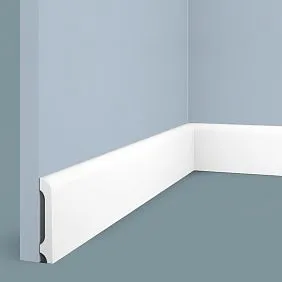
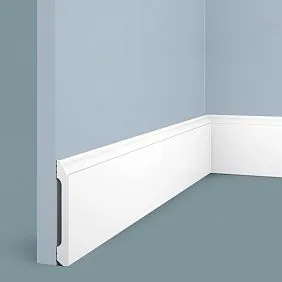
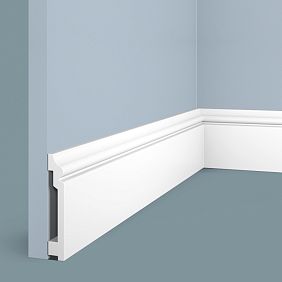
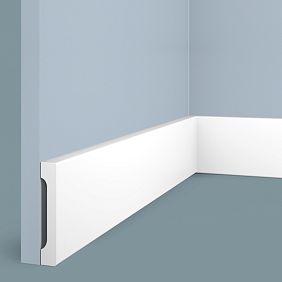
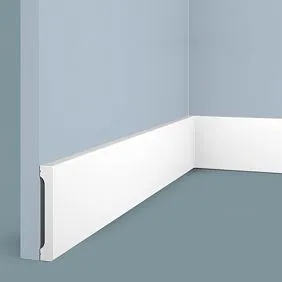
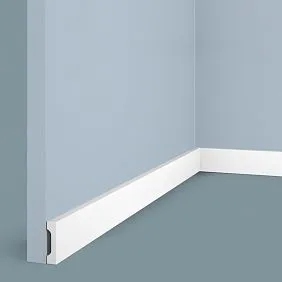
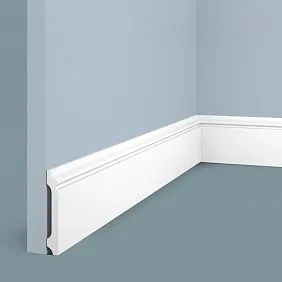

Solid wood
● Description: made from solid boards of hardwood species (oak, beech, ash, walnut).
● Thickness and width: usually 18–30 mm thick and 60–150 mm wide.
● Advantages: maximum strength, ability for multiple sanding and restoration, eco-friendliness, unique texture.
● Disadvantages: high cost (from 1200 ₽/linear m), sensitivity to humidity fluctuations (strict microclimate control required), need for expansion gaps.
Get Consultation
Laminated MDF
● Description: core made of moisture-resistant MDF, face layer — natural veneer 1–3 mm thick.
● Thickness and width: 16–20 mm thick, 60–120 mm wide.
● Advantages: stable geometry under humidity changes, more affordable price (400–800 ₽/linear m), wide range of veneer shades and species (oak, beech, walnut, mahogany).
● Disadvantages: veneer is susceptible to chipping, local restoration is impossible — damaged plank must be replaced entirely.
Combined profile
● Description: bottom part made of MDF, face panel — solid wood or veneer.
● Advantages: natural solid wood appearance at a lower price, increased moisture resistance, dimensional stability.
● Disadvantages: more complex installation due to multi-layer construction, entire element must be replaced if the face panel is severely damaged.
Flexible skirting boards
● Description: made from flexible composite materials with added wood fibers.
● Advantages: conforms to wall curves, hides unevenness up to 10 mm, suitable for arched openings and curved structures.
● Disadvantages: limited texture palette, possible loss of elasticity and fading under prolonged UV exposure.
Skirting boards with cable channels
● Description: internal cavity of the profile allows routing power, TV, and internet cables.
● Advantages: concealed wiring, neat appearance, easy access for maintenance without damaging walls.
● Disadvantages: limited cable channel capacity, slightly higher price compared to models without channels.
Wood species: selection based on purpose
When purchasing wooden skirting boards, it is important to consider the characteristics of wood species and their cost.
Oak
● Characteristics: very hard, wear-resistant, long-lasting.
● Color: from light beige to rich brown.
● Price: the highest in the solid wood segment — from 1500 ₽/linear m and above.
● Best use: high-traffic areas (living rooms, hallways), luxury interiors.
Ash
● Characteristics: elastic, good wear resistance, slightly lighter texture.
● Color: cream-white with a golden tone.
● Price: slightly lower than oak — 1200–1800 ₽/linear m.
● Best use: modern interiors, Scandinavian style.
Beech
● Characteristics: medium hardness, uniform structure, warm tone.
● Color: pinkish-brown.
● Price: more affordable than oak and ash — 1000–1400 ₽/linear m.
● Best use: living rooms, bedrooms with moderate load.
Walnut
● Characteristics: elegant dark texture, medium hardness, valued for its rich tone.
● Color: chocolate-brown.
● Price: premium segment of solid wood — from 1800 ₽/linear m.
● Best use: offices, relaxation zones, designer projects.
Birch and pine (veneer)
● Characteristics: light species, ideal for painting, budget-friendly solution.
● Color: light, with yellow undertones, easily tintable.
● Price: most affordable options — from 400 ₽/linear m for veneered MDF.
● Best use: rarely used rooms, projects with any color finish.
Main selection parameters
When purchasing, consider the following requirements:
- Load level
For high-traffic zones, choose hardwoods; for offices and hallways — beech or ash; for bedrooms and guest rooms — veneered MDF.
- Humidity level
In rooms with high humidity (kitchens, bathrooms), prefer moisture-resistant MDF with veneer or composite profiles, and ensure quality lacquer coating.
- Wall configuration
For straight walls, standard straight profiles are sufficient; for arches and curved elements, flexible models are required.
- Ceiling height
For standard ceilings up to 2.7 m, optimal width is 60–80 mm; for ceilings above 3 m — 100–150 mm.
- Design and color palette
Determine whether you want a contrasting skirting board, a monochromatic solution, or an illuminated effect. The choice of profile and finish method (lacquer, oil, paint) depends on the overall interior color palette.
- Budget
Determine your upper spending limit, taking into account the price per meter, delivery, installation, and maintenance costs. Include a 10% reserve for trimming and installation errors.
How to calculate required quantity
Accurate measurement is the key to a successful renovation without unnecessary expenses:
- Measure the perimeter dimensions
Use a tape measure and a straightedge to measure the length of each wall along the inner corner.
- Subtract large openings
From the perimeter, subtract the width of door and window openings deeper than 2 cm.
- Add a technological reserve
Add 8–12% for trimming, defects, and possible measurement inaccuracies.
- Choose the package length
Pilasters are usually sold in packages of 2.4 m, 2.5 m, or 2.7 m. Divide the total length by the length of one strip and round up.
- Assess waste for non-standard angles
In older buildings with curved walls, it is better to increase the reserve to 15%.
Example
Perimeter: 18 m;
Door opening: 0.9 m → 18 − 0.9 = 17.1 m;
10% reserve: 17.1 × 1.1 = 18.81 m;
Package length 2.5 m → 18.81 ÷ 2.5 ≈ 7.52 → 8 packages.
Where and how to buy
For Krasnoyarsk, various purchasing channels are available:
Specialized Stores
● Advantages: wide variety of species and profiles, consultations with technologists and designers, opportunity for live sample inspection.
● Disadvantages: higher prices (10–20% above average market rates), often requires advance payment.
● Tip: choose showrooms with their own production facilities and certified equipment.
Online stores with delivery
● Advantages: convenient search, promotions and discounts, city and regional delivery, opportunity to compare dozens of offers.
● Disadvantages: color may not match without a sample, delivery times depend on stock availability.
● Recommendation: always order free veneer samples or demo strips before placing a large order. Clarify return conditions.
Construction Material Hypermarkets
● Pros: low price, self-pickup, availability of all related products (corners, clips, glue).
● Cons: narrow selection of species and profiles, no designer support, installation is often not offered.
For optimal combination of price, quality, and service, we recommendwooden baseboard buy Krasnoyarsk through verified online partners with showrooms and the option to order free samples.
Installation: methods and nuances
Quality installation is the guarantee of the longevity and beauty of the skirting board. Let's consider the main methods:
Hidden clips and guides
● Description: a metal or plastic guide is mounted in the wall, into which the skirting board with a clip system clicks.
● Advantages: hidden fasteners, ventilation, quick disassembly without damage.
● Disadvantages: requires precise marking, a flat wall.
Construction adhesive or "liquid nails"
● Description: special mounting adhesive is applied to the back of the skirting board, after which it is pressed against the wall.
● Advantages: simplicity, absence of visible fasteners.
● Disadvantages: during disassembly, there is a risk of damaging the wall and skirting board, requires a well-prepared surface.
Decorative screw caps
● Description: the skirting board is mounted with screws, and the mounting points are covered with plastic or wooden caps.
● Advantages: high strength, quick installation.
● Disadvantages: visible mounting points, need to select caps to match the decor.
Tools and materials
● Level, painter's line, tape measure for precise marking.
● Mitre saw or miter block for cutting corners at 45°.
● Construction adhesive or "liquid nails" for rigid fixation.
● Clips and guides for hidden mounting.
● Screws and decorative caps for traditional mounting.
● Lacquer or oil for finishing ends and protecting against moisture.
Care and maintenance
Daily Care
● Wipe with a soft dry or slightly damp cloth without abrasives.
● Immediately wipe up spilled water or household chemicals to prevent moisture absorption into the wood.
Periodic restoration
● Apply recommended lacquer or oil every 6–12 months.
● Remove minor scratches with fine-grit sandpaper.
Controlling microclimate
● Maintain humidity at 40–60% and temperature at +18…+24 °C.
● Use humidifiers or dehumidifiers depending on the season.
Design techniques with wooden skirting boards
Contrast effect
Combining a dark skirting board with light walls and floors creates a striking accent and emphasizes the room's architecture.
Monochromatic solution
A skirting board in the same finish as the floor or walls visually "melts" into the space and expands the area, ideal for small rooms.
Lighting
Installing LED strips behind a wide skirting board creates a "floating" base effect and convenient night lighting.
Zoning
Use different wood species and profiles to zone open spaces without partitions.
Frequently Asked Questions
Can baseboard be used in the bathroom?
Yes, provided you choose moisture-resistant MDF with veneer and quality protective lacquer finish.
What width of baseboard to choose for 3 m ceilings?
It is recommended to have a width of at least 100 mm to maintain proportions.
How long does installation take?
A professional team will install baseboards in a room up to 25 m² within 3–5 hours, including preparation and finishing work.
Is it necessary to prime the walls beforehand?
Priming improves the adhesion of adhesive compounds and 'liquid nails', especially on fresh plaster.
How to store baseboards until installation?
In horizontal position, in a dry room, at a temperature of 10…25 °C and humidity of 40–60 %.
Choosing and purchasing wooden baseboard is a serious task requiring attention to details: wood species, profile type, surface treatment method, installation method, and maintenance. Once you define your needs and budget, you will be able to choose without mistakeswooden baseboard buy Krasnoyarsk, beautifully, reliably, and durably finishing the junction between floor and wall. Your interior deserves only the best!





