Article Contents:
- Baseboard function: more than decoration
- Technical role of the baseboard
- Visual frame of the room
- Stylistic role
- When to combine wood and polyurethane
- Advantages of wooden baseboard
- Advantages of polyurethane moldings
- Logic of material combination
- Stylistic Compatibility
- Height and width: mathematics of proportions
- Rule of height ratio between room and baseboard
- Adjustment to interior style
- Baseboard width and room size
- Proportions of baseboard and ceiling cornice
- Profiles and shapes: from classic to minimalism
- Classic wooden baseboard profiles
- Modern minimalist shapes
- Baseboard with hidden mounting
- Baseboard with heel
- Materials: oak, beech, pine - what to choose
- Oak: The King Among Species
- Beech: strength and texture
- Oak: hardness and uniformity
- Pine: budget option
- Polyurethane moldings: when they are indispensable
- Moisture resistance for bathrooms and kitchens
- Ease of installation
- Flexibility for complex shapes
- Complex profiles at affordable prices
- Color solutions: contrast or blending
- White baseboard - universal solution
- Baseboard in floor color
- Baseboard in wall color
- Contrasting solutions
- Joints and corners: technical nuances
- Inside corners: miter method
- Outside corners: more complex than inside
- Door casings: three options
- Length joints: seamless connection
- Installation: step-by-step technology
- Surface Preparation
- Marking and Cutting
- Ways to mount wooden baseboard
- Installation of polyurethane moldings
- Finishing
- Budget and durability: economics of choice
- Cost of wooden baseboards
- Cost of polyurethane moldings
- Durability of wooden baseboards
- Durability of polyurethane moldings
- What to choose: recommendations
- Matching with doors and windows
- Baseboard and door casings
- Baseboard and window sills
- Unity of carpentry elements
- Maintenance and operation
- Regular Cleaning
- Protection against damage
- Recoating
- Mistakes in selection and installation
- Error 1: Incorrect size
- Error 2: Style mismatch
- Error 3: Poor material quality
- Error 4: Incorrect installation
- Error 5: Lack of acclimatization
- Frequently Asked Questions
- Can wooden baseboard be used in a bathroom?
- Which baseboard is better - solid wood or MDF?
- Is it necessary to prime the wall before installing baseboard?
- Can baseboard be installed before wallpapering?
- What adhesive to use for polyurethane molding?
- How to hide the gap between baseboard and uneven wall?
- How long does it take to install baseboard in one room?
- Is underlayment needed under baseboard on an uneven floor?
- Can wooden baseboard be painted after installation?
- How does veneer baseboard differ from solid wood?
- What is the optimal humidity level in a room for wooden baseboard?
- What is better for classic interior - wood or polyurethane?
- Conclusion

Imagine a room without baseboards - bare joints between wall and floor, cut edges of wallpaper, gaps filled with dust. Incompleteness, visual discomfort. And now addwooden baseboard- and the room seems to acquire a frame, clear contour, completeness. The floor is separated from the wall by an elegant line, space is structured, order appears.
But baseboard is not just a technical necessity. It is an architectural element that can change the perception of a room's height, proportions, style. A wide, solid baseboard creates solidity, classic elegance. A narrow, minimalist one - modern lightness. And whenwooden baseboards for floor- combined withpolyurethane moldings- on walls and ceiling, you get a cohesive composition where each element complements the other, creating a clean, thoughtfully defined room outline.
How to properly choose baseboard height? When is it appropriate to combine wood at the bottom and polyurethane at the top? How to solve corner and joint problems? What budget to allocate and what provides greater longevity? Let's examine all details of this crucial finishing element.


Baseboard function: more than decoration




Technical role of baseboard
Baseboard covers the technological gap between wall and flooring. Parquet, laminate, solid wood planks are laid with an 8-15 mm setback from walls - necessary to compensate for wood's thermal-hygrometric expansion. Without baseboard, this gap remains open, dust and debris accumulate there, water enters during wet cleaning.
wooden baseboardBaseboard covers this gap, creating an aesthetic transition. But this is not all. Modern baseboards often have a cable channel - an internal cavity or groove at the back, where you can hide wires: electrical, telephone, internet cables. This is especially relevant in the era of smart homes, when the number of wires increases.
Baseboard protects the lower part of the wall from dirt and mechanical damage. During vacuuming or moving furniture, it is the baseboard that takes the impact and scratches, protecting the more fragile wall finish.
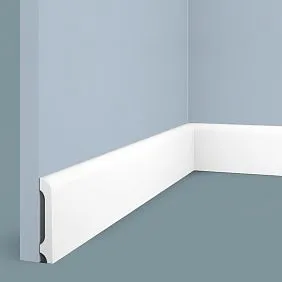
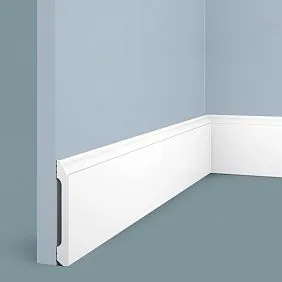
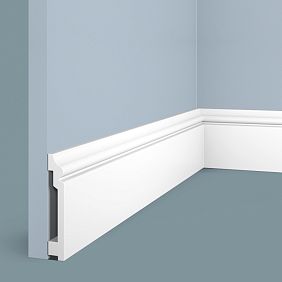
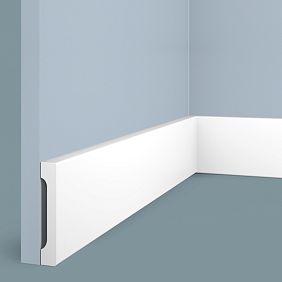
Our factory also produces:
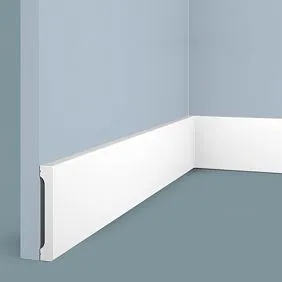
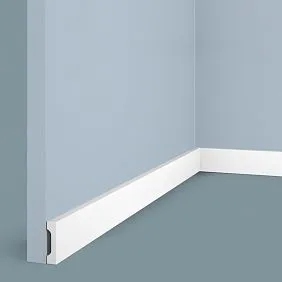
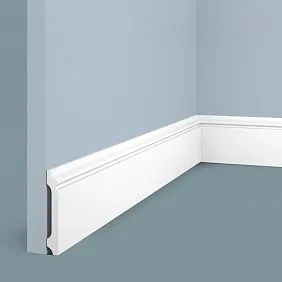

Visual frame of the room
But the main function of baseboard in modern interior design is visual. It creates a horizontal line around the perimeter of the room, structuring space, defining scale, forming perception of proportions.
Baseboard works like a picture frame. Imagine a canvas without a frame - it disappears on the wall, lacks clear boundaries. The frame focuses attention on the image, separating it from the surrounding space. Similarly, baseboard separates floor from walls, creating a visual boundary between two planes.
Combined with ceiling molding, baseboard forms a complete room frame - at the bottom and top. If you add vertical moldings on walls, you get an architectural grid that transforms a simple room into a thoughtfully designed space with clear structure.
Get Consultation
Stylistic role
Shape, width, color of baseboard - all of this are powerful styling tools. A tall baseboard (100-150 mm) with a classic profile - with grooves, rounded edges, and molding - immediately sets a classic or neoclassical style. A narrow baseboard (40-60 mm) with a simple rectangular cross-section - a sign of minimalism, Scandinavian style, or high-tech.
White baseboard against dark flooring creates graphic contrast and modernity. Baseboard in floor color - soft, subtle transition, visual expansion of floor area. Baseboard in wall color - room height visually increases, as the wall does not break at floor level.
When to combine wood and polyurethane
Advantages of wooden baseboard
wooden baseboards for floorMade from solid oak, ash, beech, pine, larch. This is a natural material with live texture, warm to the touch, eco-friendly. Each plank is unique in its wood grain pattern.
Wood is durable, withstands impacts and loads better than polyurethane. It does not crumble or crack from accidental hits. Wooden baseboard can be repainted multiple times, sanded (if it's a solid profile of sufficient thickness), and restored. Service life - decades, with proper care - half a century and more.
Aesthetically, wood is noble. It is a material with history, associated with quality, traditions, craftsmanship. A wooden skirting board made of oak or beech is status, a demonstration of taste and possibilities.
Advantages of polyurethane moldings
Moldings made of polyurethane- modern material, lightweight (3-5 times lighter than wood), moisture-resistant (does not fear water, does not swell), easy to install (sticks to polymer adhesive, no fasteners required). Polyurethane allows creating complex profiles with fine detailing, which is difficult or expensive to achieve in wood.
An important advantage - the flexibility of some types of polyurethane moldings. They can wrap around curved walls, bay windows, columns. Wood cannot (only by gluing multiple small segments).
Polyurethane is not susceptible to biological damage - mold, mildew, wood-boring insects. It is inert to temperature fluctuations, does not dry out, does not swell with changes in humidity. In rooms with unstable climate (countryside houses with intermittent heating, bathrooms, kitchens) this is critical.
Logic of material combination
Why combine wood at the bottom and polyurethane at the top? There are several reasons.
Functional logic: floor and lower wall zone - area of maximum loads. Here, feet strike, vacuum cleaners hit, furniture scratches. Wood withstands this better than polyurethane. Ceiling and upper wall zone - area without loads, here ease of installation and complexity of decoration matter, which polyurethane provides.
Aesthetic logic: wood is warm, tactile, it logically belongs at the bottom, near wooden flooring (parquet, solid planks). Polyurethane is more abstract, decorative, it suits better at the top, as a purely visual element.
Economic logic: polyurethane moldings are cheaper than wooden ones when compared by width and profile complexity. Using wood only at the bottom (where it is truly needed), you save budget without compromising overall quality.
Stylistic compatibility
It is important that the wooden skirting board and polyurethane moldings are stylistically compatible. If the skirting board is classical with a profile, then the wall moldings and ceiling cornice should also be profiled and classical. If the skirting board is modern and simple, then the moldings should be minimalist.
Color solution: white polyurethane on ceiling and walls, wooden skirting board in natural color (stain, oil) - classic combination. Or all white: skirting board (wooden, painted with enamel) and moldings - for Scandinavian or neoclassical interiors. Or monochrome in gray: gray floor, gray skirting board (painted wood), gray walls, white moldings - modern elegance.
Height and width: mathematics of proportions
Rule of proportion between room height and skirting board
There is a classical rule: the height of the skirting board should be approximately 1/20 of the room height. For standard ceilings of 2.5-2.7 m, this gives 125-135 mm. But in practice, such a skirting board in typical apartments looks unnecessarily bulky. The real comfortable height for such rooms is 60-80 mm.
For high ceilings of 3.0-3.5 m, the rule works more accurately: a skirting board of 120-150 mm truly looks harmonious. Here there is enough space, and a wide skirting board does not overwhelm, but creates the needed solidity.
For very high rooms (4 m and above) - lofts, halls, entrance rooms - a skirting board of 180-250 mm is not luxury, but necessity. Standard 70-80 mm simply disappears, and the room will look unfinished.
Adjustment for interior style
Mathematical formula is a guideline, but not dogma. Interior style introduces adjustments. In minimalism and high-tech, you can reduce the calculated height by 20-30% to create lightness and lightness. In classic and neoclassic, conversely, increase by 20-40% for solidity and weight.
Scandinavian style tends toward medium sizes - 60-80 mm for standard ceilings, giving a sense of coziness without fuss. Loft and industrial styles can use very narrow skirting boards (40-50 mm) or, conversely, emphasized bulky ones (120-150 mm), contrasting with the brutality of concrete and brick.
Skirting board width and room size
Not only ceiling height, but also room area affects the choice of skirting board size. In a small room (10-12 sq. m), a wide skirting board visually consumes space, making it even smaller. Here, it is better to limit to 50-70 mm.
In spacious rooms (30-50 sq. m and above), a narrow skirting board disappears and is not visible from a distance. More imposing sizes are needed - 100-120 mm, so the skirting board is visible and performs its framing function.
Long, narrow rooms (corridors) require caution: a too high skirting board will intensify the tunnel effect. It is better to choose medium sizes and compensate with an expressive profile or contrasting color.
Proportions of skirting board and ceiling cornice
When a room has both a floor skirting board and a ceiling cornice, their sizes should correspond. Classical approach: cornice is 20-30% wider than skirting board. For example, skirting board 80 mm - cornice 100-110 mm. This creates visual stability: top slightly heavier than bottom, room does not appear inverted.
Modern approach allows equal sizes or even reverse proportion (skirting board wider than cornice) - this works in minimalist interiors, where traditional rules are intentionally broken to create unexpected effects.
If wall moldings (panels, frames) are also used, their width is usually less than both skirting board and cornice - 40-60 mm. They play a supporting role, structuring the wall, but not competing with main framing elements.
Profiles and Shapes: from Classic to Minimalism
Classic Wooden Skirting Boards
Classicwooden baseboardIt has a complex cross-section with multiple elements. At the bottom is a flat base that adheres to the floor. Above it is a vertical or slightly inclined plane (the base of the skirting board). At the top is a decorative profile: a roundel (convex arch), a cove (concave recess), a molding (smooth transition to the wall), and bands (horizontal relief lines).
Such a profile creates a play of light and shadow, volume, and depth. It is characteristic of classical, neoclassical, and traditional interiors. The complexity of the profile should match the overall level of decoration in the room: if doors have latticework and the ceiling cornice has ornamentation, the skirting board should also be profiled.
Modern minimalist forms
Modern skirting boards often have a simple rectangular cross-section, sometimes with a beveled top edge for a softer look. No rounded edges or roundels — only clean lines and planes. The height of such a skirting board is usually 2-3 times its thickness, creating a vertical elongation.
This solution is for minimalism, Scandinavian style, and modern classicism (when you want to hint at tradition without excessive decoration). A simple skirting board does not overload the space, acting as a subtle frame, barely noticeable yet organizing.
Skirting board with hidden mounting
An innovative solution — skirting board with a shadow gap. It is mounted so that a narrow gap (5-10 mm) remains between the top edge of the skirting board and the wall. This creates an effect of a floating skirting board — it appears detached from the wall, suspended in the air.
This gap collects shadows, creating a clear horizontal line. Visually, the room becomes more graphic and modern. Such a solution requires perfectly flat walls — any irregularities will be noticeable in the shadow gap.
Skirting board with a heel
A classic European skirting board often has a 'heel' — an extended lower part that protrudes slightly forward relative to the main body. This element originates from historical interiors, where the skirting board was bulky and needed to protect the wall from dirt.
Today, the heel is more of a decorative element, giving the skirting board a classic, substantial look. It creates additional shadowing at the bottom, enhancing the profile's volume. It works well for classical and neoclassical interiors.
Materials: oak, ash, pine — what to choose
Oak: The King Among Species
Oak — the most popular species forwooden skirting boards for floorsIts hardness, density, resistance to abrasion and impacts. Beautiful expressive texture with large rays. Color ranges from light beige to dark brown (depending on the finishing method).
An oak skirting board lasts for decades without changes. It does not deform or dry out (provided the wood is properly dried to 8-12% moisture content). Oak holds complex profiles well — the routed edges are sharp and precise.
The only drawback is the price. Oak is 2-3 times more expensive than other species. But it’s an investment in longevity and status.
Ash: strength and texture
Ash is comparable to oak in hardness and even exceeds it in some parameters. Ash has a more contrasting texture with clear bands of light and dark fibers. The color is lighter than oak — from cream to light brown.
Ash skirting boards are good for modern and Scandinavian interiors, where lightness and expressive texture are valued. It pairs excellently with parquet or solid ash planks, creating material unity.
Ash is slightly cheaper than oak or at the same price level (depending on region and wood availability). Durability is comparable to oak.
Beech: hardness and uniformity
Beech is a hard species with a fine, uniform grain. The pattern is not bright, without large contrasts. The color is pink-beige, warm. Beech is well-suited for painting and staining, as its texture is not overly expressive and does not compete with color.
Beech skirting boards are often used for painting — white enamel for classic interiors or colored paints for modern ones. Solid beech performs better than pine under paint — it is denser, lacks resin pockets, and paint applies evenly.
Beech is mid-priced — cheaper than oak but more expensive than pine. A good choice for quality skirting boards at a reasonable price.
Pine: budget option
Pine is the most accessible species. Soft, lightweight, easy to work with. The color is yellowish, with clearly visible annual rings. There are resin channels (a feature of conifers) that may protrude on the surface.
Pine skirting boards require protective treatment — varnishing or painting. Without finish, pine darkens quickly, gets dirty, and may absorb moisture. Under paint, pine works well, but requires good primer to block resin.
Pine is less strong than oak or ash — it scratches more easily and may deform under impact. But for rooms with low load (bedrooms, offices), pine skirting boards are suitable, especially if budget is limited.
Polyurethane moldings: when they are indispensable
Moisture Resistance for Bathrooms and Kitchens
In high-humidity areas — bathrooms, toilets, kitchens — wood is problematic. It absorbs moisture, swells, may deform and develop mold (if the protective coating is damaged).Moldings made of polyurethaneWork perfectly under such conditions.
Polyurethane does not absorb water, does not swell, does not deform. It is not afraid of direct contact with water during cleaning or accidental leaks. It is biologically inert — mold and fungi do not appear on it. This makes polyurethane skirting boards and moldings the only sensible choice for wet zones.
Ease of Installation
Installation of Wooden Skirting BoardRequires fasteners — screws or clips. Tools needed: drill, screwdriver, sometimes a finishing nail gun. The screw holes are then spackled and painted.
Polyurethane molding is glued using polymer adhesive such as 'liquid nails'. No drilling into walls. Apply adhesive to the back of the strip, press it against the wall, hold for 30–60 seconds — ready. Joints are filled with acrylic sealant and sanded. After drying, it can be painted.
For a non-professional, polyurethane is easier to work with. No special skills or tools are required. Mistakes are easier to fix (a poorly glued strip can be removed and re-glued).
Flexibility for Complex Shapes
There are special flexible polyurethane moldings that can wrap around curved surfaces. Bay windows, semicircular niches, columns — all of this can be decorated without complex fitting of many small segments. The strip simply bends to the required radius and is glued.
With wood, this is not possible. Wood is rigid; for curved sections, either it must be steamed and bent (complex technology) or assembled from short straight segments (labor-intensive, many joints).
Complex profiles at an affordable price
Polyurethane allows stamping of very complex profiles with fine ornamentation detail. Carved floral motifs, geometric patterns, multi-level reliefs — all of this is reproduced by molding with high precision. The cost of such polyurethane molding is 2–3 times lower than that of carved wooden analogs.
For classic interiors where luxurious decoration is needed but budget is limited, polyurethane is an excellent solution. From afar, polyurethane molding is indistinguishable from plaster or wooden molding. Only up close is it evident that it is a polymer.
Color Solutions: Contrast or Blend
White Skirting Board — Universal Solution
A white wooden skirting board (painted with enamel) or white polyurethane — the most universal solution. It matches with floors of any color, any walls. White contrasts with dark flooring (wenge, dark oak), creating a clear graphic boundary. With light flooring (white oak, ash), the white skirting board blends, creating the impression of a single light space.
White skirting visually lightens the room, adds airiness. This is classic Scandinavian style, neoclassicism, modern interiors. White does not weigh down or overwhelm, allowing other elements (furniture, textiles, decor) to be focal points.
Practical note: white skirting requires maintenance. Dirt is visible on it. But modern washable paints solve this problem — the skirting is wiped with a damp cloth and looks brand new.
Skirting Board in Floor Color
When the skirting board is made of the same wood species and has the same finish as the floor, it visually becomes an extension of the floor. The boundary between the floor and the wall blurs, and the floor area appears larger.
This solution visually expands small rooms. It also creates material honesty — it is evident that both the floor and the skirting board are made of natural wood, not imitations. For interiors where material authenticity is valued (Scandinavian style, eco-style, Japanese minimalism), this is important.
Disadvantage: the skirting board becomes less noticeable, does not perform the framing function as vividly as a contrasting one. But for some concepts, this is exactly what is needed.
Skirting Board in Wall Color
When the skirting board is painted in the wall color, it visually extends the wall down to the floor. The height of the room is perceived as greater. This works in rooms with low ceilings (2.4–2.5 m), where it is necessary to visually elongate the space.
The floor is perceived as a separate plane, clearly separated in color from the verticals. If the floor is dark and the walls and skirting board are light — it creates the effect of a dark horizon on which a light room box stands. This creates stability, solidity.
Technically, this is achieved using painted wooden skirting board (paint matched to wall color) or polyurethane, which is easily painted to the desired color.
Contrasting solutions
Bold approach — skirting board in contrasting color, not matching either the floor or the walls. For example, a black skirting board against light walls and medium-toned flooring (gray laminate). Or a bright colored skirting board (blue, green, red) in a white minimalist interior.
Such a skirting board becomes an active element, an accent. It draws attention and sets the character of the room. This solution is for bold, modern interiors where experimentation is allowed. It requires a designer's touch to avoid falling into kitsch.
Joints and connections: technical nuances
Internal angles: mitering method
The most common joint is the internal corner of a room (90 degrees). The classic way to join is to miter each board at 45 degrees. A miter box is used — a device that holds the board and guides the saw at the required angle.
Two boards mitered at 45 degrees form a straight angle without a gap. But this is theoretical. In practice, problems often arise: the wall angle is not exactly 90 degrees (95 or 85), walls are uneven, the miter is not precise — and a gap appears at the joint.
Solution: after mitering, the boards are placed against the corner and the joint is checked. If there is a gap, it is trimmed with a sharp knife or sanded. Small gaps are filled with acrylic sealant in the skirting board’s color and sanded. After painting, the joint is invisible.
External angles: more complex than internal ones
An external angle (projecting) is more difficult to install. Here the same mitering technique at 45 degrees is used, but errors are more noticeable — the external angle is visible, any inaccuracy stands out.
For external angles of wooden skirting, sometimes overlay corner elements — wooden or polyurethane overlays — are used, which cover the joint. This simplifies installation and provides a decorative effect (if the overlay has ornament).
Polyurethane moldings are often supplied with ready-made corner elements — internal and external. They are simply glued into the corner, and straight boards are attached to them. No mitering — fast, simple, precise.
Door casings: three options
When the skirting board reaches the door opening, the question arises: how to finish it? There are three main options.
Option 1: the skirting board is mitered at 45 degrees and ends with a beveled cut, resting against the door casing. The cut can be sanded and painted. This is a simple solution, but the cut may be noticeable.
Option 2: the skirting board is cut at 90 degrees (vertical cut), and the end is covered with a plug (decorative overlay). Plugs are sold as part of the skirting board set. This is an neat solution, the end is covered, the wood cut is not visible.
Option 3: the skirting board does not reach the casing, but ends slightly earlier, by 5–10 mm. The casing is lowered to the floor, visually becoming an extension of the door frame. The skirting board meets the casing at a right angle and abuts it with its side face. This is an architectural solution typical of classic interiors.
Length joints: invisibility of the connection
The standard length of a wooden skirting board is 2–3 meters. If the wall is longer, several boards must be joined. The joint must be as invisible as possible.
Rule: the joint is made not in the middle of the wall (where it is noticeable), but in the corner, behind furniture, under a radiator — where it is not visible. If this is impossible, the joint is made at 45 degrees (beveled cut), not at 90 degrees (straight cut). A beveled joint is less noticeable, as the eye does not catch it.
The ends of the boards are sanded before joining for tight fitting. After installation, the joint is filled with wood putty in the skirting board’s color, sanded, painted, or varnished. If everything is done carefully, the joint is visible only up close.
Installation: step-by-step technology
Surface preparation
Beforeinstalling wooden skirtingThe walls at the bottom must be flat, clean, and dry. Irregularities over 5 mm must be removed — protrusions are sanded down, recesses are filled. If the wall is severely curved, the skirting board will replicate these curves, which is unacceptable.
The floor must be laid, including all finish coverings. The technological gap between the floor and the wall (8–15 mm) is left. The floor surface is cleaned of debris and dust.
The skirting board must acclimate before installation — it should rest in the room for 2–3 days. The wood will absorb the room’s humidity and temperature, preventing deformation after installation.
Marking and Cutting
Measure the room’s perimeter and calculate the number of boards. Make markings: where the joints will be, where the corners are. Plan so that joints are in the least noticeable locations.
Cut the boards on a workbench or table using a miter box. For straight cuts, use a miter saw or a fine-tooth hacksaw. For angles — a miter box with 45-degree guides. The cuts must be clean, without chips.
Ways to mount wooden skirting
Mounting with screws: classic method. Holes are drilled in the wall at 50–70 cm intervals, and plastic anchors are inserted. The skirting board is placed, a hole is drilled through (slightly thinner than the screw), and the screw is tightened. The screw head is recessed, the hole is filled with putty, sanded, and painted.
Mounting with clips: modern method. Metal or plastic clips are mounted on the wall (at 40–50 cm intervals). The skirting board has a groove on the back that clicks onto the clips. Advantage — the skirting board can be removed and reinstalled, and the fasteners are not visible.
Adhesive mounting: for flat walls. Use construction adhesive (liquid nails, polymer adhesive). Apply adhesive in dots or a snake pattern to the back of the skirting board. Press the board against the wall and secure with weights or supports until the adhesive sets (20-30 minutes). This method is not suitable for heavy, wide skirting boards.
Installation of polyurethane moldings
Polyurethane is glued with polymer adhesive. The wall surface must be flat, clean, and primed (for better adhesion). Apply adhesive in a snake pattern to the back of the molding. Attach the molding to the marked line on the wall, press it firmly, and hold it for 30-60 seconds until the adhesive sets.
Joints between boards and in corners are filled with acrylic sealant. Excess sealant is removed with a damp sponge. After drying (24 hours), the joints are sanded with fine-grit sandpaper. Then the entire surface is primed and painted.
For heavy, wide polyurethane moldings, additional screws are used — temporarily, until the adhesive sets. The screws are later removed, and the holes are filled with wood putty.
Final finishing
After installation, wooden skirting can be left natural (if it was already finished with oil or varnish at the factory) or treated on-site. Options: painting with enamel (white or colored), staining followed by varnishing, or covering with oil or wax.
If the skirting was mounted with screws, the holes are filled with wood putty matching the skirting color. After drying, they are sanded. Then the entire skirting is primed, painted, or varnished in two to three coats.
Polyurethane moldings are painted with acrylic paint. First, apply plastic primer (acrylic primer), then two to three coats of paint with intermediate drying. Use a brush for complex profiles, a roller for simple flat ones.
Budget and durability: economics of choice
Cost of wooden skirting
wooden skirting boards for floor purchasePrice ranges from 300 to 2000 rubles per linear meter (depending on wood species, width, profile complexity). Pine — most affordable (300–500 rubles/m). Beech — mid-range (600–900 rubles/m). Oak and ash — premium (1000–2000 rubles/m and higher for especially wide and complex profiles).
Add installation cost to material price: 150–300 rubles/m when hiring specialists. Fasteners (screws, anchors, clips) — another 50–100 rubles/m. Final finishing (if painting or varnishing on-site is required) — 100–200 rubles/m. Total all-inclusive: from 600 rubles/m (pine, simple installation) to 2500 rubles/m (oak, complex profile, painting).
For a 20 sq.m room (perimeter approximately 18 m), this amounts to 10,800 to 45,000 rubles.
Cost of polyurethane moldings
Moldings made of polyurethaneCheaper than wooden: from 200 to 1500 rubles/m. Simple skirting (height 60–80 mm, simple profile) — 200–400 rubles/m. Medium (100–120 mm, profiled) — 500–800 rubles/m. Complex moldings and wide skirting with ornament — 1000–1500 rubles/m.
Easier and cheaper to install: 100–200 rubles/m (adhesive, joint filling). Painting: 100–150 rubles/m. Total all-inclusive: from 400 to 1850 rubles/m. For the same 18 m perimeter room: from 7200 to 33,300 rubles.
Savings compared to wood: 20–30% for comparable sizes and profile complexity.
Durability of wooden skirting
Qualitywooden baseboardMade from oak or ash, it lasts 30–50 years or more. It does not lose shape or deform (provided the initial wood moisture level is correct and the room has a stable climate). Protective coating (varnish, oil) needs refreshing every 5–10 years — the procedure is simple and can be done yourself.
Wooden skirting withstands mechanical loads — impacts, scratches (on hardwoods, they are barely noticeable). It can be restored: sanded, repainted, or repaired damaged areas.
The main condition for durability — stable temperature and humidity. Fluctuations in humidity from 30% to 70% and above cause wood to swell or shrink, which may lead to deformation or detachment from the wall.
Durability of polyurethane moldings
Polyurethane is inert, not susceptible to biological or temperature effects. Service life — 20–30 years without changes. It does not deform, dry out, or swell.
However, polyurethane is less resistant to mechanical impacts. A strong impact may cause a chip or dent. Repairing such damage is more difficult than on wood (wood can be filled, sanded, but polyurethane cannot be sanded).
The painted surface of polyurethane may require refreshing over time (like wood) — repainting every 7–10 years will refresh the appearance.
What to choose: recommendations
For living rooms with wooden floors (parquet, solid plank) — wooden skirting in the same tone as the floor or contrasting white painted. This creates material unity, quality, and durability. If budget is limited — pine painted works well.
For high-humidity rooms (bathrooms, kitchens) — only polyurethane. Wood is risky here even with good protection.
For modern interiors with non-wooden floors (laminate, ceramic tile, poured floor) — both wood and polyurethane are possible. Choice depends on budget and concept. Polyurethane offers more profile and color options.
For upper wall and ceiling areas — polyurethane moldings. They are easier to install, cheaper, and offer more profile variety. Wood on upper areas is justified only in interiors where all finishes are wooden (chalet, country, eco-style).
Combination with doors and windows
Skirting and door casings
WhenWooden baseboardIt should match the door casing. The ideal option is skirting and casings made of the same wood species, color, and profile. This creates unity among carpentry elements in the interior.
If the doors are white (painted), the skirting should also be white. If the doors are natural wood (oak, walnut), the skirting matches the tone. If the doors are dark and the floor is light, you can make the skirting dark to match the doors, creating a dark border around the room (doors + skirting).
The skirting width should correspond to the casing width. If the casing is 70 mm, the skirting should be 60-80 mm — proportionally. A too narrow skirting with a wide casing looks childish.
Skirting and window sills
A window sill is another horizontal element in the room. If it is wooden, it makes sense for the skirting to also be wooden and match in species and color. If the window sill is made of artificial stone, plastic, or MDF, the skirting can be any material, as long as the overall style is maintained.
In classical interiors, decorative molding is sometimes used to frame the window sill, matching the skirting profile. This creates visual harmony — skirting at the bottom, molding at the top, and walls with their own decor in between.
Unity of carpentry elements
In a thoughtfully designed interior, all carpentry and decorative elements are connected. Skirtings, door and window casings, ceiling cornices, wall moldings — all should be in one style. Not necessarily made of the same material, but similar in profile, color, and scale.
Classic approach: everything white (white skirtings, white casings, white cornices) contrasting with colored walls and natural flooring. Or all natural wood of one tone — creating a warm, enveloping atmosphere.
Modern approach: minimal decoration, but what is there — perfectly matches. Simple rectangular skirtings + simple casings + simple ceiling moldings. All the same width, same color, creating a geometric grid.
Care and Maintenance
Regular cleaning
Wooden skirtings collect dust, especially if they have profiled surfaces with protrusions and recesses. Weekly dry cleaning — wiping with a soft cloth, brush, or vacuum cleaner attachment. This prevents dust accumulation in the relief.
Monthly wet cleaning — wiping with a slightly damp (not wet) cloth and mild detergent. Avoid excessive moisture — it may damage the protective coating. After wet cleaning, wipe dry.
Polyurethane moldings are less demanding — they can be washed more intensively and are not afraid of water. Use any household cleaning agents, avoiding abrasives (they scratch the surface).
Protection against damage
The lower part of the skirting is prone to impacts during cleaning, from feet, and from furniture. Use furniture leg caps (felt, silicone) to avoid scratching the skirting when moving furniture.
When transporting large items (refrigerator, cabinet), protect the skirting with cardboard or plywood. Local damage to wooden skirtings (scratches, dents) can be repaired with wood putty, touch-up, and repainting.
Recoating
Lacquered wooden skirtings gradually lose their gloss and develop micro-scratches over time. Every 5-7 years, you can refresh the lacquer: light sanding (removing the top lacquer layer), dust removal, and applying a fresh layer of lacquer. The skirting looks brand new.
Painted skirtings (enamel) are easier to refresh: cleaning, light sanding for adhesion, applying a new layer of paint. You can change the color if desired — this is a way to refresh the interior without replacing the skirting.
Polyurethane moldings are repainted similarly: cleaning, priming (if paint doesn't adhere well), and applying a new layer of acrylic paint. You can change the color as often as you like — it won't harm the material.
Errors in Selection and Installation
Error 1: Incorrect size
A too narrow skirting in a spacious room with high ceilings disappears and fails to serve as framing. A too wide skirting in a small room visually reduces space, creating a cramped feeling.
Solution: use the rule of proportions. For standard apartments (ceilings 2.5-2.7 m, rooms 12-20 sq.m) — optimal skirting 60-80 mm. For spacious rooms (30+ sq.m, ceilings 3 m+) — 100-120 mm. For compact rooms (less than 10 sq.m) — 50-60 mm.
Error 2: Style mismatch
A classic profiled skirting in a minimalist interior — stylistic dissonance. Or vice versa: a simple rectangular skirting in an ornate classical interior with moldings — it looks poor and out of place.
Solution: the skirting must match the overall style. Classic — profiled skirting. Minimalism — simple rectangular. Neoclassicism — moderately profiled, elegant. Study interior examples in your style and see which skirtings are used there.
Error 3: Poor material quality
Cheap skirting made of unseasoned wood (moisture over 15%) deforms after installation: it twists, detaches from the wall, and gaps appear. Skirting made of softwoods (pine) quickly develops scratches and dents in high-load areas.
Solution: buy skirting from reputable manufacturers. Check the wood moisture level (should be 8-12%). For high-load areas (hallways, entryways) choose hardwoods (oak, beech, ash), not pine.
Error 4: Incorrect installation
Attaching skirting only with glue to an uneven wall causes the board to replicate all curves, not fit tightly, and gaps form. Attaching with screws without pre-drilling may split the board.
Solution: straight walls are a mandatory condition for quality installation. If walls are uneven, level them or use a clip system that compensates for minor irregularities. Drive screws only into pre-drilled holes. For wooden skirting, use 3-4 mm diameter concealed-head screws.
Error 5: Lack of acclimatization
Installing skirting immediately after delivery from a cold warehouse causes deformation. Wood, entering a warm room, changes its moisture and dimensions — and already installed skirting deforms and pulls away from the wall.
Solution: before installation, let the skirting acclimate in the room for 2-3 days. It will adopt the room’s temperature and humidity, stabilizing. Only after this, cut and install it.
Frequently asked questions
Can wooden skirting be used in a bathroom?
Technically possible, but not recommended. Wood in constant high humidity requires very high-quality protection — multi-layer lacquering or special oils. Even then, the risk of swelling and mold remains. Better choose a polyurethane skirting, which is moisture-resistant and requires no special care.
Which skirting is better — solid wood or MDF?
Solid wood is stronger, longer-lasting, and more prestigious. MDF is cheaper, lighter, and easier to process. For living rooms where durability and naturalness matter — solid wood (oak, beech). For offices, temporary housing, budget projects — MDF with finish (veneer, film, paint). MDF skirting lasts 10-15 years, solid wood — 30-50 years.
Is it necessary to prime the wall before installing skirting?
If skirting is glued — yes, priming improves adhesive bond. If mounted with screws or clips — priming is not mandatory, but recommended to strengthen the wall surface, especially if it’s gypsum board or loose plaster.
Can skirting be installed before wallpapering?
No, this is incorrect sequence. Wallpaper is applied from ceiling to floor with a small overlap. After drying, a 2-3 cm overlap remains at the bottom, which is trimmed with a sharp knife along the future skirting line. Only after this is skirting installed, covering the wallpaper cut. If skirting is installed first, wallpaper cannot be neatly trimmed to it, leaving gaps or overlaps.
What adhesive to use for polyurethane skirting?
Polyurethane accepts polymer mounting adhesive of the "liquid nails" type based on synthetic resins. Avoid water-based adhesives — they provide weak adhesion to polyurethane. Tytan, Moment Mounting, Titebond adhesives work well. Adhesive must be white (not transparent), fast-setting (initial setting in 30-60 seconds). For heavy, wide skirting, use adhesive with enhanced fixation.
How to hide a gap between skirting and uneven wall?
If wall has minor irregularities (up to 5 mm), gap is filled with acrylic sealant in skirting color. Sealant is applied from caulking gun into gap, smoothed with wet putty knife or finger, excess removed. After drying, gap is invisible. If irregularities exceed 5 mm — this is improper wall preparation. Either level wall with plaster/putty, or use flexible skirting (polyurethane or special floor skirting with soft edge) that follows curves.
How long does skirting installation take in one room?
For a standard room 15-20 sq.m (perimeter around 16-18 m), professional crew installs wooden skirting in 2-3 hours (including marking, cutting, mounting, filling holes). DIY installation by a novice may take 4-6 hours. Polyurethane skirting installs faster — 1.5-2 hours for professionals, 3-4 hours for novices. Time increases for rooms with complex shapes, many corners, protrusions, doorways.
Is underlayment needed under skirting on uneven floor?
Skirting is mounted to wall, not floor, so floor unevenness is not critical. Bottom of skirting should rest on floor, but not tightly abut it along entire length — small gaps are acceptable (up to 2-3 mm). If gaps are larger and visible — this indicates severe floor unevenness that should have been corrected before laying finish. Underlayment under skirting is not used — it would create more problems (skirting will "float" and detach from wall).
Can wooden skirting be repainted after installation?
Yes, this is one of wood’s advantages. If skirting was natural (under lacquer or oil), it can be repainted with enamel. If previously painted — color can be changed. Process: light sanding to remove top layer and create roughness, dust removal, primer (adhesive, for better adhesion), two to three coats of paint with intermediate drying. Not necessary to remove skirting — repainting is done in place, with floor and wall protection using painter’s tape.
How does veneer skirting differ from solid wood?
Solid wood skirting is fully made of one species of solid wood. Veneer skirting has a base of inexpensive wood (usually pine or MDF), covered with a thin layer (0.5-2 mm) of valuable wood (oak, walnut, beech). Veneer skirting is 30-50% cheaper than solid wood, but visually almost indistinguishable. Veneer’s drawback — if damaged (deep scratch), base is visible. Solid wood can be sanded and restored multiple times, veneer — cannot. For most interiors, veneer is a reasonable compromise of price and quality.
What is the optimal humidity for wooden skirting?
For stability, wooden skirting requires room humidity of 40-60%, temperature 18-24°C. Under these conditions, wood remains stable, does not swell or shrink. Critical are sharp fluctuations — when humidity swings from 30% (winter with intense heating) to 80% (summer in rainy weather). This causes deformation. Use humidifier in winter, ventilate in summer, maintain stable climate. In homes with unstable heating (cabin, temporary country homes) better use polyurethane skirting — it does not react to humidity.
What is better for classic interior — wood or polyurethane?
For classic interior, optimal combination: wooden skirting at bottom (in floor color or contrasting white) and polyurethane skirting on walls and ceiling. This provides needed decor luxury at reasonable budget. If budget is unlimited — can make everything from wood, including ceiling moldings (as in historical interiors). But practically, polyurethane molding on ceiling looks no worse than wooden, is easier to install and cheaper. Key value is material underfoot — therefore wood at bottom is prioritized. Material above is less critical.
Conclusion
wooden baseboardandMoldings made of polyurethaneSkirting is not just finishing elements. They are tools for creating clean, thought-out room contours, frames that transform a set of surfaces into architectural space. Properly chosen skirting sets scale, style, character of the room. It can visually increase ceiling height or floor area, create graphic or softness, classic grandeur or modern minimalism.
Combining wood at bottom and polyurethane at top — this is a reasonable approach, combining advantages of both materials. Wood provides strength, durability, tactile warmth where it matters — in contact zones, at bottom of walls. Polyurethane ensures easy installation, moisture resistance, variety of forms where needed — on walls and ceiling, in decorative zones without load.
The key to success is attention to detail. Correct plinth height relative to the ceiling, profile matching the overall interior style, quality corner joints, neat fastener concealment, harmonious color — all this combines into a result that pleases the eye and serves for decades. Mistakes here are visible and spoil the impression of the entire interior, even if the rest of the finishing is flawless.
Installation of Wooden Skirting BoardIt requires skills and precision, but this is an achievable task even for a non-professional, if there are basic tools and patience. The main thing is not to rush — measure seven times, cut once — follow proven technologies. And for complex areas, you can always invite specialists who will complete the work quickly and professionally.
Budget for skirting boards and moldings — this is an investment in the completeness of the interior. Saving here is inappropriate. It is better to choose quality material and professional installation, rather than cheap items that will require replacement within a year or two. Oak skirting boards last half a century, polyurethane cornices — a quarter of a century. This is a long-term solution that pays off in comfort and aesthetic pleasure.
STAVROS company offers a full range of solutions for creating the ideal room contour. In the assortment,wooden baseboards for floormade from solid oak, ash, beech — from classic profiles to modern minimalist designs. Height from 40 to 150 mm, variety of profiles for any interior style. You can buy skirting boards unfinished and paint them yourself, or order with a final finish — stained, lacquered, or enamel in any color.
also available in STAVROS catalog,Polyurethane moldingsof all types: floor skirting boards, wall moldings, ceiling cornices, corner elements, decorative overlays. From simple rectangular strips for minimalism to luxurious profiles with floral ornaments for classic style. Width from 30 to 250 mm, plank length 2–2.4 m for convenient transportation and installation.
STAVROS product quality is proven by thousands of completed projects — from city apartments to country mansions, from offices to restaurants. Precise geometry of the items, high-quality air-dried wood, durable polyurethane compounds — all this guarantees that your interior will look impeccable not for one year, but for decades. With STAVROS products, you will create that perfect room contour which will transform a simple space into a thoughtfully designed, harmonious living area.