Article Contents:
- How a wooden block differs from batten
- Cross-section and geometry
- Difference in function and perception
- Why they are confused
- When it's better to choose a wooden block
- Hidden framing for cladding
- Battens for exterior and interior finishing
- Mounting base for decorative battens
- Structural elements in joinery products
- When is it better to choose wooden slats
- Decorative wall finishing
- Wooden slats in interior: application scenarios
- Slat as finishing and layout line
- What to choose for hidden framing: batten or slat
- Why batten is often better for hidden framing
- When slat is suitable for lightweight framing
- Algorithm for selecting framing material
- What is better for wall finishing and decoration: batten or slat
- Why battens are better for decorative wall finishing
- When timber is appropriate in a decorative role
- How to combine timber and battens in one project
- Classic scheme: timber as hidden base, battens as facing element
- Implementation example
- How to avoid unnecessary thickness
- What tasks are solved by battens, layout strips, glazing beads and cornice battens
- Wooden Strip
- Wooden layout strips
- Wooden glazing beads
- Cornice battens and moldings
- Comparative table of thin wooden profiles
- How to choose material for the task: finishing, decor, framing
- Question 1. Will the element be visible?
- Question 2. Is rigidity needed in two planes?
- Question 3. What visual scale is needed?
- Question 4. Is painting to match the wall color needed?
- Question 5. What weight does the structure bear?
- Question 6. What installation spacing is intended?
- Question 7. Is a decorative appearance of the front surface needed?
- Question 8. Is a set of block + batten needed?
- Mistakes that lead to incorrect material selection
- Mistake 1. Using timber for delicate decor
- Mistake 2. Using batten as a load-bearing base for heavy cladding
- Mistake 3. Not considering visual scale
- Mistake 4. Confusing decorative batten with structural base
- Mistake 5. Choosing based only on internet photos
- Mistake 6. Ignoring humidity and operating conditions
- Mistake 7. Buying exactly to the required footage
- Practical checklist before buying wooden timber and batten
- FAQ: answers to main questions about wooden timber and batten
- Conclusion
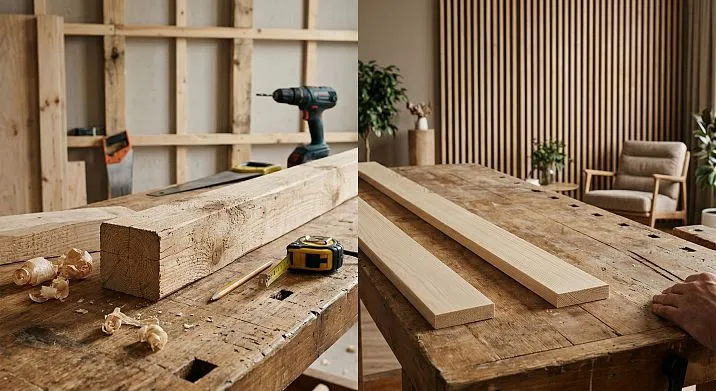
Wooden blockandWooden plank— these are not synonyms or interchangeable materials. They are two different tools with different application logics. The batten typically works where rigidity, load-bearing capacity, and concealment are needed. The slat — where precision, delicacy, and a visible decorative result are required. A wooden wall slat creates geometric rhythm and warm texture. The batten beneath these slats — an invisible but reliable foundation.
It is precisely this division of functions — between hidden and visible, load-bearing and decorative — that is the key to choosing the material correctly. In this article, we will break everything down in order: the difference in cross-section and properties, application scenarios for each, selection mistakes, and a practical algorithm that will help you make the right decision even before going to the store.



How a wooden batten differs from a slat
These are not just different words for the same thing. Between a batten and a slat, there is a fundamental difference in cross-section geometry, weight, strength, and purpose.




Cross-section and geometry
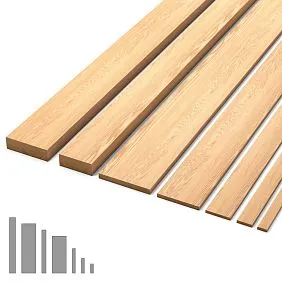
A wooden batten is lumber with a rectangular or square cross-section, where no side exceeds 100 mm, and the aspect ratio does not exceed 1:2. Typical batten sizes: 40×40, 50×50, 40×60, 50×70 mm. This is a 'dense' cross-section that provides rigidity in two planes.
A slat is a flat, thin element where the width significantly exceeds the thickness (typically a ratio from 1:3 to 1:10). Thickness — up to 20 mm, width — from 20 to 100 mm and more. Typical slat sizes for finishing: 80×7, 60×7, 40×10, 20×6 mm. This is a 'flat' cross-section that works well for bending in the narrow plane and provides an impressive visible surface.
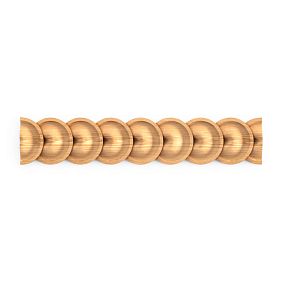
Our factory also produces:


Difference in function and perception
Here is the key difference that defines everything:
| Parameter | Wooden batten | Wooden batten |
|---|---|---|
| Cross-section | Square or near-square rectangle | Flat rectangle, width >> thickness |
| Dimensions | 40×40 to 100×100 mm | 20×6 to 100×15 mm |
| Function | Frame, base, load-bearing element | Finishing, decor, line, rhythm |
| Visibility | Usually hidden | Usually visible face element |
| Rigidity | High in two planes | High along length, flexible in thickness |
| Application | Battens, frame, base | Wall finish, decor, layout |
Simply put: a wooden block is a structural material. A batten is a surface material. The block holds. The batten shows.
Get Consultation
Why they are confused
Confusion arises where these roles intersect. A thin block 20×40 can be used both as light battens and as a horizontal strip on a wall in loft style. A wide batten 80×12 — as a decorative face element, and simultaneously as a horizontal guide. It is this blurring of functions that creates uncertainty in choice. To choose correctly — one must start not from the name, but from the task.
When it is better to choose a wooden block
A wooden batten is the workhorse of construction and finishing. It does the job that will never be seen—but without which the entire visible result is simply impossible.
Hidden framework for cladding
Batten for a hidden framework is the most common application. A wooden batten measuring 40×40 or 50×50 mm is attached to a wall, ceiling, or floor and creates a rigid spatial grid, to which the cladding material is then mounted: clapboard, panels, drywall, plywood, wooden slats.
A hidden framework made of battens performs several functions simultaneously:
-
Leveling the plane. A wall is rarely perfectly even. A batten allows for creating a smooth base plane by adjusting the thickness of the shims under each element.
-
Ventilation gap. An air gap remains between the main wall and the cladding, which prevents the cladding material from getting wet and condensation from accumulating.
-
Mounting points. The cladding material is attached precisely to the batten, not to the wall—this simplifies installation and makes it reliable.
-
Space for utilities. In the space between the wall and the batten framework, electrical wiring, pipes, and insulation can be hidden.
For lightweight claddings—clapboard, thin wooden panels, slats—a 30×40 or 40×40 mm batten is sufficient. For heavier surfaces—MDF panels, plywood 12–18 mm thick—a 50×50 mm batten is better. For particularly loaded structures (tiles, natural stone)—50×70 or 60×60 mm.
Battening for external and internal finishing
Wooden batten for lathing is one of the most common construction scenarios. Horizontal or vertical slats made from batten create a grid with a spacing of 40–60 cm, aligned into a single plane. It is onto this grid that the visible finish is then applied.
The lathing spacing depends on the cladding material:
-
Clapboard, thin wooden slats — spacing 40–60 cm
-
Drywall — spacing 60 cm (standard for a 120 cm sheet)
-
Plywood — spacing 40–50 cm
-
Tile cladding on adhesive — spacing 30–40 cm
Mounting substrate for decorative slats
One of the most relevant interior scenarios is mounting decorative slats on a wall. In this case, the wooden batten acts as an intermediate load-bearing layer: horizontal guides are screwed to it, to which vertical decorative slats are then attached. This allows for a perfectly even decorative plane even on a crooked wall.
Wooden batten for the base under slats: standard cross-section 20×40 or 25×50 mm. Attached to the wall horizontally with a spacing of 40–50 cm. Slats are attached to it vertically or at an angle.
Structural elements in joinery products
A wooden block is a basic element in the manufacture of shelves, racks, niches, and built-in furniture. Here it serves as a load-bearing element of the frame: it defines the shape, bears the load, and creates the framework to which panels, facades, and decorative elements are attached.
To buy a wooden block for a specific task means to determine the required cross-section, wood species, and degree of surface finish. A planed pine block is for hidden structures. A block made of oak or beech is for exposed elements or situations where hardness and load resistance are important.
When is it better to choose a wooden batten?
A batten is used where a block would be excessive in mass and somewhat crude in appearance. It is a material with a subtle decorative language that creates surfaces and geometry, not structure.
Decorative wall finishing
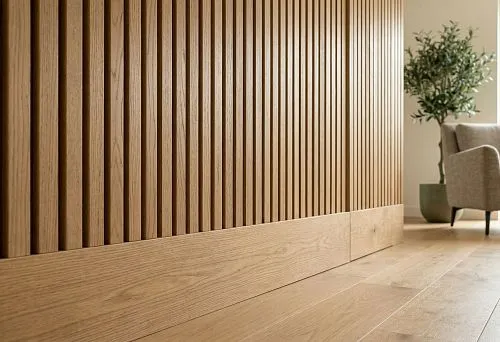
Wooden plank for wall— one of the most enduring interior trends of the last decade. The essence of the technique is simple: parallel wooden strips, mounted vertically or horizontally, create a three-dimensional surface with a linear rhythm that transforms any wall.
What makes a batten particularly good for this task:
-
Scale. A batten 40–80 mm wide and 6–10 mm thick creates delicate shadow lines without cluttering the space. A block of the same width would be visually 3–4 times heavier.
-
Lightness. A thin batten weighs significantly less, which simplifies installation and reduces the load on the supporting base.
-
Visual clarity. The rectangular cross-section of the batten provides clean end cuts, which create expressive shadows in side lighting — this is precisely what makes a batten wall beautiful.
Standard batten for decorative wall: 80×7 mm (profile RK-001) — wide format with expressive rhythm. 40×7 mm — more frequent and delicate rhythm. 20×6 mm — very thin, almost jewelry-like geometry.
Wooden battens in interior: application scenarios
Wooden boards in interiorare used much more widely than just 'stripes on the wall':
-
Accent wall — batten surface behind sofa, bed, or in dining area
-
Zoning without walls — open batten partition between kitchen and living room, between work area and relaxation area
-
Background zoning — battens on wall behind TV, along staircase, around perimeter of niche
-
Framing mirrors, paintings, niches — batten as thin decorative frame
-
Horizontal dividing line — batten as boundary between two wall colors, between paint zone and plaster zone
-
Ceiling constructions — batten coffers, linear accents, concealed cornices made of batten
Batten as finishing and layout line
A wooden batten used as trim—this closes joints, transitions, and ends without using plastic. A horizontal batten along the top edge of a wall panel conceals the cut and creates a clean line. A narrow batten along a jamb hides material transitions.
In this scenario, the batten replaces plastic trim pieces—and does so much more expressively, maintaining a unified wood language for the finish.
What to choose for a hidden frame: a square batten or a flat batten
The most frequently asked question. And the answer here is not straightforward—though in most cases, the logic leans toward a square batten.
Why a square batten is often better for a hidden frame
Rigidity in two planes. The square or near-square cross-section of a batten provides resistance to loads in both vertical and horizontal planes. A flat batten with a thin cross-section easily bends across its width—this is normal for a decorative surface but critical for a load-bearing base.
Reliability of fastening. To a 40×40 mm batten, you can securely fasten cladding material by any method: with a screw, dowel, or bolt. A thin 80×7 mm flat batten often splits along the grain when a crosswise screw is driven.
Resistance to deformation. A batten deforms less than a flat batten of the same length under humidity fluctuations—its cross-section is closer to equiaxial, which reduces internal stresses during drying and swelling.
When a flat batten is suitable for a lightweight frame
There are situations where a flat batten works perfectly well as a base:
-
Horizontal battens for thin cladding. A 20×40 or 25×50 mm batten, oriented flat against the wall (wide side to the wall), creates a horizontal platform for mounting thin decor. The load here is minimal.
-
Frame for decorative battens without insulation. If the task is simply to level the plane and provide attachment points for thin face battens, a batten as an intermediate element works quite well.
-
Light, non-load-bearing structures. Openwork partitions, decorative frames, small hanging elements.
Algorithm for selecting frame material.
Three questions that will decide everything:
1. What weight does the frame carry? Clapboard, thin battens, decorative panels up to 5 kg/m² — a 25×40 mm batten is acceptable. Drywall, plywood, MDF from 5 to 15 kg/m² — a 40×40 mm timber. Tile, natural stone, heavy panels from 15 kg/m² — a 50×50 or 50×70 mm timber.
2. What is the installation spacing? Close spacing (20–30 cm) for thin cladding — a thin batten is permissible. Wide spacing (50–60 cm) with large spans — a timber with good bending resistance is needed.
3. Will there be transverse loads? Shelves, cornices, hanging elements — only timber. Purely vertical load from cladding — a batten may cope.
What is better for wall finishing and decor: timber or batten?
If a hidden frame is the territory of timber, then a visible surface is almost always the territory of a batten. But not always.
Why battens are better for decorative wall finishing
Scale and proportions. When a 40×40 mm block is mounted on a wall as decoration, it looks rough and bulky, unless it's an intentional loft or industrial interior with a deliberate, harsh aesthetic. A 60×8 mm batten with the same external dimensions gives a completely different visual impression: a plane, a line, thin geometry.
Shadow effect. Battens create characteristic shadow stripes with clear side edges. The thinner the batten and the sharper the angle of light incidence, the more expressive the shadow. A block in a similar situation creates coarser, 'boxy' shadows without delicacy.
Painting possibilities. A batten, with its closed end surface, provides an even, predictable coating. The wide plane accepts both opaque paint and glaze and oil well.
When a block is appropriate in a decorative role
A block as a visible decorative element works in several scenarios:
-
Loft, industrial style. Square blocks on a wall create rough, constructive geometry — exactly what is needed in this aesthetic.
-
Massive decorative beams. Overlay decorative beams made from blocks (glued 'boxes' from several blocks) — a common technique in classic and rustic interiors.
-
Accent shelf or ledge. A wooden block in the role of a narrow overlay shelf or horizontal architectural accent.
-
Wooden lattices. The intersection of horizontal and vertical blocks forms a lattice — for partitions or decorative screens.
How to combine timber and slats in one project
This is where true craftsmanship begins. Timber and slats are not competitors, but partners. The most impressive and durable solutions arise precisely when both materials are used for their intended purpose within a single structure.
Classic scheme: timber as hidden base, slats as facing element
This is the most logical and common combination:
-
Horizontal timber pieces 30×40 or 40×40 mm are attached to the wall with 40–50 cm spacing — hidden base
-
Vertical decorative slats 60–80×7 mm are mounted to the timber pieces with desired spacing — decorative facing layer
-
A gap remains between the slats, creating expressive shadow and emphasizing the surface relief
The result is a slatted wall with perfectly flat plane, excellent ventilation behind the slats, and complete absence of visible fasteners.
Advantages of this scheme:
-
Base is completely hidden — only slats are visible
-
The slat does not bear structural load—it simply 'hangs' on the batten.
-
If necessary, the slats can be dismantled and replaced without disassembling the entire structure.
-
The total thickness of the structure with a 40 mm batten and 7 mm slat is about 47–50 mm from the wall (including the gap).
Implementation example
Task: accent wall in the bedroom behind the bed. Wall width 3.6 m, height to ceiling 2.7 m. Material: oak slat 80×8 mm, pine batten 40×40 mm.
-
Battens along the height: 5 pieces with a 60 cm spacing.
-
Slats along the width: 24 pieces with a 70 mm spacing (80 mm slat + ~70 mm gap between slats).
-
Batten consumption: 5 × 3.6 m = 18 linear meters.
-
Slat consumption: 24 × 2.7 m = 64.8 linear meters.
How to avoid excess thickness
If the wall is even and no ventilation gap is needed, the batten can be minimized. Load-bearing horizontal strips made from 25×40 mm slats (with the wider side facing the wall) will protrude only 25 mm from the wall—and a 60×7 mm slat will protrude a total of 32 mm. This minimally consumes room space.
What tasks do slats, trim, glazing beads, and molding slats solve?
Wooden slats are not the only thin wooden profile. There is a whole system of related elements, each occupying its own niche. Understanding this system helps in making more precise choices.
Wooden slat
Width 20–100 mm, thickness 6–15 mm. A face decorative and functional element. Creates surfaces, rhythm, lines. Used on walls, ceilings, in partitions, as a finishing profile.
Wooden trim
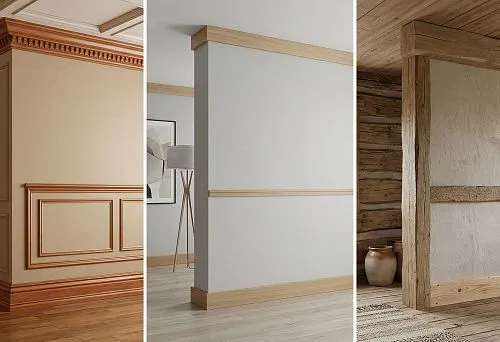
Wooden molding— a thinner element than a standard slat. Width 10–40 mm, thickness 3–8 mm. Used to cover joints, transitions, around the perimeter of inserts and panels. This is a delicate 'seam' element—it does not create volume but covers and finishes transitions.
Trim is used where a slat is too bulky. A joint between two panels 3–5 mm wide? A 15×4 mm trim will cover it discreetly and neatly.
Wooden glazing bead
wooden trim— the thinnest element of the system. Square or triangular cross-section 8×8 or 10×10 mm. Covers the narrowest and most delicate joints: between a frame and glass, between adjacent cladding elements with minimal clearance. Indispensable in joinery—frames, inserts, cassettes.
Glazing bead vs. layout strip: glazing bead for joints up to 10 mm, layout strip for joints 10–25 mm.
Picture rail and moldings
Picture frame strip— a shaped solid wood profile used for framing mirrors, paintings, decorative panels. Has a profiled cross-section—straight, concave, or convex bead. It is from picture rail that 'à la classic' frames are made—what are commonly called moldings.
Moldings— a broader category of decorative profiles made from solid wood: cornices, baseboards, corner elements. They cover wall-ceiling transitions and create horizontal architectural lines.
Comparative table of thin wooden profiles
| Element | Thickness | Width | Main function |
|---|---|---|---|
| Rail | 6–15 mm | 20–100 mm | Decoration, surface finishing |
| Layout | 3–8 mm | 10–40 mm | Joint and transition closure |
| Glazing bead | 8–10 mm | 8–10 mm | Minimum gaps, frames |
| Baguette strip | 10–25 mm | 20–60 mm | Framing, moldings |
| Block | 30–100 mm | 30–100 mm | Frame, base, structure |
AllWooden trim— battens, glazing beads, moldings, picture rail moldings, baseboards, and cornices — this is a unified system built on the principle: each element performs its precise task.
How to choose the material for the task: finishing, decor, frame
A practical eight-question algorithm. Answer each one — and the choice will become obvious.
Question 1. Will the element be visible?
Yes → batten, molding, picture rail molding. The surface should be planed or sanded, ready for finishing coating.
No → block. Planed for ease of installation, but not necessarily sanded.
Question 2. Is rigidity needed in two planes?
Yes → block with square or near-square cross-section.
No → batten or molding.
Question 3. What visual scale is needed?
Thin and delicate → slat 20–40 mm width, thickness 6–8 mm.
Medium and expressive → slat 60–80 mm width, thickness 8–12 mm.
Massive and structural → block 40×40 mm and larger.
Question 4. Is painting to match the wall color needed?
Yes → choose species with fine and closed pores: beech, birch, ash. They better accept opaque paints.
No, tinting or oil is planned → oak, ash, walnut — the grain pattern will be emphasized and become part of the decor.
Question 5. What weight does the structure bear?
Light cladding up to 5 kg/m² → slat 25×40 mm or block 30×40 mm.
Medium load 5–15 kg/m² → block 40×40 or 40×50 mm.
Heavy cladding from 15 kg/m² → 50×50 mm or 50×70 mm batten.
Question 6. What installation spacing is intended?
Frequent spacing 20–30 cm (for thin cladding) → 20×40 mm lath is sufficient.
Standard spacing 40–60 cm → 40×40 mm batten.
Wide spacing 60–80 cm (for rigid plywood) → 50×50 mm batten.
Question 7. Is a decorative appearance of the front surface needed?
Yes, high-quality finish → lath or molding with sanded or planed surface of class A or AA.
No, hidden structure → class B or BC batten, planed for installation convenience.
Question 8. Is a batten + lath kit needed?
For most lath wall projects — yes. Batten as hidden base + lath as front decor — this is the most professional and reliable scenario.
Mistakes that lead to incorrect material selection
This is not theory—these are real situations that ruin good ideas.
Mistake 1. Using timber for delicate decor
A 40×40 mm wooden timber on an accent wall as 'decorative slats' is not neat geometry but a heavy structural grid. Unless it's an intentional industrial technique—timber in a decorative role looks rough and disproportionate.
Solution: for delicate interior decor—use a 60–80×7 mm or thinner slat.
Mistake 2. Using a slat as a load-bearing base for heavy cladding
A 20×40 mm slat as a frame for drywall or tiles is a disaster in slow motion. The slat will bend, twist, and the entire cladding will lose flatness.
Solution: for a load-bearing frame—only use timber of the required cross-section.
Mistake 3. Not considering visual scale
Wide 100×12 mm slats in a small room create a feeling of a 'heavy cage'. Narrow 20×6 mm slats in a large hall 'get lost' and don't provide the needed rhythm. The scale of the slat should be proportional to the scale of the room.
Mistake 4. Confusing decorative slats with structural framework
"I'll buy a thicker slat — I'll make the frame and decorate it" — logic that doesn't work. A 20×50 mm slat as a frame will behave unpredictably with changes in humidity. A 40×50 mm batten of the same length is significantly more stable.
Mistake 5. Choosing based only on a photo from the internet
Photos don't convey scale. Slats in a photo could be 30×8 mm or 80×12 mm — and look the same. Always clarify the exact dimensions of the chosen product and try them out in your space in real proportions.
Mistake 6. Ignoring humidity and operating conditions
In rooms with high humidity (bathroom, kitchen, unheated rooms), untreated pine battens and slats will quickly warp or become moldy. For damp rooms — use larch or wood with moisture-resistant coating.
Mistake 7. Buying exactly to the required length
Always add a reserve of 10–15% to the calculated amount of slats and 5–10% to battens. End waste, offcuts, and fitting are inevitable.
Practical checklist before buying wooden battens and slats
1. Determine the function of each element
-
Hidden frame → batten
-
Visible front surface → slat or molding
-
Thin joint or framing → trim or bead
2. Measure the area and calculate the footage
-
Height × number of slats with the required spacing = linear footage of slats
-
Room length × number of horizontal rows of battens = linear footage of battens
-
+15% allowance for cuts
3. Determine the required cross-section
-
For a hidden frame under slats: batten 40×40 or 30×40 mm
-
For a decorative wall: slat 60–80×7 mm
-
For thin joints: 15×4 mm layout
4. Select wood species for the task
-
For painting: beech, birch
-
For transparent oil or glaze: oak, ash
-
For hidden frame: planed pine
5. Specify surface quality
-
Visible elements: class A, sanded
-
Hidden elements: class B, planed
6. Decide on pre-installation coating
-
Painting or staining before installation is much more convenient than after
-
Ends after trimming must be processed
Buy wooden battenandBuy wooden blockIn the required cross-section, wood species, and volume — these are steps that should be done simultaneously, having calculated in advance which of the two materials in your project serves as the base and which as the facing decor.
FAQ: answers to main questions about wooden block and batten
How does a wooden block differ from a batten?
The main difference is in cross-section and function. A block has a square or nearly square cross-section with sides up to 100 mm — it is a structural material for frames, lathing, and load-bearing bases. A batten has a flat rectangular cross-section where the width significantly exceeds the thickness (usually 3–10 times) — it is a facing decorative and finishing material.
What is better for a hidden frame: block or batten?
For most hidden frame tasks — wooden block. Square cross-section provides rigidity in two planes, resistance to transverse loads, and reliable fastening of cladding. Batten can only be used for very light non-load-bearing structures with frequent mounting spacing.
Can batten be used as a base for heavy cladding?
No. A thin, flat batten bends under transverse loads and loses rigidity. For heavy cladding—tiles, MDF panels, plywood—a block of appropriate cross-section is needed.
What is better for a decorative wall made of slats: a batten or a block?
Wooden batten for wall decoration is the optimal choice. Its flat cross-section creates delicate shadows, a light, proportional solution that does not weigh down the space. A block in a decorative role is appropriate only in industrial and loft interiors.
Which wooden battens are suitable for apartment interior?
For interior tasks, the most versatile are battens with a cross-section of 60–80 × 7–8 mm made of oak or beech. They provide an expressive decorative rhythm, accept any finishes well, and are proportional to most living spaces.
What to choose for wall finishing—a block or a batten?
For visible wall finishing—wooden batten. For the hidden base under this finishing—a block. The ideal scheme: block as the base + batten as the facing surface.
Is a block needed under decorative battens or can battens be attached directly to the wall?
On a flat wall, battens can be attached directly—with liquid nails or thin screws through the batten into a dowel. On an uneven wall (deviation over 5 mm)—a lathing of blocks is needed to level the plane.
Where to buy wooden block and battens for walls?
In the STAVROS catalog: wooden slats made of oak and beech in several profiles, bars of various cross-sections, as well as a full range of millwork — trims, glazing beads, baseboards, moldings — for a complete solution to any finishing task.
Conclusion
Wooden bar and slat are not competitors or synonyms. They are two materials with different logics that, in skilled hands, complement each other within a single project. The bar supports, the slat shows. The bar creates the foundation, the slat creates the image. And only understanding this separation of functions allows you to achieve not a random set of materials, but a cohesive, thoughtful, and beautiful solution as a result.
Proper selection does not begin with a trip to the store, but with honest answers to three questions: what will be visible, what will be hidden, and what load the structure bears. Once these questions are resolved — the choice between bar and slat becomes obvious and precise.
The company STAVROS produces wooden slats, bars, millwork, and all related finishing elements from solid oak, beech, and ash. The entire range is manufactured to uniform quality standards — with high geometric precision, clean surface, and stable dimensions. STAVROS is not just individual products, but a complete wooden finishing system that allows solving any task: from hidden framing to delicate interior decor.