Article Contents:
- The task of trim is to structure space
- Door trim as an architectural frame
- Wooden profiles for horizontal and vertical division
- Planks as a graphic layer
- Planks and beams — forming rhythmic compositions
- Wooden skirting — basic level of organization
- Examples of zoning: hallway, living room, office
- Hallway: organizing the entry point
- Living room: dividing into functional subzones
- Office: creating an isolated space
- Creating a sequential visual logic
- Conclusion: the STAVROS system for total zoning

Space is read not by walls, but by lines that structure them.Wood Trim— transforms a chaotic plane into an organized zoning system, each zone performing its own function and perceived as an independent interior fragment.Door molding, Wooden profile, Wooden molding, Wooden rails, Oak beam, Oak timber beamandWooden baseboard— is not decoration, but architectural division tools that form boundaries without erecting walls.


The task of trim is to structure space
Why is an open plan often perceived as an empty space without character? Lack of visual hierarchy.Trimming Items— solve this problem by introducing vertical and horizontal axes that divide space into manageable fragments. The ceiling cornice separates the upper zone from the main wall. Vertical planks divide the living room into a lounge and dining area. The floor skirting establishes the basic level from which the entire composition is measured.
Structuring is creating order through repetition of elements and clarity of boundaries.Wooden profile— installed at a height of 90 centimeters around the perimeter of the room, forms a horizontal axis that visually divides the wall into a plinth and main part. This is not merely a decorative strip — it is a boundary that sets the scale of other interior elements. Furniture, lighting fixtures, and paintings begin to relate to this line, forming a coherent system.
wood trim items— work like a graphic grid in typography — they are invisible, but without them the composition falls apart. Each element has its place in the hierarchy:Wooden baseboard— basic line, profiles and planks — structural axes, planks — zone filling, cornices — upper boundary. When this system is properly constructed, space acquires tectonic logic — it becomes clear where one zone begins and another ends.




Door trim as an architectural frame
A door opening is not an aperture in the wall, but a point of transition between different spatial contexts.Door molding— transforms this transition into an architectural event, emphasizing the boundary and creating a frame that controls the perception of adjacent zones.
The door block construction includes the frame, casing, filler boards, and threshold strips.Profile made of wood— has a complex cross-section with a decorative outer part and functional inner part. The casing frames the opening on both sides of the wall, creating a symmetrical frame usually 70 to 100 millimeters wide. The filler board compensates for the difference between wall thickness and frame depth, forming the opening’s bevel.
How does door trim participate in zoning? It marks the boundary of functional zones. A wide, massive casing made ofoakSignals entry into a private workspace. A minimalist, slim profile on the door between the living room and kitchen creates a soft boundary without breaking the visual connection between zones. A contrasting dark casing on a light wall acts as a graphic accent, emphasizing the verticality of the opening and drawing attention to the entrance.
trim for interior doorscan be coordinated with other linear elements of the interior. If installed on walls,wooden panelsof a certain profile, the casings must have a similar cross-section — this creates visual unity. The height of horizontal moldings can coincide with the height of the upper edge of the door frame, linking the door assembly with the overall wall structure.
Our factory also produces:


Wooden profiles for horizontal and vertical division
Space zoning is achieved through two types of lines: horizontal lines, which divide the room's height into tiers, and vertical lines, which divide the wall surface into sections.Wooden profilesof both types create a frame within which the rest of the composition unfolds.
Horizontal division begins withof wooden floor skirting boarda lower band 40–150 millimeters high. The next horizontal — a profile at the level of the sofa backrest or windowsill (typically 70–90 cm from the floor) — divides the wall into a base and middle section. The upper horizontal —wooden ceiling molding(cornice) — completes the composition, separating the ceiling from the wall.
Such division creates a three-tiered structure, characteristic of classical interiors. The lower tier (up to 90 cm) is perceived as a supporting zone, the middle tier (from 90 cm to door height, around 210 cm) as the main part, and the upper tier (from door to ceiling) as the finishing element.Profile made of woodseparating these tiers can be painted in a contrasting color or left in the natural wood tone — depending on whether the boundary needs to be emphasized or softened.
Vertical division is achieved using posts and pilasters — vertical profiles that divide a long wall into proportional sections.wooden wall profilewith a cross-section of 40×60 or 50×70 millimeters, installed at intervals of 100–150 centimeters, creating a rhythm of verticals. Horizontal moldings are placed between vertical profiles, forming rectangular panels — the basic module of classical wall cladding.
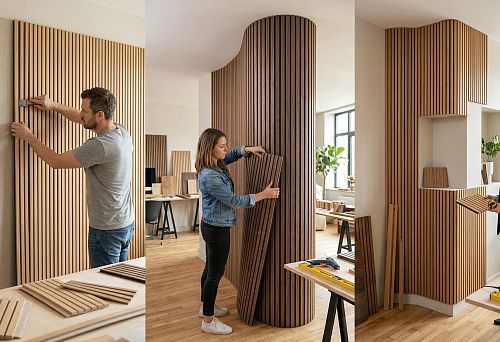
In modern interiors, vertical division is often implemented usingwooden stripsinstalled with gaps. Such a construction does not create a solid boundary but visually separates space while preserving its openness. The rails act as a filter — vision passes through them, but perception fixes the zone boundary.
Get Consultation
Moldings as a graphic layer
Wooden moldingare thin strips applied to wall or furniture surfaces, creating a graphic pattern without altering the relief. They function like lines on a drawing — defining composition but not creating volume.
The primary function of moldings in zoning — marking boundaries.Flat wooden panelingwith a width of 20–40 millimeters and thickness of 6–10 millimeters, is applied to the wall, forming a rectangular grid. Within each rectangle, there may be a different color, texture, or cladding material — thus creating a mosaic composition, where each section is perceived as a separate element.
In zoning open spaces, moldings are used to create visual boundaries without physical partitions. A vertical strip of moldings on the floor and ceiling, continued by vertical rails from 50 to 200 centimeters high, creates a conditional boundary between the living room and dining room. Vision perceives this line as a divider, although the space remains physically unified.
wooden veneer with a decorative profilewith a profiled surface is used to create framed compositions that highlight accent zones. A rectangular frame of moldings on the wall behind the sofa marks the lounge area. A similar frame on the opposite wall behind the dining table marks the dining area. The two zones are visually connected by a common design approach but are spatially separated.
Wooden corner veneerwith a G-shaped profile is used to decorate internal angles between walls and ceiling, creating a clear boundary between planes. This emphasizes the geometry of the room and enhances the sense of spatial structure.
Rails and beams — forming rhythmic compositions
Wooden railsare the basic elements for creating rhythmic structures that zone space through the repetition of vertical or horizontal lines. Rhythm is the alternation of elements and pauses (rails and gaps), which creates visual movement and directs the gaze.
Vertical rails, installed at regular intervals, form a partition that divides zones while maintaining visual permeability.Planed wooden stripwith a cross-section of 40×40 millimeters, installed with a 40-millimeter gap, creates a mass-to-empty space ratio of 1:1. Such a construction is perceived as a semi-transparent boundary — it exists but does not create a sense of isolation.
By varying the installation spacing of rails, one can control the degree of enclosure of a zone. A dense spacing (rail 40 mm, gap 20 mm) creates almost a solid surface with narrow gaps — such a partition more strongly isolates the space. A sparse spacing (rail 40 mm, gap 80 mm) provides a light, more symbolic than functional boundary.
Wooden planks for decorationcan be combined by wood species to create contrasting compositions.oak lumberdark-toned, alternating withlight-colored, creates a striped pattern that enhances the visual impact of the partition.of larger cross-section (from 50×50 to 100×100 millimeters) are used as load-bearing elements when creating volumetric partitions.
Wooden plankswith a cross-section of 80×80 millimeters can be installed as a vertical post to which horizontal rails are attached, forming a lattice structure.Oak beamof similar cross-section is used for less heavily loaded structures — decorative shelves, open shelves that simultaneously zone space and serve a storage function.Oak timber beamHorizontal rails create an effect of space expansion — the gaze follows the lines, and the room appears wider. This technique is applied in narrow corridors, where vertical zoning of rails along a long wall visually shortens the length, while horizontal zoning compensates for the narrowness.
Wooden skirting board — basic level of organization
— is the first element of the zoning system, establishing the basic horizontal line and connecting all vertical elements into a unified composition. Without a skirting board, vertical profiles, rails, and moldings appear to be suspended in the air — they lack support.
Wooden baseboardperforms three tasks in zoning. First — closing the technological gap between the floor covering and the wall, creating a visual finish. Second — protecting the lower part of the wall from mechanical damage, especially in high-traffic areas. Third — forming a base line from which all upper elements are measured.
wooden baseboardThe height of the skirting board affects the perception of the room's scale.
with a height of 100–150 millimeters creates a solid supporting zone characteristic of high-ceilinged grand spaces. A standard skirting board of 60–80 millimeters is suitable for living rooms with ceilings of 2.7–3 meters. A low skirting board of 40–50 millimeters is used in modern minimalist interiors where a subtle boundary is required.Wide Wooden Skirting BoardThe skirting board profile can be coordinated with the ceiling cornice profile, creating a visual frame for the room. If
has a rounded top, the floor skirting board can have a similar rounded top — such a mirrored reflection links the top and bottom into a unified system.Ceiling baseboard woodenof different shades can be used to delineate functional zones in an open layout. A dark oak skirting board in the living room zone, a light beech skirting board in the dining room zone — such a color change at floor level fixes the boundary without erecting partitions.
with a classic profile creates a sense of solidity, reliability.Examples of zoning: hallway, living room, office
Hallway: organization of the entry point
The hallway is a transitional space between the external and internal worlds, where zoning solves the task of creating a buffer zone.
of the entrance door — the first element of the system. A massive casing made ofDoor moldingwith a width of 100 millimeters creates a grand portal that marks the entrance.oakFrom the entrance door, extending into the hallway, are vertical
, installed at 120 centimeters intervals along both walls. They form a rhythm that guides the gaze from the entrance to the interior rooms. At a height of 90 centimeters, a horizontal profile runs, dividing the wall into a plinth section (usually painted dark or clad with panels) and an upper section (light-colored).wooden profilesIn the hallway, a storage zone is often placed — an integrated cabinet or an open coat rack. This zone is distinguished by vertical
, which frame the cabinet on both sides, creating a visual niche.wooden stripsaround the perimeter of the hallway unifies all elements into a single system.Wooden baseboardLiving room: division into functional subzones
In an open-plan layout, the living room typically includes a relaxation zone (sofa, chairs, TV) and a dining zone (dining table, chairs). Zoning is achieved without physical partitions, using linear elements.
The boundary between zones is marked by a vertical structure made of
, installed at a distance of 2–3 meters from the wall, perpendicular to the main axis of the room. Rails with a cross-section of 50×50 millimeters are installed at 50-millimeter intervals, creating a semi-transparent wall from floor to ceiling. LED lighting can be installed behind the rails, creating a soft glow that emphasizes the boundary.wooden planksEach zone has its own
— in the relaxation zone, a 80-millimeter high dark oak skirting board, in the dining zone — a 60-millimeter high light beech skirting board. Changing the skirting board fixes the boundary at floor level, enhancing the zoning effect.wooden baseboardin the relaxation zone, a 80-millimeter high dark oak skirting board, in the dining zone — a 60-millimeter high light beech skirting board. Changing the skirting board fixes the boundary at floor level, enhancing the zoning effect.
Each zone has its own type of finish. In the lounge — horizontalWooden molding, forming rectangular panels. In the dining room — vertical rails, creating a rhythmic structure. The difference in line direction emphasizes the functional difference between zones.
Office: creating an isolated space
The office requires a higher degree of isolation than the living room, but a full physical partition is not always possible or desirable. Zoning is achieved using volumetric structures made ofmolding products.
The base — a frame ofoak beamwith a cross-section of 80×80 millimeters, which forms vertical posts and horizontal beams. On one side (toward the office) solid panels made of solid wood or plywood are mounted, creating a closed wall. On the other side (toward the common space) open shelves made ofbeech beams, which serve as shelves and simultaneously allow light to pass through.
The entrance to the office is finished with a heavydoor trim— wide casing and dados, creating a deep recess. This emphasizes the office’s status as a private zone, separated from the rest of the space.
Inside the officeWooden profileis used to create wall panels — vertical and horizontal layouts form a rectangular grid, within which solid wood inserts are placed. This creates a classic interior associated with a work atmosphere and seriousness.
Creating a sequential visual logic
Zoning is effective when all elements are linked by a unified logic — common scale, rhythm, material, color.Wood TrimThis allows creating such a system using one type of wood and coordinated profiles for all elements.
The sequence begins with selecting basic parameters: wood species (oak, beech, ash), skirting height (60–150 millimeters), profile cross-section (40×60, 50×70 millimeters), rail spacing (equal to rail width, double width, triple width). These parameters are applied to all zones of the room, creating visual unity despite functional diversity.
Visual logic is built on the principle of hierarchy: main boundaries (between rooms) are finished with heavy elements — wide casings, thick profiles. Secondary boundaries (between subzones within one room) — thin rails, narrow layouts. Tertiary (decorative wall division) — minimal elements.
Buy wooden profiled productsMust be from one batch to ensure color and texture match. Even within one species, differences may occur due to tree growth conditions and cutting methods. A single batch guarantees visual consistency — skirting in the living room, casings in the hall, and rails in the office will all appear harmonized.
Rhythm is a key element of visual logic. If one zone uses 50 mm rail spacing, another zone can use 100 mm (double) or 150 mm (triple). This creates a connection through mathematical proportions, perceived as harmony, even if not consciously understood.
basic (Wooden baseboardstructural (profiles and layouts) and filling (rails). All three levels are coordinated by material, color, scale, forming a unified tectonic structure that organizes space without physical barriers.
Conclusion: the STAVROS system for total zoning
Accurate room zoning requires not individual elements, but a complete system where each detail performs its function and is connected to the others. The company STAVROS offers a full range ofwood trim: Door molding, Wooden profiles, layouts, rails, Oak beam, Oak timber beam, wooden floor skirtingandceiling.
Production of trim elementsSTAVROS ensures consistency in quality and geometry of elements, which is critical for creating coordinated zoning systems. Each profile is manufactured on CNC machines, guaranteeing dimensional accuracy to tenths of a millimeter.Manufacturer of trimControls the entire cycle — from wood selection to final finishing — eliminating discrepancies between batches.
buy wooden trimChoosing STAVROS means getting not a set of scattered planks, but a thoughtfully designed system of elements coordinated by species, tone, and profile.Buy wooden trimAvailable for delivery to Moscow and St. Petersburg, with consultation from specialists on material calculation and technical support during installation.
Zoning of space usingwooden moldingThis is not decoration, but architectural thinking, where lines create structure, order, and visual logic. STAVROS transforms linear elements into tools for spatial organization that shape the interior long before furniture and accessories are added.