Article Contents:
- What are wooden panels for interior wall decoration
- What types of wooden wall panels are there
- Smooth panels
- Slatted panels
- Relief panels
- Paint-ready panels
- Panels with natural wood texture
- What materials are wooden panels made from
- Solid wood
- MDF
- Veneer
- Combined Solutions
- Where to use wooden panels indoors
- In the living room
- In the bedroom
- In the hallway and corridor
- In the study
- In the dining area
- In commercial interiors
- On niches, columns, and partitions
- What tasks do panels solve in interior design
- How to choose panels according to interior style
- Modern style
- Minimalism
- Scandinavian interior
- Jatoba
- Neoclassicism
- Classic Interior
- How to choose panels by color and texture
- How to choose panels by size and format
- What to choose: panel, slat, or module
- How wooden panels for interior wall finishing are installed
- Foundation Preparation
- Mounting with adhesive
- Mounting on frame
- Panel joining
- Corners, outlets, junctions, niches
- How to combine panels with other materials
- How to care for wooden panels
- Common mistakes when choosing wooden panels
- What to choose for different tasks
- For an accent wall
- For zoning
- For a calm background solution
- For a warm natural interior
- For a painting project
- For Apartments
- For Home
- For commercial interiors
- Practical tips for selection
- Conclusion: a simple selection scheme
- FAQ: Answers to Popular Questions
- About the Company STAVROS
Wooden panels for interior wall finishing are not just a finishing material. This is a solution that simultaneously works with space, sets the tone for the interior, adds warmth and that very visual depth that cannot be achieved with either paint or wallpaper. That is why they remain in demand both in small city apartments and in country residences, and in high-level commercial interiors.
Have you ever noticed that some interiors instantly catch your eye? That there is something alive, warm, almost tactile about them—even in a photograph? Most likely, wood is present in these spaces. Not a random detail, but a thoughtful system: panels on an accent wall, slatted finish behind the headboard, a deep oak tone in the living area. This is exactly what this article will be about.
What are wooden panels for interior wall finishing?
Wooden panels for interior wall finishingare finishing or decorative elements made of wood, MDF, veneer, or composite materials that are mounted on walls inside a room. They can cover the entire wall surface or act as an accent element—the area behind the sofa, the headboard, the TV wall, a column, a niche, a partition.
Unlike wallpaper, wooden panels create volume and relief. Unlike decorative plaster, they provide clear geometry and natural texture. Unlike painting, they bring materiality into the space—that very physicality that you feel even without touching.
Wooden wall panels solve a whole range of tasks:
-
create an accent plane in the relaxation, work, or dining area;
-
zone space without building partitions;
-
hide utilities, uneven surfaces, technical units;
-
set the visual rhythm and structure of the space;
-
add warmth and acoustic comfort;
-
create a sense of an expensive, well-thought-out interior.
They are used in living rooms and hallways, in offices and conference halls, in restaurants and hotels, in retail spaces and photo studios. The versatility of this solution is explained simply: wood never goes out of style. It was relevant a hundred years ago and will remain relevant for another hundred.




What types of wooden wall panels are there
The market offers several basic formats. Each works in its own way and suits different tasks.
Our factory also produces:


Smooth Panels
A smooth panel is a flat surface without relief, with a clean facade made of wood or MDF. Such solutions work well for painting, veneering, oil tinting, or varnishing. A smooth panel creates a calm, monolithic background—especially good for minimalism, Scandinavian interiors, and Japandi. It doesn't compete with furniture but works as a neutral plane on which all other decor unfolds beautifully.
Get Consultation
Rack panels
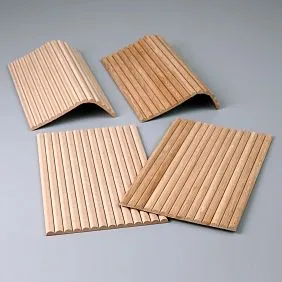
Slatted panels are one of the most popular formats in recent years. Vertical or horizontal slats, mounted at a certain pitch, create a lively play of light and shadow, visually elongate the space, and add depth. They look especially expressive with side lighting: each slat casts a soft shadow, turning the wall into a three-dimensional sculpture.
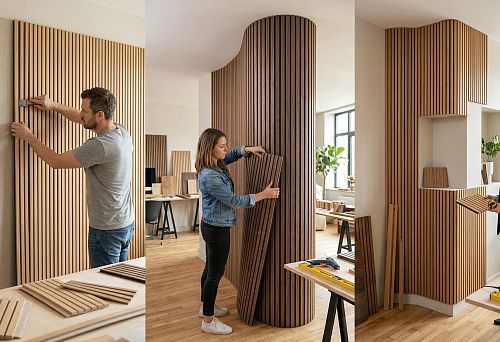
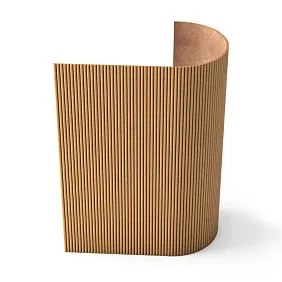
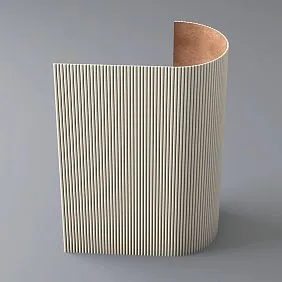
Wooden slat panels for wallsThey are produced both in a rigid version on an MDF backing and in a flexible version—on a fabric base for columns, arches, and curved surfaces. This is an important distinction: if the wall is straight, a rigid backing works excellently; if you need to wrap around complex architectural forms, the flexible option is indispensable.
Relief panels
Relief panels have a three-dimensional pattern on the surface: geometric ornamentation, diamonds, waves, abstract lines, classic coffers. Such solutions create a 'living wall' effect—especially with lighting. The relief emphasizes light, breaks up space, and adds character. They are suitable both in classic interiors and in modern eclectic solutions.
Panels for painting
A separate category is MDF panels for painting. A clean, even surface without texture, perfect geometry, the ability to paint in any color. Such panels give the designer maximum freedom: today the wall is white, tomorrow—deep blue, the day after—muted sage. MDF panels for painting are a universal tool for those who want to change the color scheme without complete dismantling.
Panels with natural wood texture
This is the most aesthetically rich format. Panels made of solid wood or with a veneered surface showcase the living pattern of wood: grain swirls, knots, shade variations, transitions from heartwood to sapwood. Natural texture is never the same—each panel is unique. This is precisely why they are valued in premium interiors.
What materials are wooden panels made from
Material choice is a key step. It affects appearance, durability, cost, and finishing possibilities.
Solid wood
Solid wood is solid timber without glue or synthetics.Solid Wood PanelsThey are made from oak, ash, beech, walnut, and pine. Each species has its own character:
-
Oak is dense, hard, with a noble grain. A classic for living rooms, studies, libraries;
-
Ash is lighter than oak, with pronounced fibers. Works well in Scandinavian and modern interiors;
-
Beech is fine-grained, uniform. Preferred for projects with an even texture;
-
Walnut is dark, with a rich hue. For interiors with a pronounced character;
-
Pine is lightweight, budget-friendly, provides a lively, slightly irregular texture.
Solid wood is not afraid of sanding and restoration: the surface can be renewed several times over the life of the panel. This is a long-term investment that retains value over time.
MDF
MDF is a board made from fine wood particles. It does not have a natural grain but holds its shape perfectly, does not warp or twist. MDF panels have stable geometry, a smooth surface, and take well to painting, veneering, and laminating. It is the most common material for slatted panels and panels for painting: precise dimensions, easy cutting, simple installation.
It is important to understand: MDF is not a substitute for solid wood — it is a different material with different purposes. Where uniformity and perfect geometry are needed, MDF is the best choice. Where a lively natural texture is needed, solid wood or veneer works.
Veneer
Veneered panels are MDF or plywood substrates faced with a thin slice of natural wood. Veneer provides the appearance of real wood at a significantly lower cost compared to solid wood. It's the perfect balance between aesthetics and practicality.
Veneered solutions are available in a huge variety of species: oak, walnut, cherry, zebrano, wenge, merbau. The surface looks like natural wood, reacts to light like natural wood, and creates the same feeling of warmth and depth. At the same time, veneer is less demanding in terms of humidity conditions than solid wood and is easier to install.
Combined Solutions
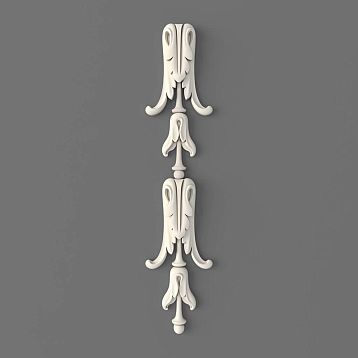
They are often complemented with decorative overlays, moldings, and carved decor, turning the wall into an architectural feature.
wood wall panelsWhere to use wooden panels indoors
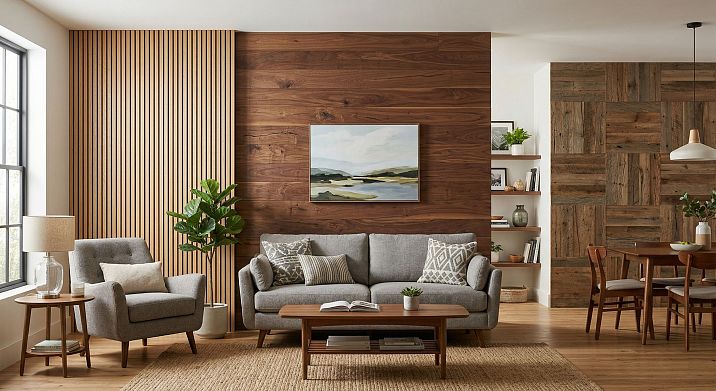
The living room is the most popular place for interior wall finishing with wooden panels. Here they work as an accent wall behind the sofa or in the TV area. Slatted panels create rhythm and depth, while smooth and veneered panels provide a noble backdrop for furniture and decor. In the living room, panels help visually unite furniture, flooring, and door portals into a single system — especially if all elements are made from the same species or similar shades.
In the living room
In the bedroom, wooden wall panels are traditionally placed behind the bed headboard. This makes the bed area a full-fledged accent plane and eliminates the need for a headboard as a separate piece of furniture. The warm texture of wood creates a feeling of coziness and relaxation, which is especially important for a rest area. The height of the paneled zone can vary: from half the wall to full-height coverage.
In the bedroom
The hallway is the calling card of an apartment. Wooden wall panels inside this space set the tone for the entire interior, greet guests, and create a first impression. In corridors, panels are often installed at a height of 90–120 cm from the floor as a protective and decorative zone. This is practical: the lower part of the wall in a hallway is subjected to the greatest loads — touches, dirt, mechanical impacts.
In the hallway and corridor
A study requires a special atmosphere: concentration, representativeness, and respect for the activity. Solid wood or veneered panels are a classic tool for creating such a space. Dark species add weight and status, light ones help with focus without a feeling of pressure. Oak panels are especially appropriate in studies with library shelves: a unified wood system works monolithically.
In the study
The dining area is a place for slow conversation, family meals, and celebrations. Here, wooden panels for interior finishing create a cozy 'cocoon' around the dining table. Slatted solutions work especially well: their rhythm adds dynamism without overloading the space. You can combine wood with soft lighting — and the area becomes warm and lively at any time of day.
In the dining area
The dining area is a place for slow conversation, family meals, and celebrations. Here, wooden panels for interior finishing create a cozy 'cocoon' around the dining table. Slatted solutions work especially well: their rhythm adds dynamism without overloading the space. You can combine wood with soft lighting — and the area becomes warm and lively at any time of day.
In commercial interiors
Restaurants, hotels, offices, showrooms, reception areas — in all these spaces, wooden wall panels create a sense of status and thoughtfulness. In commercial interiors, durability and resistance to operational loads are important — that's why panels made of hardwoods or MDF with wear-resistant coatings are often chosen here.
On niches, columns, and partitions
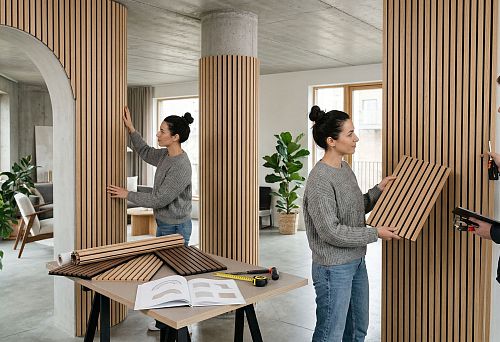
Wooden panels work brilliantly on non-standard architectural elements. A niche finished with slatted panels turns into an art object. A column wrapped in flexible slatted modules becomes a sculptural accent. A partition made of panels simultaneously zones the space and creates a decorative element. For such tasks, flexible slatted solutions are especially valuable, as they follow any shape without seams or adjustments.
What tasks do panels solve in interior design
Wooden panels are a design tool, not just a finishing material. They allow you to solve the following tasks:
Accent finishing. One wall decorated with panels becomes the focal point of the room. All other space works as a background — and this is the correct placement of accents.
Zoning without walls. A panel on part of a wall or on a partition visually divides the space without physical closure. In studio apartments and open spaces, this is an indispensable solution.
Visual rhythm. Slatted panels set a rhythm that guides the eye along the wall, creating a sense of movement and spaciousness.
Adding texture. A monotonous interior requires tactile variety. Wood provides this without visual overload — softly, organically.
Hiding imperfections. Uneven walls, pipes, cables, seams — panels hide all of this behind a neat plane.
Enhancing acoustic comfort. Wooden surfaces absorb part of the reflected sound, making the room quieter and more comfortable.
How to choose panels based on interior style
Wood is versatile, but each style requires its own approach.
Modern style
For a modern interior, clean, concise solutions work best: an even rhythm of slats, a smooth surface for tinting or painting, neutral shades—beige, light oak, linen, taupe. No overload, only precise geometry and natural warmth.
Minimalism
Minimalism requires maximum restraint. Smooth panels without relief, in light tones, with an even finish are appropriate here. Slats are possible, but with a wide pitch and without decorative inserts. It is important that the wood serves as a background, not the main element.
Scandinavian interior
Scandinavian interiors favor light wood, natural texture, and restrained slats. Birch, ash, pine—good wood species options. Finish—oil or matte varnish to preserve the liveliness of the texture. Scandinavian style does not tolerate wood that is too dark or heavy.
Japandi
Japandi—a Japanese-Scandinavian fusion—works with natural materials, precise proportions, and an almost meditative rhythm. Narrow vertical slats made of ash or oak with a calm natural finish look good here. No excess—only form and texture.
Neoclassicism
Neoclassicism is characterized by structured wall systems with moldings, cornices, coffers, and decorative overlays.INT-015 wall panels—are a good example of such a solution: they create a sense of architectural depth and classical order. Neoclassicism typically works with warm cream tones and concise carving.
Classic interior
Classicism implies full-fledgedBoiserie systems— these are wooden panels that cover the wall from the baseboard to the cornice, divided by moldings into equal fields. Oak, walnut, painted MDF in classic colors — all these solutions form a unified architectural system where walls, doors, and ceiling cornices are connected by a single rhythm and material.
How to choose panels by color and texture
Color and texture are what make an interior feel alive or dead. A few working principles:
For a light interior, panels in tones of bleached oak, ash, or birch work well. They do not overwhelm white or beige walls but add a subtle natural warmth.
For a warm natural palette, medium wood tones are suitable: honey oak, warm ash, natural beech. This combination creates a harmonious, cozy space without contrasts.
For a contrasting solution, choose dark woods — walnut, wenge, merbau — or tinted panels in graphite and swampy shades. A dark wall against light surfaces works expressively and boldly.
For painting, smooth MDF panels are best: no natural patterns, just a clean plane that can be painted any color from the palette — from antique white to dark blue.
For a natural wood grain, choose veneer with an expressive texture or solid wood with clearly visible fibers. Oak cut at a specific angle with a characteristic 'silvery' sheen is especially effective.
How to choose panels by size and format
The size of a panel affects visual perception no less than color.
Slat width: narrow slats (20–30 mm) create a frequent rhythm and visual density. Wide slats (60–100 mm) create a calm, slow rhythm. For high ceilings, a wide spacing works better; for standard rooms, a medium spacing.
Length: panels are cut to the height of the room. Standard is 2700–3000 mm, but for high ceilings, long modules or joining with a compensator is needed.
Thickness: the thicker the slat, the more expressive the shadow. Slats 10–15 mm thick give a soft shadow; 20–25 mm give a pronounced relief.
For a small room, it's better to choose a vertical rhythm with not-too-large slats—this visually stretches the space upward.
For a large room, you can work with a wide pitch and large modules—they won't get lost in the spacious area.
What to choose: panel, slat, or module
Three formats—three logics of application.
Ready-made panel (slats on a backing) is a convenient finished product that is mounted as a whole. Even geometry, quick installation, predictable result. Ideal for flat walls, standard rooms, mass-produced projects.
Individual slats offer freedom: you can set any spacing, any direction, create transitions and non-standard layouts. Requires more time for installation but delivers a unique result. Chosen for authorial projects.
Module is a flexible panel on a fabric or mesh base that wraps around complex surfaces. Indispensable for columns, arches, curved walls. Installation is with adhesive, seamless joining.
When an accent wall is needed — a ready-made panel or module is the easiest option. When zoning is required — individual slats offer more freedom. For complex areas — only a flexible module.
How wooden panels for interior wall finishing are installed
Installation is not a difficult task, but requires care and understanding of several key rules.
Foundation Preparation
The base must be level, dry, and clean. The permissible deviation for adhesive installation is no more than 5 mm over 2 m. If the wall has significant irregularities, a metal profile frame is necessary. The base must be primed to improve adhesion.
Mounting with adhesive
Installation with mounting adhesive is the simplest and fastest method. Adhesive is applied to the panel backing or directly onto the wall in strips. The panel is pressed and secured until it sets. Additionally, headless finish nails can be used for more secure fastening.
Mounting on frame
A metal profile frame is used for uneven walls or when an air gap is needed (e.g., for wiring or improving thermal insulation). Panels are attached to the frame with screws through the backing or via a hidden method through grooves.
Panel joining
Panel joints must be precise and neat. Rigid panels on MDF backing are joined butt-to-butt or with decorative molding. Flexible modules are joined seamlessly — slats continue the rhythm without a visible seam. To compensate for solid wood thermal expansion, it is recommended to leave a small gap at the top and bottom of the installation.
Corners, outlets, junctions, niches
Internal corners are handled with a corner connector or by cutting at a 45° angle. Outlets and switches — via a precise cutout made before installation. Junctions with the ceiling and floor are covered with molding or baseboard. Niches require preliminary layout planning so that slats do not end abruptly in the middle.
How to combine panels with other materials
Wood is a noble material that easily coexists with others but requires sensible balance.
With paint. The most common combination: one wall in panels, the rest in paint. The paint shade should complement the warm tones of the wood or create an intentional contrast.
With glass. Glass and wood are an expressive pair. Frosted glass softens the contrast, mirrored glass adds depth.
With metal. Brass, bronze, or matte black metal inserts and hardware pair well with the warm tones of wood. Metal emphasizes premium quality.
With stone. Wood and stone are a natural union. The combination of wood panels with marble countertops or stone cladding in the fireplace area works especially well.
With textiles. Soft textiles—rugs, pillows, curtains—soften the texture of wood and create a sense of lived-in warmth.
With furniture and doors. For a cohesive effect, choose wood panels in the same species or a similar tone as the flooring and interior doors. This unifies the space into a single system.
How to care for wood panels
Caring for wood panels is not difficult but requires regularity.
Regular cleaning. Dust is removed with a soft, dry cloth or brush. For more thorough cleaning, a slightly damp cloth can be used—without aggressive cleaning agents.
Caring for painted panels. If the panels are painted, clean them with a soft, damp cloth. Scratches are painted over with the same paint. Refreshing the coating every few years is recommended.
Care for natural texture. Solid wood panels with oil or wax coating require periodic application of protective oil or wax — once every 1–2 years. This restores the protective layer and refreshes the tone.
What to avoid: direct water contact, prolonged exposure to moisture, aggressive chemical agents, sharp objects on the surface, sudden changes in temperature and humidity (especially for solid wood).
Common mistakes when choosing wooden panels
Knowing typical mistakes in advance makes them easy to avoid:
-
Not distinguishing between solid wood, MDF, and veneered solutions: these are three different materials with different properties
-
Choosing panels only by photo, without considering the actual color under the specific room's lighting
-
Ignoring wall dimensions: too frequent a rhythm in a small room creates a claustrophobic effect
-
Buying panels before understanding the installation scheme and wall preparation
-
Not planning abutments, joints, and corner solutions — this is immediately visible
-
Mixing incompatible wood species and shades without a systematic approach
-
Covering all walls with panels in a small room — wood should be an accent, not a prison.
-
Ignoring the combination of panels with furniture, doors, and flooring.
-
Using too heavy a dark texture in a low-ceilinged room — it visually weighs down the space.
-
Ignoring the interior style and choosing panels based solely on trends.
What to choose for different tasks
For an accent wall
The best choice is slatted panels made of solid oak or veneered panels with an expressive texture. The vertical rhythm of the slats creates a dynamic surface that changes with lighting.
For zoning
Slatted partitions or individual slats on guides — a solution that zones without enclosing the space. Light and air pass through the gaps between the slats, while visual separation is still evident.
For a calm, background solution.
Smooth panels for painting in a neutral tone — the perfect background that doesn't compete with furniture and decor, but adds depth and texture.
For a warm, natural interior
Panels made of solid wood with a natural oil finish. Living texture, warm hue, organic feel — this is exactly what creates the sensation of a real home.
For a project intended for painting.
MDF panels with a clean geometric surface. Rigid modules with even slat spacing or smooth panel planes broken up by moldings work best.
For apartments
In an apartment, wooden panels for interior wall decoration are best used selectively: one accent wall in the living room, the bed area in the bedroom, a lower band in the hallway. This creates character without overloading the space.
For home
In a country house, wood is more appropriate on a wider scale: you can finish several walls, create a system of panels and wooden beams on the ceiling, and link the finish with a wooden staircase. A unified wood logic works organically here and does not look excessive.
For commercial interiors
In commercial spaces, durability and the ability to quickly replace individual elements are important. Here it is better to choosebatten panels on an MDF substratewith wear-resistant coating or veneered solutions that are easy to repair.
Practical Tips for Selection
A few conclusions that will help you make the right decision even before browsing the catalog:
-
In a modern interior, laconic panels with even rhythm and neutral tones work best.
-
For an accent wall, choose an expressive but not overloaded texture — it should attract, not tire.
-
Under side lighting, the texture of wood is read much more strongly: check samples in conditions close to real ones.
-
Vertical rhythm visually raises the ceiling—use this in rooms with standard height.
-
Plan transitions to the ceiling, niches, and adjacent surfaces in advance to ensure the installation looks finished.
-
Measure the wall before ordering, taking into account all outlets, windows, and openings—the layout is done based on actual conditions, not standard ones.
-
Panels are especially in demand for TV zones and bed areas: they create a visual 'anchor' around which the entire zone is built.
Conclusion: a simple selection scheme.
Wooden wall panels are not a complex product. Complexity only arises when a person tries to choose them without understanding the task. If the task is understood, the choice becomes logical:
-
Define the task: accent, background, zoning, concealing flaws.
-
Choose the material: solid wood—for live texture, MDF—for painting and geometry, veneer—for a balance of aesthetics and price.
-
Choose the format: ready-made panel, individual slats, or flexible module.
-
Select the color and texture to match the style, lighting, and furniture.
-
Consider the installation: level base or frame, joints, corners, outlets.
-
Go to specific solutions from the manufacturer's catalog
FAQ: Answers to popular questions
Which wooden panels are best to choose for interior wall finishing?
The choice depends on the task and interior style. For warm natural texture — solid wood or veneer. For painting and precise geometry — MDF. For complex surfaces — flexible modules.
What is better for walls: solid wood, MDF, or veneer?
Solid wood is the most durable and lively material, veneer is a more affordable analog with similar aesthetics, MDF is ideal for painting. All three options are good if used appropriately.
Are wooden panels suitable for the bedroom?
They work great. Especially suitable behind the bed headboard. The warm texture of wood creates a relaxing atmosphere and makes the bed area visually complete.
Can panels be used in the hallway and corridor?
Yes. In the hallway, panels are installed as a lower belt up to a height of 90–120 cm or full height. This serves as both decor and protection for the wall from mechanical damage.
What is better for interior finishing: slatted panels or smooth ones?
Slatted panels provide relief, depth, and light play. Smooth ones are a neutral background for painting or veneer. Both formats are functional — the choice depends on the task.
Can wooden panels be painted?
Yes. MDF panels are specifically designed for painting. Solid wood and veneer can be tinted, varnished, or coated with oil or wax.
How are wooden panels attached to the wall?
With mounting adhesive — for even walls. On a metal frame — for uneven surfaces or when an air gap is needed. Additionally, finishing nails or hidden fasteners are used.
Are panels suitable for room zoning?
Yes. Slatted partitions and partial wall finishing are one of the best tools for visual zoning without physical partitions.
Which panels are better for a modern interior?
Concise slatted panels with even spacing, in light or natural oak tones — the most relevant choice for a modern interior.
Can panels be used on niches and columns?
Yes. Flexible slatted modules on a fabric base are designed for this: they wrap around any shape without deformation and join seamlessly.
How to choose panels by size?
Base your choice on room height, wall width, and desired rhythm. Narrow slats — frequent rhythm, wide — calm. In small rooms, choose medium proportions to avoid overloading.
How to care for wooden panels inside the house?
Wipe with a dry or slightly damp soft cloth. Refresh oil-coated panels every 1–2 years. Avoid harsh chemicals and constant contact with moisture.
About the company STAVROS
If you are looking for a manufacturer from whom you can orderWooden panels for interior wall finishing—and be confident in quality, precision geometry, and breadth of selection—pay attention to the company STAVROS.
STAVROS is a Russian manufacturer of products from solid wood, MDF, and polyurethane with over 20 years of experience. The assortment includesslatted panels made of MDF and solid oak, rigid and flexible modules,wall panels for classic and modern interiors, as well as a full range of wooden decor: moldings, cornices, baseboards, trims, carved overlays.
STAVROS manufactures products to custom sizes, works with residential and commercial projects, supplies items for designers, architects, and direct clients. A unified material system—from panels to trim—allows creating interiors where wood resonates as a cohesive, thoughtful story.