Article Contents:
- What are wooden ceiling panels
- Definition and essence
- How ceiling panels differ from wall panels
- When a wooden ceiling looks particularly advantageous
- What types of wooden ceiling panels are there
- By material
- Solid wood
- Veneered Solutions
- MDF under wood and for painting
- Wooden slats separately or as part of a panel
- By format
- Smooth panels
- Slatted panels with a gap
- Modular panels
- Narrow and wide formats
- By visual effect
- Why wooden ceiling panels are popular
- Where wooden ceiling panels are appropriate
- In the living room
- In the bedroom
- In the entryway
- In the study
- In kitchen and dining room
- In country house and attic
- How to choose wooden panels for ceiling
- By material
- By size and format
- By color
- By interior style
- By room height
- By operating conditions
- Slatted ceiling panels: when is this the best option
- How wooden panels affect the perception of space
- How to combine a wooden ceiling with interior design
- With light-colored walls
- With decorative plaster
- With stone surfaces
- With wooden flooring
- With black and brass accents
- With lighting
- Installing wooden panels on the ceiling
- Foundation Preparation
- Frame and mounting
- Layout
- Joints and connections
- Light fixtures and lighting
- Important nuances
- Mistakes when choosing and installing wooden ceiling panels
- Maintenance and Durability
- Conclusion: algorithm for choosing wooden ceiling panels
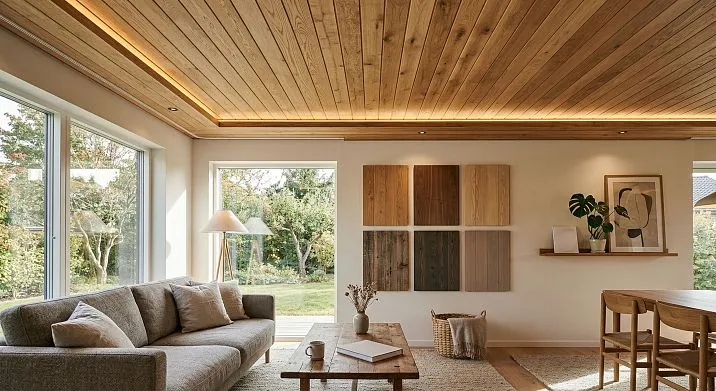
There comes a moment in renovation when you realize: the walls are already decided, the floor is chosen, the furniture is selected — but the ceiling remains a white rectangle, adding absolutely nothing. It's a shame, because it's the upper plane that creates the feeling of height, warmth, completeness, and character of the space. White paint is not a solution. It's a refusal to solve.
Wooden ceiling panels are one of the few finishing materials that simultaneously solve several problems: they create architectural volume where there was emptiness; they bring natural warmth where drywall and paint once reigned; they turn a neutral ceiling into an expressive design element that holds the entire interior together. And all this — without major renovation, without concrete work, without re-planning.
But 'wooden ceiling' is a broad concept. Solid wood or MDF? Slatted format or smooth panels? Vertical layout or horizontal? Light shade or dark? For a small apartment or a country house? The answers to these questions determine whether you'll get an expensive, atmospheric ceiling — or a heavy, oppressive ceiling that you'll want to urgently redo.
This article contains everything you need to make the right decision.

What are wooden ceiling panels




Definition and essence
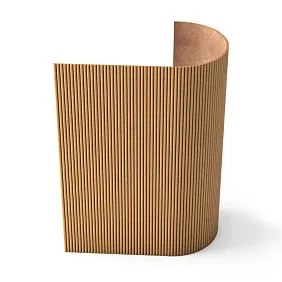
Wooden ceiling panels are ready-made structural elements made of natural wood, MDF, or veneered substrates, designed for installation on the horizontal plane of the ceiling. Unlike traditional wooden cladding—a rough building material—modern wooden ceiling panels are precisely processed products with clean geometry, factory-finished surfaces, and readiness for immediate installation.
A fundamental feature of ceiling application is the load on the fastening. A panel on a wall is held in place by its own weight; a panel on the ceiling hangs entirely on the fastening system, experiencing constant load. This means different requirements for the frame, fastening elements, and installation precision. A wooden ceiling panel installed using the correct technology lasts for decades—and never reminds you of itself with squeaking or peeling.
Our factory also produces:


How ceiling panels differ from wall panels
Structurally, many wooden panels for ceilings and walls are identical—they are the same products used in different planes. The difference lies in the installation logic. For ceilings, the following are fundamental:
-
Module weight—the lighter, the better. MDF with a density of 750–850 kg/m³ and a thin rail profile create less load on the suspension system than a thick solid wood panel.
-
Fastening rigidity—adhesive installation, applicable for walls, is only permissible on horizontal, flat surfaces with a small area on the ceiling. The main method is a metal frame with hangers.
-
Pattern orientation—if on walls the rails most often run vertically, on the ceiling the choice of direction (lengthwise or crosswise) directly affects the perception of the room's length and width.
-
Visual effect—a ceiling panel is viewed from below, under diffused or spot lighting, which requires separate selection of texture and tinting.
Get Consultation
When a wooden ceiling looks especially advantageous
Wooden ceiling panels work most effectively in several situations:
-
When an accent ceiling is needed over a specific area — dining table, sofa, bed.
-
When a room with high ceilings (from 2.9 m) requires 'lowering' and a cozy embrace.
-
When it's necessary to continue the wooden motif from the walls to the ceiling — to create a 'wooden box' effect.
-
When zoning without walls is required — a slatted ceiling over an area highlights it without physical partitions.
-
When the ceiling is in the field of view — in an attic, on a mezzanine, in a small room with a low ceiling, where a white rectangle is especially uncomfortable.
What types of wooden ceiling panels are there
By material
Solid wood
Solid wood is a pristine, living material. Each board, each slat carries a unique pattern of annual rings and grain that is never repeated. That's why a solid wood ceiling looks more expensive, more natural, and 'warmer' than any synthetic or veneered counterpart.
Oak is the main material for ceiling panels in the premium segment. Density 700–750 kg/m³, expressive natural pattern, high mechanical strength, and resistance to deformation. Oak ceiling panels under clear oil reveal a warm amber tone; tinting in gray or graphite creates a modern Scandinavian look; stained oak in dark shades — an aristocratic, heavy ceiling for formal interiors.
Beech is dense, homogeneous, with a neutral pinkish hue. Beech takes stains excellently and allows achieving almost any color, from natural bleached to rich cognac. Beech is well-suited for curved elements—thanks to steaming technology, it bends easily, allowing for seamless arched and vaulted ceiling constructions without joints or adjustments.
Ash is a light, contrasting wood with a pronounced linear grain pattern. On the ceiling, ash looks dynamic and modern; it is especially advantageous in Scandinavian and Japandi interiors with light, neutral walls.
Veneered solutions
Veneer is a thin slice of natural wood, 0.6–3 mm thick, glued onto an MDF or plywood base. On the outside—real wood texture, natural pattern, living fibers. Inside—a technologically stable engineered board that does not dry out, warp, or react to humidity fluctuations like solid wood does.
For ceiling applications, veneered panels are particularly attractive: they are lighter, more geometrically precise, and more stable than solid wood, while being visually indistinguishable from it at most distances. The 'book-matched' veneer—a mirror-symmetrical natural pattern from two consecutive slices—creates an exquisite decorative effect on wide ceiling planes.
MDF in wood finish and for painting
MDF with a density of 750–850 kg/m³ is the technological foundation of the modern slatted ceiling. A completely homogeneous structure without internal stresses or defects. A perfectly smooth surface that accepts any paint coating. Absolute geometric stability—MDF slats do not swell, dry out, or crack. For a paintable slatted ceiling, it is the unrivaled option when precise color matching to RAL is needed or when architectural purity of form is more important than natural texture.
Decorative wooden ceiling panels made of paintable MDF are an excellent solution for minimalist interiors, where the slatted rhythm creates architectural relief on a monochrome background.
Wooden slats individually or as part of a panel
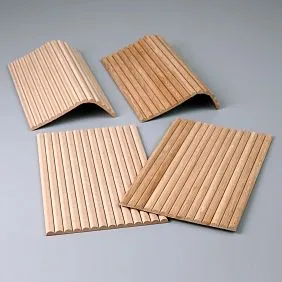
Individualform the architecture of walls and ceilings, creating a play of light and shadow.slats are mounted onto the batten one by one with individual control over spacing. This offers maximum freedom in layout, non-standard spacing, mixing wood species and formats. However, it requires significantly more installation time, demands precision from the installer, and complicates error correction.
Slatted panels on substrate— factory-assembled module with fixed slat spacing on MDF or fabric backing. Installed as a single unit; spacing between slats maintained with production precision; adjacent modules join seamlessly. For ceilings — the optimal choice, because correcting uneven spacing on a horizontal plane overhead is incomparably more difficult than on a vertical wall.
By format
Smooth Panels
Solid wood panel without inter-panel gap — the ceiling takes on the appearance of wood paneling. A classic solution for country houses, saunas, attics, and interiors in rustic, classic, or Scandinavian styles. For urban apartments with modern interiors — the slatted format with open grooves is more often chosen.
Slatted panels with gap
Slats with an open gap between them — the space between the planks is open, creating a rhythmic, architectural, three-dimensional effect. With directional lighting, the gap adds depth and chiaroscuro. Lighting can be integrated through the gap or ventilation slots can be concealed.
Wide gap (equal to or greater than the slat width) — a light, airy structure; the ceiling 'breathes'. Narrow gap — a rich rhythm, a 'dense' look, high decorative impact.
Modular Panels
Ready-made modules of fixed sizes (e.g., 600×600 mm or 600×1200 mm) — a ceiling system of interlocking square or rectangular elements. The grid pattern creates its own geometric rhythm, perpendicular to the slatted one. Used in commercial interiors, meeting rooms, lobbies.
Narrow and wide formats
Narrow slats 10–20 mm on the ceiling — a frequent, rich rhythm, a monolithic effect when viewed from below. Suitable for large rooms with high ceilings.
Medium slats 25–40 mm — a universal option for most rooms. The rhythm is perceptible but not dominant.
Wide slats 45–70 mm — Scandinavian, laconic, airy rhythm. The gap between wide slats is perceived as part of the design. A good option for rooms with low ceilings — wide light slats visually 'open up' the plane.
By visual effect
Light (natural ash, bleached oak, milk MDF) — the ceiling is perceived as higher and lighter; space expands. The optimal choice for apartments with ceilings up to 2.8 m.
Warm natural (natural oak, cognac, walnut, caramel) — spa-like image, cozy natural depth. Works with good lighting and sufficient room height.
Dark (tobacco, wenge, anthracite, graphite) — maximum expressiveness, heavy premium image. Requires high ceilings (from 2.9 m) and thoughtful lighting. In a small room with a dark ceiling — a sharp feeling of pressure and tightness.
Textured — brushed or aged surface with pronounced fiber relief creates a tactilely rich, 'warm' ceiling with developed chiaroscuro. Especially effective with side and accent lighting.
Minimalistic for painting — MDF matching the wall color; slats create architectural relief without color accent. A monochrome ceiling with slatted texture — a very modern, restrained, and expensive solution.
Why wooden ceiling panels are popular
The ceiling occupies a large area — and yet is most often ignored as a design surface. This is precisely where the potential lies: even a small change to the upper plane changes the perception of the entire room.
Warm natural texture — wood on the ceiling visually 'hugs' the space. Cold white ceilings create a feeling of emptiness above; a wooden ceiling eliminates this feeling and adds coziness that cannot be achieved with other materials.
Architectural volume — the slatted rhythm on a horizontal plane creates a three-dimensional effect absent in a painted ceiling. The depth of the grooves, the play of light and shadow under directed lighting — all this transforms the ceiling into a sculptural element of the interior.
Zoning without partitions — a fragmentary wooden ceiling over a specific zone (seating area, dining table, workspace) visually highlights it without physical walls. This is especially valuable in open-plan layouts.
Acoustics — the slatted structure scatters sound waves, reducing reverberation. A room with a wooden ceiling is acoustically softer than a similar room with a smooth painted ceiling. In living rooms with parquet and large glazing — a tangible practical effect.
Compatibility with lighting — the grooves between the slats are designed for LED strips. Warm diffused light emanating from within the slatted ceiling creates an effect that no surface-mounted fixture can replicate. At the same time, the slat itself becomes a lampshade: the light is soft, diffused, without glaring sources.
Durability — wood on the ceiling does not get dirty, does not yellow, and does not delaminate. Properly treated solid oak lasts for decades without losing its appearance.
Where wooden ceiling panels are appropriate
In the living room
Living room — the main space where a wooden ceiling reveals its maximum potential. An accent ceiling zone over the seating area made of oak slatted panels under directed side lighting — an architectural object that sets the character of the entire interior.
In open-plan 'kitchen-living room' layouts, a slatted wooden ceiling excels at dividing functional zones: slats over the seating area and a white ceiling over the kitchen create a clear visual boundary without walls or partitions.
With a ceiling height from 2.8 m and a living room area from 20 m², you can confidently use dark tones — here they work to create depth, not pressure. With a height of 2.5–2.7 m — only light natural shades with a wide slat spacing.
In the bedroom
In the bedroom, a wooden ceiling creates an effect for which there is no better word in design than 'cocoon': a warm, natural, protective space above the bed. An accent ceiling zone above the headboard — a classic technique that delivers an immediate visual result.
The width of the ceiling zone above the bed usually matches the width of the bed plus 300–500 mm on each side. The length — from the headboard to the conditional line of the mattress end or to the center of the room.
For the bedroom — unequivocally warm shades: natural oak, cognac, warm beige. Dark graphite tones require directed lighting; without it, they create anxious pressure, not cozy depth.
In the hallway
The hallway — the space of first impression, often narrow, low, and visually overloaded.Decorative wooden ceiling panelsin the hallway solve two tasks at once: they create a stylish first image of the entrance area and visually expand the horizontal narrow tunnel of the corridor.
Rule for the hallway: ceiling slats should run lengthwise — that is, parallel to the long axis of the corridor. This 'pulls' the space into depth and makes the narrow corridor longer and wider. With transverse installation, the corridor visually fragments and seems even tighter.
Material choice for the hallway: light MDF for painting to match the walls — a monochrome and modern option; natural oak in a milky tint — a warm Scandinavian look.
In the study
The home office — a space that should speak of professional weight, taste, and concentration. Wooden ceiling panels work here precisely and reliably. Dark oak in 'tobacco' or 'anthracite' tint above the work area, directed task lighting, minimal decor — the image reads unambiguously: this is a serious, thoughtful space.
For a home office with video calls — a slatted wooden ceiling above the desk creates a professional visual background that improves perception on video better than any virtual background.
In the kitchen and dining room
A wooden ceiling in the kitchen requires careful material selection. The area above the cooktop is excluded: grease, steam, and sharp temperature fluctuations will damage any wood finish. The area above the dining table or in a part of the kitchen away from the stove is fully suitable.
For the kitchen, choose: MDF with a hard polyurethane varnish or oil coating with good moisture resistance. Solid wood with an open oil finish in the area above the stove is risky; above the dining table is acceptable.
An accent wooden ceiling above the dining area in a combined kitchen-dining space is one of the strongest design techniques. It creates a separate 'restaurant-style' image for the dining area within the shared space.
In a country house and attic
A country house and attic are natural places for a wooden ceiling. There's no need to artificially 'fit' wood into a minimalist urban interior—the natural material works organically and naturally in a natural context.
In an attic with a sloped ceiling, wooden panels are mounted along the slope—parallel to the roof plane. A slatted oak ceiling creates a distinctive 'forest-like' image that is unmistakable. Ceilingcornices and moldings made of oakat the junction points of the sloped plane with vertical walls give the structure completeness and architectural precision.
How to choose wooden panels for the ceiling
By material
Ask yourself three questions:
-
Do you need a natural living texture or a monochrome architectural rhythm?
-
What is the humidity and temperature regime in the room?
-
What is the budget for materials — and are you ready for longer service life in exchange for a higher initial cost?
If you need natural aesthetics for decades — solid oak or veneered panels. If you need precise color matching to RAL — MDF for painting. If the budget is limited but visual result is important — MDF with decorative wood-like coating.
By size and format
Room height up to 2.6 m: light panels with wide slat spacing (30–50 mm); narrow gap; MDF painted to match the walls — the ceiling 'dissolves' in a neutral color, without appearing low.
Height 2.6–2.9 m: any formats. Light and warm tones. Slat spacing 20–40 mm. Full-height layout without transverse joints.
Height from 2.9 m: complete freedom. Dark tones, narrow dense rhythm, large wide panels — all of this works without putting pressure on the space.
Regarding color
Rule of three reference points: ceiling panels in color should relate to the floor, furniture, and doors. They don't have to match exactly in tone — but should be in the same tonal family.
Light ceiling + dark floor — a classic contrast that always works. The ceiling doesn't feel oppressive, the floor 'grounds' the space.
Ceiling and floor in the same tone — a 'wooden cocoon' feeling. Works only with light shades or a very high ceiling.
Dark ceiling + light floor — a bold, contemporary technique. Creates reverse perspective; the ceiling 'covers' the space. Requires excellent lighting.
By interior style
Contemporary minimalism: MDF for painting to match wall color; slat rhythm as architectural relief without color accent. No natural texture — only form.
Scandinavian/Japandi: whitewashed ash or light oak; wide slat spacing; oil finish with a matte sheen. Simplicity and naturalness.
Warm contemporary: natural oak in cognac or warm walnut tone; medium slat spacing; LED lighting in grooves. Natural warmth, architectural precision.
Loft: dark aged oak with a brushed surface; exposed metal hangers; wide gaps between slats. Industrial brutality with wooden warmth.
Classic and neoclassical: wide smooth solid wood panels in warm shades; ceilingcornices and moldings as architectural framing; symmetrical layout with a clear center.
Country and chalet style: wide solid wood boards laid continuously; exposed wooden beams; natural warm tones from natural to caramel.
By room height
| Ceiling Height | Recommended format | Tinting | Batten spacing |
|---|---|---|---|
| Up to 2.5 m | Wide slats, large gap | Only light ones | 40–60 mm |
| 2.5–2.7 m | Medium slats | Light and warm | 25–40 mm |
| 2.7–2.9 m | Any format | Light and warm | 20–40 mm |
| From 2.9 m | Any, including dark | All shades | 15–60 mm |
Based on operating conditions
Normal residential use (bedroom, living room, study): any material with lacquer or oil finish.
High humidity (kitchen area, bathroom): moisture-resistant MDF (HMR/MDFV) or solid oak with hard lacquer. Standard MDF swells and loses its shape.
Commercial space: hard polyurethane lacquer coating with a hardness rating of 3H; reinforced fastening system with a safety margin.
Attic and country house: consider temperature fluctuations. Solid wood 'breathes' with temperature changes (expands and contracts) — expansion gaps are required during installation. MDF is more stable in terms of temperature.
Batten panels on the ceiling: when it's the best option
A wooden batten ceiling is not just beautiful. It's a functional, acoustically and architecturally justified solution that in a number of situations works better than any alternative.
When a modern look is needed. A smooth wooden ceiling is a classic. A wooden batten ceiling is architecture. The rhythm of parallel slats adds dynamism to the horizontal plane, which a monolithic surface lacks.
When you need to hide utilities. It's convenient to hide wiring, ventilation ducts, and pipes behind a batten structure on a metal frame. The suspended structure leaves up to 100–150 mm of technical space — enough for laying most utilities.
When integrated lighting is needed. An LED strip in the grooves between the battens is not just 'lighting'. It's an architectural lighting object: soft, diffused, uniform light without bright sources. In the living room — evening lighting for movies and relaxation. In the bedroom — night orientation light. In the hallway — atmospheric welcoming light upon entry.
When acoustics are important. The open grooves between the battens create a diffusing surface for sound waves — reducing reverberation. Sound-absorbing material can be placed behind the batten structure, increasing the acoustic effect.
When ceiling zoning is needed. A batten fragment above a specific zone — a clear, readable, visual boundary without partitions.
About howSlatted ceiling panels create a fifth dimension of interior design, explained in detail — the principle of slatted rhythm with a horizontal plane works differently than with a wall, and it's important to understand this before purchasing.
How wooden panels affect spatial perception
The ceiling is not just a fifth wall. It's the psychological 'sky' of a room, defining the sense of volume, height, and coziness. Wooden panels for ceiling finishing change this perception in very specific ways.
Lowering and 'wrapping'. A dark wooden ceiling visually lowers — this enhances coziness in large rooms with high ceilings, where a white ceiling creates emptiness. To 'lower' a ceiling with wood means to create a sense of intimacy and protection.
Structuring the plane. The slatted rhythm breaks the monolithic ceiling plane into elements — making it easier and more interesting to perceive. This reduces the visually 'oppressive' load of large ceilings.
Directing the gaze. Slats running along the long axis of a room 'pull' the space into depth — making the room seem longer. Slats running across visually widen it. This works simultaneously on walls and ceilings.
Zoning. A fragmentary slatted ceiling over a specific zone is a powerful zoning tool. A person under this 'wooden canopy' physically feels a sense of belonging to that zone.
Perceptual temperature. A white ceiling is cold, neutral, 'clinical' under poor lighting. A wooden ceiling is warm, natural, alive. This feeling is independent of the actual air temperature: it's created purely visually — by color, texture, and material.
How to combine a wooden ceiling with interior design
With light-colored walls
The safest and most winning combination is light-colored walls (paint, plaster, white drywall) and a wooden ceiling in warm natural tones. The contrast between a white wall and a wooden ceiling reads clearly and beautifully without special design tricks.
Specific pairs: neutral white walls + natural ash ceiling; gray-beige walls + warm oak ceiling; warm white walls + whitewashed oak ceiling.
With decorative plaster
Natural plaster (micro-concrete, Venetian, lime) + wooden slatted ceiling is one of the strongest combinations of natural materials in interior design. The principle: one active texture on vertical surfaces (plaster), one active texture horizontally (wood). No competition—only dialogue.
With stone surfaces
Warm oak and white marble—a classic premium duo. Dark oak and gray slate—a modern brutal pair. Natural ash and terracotta travertine—a warm Mediterranean look.
Rule: stone and wood should not compete in area. If a wooden ceiling occupies a large part of the plane, stone finishing is appropriate as an accent element on one wall or in the form of a countertop.
With wooden flooring
Wooden ceiling + wooden floor—a 'wooden cocoon.' Works under one condition: the tones must be different, otherwise the space merges into a monotonous 'box.' Light ceiling + dark floor (or vice versa)—the correct pair. The same tone for ceiling and floor—a complex solution requiring very high designer professionalism.
With black and brass accents
A wooden ceiling in a warm shade + black matte metal in lighting fixtures and furniture hardware is one of the most popular modern design duos. Brass (brushed, matte) adds a warm metallic accent that echoes the golden tone of natural oak.
With lighting
LED lighting in the grooves of a slatted ceiling is not an option, but part of the design concept. Light temperature: 2700–3000K for a warm, cozy effect; 3000–3500K for neutral task lighting. Power: 6–10 W/linear meter for decorative accent; 12–15 W/linear meter for main lighting.
Lighting must be planned at the design stage — before installing the frame. The LED profile, wiring inserts, and switches are integrated into the structure, not added afterward.
Read more about howwooden slatted panels work on the ceiling in combination with lighting— read the STAVROS article with a detailed breakdown of the architectural approach to decorating the upper plane.
Installation of wooden panels on the ceiling
Foundation Preparation
The ceiling plane for installing slatted panels does not have to be perfectly level — the suspended frame compensates for base irregularities. But the base must be strong, stable, and dry. Crumbling plaster, peeling, and cracks are fixed before installation.
Determine the type of floor slab: monolithic reinforced concrete, hollow-core slab, wooden beams. This determines the type of fasteners for the suspended system.
Measure base moisture: no higher than 5% for wooden frame elements, no higher than 8% for metal.
Frame and fastening
Metal suspended frame is the primary method for installing wooden panels on the ceiling. Composition:
-
Straight or adjustable hangers (spacing 600–1200 mm along the guide, depends on load).
-
Guide profiles CD60 or equivalent (installed perpendicular to the direction of the slats with a spacing of 400–600 mm).
-
Fasteners: wedge anchor 8×60 mm for concrete; anchor bolt for hollow-core slab with a spacer through the void.
For a wooden frame on floor beams: 40×60 mm timber with antiseptic treatment, fastened to beams with 5×80 mm self-tapping screws with pre-drilling.
Load-bearing capacity is a critically important parameter. An oak slat 60×20 mm, 2700 mm long, weighs about 1.5–1.8 kg. For 1 m² of slatted ceiling with a 15 mm spacing and slat width of 60 mm — the load is about 10–12 kg. This is the standard load for a metal suspended frame, calculated according to norms. Always verify the load capacity of the chosen suspension system with the manufacturer.
Concealed fastening — slats are fastened to the frame via special clips or self-tapping screws into the groove, with no visible fasteners on the front side. For the ceiling, this is especially important: visible screw heads from below are an unacceptable visual defect.
Layout
Before installation, it is mandatory to draw the panel layout on the plan. Determine:
-
Direction of battens — along or across the long axis of the room.
-
Starting point — center of the room or axis of symmetry; symmetrical layout looks neater.
-
Junctions to walls — the outermost battens near the walls should be of equal width on both sides; asymmetrical trimming is perceived as an error.
-
Location of light fixtures — recessed lights should be placed in the grooves between battens, not cut into the battens; this is planned in advance.
Joints and junctions
Junction of the batten ceiling to the walls — a critical installation point. Options:
-
Ceiling cornice or molding — covers the gap between the outermost batten and the wall, creates an architectural finish.Cornices and moldings made of oak STAVROSare selected in the same material and finish as the ceiling battens — the system looks like a single whole.
-
Shadow gap — a small gap between the outermost slat and the wall without a covering element. A modern minimalist technique; requires perfectly even walls and precise installation.
-
Overlay strip — a simple and quick solution that conceals all inaccuracies at junctions.
Light fixtures and lighting
Recessed spotlights — installed in the grooves between slats. Standard mounting hole diameter is 70–75 mm. Recess depth depends on the distance between the frame and the lower plane of the slats — plan this in advance by setting the frame height.
LED strip — laid in grooves on an aluminum profile with a diffuser before installing the finish slats. After slat installation, access to the strip is limited — all connections, dimmers, and switches must be ready before closing.
Important nuances
-
Wooden slats and panels must be acclimatized in the room for 48–72 hours before installation.
-
Expansion gap between slat ends at walls: 2–3 mm for solid wood (thermal expansion), 1–2 mm for MDF.
-
Cut slats using a miter saw with a carbide-tipped blade — clean cut without chipping.
-
Protect exposed slat ends (at junctions, after cutting) with wax or varnish of the same composition as the main coating.
Mistakes in selecting and installing wooden ceiling panels
Ceiling installation errors are much harder to fix than wall errors. Removing a slatted ceiling means starting from scratch. Preventing a mistake is always cheaper than fixing it.
Dark panels in low rooms. The most costly mistake in terms of consequences. A dark wooden ceiling in a room with 2.5 m ceiling height creates an acute oppressive feeling regardless of area and lighting. The rule is absolute: for heights up to 2.7 m — only light shades.
Incorrect layout direction. Slats placed across the long axis in a narrow hallway or elongated room visually 'fragment' the space and make it even narrower. This decision is made at the design stage — not during installation.
Choosing based only on photos. A panel in a render of a spacious loft with 3.5 m ceilings is a different context. Order samples. View them in your room's conditions, with your lighting, and surrounded by your materials.
Poorly planned lighting. LED strips in grooves are a solution planned before installation. Trying to install lighting into a finished slatted ceiling is difficult, expensive, and often impossible without partial dismantling.
Saving on the frame. The suspension system must be designed for the actual load with a safety factor. A sagging slatted ceiling after a year is the result of insufficient hangers or improper fastening to the base.
Ignoring junctions. Unsightly gaps at walls, uncovered slat ends, crooked joints — details that are visible every day and immediately reduce the perceived quality of the interior. Junctions are worked out in detail before installation.
Incompatible tone with floor and furniture. A wooden ceiling in a 'random' tone unrelated to the rest of the interior is a source of constant visual discomfort. The interior's tonal system (ceiling — walls — floor — furniture — doors) must be thought through as a unified whole.
Standard MDF in wet areas. Kitchen, bathroom, rooms with unstable humidity — only moisture-resistant MDF (HMR) or solid wood with varnish coating. Standard MDF absorbs moisture, swells, and loses its geometry irreversibly.
Care and longevity
Wooden ceiling — a surface that normally does not require frequent maintenance. There are no mechanical loads, no direct contact with people, and minimal contamination. The main thing is proper care and a stable microclimate.
Routine cleaning. Dry anti-static brush or vacuum brush attachment — once every 2–4 weeks. Dust in the grooves between the slats is removed with a soft brush or narrow brush attachment. Wet cleaning — only when necessary, with a well-wrung cloth without standing water on the surface.
Climate regime. Optimal: 18–22 °C, relative humidity 45–60%. During the heating season, if the air dries out below 35% — use a humidifier. Sudden changes in humidity (especially in attics and country houses) are the main cause of solid wood deformation.
Coating renewal. Oil coating on solid wood: renewal every 4–7 years by applying new oil without dismantling. Varnish coating: local restoration if the composition matches. MDF under enamel: local repainting with exact color matching.
Service life with proper care:
-
Solid oak — 20–40 years or more without loss of appearance.
-
MDF with varnish coating — 15–25 years.
-
Veneered panels on a moisture-resistant base — 15–25 years.
Conclusion: algorithm for selecting wooden ceiling panels
Wooden ceiling is not about 'beautiful'. It's about a thoughtful interior solution where every parameter works towards the result. Below is a five-step algorithm that will help you make the right decision regardless of the type of room and budget.
Step 1. Define the task. Accent ceiling over a zone or full room coverage? Zoning or decor? Modern rhythm or classic cladding?
Step 2. Evaluate the room. Ceiling height, lighting, humidity conditions, interior style. This filters most options by material and tint.
Step 3. Choose the material. Natural living texture — solid wood or veneer. Monochrome architectural rhythm — MDF for painting. Wet area — in