Article Contents:
- What are wooden furniture overlays and where are they used
- Essence and purpose
- Where wooden overlays are used
- Why wood, not polyurethane or MDF
- What wooden furniture overlays can be bought in Moscow
- Facade overlays: main category
- Overlays for cabinets
- Overlays for dressers and nightstands
- Kitchen furniture overlays
- Decorative elements for doors and furniture panels
- How to choose furniture overlays: 6 main criteria
- By purpose: where the overlay is attached
- By shape: silhouette readability
- By ornament: language of style
- By furniture style: matching principle
- By size: proportionality rule
- By material and processing quality
- Oak or beech, under enamel or under tinting: how to choose material
- Oak: Density and Durability
- Beech: uniformity and universality
- Blank for Enameling
- Blank for Toning
- Standard or Prestige: Two Levels of Surface Finish
- How to Choose Decorative Overlays for a Specific Furniture Piece
- For a Wardrobe: Facade Architecture
- For a Dresser: The Law of Rhythm
- For a Cabinet: One Delicate Element
- For a Kitchen Facade: A System of Three Elements
- For Doors and Wall Panels
- How to avoid mistakes when buying wooden furniture overlays
- Buying without facade measurements
- Choosing overly large decor
- Mixing incompatible patterns
- Ignoring the finishing method
- Not checking availability in Moscow
- Where to buy wooden furniture overlays in Moscow
- Catalog with filters for any task
- Pickup from the warehouse in Moscow
- Showroom in Moscow
- Phone and consultation
- Why it's more convenient to choose wooden furniture decor from a catalog
- Checklist before buying wooden overlays
- Table: types of wooden overlays and their applications
- FAQ: Answers to Popular Questions
- Which wooden overlays are best to buy for facades?
- Are overlays suitable for both a wardrobe and a chest of drawers at the same time?
- What's better to choose: oak or beech?
- Which overlays are suitable for painting with enamel?
- Can I buy wooden overlays with pickup in Moscow?
- How to choose the right overlay size for a facade?
- Are wooden overlays suitable for furniture restoration?
- How to combine overlays with other wooden decorative elements?
- Does the company have a showroom in Moscow?
- How to place an order for wooden furniture decor?
- Conclusion
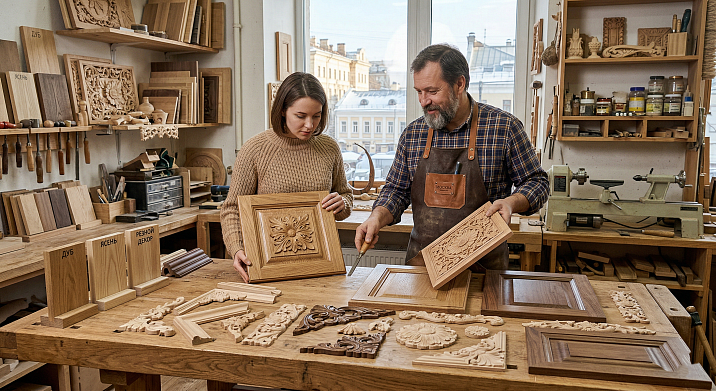
Sometimes one detail is enough to change everything. An ordinary cabinet door — and the same door with a wooden carved overlay in the center and a molding frame around the perimeter. The difference is not in the construction. The difference is in the image, in the message, in the feeling of quality. It is precisely for this difference that people come here.
Buy wooden furniture overlays in MoscowToday — it's not just a transaction. It's a decision that requires understanding: what to choose, how to combine, for which facade, in what style, with what relief, from what type of wood. This is exactly what the entire article is about. Honestly, specifically, without fluff.




What are wooden furniture overlays and where are they used




Essence and purpose
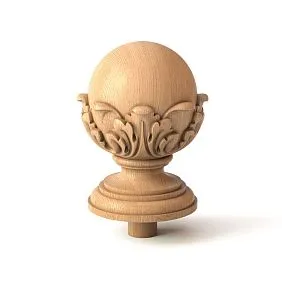
A decorative overlay is a three-dimensional element made of solid wood with a relief ornament, which is attached to the surface of a furniture facade, door, panel, or drawer. It does not bear any structural load. Its only task is to form a visual image. This is not an easy task, and it is performed with millimeter precision.
Such overlays are produced by milling on CNC machines followed by machine or manual sanding. The material is solid beech or oak, kiln-dried, with a furniture moisture content of 8 ± 2%. This is fundamental: proper moisture content prevents cracking and deformation after installation.
inSTAVROS wooden overlay catalog— over 400 models. Central and corner elements, symmetrical and asymmetrical pieces, ornamental panels, constructor overlays, tips with recesses for molding. Price range — from 920 rubles for a small element to 31,540 rubles for a full facade decor set.
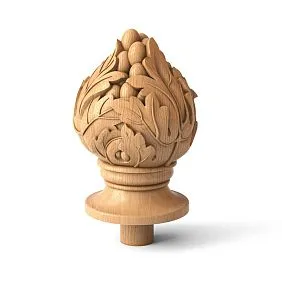
Our factory also produces:





Where wooden overlays are used
The scope of application is broader than commonly thought:
-
Furniture facades — cabinets, dressers, display cases, sideboards, cabinets
-
Kitchen sets — upper and lower cabinet facades
-
Interior doors — overlay decor on door panels
-
Wall panels — decorating panel systems in classic interiors
-
Stairs — overlays on balusters, stringers, decorative posts
-
Ceiling elements — in combination with rosettes and molding systems
However, the main and most in-demand application area is precisely furniture fronts. A wardrobe in the bedroom, a chest of drawers in the living room, a sideboard in the dining room, a kitchen set with classic doors — everywhere, a wooden overlay creates something that no other material can provide.
Get Consultation
Why wood, and not polyurethane or MDF?
This question is logical. The market has polyurethane overlays, MDF imitations, plastic analogs. They are cheaper. Sometimes they look similar. But the difference is fundamental.
Wood is painted and varnished to match the furniture front in a single tone. When the front and the overlay are the same material, the paint applies without a 'seam'. Two different materials under paint will always show a visible boundary after several years of use — as temperature and humidity change, they expand differently.
Wood can be restored. It can be sanded, repainted, scratches can be removed, the tone can be changed — as many times as needed. A polyurethane overlay, if mechanically damaged, is replaced entirely.
Wood holds deep carving. MDF crumbles on the sharp edges of an ornament. Polyurethane cannot reproduce fine undercutting. Solid oak holds relief with surgical precision for decades.
Wood is a status symbol. A natural material in an interior needs no explanation.
What wooden furniture overlays can be bought in Moscow?
Overlays for fronts: the main category
Front overlays are the main assortment in the category of wooden furniture decor. They are divided into several functional types.
Central overlays. Placed in the geometric center of the door or front panel as the main decorative accent. Sizes range from small 8–10 cm to large ornamental elements 30–40 cm. Ornamental motifs: acanthus leaves, floral garlands, rocaille, cartouches, shells, heraldic themes.
Models N-095, N-276, N-421, N-420 from the STAVROS catalog are precisely central large overlays with deep relief for representative fronts of cabinets, showcases, and buffets.
Corner overlays. Special L-shaped elements for corner positions of molding frames. They cover the joint of two profiles and add an ornamental accent to the corners. Used in a set with molding — four corner elements complete the frame system of the door.
Symmetrical paired overlays. Produced in a mirrored version: right and left. Placed symmetrically relative to the central axis of the front — they create a sense of rhythm and order. A wide selection of models with mirror imaging is presented in the STAVROS catalog under the 'mirror pair' filter.
Constructor overlays. Modular elements with joining recesses for connection with molding profiles. Tips with a recess matching the molding cross-section are mounted over the profile — the decor integrates into the molding system without a visible joint.
Overlays for cabinets
The cabinet is the largest piece of furniture in the interior; its front sets the tone for the entire space. Wooden overlays for cabinet fronts are chosen considering the height and width of the doors.
For a cabinet with doors 40–60 cm wide: central overlay 8–12 cm, molding frame around the perimeter, corner elements. For wide cabinet doors 70–90 cm: large central element 14–18 cm or a rosette in the center plus a frame system. For wardrobes and sliding-door cabinets: decorative inserts in horizontal belts.
A cabinet with fully elaborated fronts — molding, overlays, corner elements, decorative cornice on top — is no longer just a cabinet. It is an item with architectural elaboration.
Overlays for dressers and nightstands
The chest of drawers works differently: several horizontal drawers, each with its own plane. Here the overlay is a tool for creating rhythm.
The same wooden overlay on each drawer—strictly centered, one size, one pattern—turns a set of drawers into a system. No more, no less.
For medium-sized chests (drawer width 35–55 cm), horizontal overlays of 7–10 cm are suitable—for example, models N-093, N-316, N-171 from the catalog.STAVROSSmall, with floral or mixed patterns, they provide exactly the measure of decorativeness appropriate for a chest of drawers—without excess.
Bedside tables, TV stands, hallway cabinets—here the overlays are even smaller: 4–7 cm. One element. One accent. That's enough.
Overlays for kitchen furniture
The kitchen is a special environment. Humidity, temperature fluctuations, grease vapors. Wooden decor is used here, but only from properly prepared material.
Key condition: solid wood with furniture moisture content of 8 ± 2%—exactly the kind used in STAVROS production. After installation, the overlay and facade are coated with several layers of water-resistant varnish.
For kitchen facades in classic style: molding frames on each cabinet, small overlays on central facades, decorative cornice along the upper perimeter of the set. This is a three-part system that turns a kitchen set from 'storage furniture' into an architectural element of the kitchen.
Decorative elements for doors and furniture panels
The furniture door is the most 'functional' part of the facade. It is opened and closed daily, and it is the first thing the eye focuses on when entering the room.
Wooden overlays for doorsare attached using an adhesive method—wood glue plus finishing nails for reliability. After painting to match the door's overall tone—no mounting traces remain.
Side furniture panels and backs in open cabinet sections can also be decorated with molding frames or flat overlays to create unity with the facades.
How to choose furniture overlays: 6 main criteria
By purpose: where the overlay is attached
Before choosing an ornament, you need to answer a simple question: where exactly is the overlay going?
-
Center of the facade—the main accent, the most noticeable element
-
Corner of the frame system—a finishing touch, less large, coordinated with the frame
-
Horizontal belt—a rhythmic insert in a molding row
-
Drawer front – a small element proportionate to the plane
-
Decorative insert in a panel – an accent element in a wall or furniture system
Each position has its optimal size and element type. Start the selection with the position – and only then move on to shape and ornament.
By shape: silhouette readability
The shape of the overlay determines its 'silhouette' – how it reads from a distance.
-
Vertical overlays – for narrow, tall fronts, visually elongate the plane
-
Horizontal – for dresser drawers, emphasize the horizontal rhythm
-
Square and round – neutral shapes for central positions
-
Corner (L-shaped) – strictly for corner positions in frame systems
-
Asymmetric – for authorial dynamic compositions
In the STAVROS catalog, filtering by shape allows you to immediately narrow down the selection to the desired type—this saves time when matching to specific furniture.
By ornament: the language of style
Ornament is a language. The right ornament speaks the same language as the furniture style. The wrong one creates conflict.
Main ornamental motifs in the STAVROS assortment:
-
Acanthus—a classic plant motif, laconic and status-enhancing. For Empire, Neoclassical, strict classic styles.
-
Floral garlands—lush, decorative, rich. For Baroque, Rococo.
-
Rocaille and cartouche—elegant asymmetrical motifs. For Rococo, French classic styles.
-
Geometric ornament—meander, rhombic grids. For Empire, Neoclassical styles.
-
Author's collection 'Summer Garden'—Baroque carving with plant motifs in a modern interpretation. For kitchen furniture, cabinets, door structures.
Filtering by ornament in the overlay catalog allows you to select elements by artistic motif—convenient when working with a specific interior style.
By furniture style: matching principle
The style of the overlay and the style of the furniture must match — this is not a rule of good taste, it's a law of visual perception.
| Furniture style | Suitable ornament | Relief character |
|---|---|---|
| Baroque | Acanthus, garlands, cartouches | Deep, lush |
| Rococo | Rocaille, flowers, asymmetry | Light, airy |
| Empire | Acanthus, geometry, symmetry | Clear, strict |
| Neoclassical | Moderate floral motifs | Restrained |
| Provence, country | Simple plant motifs | Soft, flat |
If the furniture style is not obvious, focus on the hardware. Baroque handles require Baroque overlays. Simple bracket handles require restrained flat elements.
By size: the rule of proportionality
Size is about proportion. An overlay does not exist separately from the facade: it is part of the plane, and its size must be in the correct ratio with that plane.
Practical rule: the central element occupies 20–30% of the facade width.
-
Facade 25–35 cm → overlay 5–9 cm
-
Front 40–55 cm → overlay 8–14 cm
-
Front 60–80 cm → overlay 12–20 cm
-
Front 80–100 cm and more → overlay 16–25 cm or composite system
Deviation towards "smaller" — the overlay gets lost. Towards "larger" — it overwhelms the front. The golden mean is exactly within this range.
By material and processing quality
These are two separate decisions made independently. Details — in the next section.
Oak or beech, under enamel or under tinting: how to choose the material
The STAVROS production facility works exclusively with kiln-dried beech and oak solid wood. No MDF in the overlays — only natural wood with 8 ± 2% moisture content. This isconfirmed on the page about materials and quality.
Oak: density and durability
Oak is a hard wood with a pronounced, coarse texture. Dense, heavy, and resistant to mechanical stress. Its natural color ranges from light brown to golden ochre.
Oak is chosen:
-
When furniture is planned for tinting while preserving the wood grain
-
When a pronounced 'masculine' heaviness and solidity of decor is desired
-
For studies, libraries, dark living rooms
-
For rich classic and Empire styles with deep relief
Beech: uniformity and versatility
Beech has a finer texture, is dense and uniform. Lighter than oak, with a neutral grain. It takes paint and enamel excellently, resulting in a smooth and even surface.
Beech is chosen:
-
For painted furniture under enamel (white, ivory, gray)
-
For neoclassical and Provence styles with dense coloring
-
When color uniformity across the entire surface is important
-
For kitchen furniture with dense paint coating
Blank for enamel
In the production of blanks 'for enamel', lamellas are glued together without color or texture matching. Tonal differences between lamellas, 'live' knots, and areas with eliminated defects are possible. These features are completely hidden under a dense coating — enamel or opaque varnish. Cost — lower. This choice is justified if the furniture is painted in a solid color.
Blank for tinting
In the production of blanks 'for tinting', lamellas are selected by color and texture. Only minor tonal differences are allowed, 'live' knots with a diameter of no more than 7 mm per 1 dm². Defects and sapwood are not allowed. This blank is intended for transparent or semi-transparent finishing, where the wood grain remains visible.
Important note from STAVROS: wood is a living material, and products even from the same batch 'for tinting' may have tonal differences between them. To achieve a uniform color, the company recommends using tinting, not clear varnish.
Standard or Prestige: two levels of surface treatment
This is a choice between price and the quality of the finish.
'Standard' — milling and machine sanding. The presence of milling marks, minor roughness, and fuzz on up to 15% of the surface is acceptable. Minor defects are eliminated with putty. The optimal choice for subsequent primer application and solid color painting.
"Prestige" — milling, machine grinding, and detailed manual grinding of hard-to-reach areas. Milling marks and fuzz — no more than 3% of the surface. The surface is completely ready for finishing without additional preparation. The choice for premium furniture under transparent or semi-transparent finish.
All this is described in detail on the page "Materials and Product Quality" — there you can also understand the differences before placing an order.
How to choose decorative overlays for a specific piece of furniture
For a wardrobe: facade architecture
A wardrobe requires a systematic approach. An arbitrary overlay on a wardrobe door without a molding frame and corner elements looks like a 'sticker,' not like decor. A wardrobe requires a full decorative system.
Basic scheme: molding frame around the door perimeter + central overlay + corner elements at frame intersections. For tall wardrobes: add a decorative cornice on top and, if necessary, a dividing horizontal molding belt.
All elements are from one collection. This is fundamental. Different collections on one wardrobe create a sense of randomness.
For a chest of drawers: the law of rhythm
Repetition is the main principle of chest decoration. One overlay on each drawer. Same type. Same size. Same ornament. Strictly in the center of each drawer.
This may seem too strict—but it is precisely discipline that creates aesthetics. A chest of drawers with identical wooden overlays on each drawer is furniture with character. A chest of drawers with different overlays is disorder in wooden decor.
For a cabinet: one delicate element
A cabinet is a small piece. One small wooden element in the center of the door. Size: 4–7 cm. Ornament: in the style of the nearby large furniture. No molding if the door is small—the overlay looks appropriate even without it.
For a kitchen facade: a system of three elements
Molding frame + a small overlay in the center of each facade + a decorative cornice along the upper perimeter of the unit. This three-part system completely transforms a kitchen unit. Mandatory condition: reliable coating with waterproof varnish.
For doors and wall panels
On a door leaf, the overlay works the same as on a furniture facade: a molding frame + a central accent. For wall panels—molding frames creating a cellular structure, with overlays in the center of each cell. This is a classic solution for formal halls, studies, libraries.
How to avoid mistakes when buying wooden overlays for furniture
Practice shows: most unsuccessful results are the consequence of several predictable errors.
Buying a facade without measurements
The first and most common. A person sees a beautiful overlay in the catalog, orders it—and receives an element that either gets lost on a large facade or 'overwhelms' a small door. Measurement is mandatory before choosing a model.
Choosing overly large decor
A large overlay on a small facade is not a sign of 'decorative richness.' It is a violation of proportion that ruins the image. The overlay should occupy 20–30% of the facade width—no more.
Mixing incompatible ornaments
A Baroque overlay and a corner element from a neoclassical series. A floral central overlay and a geometric molding. These are two different languages. They do not complement—they argue. Everything should be from one collection.
Ignoring the finishing method
An overlay 'for tinting' on furniture with dense enamel paint—unnecessary expenses without visible results. An overlay 'for enamel' with a transparent finish—noticeable tonal spots between the slats. The type of blank must match the method of final finishing of the furniture.
Not checking availability in Moscow
If you need to receive an order quickly—clarify availability at the warehouse in Moscow during selection. The STAVROS catalog has a filter for availability in Moscow: this eliminates the situation where the desired model turns out to be 'only available to order.'
Where to buy wooden furniture overlays in Moscow
Catalog with filters for any task
STAVROS wooden overlays catalog— this is over 400 models with detailed filtering:
-
By product type (central, corner, sets)
-
By collection (including the author's 'Summer Garden')
-
By shape (straight, corner, round, asymmetrical)
-
By ornament (acanthus, floral, geometric, rocaille, cartouche)
-
By availability in Moscow
Purchase is possible from one item — no minimum order volume.
Pickup from the warehouse in Moscow
If the item is in stock, pickup in Moscow is available. Order pickup conditions, payment methods, and current delivery information are provided on the page"Payment and Delivery".
Showroom in Moscow
STAVROS has a Moscow showroom where you can evaluate products in person: see the actual relief, tactilely feel the material, compare the quality of "Standard" and "Prestige" finishes, and select elements to match your furniture samples.
Address of the Moscow showroom: Volokolamskoye Highway, 3. Contacts, working hours, and directions are on the page"Contacts. Moscow".
Phone and consultation
Orders can be placed through the online store's shopping cart or by phone at 8-800-555-46-75 (toll-free). Managers will help you select overlays for specific facades, calculate the number of elements, and guide you on the type of blank and quality of finish.
Why it's more convenient to select wooden furniture decor from the catalog
Working with the STAVROS catalog offers several practical advantages that are not obvious when buying in a regular store.
Filtering by shape and ornament allows you to immediately eliminate irrelevant models and work only with those that match the desired style.
The filter for availability in Moscow is especially valuable for urgent projects. You see only what can be picked up or received quickly, without waiting for production.
Viewing products by collections helps you immediately see compatible elements—overlays, rosettes, moldings from the same stylistic family. This eliminates the mistake of mismatched parts.
Purchasing from one item removes minimum order restrictions—important for spot replacements or restoration work where one specific element is needed.
Checklist before purchasing wooden overlays
-
For which furniture are overlays needed: wardrobe, chest of drawers, cabinet, kitchen, door?
-
What are the dimensions of the fronts—width and height of each decorated plane?
-
One element or a system—only a central overlay or in combination with molding and corner elements?
-
What is the style of the furniture—Baroque, Empire, Neoclassical, Provence?
-
How will the furniture be finished — enamel, tinting, clear varnish?
-
Oak or beech — with preserved texture or for solid painting?
-
Standard or Prestige — regular machine or additional manual sanding?
-
Is the required item in stock in Moscow — check the filter in the catalog?
Table: types of wooden overlays and their application
| Overlay Type | For which furniture | Visual effect | When to choose |
|---|---|---|---|
| Central carved | Cabinet, showcase, sideboard | Main accent of the facade | One expressive element |
| Corner overlay | Any furniture with a molding frame | Completion of system corners | Always paired with molding |
| Horizontal | Chest of drawers, drawers | Rhythm of repetition | Same for each drawer |
| Symmetrical paired | Wide cabinet fronts | Symmetry and order | Mirrored along the central axis |
| Overlay-constructor | Any furniture with molding | Profile Integration | When a Seamless System is Needed |
| Decorative set | Full Cabinet or Showcase Front | Integrated decorative system | For Complete Front Design |
FAQ: Answers to popular questions
Which Wooden Overlays Are Best to Buy for Fronts?
The choice depends on the furniture style and front size. For classic — floral or acanthus overlays with moderate or deep relief. For neoclassical — restrained geometric or mixed motifs. Start by defining the style — this immediately narrows the choice to the right series.
Are Overlays Suitable for Both a Wardrobe and a Dresser?
Yes, but with scale observance. Overlays for the wardrobe — larger, for the dresser — smaller. At the same time, the ornamental motif should match — both pieces in the same space should speak the same decorative language.
What's Better to Choose: Oak or Beech?
Oak — for tinting while preserving texture, rich classic style, dark interiors. Beech — for painted furniture under enamel, neoclassical, light and neutral color solutions.
Which overlays are suitable for enamel painting?
Beech blanks 'for enamel' are the optimal choice. More affordable in price, they sand well and accept dense paint without visible structural defects. The 'Standard' processing quality is sufficient here.
Can I buy wooden overlays with pickup in Moscow?
Yes. If the product is in stock, pickup in Moscow is available. Conditions on the page"Payment and Delivery".
How to choose the overlay size for the facade?
The central element is 20–30% of the facade width. Measure the door, multiply the width by 0.25 — this is the approximate optimal size. The molding frame is set back from the edge of the facade by 2–5 cm on each side.
Are wooden overlays suitable for furniture restoration?
This is the perfect material for restoration. Wood behaves identically to original wooden furniture parts during sanding, painting, and patination. The STAVROS range features historical ornamental motifs — acanthus, rocaille, cartouches, garlands — characteristic of 18th–19th century furniture.
How to combine overlays with other wooden decorative elements?
Overlays combine withwooden rosettes, moldingsandwith matching legsfrom one collection. The principle of unity: one ornamental motif, one relief depth, one finish. Then the furniture reads as a system, not as a set of parts.
Does the company have a showroom in Moscow?
Yes. The STAVROS showroom is located at: Volokolamskoye Highway, 3. There you can see the products in person, evaluate the quality of finishing, and select elements to match samples of your furniture. Contacts and working hours are on the page."Contacts. Moscow".
How to place an order for wooden furniture decor?
Through the shopping cart on the stavros.ru online store or by free phone 8-800-555-46-75. Orders are possible from a single item. A manager will help select elements for your specific task.
Conclusion
Wooden overlays for furniture are a category where the quality of the solution is determined not by a separately chosen element, but by the system: the right size, the right ornament, the right material, the right position on the facade. When all this aligns—the furniture changes. Not 'improves a little,' but changes fundamentally—in image, in perception, in status within the interior.
Buy decorative wooden overlays for furniture in Moscowtoday—it's accessible, specific, and practical. There's a catalog with filters, a warehouse in Moscow with pickup, a showroom where you can see everything in person. All that's left is to decide—what image your furniture should have.
STAVROS produces wooden decor for furniture and interiors with its own CNC production and multi-stage quality control. Solid oak and beech from chamber drying. Over 400 models of decorative overlays. Two levels of finishing quality—Standard and Prestige. Two types of blanks—for enamel and for tinting. Orders from a single item. Pickup from the warehouse in Moscow. Showroom: Volokolamskoye Highway, 3. Delivery across all of Russia.
STAVROS—when decor and furniture become one whole.