Article Contents:
- 1. Introduction: why wood continues to lead
- 2.1. Ecological safety and reliability
- 2.2. Strength and durability
- 2.3. Aesthetics and uniqueness
- 2.4. Stylistic versatility
- 4.1. Reputation and experience
- 4.2. Certification and standards
- 4.3. Product range and customization options
- 4.4. Logistics and warranties
- 5.1. Drying solid wood
- 5.2. Sorting and cutting
- 5.3. Frame assembly
- 5.4. Sanding and final finishing
- 6.1. Headboard frame beds
- 6.2. Lift mechanism
- 6.3. Bed models without footboard
- 6.4. Panel and slatted beds
- 8.1. Individual approach
- 8.2. Transparency and openness
- 8.3. Warranty service and repairs
- 9.1. Proper assembly
- 9.2. Microclimate consideration
- 9.3. Mattress selection
- Example 1: Classic interior in a country house
- Example 2: Modern studio in Scandinavian style
- Example 3: Bed with lift mechanism in an urban apartment
- 14. Conclusion: making a thoughtful choice for years to come


1. Introduction: why wood continues to lead
In a rapidly changing world, where modern materials and technologies dominate the market, natural wood retains its high status and appeal, especially in such an important piece of furniture as a bed. Demand forsolid wood beds from the manufacturer is steadily growing. People are looking not only for reliability and eco-friendliness, but also for durability combined with natural beauty.
Why do many choose solid wood furniture? The reasons are simple: natural wood grain pattern, restoration possibilities, warm tactile feel, absence of toxic emissions, and distinct individuality of each piece. However, of course, to obtain all these advantages, it is necessary to choose a good manufacturer who is responsible for the quality of raw materials and manufacturing technologies.




Our factory also produces:


2. Advantages of solid wood beds
Get Consultation
2.1. Ecological safety and health
Wood is a natural material; provided it is properly processed and dried, it contains no harmful substances. If the manufacturer uses non-toxic adhesives and finishes (water-based varnishes, oils, wax), such a bed will not emit toxic vapors and is suitable even for allergy sufferers and children.
2.2. Durability and Longevity
Beds made from solid wood can last for decades thanks to the natural properties of wood and special assembly methods. In case of minor defects (scratches, chips), the item can be sanded and re-coated with a finishing compound, restoring its original appearance.
2.3. Aesthetics and uniqueness
The natural texture and pattern of growth rings give solid wood beds a unique character. Unlike series-produced furniture made of particleboard or MDF, each wooden bed has its own 'soul,' since there are no two identical pieces of wood. It is precisely this that creates a warm and cozy atmosphere in the bedroom.
2.4. Stylistic versatility
Natural wood easily fits into any interior style: classic, modern, Scandinavian, vintage, eco, Provence. You can choose the wood species, shades, and shapes to ensure the bed harmonizes with your room's design.
3. Wood species: from pine to oak
- Pine, spruce
○ Characteristics: soft structure, pleasant light shade, affordable price.
○ Features: requires careful handling, easily dents and scratches.
- Birch, aspen
○ Characteristics: medium density, even color without sharp transitions.
○ Features: optimal 'middle' solution, often used in quality but affordable furniture.
- Larch
○ Characteristics: increased moisture resistance, noble shade, strength.
○ Features: used where the combination of beauty and high durability is important.
- Beech, ash
○ Characteristics: harder species, expressive texture, good wear resistance.
○ Features: popular among those seeking the 'golden mean' between pine and oak in terms of cost.
- Oak
○ Characteristics: premium species, known for its density and luxurious grain pattern.
○ Features: higher than average price, but impressive durability and aesthetics.
Exotic varieties (palisander, teak, mahogany, etc.) are less common in the Russian market due to high cost and logistical challenges, but they can be chosen for elite projects.
4. 'Solid wood beds from the manufacturer': key selection criteria
4.1. Reputation and experience
Before placing an order, study the company's history, reviews, photos of completed projects, and check for the presence of a showroom or office where you can view samples. Companies with an established reputation value their reputation and ensure consistent quality.
Reliable companies operate in accordance with GOSTs, DIN standards, monitor wood moisture (8–12%), use non-toxic adhesives and hardware. The presence of confirming documentation indicates integrity.
Reliable companies operate in accordance with GOSTs, DIN standards, monitor wood moisture (8–12%), use non-toxic adhesives and hardware. The presence of confirming documentation indicates integrity.
4.3. Assortment and Customization Options
A wide range of wood species, finishes, headboard styles, and mechanical options (e.g., lift mechanism) allows satisfying any style or requirement. Some manufacturers also allow ordering beds to custom dimensions, with additional drawers and other "features."
4.4. Logistics and Warranties
The manufacturer usually provides careful packaging and delivery, minimizing the risk of damage. Pay attention to the warranty period: if the company offers long warranties, it is confident in its product.
5. Production Technology and Its Impact on Quality
5.1. Drying Solid Wood
Optimal moisture level is crucial. Insufficient drying may cause warping and cracking. Excessive drying increases brittleness. A reliable manufacturer, for example, STAVROS, uses kiln drying and monitors moisture levels.
5.2. Sorting and Cutting
At this stage, defective sections with many knots, splits, or mold are removed. As a result, only high-quality boards are used for beds. Then, parts (sides, headboard, legs) are formed according to specified dimensions and design.
5.3. Frame Assembly
Dovetail joints, glued connections, bolts, and decorative plates are used. It is important that each joint withstands load, has no play, and lacks weak spots.
5.4. Sanding and Final Finishing
Essential stages that determine surface smoothness and protection. Applying oils, varnishes, and paints of different gloss levels, shades, and textures (matte, glossy, satin) helps tailor the product to a specific style.
6. Construction Variants and Stylistic Solutions
6.1. Frame Beds with Headboard
Classic variant consisting of headboard, side rails, and footboard (sometimes absent). May include decorative elements (carvings, shaped inserts). Suitable for both traditional and modern interiors.
6.2. Lift Mechanism
Convenient solutions for storing linens or seasonal items. The mechanism may be gas-lift, spring, or manual. Saves space and looks neat.
6.3. Beds Without Footboard
In modern design, footboards are often omitted, creating the impression of an airy frame. This visually expands the space, simplifies access to the bed, and appeals to those who prefer minimalism.
6.4. Panel and Slatted
Instead of solid wood, the headboard (or footboard) may be assembled from slats or panels, adding extra charm and design flexibility. Looks great in classic, country, and retro styles.
7. How to Tell if a Bed Is Professionally Made
- No cracks or unevenness. Try rocking the bed and listen for any squeaks. Check joints — they should fit snugly without gaps.
- Uniform thickness of parts. Glued laminates and beams look uniform, with no visible bumps at connection points.
- Smooth surface. Sanding and finish should not have scratches, lacquer runs, or visible missed areas.
- Uniform wood tone. If it’s one wood species, the shade is relatively even. Minor natural variations are acceptable.
- Quality hardware. Hinges, screws, and feet: all affect usability, absence of squeaks, and adjustability.
8. Features of cooperation with manufacturers
8.1. Individual approach
You can agree on size changes, add drawers or a lifting mechanism, select the right finish. And all this — without unnecessary middleman markup.
8.2. Transparency and openness
In most cases, the manufacturer is happy to show how production is organized, which machines are used, which wood species are available. This builds trust and allows the buyer to understand what they are paying for.
8.3. Warranty service and repair
Direct contact with the company eliminates complex bureaucratic procedures when factory defects are discovered. The manufacturer can send the missing part, offer a discount, or replace the item — which can be difficult in chain stores.
9. Important aspects of assembly and operation
9.1. Correct assembly
Strictly follow the included instructions. Place parts on a flat surface, do not over-tighten screws to avoid damaging the wood; if needed, get help. If the volume or complexity of assembly is large, you can hire professional assemblers.
9.2. Microclimate consideration
Wood does not like sharp fluctuations in humidity and temperature. It is desirable to maintain humidity within 40–60%, which prevents drying out and cracking. Place the bed away from direct heat from radiators.
9.3. Mattress selection
Consider the manufacturer's recommendations regarding weight load and base type (slatted, solid). The mattress should be properly matched to the size and firmness of the frame to ensure comfortable sleep and not overload the slats.
10. Optimal care for solid wood beds
- Regular cleaning: wipe dust with a dry or slightly damp cloth, avoiding abrasives.
- Moisture protection: immediately wipe up any spilled water or liquid. Accumulated moisture may cause swelling.
- Finish refreshment: every 3–5 years (or as needed) you can reapply varnish, oil, or wax to refresh the appearance and extend the service life.
- Minimum exposure to extreme conditions: strong heat or prolonged dampness negatively affects the wood.
11. Modern trends in solid wood bed design
● Minimalism and Scandinavian: simple geometric shapes, light wood tones (birch, beech), no decoration.
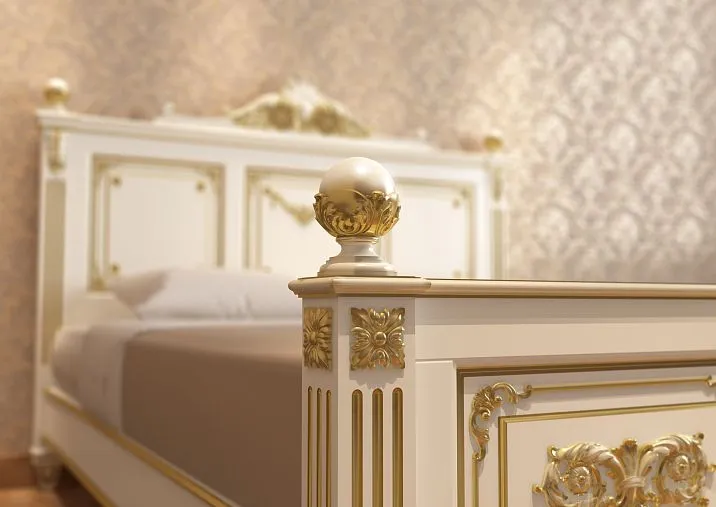
● Classic and vintage: carved headboards, decorative posts, warm stain tones (walnut, cherry, oak).
● Eco and biophilic design: preserving natural edges ("live edge"), using pigment-free oils that highlight the natural texture.
● Loft: combination of solid wood with metal elements. Industrial tone gives the bed a rugged charm.
● Custom solutions: experimental models with built-in shelves, lighting, and combined materials (glass, stone, leather).
12. Examples of successful projects
Example 1: Classic interior in a country house
The client wanted a solid oak bed with a high headboard decorated with neoclassical carving. The manufacturer produced a substantial bed with smooth, curved slats and a dark stain (walnut tone). The couple, who bought this marvel, enjoys not only its luxurious appearance but also the absolute reliability of the construction.
Example 2: Modern studio in Scandinavian style
A young family chose a birch bed with a light matte finish. Minimalist details, thin side slats, rectangular headboard. Combined with white walls and restrained textiles, this bed creates an effect of spaciousness and calm in the room.
Example 3: Bed with a lift mechanism in an urban apartment
For a modest apartment area, every square meter matters, so the manufacturer proposed a model with a lift base and a large internal box. Material — beech, finish — semi-matte lacquer, backrest with restrained carving. As a result, owners received additional storage space for linens and a neat, stylish bed.
13. Purchase recommendations: what questions to ask the manufacturer
- How is the wood drying organized? (Kiln-dried? Controlled humidity?)
- What grade of wood is used? Is it possible to choose 'free of knots' or with minimal defects?
- What is the frame made of and how are the joints constructed?
- What is the final finish? What types of lacquers or oils are used, and how safe and durable are they?
- Is there a warranty and service? How are issues resolved if defects are found or parts need replacement?
- Is it possible to order custom sizes? If your bedroom requires a non-standard width or length, this may be an important factor.
14. Conclusion: a thoughtful choice for years to come
Solution buy a solid wood bed from the manufacturer — is a step toward creating an ideal sleeping space, where comfort, eco-friendliness, and interior individuality are considered. The key is to find a reliable manufacturer who ensures quality raw materials, professional production methods, and customer support throughout the entire purchase process. In the end, you will receive a piece of furniture capable of serving for decades, pleasing the eye, and preserving the natural charm of wood.
Follow our recommendations, don’t hesitate to ask questions and check documentation. Remember, solid wood is a material proven by time, combining traditional craftsmanship with modern technology. And by choosing the right model, you will enjoy peaceful and comfortable rest, confident that you have made the right choice for yourself, your health, and your home.