Article Contents:
- Anatomy of kitchen space: challenges and requirements
- Humidity: the invisible enemy of materials
- Temperature fluctuations: thermal stress
- Contamination: grease, soot, stains
- Mechanical wear: abrasion and impacts
- Wood species for the kitchen: selection criteria
- Oak: monumentality and biostability
- Beech: lightness and workability
- Exotic and coniferous species: specific applications
- Polyurethane in the kitchen: zones of optimal application
- Ceiling decoration: cornices and rosettes
- Wall decoration: moldings and frames
- Furniture decoration: appliqués and pilasters
- Material balance: combination strategy
- Vertical zoning: from floor to ceiling
- Horizontal zoning: from wet to dry zone
- Functional distribution: who does what better
- Installation and protection: technologies of longevity
- Preparation of wooden elements
- Installation taking into account mobility
- Protection during operation
- Installation of polyurethane: simplicity and reliability
- Conclusion: kitchen as a synthesis of beauty and function
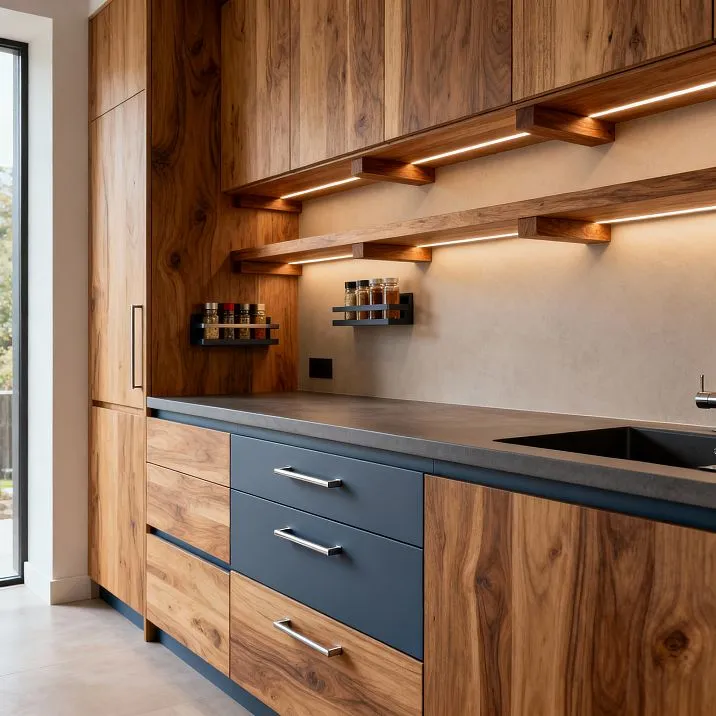
The kitchen is a space where functionality and beauty confront the most severe operating conditions. Humidity from cooking, temperature fluctuations from stoves and ovens, grease vapors, mechanical impacts, intensive daily cleaning — all this creates an extreme environment for finishing materials.Wooden panels for the kitchenandpolyurethane elementsWhen properly combined, they create an interior that not only withstands these tests but preserves beauty and functionality for decades.Oak in the kitchen interiorIt provides strength, wear resistance, and the prestige of natural material. Beech adds lightness, uniformity of texture, and accessibility. Polyurethane takes on high-risk zones — wet areas, ceiling decoration, complex architectural elements. The result is a kitchen where every square centimeter is thought out, every material is in its place, beauty does not contradict practicality.


Anatomy of kitchen space: challenges and requirements
Understanding the specific conditions of the kitchen is critical for selecting finishing materials. What works beautifully in a bedroom or living room may be unacceptable in the kitchen, and vice versa.




Humidity: the invisible enemy of materials
Cooking generates a large amount of water vapor. Boiling water in pots, oven steam, washing dishes, wet cleaning — all this increases kitchen air humidity by 15-30 percent compared to other rooms. With insufficient ventilation, humidity reaches 70-80 percent — a critical level for many materials.
Natural wood is hygroscopic — it absorbs moisture from the air at high humidity, releases it at low humidity. This causes dimensional changes — swelling when moistened, shrinking when drying. An oak panel 100 millimeters wide may change width by 2-3 millimeters when humidity fluctuates from 30 to 70 percent. Beech is even more sensitive — changes reach 3-4 millimeters.
These cyclic changes create stress in the material, may lead to warping, cracking, and joint separation. Wooden elements in the kitchen require especially high-quality protective treatment — multi-layer lacquering, wax-oil with water-repellent properties, special impregnations. Without protection, wood in the kitchen lasts years instead of decades.
Polyurethane is absolutely non-hygroscopic — water absorption coefficient less than 1 percent. Air humidity does not affect dimensions, shape, or properties. A polyurethane cornice, molding, or decorative element in the kitchen behaves the same as in a dry room. This makes polyurethane ideal for zones near sinks, stoves, where steam concentration is highest.
Our factory also produces:


Temperature fluctuations: thermal stress
The kitchen is a room with the greatest temperature variation. A working stove reaches 50-70 degrees, a refrigerator 15-18 degrees, a window in winter may be 10-12 degrees. A temperature difference of 40-60 degrees within one room creates thermal stress in materials.
Wood expands when heated, contracts when cooled. The coefficient of thermal expansion of wood across fibers is 30-60 microns per meter per degree — relatively high. A 2-meter-long wooden panel expands by 2-4 millimeters when heated by 30 degrees. With rigid mounting, this creates internal stresses and possible deformations.
Placing wooden elements away from heat sources — a rule for the kitchen. Wooden panels, backsplashes, and trim should not directly abut the stove or oven. Minimum distance 30-50 centimeters, preferably with an insulating barrier. Wooden furniture is placed away from heating radiators.
Polyurethane is thermally stable in the range from minus 50 to plus 80 degrees — household kitchen temperatures do not create problems. The coefficient of thermal expansion of polyurethane is lower than that of wood. Polyurethane decor near the ceiling, where warm air accumulates, or above the stove at a safe height does not deform and retains its shape for decades.
Get Consultation
Contamination: grease, soot, stains
Cooking, especially frying, generates grease vapors that settle on all kitchen surfaces. A thin grease film covers walls, ceiling, and furniture within 2-3 meters of the stove. Grease attracts dust and soot, forming stubborn stains. Spills from cooking and accidental food stains add to the picture.
Natural wood, especially with porous surfaces, absorbs grease stains. Oil or wax finishes partially protect but do not fully prevent this. Wooden surfaces near the stove require frequent washing with degreasing agents, which gradually degrade the protective coating. Lacquered wood is easier to maintain, but the lacquer gradually dulls from aggressive chemicals.
Placing wooden elements in low-contamination zones — a survival strategy. Wooden panels on the wall opposite or beside the stove get less dirty than directly behind the stove. Wooden furniture away from the work zone remains cleaner longer. The backsplash area behind the stove — a territory of ceramic, glass, stainless steel, maximally resistant to contamination and aggressive cleaning.
Polyurethane does not absorb contaminants — its smooth, non-porous surface repels grease. Contaminants remain on the surface and are easily removed with a damp cloth and any cleaning agent. Polyurethane cornices, moldings, and decorative elements in the kitchen are as easy to clean as ceramic tiles. Colored surfaces do not dull or yellow from grease deposits.
Mechanical wear: abrasion and impacts
The kitchen is a space of intensive activity. Constant movement, opening and closing cabinets, pulling out drawers, moving objects create mechanical impacts on all elements. Baseboards receive impacts from mops, vacuum cleaners, and accidentally dropped items. Furniture facades are abraded by countless hand touches.
Wood hardness determines resistance to abrasion. Oak with hardness 3.7-4.0 on the Brinell scale withstands intensive use, preserving edge clarity and profile sharpness. An oak baseboard in the kitchen after 10 years looks almost new. Beech with hardness 3.5-3.8 is also sufficiently hard, though slightly less than oak. Soft species — pine, spruce — wear out quickly on the kitchen and lose appearance.
Polyurethane has moderate hardness — sufficient for decorative elements but less than hard wood species. A polyurethane baseboard is less resistant to scratches and dents compared to oak. However, for elements located above risk zones — cornices, moldings, ceiling decor — hardness is not critical. Random mechanical impacts on them are unlikely.
Repairability varies. Wooden elements are sanded and re-coated upon damage. A deep scratch on an oak baseboard is removed by local sanding and re-finishing. A polyurethane element with significant damage usually requires replacement — local repair is possible with putty and touch-up, but the quality is inferior to factory finish.
Wood species for the kitchen: selection criteria
Not all wood species are equally suitable for use in the kitchen. Biostability, hardness, dimensional stability, and aesthetics determine suitability. Oak and beech — optimal choice based on combined properties.
Oak: monumentality and biostability
Oak in the kitchen interior— a traditional solution, proven over centuries. High tannin content (6-8 percent) creates natural protection against rot, mold, and fungi. Even under humid kitchen conditions, oak elements are not attacked by biological agents with minimal protective treatment.
Oak hardness of 3.7-4.0 on the Brinell scale ensures resistance to mechanical impacts. Oak furniture facades withstand daily opening and closing for decades without losing edge clarity. Oak baseboards do not wear from constant contact with mops. Oak countertops, treated with kitchen surface oil, serve as work surfaces, enduring food preparation.
Oak's expressive texture — large vessels creating contrasting dark stripes on a light background — transforms utilitarian elements into decorative accents. Oak furniture does not require additional decoration — the texture itself creates visual interest. Natural golden-brown oak color is warm, cozy, and fits most kitchen color schemes.
Oak's dimensional stability is relatively high for wood — after proper drying and correct finishing, its hygroscopicity is lower than other hardwoods due to tannins partially blocking pores. Oak elements in the kitchen are less prone to warping with humidity fluctuations compared to beech or ash.
Oak's color evolution — gradual darkening, acquiring a noble patina — is perceived as a plus. An oak kitchen after 10 years becomes darker, richer, nobler. This natural aging adds character, transforming the kitchen into a space with history. Unlike materials that degrade over time, oak improves with age.
Application of oak in the kitchen: furniture facades, baseboards, door trim, decorative panels on walls away from stove and sink, countertops, shelves, railings. Everything that requires hardness, longevity, and prestigious appearance. Avoid: backsplash directly behind the stove (too aggressive environment), ceiling decor (excessive cost for elements where oak's advantages are not critical).
Beech: lightness and workability
Beech in the kitchen — choice for those who appreciate light tones, uniform texture, and the ability to create bent elements. Beech density (710-730 kg/m³) is even higher than oak, hardness 3.5-3.8 is sufficient for most applications. Natural beech color — pinkish-yellow — is lighter than oak, creating a sense of airiness and visual expansion of space — important for compact kitchens.
Beech's uniform texture — diffuse-porous structure without large contrasting elements — creates a calm visual background. A kitchen with beech furniture is not overloaded with textural accents, the eye does not encounter contrasts. For modern and Scandinavian kitchens, where clean lines are valued, beech is preferable to oak.
Beech's ability to bend after steaming allows creating curved elements without joints — curved facades, radius shelves, bent handles. Classic Viennese chairs made of bent beech — traditional choice for dining area on the kitchen. Oak bends worse and often cracks at sharp radii.
Beech's drawback — higher hygroscopicity compared to oak, absence of tannins providing bioprotection. Beech in the kitchen requires more careful protective treatment — multi-layer lacquering or special oils with water-repellent and antiseptic additives. With proper protection, it lasts as long as oak.
Beech's coloring is uniform due to its homogeneous structure — any shade applies predictably. Beech furniture, colored in white, light gray, pastel tones while preserving visible texture — popular solution for modern kitchens. Oak colors less uniformly due to different absorption rates of large vessels and dense wood between them.
Application of beech in the kitchen: furniture facades (especially painted or bent), dining chairs and stools, decorative panels, shelves, railings, baseboards (provided quality protection). Avoid the same zones as for oak — direct proximity to moisture and heat sources, backsplash behind the stove.
Exotic and coniferous species: specific applications
Teak, merbau, and iroko are exotic species with high natural oil content, creating a water-repellent, biostable surface. Teak is traditionally used in shipbuilding due to its absolute water resistance. In the kitchen, exotic species are optimal for countertops where contact with water is inevitable. The cost, 3-5 times higher than oak, limits their use to critical zones.
Larch, among coniferous species, stands out for its high density (660-700 kg/m³), hardness, and biostability due to resin content. Larch on the kitchen is a budget alternative to oak for skirting boards, architraves, and some furniture elements. The texture with contrasting growth rings is expressive, natural color ranging from yellowish-brown to reddish. The drawback is resin content, requiring special treatment before finishing, otherwise resin may exude.
Spruce and pine are too soft for intensive kitchen use. Hardness of 2.0-2.5 on Brinell scale means rapid wear and dents from impacts. Use is limited to decorative elements outside risk zones — ceiling beams, high shelves. The cost, 2-3 times lower than oak, is attractive for budget projects, but savings result in rapid loss of appearance.
Polyurethane on the kitchen: zones of optimal application
polyurethane elementsOn the kitchen, they take on functions where their properties are critical — water resistance, lightness, ease of maintenance, accessibility of complex shapes.Kitchen decorMade from polyurethane, it creates architectural expressiveness with minimal operational requirements.
Ceiling decor: cornices and rosettes
Kitchen ceiling is a zone of accumulation of warm, humid air and grease vapors. Wooden cornice here quickly gets dirty, requires frequent washing, which damages the finish. Weight of wooden cornice creates load on fasteners, requiring strong fixation.Polyurethane moldingWeight of 1.5-2 kg per linear meter is glued with ordinary construction adhesive, does not create load.
Water resistance of polyurethane is critical for kitchen ceiling decor. Condensation settling on the ceiling during intensive food preparation does not absorb into polyurethane, easily wipes off. Wood absorbs moisture, may swell, deform, and develop mold under insufficient ventilation.
Painted polyurethane cornice can be washed with any means, does not lose color, does not dull. Grease deposits are removed with degreasers without damaging the surface. For a kitchen requiring frequent cleaning, this is critical. Wooden cornice under aggressive chemical cleaning loses varnish gloss, dulls, requires periodic finish renewal.
Cornice width on the kitchen is usually medium 10-15 cm — sufficient for architectural expressiveness, but not overloading relatively low ceilings of standard kitchens (2.5-2.7 meters). Profile ranges from simple for modern kitchens to medium complexity for classic. Excessively ornate cornices on the kitchen are inappropriate — practicality is more important than decorative appeal.
Rosette around ceiling light fixture — functional and decorative element. Functionally hides wiring, creates finished look of the fixture. Decoratively adds elegance. Diameter 40-60 cm is optimal for kitchens. Polyurethane rosette weighs 200-500 grams, glued to ceiling in minutes, cleaned together with ceiling.
Wall decor: moldings and frames
Kitchen walls are partially occupied by furniture and backsplash, but remain areas requiring decorative treatment. Polyurethane moldings create frames, borders, divisions, transforming walls into an organized composition. Wall above dining zone, free of furniture, receives molding frame, inside which contrasting paint, wallpaper, or paneling.
Horizontal molding at 100-120 cm height around kitchen perimeter separates lower zone (often occupied by furniture, backsplash) from upper (painted or wallpapered). This molding becomes a visual boundary, structuring vertical space, creating classic three-part division. Molding width 6-8 cm is sufficient for visibility without bulkiness.
Polyurethane molding around door frame wider than standardwooden architravesCreates accent, grandeur. Door from kitchen to dining or living room (in studio apartments) receives solid polyurethane framing 10-12 cm wide with classic profile. Above door, horizontal element — pediment or cartouche — enhances accent.
Water resistance of polyurethane wall elements allows placing them on any kitchen wall without concerns. Molding near sink, regularly getting splashes, does not deform, easily wipes off. Wooden molding under such conditions requires water-resistant varnish, still serves less.
Furniture decor: appliqués and pilasters
Kitchen furniture from MDF or particleboard with painted facades gains decorative appeal through polyurethane appliqués. Simple flat facade transforms into classic with polyurethane frame imitating lath. Central rosette on facade adds elegance. Corner appliqués create accents.
Weight of polyurethane appliqués 30-100 grams does not create load on facade, glued with ordinary construction adhesive. Wooden appliqués weighing 200-500 grams require mechanical fastening with screws, which may split thin MDF. For budget furniture, polyurethane decor is the only option to gain decorative appeal without risk of damaging the base.
Water resistance of polyurethane is critical for kitchen furniture. Facades near sink and stove regularly exposed to moisture, steam. Polyurethane appliqués do not swell, do not peel off, retain shape. Wooden appliqués in humid conditions may deform, create gaps with base.
Maintenance of kitchen furniture with polyurethane decor is simple — wiping with damp cloth and ordinary cleaning agent. Grease deposits do not absorb, wipe off without trace. Painted surface retains freshness for years. For a kitchen requiring frequent intensive cleaning, this is a significant advantage.
Polyurethane pilasters at kitchen cabinet corners, columns, framing refrigerator or oven, create architectural organization, classic grandeur. Pilaster height 60-80 cm (from countertop to top of wall cabinets) creates vertical rhythm, structures facade. Base and capital of pilaster from polyurethane are light, easily glued, do not create overload.
Material balance: combination strategy
Successful kitchen with wood and polyurethane requires thoughtful material distribution by functional zones, heights, visual significance. Material by place principle here works imperatively — mistakes cost dearly literally and figuratively.
Vertical zoning: from floor to ceiling
Lower tier (floor - 80 cm) — zone of maximum mechanical damage risk, but relatively dry if no leaks. Oak skirting board 10-12 cm high creates strong base. Lower kitchen furniture facades (base cabinets) from solid oak or beech or MDF veneered, with polyurethane appliqués for decor. End walls of cabinets, visible facades — wood, back and side walls — MDF. Economical without loss of visual quality.
Middle tier (80-160 cm) — working zone, backsplash, part of wall between countertop and wall cabinets. Backsplash directly behind stove and sink — ceramic, glass, stainless steel. Backsplash areas away from stove may be wooden panels provided with water-resistant treatment. Wall cabinets with wooden or veneered facades, polyurethane decor. Free wall areas — painted or with polyurethane molding frames.
Upper tier (above 160 cm to ceiling) — zone of accumulation of humid air, grease vapors, minimal mechanical impact. Top of wall cabinets with polyurethane cornice, creating finish, hiding gap to ceiling. Walls to ceiling painted or wallpapered, possible polyurethane moldings. Perimeter ceiling polyurethane cornice, polyurethane rosette around light fixture. Wood is absent here — neither functionally nor aesthetically necessary.
Horizontal zoning: from wet to dry zone
Wet zone (sink, dishwasher) — maximum humidity, splashes, contact with water. Backsplash — ceramic, glass. Countertop — artificial stone, quartz aggregate, stainless steel. Cabinet facades under sink — water-resistant MDF with multi-layer paint or film. Polyurethane decor acceptable, wood minimal or absent. Skirting board polyurethane or water-resistant MDF.
Preparation zone (stove, oven, cutting board) — high temperature, grease vapors, intensive cleaning. Backsplash behind stove — ceramic, glass, stainless steel with heat resistance. Countertop — artificial stone, possible end cutting board from oak for occasional use. Cabinet facades — MDF with heat-resistant paint. Polyurethane decor on facades acceptable, wood on facades permissible if at least 30+ cm away from stove.
Storage zone (refrigerator, cabinets, pantry) — moderate humidity, minimal contamination, rare mechanical impact. Cabinet facades — wood, veneer, MDF with wooden or polyurethane appliqués. Possible decorative wooden panels on walls. Skirting board wooden. Polyurethane moldings on walls. This is a zone where wood feels comfortable.
Dining zone (table, chairs) — dry, relatively clean, intensive mechanical loads on furniture. Table from solid oak or beech with oil finish. Chairs wooden, possibly bent beech. Wall behind dining table — decorative wooden panels or painted with polyurethane molding frames. Skirting board wooden. Polyurethane decor minimal — this zone for showcasing natural wood.
Functional distribution: who does what better
Wood takes on functions where its unique properties are critical: tactile surfaces (handles, railings touched by hands), prestigious visible elements (main furniture facades), wear-resistant loaded details (countertops, cutting boards, skirting boards in dry zones), decorative accents (panels, beams, if kitchen has high ceilings).
Polyurethane solves tasks where its properties are optimal: ceiling decor (lightness critical), wet zones (absolute water resistance), furniture decor (low weight, easy mounting on thin bases), architectural elements of complex shapes (ornamented cornices, rosettes, pilasters with capitals), skirting boards in wet zones (water resistance).
Hybrid elements combine materials in one detail. Kitchen island with MDF body, wooden countertop, polyurethane decorative appliqués on facades, wooden handles. Each material in the part where its properties are most needed. Result — functionality, durability, beauty at optimal budget.
Mounting and protection: technologies of longevity
Correct mounting and quality protective treatment determine service life of wooden and polyurethane elements on kitchen. Aggressive environment does not forgive mistakes.
Wooden element preparation
Acclimatization of wood in kitchen room for minimum 2 weeks before mounting is critical. Wood equilibrates humidity with environment, size changes occur. Kitchen usually has higher humidity than warehouse, wood swells. Mounting before acclimatization leads to expansion after installation, possible deformations.
Protective treatment before mounting is mandatory for elements in risk zones. Skirting boards, facades, panels are treated with antiseptics, primed, covered with oil or varnish before installation. Treatment after mounting leaves untreated hidden parts — edges at joints, back surfaces — creating pathways for moisture penetration.
Multi-layer finish ensures protection. For varnish, minimum three layers — first absorbs, second creates base, third is finish. For oil, two-three layers with full drying between applications. Edges are treated especially carefully — they absorb 3-5 times more, require additional layers or special edge sealants.
Mounting with allowance for movement
Wooden elements are mounted with allowance for temperature-humidity changes. Rigid mounting without gaps creates stress during swelling, possible deformations. Skirting boards are mounted with compensating gaps 2-3 mm at corners, covered with corner elements or sealant. Panels are mounted on lath with allowance for micro-movements.
Solid wood furniture facades are made with frame-and-lath construction — solid frame, thin lath inserted into grooves with gap. When lath swells, it expands within the gap, not creating stress. Solid wood facades for kitchen are risky — possible warping under significant humidity fluctuations.
Wooden element mounting is combined — glue plus mechanical fastening. Glue ensures tight fit, mechanical fastening (screws, dowels) — connection strength. For kitchen, where humidity may weaken glue joints, redundancy is critical.
Protection during operation
Regular renewal of protective coatings extends life of wood on kitchen. Oil finish requires renewal every 1-2 years — applying new oil layer over old after cleaning. Procedure takes hours, performed manually. Varnish coating lasts 5-8 years, renewal requires full re-varnishing — sanding old varnish, applying new.
Timely cleaning of dirt prevents absorption. Grease stains, food splashes are immediately wiped with damp cloth. Old stains penetrate protective coating, require aggressive cleaners that damage finish. Daily wiping of visible wooden surfaces — habit preserving kitchen.
Humidity control on kitchen reduces load on wood. Powerful exhaust removes humid air, steam, prevents condensation on ceiling and walls. Ventilation after cooking normalizes humidity. Maintaining humidity 40-60 percent is optimal for wood — lower leads to drying, higher to swelling.
Mounting polyurethane: simplicity and reliability
Polyurethane elements are mounted on special adhesive or liquid nails. Surface is cleaned, degreased. Adhesive is applied to back of element in strips or dots. Element is pressed to surface, aligned, fixed with painter’s tape until set (24 hours). Lightness of polyurethane allows omitting additional mechanical fastening.
Polyurethane element joints are filled with acrylic putty, sanded, painted together with elements. Well-filled joint after painting is invisible. For kitchen where aesthetics matter, such care is justified — joints of cornices, moldings are visible, carelessness is noticeable.
Polyurethane painting is done after mounting and joint puttying. Priming improves paint adhesion (many elements come with factory primer). Two-three layers of acrylic paint with roller on flat areas, brush on textured areas. For kitchen, paint with enhanced resistance to washing and grease — special kitchen and bathroom paints.
Conclusion: kitchen as synthesis of beauty and function
Withwooden panelsandpolyurethane elementsSpace where aesthetics do not contradict practicality, beauty does not hinder functionality, traditions harmonize with modern technologies.Oak in the kitchen interiorCreates prestige, longevity, tactile nobility. Beech adds brightness, purity of lines, possibility of bent forms.
Polyurethane moldingcornices,Kitchen decormade from polyurethane provide architectural expressiveness in zones where humidity, grease, and need for frequent cleaning make wood problematic. Absolute water resistance, ease of cleaning, durability without maintenance — properties critical for kitchen environment.
Understanding kitchen space peculiarities — humidity, temperature fluctuations, contamination, mechanical wear — is the foundation for correct material selection.