Article Contents:
- Why wall finishing without plastic accessories looks neater and more expensive
- What exactly creates the feeling of 'cheapness'
- What wooden moldings change in this equation
- What problem does wooden batten solve in wall finishing
- Task 1. Vertical or horizontal rhythm
- Task 2. Transition line and finishing
- Task 3. Decorative plane with emphasis on texture
- Task 4. Framing and zoning separation
- Why a wooden corner is needed and where it works better than plastic
- Where a wooden corner works fundamentally better than its plastic counterpart
- Wooden corner dimensions
- How a wooden floor skirting board assembles the bottom line of the wall
- Why a wooden skirting board works better than plastic and MDF
- How to properly choose a wooden skirting board profile
- Skirting board as an element of a complete solution
- How to assemble a solution kit: batten + corner + skirting board + molding
- Three basic elements: what each one is responsible for
- When three elements are enough
- When layout and glazing bead are needed
- How to avoid profile inconsistency
- What to use instead of plastic corners, extensions, and cheap adapters
- Specific replacements
- How to choose tone, profile, and size for a cohesive finish
- Rule of unified tonal range
- Rule of unified profile language
- When a rail should be an accent, and when it should be a neutral background
- Where such finishing works especially well
- Hallway and entrance hall
- Staircase zone
- Bedroom
- Living Room: Accent Wall
- Office
- Finishing of slopes and door abutments
- Mistakes that make even good wood finishing look random
- Mistake 1. Batten, corner, and baseboard from different style series
- Mistake 2. Mixing warm and cold wood species
- Mistake 3. Too prominent a corner on a delicate abutment
- Mistake 4. Wood without logical abutment
- Mistake 5. Good baseboard and cheap plastic extension side by side
- Mistake 6. Overloading the wall with all elements at once
- Mistake 7. Coating without synchronization
- Practical checklist before purchasing wood moldings for wall finishing
- FAQ: answers to the most important questions about wooden moldings for wall finishing
- Conclusion
And that's it. The sense of wholeness is destroyed by one mismatched detail.
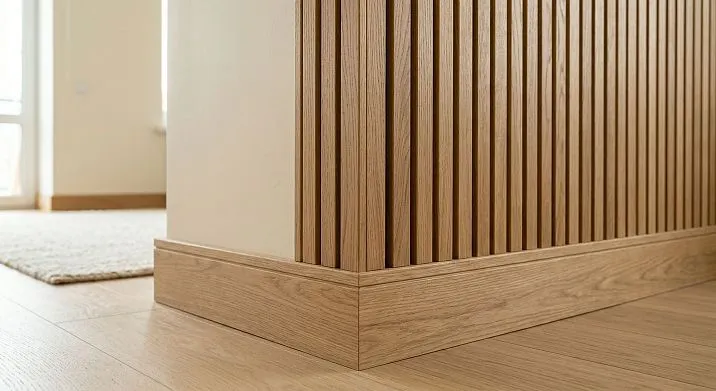
Wooden plank, Wooden corner bracketandwith a classic profile creates a sense of solidity, reliability.— these are not just three separate products. They are three elements of a single architectural language that, in combination, create a neat, finished, and visually expensive finishing unit. No plastic. No cheap adapters. No feeling that the parts were chosen at random.
This is precisely the essence of the correct approach towooden trimfor interior finishing: think not about individual details, but about the system.


Why does a wall finish without plastic trims look neater and more expensive
Let's call a spade a spade. Plastic trims are not inherently bad. They are cheap, easy to install, and moisture-resistant. But they have one problem that no quality of plastic can solve: they are not 'read' as part of a living, natural interior.




What exactly creates the feeling of 'cheapness'
Plastic gives itself away not by color or shape. It gives itself away by texture—or rather, the lack thereof. A wooden surface has a living pattern, non-uniformity of fibers, a matte or semi-matte finish. Plastic is a perfectly smooth, sealed, lifeless plane.
When a wooden wall panel and a plastic corner on its edge meet in one unit, the brain instantly registers a material conflict. This conflict creates the feeling of 'incompleteness,' 'temporariness,' and a general lowering of the level of the entire finish.
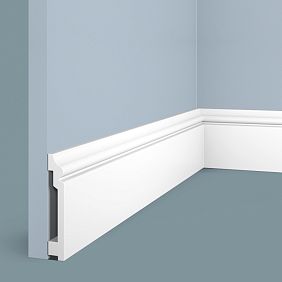
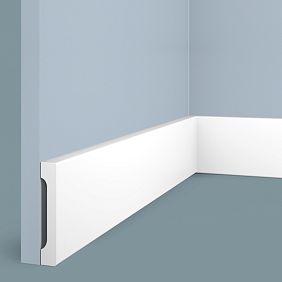
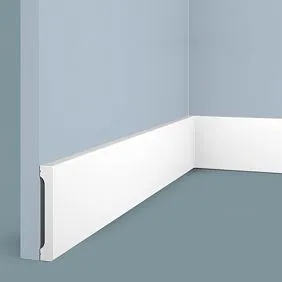
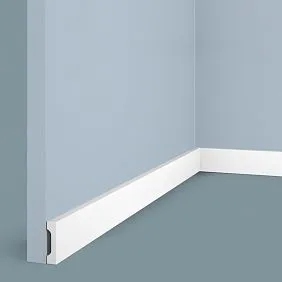
Our factory also produces:
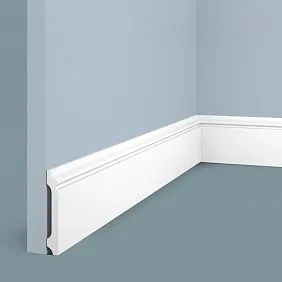


What changes wooden moldings in this equation
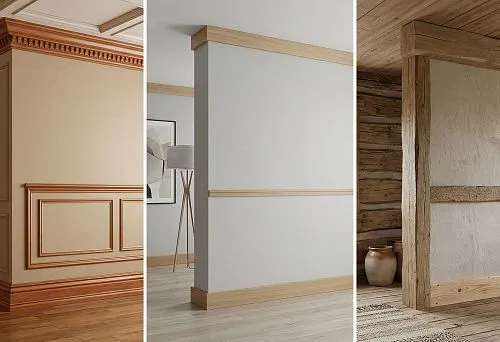
Wooden trim— is a system of elements made from natural wood, each performing its own function in the overall finishing picture. The batten sets the rhythm and vertical or horizontal lines. The corner piece closes the corner and creates a clean contour. The baseboard gathers the bottom line of the wall. The trim and glazing bead close thin joints.
When all these elements are made from the same wood species or from species with similar tones — the space gains coherence. Every transition, every joint, every abutment looks intentional and precise.
Neat wall finishing with wood is not about 'more wood'. It's about 'wood where it's needed, and in the right form'. It is precisely the comprehensive approach to wooden millwork that distinguishes professional finishing from amateur work.
Get Consultation
What problem does a wooden batten solve in wall finishing?
Before going to choose battens — you need to understand what exactly you want to get from them. This sounds obvious, but this is where most people make their first mistake: they buy battens as 'decor' and are surprised that the result looks random.
Task 1. Vertical or horizontal rhythm
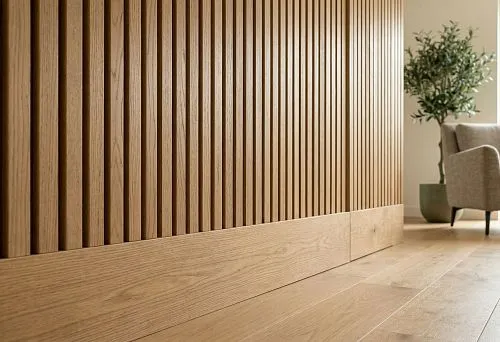
Wooden plank for wallcreates a linear rhythm — a system of parallel planes that break the wall into zones and give it depth. Vertical rhythm — visually increases the height of the room. Horizontal — expands and calms the space.
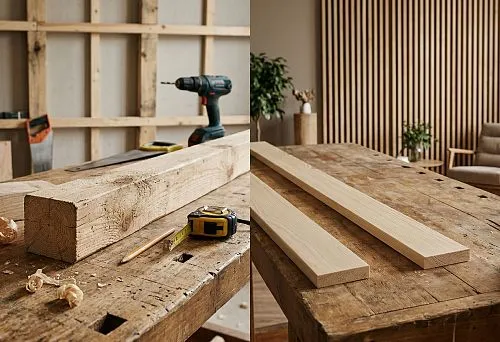
Batten size for wall mounting: width from 20 to 80 mm, thickness 6–12 mm. The standard profile RK-001 — 80×7 mm — is universal for most interior tasks. Spacing between battens: 20–80 mm depending on the desired rhythm density and room size.
Task 2. Transition and finishing line
A batten as a horizontal line on the wall is not decor, but a functional element. It can mark the upper boundary of a wall panel, divide a wall painting zone into two colors, finish a frame around an accent area. In this scenario, the batten works as a hidden molding — inconspicuous but structuring.
Task 3. Decorative surface with emphasis on texture
When battens are mounted on an accent wall, they create a three-dimensional surface with interplay of shadows. Each batten casts a micro-shadow on the wall behind it. With side lighting, this creates a depth effect that is absolutely impossible to achieve with painting.
Wooden battens in interior design are a tool for managing light and volume, not just 'stripes on a wall'.
Task 4. Framing and separating zones
A wooden batten around a doorway, along a niche, along the perimeter of a decorative mirror — this is using the batten as a laconic frame. A thin wooden outline instead of a massive casing. This is precisely where the batten works in tandem with a corner piece: the batten creates the plane, the corner piece finishes the corner joint.
For more details on application and installation options — in the article about howWooden boards in interiorcreate accents, zoning, and architectural expressiveness of walls.
Why a wooden corner piece is needed and where it works better than plastic
The corner piece is the most underrated element of wooden millwork. Most people remember it at the last moment, choose the first thing they come across, and end up with exactly that plastic 'extension' that ruins the entire carefully built finish.
A wooden corner piece is an L-shaped solid wood profile, produced in two main variants: equal-shelf (both arms of equal width) and unequal-shelf (one arm wider than the other).
Where a wooden corner works fundamentally better than its plastic counterpart
External wall corner. This is the most vulnerable spot of any finish. The external corner receives impacts, wears down, and over time begins to chip—if it's plaster or drywall. A wooden corner protects the corner mechanically and simultaneously covers the end of the finishing material.
At the same time, unlike its plastic counterpart, a wooden corner continues the visual language of the entire finish. If the wall is finished with wooden slats—a corner made from the same wood species looks like part of a unified solution. A plastic corner will be visible as a foreign element—even if it matches the color.
Internal corner. The joint of two planes in an internal corner is a technically complex node. Wallpaper, panels, paint rarely give a perfectly even joint in the corner. A wooden corner covers this joint, masking irregularities and providing a clean straight line along the entire height of the corner.
Door or window reveal. Here the corner is used as an accessory that covers the joint between the reveal and the wall. With wooden or natural reveals, a wooden corner is the only solution that works organically.
Wall panel abutment. When a wooden panel ends at a wall, ceiling, or floor—the joint needs to be covered. A corner in these nodes covers the gap, protects the panel's end cut, and creates a clean decorative line.
Wooden corner dimensions
Standard equal-leg corner dimensions: 15×15, 20×20, 25×25, 30×30, 40×40 mm. Unequal-leg: 15×25, 20×30, 25×40 mm. Size selection depends on what exactly the corner needs to cover. For thin joints and delicate abutments—15×15 or 20×20 mm. For reveals and wide gaps—25×40 or 30×30 mm.
Buying a wooden corner in the required size and wood species is a task worth solving before installation begins, not after.
How a wooden floor skirting board gathers the bottom line of the wall
A baseboard is the boundary between two worlds: the vertical plane of the wall and the horizontal plane of the floor. This boundary is always visible—in any lighting, with any furniture arrangement. And it is precisely here that the quality of the solution is instantly perceived.
Why a wooden baseboard works better than plastic and MDF
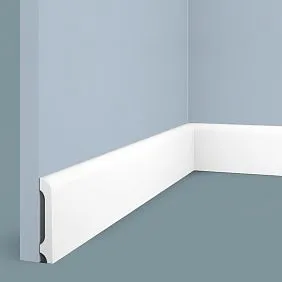
Plastic baseboards do not age 'nobly.' They yellow, become cloudy, and over time lose their shape at the attachment points. MDF baseboards are better, but they cannot tolerate moisture or mechanical damage—they swell and delaminate. Solid wood baseboards offer durability, repairability (they can be repainted, refinished), and a living surface that gains character over the years, rather than degrading.
For natural parquet, engineered wood flooring, or wooden floors—a wooden baseboard is the only logical solution. A plastic baseboard next to oak parquet is a conflict that cannot be resolved by any color matching.
How to correctly choose the profile of a wooden baseboard
Buying a wooden baseboard— means choosing not only the wood species but also the profile. Standard options:
-
Straight rectangular baseboard (height 40–80 mm, thickness 12–18 mm) — for modern and minimalist interiors. No profiles or protrusions—just a clean rectangular strip at the floor.
-
Baseboard with a quarter round — the lower part is cut at an angle for a tight fit to the floor. One of the most common options.
-
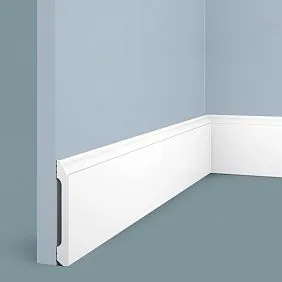
Shaped profile with a concave cove — for classic and neoclassical interiors. Adds plasticity and movement to the lower line of the wall.
-
Thin flat skirting board (height 20–40 mm) — a delicate option for delicate interiors and low rooms
The height of the skirting board is chosen based on proportion considerations. Rooms with ceilings up to 2.7 m — skirting board 40–60 mm. With ceilings 2.7–3.0 m — 60–80 mm. Higher — 80–100 mm and more.
Skirting board as an element of a complete solution
Wooden floor skirting board is most effective when it is made from the same species or from the same tonal group as the other trim elements. Oak skirting board + oak battens + oak corner — that's a system. Oak skirting board + birch battens + pine corner — that's a random set that will never create a sense of integrity.
How to assemble a solution set: batten + corner + skirting board + molding
Here is the central question of this article. And here, intuition is not needed, but an understanding of which element is responsible for what.
Three basic elements: what each is responsible for
| Element | Area of responsibility | Approximate size |
|---|---|---|
| Wooden batten | Vertical and horizontal lines on the wall, accent, rhythm, framing | 20–80 × 6–12 mm |
| Wooden corner | External and internal corners, slopes, panel joints | 15×15 to 40×40 mm |
| Wooden skirting board | Bottom line of the wall, floor and wall joint | 40–100 × 12–18 mm |
When three elements are enough
Batten + corner + skirting board cover most standard finishing tasks:
-
Battens create an accent wall surface or a horizontal dividing line.
-
Corner trim covers external corners and joints of the batten with adjacent surfaces.
-
Baseboard finishes the lower perimeter.
If the space is geometrically simple—a corridor, a rectangular room without niches or reveals—these three elements are sufficient.
When layout trim and glazing bead are needed
Wooden moldingis added to the scheme when thinner joints need to be covered: between two panels, around the perimeter of an insert, along the edge of a frame. Layout trim is thinner than batten and corner trim—it is a delicate, subtle element used where a more massive profile would look coarse.
wooden trimis the thinnest element of the system. It has a square or triangular cross-section of 10×10 mm or 8×8 mm. Its task is to cover very narrow joints: between a frame and glass, between an insert and the panel body, between two layers of finish.
Wooden corner veneeris a hybrid of corner trim and layout trim. It is used where corner trim is too massive: thin reveals, delicate junctions, thin-walled panels.
How to avoid mismatched profiles
All elements of the set should be in a unified stylistic register:
-
for minimalism — flat rectangular profiles without shaped protrusions
-
for classic and neoclassical — profiles with a fillet, quarter-round, or shaped protrusion
-
for modern Scandinavian finish — thin flat slats, straight corners, low straight baseboard
Mismatched profiles — when the baseboard is classic with a fillet and the slats are flat in a minimalist style — always stands out visually, even if the wood species and tone match.
What to use instead of plastic corners, extensions, and cheap adapters
Honest comparison table — without marketing exaggerations.
| Material | Appearance | Durability | Installation | Compatibility with wood |
|---|---|---|---|---|
| Plastic | Smooth, synthetic | Yellows, cracks | Simple | Poor |
| Painted MDF | Better than plastic | Afraid of water | Medium | Medium |
| Solid wood | Live texture, warmth | Tall, repairable | Medium | Good |
| Veneered MDF | Good for painting | Medium | Medium | Good |
The conclusion is simple: a wooden extension instead of a plastic one is not a question of budget. It's a question of the result you want to achieve.
Specific replacements
Plastic corner on the slope → wooden corner 20×30 or wooden corner molding. Provides an organic transition to a wooden slope or wooden window frame.
Plastic skirting board → wooden floor skirting board made of oak or beech. Eliminates conflict with parquet, creates a unified wooden base.
Plastic T-profile in a doorway → flat wooden molding.Flat wooden plankCovers the transition between two panels or between coverings without a synthetic profile.
Plastic molding at a wall panel → wooden bead or wooden molding. Provides the same clean joint, but in a natural material.
How to choose the tone, profile, and size so that the finish looks cohesive
Here — practice. Not theory, but specific rules that work in real interiors.
Rule of a unified tonal range
All wooden finishing elements should be within the same tonal range: either all light (ash, beech, whitewashed oak), all medium (natural oak, birch with tinting), or all dark (stained oak, walnut). Mixing a light baseboard and a dark batten without design logic is chaos.
Permissible deviation: the baseboard is slightly darker than the batten (by one tone). This creates a visual 'grounding' — the space is anchored to the floor. A baseboard lighter than the batten is less organic; the space seems 'weightless from below'.
Rule of a unified profile language
Already mentioned above, but let's repeat specifically:
-
Minimalism: all elements are straight, without curved protrusions. Flat batten 80×7, straight corner 20×20, straight baseboard 60×15
-
Classic: batten with a bead or recess, baseboard with a profile, corner — either decorative with a protrusion or maximally neutral straight
-
Scandinavian/Nordic: thin flat battens, narrow straight baseboard 40×12, corner 15×15 — everything is minimal and delicate
When the batten should be an accent, and when it should be a neutral background
Batten as an accent: wide (60–80 mm), tight spacing (20–30 mm), dark wood species or tinted light color, mounted on a contrasting wall.
Batten as a neutral background: narrow (20–40 mm), wide spacing (60–100 mm), light wood species matching the wall color, matte finish matching the finish color. Such a batten creates a slight relief that is visible in side light, but does not 'shout' in the overall view of the room.
Where such finishing works especially well
The wooden molding system — batten + corner + baseboard — works in practically any room. But there are places where it is especially expressive and functionally justified.
Corridor and hallway
Hallway — the narrowest and longest room in the apartment. Vertical wooden battens on the walls increase the visible height. The wooden baseboard creates a clear bottom line that visually 'holds' the space. Wooden corners on external corners (and there are usually many of them in hallways) protect and decorate the corners simultaneously.
In the entryway, wooden molding also works as a marker of material level: the first thing a guest sees is the floor/wall transition and corner elements. If they are wooden and of high quality — the impression is formed correctly.
Staircase zone
On the staircase, wooden moldings serve a dual purpose: aesthetic and protective. A wooden corner piece on the outer edges of the steps. A wooden batten along the staircase wall. A skirting board around the perimeter of the landing. All of this is a system that protects the finish from mechanical damage while simultaneously creating architectural cohesion in the staircase space.
Bedroom
In the bedroom, wooden moldings create warmth and tranquility. A horizontal wooden batten-divider on the wall at the head of the bed (at a height of about 140 cm) is one of the most elegant techniques in a modern bedroom. The upper part of the wall is one color, the lower part another, and the batten covers the joint. A wooden skirting board matching the parquet or laminate flooring completes the lower perimeter.
Living room: accent wall
An accent wall behind the sofa made of vertical wooden battens with consistent spacing is one of the most enduring modern trends in residential interiors. Battens + corner pieces on the sides of the accent area + a skirting board at the bottom create a complete 'picture' of natural wood. With proper lighting—from below or above—this assembly becomes the main focal point of the living room.
Office
In the study, wooden battens along the work wall or around built-in shelving create a feeling of a 'library'—an orderly, serious space with character. A wooden skirting board and corner pieces complete the look.
Finishing reveals and door junctions
Reveals are another area where plastic loses catastrophically to wood. A wooden reveal + a wooden corner piece at the junction of the reveal and the wall + a wooden casing—this is a system that turns a standard door opening into an architectural accent. The assembly reads as expensive and intentional.
Mistakes that make even good wooden finish look random
Let's be frank here. Wooden moldings are a material that, by itself, is not a guarantee of a good result. Here are the real mistakes that ruin it.
Mistake 1. Batten, corner piece, and skirting board from different stylistic series
This is the most common and most destructive mistake. A classic profiled skirting board with a projection + a minimalist flat batten = a visual conflict. Even with the same wood species and tone—the different stylistic language of the details destroys the integrity.
Solution: choose all elements of the set from the same series or from the same stylistic register.
Mistake 2. Mixing warm and cool wood species
Warm golden oak + cool gray-white ash + neutral beech—these are three different temperature sensations. Mixing them without a designer's intent is not allowed. Either all warm, or all neutral, or an intentional contrast built according to the rules.
Mistake 3. Too prominent a corner trim on a delicate junction
A 40×40 mm corner trim on a window reveal in a small room—that's too much. A bulky corner trim 'eats up' the reveal and makes the junction look crude. For delicate junctions—use a 15×15 mm corner molding or a glazing bead.
Mistake 4. Wood without a logical approach to junctions
Battens on the wall—present. Corner trim on the corner—absent. Skirting board—cheap plastic. All the work of the battens is devalued at the transitions. Wooden wall finishing without plastic accessories—this applies to all elements, not just the battens.
Mistake 5. A good skirting board and a cheap plastic accessory side by side
If a wooden skirting board is interrupted at a doorway and a plastic threshold profile is placed there—this transition ruins everything. This is precisely where a wooden molding or a wooden threshold is needed.
Error 6. Overloading the wall with all elements at once
Battens + moldings + decorative frame + divider batten + corner pieces + more battens in a different rhythm — this is overload without hierarchy. A wall should have one main element and several supporting ones. Two mains compete. Three — chaos.
Error 7. Finish without synchronization
If the batten is in natural oil, the corner piece is painted white, the baseboard is in glossy clear lacquer, and the trim is unpainted — this is not 'diversity', it's disjointedness. All elements of the system must have either one finish or finishes within a unified aesthetic (all matte, all warm tones, all in the same finishing technique).
Practical checklist before purchasing wooden trim for wall finishing
Before going to choose materials — answer these questions. They will save money and protect against mistakes.
1. Which area is being finished?
One accent wall? The entire room perimeter? Window/door reveals? Staircase? The answer determines which elements are needed and in what quantity.
2. Is an external or internal corner needed (or both)?
External corner — equal-flange wooden corner piece 20×20 or 25×25. Internal corner — triangular profile bead or corner trim 15×15.
3. Do you need only the baseboard or the full set?
If the goal is only to cover the bottom line of the wall, a baseboard is enough. If the goal is to assemble a full finishing unit, the full set is needed.
4. Will the rail be decorative or covering?
Decorative — separate from the wall, creates rhythm and volume. Covering — fits tightly to the joint, hides the transition.
5. Do you need a bead or a molding?
Bead — for very thin joints (up to 10 mm). Molding — for joints 10–25 mm, around panels, inserts, and frames.
6. What wood tone is already present in the interior?
Floor, doors, furniture — all of these set the tonal range. Molding should fit into it or intentionally contrast with it.
7. Is painting needed?
If painting to match the wall color or another color is planned, choose species with closed pores (beech, birch). They accept paint better and provide an even finish.
8. Is a set completely without plastic elements needed?
If yes — compile a list for all areas: bottom line (baseboard), corners (corner piece or corner molding), joints (molding, bead), wall decor (batten).
Buy wooden batten, buy wooden corner pieceandbuy wooden floor baseboard— these are three steps that are best done simultaneously, selecting elements as a unified system, not separately.
The entire assortmentwooden moldings, cornices, and baseboards— in the catalog, which features all the main elements of the wooden finishing system.
FAQ: answers to the most important questions about wooden trim for wall finishing
What can replace a plastic corner piece in wall finishing?
With an equal-shelf or unequal-shelf wooden corner piece made of oak, beech, or ash. For delicate joints — with a wooden corner molding 15×15 or 20×20 mm. The wooden analog covers the corner better visually, is compatible with wooden panels and battens, and ages nobly.
What is a wooden batten used for in finishing?
Battens create vertical or horizontal rhythm on a wall, divide painting zones, form an accent surface, and frame niches and openings. It is a versatile element that works both as decor and as a functional finishing profile.
How to choose a wooden corner for an external corner?
For standard external corners — an equal-shelf corner 20×20 or 25×25 mm. For slopes — an unequal-shelf corner 20×30 or 15×25 mm. Wood species — the same as for the batten and baseboard. Finish — unified for the entire system.
Which wooden floor baseboard best matches the batten?
Baseboard made from the same wood species or from the same tonal group as the battens. In style: if the battens are flat rectangular — the baseboard should also be straight without a cove. If the battens have a profile — the baseboard can have a shaped top edge.
What is included in wooden millwork for finishing?
Wooden batten, wooden corner (internal and external), floor baseboard, glazing bead, flat and corner molding, casing, cove, cornice. Depending on the task, different combinations of these elements are used.
Is it possible to assemble wall finishing entirely without plastic?
Yes, and this is the best result to strive for. Baseboard made of wood, corner made of wood, molding and glazing bead made of wood — all of this is produced and easily ordered as a set. Wooden finishing without plastic accessories is not many times more expensive, but many times better in appearance and durability.
When is a bead needed, and when is a layout strip?
Bead — for very thin and delicate joints up to 10 mm. Layout strip — for covering wider transitions (10–30 mm), around the perimeter of inserts, panels, frames. Corner layout strip — for corners in delicate junctions where a corner piece is too bulky.
Where to buy wooden skirting boards and wooden slats for finishing?
In the STAVROS wooden millwork catalog: solid oak and beech skirting boards, slats of several profiles, corner pieces, layout strips, and beads — all in a unified quality standard and in unified tonal groups for complete matching.
Conclusion
Neat wooden wall finishing is not a matter of one successful slat. It's a matter of system: how three or four elements of wooden millwork work together, how they are connected by tone and profile, how each of them covers its zone — corner, bottom line, joint, transition — and at the same time does not compete with the others.
Wooden slat, wooden corner piece, and wooden skirting board — this is exactly the set that allows removing all plastic adapters and add-ons from the interior and assembling a finish that reads as solid, warm, and visually expensive work. It is precisely this approach that distinguishes professional joinery finishing from a randomly selected set of materials.
The company STAVROS produces wooden millwork from solid oak, beech, ash, and other species: slats, corner pieces, skirting boards, beads, layout strips, and moldings — the full range of elements for neat and solid wooden finishing. STAVROS products are manufactured in unified tonal and profile standards, allowing for the creation of complete solutions without the risk of mismatch.
If you want to assemble wall finishing without plastic add-ons — STAVROS offers not just individual items, but ready-made system solutions for each node: from the floor's bottom line to decorative accents on the wall and neat corner junctions.