Article Contents:
- What is a Wooden Slat Panel
- Types of Wooden Slat Panels
- Ready-Made Plank Panels
- Paint-ready panels
- Panels made of solid wood
- Panels for accent walls
- Slat Panels for Partitions and Zoning
- Materials Used for Slat Panels
- Solid wood
- MDF
- Veneered Solutions
- Combined Panels
- Where to Use Wooden Slat Panels
- In the living room
- In the bedroom
- In the entryway
- In the study
- In the dining room
- In the TV area
- In niches and passage areas
- Wooden Slat Panel for Space Zoning
- How to Choose a Slat Panel Based on Interior Style
- Modern style
- Minimalism
- Scandinavian interior
- Jatoba
- Neoclassicism
- Warm modern interior
- How to Choose Color, Size, and Slat Rhythm
- What to choose: individual slats or a ready-made slatted panel
- Advantages of wooden slat panels
- Common mistakes when choosing a slat panel
- How to care for wooden slatted panels
- FAQ: Answers to common questions about wooden slatted panels
- Conclusion
There are solutions that change a room not partially, but entirely. Not new curtains, not rearranged furniture, and not a fresh coat of paint—but one right wall. It is the wooden slat panel that possesses this rare property: to change a space fundamentally, with a single gesture. The rhythm of parallel slats, the living texture of wood, the play of shadows between the slats—all this transforms a flat wall surface into an architectural object with depth, character, and natural warmth.
Wooden slatted panels are today one of the most sought-after formats in interior design. They are chosen for accent walls in living rooms, for zoning open layouts, for bed headboards in bedrooms, for TV zones, and home offices. They are equally organic in Scandinavian minimalism, warm Japandi, neoclassicism, and modern loft. Versatility is a rare quality for any decorative material, and slatted panels possess this quality in full measure.
But before choosing—you need to understand: what exactly is a wooden slat panel as a format? How does it differ from simply purchased slats? When is it more advantageous to take a ready-made panel, and when to install slats individually? The answers to these questions are in this article.



What is a wooden slat panel
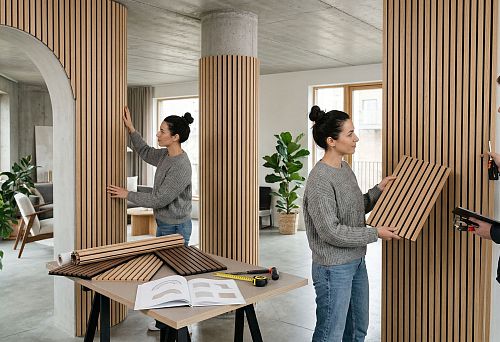
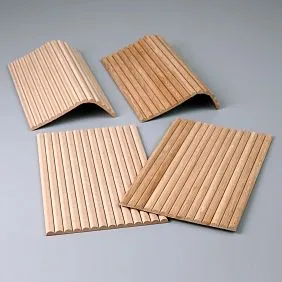
A wooden slatted panel is a ready-made interior product in which several parallel wooden slats of equal cross-section are fixed to a backing with a predetermined, geometrically precise spacing. The backing can be rigid (MDF board) or flexible (fabric or polymer base). The result is a finished modular element that is mounted as a single unit: without manual spacing layout, without selecting slats by size, without individually aligning each slat.
A fundamental question: how does a ready-made slatted panel differ from a set of individual slats for installation? The difference lies not so much in the visual result as in the technology and complexity of implementation.
Individual slats offer freedom. You can set any spacing, any angle, any combination of cross-sections. This is a tool for a designer with precise technical specifications and an experienced installer. A ready-made wooden slatted panel is about precision, reproducibility, and speed. The spacing is set by the manufacturer, the geometry is verified in production, and adjacent modules join seamlessly. For an apartment owner who wants a beautiful result without multi-day installation, a ready-made slat panel is preferable.
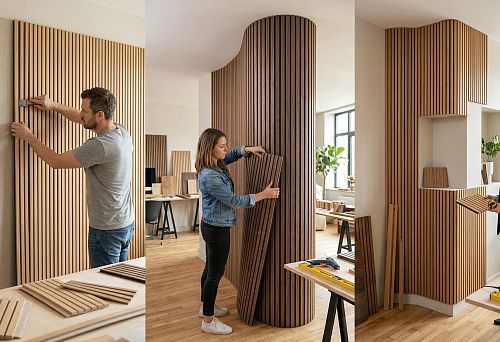
When is it better to choose a ready-made panel? For standard straight surfaces: a straight wall in the living room, a straight wall behind the bed in the bedroom, a straight decorative partition. When is it better to install slats individually? On curved surfaces—columns, arches, radius niches—or when the project requires a non-standard, individual rhythm not provided in the range of ready-made panels. Although even here, manufacturers are ready—slatted panels made of solid oak and MDF with a flexible base—wrap around curved surfaces without deforming the slats, maintaining an even rhythm on any curve.
The slat panel format is also convenient for another reason: factory panels are made with controlled material moisture and stable geometric parameters. The slats in the panel are already acclimatized, fitted, and secured—the risk of post-installation warping is minimal.




What types of wooden slatted panels are there?
Our factory also produces:





Ready-made lath panels
A ready-made slatted panel is a modular product of standard sizes (typical formats: 2440×122 mm, 2800×200 mm, 3000×300 mm, and others depending on the manufacturer) with a fixed slat spacing on a backing. It is mounted on the wall with mounting adhesive or finish nails—quickly, cleanly, without special tools. Adjacent panels join according to the pattern without visible seams, creating the impression of a single continuous surface.
Ready-made panels come in two fundamentally different types:
-
On a rigid MDF backing—for flat, even surfaces. Maximum geometric stability, perfect evenness, high precision in module joining.
-
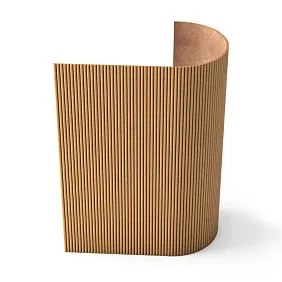
On a flexible fabric or polymer base — for curved surfaces: columns, arches, rounded niches. Bend to radius without cuts and without deformation of slats.
Get Consultation
Panels for painting
These are pure MDF panel slats, without a finish coating. Base and slats are made of uniformly dense MDF, with a perfectly sanded surface — ready for application of any enamel, from matte to satin. The advantage of this format is obvious: complete color freedom. White slats in Scandinavian interiors, charcoal gray in modern minimalism, warm terracotta in Japandi, classic cream in neoclassicism — MDF realizes any color concept. Moreover, the tone of the slats can be precisely matched to the tone of walls, furniture, or doors.
Important: for painting MDF panels with a slatted pattern, an enamel is needed that allows application on relief surfaces — without drips on the ends of the slats and without differences in gloss on horizontal and vertical planes. Satin and matte compositions are significantly better suited for this than high-gloss ones.
Solid wood panels
A panel made of natural solid oak, beech, or ash — this is maximum natural aesthetics in a ready-made modular solution. Solid wood slats possess a living grain pattern, natural uniqueness of each plank, and a tactility that cannot be reproduced in any other material. Oil or varnish coating reveals the natural tone — from amber-gold to deep honey-brown.
A panel made of solid wood slats — not just a finish, it's a declaration of naturalness. Two adjacent modules made of oak from the same tree have different patterns — and it is precisely this natural 'dissimilarity' that makes a wall from such panels truly alive.
Panels for accent walls
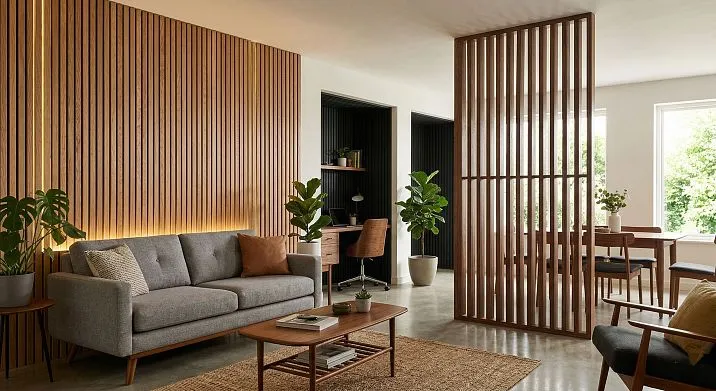
An accent slatted wall — a separate and very important story. For an accent position (wall behind a sofa, wall behind a bed, wall around a TV), panels with maximum visual strength are chosen: slats with a bright natural pattern, dark toning, textured coatings, fine or, conversely, large spacing. With properly selected side lighting, an accent slatted wall made of solid oak works like a sculptural object: alive, deep, changing the perception of the entire room.
Slatted panels for partitions and zoning
This is a separate functional scenario that a slatted panel implements better than any other material. In detail — in a separate section.
What materials are slatted panels made from
Solid wood
Oak, beech, ash, alder — these are the main species for interior slatted panels made of solid wood. Each has its own character.
Oak is the most 'substantial' wood species. Density 700–750 kg/m³, large expressive grain pattern, high mechanical strength. Oak slat panels create a sense of monumental natural material even with thin slats. Oak with open grain after brushing is especially expressive — a metal brush removes soft fibers, leaving hard ones, creating a textured tactile surface.
Ash is lighter, with a straight, uniform grain. Excellent for Scandinavian and light modern interiors. Toning ash in gray or warm beige yields a very contemporary result.
Alder — a warm pinkish hue, fine grain, soft natural texture. Alder is traditionally used in baths and saunas, but in interior slat panels, it creates a very cozy, almost homely look.
MDF
MDF in a slat panel is technological perfection. A homogeneous fine-dispersed structure without natural defects (knots, pockets, uneven density) ensures ideal slat geometry: even edges, precise spacing, flawless surface for painting. MDF slats do not warp from temperature and humidity fluctuations under normal room conditions — a significant advantage over solid wood in unstable operating environments.
Preciselywooden slat panels made of MDF with a base— a professional designer's tool: they can be painted any color, achieving a perfectly even result without color variation across the batch.
Veneered solutions
Veneered slat panel — slats with an MDF base, the face of which is covered with a thin slice of natural wood (0.6–3 mm). The surface retains the living natural grain, tactility, and hue of real wood, while the structural base ensures geometric stability. Cost — between pure MDF and solid wood.
Veneered panels are especially good in large-area formats where a significant surface needs to be designed with visual textural unity. The 'book-matching' veneer selection technology allows creating a mirror-symmetrical natural pattern, unachievable when installing individual boards.
Combined panels
In professional design, wooden slat panels are increasingly paired with other elements:moldings and cornices made of MDF or solid oakframe the slatted panels, creating a complete architectural geometry of the wall. Slatted panel + molding frame + ceiling cornice is a system where the slat panel ceases to be just a 'board on the wall' and becomes an element of thoughtful wall architecture.
Where to use wooden slatted panels
In the living room
Living room — a space where a wooden slatted wall panel reveals its full potential. An accent wall behind the sofa with vertical oak slats is the central architectural axis of the entire interior. It sets the tone, defines the style, and creates that 'expensive' feeling which is usually hard to articulate but is instantly perceived upon entering the room.
In a living room of 25–35 m², one solid oak slatted wall in a natural finish completely transforms the space. In large living rooms with high ceilings, a more complex system is appropriate: a slatted panel in a molding frame, geometric panel divisions, a ceiling cornice made from the same solid wood as the slats.Boiserie wall panel system— is precisely such a solution: slatted panels plus architectural framing as a single structure.
With accent side lighting — recessed spotlights or wall sconces — a slatted wall acquires a completely different dimension: the alternation of illuminated slats and dark shadows in the grooves creates volume, which works even in modestly sized rooms.
In the bedroom
Bedroom — an intimate, personal space where a slatted panel works softer and more gently than in the living room. A classic solution: a slatted wall behind the bed headboard. A panel of light oak, birch, or ash in a neutral finish creates a warm 'frame' for the bed, visually establishes the central axis of the bedroom, and adds that tactile warmth often lacking in painted or wallpapered walls.
The height of the slatted panel behind the headboard — from floor to ceiling or only in the 'bed zone' (approximately 60–80 cm above the mattress) — is a design decision that changes the proportions of the wall. A full-height slatted wall in the bedroom looks monumental. A panel in the headboard zone feels cozy and intimate.
In the hallway
Hallway — the first and last thing a guest sees. And it is here that a wooden slatted panel works on several levels simultaneously. Decoratively — it sets the character of the entire home at first glance. Functionally — it protects the lower part of the walls from mechanical damage: walls suffer the most in hallways. Spatially — vertical slats visually elongate a low corridor, horizontal ones widen a narrow one.
In a narrow corridor, slats 20–30 mm wide with a 30–40 mm pitch and vertical orientation — this is a proven formula that makes the space significantly taller and more spacious without any construction manipulations.
In the study
A study is a space that should convey seriousness, focus, and the professional identity of its owner. Wooden slatted panels in a study speak without words: here work people who understand quality. Dark oak, a dense, even rhythm of slats, soft side lighting from a desk lamp — this is the study aesthetic in the best sense of the word.
Slatted panels on all walls of a home study with ceilings 2.7 m and higher — this is appropriate and beautiful. With standard 2.5 m ceilings — it's better to limit it to one or two accent walls.
In the dining room
A dining room is a space of ritual significance. Here people eat together, talk together, here the family gathers. Slatted panels in a dining room create acoustic comfort: the slats disperse sound waves, reducing echo — this is a practical advantage that is rarely discussed but noticed immediately during the first meal in a properly finished space.
In the TV area
The TV zone is one of the main 'application points' for wooden slatted panels in a modern interior. A slatted panel behind the TV simultaneously solves three tasks: it hides cables and mounting elements, creates a decorative backdrop against which the dark screen looks like an organic part of the design concept, and adds natural warmth to the zone that is by default the most technological in the room.
Practical note: behind a slatted panel in the TV zone, it's easy to hide cable channels, sockets, and the TV mounting bracket. During installation, plan for access holes or panels in advance.
In niches and passage zones
Niches, reveals, decorative arches, columns, and transition zones — places where flexible-based slatted panels work where a rigid system is simply not applicable. Flexible slatted panels with a fabric backing wrap around any curvilinear geometry without cuts, gaps, or deformations. A column wrapped in an oak slatted panel is a completely different architectural element than a plastered or painted cylinder.
Wooden slatted panel for space zoning
A wooden slatted partition is one of the most elegant ways to divide a space. Not a solid wall, not a heavy furniture structure, but precisely an open slatted partition — a visual barrier that preserves air and light.
Operating principle: vertical slats with a wide pitch (50–100 mm or more) create a sense of a zone boundary but do not block the movement of the gaze or natural light. You see that this is a 'different' zone — but the room does not become smaller and does not lose the unity of space.
Where is slat panel zoning especially appropriate?
Studio apartments and open floor plans are classic scenarios. A slat partition between the living room and kitchen, between the work area and relaxation zone, between a children's play area and the parents' sleeping area. Slats serve the function without creating solid walls.
Kitchen-living room is the most in-demand situation. A slat panel-partition at bar counter height (90–100 cm) or at the full room height creates a 'kitchen / living room' separation without losing visual connection between the zones and without hindering conversation.
Bedroom with a wardrobe area or work area — slats conceal the wardrobe area or highlight a desk without creating a feeling of cramped space.
Home office in the living room — a slat partition psychologically 'disconnects' the work area from the living space, while not depriving it of natural light.
When is it better to choose a slat panel-partition rather than a full wall? Always when a space up to 50–60 m² cannot physically be 'shortened' by solid walls. Always when you want to preserve a sense of spaciousness. Always when you need an easily transformable layout.
How to choose a slat panel according to interior style
Modern style
Modern interior is a balance of natural and constructive. A wooden slat panel here works as a 'warm' element in a neutral, often monochrome space. The clear vertical geometry of the slats, the natural oak tone or a concise gray tint — it is precisely this combination that creates the edge that distinguishes a modern interior from a bland one. Slats are installed vertically, sometimes diagonally for dynamism.
Minimalism
Minimalism is the dictatorship of precision. Slat panels made of MDF with a matte monochrome enamel finish or smooth ash slats with a neutral tint — the language of minimalism. A panel in the wall color, leaving only the linear rhythm of shadows, is a technique that works unfailingly. Installation is concealed. Joints are invisible. Spacing is uniform and impeccable.
Scandinavian interior
Scandinavian style is white, light wood, and natural coziness. Slat panels in a Scandinavian interior: light oak or birch without tinting or with a light whitewashed oil finish, wide slat spacing, horizontal orientation. No dark tones, no relief — only the living natural texture against a smooth, light background.
Japandi
Japandi is a style of ultimate natural restraint: the Japanese principle of 'empty' space plus Scandinavian coziness. In Japandi, wooden slats are narrow (10–15 mm), with uniform spacing, in a warm light gray or beige oil tone. No decor, no extra elements—only rhythm, the space between rhythm, and light.
Neoclassicism
Neoclassicism demands architectural completeness. In this context, a wooden slat panel is not an independent element but part of a system. Slats in molding frames, geometric panel divisions, a ceiling cornice from the same wood species—this is the neoclassical formula for a slatted wall. The tone is neutral or classic creamy white under enamel.
Warm contemporary interior
A warm modern interior is a demand for naturalness, coziness, and visual warmth with contemporary geometry. Earthy tones, natural materials, soft light. Oak slat panels in 'cognac,' 'tobacco,' or 'warm walnut' finishes are the perfect solution. They add that warmth which cannot be achieved with paint or wallpaper.
How to choose the color, size, and rhythm of slats
Choosing the color, slat width, and spacing are three variables that define the entire character of a slatted surface. Understanding their interaction allows you to design the result, not rely on luck.
Slat width. Narrow slats (10–20 mm) create a dense, rich pattern—a 'luxurious' and refined visual effect. Wide slats (40–80 mm) offer a more laconic, airy rhythm. For an accent wall in a living room, narrow or medium slats provide maximum effect. For a zoning partition, use wide slats to maintain a sense of openness.
Spacing between slats. Spacing equal to the slat width (e.g., 20 mm slat—20 mm spacing) creates a 'grid' pattern of 50/50. Spacing narrower than the slat width results in a dense, rich surface. Spacing wider than the slat width adds lightness, transparency, and more air between the planks.
Slat height (profile depth). The higher the slat above the substrate, the deeper the shadow in the grooves—making the wall appear more voluminous and 'relief-like.' A 10 mm high slat gives a delicate shadow. A 25–30 mm high slat creates an expressive play of light and shadow with side lighting.
Color. Light finishes (whitewashed oak, natural ash, gray-beige) visually expand the space and add airiness. Dark finishes (wenge, anthracite, dark walnut) add depth and weight but require room volume and good lighting. In a small room, dark slats without sufficient lighting create visual heaviness.
Orientation. Vertical slats stretch the space upward—indispensable in rooms with standard 2.5 m ceilings. Horizontal slats visually widen the space horizontally—good for narrow corridors and hallways. Diagonal slats create dynamism and movement—a bold modern technique requiring confidence in the concept.
Three color anchor points: flooring, doors, and key furniture. The slatted panel should either support their tone (a natural interior 'theme') or consciously contrast with them. Accidental color conflict is the most common mistake when choosing.
What is better to choose: individual slats or a ready-made slatted panel?
An honest comparative breakdown—without marketing declarations.
| Parameter | Ready-made slatted panel | Individual slats (piece-by-piece installation) |
|---|---|---|
| Installation convenience | High: panel is a single element | More complex: each slat separately |
| Geometric precision | Manufacturing precision of spacing | Depends on the installer's experience |
| Appearance | Even, geometrically precise | Flexible, non-standard rhythm possible |
| Design flexibility | Limited to standard formats | Maximum — any pitch and cross-section |
| Curvilinear surfaces | Only with a flexible base | Possible with manual adjustment |
| Cost | Higher (includes underlay and production) | Lower on material, higher on installation |
| Installation timeframes | Fast (hours) | Slower (days) |
| Best scenario | Standard straight surfaces | Complex shapes, non-standard projects |
Conclusion: for most residential interiors with standard straight walls — ready-made slatted panels are optimal. Saves time, ensures precise results, requires minimal installation experience. For complex architectural objects with non-standard surfaces — piece-by-piece installation with a professional installer.
Advantages of wooden slatted panels
-
Expressive appearance. The rhythm of parallel slats with shadow play creates a graphically active surface that changes with viewing angle and lighting.
-
Natural texture. Solid oak or ash slats carry a living natural grain — not an imitation, but genuine material.
-
Acoustics. The slatted surface scatters sound waves, reduces echo, and improves the acoustic comfort of a room. Especially noticeable in living rooms and dining rooms with high ceilings.
-
Convenience for an accent wall. One slatted wall completely transforms a room. Minimal intervention — maximum design effect.
-
Zoning capability. A slatted partition divides space without losing light and air—a unique property not found in any other type of panel.
-
Compatibility with different styles. From Japanese minimalism to French neoclassicism, wood fits organically into any stylistic context.
-
Durability. Properly treated wooden slats in interiors last for decades without losing their appearance.
-
Eco-friendliness. Natural wood in living spaces is a biologically neutral material, safe for health.
Common mistakes when choosing slatted panels
Knowing these mistakes is more valuable than any consultation—because it helps avoid them in advance.
-
Too frequent and fine a rhythm for a small room. Small slats with minimal spacing in a room up to 12 m² create visual 'noise'. In small spaces—use wide spacing, medium slat width.
-
Dark finishes with poor lighting. Dark slats in a room with one small window will turn into a dark spot on the wall. Dark wood works only with sufficient natural or accent lighting.
-
Confusion between decorative and background functions. If slats are meant to be a background for furniture—neutral tone and moderate rhythm. If slats are the main accent—bright tone, expressive rhythm, accent lighting. Attempting to combine both options does not work.
-
Lack of connection with furniture and flooring. Slats 'on their own' are decor without context. The color of the slats should engage in a dialogue with the tone of the floor, doors, and key furniture.
-
Overloading with slat decor. Slat panels on three or four walls in a small room create a cage. One or two surfaces are enough.
-
Buying from a photo without seeing a sample. A photo does not convey the tactility, the actual wood tone, or the scale of the slat. Before ordering, view samples in person.
-
Ignoring the framing system. A slat panel without molding framing around the perimeter looks like an unfinished thought. A ceiling cornice, floor skirting, and side profiles complete the panel into a unified architectural form.
How to care for wooden slat panels
Good news: caring for wooden slat panels in an interior is simple, takes minimal time, and does not require special products.
Dry cleaning is the basis of care. A soft brush with natural bristles or a dusting brush removes dust from the grooves between slats without risk of damaging the surface. For small slats with narrow spacing, use a soft toothbrush or compressed air. Frequency: as visible dust accumulates, at least once every two weeks.
Wet cleaning only for stubborn stains, with a barely damp microfiber cloth. No wet sponges, no standing water in the grooves—wood absorbs moisture capillarily, especially in end grain areas. After wiping, dry immediately.
Controlling room humidity. The optimal conditions for wooden slat panels: temperature 18–22°C, relative humidity 40–60%. In winter with intense central heating, air in apartments can dry to 20–25% humidity—this causes micro-cracks in the solid wood. An air humidifier during the heating season is not a whim but a necessity for a wooden interior.
Caring for the finish. Varnished slats do not require special procedures—only maintaining cleanliness. MDF slats with an enamel finish can be restored from scratches by local repainting: precise color matching is ensured by using the same product from the same manufacturer. Solid wood slats with an oil finish are refreshed every 3–5 years: oil is applied directly to the existing surface without removing the panels—the process takes a few hours and fully restores the appearance.
Protection from mechanical damage. In high-traffic areas—entryway, hallway, area around the dining table—slats with a varnish finish of hardness 3H and higher are resistant to accidental scratches. Solid oak, due to its high natural hardness, is significantly more durable in this regard than ash or alder.
FAQ: Frequently Asked Questions About Wooden Slat Panels
What is a wooden slat panel?
It is a ready-made interior product: several parallel wooden slats of equal cross-section, fixed at a constant pitch on a rigid MDF backing or flexible fabric base. Installed as a single module—without manual marking or pitch adjustment.
How does a slat panel differ from individual interior slats?
A ready-made panel ensures geometric precision and quick installation. Individual slats offer freedom in pitch, cross-section, and surface shape. For standard straight walls, a panel is preferable. For curved forms or non-standard projects, piece-by-piece installation.
Which slat panels are best to choose for walls?
For an accent wall with maximum visual effect—solid oak with side lighting. For a quiet decorative background—ash or alder in a neutral tint. For maximum color freedom—MDF for painting.
What is better: solid wood, MDF, or veneer?
Solid wood—lively natural grain, maximum aesthetics. MDF—perfect geometry, any color. Veneer—natural wood appearance at a lower price than solid wood. The choice depends on priority: aesthetics, color, or budget.
Are slat panels suitable for room zoning?
Yes, and it's one of the best zoning tools. A slatted partition with a wide pitch divides the space without blocking light and maintains a sense of openness—something no solid wall can do.
Can slatted panels be used in the hallway and bedroom?
In the hallway—perfectly: they protect walls, elongate the corridor, and set the style. In the bedroom behind the headboard—a classic warm solution that always works.
Which slat panels are best for an accent wall?
Solid oak slats with side lighting—maximum effect. Dark stains with a narrow pitch—for a 'substantial' architectural accent. Light slats with a wide pitch—for a soft, natural accent without visual weight.
Which interior styles do wooden slatted panels go with?
With most current ones: contemporary, minimalism, Scandinavian, Japandi, neoclassical, warm contemporary, loft. Wood is a stylistically universal material.
Is it difficult to care for such panels?
No. Dry brushing is the basis of care. Wet cleaning—only for stains. Refreshing the oil finish on solid wood—every 3–5 years. MDF coatings under enamel do not require periodic refreshing.
What to choose: a ready-made panel or individual slats?
For standard straight walls in residential interiors — a ready-made panel: fast, precise, convenient. For non-standard surfaces and complex architectural solutions — installation of slats individually under the guidance of an experienced designer.
Conclusion
A wooden slatted panel is both the simplest and the most powerful design tool in a modern interior. Simple — because even one slatted panel on an accent wall changes a room dramatically. Powerful — because it can solve various tasks: create an accent, form a background, divide space, manage light and acoustics.
For an accent wall in the living room — vertical solid oak slats with side lighting. For a quiet bedroom behind the headboard — light ash in a neutral oil tone. For the hallway — a medium slat in vertical orientation with molding framing. For an open plan with zoning — a slatted partition with a wide pitch that lets light through. For a study — dark oak, dense rhythm, directional lighting.
The main rule: a wooden slat panel is a system, not a single element. It works in an ensemble with molding profiles, ceiling cornices, floor skirting boards, and lighting. Only in this ensemble does it reveal its full potential.
If you are looking for wooden slatted panels with production quality control and a professional approach — pay attention to the company STAVROS. Since 2002, STAVROS has been producing slatted panels from solid oak and MDF, as well as a full range of accessories: moldings, cornices, skirting boards, decorative overlays, and profile products for wall finishing systems. Over 4,000 models, 20,000 modifications, production with chamber drying and precise geometric control, showrooms in Moscow and St. Petersburg. STAVROS is wooden slatted panels that work as a system.View STAVROS slat panels