Article Contents:
- Anatomy of a slat panel: what's inside and why it matters
- Slat material: oak, beech or MDF
- Solid oak: natural grain as the main argument
- Solid beech: neutrality for color solutions
- MDF: precise color matching without limitations
- Comparison table: oak, beech or MDF — what to choose
- Structural choice: rigid module or flexible base
- When a rigid panel is the right answer
- When only the flexible fabric base
- How the step and profile of slats define the character of the surface
- Application by zones and rooms
- Accent wall: one surface — the entire character of the room
- Behind the TV: slat rhythm as the proper background
- At the headboard: architectural bed without a furniture headboard
- In a niche: back wall and slopes as a single object
- For furniture fronts: architectural character of furniture
- In the living room: zoning without partitions
- In the hallway: vertical rhythm stretches the height
- In the study and office: an atmosphere of seriousness
- Slat spacing, ceiling height, and optical effects
- Lighting: an ally of the slatted surface
- Installation: a sequence with no room for error
- Foundation Preparation
- Marking
- Fixing a rigid module
- Fixing a flexible panel
- Joining
- Finishing
- Care: what to do and what not to do
- How to choose a supplier: three things you can't ignore
- FAQ: Most Frequently Asked Questions
- About the Company STAVROS
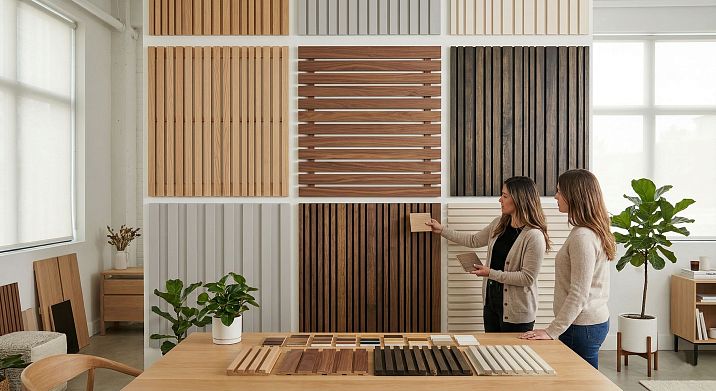
Wood in the interior is not a trend. It is a return to something that humans have always known: warm texture, natural pattern, tactile liveliness of a surface that cannot be reproduced by any synthetic material. But wood on the wall has its own logic of selection—and it is precisely ignorance of this that turns the right material into the wrong result.
Wooden slat panel for the wall— it's not just a 'tree on the wall'. It's a constructive system with specific geometry, specific technical properties, and specific conditions of application. Choosing it correctly means understanding: what is the geometry of your surface, which material solves your task, whether you need a rigid base or a flexible fabric construction. This breakdown is exactly about that. Not about the history of wood in interiors, not about the philosophy of natural materials — but about the practical choice that leads to a result.



Anatomy of a slatted panel: what's inside and why it matters
Before choosing, you need to understand the product's structure. Not in an academic sense — but pragmatically: the construction determines the application scenario.
wooden lath panels— it always consists of three components: slats, base, spacing. Slats — parallel planks of identical cross-section, made of solid wood or MDF. Base — what they are mounted on. Spacing — the distance between slats, which determines the visual rhythm of the surface. Changing any of these parameters changes the entire character of the product.
The base comes in two types, and this is critical:
A rigid MDF backing fixes the slats into a monolithic panel. The geometry is perfect — the panel does not deform, the spacing is unchanged. Installation on a flat wall is maximally simple: apply, align, fix. There is one weakness — the rigid panel does not bend. A column, an arch, a radius vault — the physical limit of the rigid format.
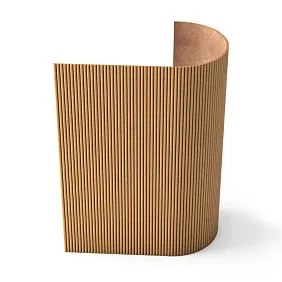
A flexible fabric base — a fundamentally different logic. The slats are fixed to an elastic textile carrier with fixed gaps. It is precisely these gaps that give the construction its main property: the ability to bend across without deforming the slats themselves. Along the arc of a column, along an arched vault, around a rounded corner — the slatted rhythm remains continuous. This is not an additional option — it's a different product, solving a different task.
Understanding this difference is the starting point of any correct choice.




Slat material: oak, beech, or MDF
Our factory also produces:





Solid oak: the natural grain as the main argument
Wooden slat wall panel made of oak— is the choice for those who want a wall with a vitality that cannot be obtained from any synthetic coating. Oak wood density is 700–750 kg/m³, Brinell hardness 3.7–3.9 kN/mm² — this is one of the most durable materials for interior use. But it's not just strength that makes oak the first choice for walls.
The main thing is the grain pattern. The layered structure of an oak cut is unique to each board. The semicircular profile of the slat diffuses light differently than a rectangular one: the rounded surface creates a soft transition from light to shadow that changes with the lighting angle. In the morning, the surface appears warmer. In the evening with spotlights — deeper and darker. This is not a metaphor — it's the actual optics of the material.
Under a transparent oil finish, oak reveals a warm golden-honey tone. Under stains and tints — a range from Nordic chalky gray to rich wenge. Each shade reveals the grain pattern in its own way: light tints make the texture more delicate, dark ones emphasize its contrast and monumentality.
There is also a special processing technique — brushing. A metal brush removes soft fibers, leaving the hard ones untouched, creating a textured tactile surface. Brushed oak under white oil is one of the most expressive formats for Scandinavian and wabi-sabi concepts.
An important practical point: oak for tinting requires a 'for tinting' grade of lamination — with slats selected for color and texture within the module. Without such selection, when applying a semi-transparent coating to an installed surface, tonal variations between adjacent slats will be visible. Specify the grade when ordering.
Get Consultation
Solid beech: neutrality for color solutions
Beech is a species with a fine-grained, uniform structure and a neutral light tone. The grain pattern of beech is significantly quieter than that of oak: there are no layered flashes, no open porosity. This is precisely why beech better accepts opaque enamel coatings: the surface under paint remains even, without the grain showing through.
Wooden slat wall panelmade of beech — the right choice for design concepts where color is the main tool: deep matte black, emerald green, powder pink. The material remains natural wood with a natural tactile feel, but color controllability is higher than with open-pored oak.
MDF: precise color matching without limitations
planks made of wood— is about natural material. But if the project requires an exact RAL color and natural texture is not a priority — MDF with a density of 750–850 kg/m³ provides what no living wood species can: an absolutely uniform, pore-free surface that accepts any paint evenly and consistently.
No knots. No resin pockets. No tonal variation between slats. Any shade from any catalog — RAL, NCS, Pantone — without exceptions.
The most sophisticated scenario with MDF is a monochrome interior: the panel is painted to match the exact wall tone. No color accent. Only relief — the vertical rhythm of battens, visible exclusively through the play of light and shadow. The surface 'comes alive' without color. This is architectural minimalism in its purest expression, and it can only be realized on MDF with a perfect surface.
Comparison table: oak, beech, or MDF — what to choose
| Criterion | Oak | Beech | MDF |
|---|---|---|---|
| Natural texture | Pronounced, lively | Soft, uniform | No |
| Finish | Oil, varnish, tinting | Enamel, oil, varnish | Any RAL paint |
| Color freedom | Within the natural tone range | Wider than oak | No restrictions |
| Durability | Very High | High | High with proper coating |
| For commercial objects | Optimal (hardness) | Good | Good |
| For curved surfaces | Yes (flexible base) | Yes (flexible base) | Yes (flexible base) |
| Tactile sensation | Natural wood | Natural wood | MDF under coating |
Design choice: rigid module or flexible base
When a rigid panel is the right answer
Straight walls, flat furniture fronts, ceilings without complex geometry — for all of these, a rigid module on an MDF substrate is the most precise and cost-effective solution. The construction is monolithic, the geometry is factory-made, the pitch is stable along the entire length. Two adjacent modules join end-to-end without a visible transition. Installation: leveled, fixed with adhesive — the surface is ready.
Rigid panels require no special skills for installation. This is their main practical advantage for standard linear applications.
When only a flexible fabric base
Flexible wooden slat wall panel— not an alternative to rigid panels, but a standalone tool for different tasks. Four situations where it is indispensable:
Columns and round supports. A rigid module on a closed cylinder is physically impossible without visible seams. A flexible panel wraps around the column along the entire perimeter: one seam at the least noticeable point, continuous slat rhythm along the entire arc.
Arched transitions. A slat rhythm that runs from a straight wall through an arched vault and returns to a straight wall is a continuous architectural technique that only works with a flexible format.
Radius walls. A smooth arc of a load-bearing wall, a radius partition, a rounded corner transition — rigid panels here create visible gaps or deformation. Flexible panels accommodate any radius.
Curved furniture fronts. A radius cabinet, a curved kitchen island, a rounded corner shelving unit —wooden slat panel for furnitureon a fabric base takes on any curvature without distorting the slat rhythm.
Practical advice: if a project has at least one column, one arch, or one rounded corner — choose the flexible format right away. It works just as well on straight walls, and redoing an order for complex areas is twice as expensive.
Learn more about using flexible panels on complex surfaces in a separate article:Flexible wall panels.
How the spacing and profile of battens define the character of a surface
Two parameters that are often considered last — yet actually define the entire visual mood of a surface.
Batten spacing — the distance between adjacent battens. Not between centers, but between the nearest edges. This is important: the spacing determines how much the surface 'breathes'.
Narrow spacing (up to 15 mm) creates a dense, rich texture. The surface feels heavy, monumental. Suitable for formal spaces — offices, meeting rooms, hotel lobbies.
Medium spacing (15–35 mm) — a universal balance. Works equally well in living rooms, bedrooms, hallways. Doesn't overwhelm or look empty.
Wide spacing (over 35 mm) — airiness, pause, Japanese minimalism. For small rooms, it's not overwhelming but light.
Batten profile determines the light behavior of the surface. A rectangular cross-section gives a clear, sharp shadow — a strict architectural character. A semicircular cross-section diffuses light more softly: the rounded surface transitions smoothly from light to shadow. The result is a natural, tactilely warm surface. That's why the semicircular solid oak profile is the most sought-after format for residential interiors.
Application by zones and rooms
Accent wall: one surface — the entire character of the room
Accent wall withwooden slat panel— the most common application scenario. One wall is the center of the space. All others are neutral. The slat texture creates depth where there was none: a flat wall becomes a three-dimensional object that works with side lighting, creating shadow and rhythm.
For living rooms: the wall behind the TV or behind the sofa. For bedrooms: the wall behind the headboard. For hallways: the wall opposite the entrance door — the first thing a guest sees. In each of these cases, the slatted surface works as an architectural statement: 'this interior is well thought out.'
Behind the TV: slatted rhythm as the right backdrop
The TV area is a place where the gaze is directed for hours. A slatted surface behind the TV is not a distraction, but the right architectural context for the screen. A dark screen on a dark slatted surface of wenge or graphite — an object within an object. A light screen on warm oak — a contrast of material and technology, one of the strongest design techniques.
LED strip, hidden behind the panel on a frame with an air gap, adds soft background glow, which in the evening turns the wall into a living light object.
At the headboard: an architectural bed without a furniture headboard
Wooden slat panel for the wall at the headboard— is a technique that designers reproduce in most modern residential projects. The reason is simple: the slatted texture behind the bed creates a sense of cozy architectural framing — without a bulky furniture headboard. The wall itself becomes the headboard.
Format: floor-to-ceiling headboard panel — creates a vertical accent. Or from mattress level at a height of 1.2–1.5 m — a delicate horizontal accent without vertical overload. Warm oak with oil finish, soft semi-circular profile, bedside lamps on the side — the perfect combination for a natural, warm interior.
In a Niche: The Back Wall and Reveals as a Single Object
A niche is an architectural stroke of luck that a slatted panel turns into a design technique. The back wall, lined with a slatted module, and the side reveals, continuing the same rhythm, create a closed spatial object. Especially effective — in combination with vertical LED lighting along the reveals: the light falls along the slats, enhancing their volume.
Wooden slatted panel on the wall in a niche— this is also a case where a flexible structure is more convenient than a rigid one: lining the reveals and back wall with a single roll is much easier than fitting rigid panels to unexpected angular transitions.
For furniture fronts: architectural character of furniture
A floor-to-ceiling sliding wardrobe with slatted fronts is no longer just storage, it's a spatial object. A kitchen island with a slatted end is a design detail, not kitchen furniture.wooden slat panel for furniturebreaks up the monolithic furniture volume into a lively architectural rhythm.
For straight fronts — rigid or flexible panel, both options work. For curved fronts, radiused ends, rounded corners — only flexible fabric backing. This is what makes PAN-001 indispensable in furniture applications: the panel takes on any curvature of a bent front without distorting the rhythm of the slats.
In the living room: zoning without partitions
In open-plan living rooms, decorativewooden slatted wall panelfunctions as a zoning tool without physical partitions. A slatted wall behind the sofa visually separates the living area from the dining zone without destroying the visual openness. The space is 'divided' but not 'closed off.' This is an architectural technique particularly valued in studio apartments and combined spaces.
In the hallway: vertical rhythm adds height
In the hallway, a slatted wall works on two levels simultaneously. The first is aesthetic: it sets the character of the entire apartment from the first step. The second is functional: it protects the surface from mechanical damage in a high-traffic area.
The vertical rhythm of the slats optically elongates the hallway—a critical technique for narrow corridors with low ceilings. For hallways, a wear-resistant finish is recommended: oak with a hard lacquer or MDF with polyurethane enamel will withstand regular mechanical contact and wet cleaning.
In the study and office: an atmosphere of seriousness
A study with a dark oak slatted wall is an environment that is instantly understood. Dark staining on expressive oak grain, the strict rhythm of the battens—this is not decoration, it's an atmosphere. For meeting rooms, a slatted wall behind a presentation screen creates a representative backdrop. For offices in corporate colors—MDF in the exact RAL shade from the brand book.
Slat spacing, ceiling height, and optical effects
Slatted panels influence the perception of a room's proportions—and they do so in a controllable and predictable way.
Vertical orientation of battens in standard alignment enhances the perception of ceiling height. The eye follows the lines upward—the ceiling appears higher. In low spaces, this effect is particularly valuable: batten paneling makes a corridor taller without physically altering the geometry.
Horizontal orientation produces the opposite effect: space visually expands, the ceiling appears lower. Used in halls with excessively high ceilings where the space needs to be 'grounded'.
Diagonal or chevron orientation creates dynamism—the surface appears to 'move'. This technique is more complex to execute, requiring careful layout, but produces a truly unique effect.
The optical effect of batten panels is not theory but the practice of thousands of completed projects. Plan the batten orientation alongside decisions about material and color.
Lighting: the ally of batten surfaces
A batten wall without thoughtful lighting is only half the result. Proper lighting reveals what wood does to the space.
Directional spotlights at a 30–45° angle to the surface—a classic technique. Light falls along the battens, shadows accumulate in the gaps. The surface gains volume and depth that are absent with direct lighting. This is why a batten wall appears flat on a cloudy day but sculptural with evening spotlights.
Hidden LED strip behind the panel when mounted on a frame with an air gap. Diffused light filters through the batten gaps: soft, almost organic glow from within the wall. The effect is especially strong for niches, TV zones, and headboards.
Linear profile lights along the batten rhythm. Glowing lines in sync with the battens—a delicate technique for bedrooms and restaurant halls, creating a sense of continuous movement along the surface.
One rule: plan lighting before installation. Concealed wiring behind panels after finishing is a rework, not an improvement.
Installation: Sequence with No Room for Error
A correct panel, installed without following the sequence, yields poor results. Several practical rules:
Foundation Preparation
The surface must be clean, dry, and degreased. Variations exceeding 3 mm per linear meter require leveling. Porous surfaces (plaster, drywall) require priming before applying adhesive.
Marking
Vertical line from the corner. Horizontal level along the bottom edge of the first module. The first panel strictly according to level—the entire subsequent layout depends on it. An error in the first module accumulates across the entire wall.
Fixing a rigid module
Mounting adhesive around the perimeter and diagonally on the backing. Press, align to level, hold according to the adhesive manufacturer's instructions (usually 1–2 minutes). Additional fixation with micro-pins for ceiling applications.
Fixing a flexible panel
Contact adhesive is applied to both the fabric backing and the wall surface. After open time (per adhesive instructions)—apply smoothly, starting from one edge, gradually forming the bend on radius sections. Additional fixation with micro-pins at points of maximum tension. On straight walls—the algorithm is similar, plus checking verticality with a level.
Joining
End to end, rail to rail, without gaps. Precise factory spacing ensures seamless continuation of the pattern across joints. Check the fit on samples before starting installation—it takes two minutes and prevents disappointment when working on the finished project.
Final finishing
MDF—finish paint in the chosen shade. Oak—toning, stain, or varnish according to the recommended technology. For commercial projects—polyurethane varnish with high coating hardness.
Care: What to Do and What Not to Do
wooden slatted wall panelwith proper finishing does not require any complex maintenance procedures.
Daily care: soft dry or slightly damp cloth. No abrasives. No acidic cleaning agents.
Coating renewal: oil coating on oak — once every 3–5 years. Applying a new layer of oil with a soft cloth without dismantling. Lacquer coating, with proper use, does not require regular renewal in residential interiors.
Repair of enameled MDF: local mechanical damage is eliminated by spot repainting. Fill with putty, sand with sandpaper, prime, paint to match the tone — the operation takes half an hour.
How to Choose a Supplier: Three Things You Cannot Ignore
The quality of a slatted panel is not determined by a catalog picture. There are three practical criteria that do not allow compromise.
Sample. A proper supplier sends a real sample upon request. Everything is checked on the sample: quality of sanding, stability of the spacing, density of the fabric base, tonal uniformity of the slats. What looks like warm honey oak in the photo may turn out to be completely different under the actual lighting of your space.
Technical data. MDF density, solid wood species, slat spacing, slat width and height, type of fabric base — all this must be specified, not hidden in 'upon request'. Lack of technical data means the manufacturer is not confident in their product.
Batch uniformity. Solid oak can vary significantly in tone between different batches. The entire volume for one project should be from a single batch. Reordering from a new batch risks a visible tonal seam.
FAQ: most frequently asked questions
How does a wooden slat panel differ from a set of individual slats?
A ready-made module is a factory-made construction with a fixed pitch and calibrated ends. The pitch is consistent along the entire length, and the ends allow modules to be joined without visible transitions. A set of individual slats requires manual marking and fixing of each plank individually, with individual level checks. Even an experienced installer on a standard 3×2.7 m accent wall spends 3–4 times more time on self-assembly than on installing ready-made modules.
Oak or MDF — what to choose for a bedroom?
It depends on the concept. If the interior is built around natural materials, warm tones, and tactile liveliness — oak with an oil finish. If the interior is monochrome or requires precise color matching — MDF with a matte enamel finish. Both solutions are equally appropriate in a bedroom with the right approach.
Can a wooden slat panel be used in a bathroom?
Standard panels made of MDF and solid wood — only in dry and normally humid rooms. For bathrooms — moisture-resistant MDF with a waterproof coating or solid wood of dense species (oak, beech) with several layers of yacht varnish.
How to calculate the number of panels?
Surface width ÷ module width = number of strips. Multiply by the number of rows in height. Add 10–12% for trimming. The entire volume should be from a single production batch.
What is the minimum radius for a flexible panel?
It depends on the specific model: slat thickness, gap width, fabric backing density. Before ordering — check with the manufacturer for the minimum working radius and specify the radius of your surface.
Where to buy a wooden slat panel?
Current assortment with prices and technical specifications — in the STAVROS catalog:wooden slat panel for wall buy. Samples are sent upon request. Showrooms in Saint Petersburg and Moscow.
Is there delivery across Russia?
Yes — delivery across all of Russia and CIS countries from one unit. In-stock items are shipped within 3 business days, made-to-order items — 5–10 business days.
Can a wooden MDF panel be painted after installation?
Yes. Water-based acrylic paints are applied directly on-site. For polyurethane and two-component enamels — painting in a spray booth before installation is recommended: the quality of the finish coating is significantly higher.
About the company STAVROS
The right supplier is as important a choice as the right material. Behind a high-level wooden slat panel should stand a production culture that cannot be created in one season.
STAVROS has been operating since 2002. Founded by two artists — Andrey Ragozin and Evgeniy Tsapko — the company started with a small workshop of carved wooden products. Their work was noticed in the very first years: the reconstruction of the Konstantinovsky Palace in Strelna became the first major project. It was followed by interiors of the Hermitage, Alexander Palace, Trinity-Izmailovsky Cathedral, Sheremetev Mansion. Over two decades — and the principle remains unchanged: each product is created with a deep understanding of artistic laws and the requirements of interior styles.
Today, STAVROS producesWooden slat wall panelin MDF for painting, solid oak, and solid beech versions — in a rigid format for flat surfaces and in a flexible format on a fabric base for curved surfaces, columns, arches, and furniture fronts. Strict geometry of edges, stable tone within a batch, high-quality fabric base — not a declaration, but a production standard.
STAVROS showrooms in St. Petersburg and Moscow welcome designers, architects, and end clients. Samples are sent upon request. A large warehouse program ensures shipment of in-stock goods within 3 business days. Delivery is available across Russia and CIS countries, starting from one unit.
Quality without complaints is the STAVROS standard, which the company has upheld for over twenty years.